Table of Contents
Share Article
Best AI SEO Tools For Marketing Agencies In 2026
Best AI SEO Tools For Marketing Agencies In 2026
Best AI SEO Tools For Marketing Agencies In 2026

Discover the top 8 AI SEO tools built for marketing agencies in 2026, from end-to-end automation platforms to content optimization and GEO tracking.
Marketing agencies managing multiple clients in 2026 need AI SEO tools that automate keyword research, content creation, optimization, and publishing while tracking visibility across both Google and AI platforms like ChatGPT and Perplexity.
The best agency tools consolidate 5-8 separate workflows into unified platforms, reducing manual effort by 60-80% and cutting tool costs by up to 97% compared to legacy SEO stacks.
If you're running an agency, you know the pain. Client A needs 30 blog posts this month. Client B wants to rank for 200 keywords yesterday. Client C just asked why they're not showing up in ChatGPT searches yet. Meanwhile, you're switching between Semrush for keywords, Surfer for optimization, WordPress for publishing, and three other tools just to get one article live.
This guide breaks down the 8 best AI SEO tools actually built for agencies in 2026—platforms that handle content at scale, track AI search visibility, and let you manage multiple clients without losing your mind. We'll cover pricing, core features, what each tool does best, and which agencies should use them.
Why Agencies Need Different AI SEO Tools in 2026
The Shift from Google-Only to Multi-Platform Visibility
Search isn't just Google anymore. ChatGPT's search feature launched in 2024, Perplexity is answering 15 million queries daily, and Google's AI Overviews now appear for 60% of searches. Your clients aren't just asking "do we rank on Google?" They're asking "does ChatGPT recommend us?"
Traditional SEO tools like Ahrefs and Semrush track Google rankings beautifully. What they don't track is whether your client's brand gets cited when someone asks ChatGPT "best CRM for real estate agents" or when Perplexity generates an answer about "top HR software for startups."
That gap created an entirely new category: Generative Engine Optimization (GEO) tools that monitor and optimize for AI-powered answer engines.
Agency-Specific Pain Points These Tools Solve
Multi-client content management at scale. When you're managing 10-50 client blogs, manually creating briefs, optimizing drafts, and publishing across different CMSs eats 20-30 hours per week.
Tool cost consolidation. The average agency pays $800-2,400 per month for separate subscriptions to keyword tools, content optimizers, rank trackers, and publishing platforms. All-in-one platforms cut that to $99-400.
White-label reporting needs. Clients want clean dashboards showing keyword movement, traffic growth, and content performance without seeing "Powered by [Tool Name]" everywhere.
Speed to published content. Agencies that publish faster win more retainers. Tools that go from keyword input to indexed article in 48 hours (instead of 2 weeks) give you a competitive edge.
What Makes a Tool "Agency-Ready" vs. Solo-Friendly
Not every AI SEO tool works for agencies. Here's what actually matters when you're managing clients:
Multi-project dashboards. You need separate workspaces for each client with isolated keyword lists, content calendars, and performance tracking.
Team collaboration features. Writers, editors, and account managers should all access the same platform without sharing login credentials or emailing Google Docs back and forth.
Volume pricing that scales. Per-article or per-report pricing models break your budget when you're publishing 100+ pieces monthly. Look for unlimited plans or bulk credit systems.
CMS integrations that actually work. Direct publishing to WordPress, Shopify, Webflow, and custom CMSs saves 2-3 hours per article compared to copy-paste workflows.
White-label or brandable outputs. Client-facing reports and briefs should reflect your agency brand, not the tool's logo plastered everywhere.
Top 8 AI SEO Tools for Agencies in 2026
Tool | Keyword Research | Content Optimization | Auto-Publishing | GEO Tracking | Multi-Client | Starting Price |
|---|---|---|---|---|---|---|
Keytomic | ✅ Automated | ✅ E-E-A-T focused | ✅ Multi-CMS | ✅ Included | ✅ Yes | $99/mo |
Surfer SEO | ❌ No | ✅ Best-in-class | ❌ No | 💰 Paid add-on | ✅ Yes | $99/mo |
Frase | ⚠️ Limited | ✅ Strong | ❌ No | ✅ Included | ✅ Yes | $14.99/mo |
Clearscope | ❌ No | ✅ Premium NLP | ❌ No | ❌ No | ✅ Yes | $189/mo |
MarketMuse | ✅ Advanced | ✅ AI-powered | ❌ No | ❌ No | ✅ Yes | ~$600/mo |
Writesonic | ⚠️ Basic | ⚠️ Basic | ✅ WordPress | ❌ No | ✅ Yes | $12/mo |
Rank Prompt | ❌ No | ❌ No | ❌ No | ✅ Best-in-class | ✅ Yes | $49/mo |
SE Ranking | ✅ Comprehensive | ✅ Good | ❌ No | ❌ No | ✅ Yes | $65/mo |
1. Keytomic – End-to-End SEO Automation for Agencies
Keytomic is an all-in-one AI SEO platform built for agencies and in-house teams that want to automate the entire content workflow from keyword discovery to indexed articles. Unlike tools that focus on one piece of the puzzle, Keytomic handles research, content generation, optimization, publishing, and indexing in a single system.
Key Features
Automated keyword research and clustering. Keytomic's AI analyzes your domain and competitors to surface long-tail opportunities, then automatically groups keywords into topic clusters.
E-E-A-T optimized content generation. The platform creates full articles optimized for Experience, Expertise, Authoritativeness, and Trustworthiness signals that Google and AI platforms prioritize.
Multi-CMS auto-publishing. One-click publishing to WordPress, Shopify, and other platforms—no manual copy-paste or formatting cleanup required.
Google Search Console auto-indexing. Keytomic automatically submits new content for indexing, cutting the time from publish to crawl from days to hours.
AI visibility tracking. Monitor how often your content gets cited in ChatGPT, Perplexity, and Gemini responses—not just Google rankings.
30-day content calendars. The platform generates complete monthly editorial plans based on keyword clusters and search trends.
Pricing
$99/month for unlimited keyword research, 30+ AI-generated articles, branded images, auto-publishing, and GEO tracking. No per-article fees or hidden add-ons.
Pros
True end-to-end automation. Most agencies use 5-8 tools to go from keyword to indexed article. Keytomic replaces all of them, saving 15-20 hours per week on content operations.
Massive cost savings. At $99/month, it's 97% cheaper than maintaining separate subscriptions to Semrush ($139), Surfer ($99), Jasper ($49), and rank tracking ($50+).
Built for AI search visibility. While competitors added GEO features as an afterthought, Keytomic optimizes for both Google and AI platforms from the ground up.
Cons
Newer platform. Keytomic launched recently compared to 10-year-old tools like Ahrefs, so its backlink database and historical data aren't as deep.
Less brand recognition. If you're pitching Fortune 500 clients who expect to see Semrush or Ahrefs in your tech stack, you may need to educate them on newer automation platforms.
Best For
Agencies managing 5+ clients who want to consolidate their SEO stack, scale content production to 30+ articles monthly per client, and track visibility across Google and AI platforms without hiring a dedicated SEO team.
2. Surfer SEO – Content Optimization Powerhouse
Surfer SEO is one of the most popular content optimization tools for agencies, known for its real-time Content Score and SERP analysis. It doesn't replace your keyword tool or CMS, but it excels at guiding writers to create SEO-friendly content that matches top-ranking competitor patterns.
Key Features
Content Editor with real-time scoring. As you write, Surfer analyzes your draft against top 20 SERP results and scores it on keyword usage, structure, and readability.
SERP Analyzer. Get detailed breakdowns of what's ranking for any keyword: word count, headers, keyword density, and semantic terms competitors use.
AI Outline Generator. Surfer creates data-backed outlines based on top-ranking content, so writers know exactly what sections to include.
Google Docs and WordPress integrations. Optimize content directly in Google Docs or WordPress without switching platforms.
AI visibility add-on. Surfer recently added tracking for how your pages appear in AI Overviews, ChatGPT, and Perplexity (separate paid add-on).
Pricing
Essential: $99/month (30 articles, 5 AI articles) Scale: $219/month (100 articles, 20 AI articles) Enterprise: Custom pricing for agencies
Pros
Best-in-class content optimization. Surfer's Content Score is the industry gold standard. Following its recommendations consistently improves rankings.
Easy for writers to use. Non-SEO writers can follow Surfer's visual guidance without deep technical knowledge.
Strong SERP analysis. The SERP Analyzer reveals exactly why competitors rank, helping you reverse-engineer winning content strategies.
Cons
Doesn't handle keyword research. You still need Ahrefs, Semrush, or another tool to find keywords before using Surfer.
No publishing automation. Surfer optimizes content but doesn't auto-publish or handle indexing, so you're still manually moving articles to your CMS.
AI features cost extra. The AI writing assistant and visibility tracking are paid add-ons on top of base pricing.
Best For
Agencies with strong keyword research workflows that need a dedicated content optimization layer, especially if you work with freelance writers who need clear SEO guidance.
3. Frase – Research-to-Publish Content Platform
Frase combines SERP research, content briefs, AI writing, and optimization in one platform. It's designed for agencies that want to streamline the entire content creation process from initial research through final optimization.
Key Features
SERP research panel. Frase pulls top-ranking content for any keyword and displays headers, questions, statistics, and topics in a research dashboard.
AI content brief generator. Create detailed briefs in 6 seconds with recommended structure, topics to cover, and questions to answer.
AI article writer. Generate full drafts based on your outline and SERP data, then refine with Frase's editing tools.
Content optimization scoring. Like Surfer, Frase scores your content against competitors and suggests keyword improvements.
GEO tracking. Monitor when ChatGPT, Perplexity, Claude, and Gemini cite your content (included in all plans).
Unlimited documents. Unlike competitors with per-article limits, Frase lets you create unlimited content briefs and articles.
Pricing
Starts at $14.99/month for Solo plan (4 articles) Team plans scale based on article volume Unlimited content briefs on all plans
Pros
Fastest research-to-brief workflow. Frase generates comprehensive content briefs faster than manually analyzing SERPs for hours.
GEO tracking included. Most tools charge extra for AI visibility monitoring; Frase includes it in base pricing.
Unlimited briefs. Create as many content briefs as needed without worrying about per-brief costs.
Cons
AI writing quality varies. Frase's AI writer is decent but often needs heavy editing compared to specialized tools like Jasper or Claude.
Limited keyword discovery. Frase focuses on optimizing for keywords you already identified, not discovering new opportunities.
No auto-publishing. You still need to manually copy content to WordPress or other CMSs.
Best For
Agencies that prioritize speed in content brief creation and want built-in GEO tracking without paying for expensive add-ons.
4. Clearscope – Premium Content Intelligence for Enterprises
Clearscope is a high-end content optimization platform favored by enterprise marketing teams and agencies managing Fortune 500 clients. It focuses on semantic relevance and content quality scoring based on NLP analysis.
Key Features
Content grading system (A-F). Clearscope grades your content quality and provides actionable recommendations to improve scores.
Semantic keyword suggestions. The platform identifies related terms and concepts that strengthen topical authority, not just exact-match keywords.
Content inventory tracking. Monitor performance of your entire content library and identify optimization opportunities.
Google Docs integration. Optimize content directly in Google Docs with real-time Clearscope sidebar recommendations.
Multilingual support. Clearscope supports 12+ languages including Spanish, French, and German for international SEO campaigns.
Pricing
Essentials: $189/month (50 reports) Business: $399/month (advanced features, dedicated account manager) Enterprise: Custom pricing
Pros
Best for enterprise clients. If you're pitching to brands that expect premium tools in your stack, Clearscope's reputation helps close deals.
Superior semantic analysis. Clearscope's NLP recommendations often reveal content gaps competitors miss.
Strong international support. The 12-language support is unmatched for agencies with global clients.
Cons
Expensive. At $189-399/month, Clearscope costs 2-4x more than alternatives with similar features.
No free trial. You can't test the platform before committing to monthly billing.
Limited to content optimization. Clearscope doesn't handle keyword research, publishing, or rank tracking—you need separate tools.
Best For
Agencies serving enterprise clients who want premium content intelligence and can justify $189+/month for optimization alone.
5. MarketMuse – AI-Powered Content Planning at Scale
MarketMuse uses proprietary AI to analyze entire websites and create comprehensive content strategies based on topical authority gaps. It's built for agencies that want data-driven content planning, not just optimization.
Key Features
Automated content audits. MarketMuse crawls your entire site and identifies which pages need updating, which topics you lack authority in, and where competitors are weak.
Content cluster analysis. The platform groups related topics into clusters and shows how to build topical authority across multiple articles.
Personalized difficulty scores. Unlike generic keyword difficulty, MarketMuse calculates how hard it will be for YOUR domain to rank based on existing authority.
Content briefs with topic modeling. Briefs include not just keywords but semantic topics, questions, and concepts to cover for comprehensive content.
Competitive gap analysis. See exactly what topics competitors cover that you don't, and where you can outperform them.
Pricing
Contact sales for custom pricing (typically $600-1,500/month for agencies) Free plan: 10 queries per month
Pros
Best content strategy insights. MarketMuse's AI-driven content plans save 20-40 hours of manual SERP research and competitive analysis.
Topical authority focus. The platform helps you build comprehensive topic coverage instead of chasing individual keywords.
Personalized metrics. Difficulty scores based on your domain's actual authority make prioritization decisions clearer.
Cons
Expensive for smaller agencies. Pricing starts around $600/month, making it cost-prohibitive unless you're managing high-value clients.
Steep learning curve. MarketMuse's comprehensive feature set takes time to master compared to simpler tools.
No publishing automation. Like most competitors, MarketMuse stops at optimization—you still need separate publishing workflows.
Best For
Established agencies managing large content libraries (500+ articles) who need strategic content planning based on topical authority analysis.
6. Writesonic – AI Content Creation with SEO Integration
Writesonic is an AI writing platform with built-in SEO features, including Chatsonic (an AI research assistant) and integrations with Semrush and Ahrefs for real-time keyword data.
Key Features
Chatsonic AI assistant. Access GPT-4, Claude, and other LLMs with live data from Ahrefs and Semrush to answer SEO questions and generate content.
AI article writer. Generate complete articles optimized for target keywords, with real-time SERP analysis.
Brand voice customization. Train Writesonic on your clients' existing content to match their tone and style.
One-click publishing. Publish directly to WordPress and social media platforms.
Real-time SEO optimization. Get keyword suggestions and optimization tips powered by Semrush and Ahrefs data.
Pricing
Starts at $12/month for individuals Business plans with team features and API access available
Pros
Cheapest AI writing option. At $12-49/month, Writesonic costs a fraction of dedicated SEO tools while including AI content generation.
Multi-LLM access. Switch between GPT-4, Claude, and other models based on which performs best for each task.
Ahrefs and Semrush integrations. Pull live keyword data from premium tools without separate subscriptions.
Cons
SEO features are secondary. Writesonic is primarily an AI writer; its SEO capabilities aren't as deep as dedicated platforms.
Quality varies. AI-generated content often needs significant editing to meet publication standards.
Limited content strategy features. No content audits, cluster analysis, or advanced planning tools.
Best For
Budget-conscious agencies that prioritize AI writing speed and want basic SEO guidance without paying for premium optimization tools.
7. Rank Prompt – AI Visibility Tracking Specialist
Rank Prompt is purpose-built for tracking how brands appear in AI-powered search platforms like ChatGPT, Perplexity, Claude, and Gemini. It doesn't optimize content or handle publishing, but it's the best tool for monitoring AI visibility.
Key Features
Multi-platform AI tracking. Monitor brand mentions and content citations across ChatGPT, Perplexity, Claude, Gemini, and other LLMs.
Prompt testing. See how your brand appears for hundreds of different user queries and prompts.
Competitor comparison. Track when competitors get cited instead of your brand, revealing content gaps.
Multi-client dashboards. Separate tracking projects for each agency client with exportable PDF reports.
Multilingual support. Track AI visibility in Spanish, French, German, and other languages.
Pricing
Starts at $49/month for basic tracking Agency plans with multi-client dashboards available
Pros
Best AI visibility tracking. Rank Prompt is the only platform purpose-built for monitoring LLM citations and brand mentions.
Critical for modern SEO. As AI search grows, tracking visibility in ChatGPT and Perplexity becomes as important as Google rankings.
Agency-friendly features. Multi-client dashboards and white-label reports make client communication simple.
Cons
Narrow focus. Rank Prompt only tracks AI visibility—you need separate tools for keyword research, optimization, and publishing.
No content optimization. The platform tells you where you're visible but doesn't help improve content to rank better.
Relatively new category. AI visibility tracking is still emerging, so ROI metrics and best practices are evolving.
Best For
Agencies that already have content workflows in place and need to add AI visibility tracking to their reporting suite.
8. SE Ranking – All-in-One SEO Platform for Budget-Conscious Agencies
SE Ranking is a comprehensive SEO platform offering keyword research, rank tracking, site audits, backlink analysis, and content tools at a fraction of Semrush or Ahrefs pricing.
Key Features
Keyword research and clustering. Find keywords and group them into topic clusters for content planning.
Rank tracking. Monitor Google rankings daily for unlimited keywords.
Site auditor. Crawl websites to identify technical SEO issues.
Backlink checker. Analyze backlink profiles and find link-building opportunities.
Content editor. AI-powered content optimization with keyword suggestions and scoring.
White-label reporting. Create branded PDF reports for clients.
Pricing
Starts at $65/month for Essential plan (500 keywords, 5 projects) Pro and Business plans scale up to thousands of keywords
Pros
Most affordable all-in-one platform. SE Ranking costs 50-60% less than Semrush or Ahrefs while covering similar features.
Strong white-label features. Agency-focused tools for client reporting and branded dashboards.
No feature gaps. Unlike niche tools, SE Ranking handles everything from technical audits to content optimization.
Cons
Smaller data index. SE Ranking's keyword and backlink databases aren't as comprehensive as Ahrefs or Semrush.
AI features lag behind. No GEO tracking or advanced AI content tools compared to newer platforms.
Interface feels dated. The UI isn't as polished as modern competitors.
Best For
Agencies wanting a budget-friendly all-in-one platform that covers traditional SEO needs (keywords, ranks, audits) without cutting-edge AI features.
How Agencies Use Keytomic to Manage Multiple Client Campaigns
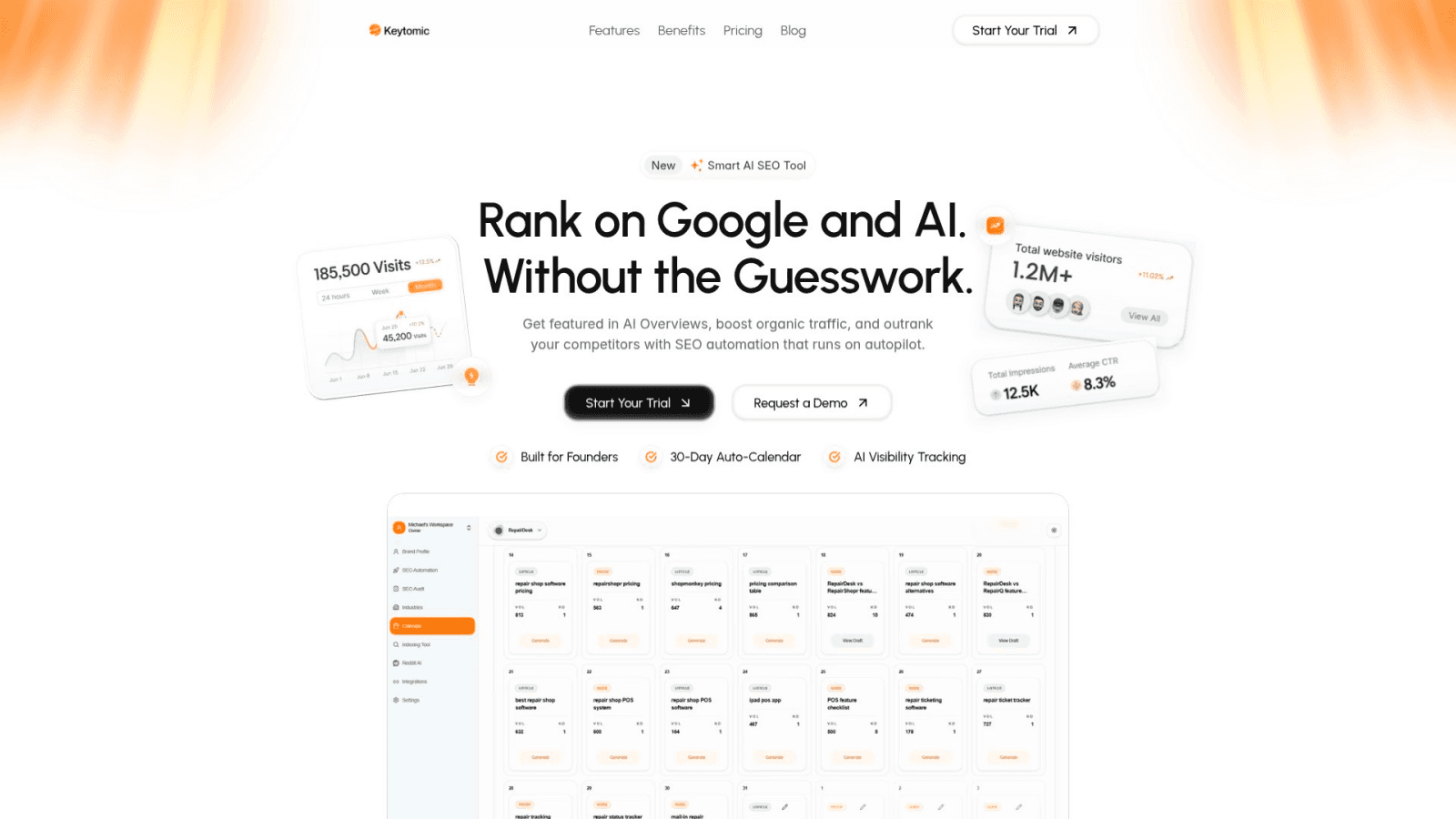
We've all been there. You're managing 10 client blogs, each one demanding fresh content every week. Client A needs 20 articles on SaaS marketing. Client B wants to rank for 150 local SEO keywords. Client C just discovered ChatGPT exists and wants to know why they're not showing up there yet.
Most agencies solve this by stacking tools. Semrush for keywords. Surfer for optimization. Jasper for drafts. WordPress for publishing. A separate rank tracker. Maybe Zapier to connect it all. You're paying $800-1,200/month and your team spends 10 hours weekly just moving content between platforms.
Keytomic replaces that entire stack with one platform. Here's how agencies actually use it:
Week 1: Set Up Client Projects
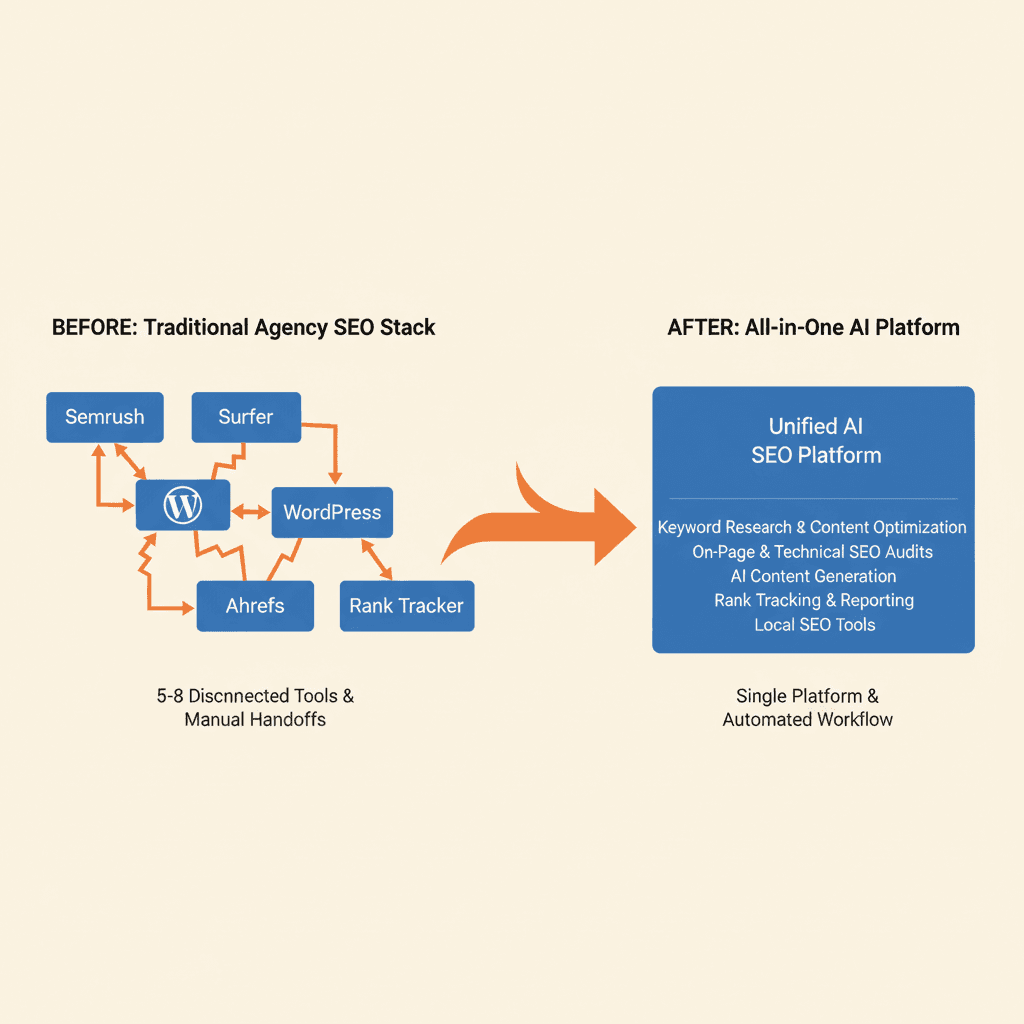
Create separate workspaces for each client. Input their domain, competitors, and target topics. Keytomic's AI analyzes the competitive landscape and generates a 30-day content calendar with keyword clusters ranked by opportunity score.
Instead of manually researching 100 keywords in Semrush, you get a complete monthly plan in 15 minutes. Each cluster includes primary keywords, related long-tails, and current ranking gaps.
Week 2-4: Automate Content Production
For each calendar item, Keytomic generates E-E-A-T optimized articles that include:
Proper keyword density (2-2.5%) without stuffing
Semantic variations and related entities
Data-backed claims with citation placeholders
Structured headings optimized for featured snippets
Custom branded images matching client brand colors
Your editors review and refine AI drafts instead of writing from scratch. Average time per article drops from 8 hours to 90 minutes.
Week 4: Publish and Index
One-click publishing to each client's WordPress, Shopify, or custom CMS. Keytomic handles formatting, image uploads, and meta tag insertion automatically.
Then it submits URLs to Google Search Console for indexing. Articles that used to take 5-7 days to get crawled now appear in search within 24-48 hours.
Ongoing: Track Performance Across Google and AI
Keytomic's dashboard shows:
Google rankings for tracked keywords
Traffic from Google Analytics (integrated)
Brand mentions in ChatGPT, Perplexity, and Gemini
Content performance by topic cluster
Month-over-month visibility growth
When Client C asks about ChatGPT visibility, you pull up the AI tracking dashboard showing exactly which queries cite their content and which competitors are winning.
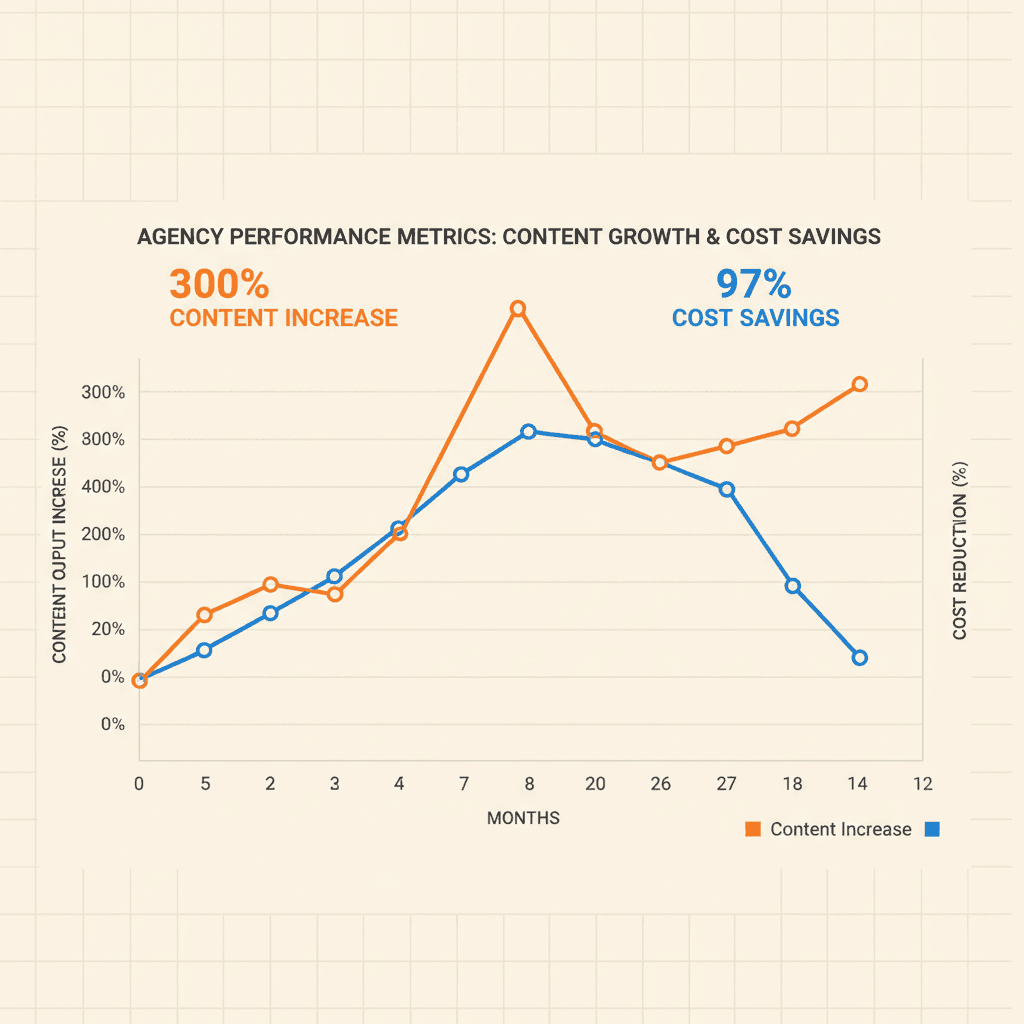
Real Results: 300% Content Increase, 97% Cost Reduction
Agencies using Keytomic report:
3x content output compared to manual workflows (10 articles/month → 30 articles/month)
97% cost savings vs. maintaining separate subscriptions ($1,200/month → $99/month)
70% time reduction on content operations (20 hours/week → 6 hours/week)
44% faster indexing with auto-submission to Google Search Console
The biggest change isn't the cost savings. It's the ability to say "yes" when a client asks for 50 articles next month, instead of panicking about how you'll staff that.
Frequently Asked Questions
Do I still need Ahrefs or Semrush if I use an all-in-one AI SEO tool?
It depends on your backlink analysis needs. Tools like Keytomic, Frase, and SE Ranking handle keyword research and content optimization well, but Ahrefs and Semrush have the deepest backlink databases. If you're actively running link-building campaigns, keep Ahrefs. If you primarily focus on content, all-in-one platforms cover 90% of daily workflows.
How accurate is AI visibility tracking for platforms like ChatGPT and Perplexity?
AI visibility tracking is still evolving. Tools like Rank Prompt and Keytomic test hundreds of prompts and monitor when your content gets cited, but results vary based on prompt phrasing and LLM updates. Think of it like early Google rank tracking in 2005—directionally accurate and critical to monitor, even if not perfectly precise.
Can AI-generated content from these tools actually rank in 2026?
Yes, if it's properly optimized for E-E-A-T signals. Google doesn't penalize AI content itself—it penalizes low-quality, thin, or unhelpful content. Tools like Keytomic, Frase, and MarketMuse generate comprehensive, well-structured articles that pass quality thresholds. The key is editorial review to add brand voice, data accuracy, and unique insights AI can't generate alone.
What's the difference between SEO and GEO optimization?
SEO (Search Engine Optimization) focuses on ranking in traditional search engines like Google and Bing by optimizing for keywords, backlinks, and technical site health. GEO (Generative Engine Optimization) optimizes for AI-powered answer engines like ChatGPT, Perplexity, and Google's AI Overviews. GEO prioritizes comprehensive answers, clear explanations, structured data, and authoritative citations over keyword density.
Which tool is best for agencies just starting with AI SEO?
For agencies new to AI SEO, start with Keytomic or Frase. Both platforms consolidate multiple workflows into beginner-friendly interfaces at affordable price points ($99/month or less). Keytomic offers the most complete end-to-end automation, while Frase excels at research-to-brief workflows. Avoid starting with expensive enterprise tools like MarketMuse or Clearscope until you've validated ROI with simpler platforms.
Marketing agencies managing multiple clients in 2026 need AI SEO tools that automate keyword research, content creation, optimization, and publishing while tracking visibility across both Google and AI platforms like ChatGPT and Perplexity.
The best agency tools consolidate 5-8 separate workflows into unified platforms, reducing manual effort by 60-80% and cutting tool costs by up to 97% compared to legacy SEO stacks.
If you're running an agency, you know the pain. Client A needs 30 blog posts this month. Client B wants to rank for 200 keywords yesterday. Client C just asked why they're not showing up in ChatGPT searches yet. Meanwhile, you're switching between Semrush for keywords, Surfer for optimization, WordPress for publishing, and three other tools just to get one article live.
This guide breaks down the 8 best AI SEO tools actually built for agencies in 2026—platforms that handle content at scale, track AI search visibility, and let you manage multiple clients without losing your mind. We'll cover pricing, core features, what each tool does best, and which agencies should use them.
Why Agencies Need Different AI SEO Tools in 2026
The Shift from Google-Only to Multi-Platform Visibility
Search isn't just Google anymore. ChatGPT's search feature launched in 2024, Perplexity is answering 15 million queries daily, and Google's AI Overviews now appear for 60% of searches. Your clients aren't just asking "do we rank on Google?" They're asking "does ChatGPT recommend us?"
Traditional SEO tools like Ahrefs and Semrush track Google rankings beautifully. What they don't track is whether your client's brand gets cited when someone asks ChatGPT "best CRM for real estate agents" or when Perplexity generates an answer about "top HR software for startups."
That gap created an entirely new category: Generative Engine Optimization (GEO) tools that monitor and optimize for AI-powered answer engines.
Agency-Specific Pain Points These Tools Solve
Multi-client content management at scale. When you're managing 10-50 client blogs, manually creating briefs, optimizing drafts, and publishing across different CMSs eats 20-30 hours per week.
Tool cost consolidation. The average agency pays $800-2,400 per month for separate subscriptions to keyword tools, content optimizers, rank trackers, and publishing platforms. All-in-one platforms cut that to $99-400.
White-label reporting needs. Clients want clean dashboards showing keyword movement, traffic growth, and content performance without seeing "Powered by [Tool Name]" everywhere.
Speed to published content. Agencies that publish faster win more retainers. Tools that go from keyword input to indexed article in 48 hours (instead of 2 weeks) give you a competitive edge.
What Makes a Tool "Agency-Ready" vs. Solo-Friendly
Not every AI SEO tool works for agencies. Here's what actually matters when you're managing clients:
Multi-project dashboards. You need separate workspaces for each client with isolated keyword lists, content calendars, and performance tracking.
Team collaboration features. Writers, editors, and account managers should all access the same platform without sharing login credentials or emailing Google Docs back and forth.
Volume pricing that scales. Per-article or per-report pricing models break your budget when you're publishing 100+ pieces monthly. Look for unlimited plans or bulk credit systems.
CMS integrations that actually work. Direct publishing to WordPress, Shopify, Webflow, and custom CMSs saves 2-3 hours per article compared to copy-paste workflows.
White-label or brandable outputs. Client-facing reports and briefs should reflect your agency brand, not the tool's logo plastered everywhere.
Top 8 AI SEO Tools for Agencies in 2026
Tool | Keyword Research | Content Optimization | Auto-Publishing | GEO Tracking | Multi-Client | Starting Price |
|---|---|---|---|---|---|---|
Keytomic | ✅ Automated | ✅ E-E-A-T focused | ✅ Multi-CMS | ✅ Included | ✅ Yes | $99/mo |
Surfer SEO | ❌ No | ✅ Best-in-class | ❌ No | 💰 Paid add-on | ✅ Yes | $99/mo |
Frase | ⚠️ Limited | ✅ Strong | ❌ No | ✅ Included | ✅ Yes | $14.99/mo |
Clearscope | ❌ No | ✅ Premium NLP | ❌ No | ❌ No | ✅ Yes | $189/mo |
MarketMuse | ✅ Advanced | ✅ AI-powered | ❌ No | ❌ No | ✅ Yes | ~$600/mo |
Writesonic | ⚠️ Basic | ⚠️ Basic | ✅ WordPress | ❌ No | ✅ Yes | $12/mo |
Rank Prompt | ❌ No | ❌ No | ❌ No | ✅ Best-in-class | ✅ Yes | $49/mo |
SE Ranking | ✅ Comprehensive | ✅ Good | ❌ No | ❌ No | ✅ Yes | $65/mo |
1. Keytomic – End-to-End SEO Automation for Agencies
Keytomic is an all-in-one AI SEO platform built for agencies and in-house teams that want to automate the entire content workflow from keyword discovery to indexed articles. Unlike tools that focus on one piece of the puzzle, Keytomic handles research, content generation, optimization, publishing, and indexing in a single system.
Key Features
Automated keyword research and clustering. Keytomic's AI analyzes your domain and competitors to surface long-tail opportunities, then automatically groups keywords into topic clusters.
E-E-A-T optimized content generation. The platform creates full articles optimized for Experience, Expertise, Authoritativeness, and Trustworthiness signals that Google and AI platforms prioritize.
Multi-CMS auto-publishing. One-click publishing to WordPress, Shopify, and other platforms—no manual copy-paste or formatting cleanup required.
Google Search Console auto-indexing. Keytomic automatically submits new content for indexing, cutting the time from publish to crawl from days to hours.
AI visibility tracking. Monitor how often your content gets cited in ChatGPT, Perplexity, and Gemini responses—not just Google rankings.
30-day content calendars. The platform generates complete monthly editorial plans based on keyword clusters and search trends.
Pricing
$99/month for unlimited keyword research, 30+ AI-generated articles, branded images, auto-publishing, and GEO tracking. No per-article fees or hidden add-ons.
Pros
True end-to-end automation. Most agencies use 5-8 tools to go from keyword to indexed article. Keytomic replaces all of them, saving 15-20 hours per week on content operations.
Massive cost savings. At $99/month, it's 97% cheaper than maintaining separate subscriptions to Semrush ($139), Surfer ($99), Jasper ($49), and rank tracking ($50+).
Built for AI search visibility. While competitors added GEO features as an afterthought, Keytomic optimizes for both Google and AI platforms from the ground up.
Cons
Newer platform. Keytomic launched recently compared to 10-year-old tools like Ahrefs, so its backlink database and historical data aren't as deep.
Less brand recognition. If you're pitching Fortune 500 clients who expect to see Semrush or Ahrefs in your tech stack, you may need to educate them on newer automation platforms.
Best For
Agencies managing 5+ clients who want to consolidate their SEO stack, scale content production to 30+ articles monthly per client, and track visibility across Google and AI platforms without hiring a dedicated SEO team.
2. Surfer SEO – Content Optimization Powerhouse
Surfer SEO is one of the most popular content optimization tools for agencies, known for its real-time Content Score and SERP analysis. It doesn't replace your keyword tool or CMS, but it excels at guiding writers to create SEO-friendly content that matches top-ranking competitor patterns.
Key Features
Content Editor with real-time scoring. As you write, Surfer analyzes your draft against top 20 SERP results and scores it on keyword usage, structure, and readability.
SERP Analyzer. Get detailed breakdowns of what's ranking for any keyword: word count, headers, keyword density, and semantic terms competitors use.
AI Outline Generator. Surfer creates data-backed outlines based on top-ranking content, so writers know exactly what sections to include.
Google Docs and WordPress integrations. Optimize content directly in Google Docs or WordPress without switching platforms.
AI visibility add-on. Surfer recently added tracking for how your pages appear in AI Overviews, ChatGPT, and Perplexity (separate paid add-on).
Pricing
Essential: $99/month (30 articles, 5 AI articles) Scale: $219/month (100 articles, 20 AI articles) Enterprise: Custom pricing for agencies
Pros
Best-in-class content optimization. Surfer's Content Score is the industry gold standard. Following its recommendations consistently improves rankings.
Easy for writers to use. Non-SEO writers can follow Surfer's visual guidance without deep technical knowledge.
Strong SERP analysis. The SERP Analyzer reveals exactly why competitors rank, helping you reverse-engineer winning content strategies.
Cons
Doesn't handle keyword research. You still need Ahrefs, Semrush, or another tool to find keywords before using Surfer.
No publishing automation. Surfer optimizes content but doesn't auto-publish or handle indexing, so you're still manually moving articles to your CMS.
AI features cost extra. The AI writing assistant and visibility tracking are paid add-ons on top of base pricing.
Best For
Agencies with strong keyword research workflows that need a dedicated content optimization layer, especially if you work with freelance writers who need clear SEO guidance.
3. Frase – Research-to-Publish Content Platform
Frase combines SERP research, content briefs, AI writing, and optimization in one platform. It's designed for agencies that want to streamline the entire content creation process from initial research through final optimization.
Key Features
SERP research panel. Frase pulls top-ranking content for any keyword and displays headers, questions, statistics, and topics in a research dashboard.
AI content brief generator. Create detailed briefs in 6 seconds with recommended structure, topics to cover, and questions to answer.
AI article writer. Generate full drafts based on your outline and SERP data, then refine with Frase's editing tools.
Content optimization scoring. Like Surfer, Frase scores your content against competitors and suggests keyword improvements.
GEO tracking. Monitor when ChatGPT, Perplexity, Claude, and Gemini cite your content (included in all plans).
Unlimited documents. Unlike competitors with per-article limits, Frase lets you create unlimited content briefs and articles.
Pricing
Starts at $14.99/month for Solo plan (4 articles) Team plans scale based on article volume Unlimited content briefs on all plans
Pros
Fastest research-to-brief workflow. Frase generates comprehensive content briefs faster than manually analyzing SERPs for hours.
GEO tracking included. Most tools charge extra for AI visibility monitoring; Frase includes it in base pricing.
Unlimited briefs. Create as many content briefs as needed without worrying about per-brief costs.
Cons
AI writing quality varies. Frase's AI writer is decent but often needs heavy editing compared to specialized tools like Jasper or Claude.
Limited keyword discovery. Frase focuses on optimizing for keywords you already identified, not discovering new opportunities.
No auto-publishing. You still need to manually copy content to WordPress or other CMSs.
Best For
Agencies that prioritize speed in content brief creation and want built-in GEO tracking without paying for expensive add-ons.
4. Clearscope – Premium Content Intelligence for Enterprises
Clearscope is a high-end content optimization platform favored by enterprise marketing teams and agencies managing Fortune 500 clients. It focuses on semantic relevance and content quality scoring based on NLP analysis.
Key Features
Content grading system (A-F). Clearscope grades your content quality and provides actionable recommendations to improve scores.
Semantic keyword suggestions. The platform identifies related terms and concepts that strengthen topical authority, not just exact-match keywords.
Content inventory tracking. Monitor performance of your entire content library and identify optimization opportunities.
Google Docs integration. Optimize content directly in Google Docs with real-time Clearscope sidebar recommendations.
Multilingual support. Clearscope supports 12+ languages including Spanish, French, and German for international SEO campaigns.
Pricing
Essentials: $189/month (50 reports) Business: $399/month (advanced features, dedicated account manager) Enterprise: Custom pricing
Pros
Best for enterprise clients. If you're pitching to brands that expect premium tools in your stack, Clearscope's reputation helps close deals.
Superior semantic analysis. Clearscope's NLP recommendations often reveal content gaps competitors miss.
Strong international support. The 12-language support is unmatched for agencies with global clients.
Cons
Expensive. At $189-399/month, Clearscope costs 2-4x more than alternatives with similar features.
No free trial. You can't test the platform before committing to monthly billing.
Limited to content optimization. Clearscope doesn't handle keyword research, publishing, or rank tracking—you need separate tools.
Best For
Agencies serving enterprise clients who want premium content intelligence and can justify $189+/month for optimization alone.
5. MarketMuse – AI-Powered Content Planning at Scale
MarketMuse uses proprietary AI to analyze entire websites and create comprehensive content strategies based on topical authority gaps. It's built for agencies that want data-driven content planning, not just optimization.
Key Features
Automated content audits. MarketMuse crawls your entire site and identifies which pages need updating, which topics you lack authority in, and where competitors are weak.
Content cluster analysis. The platform groups related topics into clusters and shows how to build topical authority across multiple articles.
Personalized difficulty scores. Unlike generic keyword difficulty, MarketMuse calculates how hard it will be for YOUR domain to rank based on existing authority.
Content briefs with topic modeling. Briefs include not just keywords but semantic topics, questions, and concepts to cover for comprehensive content.
Competitive gap analysis. See exactly what topics competitors cover that you don't, and where you can outperform them.
Pricing
Contact sales for custom pricing (typically $600-1,500/month for agencies) Free plan: 10 queries per month
Pros
Best content strategy insights. MarketMuse's AI-driven content plans save 20-40 hours of manual SERP research and competitive analysis.
Topical authority focus. The platform helps you build comprehensive topic coverage instead of chasing individual keywords.
Personalized metrics. Difficulty scores based on your domain's actual authority make prioritization decisions clearer.
Cons
Expensive for smaller agencies. Pricing starts around $600/month, making it cost-prohibitive unless you're managing high-value clients.
Steep learning curve. MarketMuse's comprehensive feature set takes time to master compared to simpler tools.
No publishing automation. Like most competitors, MarketMuse stops at optimization—you still need separate publishing workflows.
Best For
Established agencies managing large content libraries (500+ articles) who need strategic content planning based on topical authority analysis.
6. Writesonic – AI Content Creation with SEO Integration
Writesonic is an AI writing platform with built-in SEO features, including Chatsonic (an AI research assistant) and integrations with Semrush and Ahrefs for real-time keyword data.
Key Features
Chatsonic AI assistant. Access GPT-4, Claude, and other LLMs with live data from Ahrefs and Semrush to answer SEO questions and generate content.
AI article writer. Generate complete articles optimized for target keywords, with real-time SERP analysis.
Brand voice customization. Train Writesonic on your clients' existing content to match their tone and style.
One-click publishing. Publish directly to WordPress and social media platforms.
Real-time SEO optimization. Get keyword suggestions and optimization tips powered by Semrush and Ahrefs data.
Pricing
Starts at $12/month for individuals Business plans with team features and API access available
Pros
Cheapest AI writing option. At $12-49/month, Writesonic costs a fraction of dedicated SEO tools while including AI content generation.
Multi-LLM access. Switch between GPT-4, Claude, and other models based on which performs best for each task.
Ahrefs and Semrush integrations. Pull live keyword data from premium tools without separate subscriptions.
Cons
SEO features are secondary. Writesonic is primarily an AI writer; its SEO capabilities aren't as deep as dedicated platforms.
Quality varies. AI-generated content often needs significant editing to meet publication standards.
Limited content strategy features. No content audits, cluster analysis, or advanced planning tools.
Best For
Budget-conscious agencies that prioritize AI writing speed and want basic SEO guidance without paying for premium optimization tools.
7. Rank Prompt – AI Visibility Tracking Specialist
Rank Prompt is purpose-built for tracking how brands appear in AI-powered search platforms like ChatGPT, Perplexity, Claude, and Gemini. It doesn't optimize content or handle publishing, but it's the best tool for monitoring AI visibility.
Key Features
Multi-platform AI tracking. Monitor brand mentions and content citations across ChatGPT, Perplexity, Claude, Gemini, and other LLMs.
Prompt testing. See how your brand appears for hundreds of different user queries and prompts.
Competitor comparison. Track when competitors get cited instead of your brand, revealing content gaps.
Multi-client dashboards. Separate tracking projects for each agency client with exportable PDF reports.
Multilingual support. Track AI visibility in Spanish, French, German, and other languages.
Pricing
Starts at $49/month for basic tracking Agency plans with multi-client dashboards available
Pros
Best AI visibility tracking. Rank Prompt is the only platform purpose-built for monitoring LLM citations and brand mentions.
Critical for modern SEO. As AI search grows, tracking visibility in ChatGPT and Perplexity becomes as important as Google rankings.
Agency-friendly features. Multi-client dashboards and white-label reports make client communication simple.
Cons
Narrow focus. Rank Prompt only tracks AI visibility—you need separate tools for keyword research, optimization, and publishing.
No content optimization. The platform tells you where you're visible but doesn't help improve content to rank better.
Relatively new category. AI visibility tracking is still emerging, so ROI metrics and best practices are evolving.
Best For
Agencies that already have content workflows in place and need to add AI visibility tracking to their reporting suite.
8. SE Ranking – All-in-One SEO Platform for Budget-Conscious Agencies
SE Ranking is a comprehensive SEO platform offering keyword research, rank tracking, site audits, backlink analysis, and content tools at a fraction of Semrush or Ahrefs pricing.
Key Features
Keyword research and clustering. Find keywords and group them into topic clusters for content planning.
Rank tracking. Monitor Google rankings daily for unlimited keywords.
Site auditor. Crawl websites to identify technical SEO issues.
Backlink checker. Analyze backlink profiles and find link-building opportunities.
Content editor. AI-powered content optimization with keyword suggestions and scoring.
White-label reporting. Create branded PDF reports for clients.
Pricing
Starts at $65/month for Essential plan (500 keywords, 5 projects) Pro and Business plans scale up to thousands of keywords
Pros
Most affordable all-in-one platform. SE Ranking costs 50-60% less than Semrush or Ahrefs while covering similar features.
Strong white-label features. Agency-focused tools for client reporting and branded dashboards.
No feature gaps. Unlike niche tools, SE Ranking handles everything from technical audits to content optimization.
Cons
Smaller data index. SE Ranking's keyword and backlink databases aren't as comprehensive as Ahrefs or Semrush.
AI features lag behind. No GEO tracking or advanced AI content tools compared to newer platforms.
Interface feels dated. The UI isn't as polished as modern competitors.
Best For
Agencies wanting a budget-friendly all-in-one platform that covers traditional SEO needs (keywords, ranks, audits) without cutting-edge AI features.
How Agencies Use Keytomic to Manage Multiple Client Campaigns
We've all been there. You're managing 10 client blogs, each one demanding fresh content every week. Client A needs 20 articles on SaaS marketing. Client B wants to rank for 150 local SEO keywords. Client C just discovered ChatGPT exists and wants to know why they're not showing up there yet.
Most agencies solve this by stacking tools. Semrush for keywords. Surfer for optimization. Jasper for drafts. WordPress for publishing. A separate rank tracker. Maybe Zapier to connect it all. You're paying $800-1,200/month and your team spends 10 hours weekly just moving content between platforms.
Keytomic replaces that entire stack with one platform. Here's how agencies actually use it:
Week 1: Set Up Client Projects
Create separate workspaces for each client. Input their domain, competitors, and target topics. Keytomic's AI analyzes the competitive landscape and generates a 30-day content calendar with keyword clusters ranked by opportunity score.
Instead of manually researching 100 keywords in Semrush, you get a complete monthly plan in 15 minutes. Each cluster includes primary keywords, related long-tails, and current ranking gaps.
Week 2-4: Automate Content Production
For each calendar item, Keytomic generates E-E-A-T optimized articles that include:
Proper keyword density (2-2.5%) without stuffing
Semantic variations and related entities
Data-backed claims with citation placeholders
Structured headings optimized for featured snippets
Custom branded images matching client brand colors
Your editors review and refine AI drafts instead of writing from scratch. Average time per article drops from 8 hours to 90 minutes.
Week 4: Publish and Index
One-click publishing to each client's WordPress, Shopify, or custom CMS. Keytomic handles formatting, image uploads, and meta tag insertion automatically.
Then it submits URLs to Google Search Console for indexing. Articles that used to take 5-7 days to get crawled now appear in search within 24-48 hours.
Ongoing: Track Performance Across Google and AI
Keytomic's dashboard shows:
Google rankings for tracked keywords
Traffic from Google Analytics (integrated)
Brand mentions in ChatGPT, Perplexity, and Gemini
Content performance by topic cluster
Month-over-month visibility growth
When Client C asks about ChatGPT visibility, you pull up the AI tracking dashboard showing exactly which queries cite their content and which competitors are winning.
Real Results: 300% Content Increase, 97% Cost Reduction
Agencies using Keytomic report:
3x content output compared to manual workflows (10 articles/month → 30 articles/month)
97% cost savings vs. maintaining separate subscriptions ($1,200/month → $99/month)
70% time reduction on content operations (20 hours/week → 6 hours/week)
44% faster indexing with auto-submission to Google Search Console
The biggest change isn't the cost savings. It's the ability to say "yes" when a client asks for 50 articles next month, instead of panicking about how you'll staff that.
Frequently Asked Questions
Do I still need Ahrefs or Semrush if I use an all-in-one AI SEO tool?
It depends on your backlink analysis needs. Tools like Keytomic, Frase, and SE Ranking handle keyword research and content optimization well, but Ahrefs and Semrush have the deepest backlink databases. If you're actively running link-building campaigns, keep Ahrefs. If you primarily focus on content, all-in-one platforms cover 90% of daily workflows.
How accurate is AI visibility tracking for platforms like ChatGPT and Perplexity?
AI visibility tracking is still evolving. Tools like Rank Prompt and Keytomic test hundreds of prompts and monitor when your content gets cited, but results vary based on prompt phrasing and LLM updates. Think of it like early Google rank tracking in 2005—directionally accurate and critical to monitor, even if not perfectly precise.
Can AI-generated content from these tools actually rank in 2026?
Yes, if it's properly optimized for E-E-A-T signals. Google doesn't penalize AI content itself—it penalizes low-quality, thin, or unhelpful content. Tools like Keytomic, Frase, and MarketMuse generate comprehensive, well-structured articles that pass quality thresholds. The key is editorial review to add brand voice, data accuracy, and unique insights AI can't generate alone.
What's the difference between SEO and GEO optimization?
SEO (Search Engine Optimization) focuses on ranking in traditional search engines like Google and Bing by optimizing for keywords, backlinks, and technical site health. GEO (Generative Engine Optimization) optimizes for AI-powered answer engines like ChatGPT, Perplexity, and Google's AI Overviews. GEO prioritizes comprehensive answers, clear explanations, structured data, and authoritative citations over keyword density.
Which tool is best for agencies just starting with AI SEO?
For agencies new to AI SEO, start with Keytomic or Frase. Both platforms consolidate multiple workflows into beginner-friendly interfaces at affordable price points ($99/month or less). Keytomic offers the most complete end-to-end automation, while Frase excels at research-to-brief workflows. Avoid starting with expensive enterprise tools like MarketMuse or Clearscope until you've validated ROI with simpler platforms.
FREE AI Visibility Audit
Is Your Brand Visible in AI Searches?
Free AI Visibility Audit → See where you appear (and where competitors appear).
Read More From Our Blog...

Top 10 best AI SEO tools for content automation in 2026
How to Choose SEO Automation Software That Actually Saves Time
Semrush vs Ahrefs vs Moz: Best SEO Software Compared for 2026

Start Getting Cited By Google
and AI Searches on Auto-Pilot


AI SEO agents research keywords, write & publish ranking content, track AI citations, and grow your brand visibility — while you focus on the business.


Trusted by 300+ users
4.5
Start Getting Cited By Google
and AI Searches on Auto-Pilot
Automate your SEO to rank faster, and showing up in AI search, without the guesswork.
Trusted by 300+ users
4.5
Start Getting Cited By Google
and AI Searches on Auto-Pilot
AI SEO agents research keywords, write & publish ranking content, track AI citations, and grow your brand visibility — while you focus on the business.
Trusted by 300+ users