Table of Contents
Share Article
Google Drops FAQ Rich Results From Search After Years of SERP Dominance
Google Drops FAQ Rich Results From Search After Years of SERP Dominance
Google Drops FAQ Rich Results From Search After Years of SERP Dominance

Salam Qadir
Product & Growth Lead
Google discontinued FAQ rich results in May 2026. Learn why the change happened, how it impacts organic traffic, and how to adapt your SEO strategy.
Google removed FAQ rich results from search in May 2026, marking the end of a structured data feature that once captured significant SERP real estate and drove traffic for millions of websites. The company confirmed that FAQ rich results are no longer appearing in Google Search, with related reporting tools and API support being phased out through August 2026.
Why Google removed FAQ rich results
Google's decision to retire FAQ rich results stems from a combination of quality control, user experience concerns, and the evolving role of AI in search.
Since FAQ schema launched in 2019, the feature became one of the most widely adopted structured data formats, offering sites expandable dropdowns that dominated organic listings and increased click-through rates.
However, by 2023, Google had already begun restricting the feature to authoritative government and health websites, signaling that widespread misuse had diminished its value.
Widespread schema abuse and SERP clutter
According to Google's Search Central documentation, the company found that FAQ schema was frequently stuffed with keyword-heavy questions, irrelevant content, or duplicated information that didn't genuinely help searchers.
Many sites added FAQ sections purely to capture SERP real estate rather than to answer genuine user questions. This created cluttered search results dominated by repetitive accordion-style answers, undermining Google's goal of delivering varied, high-quality results.
Industry analysis from Search Engine Journal confirms that Google had been tightening controls on rich results for months before the final removal, concerned about low-quality implementations and misuse. The May 2026 change completes a process that began nearly three years earlier.
Shift toward AI-generated answers
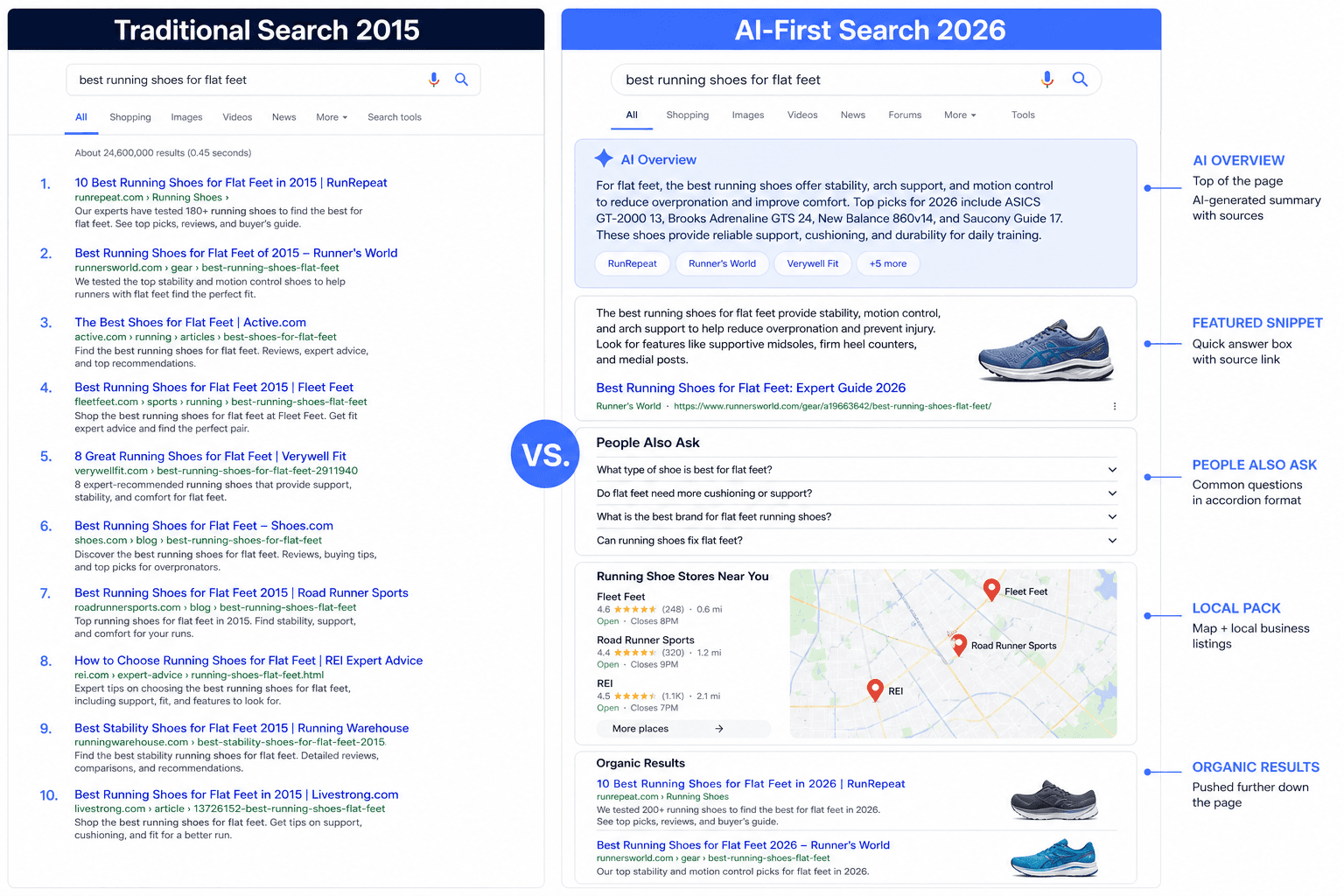
The removal of FAQ rich results also aligns with Google's broader move toward AI Overviews and AI Mode, where AI-generated summaries synthesize information from multiple sources directly on the SERP.
Unlike static FAQ snippets that webmasters control, AI Overviews dynamically assemble answers in real time, giving Google full control over the answer engine experience. By retiring FAQ rich results, Google reduces visual competition for these AI-driven features and positions itself as the primary answer provider.
Timeline of the deprecation
The removal followed a clear schedule:
May 7, 2026: FAQ rich results stopped appearing in search results
June 2026: FAQ search appearance filter, rich result report, and Rich Results Test support removed
August 2026: Search Console API support for FAQ rich results retired
This three-month rollout gave SEO teams time to adjust reporting workflows, but the core change happened immediately in early May.
What changed for SEO teams and publishers
For sites that relied on FAQ rich results as a core traffic tactic, the impact was immediate. Pages that previously enjoyed enhanced visibility through expandable FAQ dropdowns now appear as standard organic listings. This shift affects both SERP real estate and click-through performance.
Loss of SERP real estate and visibility
FAQ rich results allowed a single organic listing to occupy 3–5 times the vertical space of a standard blue link. That visual dominance is now gone for most industries.
Sites that used FAQ schema strategically to push competitors down the page have lost that advantage. Early traffic analysis from Search Engine Land suggests that sites heavily dependent on FAQ rich results may see reduced click-through rates, though the impact varies by industry and query type.
Changes to Search Console reporting
SEO teams that built dashboards, API pulls, and enhancement reports around FAQ rich results now face obsolete workflows.
Google removed FAQ-related reporting from Search Console in June 2026, and API support ended in August.
Teams that continue to monitor FAQ rich results in the same way they did before are likely to misread disappearing data as a technical error when it's simply a product retirement.
The key operational shift: FAQ markup no longer triggers a measurable SERP feature, so tracking FAQ impressions or rich result status is no longer relevant for most sites.
Content strategy uncertainty
Many content templates were built around FAQ schema. Marketing teams now face a strategic decision: should they remove FAQPage markup entirely, keep it in place for other search engines, or shift focus to alternative structured data types that still produce rich results?
Google explicitly stated that sites do not need to proactively remove FAQ structured data. The markup won't cause problems, but it also won't produce visible effects in Google Search.
Other search engines like Bing may still use FAQ schema for their own purposes, and AI systems including Google AI Overviews, Perplexity, and ChatGPT continue to parse FAQ markup as a primary citation signal.
How to adapt your content strategy after the change
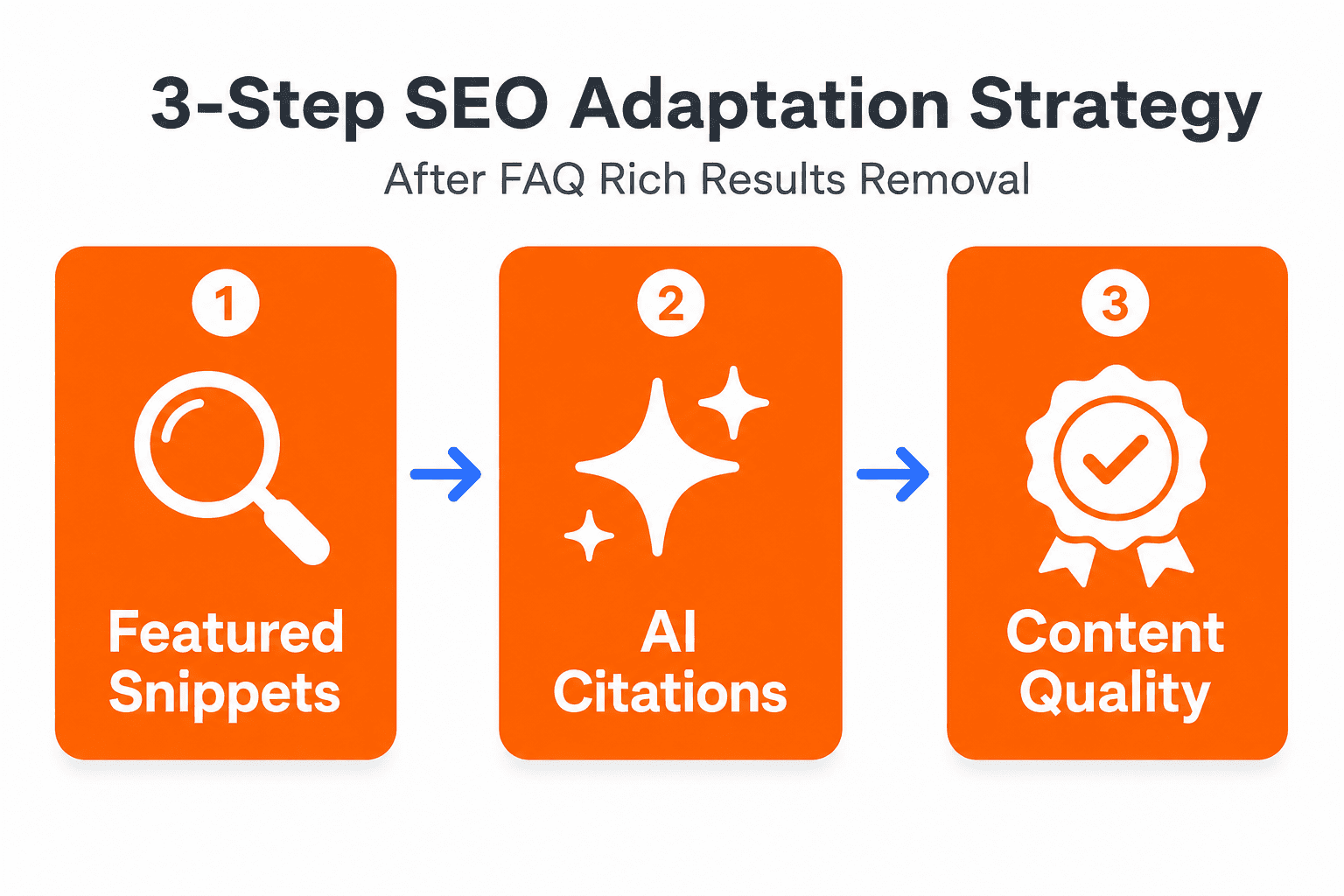
The retirement of FAQ rich results doesn't mean FAQ content is dead. It means the reason for using FAQ markup has shifted from SERP display manipulation to genuine content utility and AI discoverability.
Focus on featured snippets and People Also Ask
While FAQ rich results are gone, featured snippets and People Also Ask (PAA) boxes remain active SERP features. Well-structured FAQ content still significantly increases your chances of appearing in featured snippets, according to Epic Notion's analysis.
For healthcare and other YMYL industries, properly structured FAQ content with schema markup is more likely to appear in featured snippets compared to similar content without structured data.
To optimize for these features:
Write concise, direct answers to common user questions
Use clear H2 or H3 headings formatted as questions
Keep answers between 40–60 words for snippet eligibility
Include relevant internal links within answers to support topical authority
Optimize for AI search and citations
The most important strategic shift is optimizing FAQ content for AI search platforms. Research from Frase.io shows that pages with FAQPage markup are 3.2x more likely to appear in Google AI Overviews, and FAQ schema has one of the highest citation rates among structured data types. AI-referred sessions jumped 527% in 2025, fundamentally changing how users discover information.
FAQ schema now functions as a machine-readable signal that positions your content as the authoritative source AI systems reach for first. Even without the visual rich result, the structured data helps AI systems parse, understand, and cite your content more reliably.
Improve core content quality and page architecture
With the shortcut of FAQ rich snippets removed, intrinsic content quality matters more than ever.
SEOteric Digital Marketing recommends using the FAQ change as an opportunity to strengthen internal content architecture and surface answers within the main body of pages so they are useful even without rich snippets.
Prioritize:
Well-structured pages with clear headings and logical content flow
Authoritative answers backed by credible sources
Strong E-E-A-T signals (Experience, Expertise, Authoritativeness, Trustworthiness)
Internal linking that connects related content and builds topical authority
Audit and clean up existing FAQ markup
While removal isn't urgent, now is a good time to audit where FAQ markup provided real value. Export historical data from Search Console before reporting fully sunsets, then decide whether to keep, update, or remove FAQ schema on a page-by-page basis.
If your team uses automated tooling or scripts based on the Search Console API for FAQ reporting, schedule updates now so you aren't caught off guard by the August API removal.
What to monitor next in Google Search
The removal of FAQ rich results is part of a broader trend toward AI-first search and stricter quality filters. Staying ahead requires monitoring the right signals and adapting quickly when Google shifts priorities.
Google indexing status and crawl efficiency
With Google's crawl budget increasingly selective in 2026, pages with crawl budget waste or weak internal linking get deprioritized in the indexing queue. Monitor your Google Search Console Index Coverage report closely.
Look for increases in "Crawled – currently not indexed" or "Discovered – currently not indexed" statuses, which indicate that Google found your pages but decided they weren't valuable enough to index yet.
Key metrics to track:
Indexed/total-pages ratio compared to prior quarters
Average crawl rate and discovery vs. refresh crawl balance
Pages with no internal links (orphan pages)
Server response time and Core Web Vitals
Click-through rate and impressions
For pages that previously relied on FAQ rich results, expect CTR changes. Some pages may see modest declines as the visual prominence disappears; others may see stable or even improved CTR if the underlying content is strong.
Track CTR at the page level in Search Console Performance reports, and compare pre-May and post-May data to quantify the impact.
If CTR drops significantly, consider whether the page can be optimized for featured snippets, whether the title and meta description need improvement, or whether the page's core value proposition needs to be strengthened.
SERP feature presence and AI citation rates
As traditional ranking positions become less predictive of traffic, whole-SERP visibility strategies are now essential. Track your brand's presence across:
Featured snippets and PAA boxes
Image and video packs
Local packs (if relevant)
Google AI Overviews and AI Mode citations
Knowledge panels and entity mentions
Tools like Semrush Position Tracking or SE Ranking's Keyword Rank Checker can filter SERP features and show how your visibility evolves across multiple feature types over time.
Structured data errors and enhancement reports
Even though FAQ rich results are retired, other structured data types remain critical. Monitor your Search Console Enhancements section for errors in:
Article schema (for news and blog content)
Product schema (for ecommerce)
BreadcrumbList (for site navigation)
VideoObject (for video content)
Organization and Person schema (for entity authority)
As Google continues to simplify search results and remove underused structured data types, staying on top of enhancement reports ensures you don't lose visibility in other rich result categories.
Frequently Asked Questions
Should I remove FAQ schema from my website?
No. Google confirmed there's no need to proactively remove FAQPage structured data. The markup doesn't harm rankings and AI systems continue to parse it.
Will People Also Ask boxes be removed next?
No indication yet. People Also Ask remains highly active in 2026 and is used dynamically alongside AI Overviews and conversational search experiences.
Can FAQ content still help with SEO?
Yes. Helpful FAQ sections still support AI-driven search, featured snippets, voice search, and conversational search experiences even without rich result display.
How do I track the impact of this change?
Compare page-level CTR and impressions in Search Console before and after May 7, 2026. Monitor indexing status and SERP feature presence across all target keywords.
What structured data types still produce rich results?
Article, Product, BreadcrumbList, VideoObject, Recipe, Event, and Organization schema continue to produce rich results when properly implemented and relevant to the content type.
Google removed FAQ rich results from search in May 2026, marking the end of a structured data feature that once captured significant SERP real estate and drove traffic for millions of websites. The company confirmed that FAQ rich results are no longer appearing in Google Search, with related reporting tools and API support being phased out through August 2026.
Why Google removed FAQ rich results
Google's decision to retire FAQ rich results stems from a combination of quality control, user experience concerns, and the evolving role of AI in search.
Since FAQ schema launched in 2019, the feature became one of the most widely adopted structured data formats, offering sites expandable dropdowns that dominated organic listings and increased click-through rates.
However, by 2023, Google had already begun restricting the feature to authoritative government and health websites, signaling that widespread misuse had diminished its value.
Widespread schema abuse and SERP clutter
According to Google's Search Central documentation, the company found that FAQ schema was frequently stuffed with keyword-heavy questions, irrelevant content, or duplicated information that didn't genuinely help searchers.
Many sites added FAQ sections purely to capture SERP real estate rather than to answer genuine user questions. This created cluttered search results dominated by repetitive accordion-style answers, undermining Google's goal of delivering varied, high-quality results.
Industry analysis from Search Engine Journal confirms that Google had been tightening controls on rich results for months before the final removal, concerned about low-quality implementations and misuse. The May 2026 change completes a process that began nearly three years earlier.
Shift toward AI-generated answers
The removal of FAQ rich results also aligns with Google's broader move toward AI Overviews and AI Mode, where AI-generated summaries synthesize information from multiple sources directly on the SERP.
Unlike static FAQ snippets that webmasters control, AI Overviews dynamically assemble answers in real time, giving Google full control over the answer engine experience. By retiring FAQ rich results, Google reduces visual competition for these AI-driven features and positions itself as the primary answer provider.
Timeline of the deprecation
The removal followed a clear schedule:
May 7, 2026: FAQ rich results stopped appearing in search results
June 2026: FAQ search appearance filter, rich result report, and Rich Results Test support removed
August 2026: Search Console API support for FAQ rich results retired
This three-month rollout gave SEO teams time to adjust reporting workflows, but the core change happened immediately in early May.
What changed for SEO teams and publishers
For sites that relied on FAQ rich results as a core traffic tactic, the impact was immediate. Pages that previously enjoyed enhanced visibility through expandable FAQ dropdowns now appear as standard organic listings. This shift affects both SERP real estate and click-through performance.
Loss of SERP real estate and visibility
FAQ rich results allowed a single organic listing to occupy 3–5 times the vertical space of a standard blue link. That visual dominance is now gone for most industries.
Sites that used FAQ schema strategically to push competitors down the page have lost that advantage. Early traffic analysis from Search Engine Land suggests that sites heavily dependent on FAQ rich results may see reduced click-through rates, though the impact varies by industry and query type.
Changes to Search Console reporting
SEO teams that built dashboards, API pulls, and enhancement reports around FAQ rich results now face obsolete workflows.
Google removed FAQ-related reporting from Search Console in June 2026, and API support ended in August.
Teams that continue to monitor FAQ rich results in the same way they did before are likely to misread disappearing data as a technical error when it's simply a product retirement.
The key operational shift: FAQ markup no longer triggers a measurable SERP feature, so tracking FAQ impressions or rich result status is no longer relevant for most sites.
Content strategy uncertainty
Many content templates were built around FAQ schema. Marketing teams now face a strategic decision: should they remove FAQPage markup entirely, keep it in place for other search engines, or shift focus to alternative structured data types that still produce rich results?
Google explicitly stated that sites do not need to proactively remove FAQ structured data. The markup won't cause problems, but it also won't produce visible effects in Google Search.
Other search engines like Bing may still use FAQ schema for their own purposes, and AI systems including Google AI Overviews, Perplexity, and ChatGPT continue to parse FAQ markup as a primary citation signal.
How to adapt your content strategy after the change
The retirement of FAQ rich results doesn't mean FAQ content is dead. It means the reason for using FAQ markup has shifted from SERP display manipulation to genuine content utility and AI discoverability.
Focus on featured snippets and People Also Ask
While FAQ rich results are gone, featured snippets and People Also Ask (PAA) boxes remain active SERP features. Well-structured FAQ content still significantly increases your chances of appearing in featured snippets, according to Epic Notion's analysis.
For healthcare and other YMYL industries, properly structured FAQ content with schema markup is more likely to appear in featured snippets compared to similar content without structured data.
To optimize for these features:
Write concise, direct answers to common user questions
Use clear H2 or H3 headings formatted as questions
Keep answers between 40–60 words for snippet eligibility
Include relevant internal links within answers to support topical authority
Optimize for AI search and citations
The most important strategic shift is optimizing FAQ content for AI search platforms. Research from Frase.io shows that pages with FAQPage markup are 3.2x more likely to appear in Google AI Overviews, and FAQ schema has one of the highest citation rates among structured data types. AI-referred sessions jumped 527% in 2025, fundamentally changing how users discover information.
FAQ schema now functions as a machine-readable signal that positions your content as the authoritative source AI systems reach for first. Even without the visual rich result, the structured data helps AI systems parse, understand, and cite your content more reliably.
Improve core content quality and page architecture
With the shortcut of FAQ rich snippets removed, intrinsic content quality matters more than ever.
SEOteric Digital Marketing recommends using the FAQ change as an opportunity to strengthen internal content architecture and surface answers within the main body of pages so they are useful even without rich snippets.
Prioritize:
Well-structured pages with clear headings and logical content flow
Authoritative answers backed by credible sources
Strong E-E-A-T signals (Experience, Expertise, Authoritativeness, Trustworthiness)
Internal linking that connects related content and builds topical authority
Audit and clean up existing FAQ markup
While removal isn't urgent, now is a good time to audit where FAQ markup provided real value. Export historical data from Search Console before reporting fully sunsets, then decide whether to keep, update, or remove FAQ schema on a page-by-page basis.
If your team uses automated tooling or scripts based on the Search Console API for FAQ reporting, schedule updates now so you aren't caught off guard by the August API removal.
What to monitor next in Google Search
The removal of FAQ rich results is part of a broader trend toward AI-first search and stricter quality filters. Staying ahead requires monitoring the right signals and adapting quickly when Google shifts priorities.
Google indexing status and crawl efficiency
With Google's crawl budget increasingly selective in 2026, pages with crawl budget waste or weak internal linking get deprioritized in the indexing queue. Monitor your Google Search Console Index Coverage report closely.
Look for increases in "Crawled – currently not indexed" or "Discovered – currently not indexed" statuses, which indicate that Google found your pages but decided they weren't valuable enough to index yet.
Key metrics to track:
Indexed/total-pages ratio compared to prior quarters
Average crawl rate and discovery vs. refresh crawl balance
Pages with no internal links (orphan pages)
Server response time and Core Web Vitals
Click-through rate and impressions
For pages that previously relied on FAQ rich results, expect CTR changes. Some pages may see modest declines as the visual prominence disappears; others may see stable or even improved CTR if the underlying content is strong.
Track CTR at the page level in Search Console Performance reports, and compare pre-May and post-May data to quantify the impact.
If CTR drops significantly, consider whether the page can be optimized for featured snippets, whether the title and meta description need improvement, or whether the page's core value proposition needs to be strengthened.
SERP feature presence and AI citation rates
As traditional ranking positions become less predictive of traffic, whole-SERP visibility strategies are now essential. Track your brand's presence across:
Featured snippets and PAA boxes
Image and video packs
Local packs (if relevant)
Google AI Overviews and AI Mode citations
Knowledge panels and entity mentions
Tools like Semrush Position Tracking or SE Ranking's Keyword Rank Checker can filter SERP features and show how your visibility evolves across multiple feature types over time.
Structured data errors and enhancement reports
Even though FAQ rich results are retired, other structured data types remain critical. Monitor your Search Console Enhancements section for errors in:
Article schema (for news and blog content)
Product schema (for ecommerce)
BreadcrumbList (for site navigation)
VideoObject (for video content)
Organization and Person schema (for entity authority)
As Google continues to simplify search results and remove underused structured data types, staying on top of enhancement reports ensures you don't lose visibility in other rich result categories.
Frequently Asked Questions
Should I remove FAQ schema from my website?
No. Google confirmed there's no need to proactively remove FAQPage structured data. The markup doesn't harm rankings and AI systems continue to parse it.
Will People Also Ask boxes be removed next?
No indication yet. People Also Ask remains highly active in 2026 and is used dynamically alongside AI Overviews and conversational search experiences.
Can FAQ content still help with SEO?
Yes. Helpful FAQ sections still support AI-driven search, featured snippets, voice search, and conversational search experiences even without rich result display.
How do I track the impact of this change?
Compare page-level CTR and impressions in Search Console before and after May 7, 2026. Monitor indexing status and SERP feature presence across all target keywords.
What structured data types still produce rich results?
Article, Product, BreadcrumbList, VideoObject, Recipe, Event, and Organization schema continue to produce rich results when properly implemented and relevant to the content type.
Salam Qadir
Product & Growth Lead
Product & Growth Lead
Salam Qadir is a growth and SEO strategist with 7 plus years of experience across SaaS, ecommerce, service businesses, B2B, and B2C brands. He writes about AI SEO automation, LLM visibility, organic growth, and turning search traffic into qualified leads.
Salam Qadir is a growth and SEO strategist with 7 plus years of experience across SaaS, ecommerce, service businesses, B2B, and B2C brands. He writes about AI SEO automation, LLM visibility, organic growth, and turning search traffic into qualified leads.
FREE AI Visibility Audit

Is Your Brand Visible in AI Searches?
Free AI Visibility Audit → See where you appear (and where competitors appear).
Read More From Our Blog...

Multilingual SEO Best Practices In 2026

12 Best AI Tools for Ecommerce SEO and AI Visibility in 2026

Ecommerce Category Page SEO: Best Practices for 2026

Start Getting Cited By Google
and AI Searches on Auto-Pilot


AI SEO agents research keywords, write & publish ranking content, track AI citations, and grow your brand visibility — while you focus on the business.


Trusted by 300+ users

4.5
Start Getting Cited By Google
and AI Searches on Auto-Pilot
Automate your SEO to rank faster, and showing up in AI search, without the guesswork.
Trusted by 300+ users
4.5
Start Getting Cited By Google
and AI Searches on Auto-Pilot
AI SEO agents research keywords, write & publish ranking content, track AI citations, and grow your brand visibility — while you focus on the business.
Trusted by 300+ users