Table of Contents
Share Article
How to Create a Post Calendar for SEO
How to Create a Post Calendar for SEO
How to Create a Post Calendar for SEO

Kashaf
SEO Manager
Discover how to create a post calendar for SEO that actually drives traffic. Get expert tips to plan content consistently.
Most SEO programs don't fail due to bad writing. They fail due to bad planning. Content gets published whenever someone finds time for it, topics are selected based on gut feel and not keyword data, and internal linking is an afterthought. The result is a library of disconnected articles never building the kind of topical authority search engines reward - and a team that works harder every quarter without getting meaningful ground.
The numbers are unambiguous. According to HubSpot's State of Marketing Report 2026, more than 92% of marketers are already using or planning on SEO optimization for traditional/ AI-powered search engines. At the same time, nearly 30% have noted a tangible decline in search traffic as users follow the trend to use AI tools such as ChatGPT, Perplexity, and Google AI Overviews. The brands that are gaining ground in this environment share one trait: They publish strategically, consistently and with a clear content architecture behind every piece they produce.
A structured SEO content calendar is what makes the difference between reactive publishing and an actual organic growth system. It maps every article, guide and landing page to a target keyword, a defined search intent and a publication date -- so that content creation is driven by data, not guesswork. This guide walks through exactly how to build one, and how Keytomic automates the process for agencies and SEO teams that need to run this at scale.
What Is an SEO Content Calendar?
An SEO content calendar is a publishing schedule that lays out content pieces to target keywords, search intent, content types, and specific publishing dates. Unlike a general editorial calendar -- which is simply a log of what gets published and when - an SEO content calendar is developed based on keyword research and tied directly to business goals. Every entry is there because there is some organic search demand behind it.
The difference in practice is significant. A general content calendar provides an answer to the questions: "What do we publish this week?" An SEO content calendar answers the following questions: "What does our audience search for, what intent is behind that search and how do we systematically own that traffic over the next 90 days?" It brings together the strategy of keywords, content production, internal linking, and publishing cadence into one operational framework.
Why an SEO Content Calendar Is Non-Negotiable in 2026
Publishing frequency is one of the most obvious predictors of organic performance. Companies with regular blogging produce 67% more leads per month than companies that don't publish regularly. The difference grows even wider as volume goes up: businesses publishing 16 or more blog posts per month generate 4.5x more leads than infrequent publishers. These are not marginal gains - these represent the compounding effect of consistent, keyword-aligned publishing over time.
A well maintained SEO content calendar has five structural benefits. It enforces publishing consistency, which is a signal to freshness and authority of crawlers. It systematically extends keyword coverage in terms of short-tail, long-tail and semantic variations. It builds topical authority - the degree to which search engines recognize a site as a primary resource on a subject. It builds up the planned internal linking structures to distribute page authority across a site. And it keeps every content decision relevant to measurable business goals and not trending topics or personal preference.
In 2026, the calendar also has to take into consideration AI search. According to HubSpot State of Marketing Report 2026, website, blog, and SEO remains the number one ROI-generating channel for marketers - but the way content reaches users is changing fast. A structured content calendar is the surest way to get citations in AI-generated responses in addition to traditional SERP rankings, and content calendars should be based on entities and semantic coverage.
How to Create an SEO Content Calendar: Step-by-Step
Step 1: Define Your SEO Goals
The calendar is only as useful as the goals it serves. Before starting research on a single keyword, be clear on what success shares look like: increased organic traffic, lead generation from specific keywords, ranking in a new market, or building topical authority in a niche. Each goal alters the make-up of the calendar. A lead-generation focus skews to bottom of funnel content. A topical authority play means more comprehensive cluster content and less one-off articles. Write these goals down and mark the calendar accordingly.
Step 2: Perform Keyword Research
Keyword research is the data backbone to the entire calendar. It determines what the target audience is actually looking for, the volume and competition behind these terms, and the intent behind every query. The output of this step is a prioritized keyword list - organized by difficulty, volume and business relevance - that will be used in every content decision from topic selection to article framing. 55% of marketers say publishing more content and targeting specific keywords directly improved their content rankings, which is one of the reasons why keyword-first planning is so important.
Step 3: Map Keywords to Topics
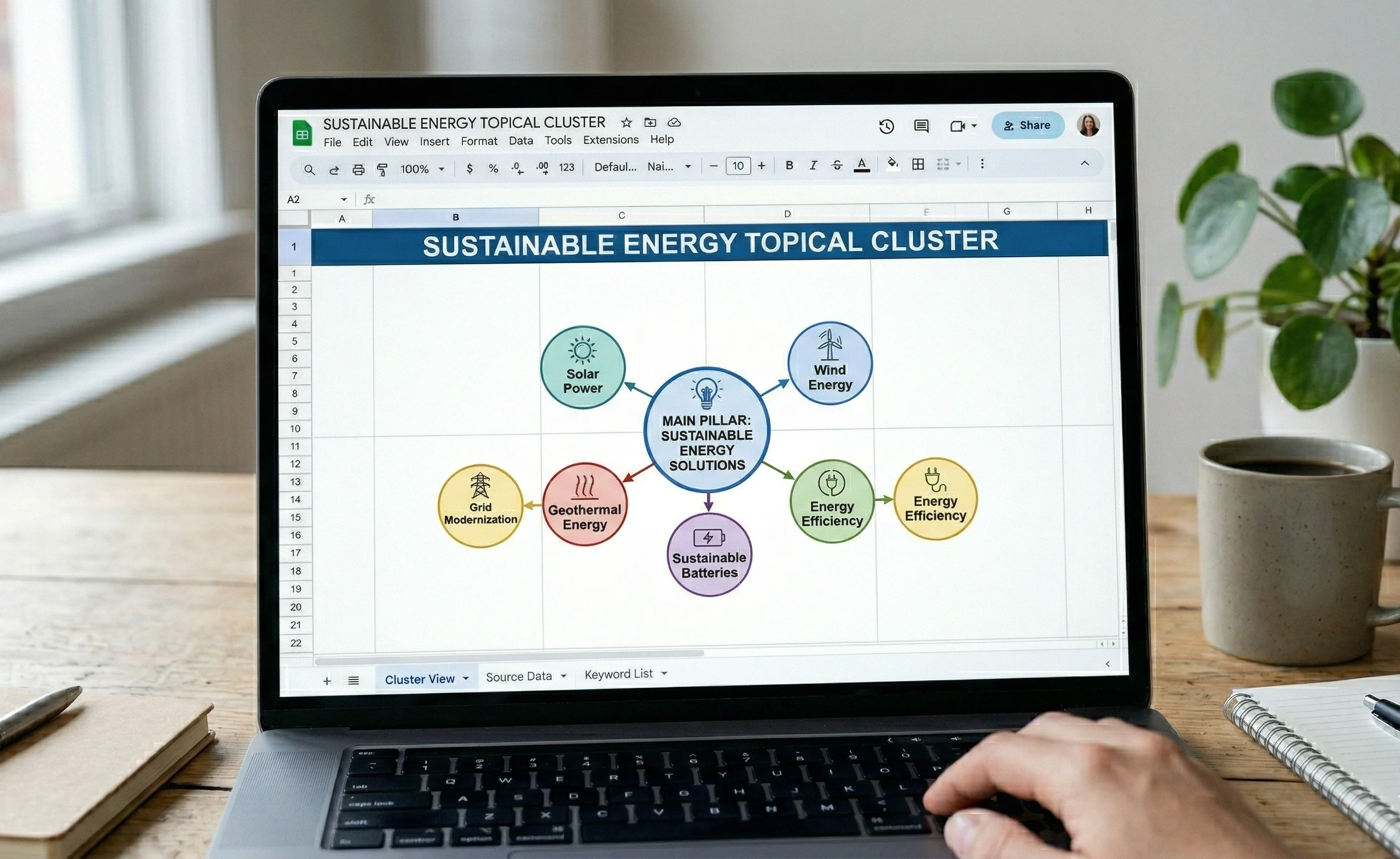
Not all keywords make their way into a separate article. Keyword mapping helps group related terms into unified topics in order to avoid cannibalization and make sure that each piece of content is well-covered on its topic. A keyword such as "SEO content strategy" could be used to anchor a pillar page, and "SEO content calendar template" and "how to organize content for SEO" would be used to support the pillar page with supporting cluster articles. Keytomic's guide to programmatic SEO for content teams details this mapping process for teams working at scale.
Step 4: Identify Search Intent
Search intent determines the format, depth and angle of each piece of content. Informational intention includes the need for educational guides and how-to articles. Commercial intention requires comparison pages and reviews. Transactional intent requires landing pages that are built to convert. Misreading intent is one of the most common reasons why well-written content fails to rank - the calendar needs to have intent mapped to every entry before writing starts.
Step 5: Plan Content Types
The calendar should be a mix of content types based on intent: blog articles, in-depth guides, service pages, FAQ content, comparison pieces. 74% of marketers say how-to articles are the most effective content format they publish, but the right format depends entirely on what the searcher expects to find. A diversified mix will ensure that the site is capturing traffic at every stage of the buyer's journey.
Step 6: Assign Publishing Frequency and Ownership
Publishing frequency is a reflection of realistic team capacity - and once determined, it must be protected. Sporadic publishing is worse than slow publishing because it interferes with crawl patterns and doesn't create the compounding authority that consistency creates. Two to four well-researched articles a week is a good baseline for most growing businesses. Each entry in the calendar should also have an owner's name and a clear deadline, not just a publication date.
Step 7: Build the Timeline with Internal Links Planned In
The timeline allocates the pieces of content to a publishing date, taking into consideration seasonal windows, product launches, and competitor gaps. Critically, it should also pre-plan internal linking: which existing pages other new articles will link to, and which future pieces will link back to it. Pillar pages should go live before their cluster articles so that the links between them come live in a logical order. Planning links before writing - not after - is what makes the difference between a well-structured content program and a disconnected blog.
Step 8: Optimize Every Entry for AI Search
In 2026, content needs to be structured for AI powered systems - not just Google's traditional crawler. Every entry in the calendar should have a note on the entities to include, the questions to answer directly and the semantic keywords to cover throughout the piece. Content that is planned with this level of coverage is much more likely to receive citations in AI Overviews and LLM answers.
How Keytomic Automates Your SEO Content Calendar
Building a content calendar manually - juggling spreadsheets, keyword tools, publishing trackers and internal link audits across multiple clients or content streams - is where most SEO programs break down. The strategy is good but the execution is the bottleneck.
Keytomic is designed just to eliminate that bottleneck. Rather than using the content calendar as a separate planning exercise, Keytomic's platform for SEO teams integrates keyword analysis, content scheduling, internal link planning, and AI search monitoring all into one automated workflow. Teams define their goals, and Keytomic reveals the keyword opportunities, identifies content gaps, and monitors the performance of each published piece - in both traditional search results and AI-generated responses.
Keytomic also takes care of the technical aspect of the publishing cycle: its auto-indexing case study shows how content is indexed faster, which means that newly published articles begin to build their ranking signals earlier. Combined with built-in tools such as the keyword density checker, the AI meta description generator, and the broken link checker, the platform takes care of the recurring technical tasks which would otherwise eat into content production time.
The result is a content calendar that does not just exist as a planning document - it runs as a live, data-driven production system. That is the difference in operation between teams that scale their SEO and teams that remain stuck at the same level of output no matter how hard they try.
Sample SEO Content Calendar - Monthly Plan
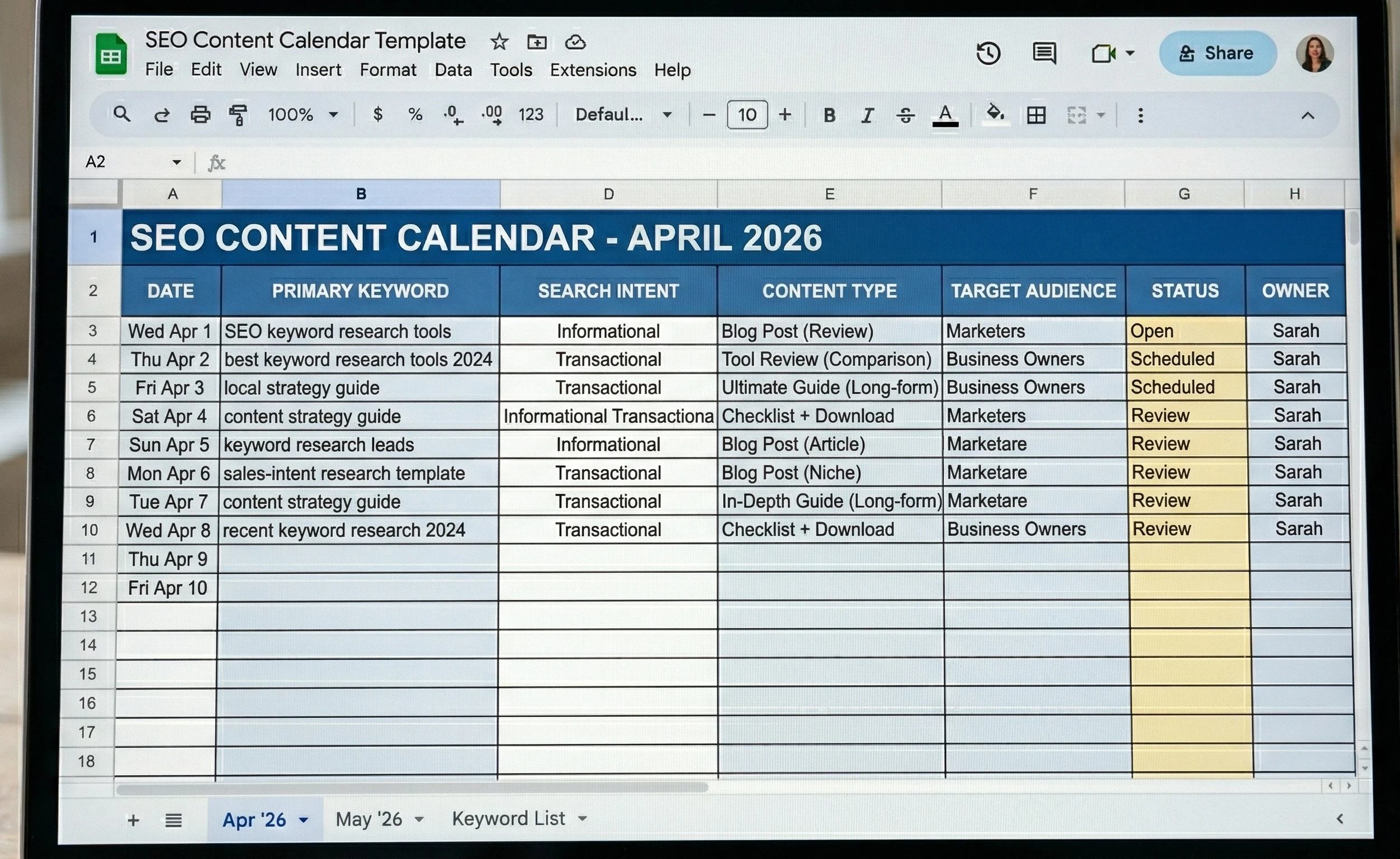
The table below shows a one-month content calendar for an SEO-focused brand, with keywords, content types, and intent mapped across four weeks.
Week | Topic | Target Keyword | Content Type | Search Intent |
Week 1 | How to Create an SEO Content Calendar | seo content calendar | How-To Guide | Informational |
Week 1 | Best SEO Automation Tools for Agencies (2026) | seo automation tools agencies | Listicle / Review | Commercial |
Week 2 | What Is Topical Authority in SEO? | topical authority seo | Educational Guide | Informational |
Week 2 | Pillar Page vs. Cluster Content Explained | pillar page vs cluster content | Comparison Article | Informational |
Week 3 | How to Plan Blog Content for Organic Rankings | how to plan blog content seo | Step-by-Step Guide | Informational |
Week 3 | SEO Tools for Content Teams That Actually Scale | seo tools for content teams | Listicle / Review | Commercial |
Week 4 | Internal Linking Strategy for SEO in 2026 | internal linking seo strategy | Strategy Guide | Informational |
Week 4 | SEO Content Calendar Template (Free Download) | seo content calendar template | Resource / Lead Magnet | Transactional |
Common SEO Content Calendar Mistakes
Publishing without keyword research is the most costly mistake. Teams that develop topics based on brainstorming or observation of competitors are often building a library of content with no organic demand to drive it - developing articles that get no traffic no matter how well they are written. The calendar needs to be keyword-first, always.
Ignoring search intent is a close second. An article written to inform, when the searcher wants to compare, or written to persuade, when the user wants to learn, will perform poorly even if it is written to the appropriate keyword. Intent alignment is not optional - it is the reason why content ranks.
Inconsistent publishing schedules compromise compounding authority. A site publishing five articles for one week and then nothing for three weeks sends mixed signals to crawlers and doesn't build up the momentum that regular publishing does. Not refreshing old content is also as bad as it gets: In 2026, as freshness signals play a bigger role in AI-driven results, content that is 12-18 months old and has not been updated loses ground quickly. The calendar should include a quarterly cycle of refreshes in addition to new publication slots. Finally, poor internal linking - from either a lack of up front planning or an inability to ever audit the existing link structure - leaves significant ranking potential on the table.
Optimizing Your Content Calendar for AI Search
AI-powered search responses have gone from being a question of the future to one of the present operational realities. For example, Google AI Overviews, ChatGPT, Perplexity, Gemini and Claude are now providing direct answers to millions of queries that would once have sent users to a search result page. For content teams, this means the calendar needs to be built in a way which will earn citations in these responses - not just positions in the traditional SERP.
The optimization for AI search begins at the planning stage. Every calendar entry should contain a note on essential entities to touch on, direct questions to answer within the piece, and range of semantic keywords to address throughout. Entity-based content planning - organizing content around concepts and concept relationships, rather than focusing on target keywords - is the principle behind content that gets cited by LLMs. Structured headings, short runs of answer, definition first paragraphs, and FAQ sections all make extraction more likely.
Conclusion
A structured SEO content calendar is not a productivity tool - it is the strategic backbone of organic growth. In an environment where search is dominated by AI overviews, LLM-powered search, and increasingly stiff competition, the brands that gain ground are those that publish with purpose: keyword-powered, consistently, and with a clear architecture that links every piece of content to the next. Without that structure, even good quality writing fails to accumulate the authority that it deserves.
Keytomic makes this process systematic and scalable. From keyword discovery and topic mapping to publishing automation, internal link planning, and AI search monitoring - the platform eliminates the operational friction that stops content calendars from being maintained over the long term. Keytomic believes that SEO content calendar is not just a planning tool - it is the basis of scalable organic growth in an ever-competitive and AI-driven search landscape.
FAQs
What is an SEO content calendar?
An SEO content calendar is a content publishing schedule that plans each and every blog post, guide, or landing page to a target keyword, search intent, content type, and publication date. It ensures content is published on a consistent basis and with a clear organic search purpose, rather than being created on an ad-hoc basis. The calendar is the operating basis of any serious SEO content program.
How often should businesses publish content for SEO?
Publishing frequency should be based on the team's capacity and also on competition pressure. Data shows that companies who publish 16 or more blog posts per month are generating 4.5x more leads than infrequent publishers. For most growing businesses, two to four well researched articles a week is a good baseline - as quality always takes precedence over raw volume.
How does a content calendar improve SEO rankings?
A content calendar helps to improve rankings by ensuring a consistent publishing cadence (which signals freshness and authority to crawlers), systematic keyword coverage (which helps capture traffic across the funnel), planned internal linking (which spreads page authority) and topical clustering (which builds the subject matter depth to earn top positions in competitive search results).
What is topical authority and why does it matter?
Topical authority is the extent to which search engines have determined that a website is a primary website on a particular subject. It is constructed through the publication of comprehensive and interlinked content that addresses every important aspect of a topic - not just high volume keywords. Sites with good topical authority have an easier time ranking for new keywords in their niche, and are more likely to be cited in AI-generated search responses.
How do you optimize content for AI search and LLMs?
Content optimized for AI search should be structured with clear H2/H3 headings, entity-rich prose, direct answer blocks and FAQ sections. It needs to address the primary keyword along with related entities and common questions asked by the users - not stuff them in, but write content comprehensive enough that they come naturally. Consistent publication of this type of content, monitored via an AI visibility platform such as Keytomic, is the best way to earn citations for LLM.
What makes Keytomic different from a standard content calendar tool?
Most content calendar tools are scheduling platforms - they track what you plan to publish but provide no data on what you should publish or how your published content is performing in AI search. Keytomic combines keyword gap analysis, automated content scheduling, AI search citation tracking and technical SEO tools into one platform -- so the calendar is always informed by live search data, not static planning assumptions.
Most SEO programs don't fail due to bad writing. They fail due to bad planning. Content gets published whenever someone finds time for it, topics are selected based on gut feel and not keyword data, and internal linking is an afterthought. The result is a library of disconnected articles never building the kind of topical authority search engines reward - and a team that works harder every quarter without getting meaningful ground.
The numbers are unambiguous. According to HubSpot's State of Marketing Report 2026, more than 92% of marketers are already using or planning on SEO optimization for traditional/ AI-powered search engines. At the same time, nearly 30% have noted a tangible decline in search traffic as users follow the trend to use AI tools such as ChatGPT, Perplexity, and Google AI Overviews. The brands that are gaining ground in this environment share one trait: They publish strategically, consistently and with a clear content architecture behind every piece they produce.
A structured SEO content calendar is what makes the difference between reactive publishing and an actual organic growth system. It maps every article, guide and landing page to a target keyword, a defined search intent and a publication date -- so that content creation is driven by data, not guesswork. This guide walks through exactly how to build one, and how Keytomic automates the process for agencies and SEO teams that need to run this at scale.
What Is an SEO Content Calendar?
An SEO content calendar is a publishing schedule that lays out content pieces to target keywords, search intent, content types, and specific publishing dates. Unlike a general editorial calendar -- which is simply a log of what gets published and when - an SEO content calendar is developed based on keyword research and tied directly to business goals. Every entry is there because there is some organic search demand behind it.
The difference in practice is significant. A general content calendar provides an answer to the questions: "What do we publish this week?" An SEO content calendar answers the following questions: "What does our audience search for, what intent is behind that search and how do we systematically own that traffic over the next 90 days?" It brings together the strategy of keywords, content production, internal linking, and publishing cadence into one operational framework.
Why an SEO Content Calendar Is Non-Negotiable in 2026
Publishing frequency is one of the most obvious predictors of organic performance. Companies with regular blogging produce 67% more leads per month than companies that don't publish regularly. The difference grows even wider as volume goes up: businesses publishing 16 or more blog posts per month generate 4.5x more leads than infrequent publishers. These are not marginal gains - these represent the compounding effect of consistent, keyword-aligned publishing over time.
A well maintained SEO content calendar has five structural benefits. It enforces publishing consistency, which is a signal to freshness and authority of crawlers. It systematically extends keyword coverage in terms of short-tail, long-tail and semantic variations. It builds topical authority - the degree to which search engines recognize a site as a primary resource on a subject. It builds up the planned internal linking structures to distribute page authority across a site. And it keeps every content decision relevant to measurable business goals and not trending topics or personal preference.
In 2026, the calendar also has to take into consideration AI search. According to HubSpot State of Marketing Report 2026, website, blog, and SEO remains the number one ROI-generating channel for marketers - but the way content reaches users is changing fast. A structured content calendar is the surest way to get citations in AI-generated responses in addition to traditional SERP rankings, and content calendars should be based on entities and semantic coverage.
How to Create an SEO Content Calendar: Step-by-Step
Step 1: Define Your SEO Goals
The calendar is only as useful as the goals it serves. Before starting research on a single keyword, be clear on what success shares look like: increased organic traffic, lead generation from specific keywords, ranking in a new market, or building topical authority in a niche. Each goal alters the make-up of the calendar. A lead-generation focus skews to bottom of funnel content. A topical authority play means more comprehensive cluster content and less one-off articles. Write these goals down and mark the calendar accordingly.
Step 2: Perform Keyword Research
Keyword research is the data backbone to the entire calendar. It determines what the target audience is actually looking for, the volume and competition behind these terms, and the intent behind every query. The output of this step is a prioritized keyword list - organized by difficulty, volume and business relevance - that will be used in every content decision from topic selection to article framing. 55% of marketers say publishing more content and targeting specific keywords directly improved their content rankings, which is one of the reasons why keyword-first planning is so important.
Step 3: Map Keywords to Topics
Not all keywords make their way into a separate article. Keyword mapping helps group related terms into unified topics in order to avoid cannibalization and make sure that each piece of content is well-covered on its topic. A keyword such as "SEO content strategy" could be used to anchor a pillar page, and "SEO content calendar template" and "how to organize content for SEO" would be used to support the pillar page with supporting cluster articles. Keytomic's guide to programmatic SEO for content teams details this mapping process for teams working at scale.
Step 4: Identify Search Intent
Search intent determines the format, depth and angle of each piece of content. Informational intention includes the need for educational guides and how-to articles. Commercial intention requires comparison pages and reviews. Transactional intent requires landing pages that are built to convert. Misreading intent is one of the most common reasons why well-written content fails to rank - the calendar needs to have intent mapped to every entry before writing starts.
Step 5: Plan Content Types
The calendar should be a mix of content types based on intent: blog articles, in-depth guides, service pages, FAQ content, comparison pieces. 74% of marketers say how-to articles are the most effective content format they publish, but the right format depends entirely on what the searcher expects to find. A diversified mix will ensure that the site is capturing traffic at every stage of the buyer's journey.
Step 6: Assign Publishing Frequency and Ownership
Publishing frequency is a reflection of realistic team capacity - and once determined, it must be protected. Sporadic publishing is worse than slow publishing because it interferes with crawl patterns and doesn't create the compounding authority that consistency creates. Two to four well-researched articles a week is a good baseline for most growing businesses. Each entry in the calendar should also have an owner's name and a clear deadline, not just a publication date.
Step 7: Build the Timeline with Internal Links Planned In
The timeline allocates the pieces of content to a publishing date, taking into consideration seasonal windows, product launches, and competitor gaps. Critically, it should also pre-plan internal linking: which existing pages other new articles will link to, and which future pieces will link back to it. Pillar pages should go live before their cluster articles so that the links between them come live in a logical order. Planning links before writing - not after - is what makes the difference between a well-structured content program and a disconnected blog.
Step 8: Optimize Every Entry for AI Search
In 2026, content needs to be structured for AI powered systems - not just Google's traditional crawler. Every entry in the calendar should have a note on the entities to include, the questions to answer directly and the semantic keywords to cover throughout the piece. Content that is planned with this level of coverage is much more likely to receive citations in AI Overviews and LLM answers.
How Keytomic Automates Your SEO Content Calendar
Building a content calendar manually - juggling spreadsheets, keyword tools, publishing trackers and internal link audits across multiple clients or content streams - is where most SEO programs break down. The strategy is good but the execution is the bottleneck.
Keytomic is designed just to eliminate that bottleneck. Rather than using the content calendar as a separate planning exercise, Keytomic's platform for SEO teams integrates keyword analysis, content scheduling, internal link planning, and AI search monitoring all into one automated workflow. Teams define their goals, and Keytomic reveals the keyword opportunities, identifies content gaps, and monitors the performance of each published piece - in both traditional search results and AI-generated responses.
Keytomic also takes care of the technical aspect of the publishing cycle: its auto-indexing case study shows how content is indexed faster, which means that newly published articles begin to build their ranking signals earlier. Combined with built-in tools such as the keyword density checker, the AI meta description generator, and the broken link checker, the platform takes care of the recurring technical tasks which would otherwise eat into content production time.
The result is a content calendar that does not just exist as a planning document - it runs as a live, data-driven production system. That is the difference in operation between teams that scale their SEO and teams that remain stuck at the same level of output no matter how hard they try.
Sample SEO Content Calendar - Monthly Plan
The table below shows a one-month content calendar for an SEO-focused brand, with keywords, content types, and intent mapped across four weeks.
Week | Topic | Target Keyword | Content Type | Search Intent |
Week 1 | How to Create an SEO Content Calendar | seo content calendar | How-To Guide | Informational |
Week 1 | Best SEO Automation Tools for Agencies (2026) | seo automation tools agencies | Listicle / Review | Commercial |
Week 2 | What Is Topical Authority in SEO? | topical authority seo | Educational Guide | Informational |
Week 2 | Pillar Page vs. Cluster Content Explained | pillar page vs cluster content | Comparison Article | Informational |
Week 3 | How to Plan Blog Content for Organic Rankings | how to plan blog content seo | Step-by-Step Guide | Informational |
Week 3 | SEO Tools for Content Teams That Actually Scale | seo tools for content teams | Listicle / Review | Commercial |
Week 4 | Internal Linking Strategy for SEO in 2026 | internal linking seo strategy | Strategy Guide | Informational |
Week 4 | SEO Content Calendar Template (Free Download) | seo content calendar template | Resource / Lead Magnet | Transactional |
Common SEO Content Calendar Mistakes
Publishing without keyword research is the most costly mistake. Teams that develop topics based on brainstorming or observation of competitors are often building a library of content with no organic demand to drive it - developing articles that get no traffic no matter how well they are written. The calendar needs to be keyword-first, always.
Ignoring search intent is a close second. An article written to inform, when the searcher wants to compare, or written to persuade, when the user wants to learn, will perform poorly even if it is written to the appropriate keyword. Intent alignment is not optional - it is the reason why content ranks.
Inconsistent publishing schedules compromise compounding authority. A site publishing five articles for one week and then nothing for three weeks sends mixed signals to crawlers and doesn't build up the momentum that regular publishing does. Not refreshing old content is also as bad as it gets: In 2026, as freshness signals play a bigger role in AI-driven results, content that is 12-18 months old and has not been updated loses ground quickly. The calendar should include a quarterly cycle of refreshes in addition to new publication slots. Finally, poor internal linking - from either a lack of up front planning or an inability to ever audit the existing link structure - leaves significant ranking potential on the table.
Optimizing Your Content Calendar for AI Search
AI-powered search responses have gone from being a question of the future to one of the present operational realities. For example, Google AI Overviews, ChatGPT, Perplexity, Gemini and Claude are now providing direct answers to millions of queries that would once have sent users to a search result page. For content teams, this means the calendar needs to be built in a way which will earn citations in these responses - not just positions in the traditional SERP.
The optimization for AI search begins at the planning stage. Every calendar entry should contain a note on essential entities to touch on, direct questions to answer within the piece, and range of semantic keywords to address throughout. Entity-based content planning - organizing content around concepts and concept relationships, rather than focusing on target keywords - is the principle behind content that gets cited by LLMs. Structured headings, short runs of answer, definition first paragraphs, and FAQ sections all make extraction more likely.
Conclusion
A structured SEO content calendar is not a productivity tool - it is the strategic backbone of organic growth. In an environment where search is dominated by AI overviews, LLM-powered search, and increasingly stiff competition, the brands that gain ground are those that publish with purpose: keyword-powered, consistently, and with a clear architecture that links every piece of content to the next. Without that structure, even good quality writing fails to accumulate the authority that it deserves.
Keytomic makes this process systematic and scalable. From keyword discovery and topic mapping to publishing automation, internal link planning, and AI search monitoring - the platform eliminates the operational friction that stops content calendars from being maintained over the long term. Keytomic believes that SEO content calendar is not just a planning tool - it is the basis of scalable organic growth in an ever-competitive and AI-driven search landscape.
FAQs
What is an SEO content calendar?
An SEO content calendar is a content publishing schedule that plans each and every blog post, guide, or landing page to a target keyword, search intent, content type, and publication date. It ensures content is published on a consistent basis and with a clear organic search purpose, rather than being created on an ad-hoc basis. The calendar is the operating basis of any serious SEO content program.
How often should businesses publish content for SEO?
Publishing frequency should be based on the team's capacity and also on competition pressure. Data shows that companies who publish 16 or more blog posts per month are generating 4.5x more leads than infrequent publishers. For most growing businesses, two to four well researched articles a week is a good baseline - as quality always takes precedence over raw volume.
How does a content calendar improve SEO rankings?
A content calendar helps to improve rankings by ensuring a consistent publishing cadence (which signals freshness and authority to crawlers), systematic keyword coverage (which helps capture traffic across the funnel), planned internal linking (which spreads page authority) and topical clustering (which builds the subject matter depth to earn top positions in competitive search results).
What is topical authority and why does it matter?
Topical authority is the extent to which search engines have determined that a website is a primary website on a particular subject. It is constructed through the publication of comprehensive and interlinked content that addresses every important aspect of a topic - not just high volume keywords. Sites with good topical authority have an easier time ranking for new keywords in their niche, and are more likely to be cited in AI-generated search responses.
How do you optimize content for AI search and LLMs?
Content optimized for AI search should be structured with clear H2/H3 headings, entity-rich prose, direct answer blocks and FAQ sections. It needs to address the primary keyword along with related entities and common questions asked by the users - not stuff them in, but write content comprehensive enough that they come naturally. Consistent publication of this type of content, monitored via an AI visibility platform such as Keytomic, is the best way to earn citations for LLM.
What makes Keytomic different from a standard content calendar tool?
Most content calendar tools are scheduling platforms - they track what you plan to publish but provide no data on what you should publish or how your published content is performing in AI search. Keytomic combines keyword gap analysis, automated content scheduling, AI search citation tracking and technical SEO tools into one platform -- so the calendar is always informed by live search data, not static planning assumptions.
FREE AI Visibility Audit

Is Your Brand Visible in AI Searches?
Free AI Visibility Audit → See where you appear (and where competitors appear).
Read More From Our Blog...
12 Best AI Tools for Ecommerce SEO and AI Visibility in 2026
Ecommerce Category Page SEO: Best Practices for 2026
Best AI Tools for Increasing Visibility in LLMs 2026

Start Getting Cited By Google
and AI Searches on Auto-Pilot


AI SEO agents research keywords, write & publish ranking content, track AI citations, and grow your brand visibility — while you focus on the business.


Trusted by 300+ users

4.5
Start Getting Cited By Google
and AI Searches on Auto-Pilot
Automate your SEO to rank faster, and showing up in AI search, without the guesswork.
Trusted by 300+ users
4.5
Start Getting Cited By Google
and AI Searches on Auto-Pilot
AI SEO agents research keywords, write & publish ranking content, track AI citations, and grow your brand visibility — while you focus on the business.
Trusted by 300+ users