Table of Contents
Share Article
How To Improve Brand Visibility In AI Search Engines
How To Improve Brand Visibility In AI Search Engines
How To Improve Brand Visibility In AI Search Engines

Salam Qadir
Product & Growth Lead

Learn how to improve brand visibility across ChatGPT, Google AI search, Perplexity, Gemini, and Copilot with better content, stronger authority, crawler access, and repeatable measurement.
TL;DR
Here is the entire strategy on how to increase brand visibility in AI search engines in seven steps:
Make sure Google, Bing, OpenAI, and Perplexity can access your important pages.
Build a stable set of non-branded prompts based on real buyer questions.
Measure your mentions, citations, recommendations, competitors, sources, and sentiment.
Clarify what your brand is, who it serves, and which category it belongs to.
Publish information that is original, useful, verifiable, and worth citing.
Earn relevant third-party mentions that corroborate your claims.
Repeat the same measurements after making changes.
For the last six months, I’ve studied a lot of AI visibility reports, crawler documentation, LinkedIn newsletters, platform announcements, and SEO nerd's rticles about getting brands into ChatGPT, Perplexity, Gemini, Copilot, and Google’s AI results.
Most of the internet is filled with fluff.
The same advice is recycled everywhere:
Add schema.
Write longer articles.
Use more statistics.
Add an FAQ.
Get backlinks.
Wait 30 days.
Some of that advice is useful. Most of it is incomplete. Some of it is simply made up.
So this will be a no-bullshit guide.
To improve brand visibility in AI search engines, your brand must be easy to discover, clearly understood, relevant to the questions buyers ask, supported by credible information, and corroborated by sources outside your own website.
Then you need to measure whether any of it is working.
That last part matters. A lot.
I would not start by publishing another 20 articles or rewriting every page into two-sentence “AI-friendly chunks.” I would first determine which part of your visibility system is broken.
This guide will help you do exactly that.
It also answers the fan-out questions that tend to sit behind the broader topic:
How do I measure brand visibility in ChatGPT?
How do I check brand visibility in ChatGPT and Perplexity?
How do I optimize my content for ChatGPT brand visibility?
Why isn’t my brand showing up in ChatGPT or Perplexity?
How do I make my site more AI-citable?
How do I get mentioned more often than competitors in AI search?
What tools can help optimize brand presence in AI search engines like ChatGPT, Perplexity, and Google AI Overviews?
How do I improve brand sentiment in AI answer engines?
Let’s get into it.
What does brand visibility mean in AI search?
Brand visibility in AI search is the extent to which your company, products, pages, experts, and ideas appear in AI-generated answers for relevant user questions.
That definition is broader than citations.
A brand can be visible without being cited. It can be cited without being recommended. It can be recommended but described inaccurately.
I separate AI visibility into eight components:
Visibility type | What it measures | Example |
|---|---|---|
Brand mention | Whether the brand appears by name | “Keytomic is an AI SEO platform.” |
Citation | Whether a page is linked or referenced | A Keytomic guide appears in the sources panel |
Recommendation | Whether the brand enters consideration | Included in a list of suggested platforms |
Category association | Whether the brand is connected to the intended market | Associated with AI SEO automation |
Representation accuracy | Whether facts about the brand are correct | Correct features, positioning, and pricing |
Sentiment | How the brand is described | Positive, neutral, mixed, or negative |
Share of voice | How often you appear relative to competitors | Your mentions compared with competing tools |
Referral and assisted influence | Whether visibility affects visits or conversions | Traffic or signups influenced by AI discovery |
I do not combine these blindly.
A mention is not automatically a citation.
A citation is not automatically a recommendation.
And a recommendation is not automatically a conversion.
That distinction may sound obvious, but many AI visibility tools hide all of these outcomes inside a single score. The number looks impressive. It often tells you very little.
For a deeper explanation of the monitoring layer, read how an AI search monitoring platform improves SEO strategy.
How AI search engines find, understand, and select brands
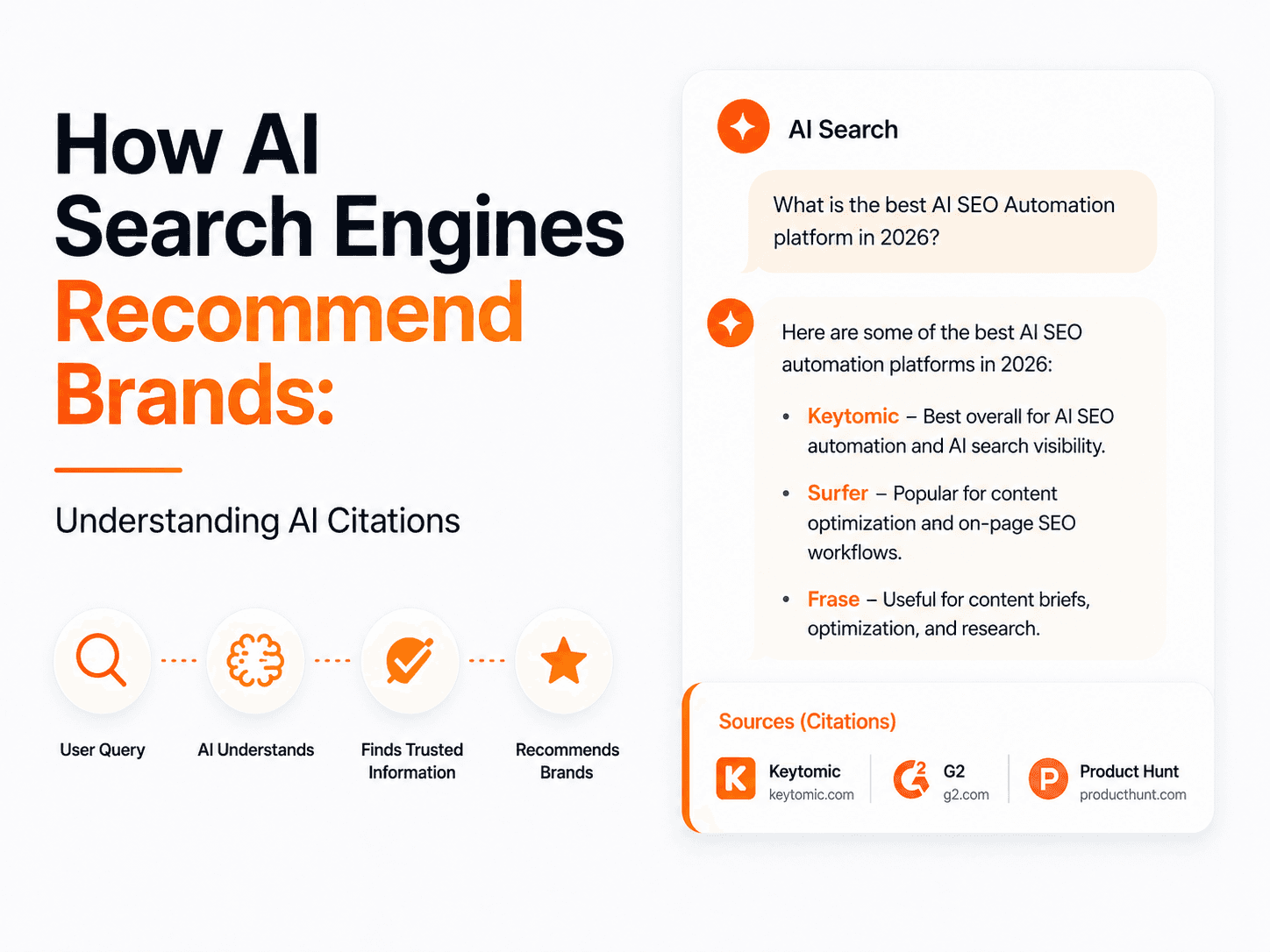
There is no universal AI ranking algorithm.
ChatGPT Search, Google AI Overviews, AI Mode, Perplexity, Gemini, and Microsoft Copilot do not retrieve and generate answers in exactly the same way.
They also change frequently.
Anyone giving you a precise universal list of “AI ranking factors” is overselling what they know.
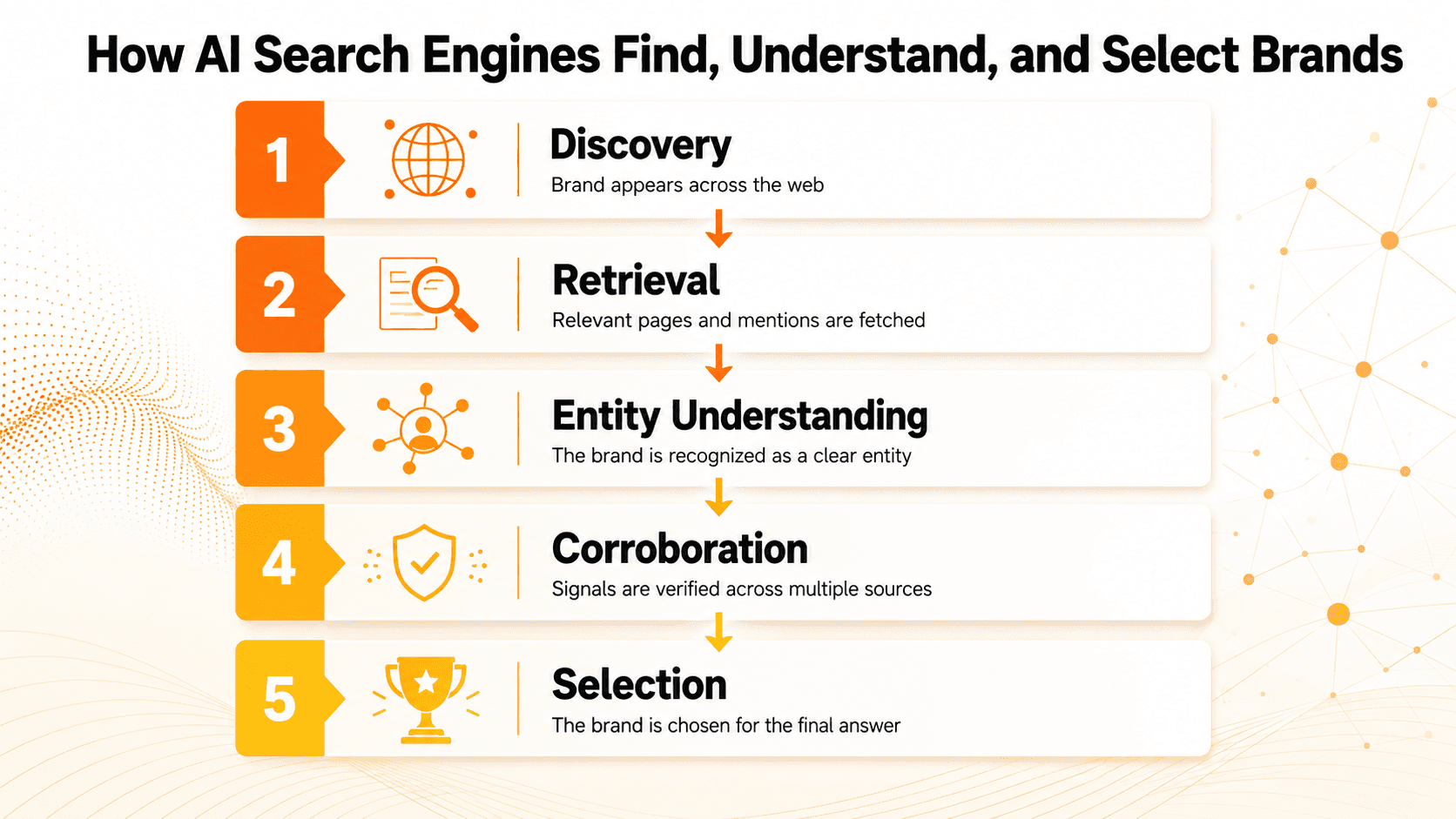
Still, the practical visibility process can be understood through five layers.
1. Discovery
The platform first needs access to information about your brand.
That information may be discovered through:
Search engine indexes
Direct web crawling
XML sitemaps
Internal links
External links
Product feeds
Business profiles
Review platforms
News and industry publications
Community discussions
Public documentation
Previously acquired model knowledge
The exact source depends on the platform and the query.
2. Retrieval
For search-enabled answers, the platform may issue searches or retrieve pages related to the user’s question.
Google officially says AI Overviews and AI Mode may use query fan-out, where the system issues multiple related searches across subtopics and data sources before generating an answer.
A user may ask:
What is the best AI SEO tool for a small agency?
But the system may separately investigate:
AI SEO tools for agencies
Multi-client SEO platforms
AI visibility trackers
Automated content tools
Agency pricing
Customer reviews
Product comparisons
CMS integrations
Competitor alternatives
This is why ranking for one exact keyword is no longer the whole job.
The answer may be assembled from several smaller retrieval paths.
3. Entity understanding
The platform needs to understand the relationships between:
Your organization
Your products
Your founders and employees
Your authors
Your category
Your features
Your audience
Your use cases
Your location
Your competitors
Your claims
If your homepage calls the product an “AI content writer,” your LinkedIn describes it as an “SEO automation platform,” review websites list it as a “blog generator,” and your product schema says something else, you create unnecessary ambiguity.
Machines are not the only ones who get confused.
Customers do too.
4. Corroboration
Your website is the primary source for facts about your own product.
It is not an independent source for whether your product is the best.
That difference matters.
If you claim your platform is the leading solution in a category, an AI system may look for evidence outside your domain:
Reviews
Editorial comparisons
Customer discussions
Industry coverage
Partner pages
Marketplace listings
Expert commentary
Public case studies
Research
Community recommendations
You cannot manufacture credible corroboration on your own blog.
5. Selection
A retrievable page still needs to be useful for the specific answer.
The source is more usable when it provides:
Direct relevance to the question
A clear subject
Accessible text
Specific facts
Verifiable evidence
Appropriate freshness
Original information
Clear limitations
A useful comparison
A complete answer
Consistency with other reliable sources
This is where content quality matters.
But not in the vague “write good content” sense.
We will make it more practical below.
First, make sure AI search engines can access your website
Before rewriting content, I would verify that your important pages can actually be crawled, indexed, rendered, and retrieved.
You would be surprised how many “content problems” are technical problems wearing a content costume.
Check your visibility in Google AI features
Google’s official guidance on AI features and your website is refreshingly simple.
There is no secret AI Overview submission process.
To be eligible as a supporting link in Google AI Overviews or AI Mode, a page must be indexed and eligible to appear in Google Search with a snippet. Google says there are no additional technical requirements for these AI features.
Check:
Does the page return HTTP 200?
Is crawling allowed in robots.txt?
Is your CDN or hosting layer blocking Googlebot?
Does the page have a
noindexdirective?Is the canonical correct?
Is the important content available in rendered HTML?
Is the page internally linked?
Is the content eligible to appear with a snippet?
Does the XML sitemap contain the correct canonical URL?
Can Google render the page properly in URL Inspection?
Use Keytomic’s Google Page Crawl Analyzer for a quick accessibility check, and use the Canonical URL Checker to catch obvious canonical problems.
If a page is indexed but receives no meaningful rankings, citations, or impressions, repeatedly submitting it for indexing is unlikely to fix the underlying problem. Read why content gets indexed by Google but never actually ranks before blaming crawl speed.
Understand GPTBot versus OAI-SearchBot
GPTBot is the crawler that gets your pages into ChatGPT Search.
That is a myth.
Stop taking it seriously.
OpenAI documents separate user agents for separate purposes:
OpenAI user agent | Main purpose | What site owners should know |
|---|---|---|
OAI-SearchBot | Surfacing websites in ChatGPT search | Allow this when you want eligible content to appear in ChatGPT search |
GPTBot | Crawling content that may be used to improve foundation models | Can be allowed or blocked independently |
ChatGPT-User | User-triggered page visits | Not the crawler used to determine automatic ChatGPT Search inclusion |
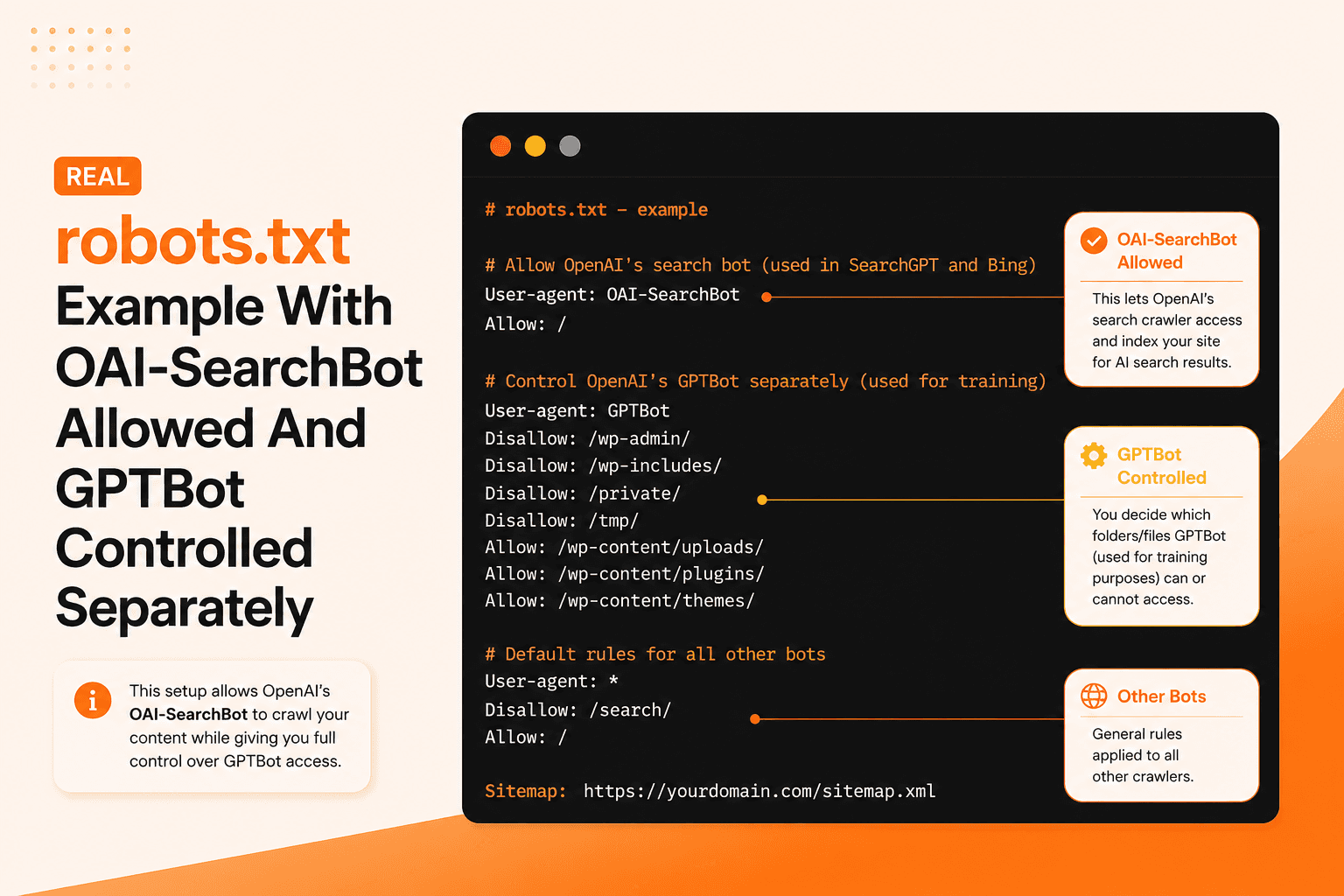
OpenAI explicitly says the settings for OAI-SearchBot and GPTBot are independent. A publisher can allow OAI-SearchBot for search visibility while blocking GPTBot for potential training use.
A basic configuration may look like this:
User-agent: OAI-SearchBot
Allow: /

User-agent: GPTBot
Disallow:
User-agent: OAI-SearchBot
Allow: /

User-agent: GPTBot
Disallow:
This tells OpenAI that your public pages may be surfaced through ChatGPT Search while expressing that you do not want GPTBot to crawl them for model-training purposes.
Adjust this to your own policy.
Do not copy robots.txt rules without understanding them.
OpenAI also recommends allowing requests from its published OAI-SearchBot IP ranges. A firewall can block the crawler before robots.txt ever becomes relevant.
Check:
robots.txt
Cloudflare or another CDN
Web application firewall rules
Bot-management settings
Server logs
IP allowlists
Response codes served to the bot
Whether important assets and HTML are accessible
OpenAI states that public websites can appear in ChatGPT Search when their content is accessible. It also adds utm_source=chatgpt.com to referral links, which gives publishers a practical way to identify at least some ChatGPT-originated traffic.
For a deeper breakdown, read:
Check PerplexityBot and your WAF
Perplexity documents two relevant user agents:
PerplexityBotfor discovering and surfacing websites in Perplexity searchPerplexity-Userfor user-triggered page access
Perplexity recommends allowing PerplexityBot and requests from its published IP ranges when you want your site to appear in its search results. It also warns that WAF configurations may require explicit allowlisting.
This matters because a site can appear open in a browser and still block a crawler through:
Bot Fight Mode
Managed firewall rules
Rate limiting
IP reputation filters
JavaScript challenges
Country restrictions
User-agent restrictions
Do not stop after reading robots.txt.
Check the logs.
Check Bing and Microsoft Copilot visibility
Bing still matters.
Especially for Microsoft Copilot and other experiences built on Microsoft’s search and retrieval infrastructure.
Submit your sitemap in Bing Webmaster Tools and review:
URL Inspection
Crawl errors
Indexed pages
Sitemaps
Backlinks
Search performance
IndexNow implementation
AI Performance data
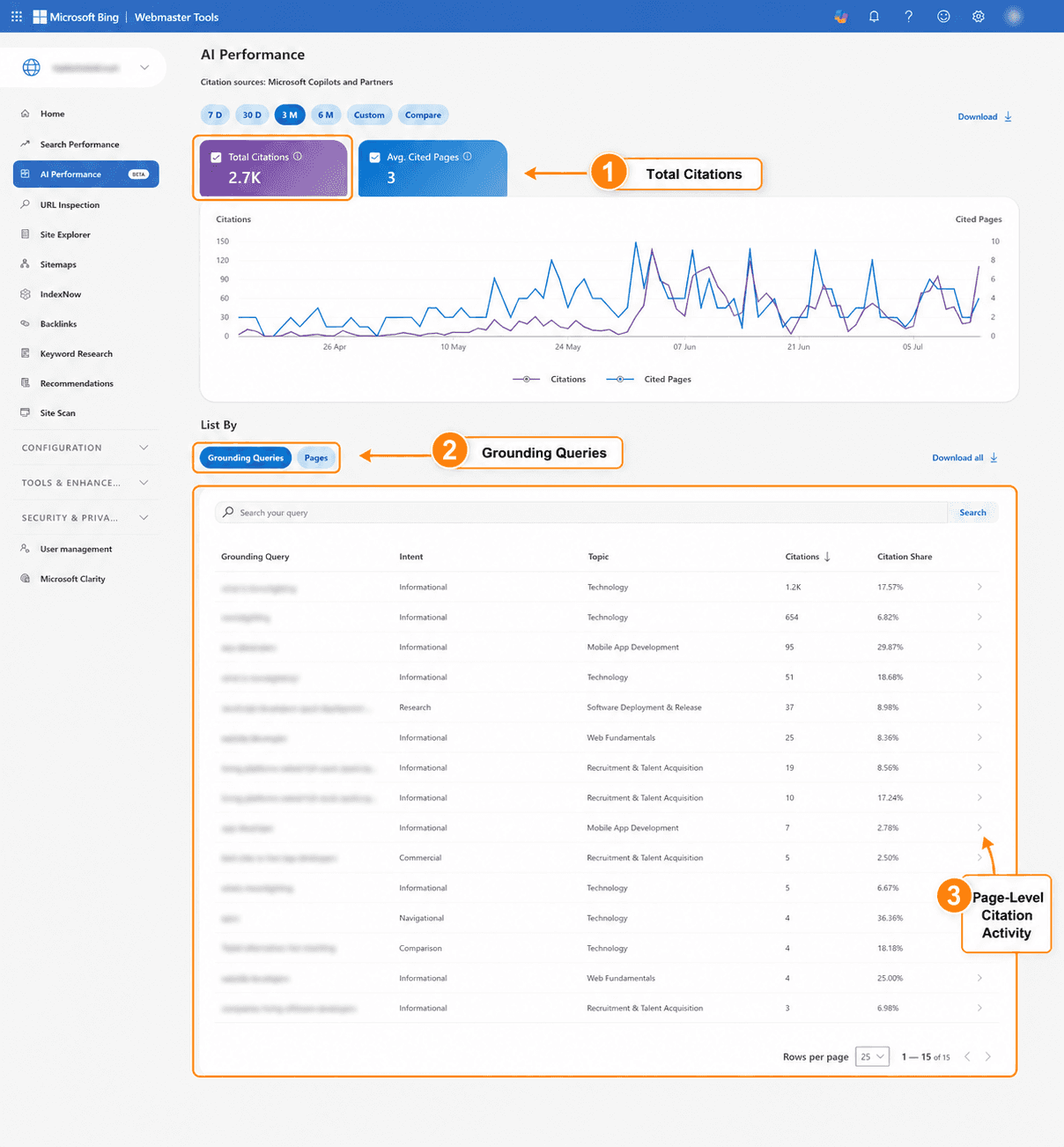
Bing introduced an AI Performance dashboard that reports:
Total citations
Average cited pages
Sample grounding queries
Page-level citation activity
Visibility trends
The report measures citation activity across supported Microsoft AI experiences. It does not claim to show a universal AI authority score or your position in every generated answer.
That is an important limitation.
Microsoft also connects content freshness with IndexNow, which lets participating search engines know when a page has been added, updated, or removed.
Use it as a discovery signal.
Not magic.
Technical AI visibility checklist
Copy this checklist into your project manager:
AI SEARCH ACCESSIBILITY CHECKLIST

[ ] The priority page returns HTTP 200
[ ] The canonical points to the intended indexable URL
[ ] No noindex directive is present
[ ] Googlebot can crawl the page
[ ] Bingbot can crawl the page
[ ] OAI-SearchBot is allowed where desired
[ ] PerplexityBot is allowed where desired
[ ] CDN and WAF rules do not silently block legitimate bots
[ ] Main content appears in rendered HTML
[ ] Important facts are available as text, not only images
[ ] The URL is included in a valid XML sitemap
[ ] Internal links point to the page
[ ] Duplicate URLs are consolidated
[ ] Structured data matches visible content
[ ] Server logs are checked for failed crawler requests
[ ] The mobile version contains the complete answer
AI SEARCH ACCESSIBILITY CHECKLIST

[ ] The priority page returns HTTP 200
[ ] The canonical points to the intended indexable URL
[ ] No noindex directive is present
[ ] Googlebot can crawl the page
[ ] Bingbot can crawl the page
[ ] OAI-SearchBot is allowed where desired
[ ] PerplexityBot is allowed where desired
[ ] CDN and WAF rules do not silently block legitimate bots
[ ] Main content appears in rendered HTML
[ ] Important facts are available as text, not only images
[ ] The URL is included in a valid XML sitemap
[ ] Internal links point to the page
[ ] Duplicate URLs are consolidated
[ ] Structured data matches visible content
[ ] Server logs are checked for failed crawler requests
[ ] The mobile version contains the complete answer
Keytomic also provides a robots.txt generator and sitemap URL extractor if you need to audit these elements quickly.
Measure your current AI brand visibility before changing anything
I treat AI visibility as a measurement problem before treating it as a publishing problem.
Without a baseline, you cannot tell whether a change improved visibility or whether the answers simply varied between runs.
AI-generated answers are not perfectly deterministic. The same prompt can produce different sources, competitors, and recommendations at different times.
A 2026 research paper examining repeated tests across generative search platforms found meaningful variability in citation distributions and warned that single-run measurements can create false precision.
In plain English:
One prompt is not data.
Build a prompt universe from real buyer intent
Do not test only branded questions.
Asking ChatGPT:
Is Keytomic a good AI SEO platform?
is not a serious measure of non-branded visibility. You put the brand inside the prompt.
Your prompt universe should include several types of buyer questions:
Prompt type | Example | What it measures |
|---|---|---|
Category discovery | Best AI SEO tools for a small agency | Recommendation visibility |
Problem solving | How can I increase organic traffic without hiring more writers? | Problem association |
Use case | Best SEO platform for managing five client websites | Use-case relevance |
Comparison | AI SEO automation versus a content optimization tool | Category positioning |
Alternatives | Alternatives to [competitor] for automated publishing | Competitive consideration |
Buyer criteria | What should I look for in an AI visibility platform? | Feature association |
Informational | How do AI search engines choose sources? | Citation potential |
Objection | Are AI-generated SEO articles safe to publish? | Trust and objection handling |
Location or industry | Best SEO software for a US SaaS company | Segment relevance |
Brand verification | What does [brand] do? | Representation accuracy |
Start with 20–50 prompts.
More is not automatically better.
A clean prompt set you can repeat is more valuable than 2,000 random queries you never inspect.
Use this prompt to generate a buyer-intent prompt universe
Copy and edit this:
Act as an AI search visibility researcher.

Analyze the following company:

Brand:
Website:
Product category:
Primary products or services:
Ideal customers:
Industries:
Locations:
Main competitors:
Key features:
Primary customer problems:
Important buying objections:

Create 50 non-branded prompts that a potential customer could ask ChatGPT, Perplexity, Gemini, Google AI Mode, or Microsoft Copilot.

Organize the prompts into these groups:

1. Category discovery
2. Problem-solving
3. Product or service comparison
4. Use-case recommendations
5. Industry-specific recommendations
6. Location-specific recommendations
7. Feature and capability research
8. Competitor alternatives
9. Purchase objections
10. Educational questions that could cite the company’s expertise

Rules:

- Do not include the brand name in non-branded prompts.
- Do not produce minor wording variations of the same question.
- Use natural conversational language.
- Prioritize questions with commercial or strategic relevance.
- Include both broad prompts and highly specific follow-up questions.
- State the likely buyer stage and desired answer type for every prompt
Act as an AI search visibility researcher.

Analyze the following company:

Brand:
Website:
Product category:
Primary products or services:
Ideal customers:
Industries:
Locations:
Main competitors:
Key features:
Primary customer problems:
Important buying objections:

Create 50 non-branded prompts that a potential customer could ask ChatGPT, Perplexity, Gemini, Google AI Mode, or Microsoft Copilot.

Organize the prompts into these groups:

1. Category discovery
2. Problem-solving
3. Product or service comparison
4. Use-case recommendations
5. Industry-specific recommendations
6. Location-specific recommendations
7. Feature and capability research
8. Competitor alternatives
9. Purchase objections
10. Educational questions that could cite the company’s expertise

Rules:

- Do not include the brand name in non-branded prompts.
- Do not produce minor wording variations of the same question.
- Use natural conversational language.
- Prioritize questions with commercial or strategic relevance.
- Include both broad prompts and highly specific follow-up questions.
- State the likely buyer stage and desired answer type for every prompt
Standardize the test
For each prompt, record:
Exact prompt
Platform
Model or search experience
Date
Country
Language
Logged-in or logged-out state
Whether web search was active
Brand mentioned: yes or no
Brand cited: yes or no
Brand recommended: yes or no
Mention position
Competitors mentioned
Sources cited
Description accuracy
Sentiment
Screenshot or stored response
Do not change the prompt every week and pretend you are tracking a trend.
Calculate useful AI visibility metrics
Mention rate
Prompts containing your brand ÷ total prompts tested × 100
Prompts containing your brand ÷ total prompts tested × 100
Citation rate
Prompts citing your domain ÷ total prompts tested × 100
Prompts citing your domain ÷ total prompts tested × 100
Recommendation rate
Prompts recommending your brand ÷ eligible recommendation prompts × 100
Prompts recommending your brand ÷ eligible recommendation prompts × 100
AI share of voice
Your brand mentions ÷ mentions of all tracked brands × 100
Your brand mentions ÷ mentions of all tracked brands × 100
Source ownership rate
Citations to your owned domain ÷ all citations associated with your brand × 100
Citations to your owned domain ÷ all citations associated with your brand × 100
Positive representation rate
Positive or accurate brand descriptions ÷ total brand mentions × 100
Positive or accurate brand descriptions ÷ total brand mentions × 100
Prompt coverage
Prompt clusters containing at least one brand mention ÷ all tracked prompt clusters × 100
Prompt clusters containing at least one brand mention ÷ all tracked prompt clusters × 100
Do not hide the inputs.
A score should make a decision easier. If it only gives your manager another line chart to look at, it has failed.
You can run an initial check using Keytomic’s free AI visibility tracker, then compare the automated findings with a smaller manually verified sample.
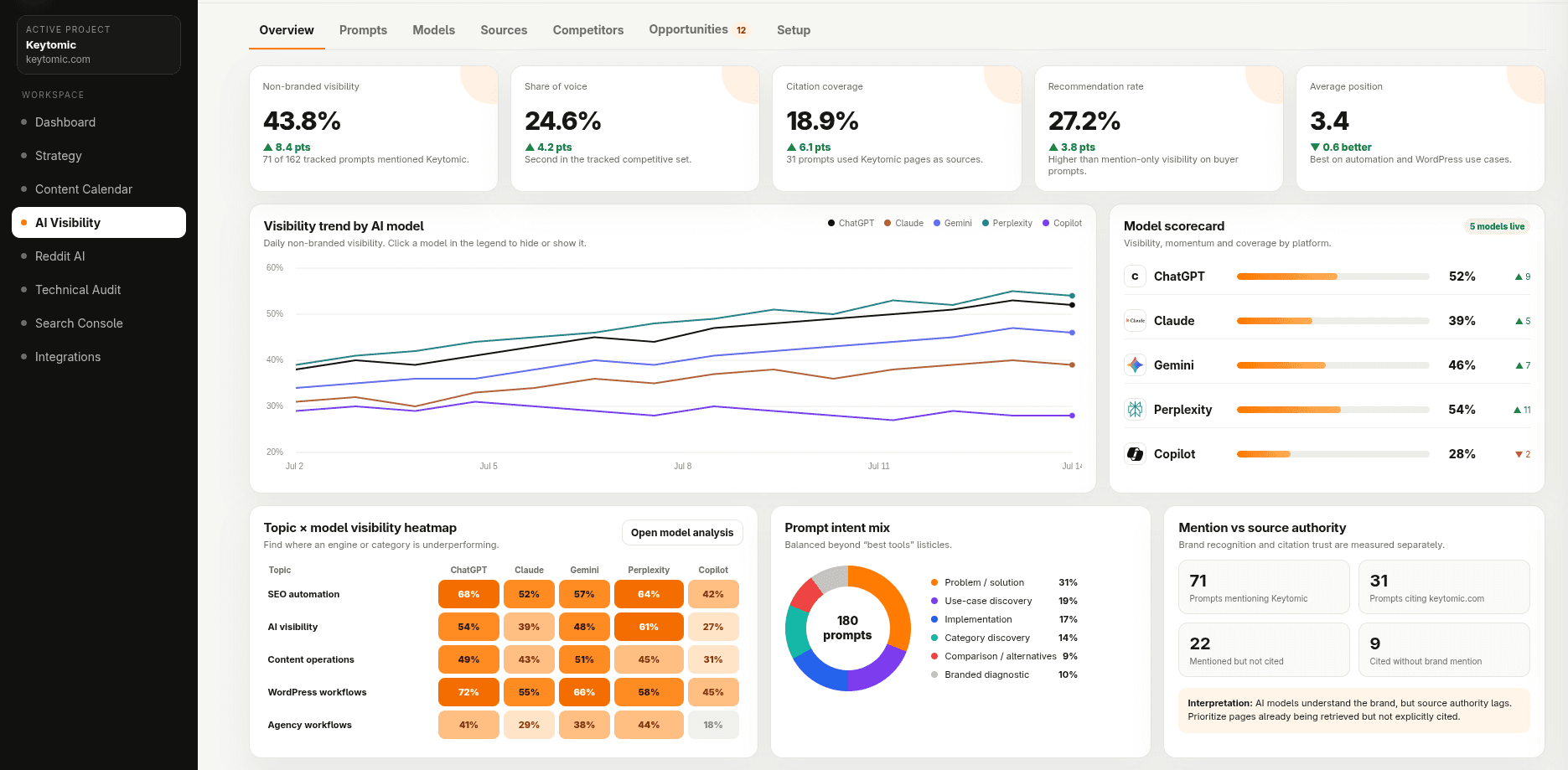
Why isn’t your brand showing up in ChatGPT, Perplexity, or Google AI results?
Brand invisibility is rarely caused by one issue.
Here is the diagnostic framework I use.
Symptom | Likely problem | First action |
|---|---|---|
No mentions on any platform | Weak category association or almost no external footprint | Audit your brand entity and third-party presence |
Brand appears only in branded prompts | Weak relevance for non-branded category questions | Build problem, category, and use-case associations |
Competitors appear but you do not | Competitors have stronger coverage, authority, reviews, or corroboration | Run a competitor source-gap analysis |
Your site is never cited | Crawl, indexing, content usefulness, or source-value issue | Check access, then compare your pages with cited pages |
Your brand is described incorrectly | Conflicting or outdated facts across sources | Correct owned content and high-impact external profiles |
One platform shows you but others do not | Different indexes, retrieval systems, or source preferences | Diagnose each platform separately |
Visibility changes wildly | Unstable prompt methodology or normal answer variance | Standardize prompts and repeat tests |
Your indexed pages never appear | Generic content or weak relevance | Improve information gain and query ownership |
The brand appears negatively | Reviews, complaints, or outdated information dominate | Resolve source-level reputation problems |
Your content is cited but the brand is not recommended | Useful information but weak commercial/category positioning | Strengthen product and use-case pages |
Third-party pages are cited instead of your site | External sources may answer the question more clearly or independently | Improve owned content while maintaining third-party corroboration |
Visibility is high but traffic is zero | Mentions may not contain links or occur on zero-click journeys | Track influence, branded demand, and assisted conversions |
This is why what’s causing my brand to lose visibility in AI-powered search platforms? is not answered by “add FAQ schema.”
The symptom matters.
The failure layer matters.
The next action should change accordingly.
Run a competitor citation and source-gap analysis
When competitors appear more often than you, do not immediately copy their blog.
That is lazy analysis.
The useful question is:
Why was that brand or source selected for this prompt?
Step 1: Choose your priority prompts
Start with prompts that have:
Commercial intent
Strong business relevance
Clear competitor visibility
A realistic connection to your product
A meaningful downstream action
Do not prioritize “What is SEO?” just because the potential audience is enormous.
A highly visible answer that never leads to product consideration may be strategically worthless.
Step 2: Record every mentioned competitor and cited source
Create a worksheet like this:
Prompt | Brands mentioned | URLs cited | Source types | Attributes mentioned |
|---|---|---|---|---|
Best AI SEO tools for agencies | Brand A, Brand B | Review page, product page | Editorial, owned | Multi-client, automation, reporting |
Alternatives to Brand A | Brand B, Brand C | Comparison articles | Editorial | Lower price, publishing |
How to monitor ChatGPT mentions | Brand C | Tool page, guide | Owned, editorial | Prompt tracking, citations |
Step 3: Classify the source
Useful categories include:
Competitor website
Review platform
Independent comparison
News or editorial publication
Industry organization
Academic source
Government source
Reddit or community discussion
YouTube
Partner website
Product marketplace
Customer review
Documentation
Original research
Step 4: Identify repeated source patterns
Look for:
Domains appearing across several prompts
Pages cited for several related questions
Competitor attributes mentioned repeatedly
Topics where your site has no strong page
Claims supported externally for competitors but not for you
Communities that repeatedly influence recommendations
Comparison pages that shape category perception
Review platforms appearing in commercial prompts
Step 5: Separate three different gaps
Content gap
You do not answer the question well enough.
Evidence gap
You make the claim but do not support it.
Corroboration gap
You make the claim on your own website, but credible external sources do not confirm it.
These require different fixes.
Publishing another article does not fix all three.
Copyable AI source-gap worksheet
AI SOURCE-GAP ANALYSIS

Prompt:
Buyer stage:
Business value:
AI platform:
Date tested:

Our brand mentioned:
Our domain cited:
Our description accurate:
Our sentiment:

Competitors mentioned:
1.
2.
3.

Sources cited:
1.
2.
3.
4.
5.

Repeated source domains:
Source types:
Competitor attributes emphasized:
Information our site already covers:
Information our site does not cover:
Claims lacking evidence:
Claims lacking third-party corroboration:
Technical accessibility issues:
Content action:
Authority or PR action:
Product-page action:
Priority:
Owner:
Review date:
AI SOURCE-GAP ANALYSIS

Prompt:
Buyer stage:
Business value:
AI platform:
Date tested:

Our brand mentioned:
Our domain cited:
Our description accurate:
Our sentiment:

Competitors mentioned:
1.
2.
3.

Sources cited:
1.
2.
3.
4.
5.

Repeated source domains:
Source types:
Competitor attributes emphasized:
Information our site already covers:
Information our site does not cover:
Claims lacking evidence:
Claims lacking third-party corroboration:
Technical accessibility issues:
Content action:
Authority or PR action:
Product-page action:
Priority:
Owner:
Review date:
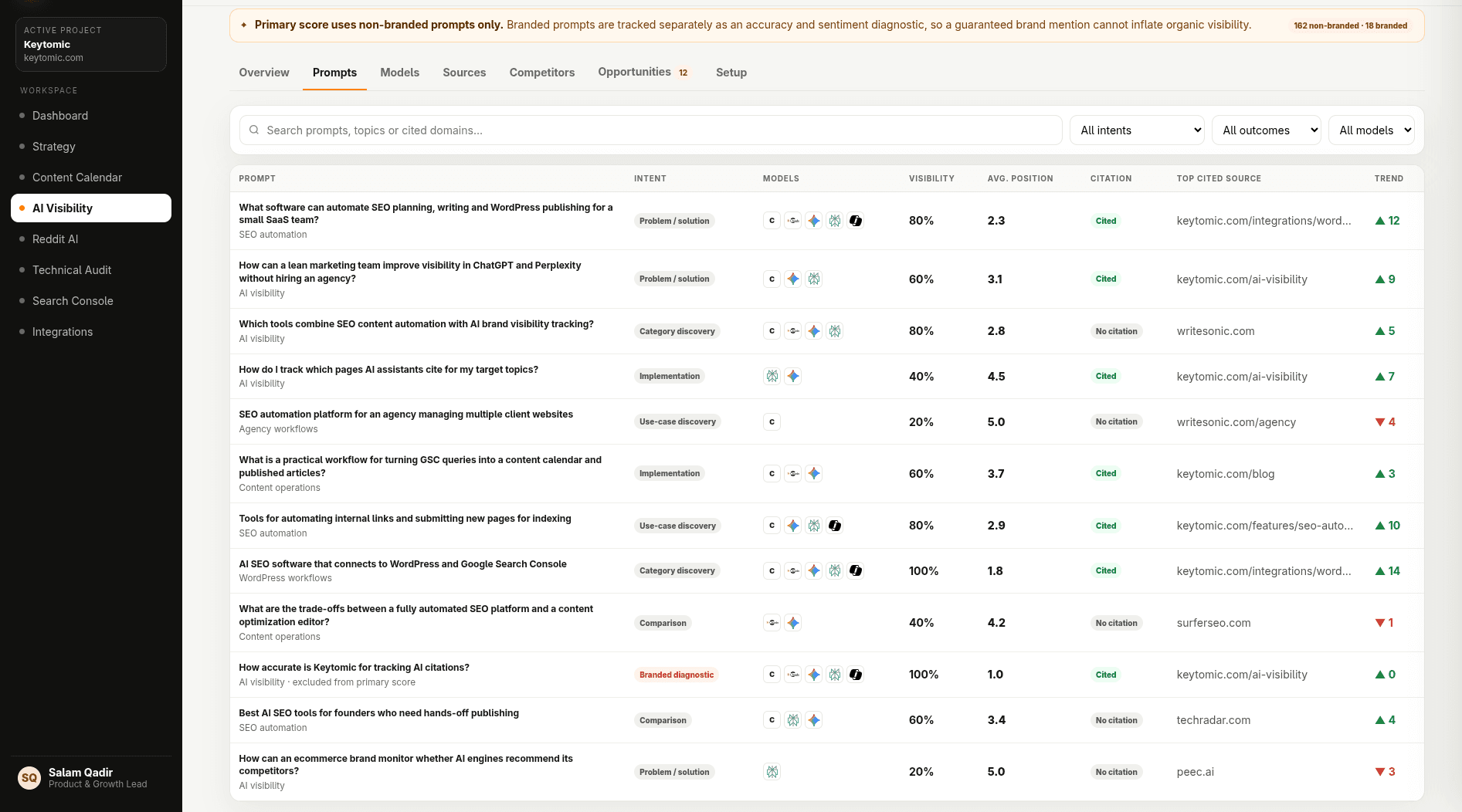
For broader tool-based analysis, see the best AI visibility tracking tools and AI visibility tools for global brands and agencies.
Strengthen your brand entity and category associations
A brand can be crawlable and still be misunderstood.
This is an identity problem.
Before creating more content, write down the factual version of your brand:
Official company name
Product name
Primary category
Secondary categories
Core use cases
Ideal customers
Industries served
Locations served
Main features
Pricing model
Integrations
Founders
Leadership
Authors and experts
Official social profiles
Important limitations
Approved product descriptions
Claims that require evidence
Claims that should never be made
Then compare that source of truth with:
Homepage
Product pages
About page
LinkedIn
Crunchbase
G2
Capterra
Product Hunt
Partner profiles
App marketplaces
Press releases
Author profiles
YouTube descriptions
Podcast bios
Schema markup
You do not need identical copy everywhere.
You need consistent facts.
Make the category obvious
Do not make users or machines reverse-engineer what you sell.
A homepage should make the following clear:
What is the product?
What problem does it solve?
Who is it for?
How is it different?
What can it actually do?
Which claims are supported?
What should a buyer do next?
“Transforming the future through intelligent digital experiences” tells me nothing.
Kill it.
Build internal entity connections
Use internal links to connect:
Organization → products
Products → features
Features → use cases
Use cases → industries
Authors → expertise
Research → methodology
Claims → evidence
Guides → tools
Comparisons → relevant product pages
This is where topical authority becomes practical rather than theoretical.
A topic cluster is not a folder full of keyword variations.
It is a network of pages that answers distinct parts of the same user problem.
Your author information also matters. A visible expert should have a consistent name, role, biography, social profile, and body of relevant work. Read Keytomic’s guide to E-E-A-T and why it matters for SEO for the broader trust framework.
Does structured data improve brand visibility in AI search?
Structured data improves brand visibility in AI search engines is an oversimplification.
Schema can help search engines understand explicitly marked information.
It does not force an AI system to cite you.
It does not create expertise.
It does not create customer reviews.
It does not turn a generic page into an authoritative source.
And it does not prove your marketing claims.
Google states that no special schema.org markup is required to appear in AI Overviews or AI Mode. It also says structured data should match the visible content on the page.
The useful schema types depend on the page:
Schema type | What it can clarify | What it cannot guarantee |
|---|---|---|
Organization | Brand identity and official properties | Brand recommendations |
Person | Author or leadership identity | Recognition as an expert |
Article | Author, dates, headline, and article metadata | Citation |
Product | Product facts and offers | Inclusion in product recommendations |
SoftwareApplication | Software category and product details | Category leadership |
LocalBusiness | Location and business information | Local recommendations |
BreadcrumbList | Site hierarchy | Better AI rankings |
FAQPage | Visible questions and answers where appropriate | Rich results or AI citations |
Review/AggregateRating | Legitimate review information when eligible | Trust without real reviews |
Schema is plumbing.
Important plumbing.
Still plumbing.
Use Keytomic’s FAQ Schema Generator and Article Schema Generator when the markup genuinely matches the page.
For a fuller explanation, read how schema markup affects AI visibility.
What about llms.txt?
Do not treat llms.txt as a universal ranking requirement.
Google explicitly says you do not need to create special AI text files or new machine-readable files to appear in its AI features.
Other systems and tools may experiment with it.
That is different from evidence that it improves rankings or citations.
Interesting idea.
Not a magic file.
Create content AI systems can confidently use and cite
“Write high-quality content” is useless advice unless we define quality.
For AI visibility, a strong source should make it easier to answer the question accurately.
Answer the question early
Do not begin every article with:
In today’s rapidly changing digital landscape…
Delete it.
When a reader asks a direct question, give them the direct answer.
Then explain it.
This article did that.
Publish non-commodity information
Google’s updated generative AI search guidance emphasizes unique, useful, expert-led content and warns publishers not to recycle information that could easily be generated from existing pages. It also warns against creating separate pages for every possible fan-out or long-tail query primarily to manipulate visibility.
That is the right direction.
Useful non-commodity content can include:
Original research
First-party product data
Transparent experiments
Screenshots
Practitioner analysis
Decision frameworks
Calculators
Templates
Comparison methodologies
Customer questions
Industry benchmarks
Failure analyses
Technical documentation
Real examples
Clear limitations
Informed professional opinions
The internet does not need another article saying:
Create helpful content and build authority.
It needs the worksheet, method, evidence, example, and decision rule.
Make claims verifiable
For every important statistic or result, disclose:
Original source
Publication date
Sample size
Methodology
Market or geography
Limitations
Whether the conclusion is observed or inferred
Do not cite a roundup that cites another roundup that cites a deleted LinkedIn post.
Go to the source.
If you cannot verify a statistic, remove it.
Use structure because it helps readers
Good structure also makes information easier to retrieve and reuse.
Use:
Clear headings
Direct opening answers
Definitions
Tables
Ordered steps
Comparisons
Checklists
Examples
Source links
Meaningful image captions
But do not turn your article into 70 disconnected fragments because someone told you AI only reads 150-word chunks.
There is no universal ideal section length.
That is another myth.
Build content around the buyer journey
AI systems answer questions throughout discovery and evaluation.
Your content should cover:
Problem awareness
Category education
Solution evaluation
Product use cases
Comparisons
Alternatives
Objections
Pricing
Implementation
Troubleshooting
Measurement
Decision support
A company with only informational blog posts may earn citations but still fail to become a recommendation.
A company with only product pages may be clearly commercial but offer very little source-worthy education.
You need both.
For the broader methodology, read Keytomic’s complete GEO guide and five GEO tactics for earning more LLM citations.
Build supporting content around fan-out queries without creating SEO landfill
Google has now publicly explained query fan-out.
This does not mean you should create one page for every query an AI system might issue.
That would be a terrible interpretation.
Suppose someone asks:
How can I increase my brand visibility in AI search engines?
Related retrieval paths might include:
AI features and your website
How Google AI Overviews select supporting pages
How OAI-SearchBot works
What is the difference between GPTBot and OAI-SearchBot?
How to configure PerplexityBot
How to use structured data
How to submit an XML sitemap
How to monitor citations in Bing Webmaster Tools
How to measure brand visibility in ChatGPT
How to build topical authority
How to earn third-party mentions
How to improve brand sentiment in AI answers
Some of these belong inside one comprehensive guide.
Others deserve dedicated pages.
The decision depends on search intent and information depth.
Keep the topic inside the pillar when:
The answer is necessary to complete the primary task.
The section can be answered adequately in a few paragraphs.
Creating a new page would duplicate most of the pillar.
The reader would otherwise need to jump between pages constantly.
Create a supporting page when:
The query has a distinct task.
The subject requires a complete tutorial.
The reader needs separate tools, steps, screenshots, or examples.
The page can satisfy a different search intent without competing with the pillar.
Do not create separate pages for:
Improve AI visibility
Increase AI visibility
Boost AI visibility
Enhance AI visibility
Grow AI visibility
Those are wording variants.
Not separate topics.
The Keytomic cluster already contains distinct resources for:
Each page should own a different job.
Earn credible mentions beyond your own website
Your website can establish facts about your company.
The wider web helps establish whether other people believe them.
Useful external sources may include:
Industry publications
Independent comparisons
Customer reviews
Partner pages
Software marketplaces
Integration directories
Relevant podcasts
YouTube channels
Professional associations
Expert interviews
Original research citations
Community discussions
Reddit threads
Customer case studies
Event speaker profiles
Public documentation
The word “relevant” is doing a lot of work here.
A mention on a random high-DR website is not automatically useful.
I would prioritize sources that already appear around the prompts your buyers use.
A simple external-source prioritization model
Score each opportunity from one to five:
Factor | Question |
|---|---|
Prompt relevance | Does this source appear for buyer-relevant questions? |
Audience overlap | Do our potential customers use or trust it? |
Editorial credibility | Is the source independent and transparent? |
Category influence | Does it shape how products in our market are described? |
Longevity | Will the page remain accessible and maintained? |
Feasibility | Can we genuinely earn inclusion? |
Evidence fit | Do we have something valuable to contribute? |
Do not chase every mention.
Chase meaningful corroboration.
Avoid manufactured authority
Do not:
Buy fake reviews.
Create fake Reddit conversations.
Pay for undisclosed editorial recommendations.
Use fabricated authors.
Invent statistics.
Mass-produce guest posts.
Submit to hundreds of irrelevant directories.
Create fake comparison websites.
Present sponsored coverage as independent proof.
That is not GEO.
It is reputation debt.
Improve brand sentiment and recommendation readiness
Being visible is not enough if the answer says:
Your product is outdated.
Your pricing is wrong.
You lack a feature that launched six months ago.
Your support is poor.
Your product is suitable for the wrong audience.
You are no longer operating.
This is why how to improve brand sentiment in AI answer engines is partly a reputation-management question.
Audit how AI systems describe you
For each tracked prompt, record whether the answer gets these facts right:
Product category
Core audience
Features
Integrations
Pricing
Availability
Location
Leadership
Strengths
Limitations
Competitors
Best use cases
Security or compliance details
Fix the source, not just the generated answer
You usually cannot directly edit an AI-generated answer.
Instead:
Correct inaccurate information on your website.
Update old product pages.
Correct outdated directory listings.
Improve your documentation.
Respond professionally to legitimate reviews.
Contact publishers when verifiable facts are wrong.
Strengthen accurate third-party information.
Remove contradictions between your own pages.
Republish genuinely updated information.
Retest after the source changes are discoverable.
Make the brand easier to recommend responsibly
A recommendation system needs enough information to determine fit.
Publish clear information about:
Who the product is for
Who it is not for
Pricing
Features
Limitations
Integrations
Setup requirements
Support
Security
Alternatives
Use cases
Customer evidence
Saying who you are not for can improve trust.
Not every visitor is your customer.
That is fine.
How optimization differs across Google AI, ChatGPT, Perplexity, Gemini, and Copilot
You should build one strong information ecosystem.
But you should not assume every platform uses it identically.
Platform | Main accessibility consideration | Common visibility outcome | Practical measurement |
|---|---|---|---|
Google AI Overviews and AI Mode | Google indexing and snippet eligibility | Supporting links, summaries, source inclusion | Search Console Web performance and manual checks |
ChatGPT Search | OAI-SearchBot and retrievable public content | Mentions, linked sources, recommendations | Prompt tracking and |
Perplexity | PerplexityBot, live retrieval, and WAF access | Highly visible citations and source lists | Prompt, citation, and referral tracking |
Gemini | Google’s ecosystem and available retrieval sources | Answers, summaries, source links | Prompt testing and Google reporting where available |
Microsoft Copilot and Bing | Bing indexing, sitemaps, and IndexNow | Citations across Microsoft AI experiences | Bing Webmaster Tools AI Performance |
Google AI Overviews and AI Mode
Focus on:
Search eligibility
Indexing
Search intent
Helpful original content
Internal links
Clear page structure
Textual accessibility
Accurate structured data
Relevant images and video
Strong traditional SEO foundations
Google says its AI features use the same foundational SEO requirements as Search, without a separate AI schema or submission system.
ChatGPT Search
Focus on:
OAI-SearchBot access
Clear product and organization facts
Useful answer pages
Third-party corroboration
Citation-worthy educational resources
Accurate brand descriptions
Referral tracking
Category and use-case associations
Perplexity
Focus on:
PerplexityBot access
WAF validation
Factual, source-rich pages
Current information
Clear page-level answers
Research and educational content
Citation monitoring
Microsoft Copilot and Bing
Focus on:
Bing indexing
Bing Webmaster Tools
Current sitemaps
IndexNow
Clear content
Evidence-backed claims
Bing AI Performance data
The platform strategy should follow your buyers.
Do not optimize equally for eight platforms because a tool dashboard contains eight logos.
How to track whether your AI visibility is improving
You have three practical options.
1. Manual tracking
Best for:
Small prompt sets
Early-stage programs
Quality control
Understanding answer context
Validating automated tools
Use a spreadsheet and run the same prompts weekly or biweekly.
Manual tracking is slow.
It is also extremely educational.
2. Custom automation
You can use:
APIs
Scheduled workflows
n8n
Make
Custom scripts
Data warehouses
LLM classification
Screenshot storage
Brand-entity detection
This gives you control but requires engineering, maintenance, cost monitoring, and quality checks.
3. AI visibility platforms
A useful AI visibility platform should show:
Prompts
Raw answers
Brand mentions
Citations
Citation URLs
Competitor mentions
Share of voice
Sentiment
Platform differences
Historical trends
Geography
Language
Actionable gaps
Be suspicious of a tool that gives you a score but hides the prompts and answers behind it.
You cannot audit a black box with another black box.
For a comparison of current options, read:
Where Keytomic fits
Keytomic connects AI visibility monitoring with the execution layer.
That means teams can use one workflow to:
Analyze a brand and its category
Generate relevant prompts
Identify competitors appearing in AI answers
Track brand mentions across supported AI platforms
Find content and topical gaps
Create an SEO and AI-search content roadmap
Produce and review content
Publish through supported CMS integrations
Monitor Google Search Console performance
Recheck brand visibility over time
Monitoring alone does not improve visibility.
Execution does.
That is the gap Keytomic is designed to close.
Prioritize the AI visibility opportunities that can affect the business
Not every missing mention deserves investment.
I would score opportunities using:
Business relevance
Buyer intent
Current visibility gap
Competitor visibility
Citation gap
Content gap
Authority gap
Ability to provide original value
Implementation effort
Conversion potential
Example opportunity matrix
Opportunity | Business value | Visibility gap | Effort | Priority |
|---|---|---|---|---|
Best category tools for target customer | High | High | Medium | 1 |
Competitor alternatives | High | Medium | Medium | 2 |
High-intent use-case recommendations | High | High | High | 3 |
General category definitions | Low | Medium | Low | 5 |
Branded “What is our company?” prompts | Diagnostic only | Low | Low | Monitor |
Unrelated high-volume topics | Low | High | High | Ignore |
A simple scoring formula could be:
Priority score =
(Business relevance × 3)
+ (Buyer intent × 3)
+ (Competitor visibility × 2)
+ (Current gap × 2)
+ (Original information potential × 2)
- (Effort × 1)
Priority score =
(Business relevance × 3)
+ (Buyer intent × 3)
+ (Competitor visibility × 2)
+ (Current gap × 2)
+ (Original information potential × 2)
- (Effort × 1)
The weighting is not sacred.
The discipline is.
A practical 30-day plan for improving AI brand visibility
Week 1: Measure and diagnose
Define your category and competitors.
Build 20–50 non-branded prompts.
Test ChatGPT, Perplexity, Gemini, Google, and Copilot where relevant.
Record mentions, citations, sources, competitors, and sentiment.
Check Googlebot, Bingbot, OAI-SearchBot, and PerplexityBot access.
Identify the five highest-value gaps.
Week 2: Fix accessibility and entity problems
Correct indexing problems.
Fix canonicals.
Update sitemaps.
Review CDN and WAF rules.
Correct outdated product facts.
Improve organization, product, person, and article schema.
Standardize category and feature descriptions.
Strengthen author profiles.
Improve internal links.
Week 3: Improve the information itself
Rewrite weak introductions.
Add direct answers.
Remove unsupported statistics.
Replace secondary citations with primary sources.
Add original examples.
Add decision frameworks.
Add screenshots.
Improve product and use-case pages.
Create missing supporting content.
Consolidate overlapping pages.
Week 4: Strengthen external corroboration and retest
Update relevant third-party profiles.
Earn legitimate reviews.
Pitch original research or expert contributions.
Improve partner and integration listings.
Correct inaccurate editorial information.
Retest the same prompt set.
Compare source changes.
Record early movement.
Do not overreact to one answer.
For a sprint-by-sprint implementation workflow, use Keytomic’s 30-day AI search optimization roadmap.
How long does it take to improve AI-generated brand mentions?
There is no universal timeline.
Anyone promising that your citations will increase in exactly 30 or 45 days is guessing.
The timeline depends on:
Whether your pages are already indexed
Crawl frequency
Search-engine discovery
Platform retrieval behavior
Query competitiveness
Existing authority
Content quality
Third-party publication speed
Review acquisition
How substantial the changes are
How often you retest
Use these as evaluation windows, not guarantees:
First 30 days
Look for:
Technical fixes
Corrected entity information
Improved crawler access
New indexing
Early changes in retrieved sources
Better representation accuracy
Days 30–60
Look for:
Broader prompt coverage
New citations
Improved source diversity
Initial third-party mentions
Better visibility for lower-competition prompts
Days 60–90 and beyond
Evaluate:
Competitive share of voice
Recommendation visibility
Stable citation trends
Brand sentiment
Referral traffic
Assisted conversions
Growth in branded searches
Stronger category associations
Some changes can be discovered quickly.
Authority usually takes longer.
Common AI visibility mistakes
1. Testing only branded prompts
You are measuring recognition, not discovery.
2. Treating every mention as a citation
They are different outcomes.
3. Publishing before diagnosing
More content can create more overlap and confusion.
4. Blocking crawlers through a WAF
Your robots.txt may look perfect while Cloudflare blocks the request.
5. Confusing GPTBot with OAI-SearchBot
GPTBot is not the OpenAI search crawler.
6. Treating schema as a citation button
It is not.
7. Creating one page per fan-out variation
That creates thin, competing pages.
8. Copying the current top-ranking articles
A cleaner summary of existing information is still existing information.
9. Ignoring third-party sources
Your website cannot independently verify its own superiority.
10. Measuring one response
AI answers vary.
11. Tracking every platform equally
Prioritize where your audience actually searches.
12. Ignoring inaccurate representation
A mention with incorrect information can hurt more than silence.
13. Tracking visibility without business outcomes
Citations are not revenue.
14. Automatically accepting tool recommendations
Inspect the prompts and raw answers.
15. Changing the “last updated” date without changing the article
Freshness theatre is still theatre.
Frequently asked questions about AI brand visibility
How can I check my brand visibility in ChatGPT?
Create a set of non-branded buyer questions and run them in ChatGPT with web search active. Record whether your brand is mentioned, recommended, or cited, which competitors appear, and which URLs are used as sources.
Repeat the same prompts over time.
You can also use an AI visibility tracker to automate a larger portion of this process.
Why is my brand not showing up in ChatGPT?
Your brand may be absent because OAI-SearchBot cannot access your site, your brand has weak category associations, your pages do not answer relevant prompts, competitors have stronger third-party corroboration, or your company has a limited public footprint.
Do not assume it is purely a content-formatting problem.
How do I optimize my content for ChatGPT brand visibility?
Make your important pages accessible to OAI-SearchBot, answer buyer questions directly, clarify brand and product entities, support claims with evidence, publish original information, and build relevant third-party mentions.
Read the complete guide to improving brand visibility in ChatGPT.
How do I make my website more AI-citable?
Create pages that provide clear, complete, specific, and verifiable answers. Include original evidence where possible, link to primary sources, use descriptive headings, keep information current, and remove unsupported claims.
Then make sure the page is crawlable and internally discoverable.
Does ranking first on Google guarantee AI citations?
No.
Strong organic visibility can improve discovery opportunities, but AI systems may retrieve and synthesize information from several pages and source pools.
Traditional SEO remains important.
It is not a citation guarantee.
Does structured data improve AI visibility?
Structured data can clarify explicit page and entity information, but it does not guarantee that an AI system will cite, mention, or recommend your brand.
It should support accurate visible content.
Not replace it.
What is the difference between GPTBot and OAI-SearchBot?
OAI-SearchBot is used to surface websites in ChatGPT’s search features. GPTBot crawls content that may be used to improve OpenAI’s foundation models.
The two controls are independent.
How do I get mentioned more often than competitors in AI search?
Identify the prompts where competitors appear, inspect the cited sources, determine whether you have a content, evidence, entity, or corroboration gap, and address the specific missing layer.
Do not blindly copy the competitor’s article.
Can Reddit and community mentions improve AI discoverability?
Authentic community discussions can contribute useful third-party information and influence how products are understood across the web.
Fake conversations and manufactured recommendations are not a sustainable strategy.
Participate where you can genuinely help.
Which metrics should I track?
Track:
Mention rate
Citation rate
Recommendation rate
Share of voice
Sentiment
Source diversity
Prompt coverage
Platform coverage
Referral traffic
Assisted conversions
How frequently should I measure AI visibility?
Weekly or biweekly testing is sufficient for many stable prompt sets.
Run additional checks after major product launches, content updates, technical fixes, pricing changes, or important third-party coverage.
Consistency is more important than daily noise.
AI brand visibility is a system, not a formatting trick
My view is simple.
AI visibility is not won through one schema type, one crawler rule, one content template, or one dashboard score.
Your brand becomes more visible when it is:
Easy to discover
Easy to understand
Relevant to real questions
Useful enough to cite
Credible enough to recommend
Consistent across sources
Measured with a repeatable method
Start by diagnosing the failure.
Then fix the right layer.
Not the fashionable one.
You can use Keytomic’s free AI visibility tracker to see where your brand appears, which competitors are being mentioned instead, and which visibility gaps deserve attention first.
No tool can guarantee that an AI platform will cite you immediately.
But you can stop guessing.
And that is a much better place to start.
TL;DR
Here is the entire strategy on how to increase brand visibility in AI search engines in seven steps:
Make sure Google, Bing, OpenAI, and Perplexity can access your important pages.
Build a stable set of non-branded prompts based on real buyer questions.
Measure your mentions, citations, recommendations, competitors, sources, and sentiment.
Clarify what your brand is, who it serves, and which category it belongs to.
Publish information that is original, useful, verifiable, and worth citing.
Earn relevant third-party mentions that corroborate your claims.
Repeat the same measurements after making changes.
For the last six months, I’ve studied a lot of AI visibility reports, crawler documentation, LinkedIn newsletters, platform announcements, and SEO nerd's rticles about getting brands into ChatGPT, Perplexity, Gemini, Copilot, and Google’s AI results.
Most of the internet is filled with fluff.
The same advice is recycled everywhere:
Add schema.
Write longer articles.
Use more statistics.
Add an FAQ.
Get backlinks.
Wait 30 days.
Some of that advice is useful. Most of it is incomplete. Some of it is simply made up.
So this will be a no-bullshit guide.
To improve brand visibility in AI search engines, your brand must be easy to discover, clearly understood, relevant to the questions buyers ask, supported by credible information, and corroborated by sources outside your own website.
Then you need to measure whether any of it is working.
That last part matters. A lot.
I would not start by publishing another 20 articles or rewriting every page into two-sentence “AI-friendly chunks.” I would first determine which part of your visibility system is broken.
This guide will help you do exactly that.
It also answers the fan-out questions that tend to sit behind the broader topic:
How do I measure brand visibility in ChatGPT?
How do I check brand visibility in ChatGPT and Perplexity?
How do I optimize my content for ChatGPT brand visibility?
Why isn’t my brand showing up in ChatGPT or Perplexity?
How do I make my site more AI-citable?
How do I get mentioned more often than competitors in AI search?
What tools can help optimize brand presence in AI search engines like ChatGPT, Perplexity, and Google AI Overviews?
How do I improve brand sentiment in AI answer engines?
Let’s get into it.
What does brand visibility mean in AI search?
Brand visibility in AI search is the extent to which your company, products, pages, experts, and ideas appear in AI-generated answers for relevant user questions.
That definition is broader than citations.
A brand can be visible without being cited. It can be cited without being recommended. It can be recommended but described inaccurately.
I separate AI visibility into eight components:
Visibility type | What it measures | Example |
|---|---|---|
Brand mention | Whether the brand appears by name | “Keytomic is an AI SEO platform.” |
Citation | Whether a page is linked or referenced | A Keytomic guide appears in the sources panel |
Recommendation | Whether the brand enters consideration | Included in a list of suggested platforms |
Category association | Whether the brand is connected to the intended market | Associated with AI SEO automation |
Representation accuracy | Whether facts about the brand are correct | Correct features, positioning, and pricing |
Sentiment | How the brand is described | Positive, neutral, mixed, or negative |
Share of voice | How often you appear relative to competitors | Your mentions compared with competing tools |
Referral and assisted influence | Whether visibility affects visits or conversions | Traffic or signups influenced by AI discovery |
I do not combine these blindly.
A mention is not automatically a citation.
A citation is not automatically a recommendation.
And a recommendation is not automatically a conversion.
That distinction may sound obvious, but many AI visibility tools hide all of these outcomes inside a single score. The number looks impressive. It often tells you very little.
For a deeper explanation of the monitoring layer, read how an AI search monitoring platform improves SEO strategy.
How AI search engines find, understand, and select brands
There is no universal AI ranking algorithm.
ChatGPT Search, Google AI Overviews, AI Mode, Perplexity, Gemini, and Microsoft Copilot do not retrieve and generate answers in exactly the same way.
They also change frequently.
Anyone giving you a precise universal list of “AI ranking factors” is overselling what they know.
Still, the practical visibility process can be understood through five layers.
1. Discovery
The platform first needs access to information about your brand.
That information may be discovered through:
Search engine indexes
Direct web crawling
XML sitemaps
Internal links
External links
Product feeds
Business profiles
Review platforms
News and industry publications
Community discussions
Public documentation
Previously acquired model knowledge
The exact source depends on the platform and the query.
2. Retrieval
For search-enabled answers, the platform may issue searches or retrieve pages related to the user’s question.
Google officially says AI Overviews and AI Mode may use query fan-out, where the system issues multiple related searches across subtopics and data sources before generating an answer.
A user may ask:
What is the best AI SEO tool for a small agency?
But the system may separately investigate:
AI SEO tools for agencies
Multi-client SEO platforms
AI visibility trackers
Automated content tools
Agency pricing
Customer reviews
Product comparisons
CMS integrations
Competitor alternatives
This is why ranking for one exact keyword is no longer the whole job.
The answer may be assembled from several smaller retrieval paths.
3. Entity understanding
The platform needs to understand the relationships between:
Your organization
Your products
Your founders and employees
Your authors
Your category
Your features
Your audience
Your use cases
Your location
Your competitors
Your claims
If your homepage calls the product an “AI content writer,” your LinkedIn describes it as an “SEO automation platform,” review websites list it as a “blog generator,” and your product schema says something else, you create unnecessary ambiguity.
Machines are not the only ones who get confused.
Customers do too.
4. Corroboration
Your website is the primary source for facts about your own product.
It is not an independent source for whether your product is the best.
That difference matters.
If you claim your platform is the leading solution in a category, an AI system may look for evidence outside your domain:
Reviews
Editorial comparisons
Customer discussions
Industry coverage
Partner pages
Marketplace listings
Expert commentary
Public case studies
Research
Community recommendations
You cannot manufacture credible corroboration on your own blog.
5. Selection
A retrievable page still needs to be useful for the specific answer.
The source is more usable when it provides:
Direct relevance to the question
A clear subject
Accessible text
Specific facts
Verifiable evidence
Appropriate freshness
Original information
Clear limitations
A useful comparison
A complete answer
Consistency with other reliable sources
This is where content quality matters.
But not in the vague “write good content” sense.
We will make it more practical below.
First, make sure AI search engines can access your website
Before rewriting content, I would verify that your important pages can actually be crawled, indexed, rendered, and retrieved.
You would be surprised how many “content problems” are technical problems wearing a content costume.
Check your visibility in Google AI features
Google’s official guidance on AI features and your website is refreshingly simple.
There is no secret AI Overview submission process.
To be eligible as a supporting link in Google AI Overviews or AI Mode, a page must be indexed and eligible to appear in Google Search with a snippet. Google says there are no additional technical requirements for these AI features.
Check:
Does the page return HTTP 200?
Is crawling allowed in robots.txt?
Is your CDN or hosting layer blocking Googlebot?
Does the page have a
noindexdirective?Is the canonical correct?
Is the important content available in rendered HTML?
Is the page internally linked?
Is the content eligible to appear with a snippet?
Does the XML sitemap contain the correct canonical URL?
Can Google render the page properly in URL Inspection?
Use Keytomic’s Google Page Crawl Analyzer for a quick accessibility check, and use the Canonical URL Checker to catch obvious canonical problems.
If a page is indexed but receives no meaningful rankings, citations, or impressions, repeatedly submitting it for indexing is unlikely to fix the underlying problem. Read why content gets indexed by Google but never actually ranks before blaming crawl speed.
Understand GPTBot versus OAI-SearchBot
GPTBot is the crawler that gets your pages into ChatGPT Search.
That is a myth.
Stop taking it seriously.
OpenAI documents separate user agents for separate purposes:
OpenAI user agent | Main purpose | What site owners should know |
|---|---|---|
OAI-SearchBot | Surfacing websites in ChatGPT search | Allow this when you want eligible content to appear in ChatGPT search |
GPTBot | Crawling content that may be used to improve foundation models | Can be allowed or blocked independently |
ChatGPT-User | User-triggered page visits | Not the crawler used to determine automatic ChatGPT Search inclusion |
OpenAI explicitly says the settings for OAI-SearchBot and GPTBot are independent. A publisher can allow OAI-SearchBot for search visibility while blocking GPTBot for potential training use.
A basic configuration may look like this:
User-agent: OAI-SearchBot
Allow: /

User-agent: GPTBot
Disallow:
This tells OpenAI that your public pages may be surfaced through ChatGPT Search while expressing that you do not want GPTBot to crawl them for model-training purposes.
Adjust this to your own policy.
Do not copy robots.txt rules without understanding them.
OpenAI also recommends allowing requests from its published OAI-SearchBot IP ranges. A firewall can block the crawler before robots.txt ever becomes relevant.
Check:
robots.txt
Cloudflare or another CDN
Web application firewall rules
Bot-management settings
Server logs
IP allowlists
Response codes served to the bot
Whether important assets and HTML are accessible
OpenAI states that public websites can appear in ChatGPT Search when their content is accessible. It also adds utm_source=chatgpt.com to referral links, which gives publishers a practical way to identify at least some ChatGPT-originated traffic.
For a deeper breakdown, read:
Check PerplexityBot and your WAF
Perplexity documents two relevant user agents:
PerplexityBotfor discovering and surfacing websites in Perplexity searchPerplexity-Userfor user-triggered page access
Perplexity recommends allowing PerplexityBot and requests from its published IP ranges when you want your site to appear in its search results. It also warns that WAF configurations may require explicit allowlisting.
This matters because a site can appear open in a browser and still block a crawler through:
Bot Fight Mode
Managed firewall rules
Rate limiting
IP reputation filters
JavaScript challenges
Country restrictions
User-agent restrictions
Do not stop after reading robots.txt.
Check the logs.
Check Bing and Microsoft Copilot visibility
Bing still matters.
Especially for Microsoft Copilot and other experiences built on Microsoft’s search and retrieval infrastructure.
Submit your sitemap in Bing Webmaster Tools and review:
URL Inspection
Crawl errors
Indexed pages
Sitemaps
Backlinks
Search performance
IndexNow implementation
AI Performance data
Bing introduced an AI Performance dashboard that reports:
Total citations
Average cited pages
Sample grounding queries
Page-level citation activity
Visibility trends
The report measures citation activity across supported Microsoft AI experiences. It does not claim to show a universal AI authority score or your position in every generated answer.
That is an important limitation.
Microsoft also connects content freshness with IndexNow, which lets participating search engines know when a page has been added, updated, or removed.
Use it as a discovery signal.
Not magic.
Technical AI visibility checklist
Copy this checklist into your project manager:
AI SEARCH ACCESSIBILITY CHECKLIST

[ ] The priority page returns HTTP 200
[ ] The canonical points to the intended indexable URL
[ ] No noindex directive is present
[ ] Googlebot can crawl the page
[ ] Bingbot can crawl the page
[ ] OAI-SearchBot is allowed where desired
[ ] PerplexityBot is allowed where desired
[ ] CDN and WAF rules do not silently block legitimate bots
[ ] Main content appears in rendered HTML
[ ] Important facts are available as text, not only images
[ ] The URL is included in a valid XML sitemap
[ ] Internal links point to the page
[ ] Duplicate URLs are consolidated
[ ] Structured data matches visible content
[ ] Server logs are checked for failed crawler requests
[ ] The mobile version contains the complete answer
Keytomic also provides a robots.txt generator and sitemap URL extractor if you need to audit these elements quickly.
Measure your current AI brand visibility before changing anything
I treat AI visibility as a measurement problem before treating it as a publishing problem.
Without a baseline, you cannot tell whether a change improved visibility or whether the answers simply varied between runs.
AI-generated answers are not perfectly deterministic. The same prompt can produce different sources, competitors, and recommendations at different times.
A 2026 research paper examining repeated tests across generative search platforms found meaningful variability in citation distributions and warned that single-run measurements can create false precision.
In plain English:
One prompt is not data.
Build a prompt universe from real buyer intent
Do not test only branded questions.
Asking ChatGPT:
Is Keytomic a good AI SEO platform?
is not a serious measure of non-branded visibility. You put the brand inside the prompt.
Your prompt universe should include several types of buyer questions:
Prompt type | Example | What it measures |
|---|---|---|
Category discovery | Best AI SEO tools for a small agency | Recommendation visibility |
Problem solving | How can I increase organic traffic without hiring more writers? | Problem association |
Use case | Best SEO platform for managing five client websites | Use-case relevance |
Comparison | AI SEO automation versus a content optimization tool | Category positioning |
Alternatives | Alternatives to [competitor] for automated publishing | Competitive consideration |
Buyer criteria | What should I look for in an AI visibility platform? | Feature association |
Informational | How do AI search engines choose sources? | Citation potential |
Objection | Are AI-generated SEO articles safe to publish? | Trust and objection handling |
Location or industry | Best SEO software for a US SaaS company | Segment relevance |
Brand verification | What does [brand] do? | Representation accuracy |
Start with 20–50 prompts.
More is not automatically better.
A clean prompt set you can repeat is more valuable than 2,000 random queries you never inspect.
Use this prompt to generate a buyer-intent prompt universe
Copy and edit this:
Act as an AI search visibility researcher.

Analyze the following company:

Brand:
Website:
Product category:
Primary products or services:
Ideal customers:
Industries:
Locations:
Main competitors:
Key features:
Primary customer problems:
Important buying objections:

Create 50 non-branded prompts that a potential customer could ask ChatGPT, Perplexity, Gemini, Google AI Mode, or Microsoft Copilot.

Organize the prompts into these groups:

1. Category discovery
2. Problem-solving
3. Product or service comparison
4. Use-case recommendations
5. Industry-specific recommendations
6. Location-specific recommendations
7. Feature and capability research
8. Competitor alternatives
9. Purchase objections
10. Educational questions that could cite the company’s expertise

Rules:

- Do not include the brand name in non-branded prompts.
- Do not produce minor wording variations of the same question.
- Use natural conversational language.
- Prioritize questions with commercial or strategic relevance.
- Include both broad prompts and highly specific follow-up questions.
- State the likely buyer stage and desired answer type for every prompt
Standardize the test
For each prompt, record:
Exact prompt
Platform
Model or search experience
Date
Country
Language
Logged-in or logged-out state
Whether web search was active
Brand mentioned: yes or no
Brand cited: yes or no
Brand recommended: yes or no
Mention position
Competitors mentioned
Sources cited
Description accuracy
Sentiment
Screenshot or stored response
Do not change the prompt every week and pretend you are tracking a trend.
Calculate useful AI visibility metrics
Mention rate
Prompts containing your brand ÷ total prompts tested × 100
Citation rate
Prompts citing your domain ÷ total prompts tested × 100
Recommendation rate
Prompts recommending your brand ÷ eligible recommendation prompts × 100
AI share of voice
Your brand mentions ÷ mentions of all tracked brands × 100
Source ownership rate
Citations to your owned domain ÷ all citations associated with your brand × 100
Positive representation rate
Positive or accurate brand descriptions ÷ total brand mentions × 100
Prompt coverage
Prompt clusters containing at least one brand mention ÷ all tracked prompt clusters × 100
Do not hide the inputs.
A score should make a decision easier. If it only gives your manager another line chart to look at, it has failed.
You can run an initial check using Keytomic’s free AI visibility tracker, then compare the automated findings with a smaller manually verified sample.
Why isn’t your brand showing up in ChatGPT, Perplexity, or Google AI results?
Brand invisibility is rarely caused by one issue.
Here is the diagnostic framework I use.
Symptom | Likely problem | First action |
|---|---|---|
No mentions on any platform | Weak category association or almost no external footprint | Audit your brand entity and third-party presence |
Brand appears only in branded prompts | Weak relevance for non-branded category questions | Build problem, category, and use-case associations |
Competitors appear but you do not | Competitors have stronger coverage, authority, reviews, or corroboration | Run a competitor source-gap analysis |
Your site is never cited | Crawl, indexing, content usefulness, or source-value issue | Check access, then compare your pages with cited pages |
Your brand is described incorrectly | Conflicting or outdated facts across sources | Correct owned content and high-impact external profiles |
One platform shows you but others do not | Different indexes, retrieval systems, or source preferences | Diagnose each platform separately |
Visibility changes wildly | Unstable prompt methodology or normal answer variance | Standardize prompts and repeat tests |
Your indexed pages never appear | Generic content or weak relevance | Improve information gain and query ownership |
The brand appears negatively | Reviews, complaints, or outdated information dominate | Resolve source-level reputation problems |
Your content is cited but the brand is not recommended | Useful information but weak commercial/category positioning | Strengthen product and use-case pages |
Third-party pages are cited instead of your site | External sources may answer the question more clearly or independently | Improve owned content while maintaining third-party corroboration |
Visibility is high but traffic is zero | Mentions may not contain links or occur on zero-click journeys | Track influence, branded demand, and assisted conversions |
This is why what’s causing my brand to lose visibility in AI-powered search platforms? is not answered by “add FAQ schema.”
The symptom matters.
The failure layer matters.
The next action should change accordingly.
Run a competitor citation and source-gap analysis
When competitors appear more often than you, do not immediately copy their blog.
That is lazy analysis.
The useful question is:
Why was that brand or source selected for this prompt?
Step 1: Choose your priority prompts
Start with prompts that have:
Commercial intent
Strong business relevance
Clear competitor visibility
A realistic connection to your product
A meaningful downstream action
Do not prioritize “What is SEO?” just because the potential audience is enormous.
A highly visible answer that never leads to product consideration may be strategically worthless.
Step 2: Record every mentioned competitor and cited source
Create a worksheet like this:
Prompt | Brands mentioned | URLs cited | Source types | Attributes mentioned |
|---|---|---|---|---|
Best AI SEO tools for agencies | Brand A, Brand B | Review page, product page | Editorial, owned | Multi-client, automation, reporting |
Alternatives to Brand A | Brand B, Brand C | Comparison articles | Editorial | Lower price, publishing |
How to monitor ChatGPT mentions | Brand C | Tool page, guide | Owned, editorial | Prompt tracking, citations |
Step 3: Classify the source
Useful categories include:
Competitor website
Review platform
Independent comparison
News or editorial publication
Industry organization
Academic source
Government source
Reddit or community discussion
YouTube
Partner website
Product marketplace
Customer review
Documentation
Original research
Step 4: Identify repeated source patterns
Look for:
Domains appearing across several prompts
Pages cited for several related questions
Competitor attributes mentioned repeatedly
Topics where your site has no strong page
Claims supported externally for competitors but not for you
Communities that repeatedly influence recommendations
Comparison pages that shape category perception
Review platforms appearing in commercial prompts
Step 5: Separate three different gaps
Content gap
You do not answer the question well enough.
Evidence gap
You make the claim but do not support it.
Corroboration gap
You make the claim on your own website, but credible external sources do not confirm it.
These require different fixes.
Publishing another article does not fix all three.
Copyable AI source-gap worksheet
AI SOURCE-GAP ANALYSIS

Prompt:
Buyer stage:
Business value:
AI platform:
Date tested:

Our brand mentioned:
Our domain cited:
Our description accurate:
Our sentiment:

Competitors mentioned:
1.
2.
3.

Sources cited:
1.
2.
3.
4.
5.

Repeated source domains:
Source types:
Competitor attributes emphasized:
Information our site already covers:
Information our site does not cover:
Claims lacking evidence:
Claims lacking third-party corroboration:
Technical accessibility issues:
Content action:
Authority or PR action:
Product-page action:
Priority:
Owner:
Review date:
For broader tool-based analysis, see the best AI visibility tracking tools and AI visibility tools for global brands and agencies.
Strengthen your brand entity and category associations
A brand can be crawlable and still be misunderstood.
This is an identity problem.
Before creating more content, write down the factual version of your brand:
Official company name
Product name
Primary category
Secondary categories
Core use cases
Ideal customers
Industries served
Locations served
Main features
Pricing model
Integrations
Founders
Leadership
Authors and experts
Official social profiles
Important limitations
Approved product descriptions
Claims that require evidence
Claims that should never be made
Then compare that source of truth with:
Homepage
Product pages
About page
LinkedIn
Crunchbase
G2
Capterra
Product Hunt
Partner profiles
App marketplaces
Press releases
Author profiles
YouTube descriptions
Podcast bios
Schema markup
You do not need identical copy everywhere.
You need consistent facts.
Make the category obvious
Do not make users or machines reverse-engineer what you sell.
A homepage should make the following clear:
What is the product?
What problem does it solve?
Who is it for?
How is it different?
What can it actually do?
Which claims are supported?
What should a buyer do next?
“Transforming the future through intelligent digital experiences” tells me nothing.
Kill it.
Build internal entity connections
Use internal links to connect:
Organization → products
Products → features
Features → use cases
Use cases → industries
Authors → expertise
Research → methodology
Claims → evidence
Guides → tools
Comparisons → relevant product pages
This is where topical authority becomes practical rather than theoretical.
A topic cluster is not a folder full of keyword variations.
It is a network of pages that answers distinct parts of the same user problem.
Your author information also matters. A visible expert should have a consistent name, role, biography, social profile, and body of relevant work. Read Keytomic’s guide to E-E-A-T and why it matters for SEO for the broader trust framework.
Does structured data improve brand visibility in AI search?
Structured data improves brand visibility in AI search engines is an oversimplification.
Schema can help search engines understand explicitly marked information.
It does not force an AI system to cite you.
It does not create expertise.
It does not create customer reviews.
It does not turn a generic page into an authoritative source.
And it does not prove your marketing claims.
Google states that no special schema.org markup is required to appear in AI Overviews or AI Mode. It also says structured data should match the visible content on the page.
The useful schema types depend on the page:
Schema type | What it can clarify | What it cannot guarantee |
|---|---|---|
Organization | Brand identity and official properties | Brand recommendations |
Person | Author or leadership identity | Recognition as an expert |
Article | Author, dates, headline, and article metadata | Citation |
Product | Product facts and offers | Inclusion in product recommendations |
SoftwareApplication | Software category and product details | Category leadership |
LocalBusiness | Location and business information | Local recommendations |
BreadcrumbList | Site hierarchy | Better AI rankings |
FAQPage | Visible questions and answers where appropriate | Rich results or AI citations |
Review/AggregateRating | Legitimate review information when eligible | Trust without real reviews |
Schema is plumbing.
Important plumbing.
Still plumbing.
Use Keytomic’s FAQ Schema Generator and Article Schema Generator when the markup genuinely matches the page.
For a fuller explanation, read how schema markup affects AI visibility.
What about llms.txt?
Do not treat llms.txt as a universal ranking requirement.
Google explicitly says you do not need to create special AI text files or new machine-readable files to appear in its AI features.
Other systems and tools may experiment with it.
That is different from evidence that it improves rankings or citations.
Interesting idea.
Not a magic file.
Create content AI systems can confidently use and cite
“Write high-quality content” is useless advice unless we define quality.
For AI visibility, a strong source should make it easier to answer the question accurately.
Answer the question early
Do not begin every article with:
In today’s rapidly changing digital landscape…
Delete it.
When a reader asks a direct question, give them the direct answer.
Then explain it.
This article did that.
Publish non-commodity information
Google’s updated generative AI search guidance emphasizes unique, useful, expert-led content and warns publishers not to recycle information that could easily be generated from existing pages. It also warns against creating separate pages for every possible fan-out or long-tail query primarily to manipulate visibility.
That is the right direction.
Useful non-commodity content can include:
Original research
First-party product data
Transparent experiments
Screenshots
Practitioner analysis
Decision frameworks
Calculators
Templates
Comparison methodologies
Customer questions
Industry benchmarks
Failure analyses
Technical documentation
Real examples
Clear limitations
Informed professional opinions
The internet does not need another article saying:
Create helpful content and build authority.
It needs the worksheet, method, evidence, example, and decision rule.
Make claims verifiable
For every important statistic or result, disclose:
Original source
Publication date
Sample size
Methodology
Market or geography
Limitations
Whether the conclusion is observed or inferred
Do not cite a roundup that cites another roundup that cites a deleted LinkedIn post.
Go to the source.
If you cannot verify a statistic, remove it.
Use structure because it helps readers
Good structure also makes information easier to retrieve and reuse.
Use:
Clear headings
Direct opening answers
Definitions
Tables
Ordered steps
Comparisons
Checklists
Examples
Source links
Meaningful image captions
But do not turn your article into 70 disconnected fragments because someone told you AI only reads 150-word chunks.
There is no universal ideal section length.
That is another myth.
Build content around the buyer journey
AI systems answer questions throughout discovery and evaluation.
Your content should cover:
Problem awareness
Category education
Solution evaluation
Product use cases
Comparisons
Alternatives
Objections
Pricing
Implementation
Troubleshooting
Measurement
Decision support
A company with only informational blog posts may earn citations but still fail to become a recommendation.
A company with only product pages may be clearly commercial but offer very little source-worthy education.
You need both.
For the broader methodology, read Keytomic’s complete GEO guide and five GEO tactics for earning more LLM citations.
Build supporting content around fan-out queries without creating SEO landfill
Google has now publicly explained query fan-out.
This does not mean you should create one page for every query an AI system might issue.
That would be a terrible interpretation.
Suppose someone asks:
How can I increase my brand visibility in AI search engines?
Related retrieval paths might include:
AI features and your website
How Google AI Overviews select supporting pages
How OAI-SearchBot works
What is the difference between GPTBot and OAI-SearchBot?
How to configure PerplexityBot
How to use structured data
How to submit an XML sitemap
How to monitor citations in Bing Webmaster Tools
How to measure brand visibility in ChatGPT
How to build topical authority
How to earn third-party mentions
How to improve brand sentiment in AI answers
Some of these belong inside one comprehensive guide.
Others deserve dedicated pages.
The decision depends on search intent and information depth.
Keep the topic inside the pillar when:
The answer is necessary to complete the primary task.
The section can be answered adequately in a few paragraphs.
Creating a new page would duplicate most of the pillar.
The reader would otherwise need to jump between pages constantly.
Create a supporting page when:
The query has a distinct task.
The subject requires a complete tutorial.
The reader needs separate tools, steps, screenshots, or examples.
The page can satisfy a different search intent without competing with the pillar.
Do not create separate pages for:
Improve AI visibility
Increase AI visibility
Boost AI visibility
Enhance AI visibility
Grow AI visibility
Those are wording variants.
Not separate topics.
The Keytomic cluster already contains distinct resources for:
Each page should own a different job.
Earn credible mentions beyond your own website
Your website can establish facts about your company.
The wider web helps establish whether other people believe them.
Useful external sources may include:
Industry publications
Independent comparisons
Customer reviews
Partner pages
Software marketplaces
Integration directories
Relevant podcasts
YouTube channels
Professional associations
Expert interviews
Original research citations
Community discussions
Reddit threads
Customer case studies
Event speaker profiles
Public documentation
The word “relevant” is doing a lot of work here.
A mention on a random high-DR website is not automatically useful.
I would prioritize sources that already appear around the prompts your buyers use.
A simple external-source prioritization model
Score each opportunity from one to five:
Factor | Question |
|---|---|
Prompt relevance | Does this source appear for buyer-relevant questions? |
Audience overlap | Do our potential customers use or trust it? |
Editorial credibility | Is the source independent and transparent? |
Category influence | Does it shape how products in our market are described? |
Longevity | Will the page remain accessible and maintained? |
Feasibility | Can we genuinely earn inclusion? |
Evidence fit | Do we have something valuable to contribute? |
Do not chase every mention.
Chase meaningful corroboration.
Avoid manufactured authority
Do not:
Buy fake reviews.
Create fake Reddit conversations.
Pay for undisclosed editorial recommendations.
Use fabricated authors.
Invent statistics.
Mass-produce guest posts.
Submit to hundreds of irrelevant directories.
Create fake comparison websites.
Present sponsored coverage as independent proof.
That is not GEO.
It is reputation debt.
Improve brand sentiment and recommendation readiness
Being visible is not enough if the answer says:
Your product is outdated.
Your pricing is wrong.
You lack a feature that launched six months ago.
Your support is poor.
Your product is suitable for the wrong audience.
You are no longer operating.
This is why how to improve brand sentiment in AI answer engines is partly a reputation-management question.
Audit how AI systems describe you
For each tracked prompt, record whether the answer gets these facts right:
Product category
Core audience
Features
Integrations
Pricing
Availability
Location
Leadership
Strengths
Limitations
Competitors
Best use cases
Security or compliance details
Fix the source, not just the generated answer
You usually cannot directly edit an AI-generated answer.
Instead:
Correct inaccurate information on your website.
Update old product pages.
Correct outdated directory listings.
Improve your documentation.
Respond professionally to legitimate reviews.
Contact publishers when verifiable facts are wrong.
Strengthen accurate third-party information.
Remove contradictions between your own pages.
Republish genuinely updated information.
Retest after the source changes are discoverable.
Make the brand easier to recommend responsibly
A recommendation system needs enough information to determine fit.
Publish clear information about:
Who the product is for
Who it is not for
Pricing
Features
Limitations
Integrations
Setup requirements
Support
Security
Alternatives
Use cases
Customer evidence
Saying who you are not for can improve trust.
Not every visitor is your customer.
That is fine.
How optimization differs across Google AI, ChatGPT, Perplexity, Gemini, and Copilot
You should build one strong information ecosystem.
But you should not assume every platform uses it identically.
Platform | Main accessibility consideration | Common visibility outcome | Practical measurement |
|---|---|---|---|
Google AI Overviews and AI Mode | Google indexing and snippet eligibility | Supporting links, summaries, source inclusion | Search Console Web performance and manual checks |
ChatGPT Search | OAI-SearchBot and retrievable public content | Mentions, linked sources, recommendations | Prompt tracking and |
Perplexity | PerplexityBot, live retrieval, and WAF access | Highly visible citations and source lists | Prompt, citation, and referral tracking |
Gemini | Google’s ecosystem and available retrieval sources | Answers, summaries, source links | Prompt testing and Google reporting where available |
Microsoft Copilot and Bing | Bing indexing, sitemaps, and IndexNow | Citations across Microsoft AI experiences | Bing Webmaster Tools AI Performance |
Google AI Overviews and AI Mode
Focus on:
Search eligibility
Indexing
Search intent
Helpful original content
Internal links
Clear page structure
Textual accessibility
Accurate structured data
Relevant images and video
Strong traditional SEO foundations
Google says its AI features use the same foundational SEO requirements as Search, without a separate AI schema or submission system.
ChatGPT Search
Focus on:
OAI-SearchBot access
Clear product and organization facts
Useful answer pages
Third-party corroboration
Citation-worthy educational resources
Accurate brand descriptions
Referral tracking
Category and use-case associations
Perplexity
Focus on:
PerplexityBot access
WAF validation
Factual, source-rich pages
Current information
Clear page-level answers
Research and educational content
Citation monitoring
Microsoft Copilot and Bing
Focus on:
Bing indexing
Bing Webmaster Tools
Current sitemaps
IndexNow
Clear content
Evidence-backed claims
Bing AI Performance data
The platform strategy should follow your buyers.
Do not optimize equally for eight platforms because a tool dashboard contains eight logos.
How to track whether your AI visibility is improving
You have three practical options.
1. Manual tracking
Best for:
Small prompt sets
Early-stage programs
Quality control
Understanding answer context
Validating automated tools
Use a spreadsheet and run the same prompts weekly or biweekly.
Manual tracking is slow.
It is also extremely educational.
2. Custom automation
You can use:
APIs
Scheduled workflows
n8n
Make
Custom scripts
Data warehouses
LLM classification
Screenshot storage
Brand-entity detection
This gives you control but requires engineering, maintenance, cost monitoring, and quality checks.
3. AI visibility platforms
A useful AI visibility platform should show:
Prompts
Raw answers
Brand mentions
Citations
Citation URLs
Competitor mentions
Share of voice
Sentiment
Platform differences
Historical trends
Geography
Language
Actionable gaps
Be suspicious of a tool that gives you a score but hides the prompts and answers behind it.
You cannot audit a black box with another black box.
For a comparison of current options, read:
Where Keytomic fits
Keytomic connects AI visibility monitoring with the execution layer.
That means teams can use one workflow to:
Analyze a brand and its category
Generate relevant prompts
Identify competitors appearing in AI answers
Track brand mentions across supported AI platforms
Find content and topical gaps
Create an SEO and AI-search content roadmap
Produce and review content
Publish through supported CMS integrations
Monitor Google Search Console performance
Recheck brand visibility over time
Monitoring alone does not improve visibility.
Execution does.
That is the gap Keytomic is designed to close.
Prioritize the AI visibility opportunities that can affect the business
Not every missing mention deserves investment.
I would score opportunities using:
Business relevance
Buyer intent
Current visibility gap
Competitor visibility
Citation gap
Content gap
Authority gap
Ability to provide original value
Implementation effort
Conversion potential
Example opportunity matrix
Opportunity | Business value | Visibility gap | Effort | Priority |
|---|---|---|---|---|
Best category tools for target customer | High | High | Medium | 1 |
Competitor alternatives | High | Medium | Medium | 2 |
High-intent use-case recommendations | High | High | High | 3 |
General category definitions | Low | Medium | Low | 5 |
Branded “What is our company?” prompts | Diagnostic only | Low | Low | Monitor |
Unrelated high-volume topics | Low | High | High | Ignore |
A simple scoring formula could be:
Priority score =
(Business relevance × 3)
+ (Buyer intent × 3)
+ (Competitor visibility × 2)
+ (Current gap × 2)
+ (Original information potential × 2)
- (Effort × 1)
The weighting is not sacred.
The discipline is.
A practical 30-day plan for improving AI brand visibility
Week 1: Measure and diagnose
Define your category and competitors.
Build 20–50 non-branded prompts.
Test ChatGPT, Perplexity, Gemini, Google, and Copilot where relevant.
Record mentions, citations, sources, competitors, and sentiment.
Check Googlebot, Bingbot, OAI-SearchBot, and PerplexityBot access.
Identify the five highest-value gaps.
Week 2: Fix accessibility and entity problems
Correct indexing problems.
Fix canonicals.
Update sitemaps.
Review CDN and WAF rules.
Correct outdated product facts.
Improve organization, product, person, and article schema.
Standardize category and feature descriptions.
Strengthen author profiles.
Improve internal links.
Week 3: Improve the information itself
Rewrite weak introductions.
Add direct answers.
Remove unsupported statistics.
Replace secondary citations with primary sources.
Add original examples.
Add decision frameworks.
Add screenshots.
Improve product and use-case pages.
Create missing supporting content.
Consolidate overlapping pages.
Week 4: Strengthen external corroboration and retest
Update relevant third-party profiles.
Earn legitimate reviews.
Pitch original research or expert contributions.
Improve partner and integration listings.
Correct inaccurate editorial information.
Retest the same prompt set.
Compare source changes.
Record early movement.
Do not overreact to one answer.
For a sprint-by-sprint implementation workflow, use Keytomic’s 30-day AI search optimization roadmap.
How long does it take to improve AI-generated brand mentions?
There is no universal timeline.
Anyone promising that your citations will increase in exactly 30 or 45 days is guessing.
The timeline depends on:
Whether your pages are already indexed
Crawl frequency
Search-engine discovery
Platform retrieval behavior
Query competitiveness
Existing authority
Content quality
Third-party publication speed
Review acquisition
How substantial the changes are
How often you retest
Use these as evaluation windows, not guarantees:
First 30 days
Look for:
Technical fixes
Corrected entity information
Improved crawler access
New indexing
Early changes in retrieved sources
Better representation accuracy
Days 30–60
Look for:
Broader prompt coverage
New citations
Improved source diversity
Initial third-party mentions
Better visibility for lower-competition prompts
Days 60–90 and beyond
Evaluate:
Competitive share of voice
Recommendation visibility
Stable citation trends
Brand sentiment
Referral traffic
Assisted conversions
Growth in branded searches
Stronger category associations
Some changes can be discovered quickly.
Authority usually takes longer.
Common AI visibility mistakes
1. Testing only branded prompts
You are measuring recognition, not discovery.
2. Treating every mention as a citation
They are different outcomes.
3. Publishing before diagnosing
More content can create more overlap and confusion.
4. Blocking crawlers through a WAF
Your robots.txt may look perfect while Cloudflare blocks the request.
5. Confusing GPTBot with OAI-SearchBot
GPTBot is not the OpenAI search crawler.
6. Treating schema as a citation button
It is not.
7. Creating one page per fan-out variation
That creates thin, competing pages.
8. Copying the current top-ranking articles
A cleaner summary of existing information is still existing information.
9. Ignoring third-party sources
Your website cannot independently verify its own superiority.
10. Measuring one response
AI answers vary.
11. Tracking every platform equally
Prioritize where your audience actually searches.
12. Ignoring inaccurate representation
A mention with incorrect information can hurt more than silence.
13. Tracking visibility without business outcomes
Citations are not revenue.
14. Automatically accepting tool recommendations
Inspect the prompts and raw answers.
15. Changing the “last updated” date without changing the article
Freshness theatre is still theatre.
Frequently asked questions about AI brand visibility
How can I check my brand visibility in ChatGPT?
Create a set of non-branded buyer questions and run them in ChatGPT with web search active. Record whether your brand is mentioned, recommended, or cited, which competitors appear, and which URLs are used as sources.
Repeat the same prompts over time.
You can also use an AI visibility tracker to automate a larger portion of this process.
Why is my brand not showing up in ChatGPT?
Your brand may be absent because OAI-SearchBot cannot access your site, your brand has weak category associations, your pages do not answer relevant prompts, competitors have stronger third-party corroboration, or your company has a limited public footprint.
Do not assume it is purely a content-formatting problem.
How do I optimize my content for ChatGPT brand visibility?
Make your important pages accessible to OAI-SearchBot, answer buyer questions directly, clarify brand and product entities, support claims with evidence, publish original information, and build relevant third-party mentions.
Read the complete guide to improving brand visibility in ChatGPT.
How do I make my website more AI-citable?
Create pages that provide clear, complete, specific, and verifiable answers. Include original evidence where possible, link to primary sources, use descriptive headings, keep information current, and remove unsupported claims.
Then make sure the page is crawlable and internally discoverable.
Does ranking first on Google guarantee AI citations?
No.
Strong organic visibility can improve discovery opportunities, but AI systems may retrieve and synthesize information from several pages and source pools.
Traditional SEO remains important.
It is not a citation guarantee.
Does structured data improve AI visibility?
Structured data can clarify explicit page and entity information, but it does not guarantee that an AI system will cite, mention, or recommend your brand.
It should support accurate visible content.
Not replace it.
What is the difference between GPTBot and OAI-SearchBot?
OAI-SearchBot is used to surface websites in ChatGPT’s search features. GPTBot crawls content that may be used to improve OpenAI’s foundation models.
The two controls are independent.
How do I get mentioned more often than competitors in AI search?
Identify the prompts where competitors appear, inspect the cited sources, determine whether you have a content, evidence, entity, or corroboration gap, and address the specific missing layer.
Do not blindly copy the competitor’s article.
Can Reddit and community mentions improve AI discoverability?
Authentic community discussions can contribute useful third-party information and influence how products are understood across the web.
Fake conversations and manufactured recommendations are not a sustainable strategy.
Participate where you can genuinely help.
Which metrics should I track?
Track:
Mention rate
Citation rate
Recommendation rate
Share of voice
Sentiment
Source diversity
Prompt coverage
Platform coverage
Referral traffic
Assisted conversions
How frequently should I measure AI visibility?
Weekly or biweekly testing is sufficient for many stable prompt sets.
Run additional checks after major product launches, content updates, technical fixes, pricing changes, or important third-party coverage.
Consistency is more important than daily noise.
AI brand visibility is a system, not a formatting trick
My view is simple.
AI visibility is not won through one schema type, one crawler rule, one content template, or one dashboard score.
Your brand becomes more visible when it is:
Easy to discover
Easy to understand
Relevant to real questions
Useful enough to cite
Credible enough to recommend
Consistent across sources
Measured with a repeatable method
Start by diagnosing the failure.
Then fix the right layer.
Not the fashionable one.
You can use Keytomic’s free AI visibility tracker to see where your brand appears, which competitors are being mentioned instead, and which visibility gaps deserve attention first.
No tool can guarantee that an AI platform will cite you immediately.
But you can stop guessing.
And that is a much better place to start.
Salam Qadir
Product & Growth Lead
Product & Growth Lead
Salam Qadir is a Product and Growth Lead at Keytomic, an AI SEO automation platform. He has worked in SEO and digital marketing for over seven years across SaaS products, service businesses, and content operations.
Salam Qadir is a Product and Growth Lead at Keytomic, an AI SEO automation platform. He has worked in SEO and digital marketing for over seven years across SaaS products, service businesses, and content operations.
FREE AI Visibility Audit
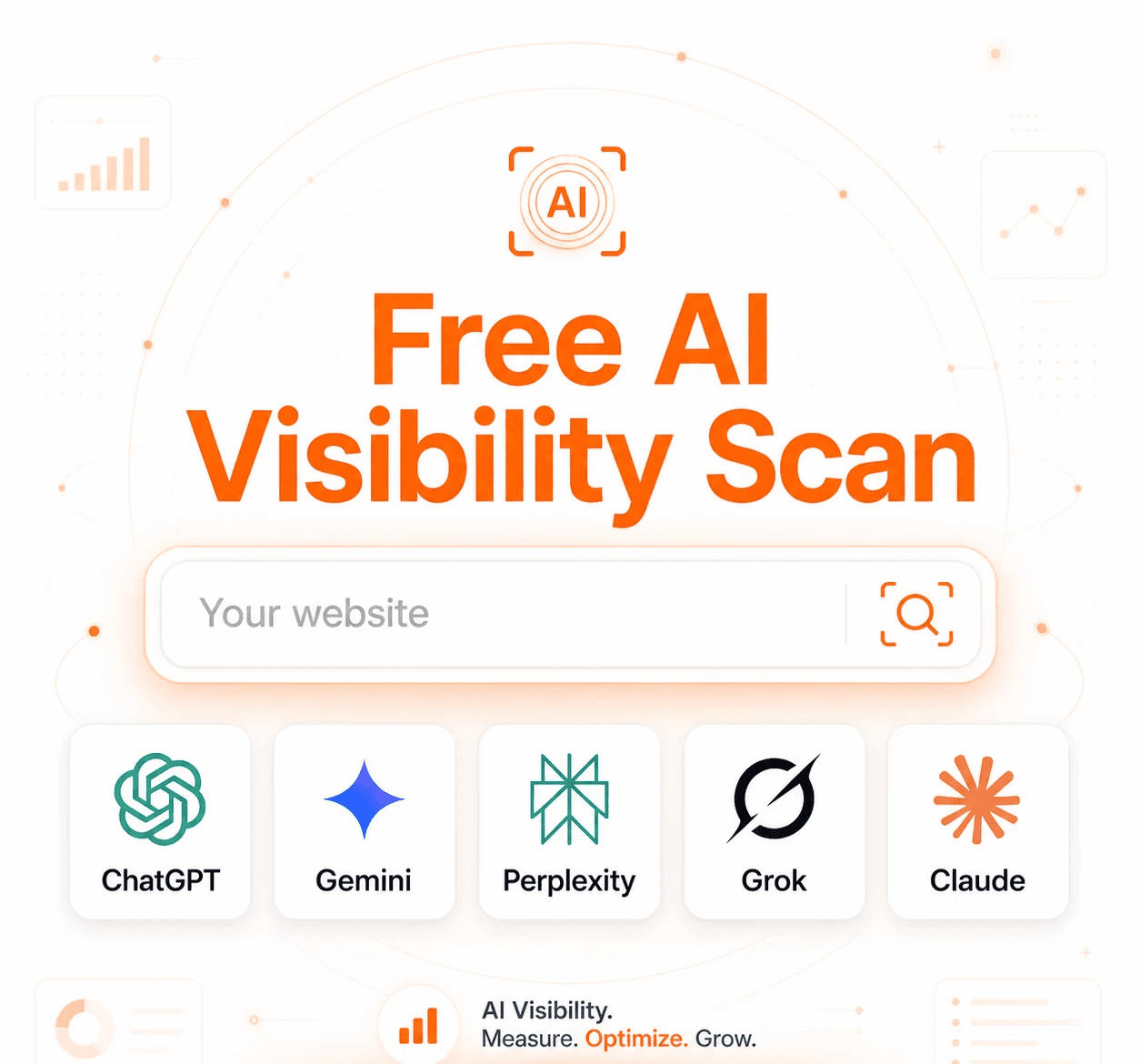
Is Your Brand Visible in AI Searches?
Free AI Visibility Audit → See where you appear (and where competitors appear).
Read More From Our Blog...
12 Best AI Tools for Ecommerce SEO and AI Visibility in 2026
Ecommerce Category Page SEO: Best Practices for 2026
Best AI Tools for Increasing Visibility in LLMs 2026

Start Getting Cited By Google
and AI Searches on Auto-Pilot


AI SEO agents research keywords, write & publish ranking content, track AI citations, and grow your brand visibility — while you focus on the business.


Trusted by 300+ users
4.5
Start Getting Cited By Google
and AI Searches on Auto-Pilot
Automate your SEO to rank faster, and showing up in AI search, without the guesswork.
Trusted by 300+ users
4.5
Start Getting Cited By Google
and AI Searches on Auto-Pilot
AI SEO agents research keywords, write & publish ranking content, track AI citations, and grow your brand visibility — while you focus on the business.
Trusted by 300+ users