AEO focuses on making answers easy for AI systems and search features to extract, while SEO focuses on helping full pages rank and earn traffic. You still need both because AI visibility depends on the same crawlability, indexing, and authority signals that help pages get discovered in the first place. Use AEO for direct question answering, SEO for depth and commercial evaluation, and GEO for brand citation presence across generative engines. As of June 2026, Google now reports generative AI impressions in Search Console for some sites, making hybrid measurement more practical than ever.
AEO vs SEO is not a winner-take-all choice. If your site cannot earn trust, get crawled, and support deep topic coverage, answer formatting alone will not carry you. The strongest teams build answer-ready content on top of solid SEO foundations.
Most marketing teams I talk to are dealing with the same confusion. They hear Answer Engine Optimization (AEO), Generative Engine Optimization (GEO), AI SEO, and traditional Search Engine Optimization (SEO) used almost interchangeably in the same meeting, and no one quite agrees on what each term means or who owns it.
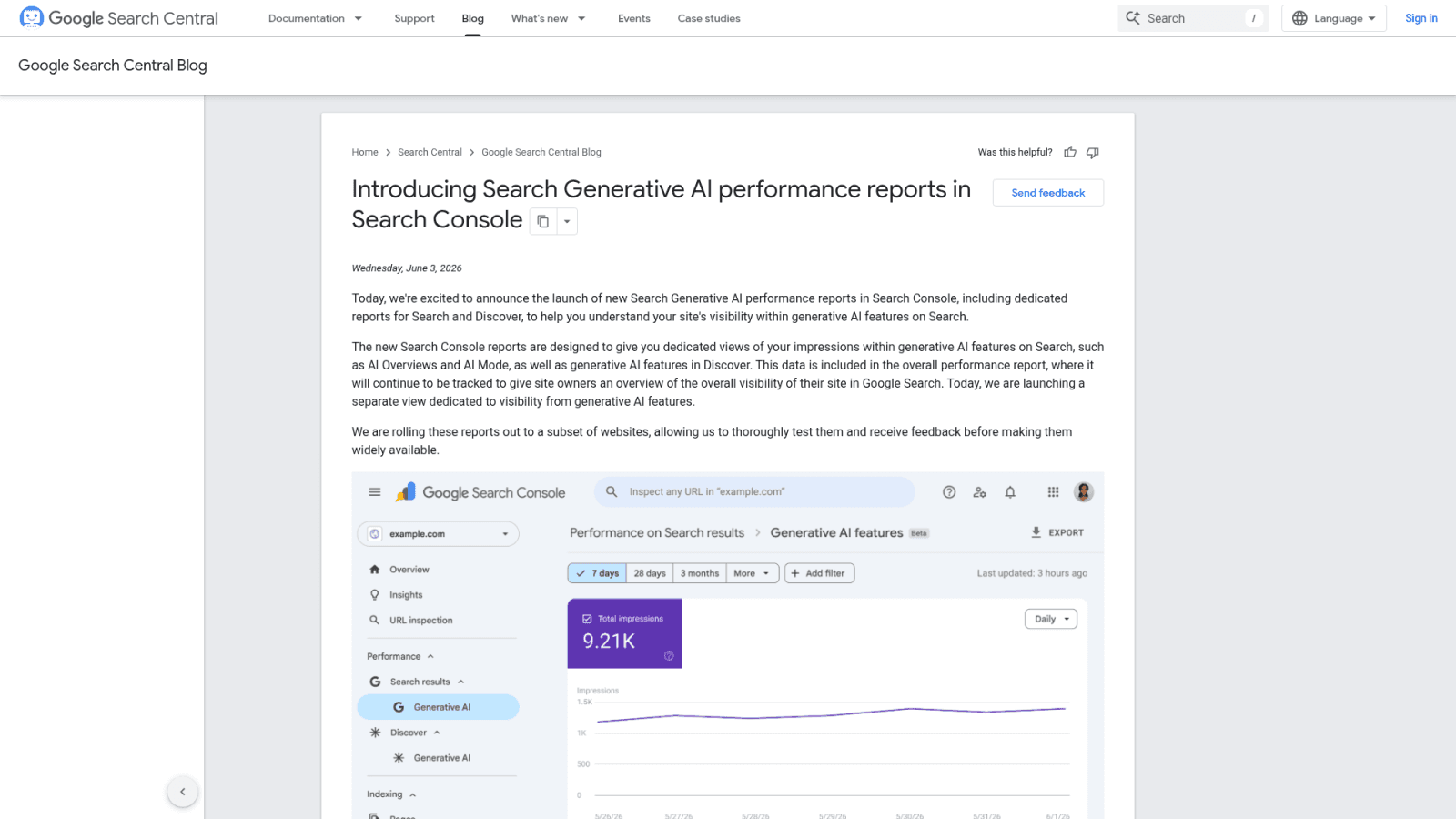
That confusion is now a budget problem. On June 3, 2026, Google launched dedicated generative AI performance reports inside Google Search Console, giving site owners impression data for AI Overviews, AI Mode, and Discover separately from classic organic results. Measurement has caught up, but most team strategies have not.
This article gives you a clean framework: what each term means, where they genuinely overlap, when each should lead, and how to build one workflow instead of three disconnected programs.
What is the real difference between AEO and SEO?
Search Engine Optimization (SEO) is the practice of making pages discoverable, indexable, and authoritative so they rank in search results and earn sustained traffic. AEO is the practice of structuring content so that AI systems, answer surfaces, and search features can extract direct answers from it. Both matter. Neither makes the other irrelevant.
According to Google's AI features documentation, the best practices for SEO remain relevant for AI features including AI Overviews and AI Mode, with no additional technical requirements needed to appear in those surfaces. That is the clearest possible signal that AEO is not a replacement discipline. It is an answer-layer built on top of SEO foundations.
In practice, what TechRadar describes as AEO-friendly content places the answer first and breaks information into extractable chunks. That is useful framing, but it still depends on the page being indexed, trusted, and accessible.
AEO focuses on extractable answers while SEO focuses on rankable pages
SEO wins page retrieval. A well-optimized page earns a position in search results for relevant queries, building an audience over time through ranking, clicks, and depth of coverage.
AEO wins answer extraction. A well-structured answer block can be pulled into AI Overviews, ChatGPT search results, Perplexity citations, or Gemini responses, giving your brand visibility even in sessions where no click is made.
The distinction is about retrieval mode, not channel labels. SEO concerns the full page journey. AEO concerns the moment a system decides which passage to quote or surface. You need both because the systems that power AEO extraction still depend on classic SEO quality signals to decide what is worth quoting.
I have seen teams invest in answer formatting without fixing indexing gaps, and their AI visibility remains thin. The content is well-structured but invisible because the foundation was skipped.
Where AEO and SEO overlap in practice
The overlap is substantial. Both disciplines depend on crawlability, proper indexing, topic authority, internal linking structure, and content that meets Google's helpful, reliable, people-first content guidance. E-E-A-T signals, structured data accuracy, and page experience all contribute to both ranking potential and answer extraction eligibility.
Building topical authority in SEO through a coherent content cluster also increases the likelihood that your pages are selected as sources across answer engines. A site that covers a topic comprehensively and interlinks well is more extractable than a site with one isolated, well-formatted page.
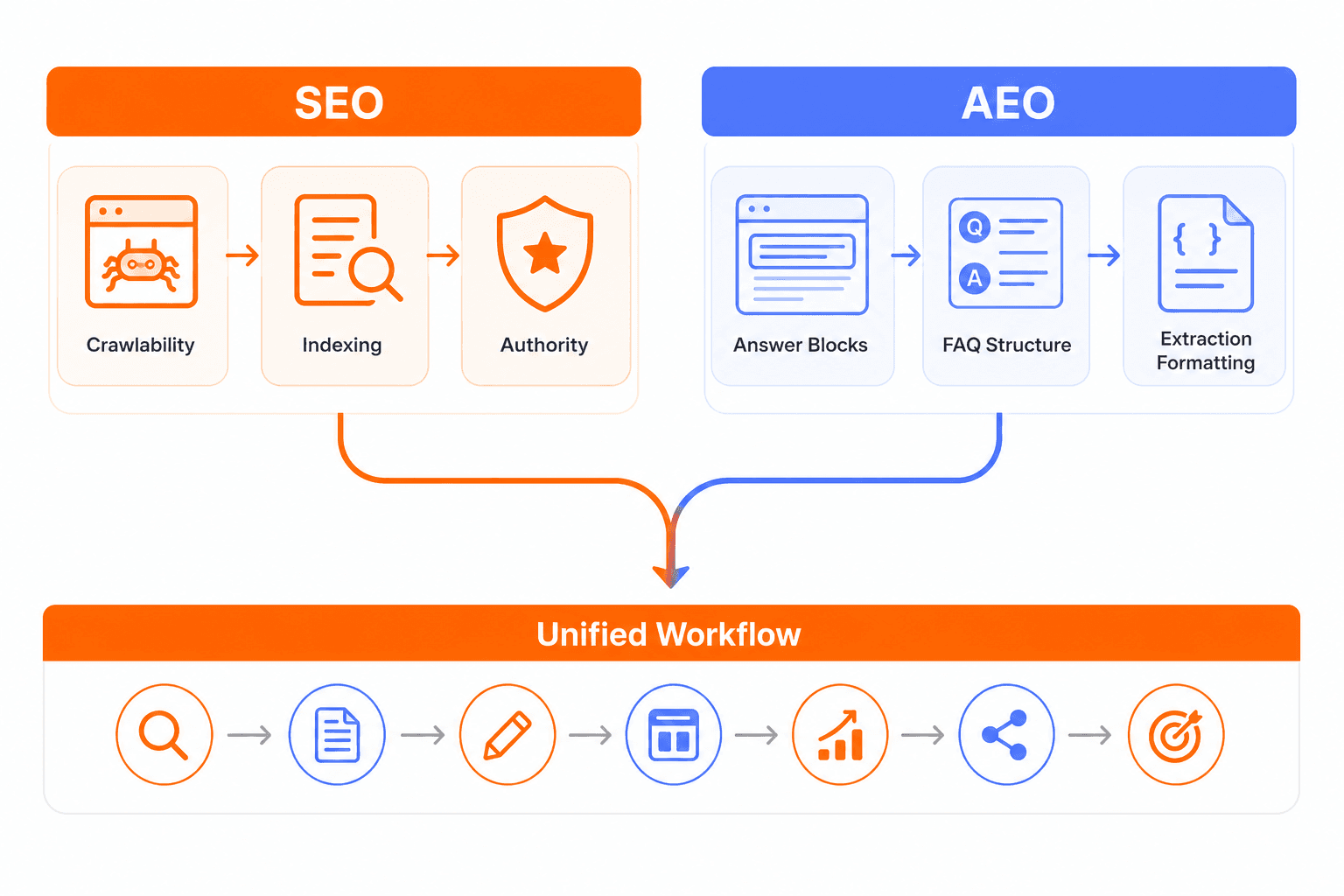
The short version: the shared dependency is quality infrastructure. AEO is about formatting and answer clarity. SEO is about discoverability and depth. One without the other produces partial results.
AEO vs SEO comparison table by goal, format, metrics, and failure mode
Dimension | SEO | AEO |
|---|---|---|
Primary goal | Page ranking and sustained traffic | Answer extraction and AI surface visibility |
Content format | Long-form, comprehensive, structured | Direct answer blocks, FAQs, definition sections |
Success metrics | Rankings, clicks, organic traffic, backlinks | AI impression share, featured snippet capture, citation mentions |
Typical failure mode | Buries the answer in supporting depth | Lacks the authority and indexing to be trusted as a source |
Key dependencies | Crawlability, indexing, authority, internal links | Crawlability, indexing, authority, answer-first formatting |
Platform context | Google Search, Bing | Google AI Overviews, AI Mode, ChatGPT, Perplexity, Gemini |
The clearest verdict: AEO is how you format your answers, and SEO is the infrastructure that makes those answers reachable.
Why do teams still need both instead of choosing one?
AI systems do not operate in a parallel universe separate from search infrastructure. Google has confirmed that its generative AI features are rooted in the same core ranking and quality systems that power classic Search. Choosing between SEO and AEO is a false tradeoff. The question is how to weight them by query type and content goal.
AI answer visibility still depends on discoverability and trust signals
For Google AI Overviews and AI Mode, the eligibility requirement is clear: a page must be indexed and eligible to appear in Google Search with a snippet. No indexing means no AI visibility. No trust signals means lower selection probability, even when a page is indexed.
For non-Google answer engines like ChatGPT search, access works differently. According to OpenAI's publisher FAQ, publishers can allow OAI-SearchBot, and inclusion in ChatGPT search results depends in part on whether the crawler can access the site. That is still a crawlability problem, which is still an SEO problem.
AI visibility across platforms is not a content formatting exercise in isolation. It is a trust and access problem first.
What breaks when a team does SEO without answer formatting
Pages optimized purely for ranking often front-load background context, bury the direct answer three paragraphs in, and use prose structures that are hard for extraction systems to parse. The result:
Featured snippets go to competitors whose answers are surfaced earlier
AI Overviews and AI Mode pull from pages with cleaner answer blocks, not necessarily the highest-ranking ones
The brand earns a ranking position but minimal AI citation share
In my experience, this is the most common gap I see in content audits. The page ranks. The answer is there. But extraction systems skip it because the opening paragraphs assume too much context.
What breaks when a team does AEO without SEO fundamentals
Answer-formatted content with weak SEO fundamentals runs into a different set of problems:
Pages do not get indexed reliably or quickly
No topical authority means the site is not treated as a credible source by systems that weight authority signals
Thin internal linking means supporting context is absent, reducing topical coverage signals
Without distribution through ranking, the well-formatted page gets no organic traffic and limited discovery by AI crawlers
I would warn against treating AEO as a standalone content format strategy. You cannot answer-optimize your way out of a technical or authority deficit.
How should marketers decide when SEO leads, when AEO leads, and when GEO enters the picture?
The decision is not about picking a discipline. It is about matching the content approach to the query type and the outcome you are building toward. Here is how I think about it in practice.
Use SEO-first for comparison, evaluation, and high-depth queries
Commercial queries, tool comparisons, evaluation pages, and anything where the reader needs to weigh options and make a decision require depth, internal linking, and structured coverage. These pages need to rank. They need to earn trust through topical completeness, not just answer clarity.
AEO formatting still helps within these pages, but the primary architecture is SEO: topic cluster coverage, competitor intent coverage, backlink support, and conversion-adjacent content.
Use AEO-first for direct question queries and answer surfaces
Definition queries, how/what/when questions, and short informational lookups benefit most from answer-first formatting. These are the pages most likely to appear in AI Overviews, get cited by Perplexity, or surface in ChatGPT search when a user asks a direct question.
For these pages, the structure is: direct answer in the first 50 words, supporting explanation, structured FAQ section, and schema markup to help machines interpret the content structure. Understanding what is AEO is the practical starting point for building these pages correctly.
Treat GEO as citation visibility across generative engines, not a replacement for SEO
Generative Engine Optimization (GEO) concerns how your brand earns citation presence across generative AI engines, including non-Google surfaces. It is related to AEO but operates at a different layer: brand mention frequency, source reputation, and multi-engine visibility rather than individual answer extraction.
GEO does not replace SEO or AEO. It extends them into a brand citation layer. The full GEO guide covers that territory in depth; keeping it separate here prevents this article from turning into three different strategy documents at once.
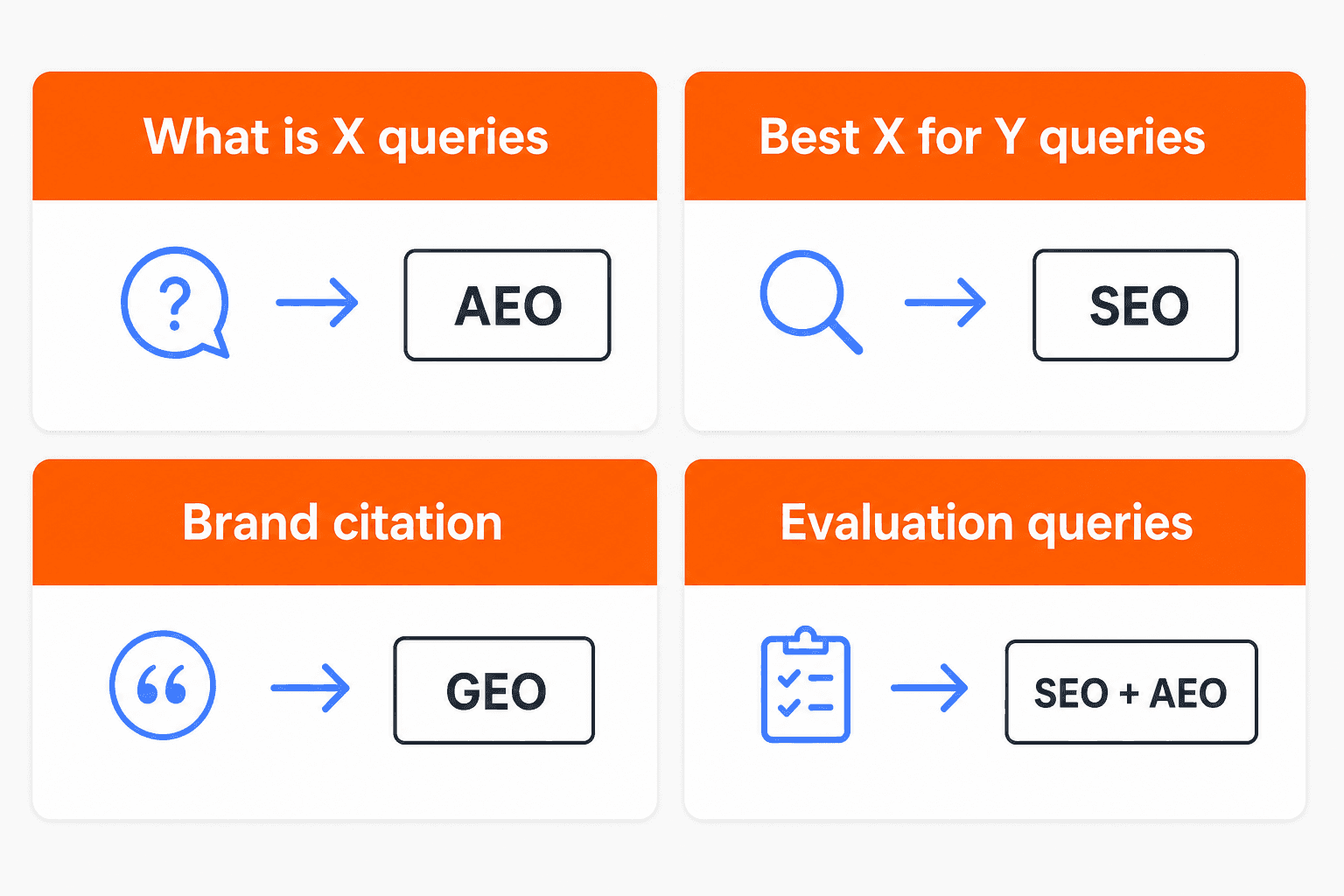
A simple decision matrix for founders and content teams
Query type | Primary approach | Secondary layer |
|---|---|---|
"What is X" / "How does X work" | AEO-first: answer block, FAQ, schema | SEO: indexing, authority, internal links |
"Best X for Y" / Comparisons | SEO-first: depth, topical cluster | AEO: clear recommendation blocks |
"X vs Y" / Evaluation | SEO-first: structured comparison, pros/cons | AEO: verdict sentences, structured tables |
Brand citation across AI engines | GEO: source credibility, multi-engine presence | SEO + AEO: foundation both depend on |
Local / transactional | SEO-first: local authority, schema | AEO: direct answer for "near me" intent |
The verdict: let query intent drive the approach, not internal debates about which discipline is more modern.
What does an AEO plus SEO content workflow actually look like?
A unified workflow is more useful than a list of tactics. Here is the order of execution that I have found produces the most consistent results across both ranking performance and AI surface visibility.
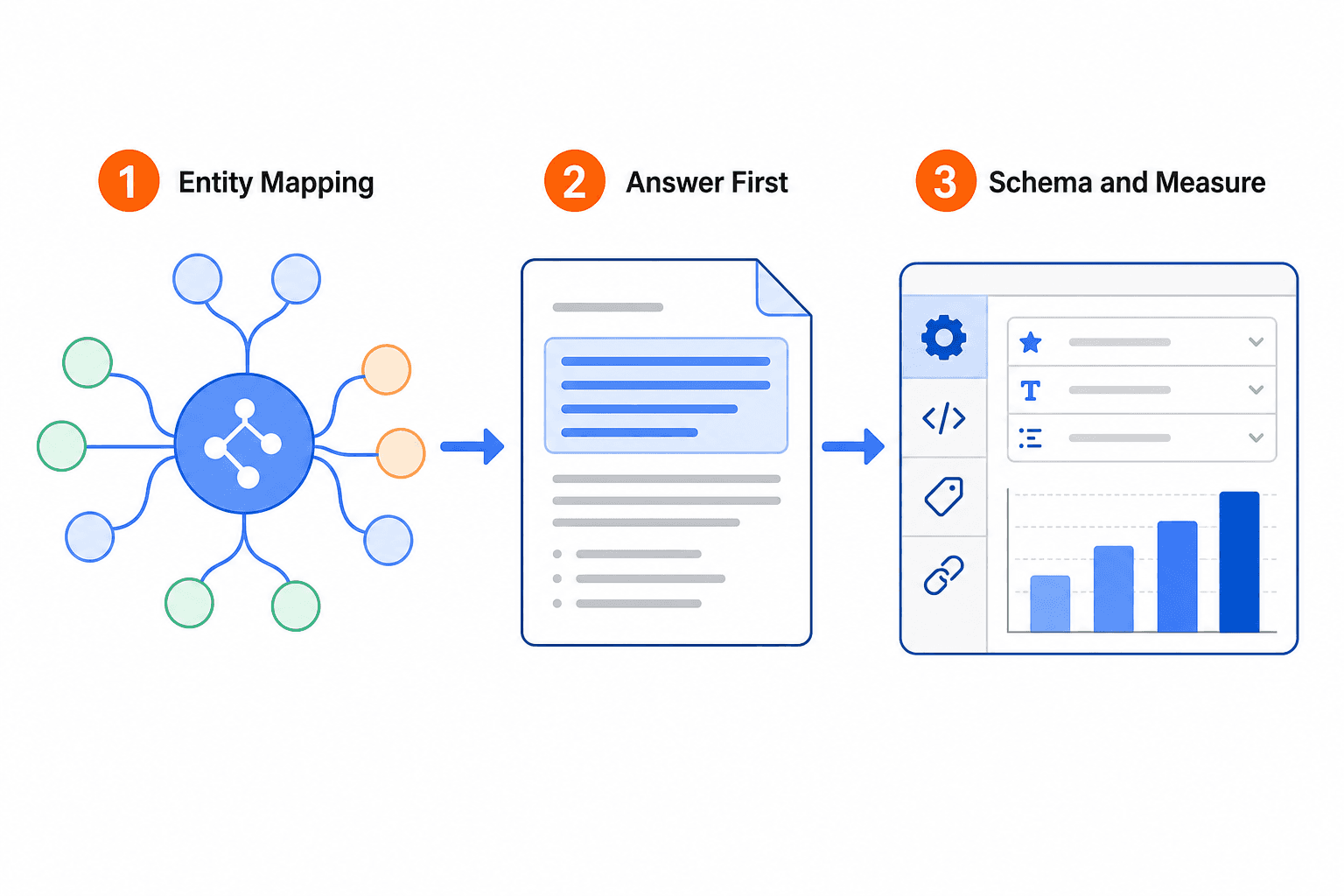
Start with entity clarity and intent mapping
Before writing a single heading, map the central entity and its predicates. What is the subject? What attributes are readers looking for? What queries form the cluster around this entity? This prevents keyword-chasing and anchors the content in what the topic actually means.
Entity mapping also tells you which subtopics earn their own pages versus which get covered as sections. That distinction matters for avoiding cannibalization and for building the internal link architecture that supports topical authority.
Write the answer first, then build the supporting depth
Every section should open with a direct answer to the question the heading poses. Then add the evidence, examples, and supporting layers. This structure serves both extraction systems and human readers who scan before they read.
Understanding how ChatGPT actually picks sources makes clear that answer clarity and source credibility are the two primary variables. You control the first through content structure, and you build the second through SEO fundamentals over time.
Add schema, internal links, and measurement after the content is useful
Schema markup can help machines interpret page structure and support eligibility for certain features, including FAQPage and Article schema. It is worth adding after the content is useful, not before. Schema that accurately describes thin or poorly structured content does not compensate for the content problem.
Internal links should be added where they help the reader move to relevant depth, not to fill a quota. How schema markup improves AI visibility covers the right way to think about structured data implementation.
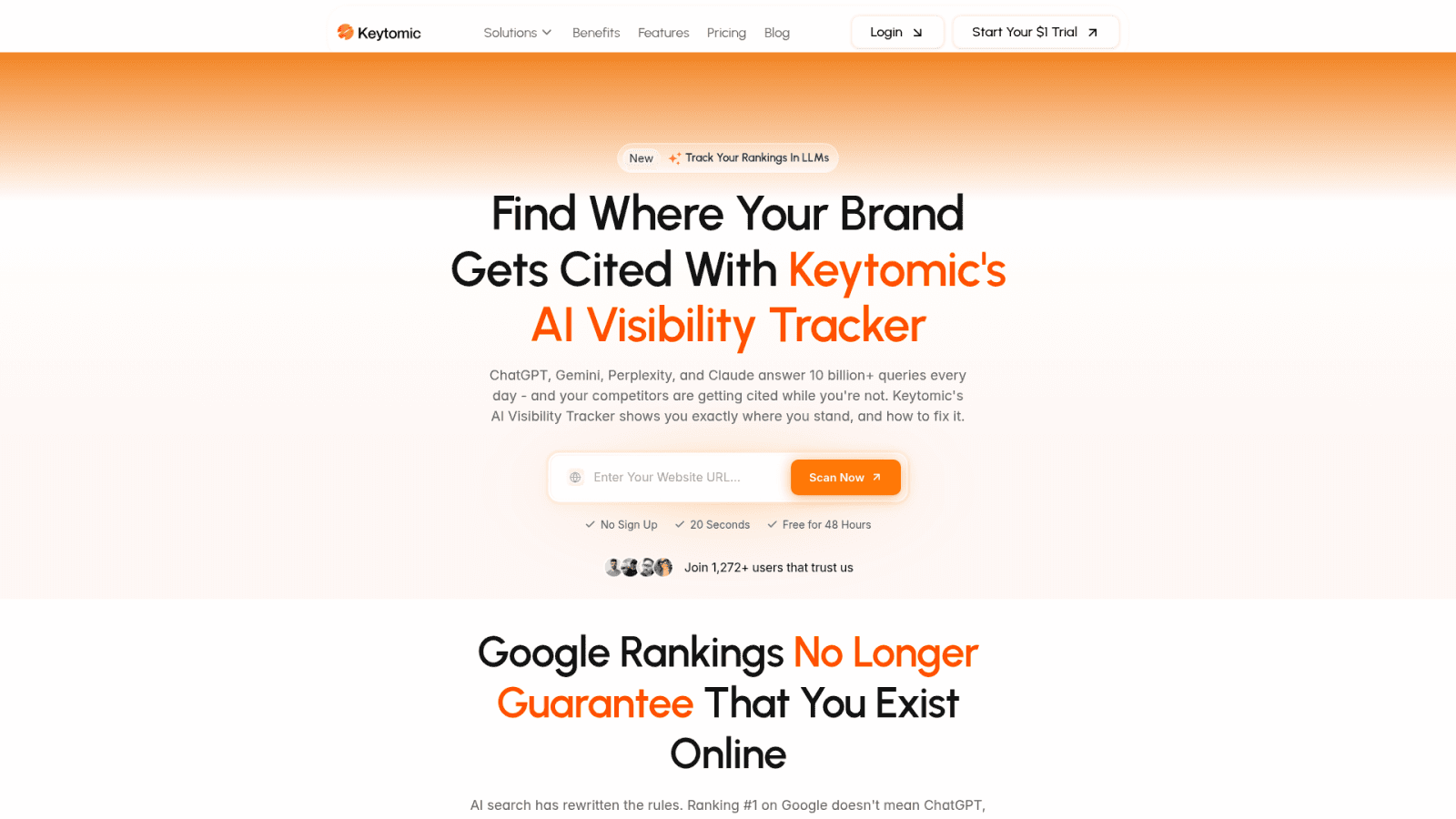
For measurement, track both classic GSC performance and, for sites with access, the new generative AI performance reports Google launched in June 2026. The AI Visibility Tracker from Keytomic is designed to complement this by tracking citation presence across non-Google answer engines where Search Console data does not reach.
How Keytomic helps teams manage SEO and AI visibility in one workflow
Disclosure: Keytomic is our platform, so this section explains where it fits and where it does not.
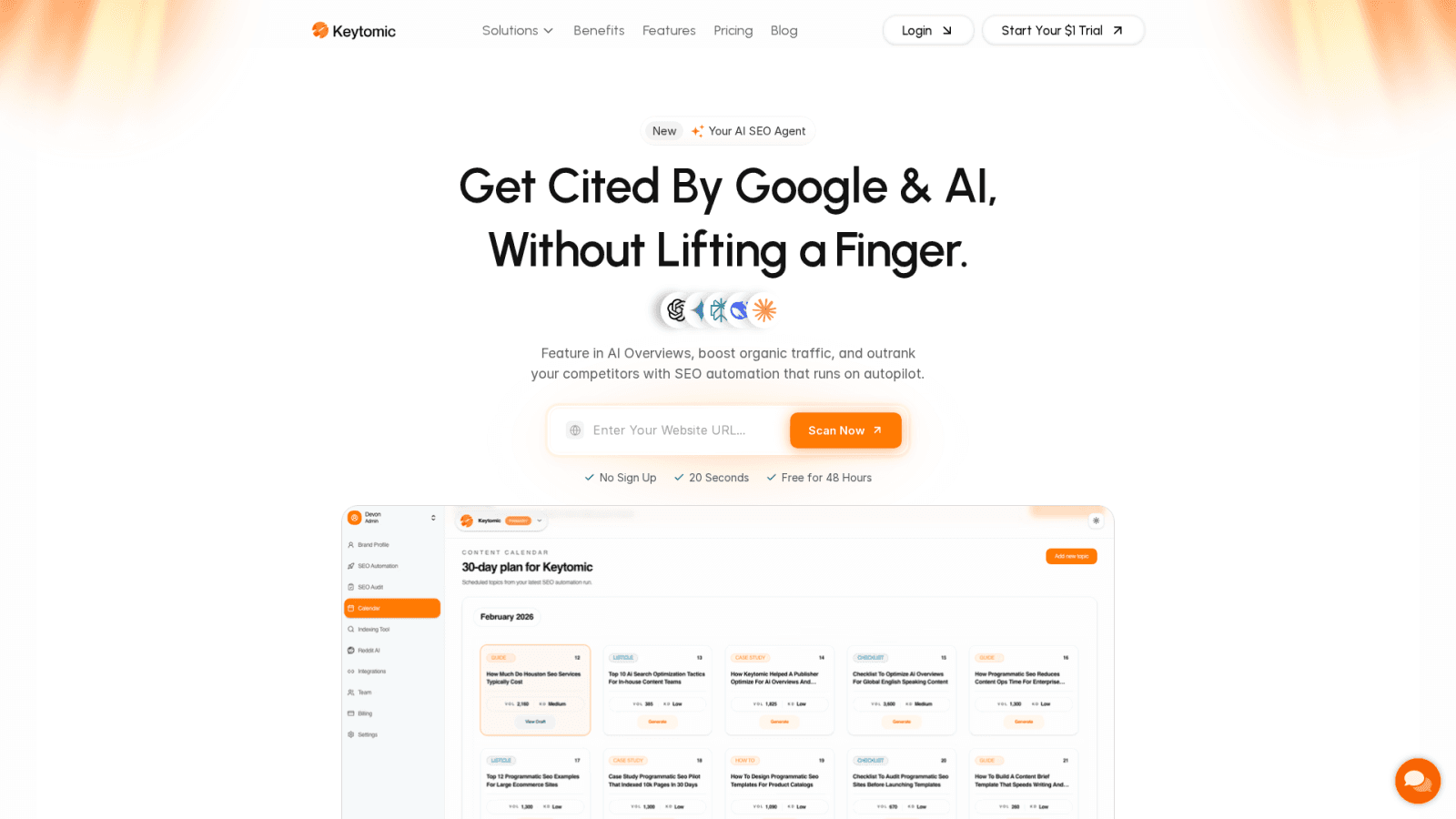
The Keytomic AI SEO automation platform was built around the exact problem this article describes: fragmented tools create fragmented execution. When keyword research, content briefing, publication, and visibility tracking live in separate tools with no shared logic, teams end up running disconnected SEO and AEO programs that do not reinforce each other.
Keytomic is designed to handle keyword discovery, 30-day content roadmaps, and auto-publishing inside one workflow, with AI search visibility as a native measurement layer rather than a bolt-on report.
Where Keytomic fits in a combined visibility workflow
For teams that want to apply the framework in this article without rebuilding their stack, Keytomic covers several of the workflow steps:
Keyword discovery and topic cluster mapping before content is written
Content calendar planning across a 30-day window so SEO-first and AEO-first pages are built in sequence, not at random
Auto-publishing to reduce the delay between content completion and indexing
The AI Visibility Tracker for monitoring citation presence across answer engines where Google Search Console data does not apply
The goal is one system of record rather than three disconnected programs for SEO, AEO, and GEO.
When Keytomic is not the right fit
Keytomic does not replace strategic human review. Topic selection, brand voice calibration, and editorial judgment on sensitive or complex content still require a person. The platform is designed to handle workflow mechanics, not to substitute for content strategy decisions that depend on business context.
For teams that already have a mature, well-integrated content stack and a dedicated SEO team, Keytomic may not add enough marginal efficiency to justify switching. It is most useful for teams where the bottleneck is execution speed and measurement fragmentation rather than strategy.
Book your 1-1 demo to see the workflow in context and decide whether it fits your team's setup.
Frequently asked questions about AEO vs SEO
What is the difference between AEO and SEO? SEO helps pages rank and earn traffic. AEO formats content so AI systems and answer surfaces can extract direct answers. Both depend on the same crawlability and authority foundations.
Is AEO replacing SEO? No. Google's own documentation confirms that generative AI features are built on core Search ranking systems. AEO adds an answer layer on top of SEO, it does not replace it.
Do I need AEO if my site already ranks in Google? Yes, if you want visibility in AI Overviews, AI Mode, and other answer surfaces. Rankings help, but answer-first formatting determines whether your content gets extracted and cited.
How is AEO different from GEO? AEO focuses on individual answer extraction from specific pages. GEO focuses on brand citation presence across generative engines more broadly. AEO is a page-level tactic; GEO is a brand-level visibility strategy.
Does structured data help with AI search visibility? Structured data can help machines interpret page content and supports eligibility for certain features. Google has confirmed there is no special schema required for AI Overviews, but accurate structured data still improves how content is understood.
Can you appear in AI Overviews without ranking first? Generally, no for Google. Pages must be indexed and eligible to appear in Google Search with a snippet to qualify as supporting links in AI Overviews or AI Mode. Strong rankings improve selection probability.
How do you measure AEO performance? For Google surfaces, the generative AI performance report in Search Console now shows impression data for AI Overviews, AI Mode, and Discover. For non-Google answer engines, third-party tools are required since Search Console data does not cover ChatGPT or Perplexity.
Does ChatGPT use website content from across the web? Yes. According to OpenAI's ChatGPT Search documentation, ChatGPT search uses the web, and inclusion depends in part on crawl access for OAI-SearchBot. Blocking this bot excludes your content.
What content format works best for AEO and SEO together? Answer-first structure with supporting depth. Open each section with a direct answer, follow with evidence and examples, add FAQ schema, and support the page with internal links and topical cluster coverage.
What should a small marketing team prioritize first? Fix crawlability and indexing first. Then audit whether key pages answer the query in the first 100 words. Then add AEO formatting and measurement. Building on a broken foundation produces poor results in both SEO and AEO.
Three-step decision checklist before creating new content:
Audit whether your key pages answer the central query within the first 100 words.
Verify those pages are supported by crawlability, internal links, and topical depth from related pages.
Add AI visibility tracking and improve weak existing pages before creating net-new content.
If you want to run this workflow without patching together separate tools, Start your $1 trial and see how Keytomic handles the execution layer so your team can focus on strategy.