
Key takeaways
Traditional SEO tools measure search data in depth: keywords, rankings, backlinks, and technical health.
AI SEO tools either use AI to automate SEO work, or help you appear in AI answers from ChatGPT, Perplexity, and Google AI Overviews. The strongest platforms do both.
Choose by bottleneck: AI-led workflows fix slow execution; specialist tools fix shallow analysis.
Track Google performance and AI visibility as separate metrics. Do not merge them into one score.
Keep human review for strategy, facts, brand voice, and high-risk pages.
If you manage any kind of content operation, you have probably faced the same stack problem. You have a keyword research tool, a content optimization tool, an AI writer, a CMS, and one or two reporting dashboards, and none of them talk to each other cleanly. Every handoff is a manual step.
The real buying question is whether you need better data, faster execution, fewer handoffs, broader AI search visibility, or some combination of all four. The answer shapes which tool type actually solves your problem.
Google Search remains the core measurement environment for most teams. Google's own documentation on AI features in Search confirms that AI Overviews and AI Mode add a visibility layer on top of traditional results, not a replacement for them.
What Counts as an AI SEO Tool?
"AI SEO tool" is used for two different things, and most comparisons only cover one of them.
AI-powered SEO tools use AI to do SEO work faster. They cluster keywords, write briefs, draft articles, suggest internal links, and publish to your CMS. The goal is less manual effort between research and a live page.
AI search optimization tools help your brand appear in AI-generated answers. This practice is also called generative engine optimization (GEO) or answer engine optimization (AEO). These tools track whether ChatGPT, Perplexity, Gemini, or Google AI Overviews mention or cite you, and suggest content changes that make citation more likely.
Traditional SEO tools sit underneath both. They supply the keyword, ranking, link, and crawl data that AI tools interpret or act on.
This article compares all three against your workflow. Some platforms, including Keytomic, combine AI-powered production with AI visibility tracking. Others specialize in one.
AI SEO Tools and Traditional SEO Tools Solve Different Parts of the Same Workflow
Traditional SEO tools generally expose and measure SEO data. AI SEO tools add interpretation, generation, prioritization, or workflow execution on top of that data. Both categories vary significantly by vendor, so this is a workflow distinction, not a binary technology split.

What Traditional SEO Tools Are Designed to Measure
Tools like Semrush and Ahrefs were built around data depth and inspection. They give you keyword databases, rank tracking, crawl-based technical audits, backlink profiles, SERP analysis, and competitor research. The premise is that a skilled SEO professional will interpret that data and decide what to do with it.
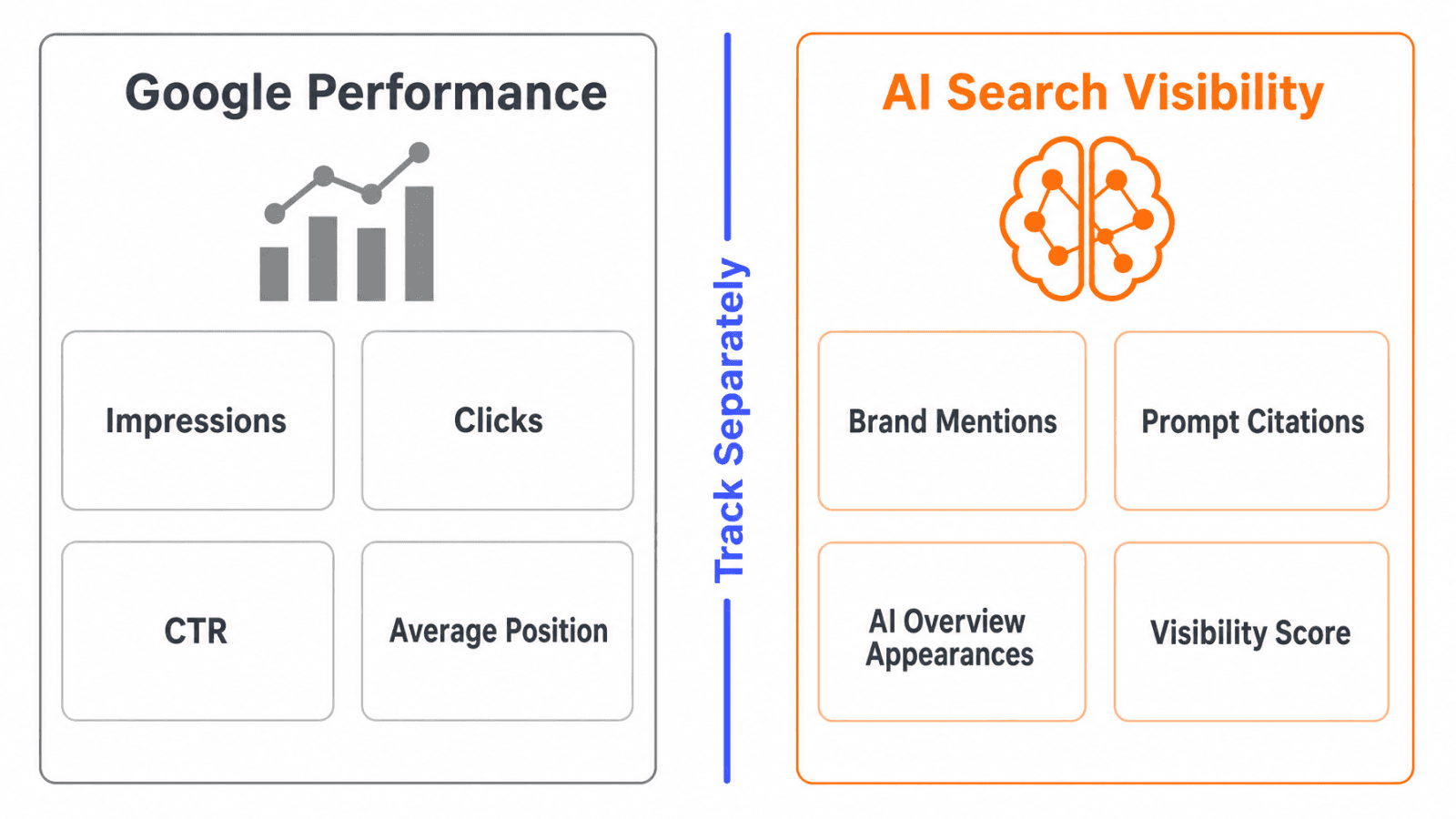
Google Search Console sits alongside these tools as the authoritative source for your own site's Google performance, covering impressions, clicks, CTR, and average position.
What AI SEO Tools Add to Interpretation and Execution
AI SEO tools go further by interpreting the data and generating the next output. That might mean clustering keywords into a topical map, writing a content brief, drafting an article, scheduling publication, or flagging an AI visibility gap. The goal is to compress the distance between research and a published, indexed piece of content.
The tradeoff is control. The faster the workflow moves, the more it depends on the quality of the AI's interpretation and the strength of the human review behind it.
Quick Comparison of AI SEO Tools and Traditional SEO Tools
This comparison evaluates categories by workflow coverage, data depth, control, implementation risk, AI visibility coverage, and pricing transparency. No individual product winner is declared, because this article compares workflow approaches, not specific platforms.
Feature and Workflow Comparison Table
Capability | AI SEO tools | Traditional SEO tools |
|---|---|---|
Keyword research | Automated discovery, clustering, and prioritization | Deep keyword databases with manual filtering and sorting |
Content planning | Generates topical maps and content calendars | Requires manual organization from data exports |
Content creation | Draft generation from brief to article | Not typically included; separate tool needed |
Technical SEO | Varies; some include basic audits | Deep crawl-based audits, error diagnosis, structured checks |
Backlink analysis | Varies; some include backlink data | Core strength; large databases with historical data |
CMS publishing | Some platforms publish directly to a CMS | Not typically included |
Google reporting | Search Console integration varies | Strong rank tracking and SERP data |
AI search visibility | Core feature in newer platforms | Emerging; some suites now offer AI visibility modules |
Integrations | Often CMS-focused; varies by platform | Wide API and data integrations |
Human oversight required | High for content accuracy and brand voice | High for data interpretation and action planning |
Pricing transparency | Varies; check official pricing pages | Varies; typically modular or tiered |
AI SEO tools are strongest when the bottleneck is moving from insight to published action. Traditional tools remain strongest when the bottleneck is deep analysis and control.
What Changes in Day-to-Day SEO Work
The feature table shows what each tool type offers. This table shows how each core SEO task changes once AI search is part of the job.
SEO task | Traditional approach | AI search approach |
|---|---|---|
Research | Find the short keywords people type into Google | Find the longer, conversational prompts people ask AI assistants |
On-page | Optimize titles, headings, and keyword placement | Lead each section with a direct answer that makes sense on its own |
Technical | Crawlability, speed, indexation, Core Web Vitals | Same foundations, plus AI crawler access and content that renders without JavaScript |
Off-page | Earn backlinks from relevant, authoritative sites | Earn brand mentions on reviews, forums, and publications, even unlinked |
Measurement | Rankings, clicks, CTR, conversions | Mentions, citations, share of voice, and sentiment in AI answers |
Most traditional SEO work still applies. AI search adds a second layer on top of it rather than replacing it.
What the Comparison Means for a Lean Marketing Team
For a team of two or three people publishing at volume, managing five subscriptions and the handoffs between them creates real overhead. That overhead is not just time. It is the gap between research sitting in one tool and content waiting to be written in another, and it accumulates across every article in the calendar. This is the problem AI SEO for marketing teams is meant to solve.
How AI SEO Tools Handle Keyword Research and Content Planning
AI SEO tools can connect keyword discovery with intent interpretation, topic clustering, briefs, and content calendars. The quality of that output depends on source data, brand context, and how much human review is applied to the plan before production starts.
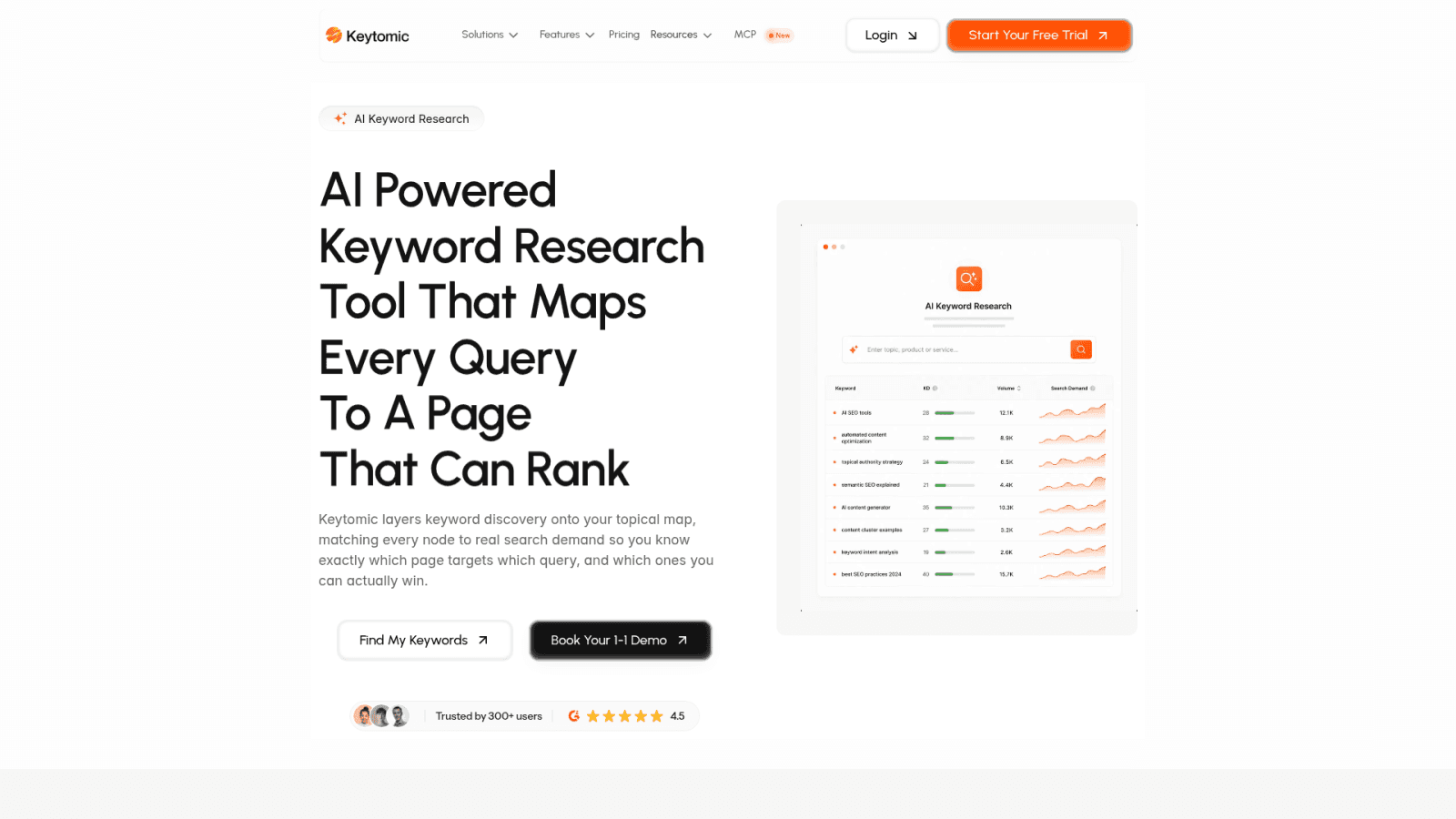
Keyword Discovery, Intent, and Topical Mapping
Rather than delivering a flat keyword list for a human to sort, AI-led keyword research platforms assign each keyword to a position in a topic cluster. The system separates primary targets from supporting terms, identifies intent patterns, and suggests the content type most likely to satisfy each query.
This is useful for teams that need to build topical coverage quickly. With AI keyword research and a topical map in one connected workflow, the cluster structure carries through into briefs and drafts instead of being rebuilt manually at each stage.
A practical decision rule: automate clustering and prioritization when the keyword inputs are stable. Require human approval when the topic affects brand positioning, regulated advice, or revenue-critical pages.
Planning for Prompts, Not Just Keywords
People type short keywords into Google but ask AI assistants full questions. Semrush's analysis of one brand found its Google ranking keywords averaged four words, while the AI prompts it appeared for averaged eight.
AI systems also expand a single prompt into several related searches behind the scenes, a process often called query fan-out. A page built around one exact keyword can miss most of those variations.
The practical response is to plan by topic, not by keyword. A topical map that covers the main question and its likely follow-ups gives AI systems more relevant passages to pull from. AI keyword clustering earns its place here: it groups the variations so one article, or one cluster of articles, covers the whole question.
Content Briefs, Calendars, and Production Handoffs
Once a keyword map exists, AI SEO tools can generate briefs, suggest headings, estimate word counts, and schedule articles into a publishing calendar. The time saved here is real, particularly for teams producing ten or more articles per month.
The tradeoff is that brief quality reflects the model's interpretation. A human editor should review the structure, confirm the intent match, and flag any heading or claim that needs specialist input before drafting begins.
Where Human Review Remains Necessary
Automation risk varies by task:
Low risk: keyword organization, brief generation, and content scheduling.
Medium risk: drafting factual claims, competitor mentions, and category positioning.
High risk: pricing content, regulated topics, legal or medical-adjacent claims, and any page where an error would directly affect revenue or trust.
Google's guidance on AI-generated content is clear that accuracy, quality, and relevance are what matter, not the method of production. Scaled content that is inaccurate or unhelpful is the problem, not AI assistance itself.
Where Traditional SEO Tools Still Provide Stronger Control
Traditional tools remain valuable when a team needs to inspect the underlying evidence rather than act on an interpreted summary. That situation comes up more often than AI advocates tend to acknowledge.
Technical Audits, Rank Tracking, and Search Console Data
A crawl-based technical audit surfaces issues that require forensic review: redirect chains, canonical mismatches, duplicate content, Core Web Vitals failures, structured data errors, and crawl depth problems. Fixing these usually requires a developer or technical SEO specialist who needs to see the raw data, not a generated recommendation.
Rank tracking gives you a signal over time. When a page drops, finding out whether the cause is a content change, a technical issue, a competitor gain, or an algorithm shift requires the underlying query and position data from the Search Console performance report, not an automated summary.
Technical SEO for AI Crawlers
AI answers can only cite pages that AI crawlers can reach and read. Two checks matter most.
Crawler access in robots.txt. AI companies run their own bots, often separate ones for training and for live search. Blocking the search bots can keep your pages out of AI answers. Common user agents include:
Company | Search and retrieval bots | Training bot |
|---|---|---|
OAI-SearchBot, ChatGPT-User | GPTBot | |
Anthropic | Claude-SearchBot, Claude-User | ClaudeBot |
PerplexityBot, Perplexity-User | — | |
Googlebot (also used for AI Overviews) | Google-Extended (Gemini use) |
A site that wants AI search visibility but no model training might use:
Google-Extended does not control AI Overviews. Those rely on the regular Googlebot crawl, so blocking Google-Extended will not remove you from them. To build rules for each bot, use a robots.txt generator.
Content that renders without JavaScript. A Vercel analysis found that most major AI crawlers do not execute JavaScript. If key text loads client-side, those bots may see an empty page. Check that your main content is in the server-rendered HTML.
Traditional crawlers like Screaming Frog can test both: crawl with a custom user agent, and compare rendered and raw HTML. A technical SEO audit inside an AI SEO platform covers the routine checks between deeper investigations.
Backlink Analysis, Brand Mentions, and Competitor Research
Backlink profiles, referring domain quality, lost links, and competitor link acquisition patterns are areas where data depth matters. Tools like Ahrefs document Site Audit and backlink workflows backed by large link databases and historical crawl data. That kind of investigation requires a human who can weigh domain relevance, anchor text patterns, and link velocity over time.
For competitive research, traditional tools often provide richer SERP-level data: which pages rank for a query, how strong their domains are, and how the featured snippet is structured.
Links are not the only off-page signal anymore. AI assistants also draw on brand mentions across reviews, forums, comparison articles, and industry publications, including mentions with no link at all. A nofollow or unlinked mention that adds little link equity can still shape how an AI answer describes your category.
This changes what off-page work is worth tracking. Traditional backlink tools remain the best way to audit links in depth. Pair them with a tool that shows where your brand is mentioned, and which sources AI answers cite when they recommend competitors instead of you.
Governance, Repeatability, and Specialist Workflows
For agencies managing client accounts with compliance requirements, or in-house teams with strict content governance, traditional tools offer more granular audit trails and manual controls. When a change goes wrong, you need to trace it. Specialist tools make that easier.
What Changes in Content Production, Publishing, and Measurement
AI-led workflows can shorten the path from opportunity to draft and publication, but speed does not remove the need for fact checking, brand review, technical checks, or measurement.
Drafting Speed Versus Editorial Control
An AI-generated draft can give a writer a structured starting point in minutes rather than hours. The practical gain is in setup time: research is already organized, headings are suggested, and the word count target is built in. What changes is where the human effort goes, from setup to review and refinement.
The editorial control question is real. Brand voice, factual accuracy, nuanced product positioning, and sensitive topics all require a human editor.
CMS Publishing, Indexing, and Implementation Risk
Some AI SEO platforms support direct publishing to a CMS, which removes the manual formatting and upload step. Implementation risk exists here: a misconfigured publish can push content to the wrong URL, with the wrong canonical, or with missing metadata. Any automated publishing workflow needs a verification step before content goes live at scale.
How to Measure Google Performance and AI Visibility
Google performance and AI visibility are separate signals, so track them separately. A page can rank well on Google and never be cited by an AI assistant, or the reverse.
Metric | What it tells you | Where it comes from |
|---|---|---|
Impressions, clicks, CTR, average position | How your pages perform in Google results | Google Search Console |
Organic sessions and conversions | Whether search traffic turns into leads or sales | Google Analytics or your analytics tool |
AI mentions | How often AI answers name your brand | AI visibility tools |
AI citations | How often AI answers link to or cite your pages | AI visibility tools |
AI share of voice | How often you appear compared with competitors for the same prompts | AI visibility tools |
AI sentiment | Whether AI answers describe you positively, neutrally, or negatively | AI visibility tools |
AI referral traffic | Visits that arrive from ChatGPT, Perplexity, and similar sources | Analytics, filtered by referrer |
Treat vendor AI metrics as directional. Each tool tests its own set of prompts, so scores are not comparable across vendors and are not equivalent to Search Console data. To see where you stand today, run a free AI visibility audit.
SEO Tool Categories and Where AI Fits
"Traditional" and "AI" are not single categories. Most stacks combine several of these tool types.
Category | Examples | Best for | AI search coverage |
|---|---|---|---|
All-in-one SEO suites | Semrush, Ahrefs, Moz | Keyword research, backlinks, rank tracking, competitor gaps | Growing: Semrush offers AI Visibility and Ahrefs offers Brand Radar |
Enterprise SEO platforms | BrightEdge, Conductor | Large sites, many stakeholders, reporting at scale | Varies by plan; check current modules |
Technical crawlers | Screaming Frog, Sitebulb | Deep audits, redirects, canonicals, rendering | Indirect: can test AI crawler access and JavaScript rendering |
Content optimizers | Surfer, Clearscope, MarketMuse | Topic coverage and on-page content scoring | Limited; focused on Google results |
Local SEO tools | BrightLocal, Whitespark | Business profiles, citations, local rankings | Limited |
AI visibility trackers | Profound, Peec AI | Mentions, citations, and share of voice in AI answers | Core feature |
AI workflow platforms | Keytomic | Research to published, indexed content, plus Google and AI tracking | Core feature |
Free first-party data | Google Search Console, Bing Webmaster Tools | Your own impressions, clicks, CTR, and indexing | None for third-party AI assistants |
The useful question is not which category wins. It is which categories your current bottleneck requires. If you are weighing a dedicated tracker, see how Keytomic compares with Profound and Peec AI.
Are AI SEO Tools Replacing Traditional SEO Tools?
AI SEO tools can replace selected manual handoffs or overlapping subscriptions. They should not automatically replace specialist tools that provide evidence or controls the team still needs.
When an AI-Led Workflow Can Consolidate Tool Handoffs
The operational cost of disconnected tools, what we call handoff debt, is the time and error risk created when research lives in one platform, writing in another, publishing in a CMS, indexing in a third tool, and reporting in a fourth. Each export and re-import is a friction point. An AI SEO platform that connects those steps into one workflow reduces that friction.
If your team's main bottleneck is execution volume, and your current stack needs four manual steps to get from a keyword idea to a published, indexed article, a consolidated AI-led workflow may remove that overhead.
When a Traditional Specialist Tool Is Still the Better Fit
If your main constraint is data depth for technical diagnosis, large-scale backlink investigation, or granular competitor analysis, a specialist tool is still the better fit. Replacing Ahrefs with an AI platform that includes a basic backlink module is a meaningful downgrade if backlink research is central to your workflow.
The decision is task-specific, not category-specific.
How Keytomic Approaches AI SEO Workflow Automation
Keytomic is a connected AI SEO automation platform covering keyword discovery, topical planning, content generation, CMS publishing, indexing, and both Google and AI visibility measurement. Keytomic is the publisher of this article, so the description below is based on our own product pages.
Map-First Keyword Planning and a Connected Content Workflow
Keytomic starts with keyword mapping rather than a flat keyword list. The platform assigns keywords to primary and supporting clusters, generates a 30-day content plan from that map, and surfaces the plan for human review and approval before any content is drafted. The approval step is a defined part of the workflow, not an afterthought.
From the approved plan, the platform moves to brief generation, article drafting with the AI blog writer, internal linking, and image generation before the draft reaches CMS publishing.
From Approved Plan to CMS Publishing and Visibility Tracking
Once a plan is approved, Keytomic connects brief creation through to direct publishing. It supports WordPress, Shopify, Webflow, Framer, and other CMS integrations, and includes indexing workflows that submit new URLs to Google and Bing. After publishing, the platform tracks Search Console performance alongside AI search visibility across ChatGPT, Perplexity, Gemini, Claude, and Google AI Overviews.
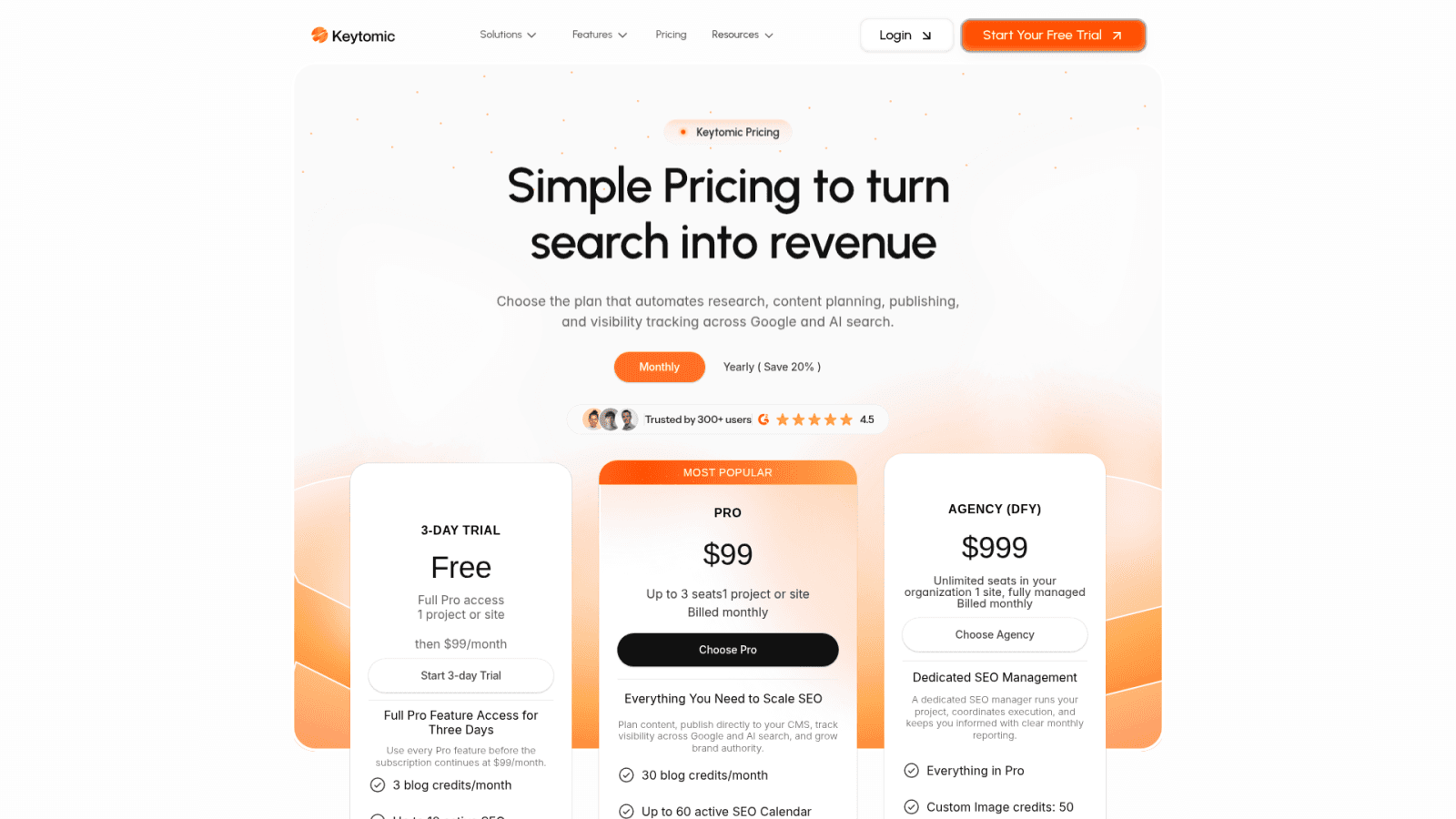
Pricing as of October 2026: plans start at $99 per month, with a free three-day trial. Check Keytomic pricing before you buy, as prices may have changed since this article was published.
The Limitation: Automation Still Needs Human Direction and Review
Keytomic automates the handoffs between stages, but it does not remove the need for human direction, fact checking, brand voice review, or suitability checks. Content for regulated topics, pricing pages, medical-adjacent claims, or revenue-critical decisions still requires editorial oversight before publication.
When Keytomic may not be the right fit: teams that only need a one-off keyword export, forensic backlink research, a specialist crawler, or a narrow reporting task may find a focused specialist tool more cost-effective. Keytomic is designed for teams whose bottleneck is the connected workflow from research to published, indexed content.
Which SEO Tool Approach Is Right for Your Team?
The right choice depends on where your workflow is actually breaking down, not on which category of tool sounds more advanced.
Choose an AI-Led Workflow if Your Bottleneck Is Execution
An AI-led approach fits teams that:
Have a stable content strategy but struggle to produce and publish at planned volume
Spend significant time manually organizing keyword research before writing can begin
Manage multiple CMS destinations and need a unified publishing workflow
Want AI search visibility data alongside Google performance in one place
Can allocate a human editor to review drafts before publication
Choose a Traditional-Led Stack if Your Bottleneck Is Analysis
A traditional specialist approach fits teams that:
Rely on forensic technical audits and need full crawl data to diagnose site issues
Run link-building campaigns that require deep backlink research and domain-level analysis
Have clients or stakeholders who require granular, auditable rank tracking reports
Work in regulated industries where every recommendation needs a traceable source
Choose a Hybrid Workflow if You Need Both Speed and Control
Many established SEO teams keep a specialist tool for technical and backlink work while adding an AI SEO platform for content planning and production. The hybrid model works when the two workflows are clearly separated and the team has the capacity to manage both. Agencies often run this model across clients; see how AI SEO for agencies fits alongside an existing suite.
Factor In Where Your Buyers Search
Your bottleneck decides the workflow. Your buyers' search habits decide how much AI visibility tracking matters.
Mostly Google: keep your traditional stack as the base. Add light AI visibility monitoring to set a baseline before the channel grows.
A mix of Google and AI assistants: track both channels. A connected platform that covers production plus Google and AI reporting avoids running two separate programs.
AI-first research, such as B2B buyers shortlisting vendors in ChatGPT: move AI visibility tracking up your list, but still build the traditional foundation. Pages with strong topical authority in Google tend to be the pages AI answers cite.
Not sure which group you are in? Ask recent customers how they first found you, and check your analytics for referrals from AI assistants.
Choose the tool approach that removes your highest-cost bottleneck without removing the evidence and review your decisions require. If a connected AI workflow might fit your current operation, see how Keytomic's research-to-publishing workflow works before committing to a change.
Frequently Asked Questions About AI SEO Tools
What Is the Difference Between AI SEO Tools and Traditional SEO Tools?
AI SEO tools add workflow automation, content generation, and interpretation on top of keyword and ranking data, and some track visibility in AI answers. Traditional SEO tools focus on exposing and measuring data for specialist analysis and manual action.
What Are GEO and AEO?
Generative engine optimization (GEO) and answer engine optimization (AEO) are names for optimizing content to appear in AI-generated answers. They mean roughly the same thing as AI search optimization. The work builds on SEO: crawlable pages, clear answers, topical depth, and brand authority.
Is Traditional SEO Dead?
No. Google still handles about five trillion searches a year, and AI assistants often rely on search indexes to find sources. AI search adds a channel on top of traditional SEO rather than replacing it.
Do I Need Both an SEO Tool and an AI Visibility Tool?
Most teams need coverage of both channels, but not always two tools. Some platforms combine Google performance data with AI visibility tracking. If your current suite already offers an AI visibility module, test it before buying a separate tracker.
Are AI SEO Tools Accurate Enough for SEO Content?
They can assist effectively, but accuracy depends on source quality, editorial controls, and human review. Google's guidance on AI-generated content sets the standard as quality, accuracy, and relevance, regardless of how content was produced.
Do AI SEO Tools Improve Google Rankings?
No tool can guarantee Google rankings. AI SEO tools can support research, content production, technical checks, and measurement, which can contribute to ranking improvements. The outcome still depends on content quality, competition, and many other factors.
Do Traditional SEO Tools Track AI Search Visibility?
Some now do. Semrush and Ahrefs have both added AI visibility features, while many crawlers, content optimizers, and local tools have not. Capabilities change quickly, so check each tool's current product page.
Which AI Platforms Should I Track?
Start with the assistants your buyers actually use. For most teams that means ChatGPT, Google AI Overviews and AI Mode, Perplexity, and Gemini. Add Claude, Copilot, or others if your audience uses them.
How Do I Optimize Content for AI Overviews?
Open each section with a direct answer to its heading, and make each section understandable on its own. Keep pages crawlable by Googlebot, use clear structure and schema, and cover the topic in enough depth to be a reliable source.
Does Topical Authority Help AI Visibility?
It tends to. AI assistants pull from sources that cover a topic well and are referenced elsewhere on the web. Building topic clusters and earning mentions supports both Google rankings and AI citations.
Can AI SEO Tools Publish Directly to a CMS?
Some platforms do. Keytomic publishes directly to WordPress, Shopify, Webflow, Framer, and other supported platforms. Verify CMS compatibility and the publishing workflow before committing.
Should Small Businesses Use AI SEO Software?
The better question is whether the team's bottleneck is execution volume or specialist analysis. A small business publishing often with limited editorial staff may benefit more from an AI-led workflow than from a feature-rich specialist tool it rarely uses fully.
What Should Agencies Automate First in SEO?
Start with repeatable, low-risk handoffs: keyword organization, brief generation, content scheduling, and performance reporting. Preserve human review for strategy, client-facing claims, and any content that affects compliance or regulated topics.
Use a Task-Based Decision Framework Before Changing Your SEO Stack
Before cancelling a subscription or committing to a new platform, work through these five checks:
Inventory your current tasks. List every repeating SEO task and which tool handles it.
Identify the largest handoff. Find the step where work stalls most often or takes the most manual effort.
Separate data needs from execution needs. If you need more data, a specialist tool is probably the answer. If you need faster execution, an AI-led workflow may help.
Verify product claims. Test any feature that is critical to your workflow before the trial ends.
Run a bounded pilot. Pick one topic cluster, set baseline metrics, apply review rules, and measure before making a wider change.
If your main constraint is the distance between a keyword idea and a published, indexed article, start a free Keytomic trial and run that pilot on one cluster.