
Microsoft just gave publishers their first real look at how content performs inside AI-generated answers. Here's what the data shows, what's still missing, and how to act on it.
Bing is one of the mainstream options beyond Google. Compare it with other engines in Bing as a Google alternative.
We've all been waiting for this. For years, SEO teams have been flying blind when it comes to AI search optimization; publishing content, hoping AI systems would cite it, and having no way to verify if that was actually happening.
On February 10, 2026, Microsoft changed that. The company officially launched the AI Performance dashboard inside Bing Webmaster Tools as a public preview. It tracks how often your content gets cited in AI-generated answers across Microsoft Copilot, Bing's AI summaries, and select partner integrations.
This is the first time any major search platform has offered dedicated, first-party reporting on generative engine optimization (GEO) metrics. And while it's far from perfect, the implications for content teams are significant.
Let's break down what the report actually shows, what it doesn't, and what you should do about it right now.
What Is the Bing AI Performance Report?
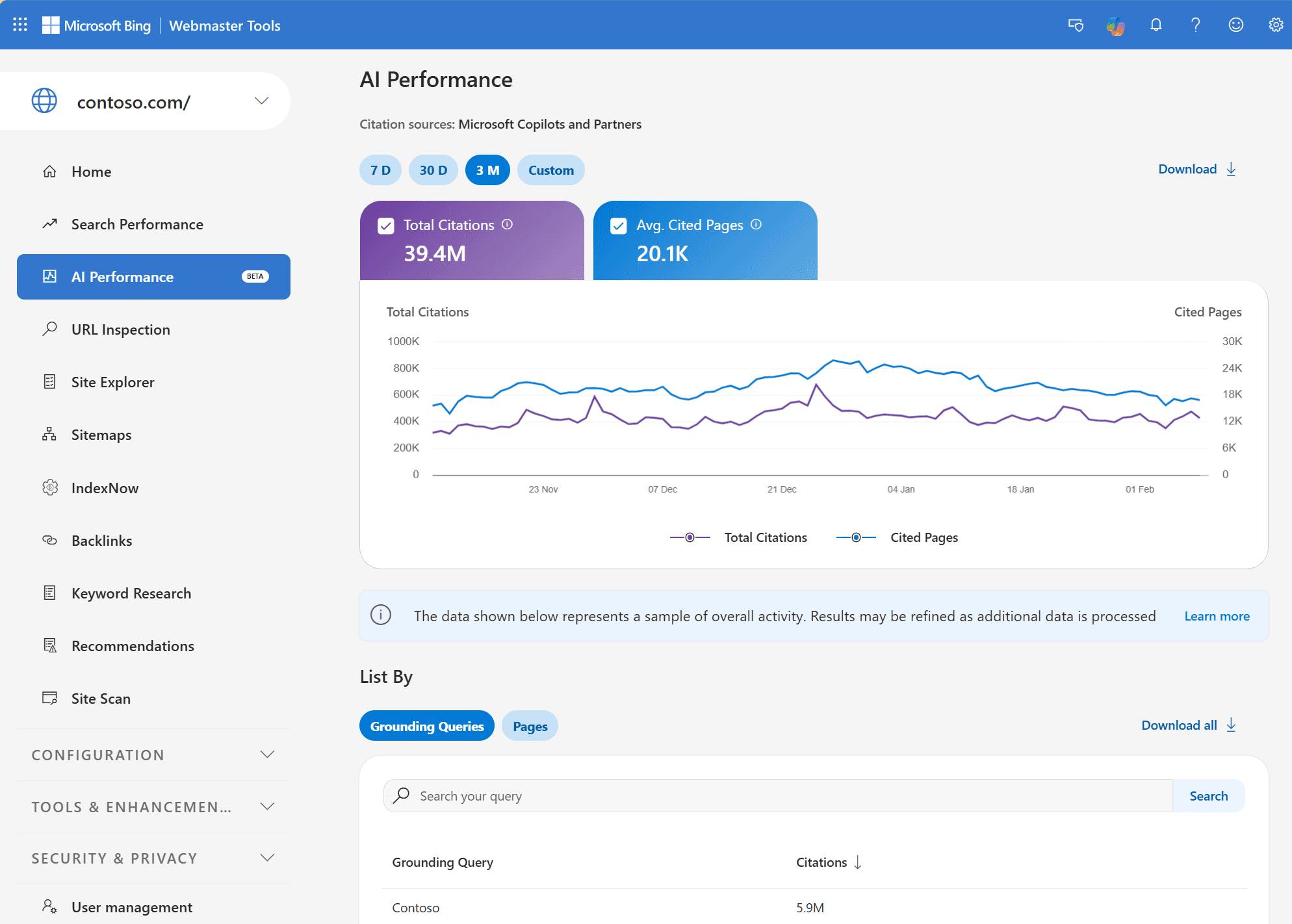
The AI Performance report is a new, dedicated dashboard inside Bing Webmaster Tools. It sits under the Search Performance section and focuses exclusively on one thing: citation visibility across Microsoft's AI-powered surfaces.
Unlike traditional search analytics that track rankings, impressions, and clicks, this report answers a fundamentally different question: Is your content being used as a source when AI generates answers?
Microsoft framed the launch as "an early step toward Generative Engine Optimization (GEO) tooling," and they're not wrong. This is the foundation of a new optimization discipline. Until now, tracking whether AI platforms cited your content was guesswork — checking referral logs, manually querying ChatGPT, or relying on third-party scrapers. Bing just made it measurable.
The announcement came from Microsoft's Krishna Madhavan, Meenaz Merchant, Fabrice Canel, and Saral Nigam on the Bing Webmaster Blog.
Quick context:Search Engine Land first reported that Microsoft was testing this report in a limited beta back on January 27, 2026. The public preview went live for all verified sites on February 10.
Five Metrics Inside the Dashboard
The dashboard introduces five core metrics. None of them work like traditional search console data. Here's what each one actually tells you:
Metric | What It Measures | What It Doesn't Tell You |
|---|---|---|
Total Citations | How many times your site appeared as a source in AI answers during a selected date range | Placement, prominence, or whether the citation had a visible link |
Average Cited Pages | Daily average of unique URLs from your site that AI systems referenced | Authority, ranking, or relative importance of cited pages |
Grounding Queries | Sample phrases the AI used when retrieving your content (not the user's exact question) | Full query set — Microsoft notes this is a sample that will be refined |
Page-Level Citation Activity | Citation counts broken down by individual URL | Why specific pages get cited more than others |
Visibility Trends Over Time | A timeline of citation activity across AI experiences | Correlation with traffic, conversions, or revenue impact |
A few things worth noting. Average Cited Pages is particularly useful for understanding whether citations cluster on a few pages or spread across your entire site. If your top 3 blog posts account for 90% of citations, that tells you something about content structure and topical authority.
Visibility Trends let you spot patterns, spikes after publishing new content, drops after algorithm changes, or seasonal shifts. If you publish a data-backed case study and see citations jump within a week, you have real evidence that timely, structured content drives AI visibility.
Important: All metrics reflect citation frequency only. Microsoft explicitly states they don't indicate ranking, authority, or the role a page played in any specific AI answer. There's no "cited in position 1" because AI answers don't work that way.
How Grounding Queries Work (And Why They Matter)
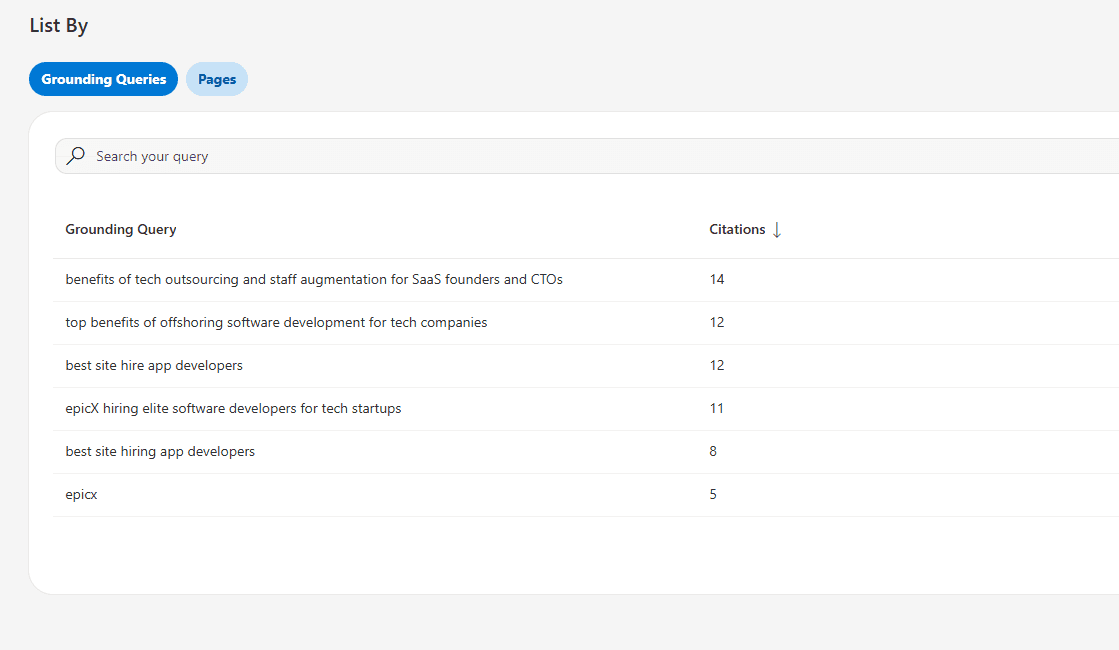
This is probably the most interesting ( and most confusing ) part of the new dashboard.
Grounding queries are not the actual questions users type into Copilot or Bing. They're the internal search phrases Bing's retrieval system generates to find candidate content before constructing an AI answer.
Here's how the process works:
A user asks Copilot something conversational, like "What's the best way to recover from the Google core update?"
Bing's AI system translates that intent into structured retrieval queries — something like "Google core update recovery strategies" or "core update SEO fixes 2026."
The retrieval system searches Bing's index using those grounding queries.
Your content gets cited if it matches the grounding query semantically and structurally.
This distinction matters for your content strategy. You need to write for both conversational user language (the way people talk to AI assistants) and structured retrieval language (the way Bing's grounding layer searches for sources).
Practical Implications for Content Teams
When you see specific grounding queries appearing in your dashboard, treat them like a keyword discovery tool on steroids. They reveal what Bing's AI is actually searching for, not what users type.
If "multilingual SEO strategies" keeps showing up as a grounding query, you know that exact phrase is a strong retrieval signal. You can then audit your related pages and ensure they use that phrasing in headings and opening paragraphs. This is a direct window into how to rank in AI search.
One more thing: grounding queries often include implied time filters. If users are asking about "SEO tools," Bing might ground it as "SEO tools 2026" to surface recent content. This reinforces why publishing fresh, updated content consistently is no longer optional — it's a retrieval requirement.
Worth watching: As industry SEO experts like Wil Reynolds and Aleyda Solis pointed out on X, grounding queries are still being refined by Microsoft. Fabrice Canel acknowledged this is a sample metric that will improve over time. Expect it to get more granular throughout 2026.
Barry Schwartz covers the Bing AI Performance Report in his weekly search news recap — including initial industry reactions and what the grounding queries actually mean.
The Big Gap: No Click Data
Let's address the elephant in the room. The AI Performance report does not show click-through data.
You can see how many times Copilot cited your site, but you won't know how many users actually clicked from that citation to visit your page. This is, as Search Engine Land put it, the reason "publishers still can't tell if AI visibility delivers value."
A page cited 200 times might generate 50 clicks or zero clicks, depending on:
How the AI answer was phrased (did it fully answer the question inline?)
Whether the citation appeared with a visible, clickable link
Whether the user even noticed the source attribution
For agencies billing on performance, this creates a real reporting gap. You can demonstrate visibility — "your content was cited 400 times in Copilot this month" — but you can't tie it to conversions or revenue. Not yet, anyway.
Microsoft hasn't announced plans to add click metrics. Fabrice Canel said on X that "it's just a preview, you will get more in 2026," but no specifics on click data were offered.
The Workaround (For Now)
Until click data arrives, cross-reference your citation volume with GA4 referral traffic from Bing and Copilot. Look at traffic patterns from copilot.microsoft.com and Bing referral sources. It's manual, it's imperfect, but it's the best way to estimate whether AI citations are actually driving visitors.
If you're analyzing SEO performance trends across channels, adding AI citation volume as a parallel metric gives you a more complete picture of where your content is being consumed — even if the conversion path isn't fully trackable yet.
Bing vs. Google: Who's Giving Publishers More?
This is where things get interesting. Bing and Google have taken fundamentally different approaches to AI search reporting, and neither one gives the full picture.
Feature | Bing AI Performance | Google Search Console |
|---|---|---|
Dedicated AI report | ✅ Yes — separate AI Performance dashboard | ❌ No — AI Overviews lumped into standard reporting |
Citation counts by URL | ✅ Yes — page-level breakdown | ❌ No — all AI Overview links share one position |
Grounding queries | ✅ Yes — sample phrases shown | ❌ No |
Click data | ❌ No | ✅ Yes — clicks and impressions included |
AI vs. organic separation | ✅ Fully separated | ❌ Combined — can't distinguish AI clicks |
API access | ❌ Not yet (on backlog per Fabrice Canel) | ✅ Available via Search Console API |
As Search Engine Journal noted, "Bing's dashboard goes further. It tracks which pages get cited, how often, and what phrases triggered the citation. That gives you data to work with instead of guesses."
Google includes AI Overviews in its standard Performance reporting — meaning you get click data, but you can't isolate it. All cited links inside an AI Overview share the same position value, making it impossible to distinguish traditional organic clicks from AI-driven ones.
Bottom line: Bing gives you more granular citation data. Google gives you traffic data. Neither platform offers both yet. Smart SEO teams will monitor both and cross-reference to build the most complete picture possible.
What SEO Teams Should Do Right Now
This isn't a "wait and see" moment. There are concrete steps you can take today to start building an ai search optimization workflow around this data.
1. Verify Your Site in Bing Webmaster Tools
If you haven't already, claim and verify your site. Even if Bing represents a smaller share of your traffic than Google, it's currently the only search engine offering dedicated AI citation reporting. Access the report at bing.com/webmasters/aiperformance.
2. Audit Existing Content for Citation Eligibility
Pages that get cited share certain structural patterns. Run a crawl to identify:
Thin pages under 300 words with no clear definitions
Pages missing H2/H3 heading structure
Content without schema markup (especially FAQ, HowTo, and Article schema)
Pages that bury the answer deep in the content instead of leading with it
Content with proper schema markup shows 30-40% higher visibility in AI-generated answers, according to research from multiple GEO studies. If you're running programmatic SEO campaigns, make sure every template includes these structural elements by default.
3. Monitor Grounding Query Trends Weekly
New grounding queries appearing in your dashboard are content opportunities. If you spot a query you don't have dedicated content for, build it. Treat grounding queries the way you'd treat a keyword gap analysis — they show you exactly what Bing's AI is searching for when it retrieves sources.
4. Compare Citation Volume to Traditional Rankings
If a page ranks #3 in traditional search but has zero AI citations, investigate. Common culprits:
No featured snippet-style definition in the opening paragraph
Vague headings that don't map to grounding queries
Missing authoritative external links that signal trustworthiness
Outdated content that AI systems skip in favor of fresher sources
5. Test Content Formats That Favor Citations
Early patterns suggest certain formats get cited more often:
Content Format | Citation Potential | Why It Works |
|---|---|---|
How-to guides | High | Step-by-step structure maps cleanly to AI answer formats |
Comparison tables | High | Structured data that AI can extract and summarize easily |
Definition-heavy content | High | Direct answers to "what is" queries that grounding systems target |
FAQ sections | High | Q&A format matches conversational retrieval patterns |
Data-backed case studies | Medium-High | Specific statistics and outcomes that AI systems trust as authoritative |
Opinion/commentary | Low | AI systems prefer factual, structured content over subjective takes |
If you're publishing thought leadership, pair it with a structured FAQ or methodology section to increase citation odds. For content teams working with AI SEO tools, this data should directly inform your editorial calendar priorities.
How Third-Party SEO Tools Will Adapt
This launch sends a signal to the entire SEO tooling ecosystem. Platforms like Ahrefs, Semrush, Moz, and Surfer SEO currently track traditional rankings and backlinks. None of them measure AI citation frequency natively — because search engines hadn't exposed that data. Until now.
Here's what to expect:
Rank tracking tools will need to add AI citation tracking as a separate metric. Agencies will want to see week-over-week changes in both traditional position and citation volume, broken down by page and topic cluster.
Content optimization platforms like Clearscope, MarketMuse, and Surfer SEO will likely add "AI citation readiness" scoring. This could analyze whether a draft includes featured snippet-style definitions, uses grounding-query-friendly headings, and cites authoritative sources.
Enterprise SEO platforms face the bigger challenge: attribution. If a page is cited 500 times in Copilot but drives only 20 clicks, how do you value that visibility? The industry will need benchmarks for citation-to-traffic ratios before AI performance can be tied to revenue forecasting.
The API question is also critical. Fabrice Canel confirmed on X that the data isn't available via the Bing Webmaster Tools API yet, but it's on their backlog. Once API access opens up, expect a flood of integrations from third-party tools.
Local SEO and AI Citations
Microsoft specifically called out Bing Places for Business in their announcement. For local businesses, accurate structured data is critical for location-based AI queries.
When someone asks Copilot "what's the best Italian restaurant near me with outdoor seating," AI systems pull from verified business listings. If your hours, address, or amenities are wrong in Bing Places, you won't appear in those answers.
For teams managing local SEO at scale, this adds another verification layer. Make sure your Bing Places listings match your website data and your Google Business Profile. Consistency across platforms has always mattered for local SEO — now it matters for AI citations too. Our guide on how to rank higher in local listings covers the foundational steps.
Ready to Automate Your AI Search Strategy?
Keytomic handles keyword research, content creation, publishing, and indexing — structured for both traditional search and generative engines.
What Comes Next for AI Search Reporting
Microsoft launched AI Performance as a public preview, which means the metrics and interface will evolve. Fabrice Canel hinted on X that "more data is coming" in 2026. Likely additions based on industry demand and current gaps:
Click-through data — the single most requested feature from publishers
Intent classification — whether grounding queries are navigational, informational, or transactional
API access — confirmed as being on the backlog, which would unlock third-party integrations
Bing Places integration — deeper local citation tracking for businesses
Google has not announced plans for a dedicated AI Overviews report inside Search Console. They currently lump AI traffic into standard Performance reporting, which makes it impossible to separate traditional clicks from AI-driven ones. If Bing's dashboard gains traction, Google will face competitive pressure to match or exceed the granularity.
Other AI platforms — ChatGPT, Perplexity, Gemini — don't offer webmaster tools at all. Publishers have zero first-party data on citation activity in those environments. This gap will either be filled by platform-level tools or by third-party analytics providers who find ways to monitor AI answers at scale.
The competitive pressure is real. As SEO expert Koray Tuğberk GÜBÜR noted on X: "Microsoft Bing Webmaster Tools has always been more useful and efficient than Google Search Console, and once again, they've proven their commitment to transparency."
A solid overview of Generative Engine Optimization (GEO) fundamentals — helpful context for understanding why Bing's AI Performance data matters for your content strategy.
Frequently Asked Questions
What is the Bing AI Performance report?
A dedicated dashboard in Bing Webmaster Tools that shows how often your content is cited in AI-generated answers across Microsoft Copilot, Bing AI summaries, and select partner integrations. It tracks citation frequency — not rankings or click-through rates.
Does the report show click-through data?
No. As of the February 2026 public preview, the report only tracks citation frequency. Microsoft has hinted that more data is coming but hasn't committed to a timeline for click metrics.
What are grounding queries?
Internal search phrases that Bing's AI system generates to retrieve candidate content before constructing an answer. They're different from the actual user query — for example, a user might ask "how do I speed up my Shopify store" but Bing grounds it as "Shopify speed optimization 2026."
How can I increase my AI citations?
Structure content with clear H2/H3 headings, lead with direct definitions, add FAQ schema markup, cite authoritative sources, and publish fresh content regularly. Pages that follow best practices for AI content indexing tend to perform better across both traditional and AI search.
Is this data available via API?
Not yet. Fabrice Canel confirmed that enabling AI Performance data in the Bing Webmaster Tools API is on their backlog, but no timeline has been provided.
When will Google release a similar report?
Google has not announced plans for a dedicated AI Overviews citation dashboard as of February 2026. AI Overview data is currently bundled into standard Search Console Performance reporting without citation-level breakdowns.
Should I care about Bing if most of my traffic comes from Google?
Yes. Bing is the only platform currently offering first-party AI citation data. Use it to refine your content structure and test what drives citations — those insights will transfer to other platforms (including Google) once they release similar tools. The optimization patterns that work for Bing's AI will likely work across all generative engines.