Share Article

A practical framework for comparing AI SEO tools by workflow fit, automation depth, reporting, and AI search visibility for teams and agencies.
The fastest way to choose the right SEO platform is not to chase every AI feature on the market. It is to compare tools by the jobs you actually need done, from research and briefs to publishing and AI visibility tracking.
If you are evaluating the best ai seo tools for a small team or agency, this guide shows you what matters, what to ignore, and where a platform like Keytomic fits into an automation-first workflow.
What an AI SEO tool should actually do
A good AI SEO tool does more than write text. It should help you find opportunities, map topics, generate usable briefs, improve content quality, and keep work moving after publish.
For agencies, the right seo tool for agencies also reduces handoff friction. That means fewer tabs, fewer exports, and fewer checks spread across separate apps.
Google's documentation still emphasizes structured data and clear page meaning as signals that help search systems understand content, even though rich result support changes over time. That matters because modern SEO tools should support not just writing, but page structure and visibility across search surfaces. (developers.google.com)
The core jobs to compare
Use this list to separate useful platforms from feature clutter:
Keyword discovery and topic clustering
Search intent analysis
Content brief generation
Draft creation and editing support
On-page seo content optimization tool features
Internal linking suggestions
Technical checks like schema, canonicals, and robots directives
AI visibility tracking and brand monitoring
Publishing or workflow automation
A simple comparison framework that keeps you focused
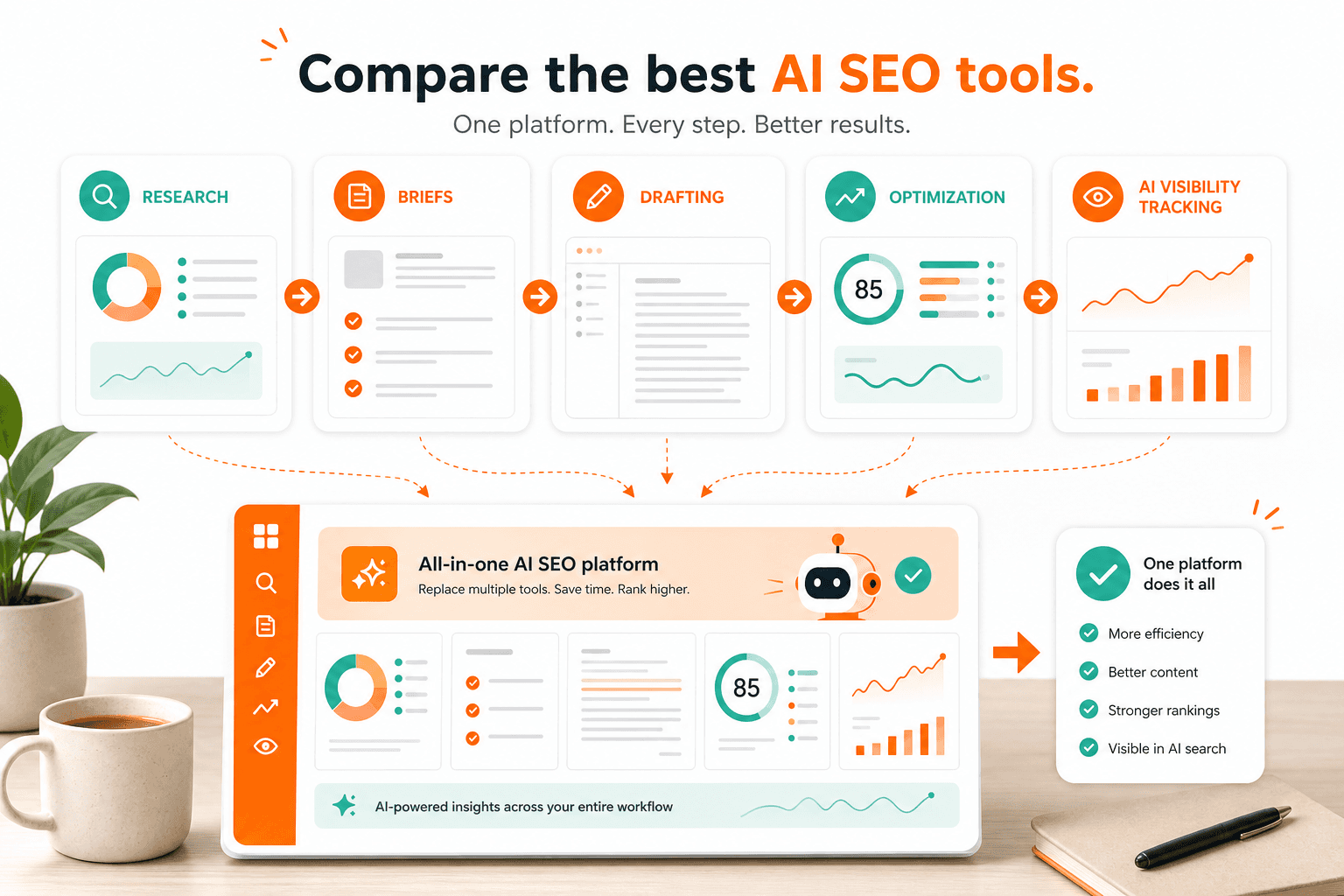
Most buyers get stuck because every vendor claims to do everything. Instead of comparing feature lists line by line, score each tool in the same five areas.
Comparison area | What to look for | Why it matters |
|---|---|---|
Workflow depth | Research, drafting, optimization, publishing, tracking | More steps in one place means less manual coordination |
Agency fit | Multi-client support, collaboration, approvals | Agencies need repeatable output, not one-off writing |
Optimization quality | Briefs, entity coverage, SERP alignment | Better content structure improves execution consistency |
AI visibility | Monitoring in AI answers and LLMs | Search is expanding beyond blue links |
Automation | Scheduling, bulk actions, reusable templates | Automation saves time as content volume grows |
This is the point where many teams discover they do not need another isolated writer. They need seo automation software that fits the full process.
How to score tools without bias
Give each category a score from 1 to 5, then weight the ones that affect your outcomes most. A founder may care most about speed and price, while an agency cares about repeatability and client reporting.
If you want a deeper view of how AI search tracking changes strategy, read how an AI search monitoring platform can improve SEO strategy. For brand-level discovery in AI answers, how to improve brand visibility in AI search engines is the next useful read.
Features that matter most for agencies and lean teams
Not every feature deserves equal weight. The most valuable capabilities are the ones that reduce repeated work across many pages or many clients.
1. Keyword research and opportunity finding
You still need a strong starting point. A useful ai seo tool should uncover topic gaps, related entities, and keyword clusters that support a content plan instead of random one-off posts.
That matters because Google Search Central notes structured data helps search systems understand the meaning of a page, and content organization is a big part of that understanding. (developers.google.com)
2. Brief generation and content structure
A strong brief saves more time than a fast draft. Look for tools that suggest headings, search intent, FAQ ideas, internal links, and editorial angles before writing starts.
This is where Keytomic is positioned for small teams, because it is built around content planning as much as content generation. That is a meaningful difference if your team is trying to produce a content calendar instead of isolated posts.
3. Optimization after the draft is written
Many platforms can create text. Fewer can tell you whether the draft actually supports the target query, covers the right entities, or needs clearer structure.
If your team publishes at scale, an seo content optimization tool should help refine title tags, meta descriptions, schema, and internal links before the article goes live. Those are the fixes that often save more ranking effort than extra paragraphs do.
4. AI visibility tracking
AI search visibility matters because discovery is no longer limited to classic results pages. Semrush announced general availability of Enterprise AI Optimization in 2025, with expanded LLM tracking and visibility for AI search experiences, which is a strong signal that this category is becoming mainstream. (semrush.com)
If your buyers ask where your brand appears in AI answers, you need tracking, not just content generation. That is why ai visibility tools now belong in the shortlist for many teams.
Best fit by team type
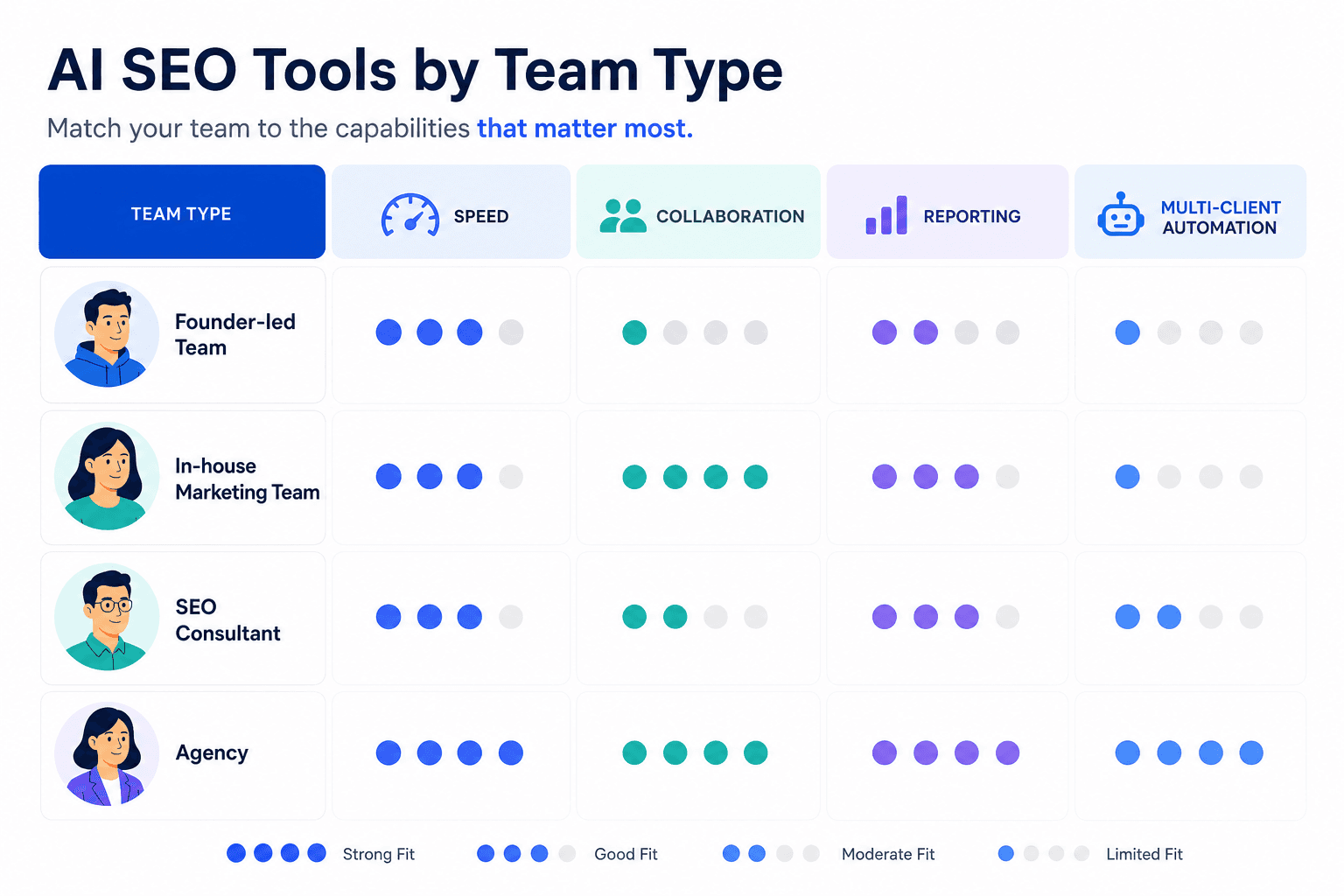
The best ai seo tools are rarely the same for every buyer. Your team structure changes the ideal stack.
Team type | What matters most | Best fit |
|---|---|---|
Founder-led team | Speed, simplicity, price | All-in-one automation with light learning curve |
In-house marketing team | Collaboration, content quality, reporting | Workflow platform with briefs and optimization |
SEO consultant | Audit depth, analysis, repeatability | Tool with research, briefs, and client-ready output |
Agency | Multi-client workflow, bulk production, visibility tracking | seo tool for agencies with automation and AI search support |
A small team usually benefits from consolidation. If you keep research in one tool, drafting in another, and reporting somewhere else, the hidden cost is time lost to handoff and quality checks.
What to ignore when comparing vendors
Shiny features can make a demo feel impressive without improving output. Ignore anything that does not connect to a measurable workflow step.
Common distractions
Giant feature lists with no clear use case
AI writing claims without editing controls
Decorative dashboards that do not guide action
Reporting that looks polished but does not support decisions
Keyword tools that stop at volume and miss intent
A tool can look advanced and still be a poor fit if it creates more manual review than it removes. That is especially true for ai seo tools for marketing agencies, where consistency matters across many clients and pages.
Questions to ask before you buy
Use these questions in every demo:
Can it handle research, brief creation, drafting, and optimization in one workflow?
Does it help me plan content clusters, not just single keywords?
Can I track brand visibility in AI search surfaces?
How much of the process is actually automated?
What will my team still need to do manually?
A practical comparison process you can run this week
Do not compare tools in abstract. Compare them against one real content task.
Pick one keyword cluster you want to rank for.
Ask each tool to build a brief for the same topic.
Check whether the outline reflects search intent and related entities.
Review whether the draft needs heavy rewriting or only light editing.
Test whether the tool supports publishing, linking, or follow-up optimization.
This makes the tradeoffs obvious. A tool that feels expensive on paper may still be cheaper if it cuts two other subscriptions and reduces hours of manual work.
Where Keytomic fits in the comparison
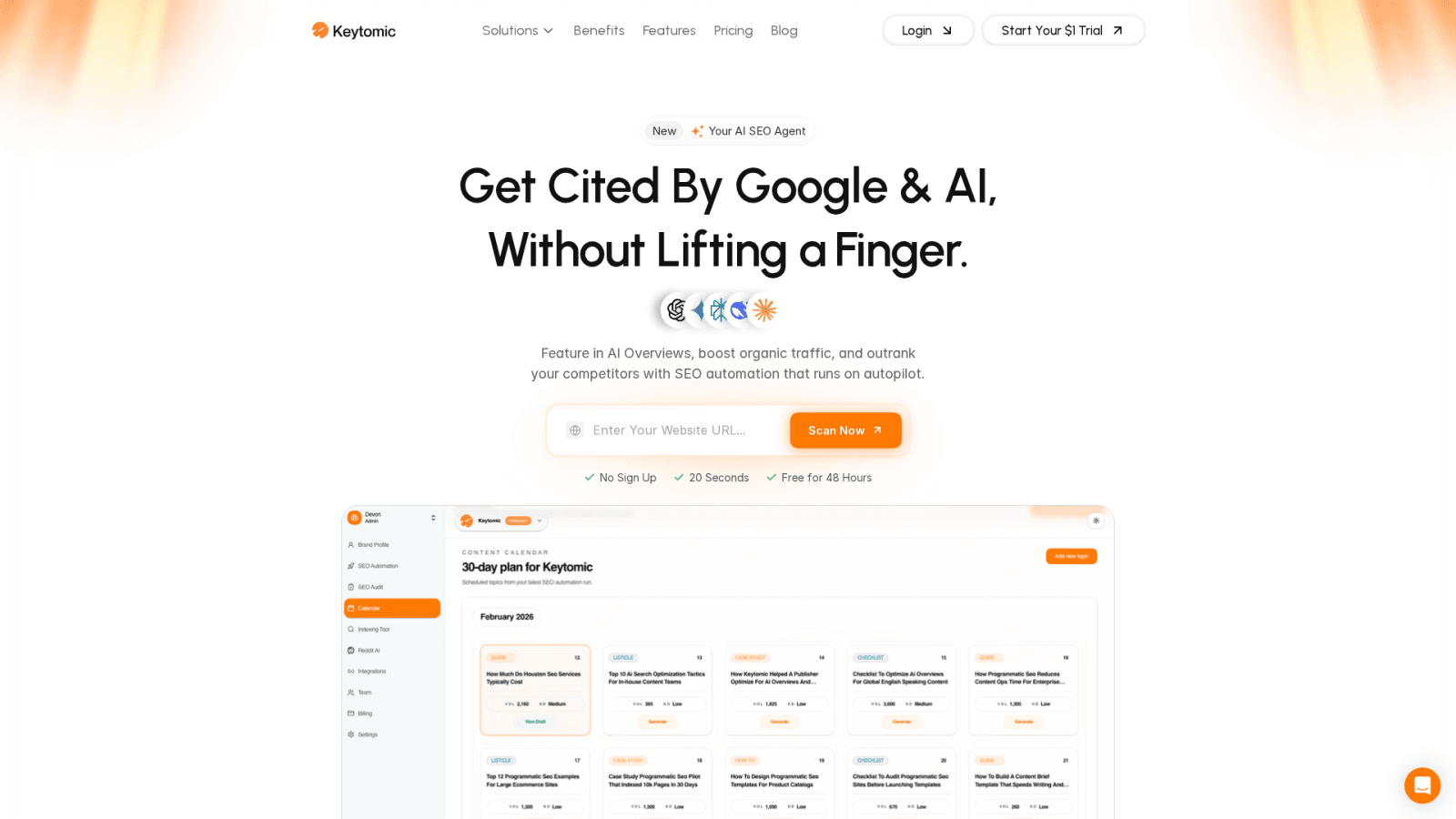
Keytomic is designed for teams that want content-led SEO to run with less friction. Instead of treating AI as just a writer, it focuses on the full organic workflow, including keyword research, planning, article generation, publishing support, indexing, and visibility tracking.
That makes it a strong option if you want one platform to replace a stack of point tools. It is especially relevant for teams looking for seo automation software that supports both traditional search and AI-driven discovery.
The bottom line
The best decision is not the tool with the most features. It is the one that removes the most manual work from your exact workflow while still improving content quality and visibility.
If you are comparing the best ai seo tools for a growing team, pick the platform that helps you plan, produce, publish, and measure in one motion. For many lean teams, that is the difference between a tool that adds overhead and one that actually ships SEO.
FREE AI Visibility Audit

Is Your Brand Visible in AI Searches?
Free AI Visibility Audit → See where you appear (and where competitors appear).