Share Article

Learn how to read AI visibility data, spot your brand gap in ChatGPT, and use a simple scoring model to decide which content to update first.
AI visibility data tells you whether your brand gets cited, mentioned, or ignored when buyers ask AI engines questions in your category. Reading it correctly means knowing which pages are close to being cited, which topics are missing entirely, and which gaps connect to real business value rather than vanity metrics.
Here is the problem most teams run into: they pull a visibility report, see a list of prompts where they are absent, and immediately start updating every page at once. That is the wrong move. Not all gaps are equally urgent, and not all content is equally fixable. The brands winning in AI search right now are making deliberate, prioritized decisions about what to change and in what order.
This guide walks through how to read your AI visibility data properly, filter out noise, and build a prioritization system that gets results without burning your team on low-impact work.
What AI visibility data actually tells you
The core metrics worth paying attention to
AI visibility reports are not the same as rank-tracking dashboards. There is no page-one position to chase. Instead, the metrics that matter are citation frequency, prompt coverage, and mention rate across the AI engines your buyers actually use.
Citation frequency: How often your domain or a specific page is cited as a source in AI-generated answers.
Prompt coverage: The percentage of relevant buyer prompts where your brand appears at all.
Mention rate: How often your brand name is referenced in an answer, even without a direct citation link.
Sentiment signals: Whether the brand is described accurately, positively, or with outdated information.
Competitor gap: Which prompts surface your competitors but not you.
According to Ahrefs research cited by multiple 2025 tracking studies, around 80% of URLs cited by ChatGPT, Perplexity, Copilot, and AI Mode do not rank in Google's top 100 results for the same query. That single statistic reframes the entire problem. Strong Google rankings do not translate to AI visibility, and the two datasets need to be read separately.
What visibility gaps actually signal
A gap where your brand does not appear could mean one of three things. First, you have no content on that topic at all. Second, you have content but it is structured in a way AI engines cannot extract cleanly. Third, your brand lacks sufficient third-party corroboration for that topic. Each of these requires a different fix, and conflating them leads to wasted effort.
Content that is missing needs to be created. Content that is thin or poorly structured needs to be deepened and reorganized. Authority gaps, where no external sources corroborate your brand's position on a topic, take longer to close and usually require a PR or earned media effort in parallel.
How to separate signal from noise in your visibility report
Ignore prompt coverage that does not connect to business value
A common mistake is treating every prompt where you are absent as equally important. Your report may show 200 prompts where you are not mentioned. Most of them will not matter. The ones that matter are the prompts your actual buyers are typing when they are actively evaluating solutions.
Filter your prompt list by three criteria before anything else. The first is buyer intent: is this the kind of question someone asks when they are close to making a purchase decision or building a vendor shortlist? The second is category relevance: does this prompt map directly to your core product category or a feature your team has specifically built? The third is competitive displacement: are competitors being cited in this answer while you are absent?
Prompts that meet all three criteria are your real signal. Everything else is noise you can deprioritize.
The Google rank vs ChatGPT visibility gap
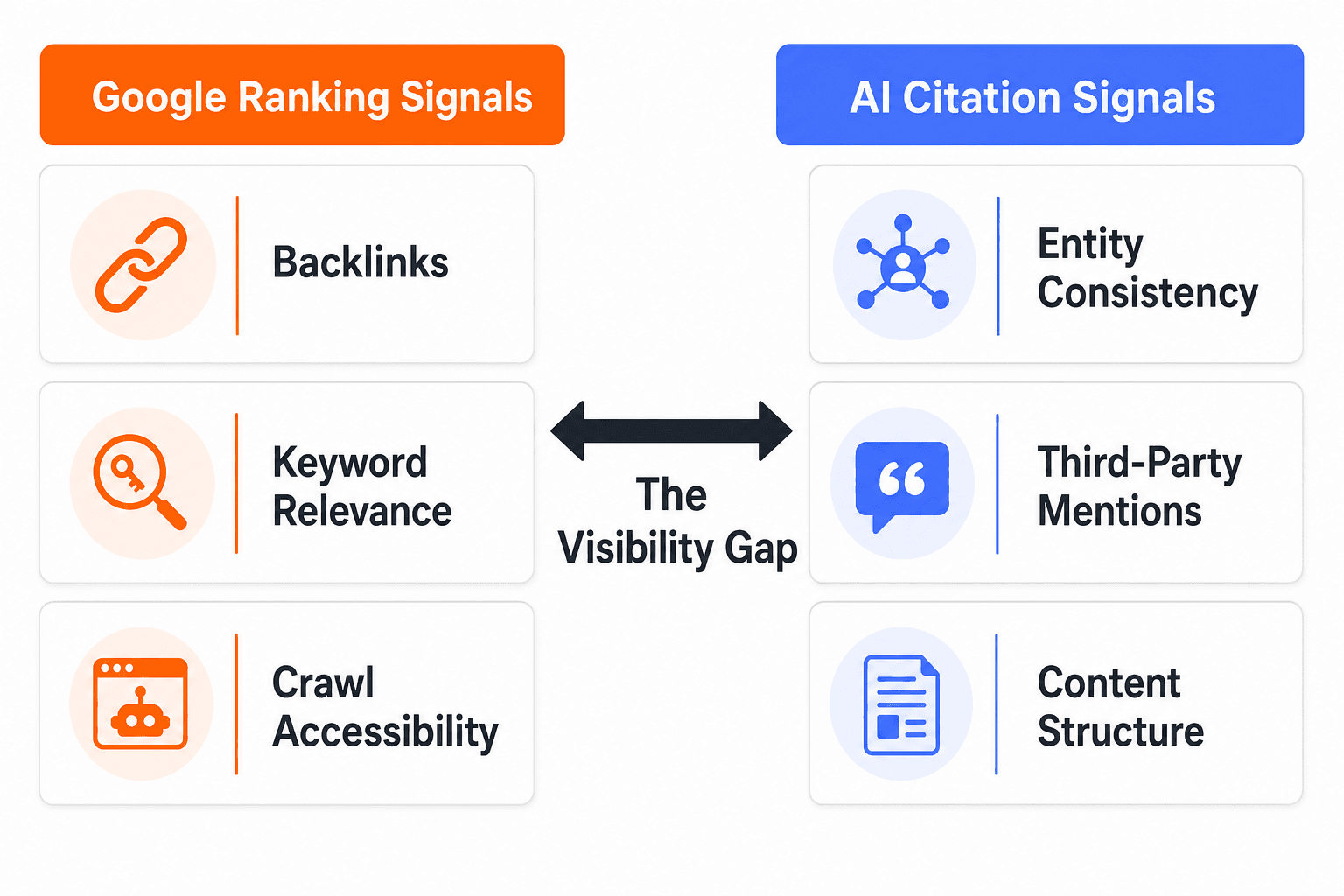
This is where a lot of B2B SEO teams get confused. You can hold a top-three Google ranking for a primary keyword and still be completely absent from ChatGPT answers on the same topic. The Google rank vs ChatGPT visibility divergence is not a bug; it reflects genuinely different ranking signals.
Google rewards backlink authority, on-page keyword relevance, and crawl accessibility. ChatGPT and similar LLMs weight entity consistency, third-party mentions across trusted sources (Reddit, Wikipedia, G2, industry publications), content structure, and directness of answers. A page optimized purely for traditional SEO will often fail both structure tests and third-party corroboration checks that AI engines run.
The practical implication: if a page ranks well on Google but scores low in AI visibility, the problem is usually content format and entity coverage, not authority. That is actually easier to fix than a backlink deficit.
The fastest way to decide what content to change first
A four-factor prioritization framework
Once you have separated signal from noise, the next step is sequencing. Use this four-factor framework to rank every gap on your list before you write a single word.
Revenue proximity: Does this topic appear in queries buyers ask during active vendor evaluation? A prompt like "best SEO automation tools for agencies" is more revenue-proximate than "what is content marketing."
Closeness to citation: Is your brand already being mentioned in some AI answers for this topic but not cited, or are you absent entirely? Pages that are close to citation thresholds move faster when updated.
Effort to fix: Is this a structural rewrite, a content gap requiring net-new creation, or a light refresh of an existing page?
Prompt search volume and difficulty: Cross-reference your visibility gaps against keyword volume and difficulty data to prioritize topics with real demand and achievable citation potential.
Start with gaps that score high on revenue proximity and low on effort. These produce results fast and build confidence in the process. Reserve your heaviest content investments for high-intent, high-volume gaps where competitors are already winning AI citations.
What "close to citation" actually looks like
A page that is close to citation typically meets some but not all of the signals AI engines look for. Common patterns include: the page answers the question but buries the answer in the third paragraph; the page has one clear section but lacks supporting data or specific claims; or the brand is mentioned on the topic by a few external sources but not enough for an LLM to confirm authority.
These pages are the highest-ROI targets in your update queue. A structural edit, a direct-answer paragraph at the top, or the addition of a cited statistic can move a page from "ignored" to "cited" faster than building an entirely new piece of content from scratch.
A simple scoring model for content updates
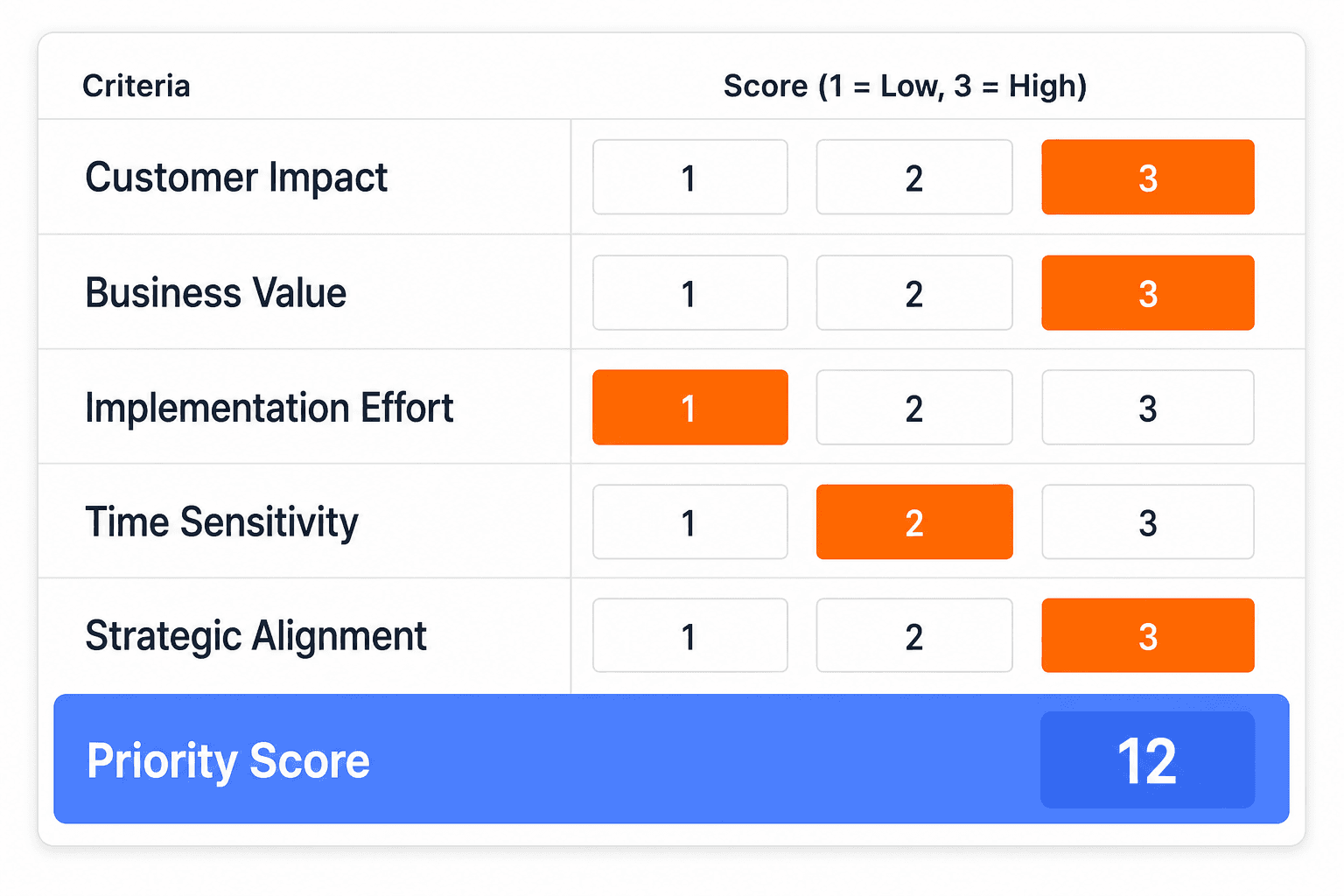
Use this scoring table to rank pages in your update queue. Score each criterion from 1 (low) to 3 (high), then sum the scores. Pages with the highest totals should be updated first.
Scoring Criterion | Score 1 | Score 2 | Score 3 |
|---|---|---|---|
Buyer intent match | Informational only | Consideration stage | Decision/evaluation stage |
Revenue proximity | Brand awareness topic | Category-level topic | Competitor comparison or purchase prompt |
Current visibility gap | Completely absent | Mentioned, not cited | Close to citation threshold |
Effort to fix | Full rewrite needed | Structural refresh required | Light update or answer insertion |
Competitor displacement | No competitor cited | One competitor cited | Multiple competitors cited, brand absent |
A page scoring 12 to 15 is an immediate priority. A page scoring 7 to 9 belongs in the next sprint. Anything below 7 can wait unless your roadmap has capacity.
This model is not perfect, and it requires honest assessment. The temptation is to score your favorite pages higher than the data supports. Treat it as a first-pass filter, not a final editorial decision.
How Keytomic approaches AI visibility analysis
Keytomic is an AI-driven SEO engine built specifically for teams who need to track and close AI visibility gaps without building and maintaining manual spreadsheets for every update cycle.
The platform connects AI visibility tracking with automated content gap analysis, 30-day content roadmaps, and publishing workflows in a single system. Instead of running manual prompt tests across ChatGPT and Perplexity each week, Keytomic surfaces citation gaps, identifies which pages are close to earning citations, and maps those gaps to content actions.
For teams trying to close the brand-invisible-in-ChatGPT problem at scale, the bottleneck is rarely identifying that a gap exists. It is knowing which gap to fix first and having a production workflow that actually gets the updated content published before the next review cycle. Keytomic's roadmap automation addresses both sides of that problem. You can read more about the underlying GEO and SEO strategy framework that informs how the platform ranks and sequences content recommendations.
It is worth being direct about what the platform does not do automatically: strategic topic selection based on unique business goals still requires human judgment. The system surfaces the data and sequences the work; your team decides which topics are non-negotiable based on product positioning and sales priorities.
Common mistakes when reading AI visibility data
Reacting to single-data-point shifts
AI Overview content changes approximately 70% of the time for the same query, and when an answer updates, nearly half of the citations are replaced with new sources. That level of volatility means a single visibility drop on one prompt is not a content emergency. It may be normal rotation. Always look at trend lines across multiple measurement periods before treating a change as a signal that requires immediate action.
Updating low-value pages first
The most common prioritization error is starting with pages that are easy to update rather than pages that matter. Updating a general informational post when a high-intent comparison page is sitting completely absent from AI answers is a misallocation of effort. Use the scoring model above to enforce a discipline here.
Confusing AI search visibility with traditional rank tracking
AI visibility and traditional search visibility measure fundamentally different things. A brand that is not appearing in ChatGPT for category queries is not necessarily doing poorly on Google. These datasets need separate review cycles, separate prioritization queues, and separate success metrics. Teams that fold AI visibility data into their standard rank-tracking workflow will consistently misread what the data is telling them.
When to refresh, merge, or leave content alone
Refresh
A light refresh is appropriate when a page has solid structure but lacks a direct-answer paragraph, is missing specific claims with data, or has content that is more than 12 months old on a fast-moving topic. These updates typically take less than two hours and can materially improve citation probability.
Perplexity, for instance, cites content updated within the last 30 days at a significantly higher rate than content older than six months. For platforms that perform real-time retrieval, freshness is a citation signal you can act on quickly.
Merge
Merge pages when you have two or three thin pieces covering overlapping subtopics that individually lack depth. A consolidated page with broader entity coverage and more specific claims will outperform three shallow pieces in AI retrieval. Before merging, check whether any of the thin pages are currently earning Google traffic. If so, redirect and preserve the canonical URL.
Full rewrite
A full rewrite is warranted when the existing content is structured around keyword density rather than direct answers, when the framing is outdated relative to current buyer questions, or when the LLM citations checklist reveals multiple structural failures on the same page. Rewrites are high effort; reserve them for pages with high revenue proximity scores.
Leave it alone
Not every content gap requires immediate action. If a topic has low buyer intent, no competitive displacement, and appears on no purchase-stage prompts, it can stay in the backlog without penalty. Treat inaction as a deliberate choice, not an oversight, and revisit during each quarterly review.
FAQs about AI visibility data and content prioritization
How often should I review my AI visibility data? For most teams, a monthly review cycle is sufficient. Fast-moving topics or active product launches may warrant bi-weekly spot checks across ChatGPT and Perplexity.
Which pages should I update first for AI visibility? Start with high-intent pages where competitors are cited and you are absent. These have the highest revenue proximity and the clearest competitive displacement signal.
What metrics matter most in an AI visibility report? Citation frequency, prompt coverage on decision-stage queries, and competitor displacement rate. Mention rate without citation is a secondary signal worth monitoring but not acting on immediately.
Is strong Google ranking enough to get cited by ChatGPT? No. Research shows around 80% of AI-cited URLs do not rank in Google's top 100 for the same query. AI citation depends on content structure, entity coverage, and third-party corroboration signals that differ from traditional ranking factors.
How long does it take to see results after updating content for AI visibility? For platforms with real-time retrieval like Perplexity, improvements can appear within days to weeks. For ChatGPT, which has longer model update cycles, expect 4 to 12 weeks depending on how frequently the relevant topic area is refreshed in training or retrieval windows.
FREE AI Visibility Audit

Is Your Brand Visible in AI Searches?
Free AI Visibility Audit → See where you appear (and where competitors appear).