Table of Contents
Share Article
How An AI Search Monitoring Platform Can Improve SEO Strategy
How An AI Search Monitoring Platform Can Improve SEO Strategy
How An AI Search Monitoring Platform Can Improve SEO Strategy

Kashaf
SEO Manager
Stay ahead of the zero-click shift. Find out how an AI search monitoring platform can improve SEO strategy, optimize for AI answers, and drive actual growth
Search has fundamentally changed. AI-powered engines - like Google AI Overviews, ChatGPT, Perplexity, and Gemini - now generate comprehensive answers instead of just listing results, and they are doing it at an unprecedented scale.
As of early 2026, roughly 68% to 72% of all Google searches end without a single click to an external website, with mobile zero-click rates hitting around 75%.
The shift is even more dramatic in conversational interfaces: when users engage with Google's dedicated AI Mode, an astonishing 93% of searches end without any outbound clicks.
Traditional rank-tracking tools never were designed for this environment. They tell a team what position a page has on a SERP; they can't tell a team if that brand is cited when someone asks ChatGPT for a vendor recommendation, or how a competitor has quietly dominated AI answers in a category.
Keytomic has seen this gap widen across each client sector and it is the reason that AI search monitoring has shifted from a specialist technique to a baseline strategic requirement in 2026.
The sections below cover what the technology does, where the performance gains are and how to integrate the technology into an existing SEO program.
What is an AI Search Monitoring Platform?
An AI search monitoring platform keeps track of a brand's visibility, mentions and citations within AI generated search environments.
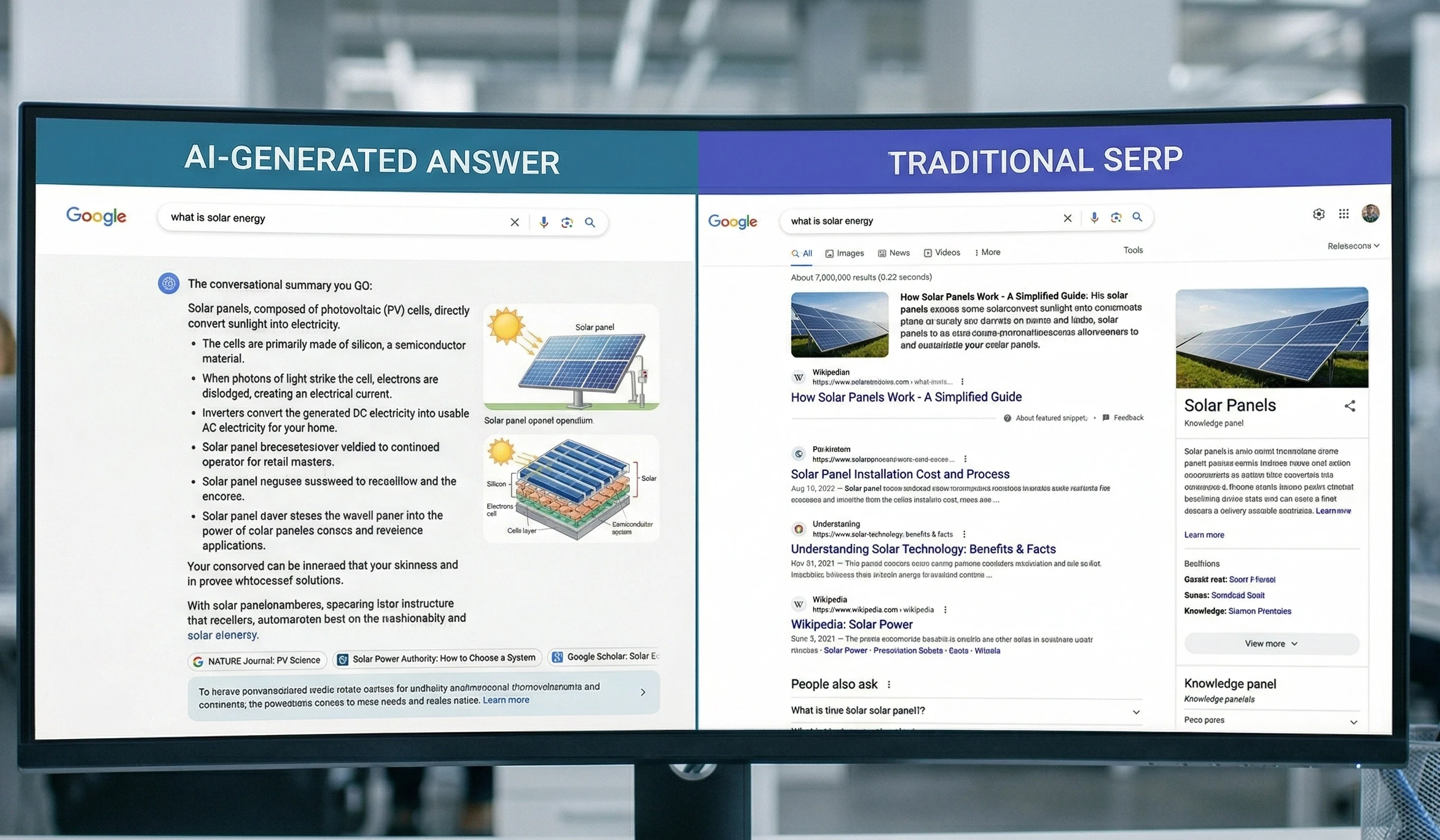
Where traditional SEO tools record the position of a URL in a list, AI monitoring platforms analyse how and when a brand is mentioned in the synthesised answers that ChatGPT, Perplexity, Google AI Overviews, Gemini and Microsoft Copilot produce.
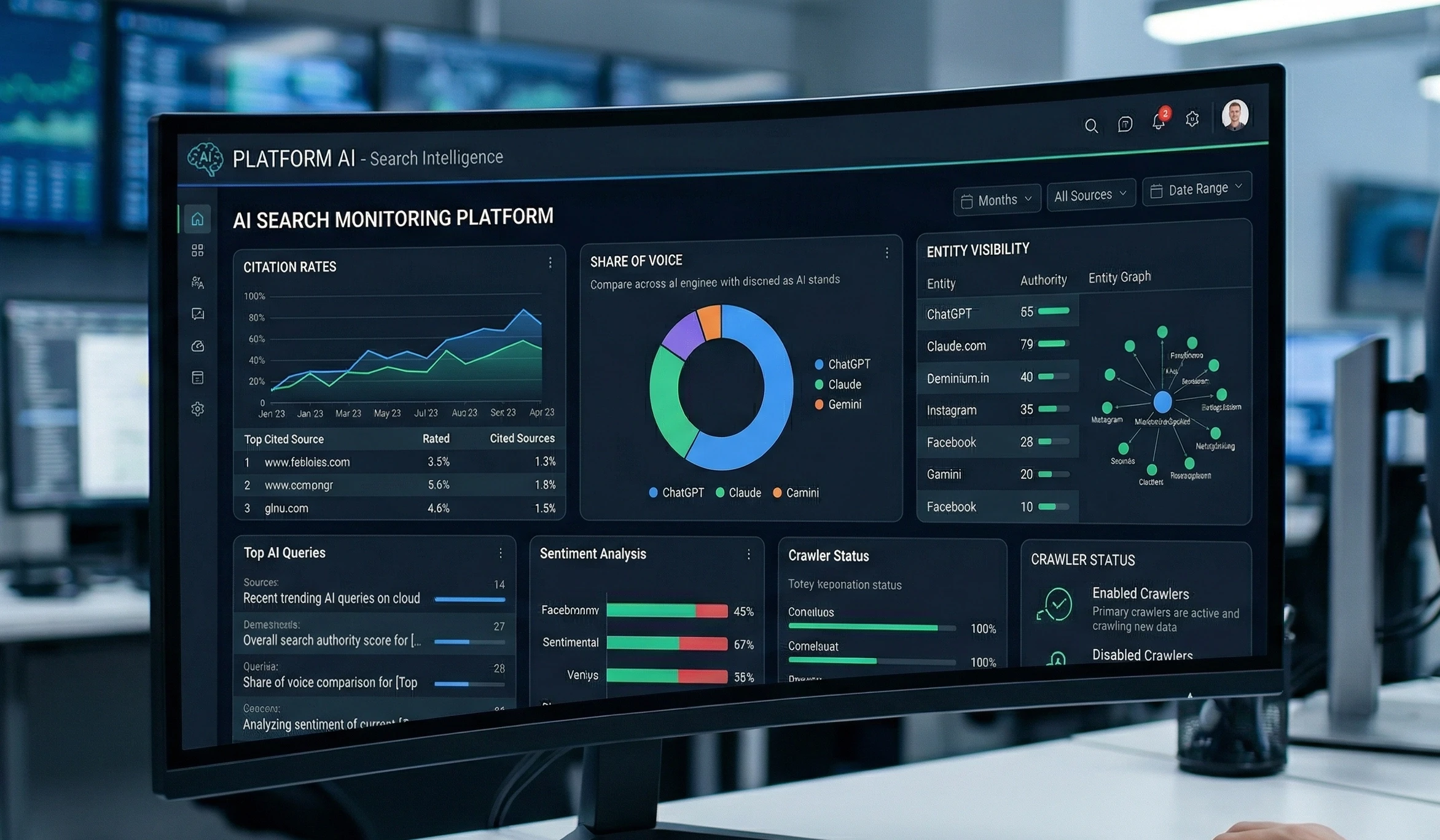
The most important measure is AI share of voice - what percentage of relevant answers generated by AI include the brand, relative to your competition.
These platforms work by asking AI engines a series of questions, then recording whether or not the brand is mentioned, in what context, with what sentiment and whether or not a source URL is cited.
Over time, this data tells us what trends are happening: what content gets consistent AI citations, what topics are surrendered to our competitors, what structural changes or entity changes improve the rate of inclusion.
Keytomic applies this monitoring layer to its entire client base, running it alongside traditional SEO automation tools, to help surface a two-picture view of search performance that neither dataset provides on its own.
The scope of monitoring is usually as follows: AI-generated answer tracking across LLMs, brand mention frequency, entity recognition and knowledge graph signals, citation and URL reference rates, competitor AI presence, and content gap identification.
Why Traditional SEO Tracking is No Longer Enough
Keyword rankings were the appropriate measurement for a world that was all about getting on a list of ten blue links. That world still exists, but it is now one that co-exists with a fundamentally different reality.
Organic CTR in queries in which AI Overviews were displayed fell by 61% from June 2024 to September 2025, from 1.76% to just 0.61%. AI Overviews now cut down on overall clicks by 58% on the queries in which they appear. A page with position one for a high-value keyword may be generating a fraction of the traffic that it had 18 months ago - and traditional rank tracking will report no change.
The zero-click acceleration is not uniform. On mobile, zero-click searches get to 75%. Queries of eight words or longer - the complex and high-intent questions that lead to research and purchase consideration - now generate AI Overviews 57% of the time.
For B2B and professional services businesses, the queries most likely to be converted are those most likely to be answered inside an AI summary, never getting to an organic click at all.
Meanwhile, AI referral traffic is increasing rapidly. AI platforms generated 1.13 billion referral visits in June 2025 - a 357% year over year increase. More importantly, AI search traffic converts at 14.2% as compared to Google organic's 2.8% - making AI citation quality one of the highest-leverage SEO investments that can be made right now. T
eams only using traditional tools are optimising for a channel that is getting smaller, while the higher converting channel is growing unmonitored.
How AI Search Monitoring Improves SEO Strategy
Integrating AI monitoring is not a replacement of traditional optimisation - it is an extension. The six areas below are where the practical gains are most tangible.
1) Tracking AI Visibility & Mentions
The first advantage is measurement. AI monitoring sets a baseline of how frequently a brand is used in AI-generated answers in a set of defined queries.
Without this baseline, there is no way of knowing if improvements in content are leading to an increase in AI citation frequency or a loss of ground to competitors.
Only 22% of marketers are actively tracking AI visibility and traffic - which means the 78% who are not have a blind spot in the fastest growing search channel. Platforms that are focused on this tracking, such as those covered in Keytomic's roundup of AI search visibility tools, are closing that gap for teams that get to work early.
2) Understanding AI Search Intent
AI monitoring shows not only whether a brand is mentioned, but the categories of questions that it is mentioned in.
A brand may rank highly for 'CRM software pricing' and never appear in response to 'what CRM should a 20-person SaaS company use?' - a conversational question which is more indicative of real buyer intent.
Mapping the categories of intent in which a brand is and isn't mentioned yields a precise content brief like no keyword tool can.
3) Optimising Content for AI Answers
Research consistently shows that AI systems prefer content that is clearly structured, has direct answers, a high density of entities, credible citations and factual specificity. AI monitoring allows for content audits that are based on evaluating existing assets against these criteria.
Pages that are well-ranked in traditional search but don't receive AI citations usually require changes to the page structure (e.g., better definitions, FAQ, updated statistics, or schema) rather than new keyword targeting.
The GEO (Generative Engine Optimisation) framework Keytomic applies to client content is built right around these citation-earning signals.
4) Identifying Content Gaps
One of the most strategic outputs of AI monitoring is the gap analysis: queries in which competitors are mentioned in AI answers but not a brand.
These are opportunities missed in which a competitor established itself as the authoritative answer for a relevant topic before others realized it was something people were interested in.
Identifying these gaps as early as possible enables content teams to take action whilst the opportunity remains open - which is the basic premise behind Keytomic's 30-day AI search optimisation roadmap.
5) Competitor AI Visibility Analysis
AI monitoring makes a new type of competitive intelligence possible. Rather than comparing the rankings of keywords, teams can see which competitors are most often cited among the AI generated answers and in which query categories.
A competitor that is consistently coming up in AI responses related to 'best practices in enterprise logistics' is building topical authority with AI systems that will become compounded. Brands mentioned in AI Overviews serve 35% higher organic CTR than non-mentioned brands - which means competitor presence in AI is not only a vanity metric but a direct indicator of revenue.
6) Improving Entity-Based SEO
AI systems know about the world in terms of entities - named concepts, organisations and products - and relationships between them. A brand that is well-represented in Google's Knowledge Graph, and has consistent structured data and authoritative third-party mentions, is much more likely to appear in AI Overviews and LLM responses.
AI monitoring highlights how well known and understood a brand is as an entity, where reinforcement is required. This is why entity clarity is at the centre of how to rank in AI search - this is the foundational signal, everything else in AI optimisation work builds on.
The Real Impact on SEO Performance
Businesses that implement AI search monitoring always report a change in strategic clarity before reporting traffic gains.
The first result is a performance baseline that could not previously be measured: how often is this brand mentioned in the AI answers to the queries that are most important?
From that baseline, improvements in content structure, entity signals and structured data yield measurable improvements in citation frequency in a clear lead up to improvements in qualified referral traffic.
The greater competitive advantage is big. 84% of businesses are not already actively monitoring their AI search presence. Brands that set up AI visibility baselines and optimise systematically now are building up a lead in AI share of voice that will be difficult for late adopters to close.
In sectors where a few trusted sources lead the way in AI answers, being one of them is a long-lasting advantage - and the timeframe to establish that position via content and entity work, instead of via sheer domain authority, is still open in 2026.
Content teams that don't use AI to monitor content are essentially making editorial decisions using half of the data available. With monitoring in place, briefs are informed through actual AI citation gaps.
Priorities are determined by the keyword volume where competitors dominate their answer to AI questions, not by the keyword volume alone. On-page updates are aimed at the things that AI systems value, namely the structural signals that AI systems reward, not keyword density measures that are increasingly less important.
AI Search Monitoring vs Traditional SEO Tools
The two approaches are complimentary. Traditional tools are still essential for technical audits, backlink analysis and rank tracking. AI monitoring gives the added layer of visibility to determine if a brand is in the search experiences growing fastest.
Feature | Traditional SEO Tools | AI Search Monitoring Platforms |
Rank Tracking | Keyword positions on SERPs | AI answer visibility & citation frequency |
Search Insights | SERP-based click-through data | AI-generated response coverage |
Content Optimisation | Keyword density & on-page factors | Entity & intent-focused optimisation |
Competitor Analysis | Ranking positions | AI presence, citations & share of voice |
Zero-Click Coverage | Not tracked | Monitors brand visibility without clicks |
LLM Monitoring | Not available | Tracks mentions in ChatGPT, Gemini, Perplexity |
Entity Tracking | Limited | Full entity recognition & knowledge graph signals |
Reporting Metrics | Traffic, rankings, CTR | Citation rate, AI share of voice, answer presence |
Integrating AI Monitoring Into an SEO Strategy
The best approach is to treat AI search monitoring as an intelligence layer and use it to inform and upgrade all other components of an SEO programme.
In practice, this means linking the outputs of AI monitoring to the planning of content, technical SEO, and link building decisions - not operating in parallel silos.
Practically, integration begins with a dual-metric reporting approach, which means you are tracking both traditional keyword ranking data and AI citation frequency for the same universe of queries. Where rankings are high but AI citations are low, content needs to be improved structurally.
Where citations for AI are strong, but rankings are humble, signals of authority require reinforcement. This combined view is what enables SEO managers to focus on the right priorities rather than optimising one channel but unknowingly degrading the other.
Practically, integration begins with a dual-metric reporting approach, which means you are tracking both traditional keyword ranking data and AI citation frequency for the same universe of queries.
Where rankings are high but AI citations are low, content needs to be improved structurally. Where citations for AI are strong, but rankings are humble, signals of authority require reinforcement.
This combined view is what enables SEO managers to focus on the right priorities rather than optimising one channel but unknowingly degrading the other.
Common Mistakes Businesses Make Without AI Monitoring
Taking rankings as the whole story: Rank tracking is a lagging indicator in 2026 A page that is in position one for a commercial query may be receiving a lot less clicks than 18 months ago if AI Overviews have entered that SERP. Monitoring only rankings gives the illusion that performance is stable when in fact visibility is going down.
Ignoring AI-generated answer visibility: ChatGPT now processes 2 billion queries each day and has more than 77% of all AI-driven website referral traffic in the world. A brand not present in those answers is not present in a growing and large share of how its audience finds information. This is not a risk for the future - it is a gap now.
Not optimising for entities: Many businesses still go about their SEO approach with keyword optimisation without taking entity clarity into account. AI systems that cannot be sure what a brand does, who it serves, and what its knowledge is will not reference it in authoritative answers. Without monitoring, this gap is invisible; with it, the particular entity signals are clearly identifiable that need reinforcement.
Missing emerging search opportunities: AI search monitoring surfaces the conversational questions creating significant AI answer activity in a market - often before those topics develop competitive traditional search volume. Brands who watch this space can develop content around new questions before they are identified, building AI citation authority before their competitors realise the opportunity.
AI Search Optimisation Best Practices (2026)
Structured Data Implementation
Schema markup is one of the most direct signals to help AI systems understand the context of content and relationships between entities. FAQ, How-To, Article, Organisation and Review schema should be implemented where semantically appropriate.
Keytomic's free FAQ Schema Generator and Article Schema Generator make it easy to generate properly formatted schema for any content type without having to rely on a developer.
Entity SEO
Make sure that the brand is being represented consistently and accurately in all major entity databases, social profiles, and authorities directories. Inconsistent entity information across sources creates ambiguity which is resolved by AI systems by lowering the confidence of the citations.
Strong entity clarity is the single most consistent factor that distinguishes those brands that receive frequent AI citations from those that do not.
Content Clarity and Structure
AI systems prefer content written in direct language, with specific provable information, and answers questions in a format that can be extracted as a separate response.
Long paragraphs of general commentary are not often cited. Descriptive subheadings that reflect common formats of queries, concrete statistics with source citations, and answer-first paragraph structure are all consistent ways to improve AI citation rates.
Page Speed and Core Web Vitals
Technical performance is a part of the basic trust signal. Page speed remains an important ranking and citation factor in 2026, with fast loading pages having a measurable advantage in traditional rankings and inclusion in AI Overview. AI systems that have source quality as a criterion for citation penalise pages producing poor user experience signals, even though there may be a well-structured content.
How Keytomic Makes AI Search Monitoring Actionable
Keytomic is designed specifically for the age of AI search. The platform brings AI visibility tracking, entity monitoring and content gap analysis into a single workflow - eliminating the fragmentation that comes with stitching together traditional SEO tools that were never designed to track LLM citations.
Rather than having teams manually query AI engines and log results, Keytomic helps to automate the tracking of ChatGPT, Perplexity, Google AI Overviews, and Gemini to provide a clear AI share of voice metric that updates on a regular cadence.
For agencies that work with multiple clients, Keytomic's agency dashboard allows for portfolio-level AI visibility reporting, which makes it easy to show AI search performance gains along with more conventional metrics.
For in-house marketing teams, the content gap and competitor AI presence features on the platform feed directly into editorial planning - changing the way content is monitored from a static report into a prioritised content action plan.
Teams interested in getting a clear view of where they are in terms of AI search can request a Keytomic demo to see how the platform can map existing AI visibility and pinpoint the highest-priority opportunities for improvement.
Conclusion
AI search monitoring has gone from being a specialist capability to a strategic baseline in 2026. The transition from ranking-based to answer-based visibility is not an evolutionary process that will happen slowly over time - it is the overwhelming dynamic as a substantial and growing portion of search queries.
Businesses who are still only measuring SEO by traditional keyword ranking are working with a framework that was accurate two years ago but no longer reflects how the majority of search activity works now. The brands that are gaining ground in the competition are those that have instrumented both channels and are optimising for both at the same time.
The early mover advantage is still available. 84% of businesses are yet to implement systematic AI visibility monitoring - meaning the AI share of voice advantages established now are compounding against a largely unmonitored competitive set.
Keytomic believes that the future of SEO is in knowing how AI interprets and delivers information. Businesses that implement AI search monitoring early will receive a strong competitive advantage in the changing world of search.
FAQs
What is AI search monitoring?
AI search monitoring monitors brand's visibility, citations, and mentions within AI-generated search results - ChatGPT, Perplexity, Google AI Overviews, and Gemini. Unlike traditional SEO tools that measure keyword rankings, AI monitoring measures citation frequency, AI share of voice, and entity presence across answer-based search environments, giving teams data on the majority of search activity that rank tracking alone can't capture.
How does AI search affect SEO in 2026?
AI search has changed the relationship between ranking and traffic on a structural level. Organic CTRs on the queries with AI Overviews has decreased by 61% since the middle of 2024, and zero-click rates reach 83% when the AI Overviews are present. SEO must now go for two parallel goals, traditional rankings and AI answer citations.
What tools track AI search visibility?
A growing category of AI search monitoring platforms are now tracking LLM and AI Overview visibility. Keytomic is especially made for this purpose providing AI share of voice tracking, entity monitoring, and competitor AI presence analysis. Other platforms in this space have different levels of coverage for LLMs. The most important criteria when reviewing options are: the amount of queries tracked, the breadth of AI engines being monitored, and whether the output from the AI engine is tied directly to content action plan.
Is traditional SEO still relevant in 2026?
Yes - traditional SEO is important. Technical site health, backlink authority, Core Web Vitals and on page optimisation all still have an impact in both traditional rankings and AI citation likelihood. The important change is that traditional SEO is no longer a comprehensive approach. AI monitoring and entity-based optimisation need to be layered on top and ensure visibility in the full spectrum of the way users now discover information.
How can businesses optimise content for AI search?
Focus on five areas: Implement structured data schema comprehensively, build consistent representation of the entities across authoritative data sources, write with direct answers and specific verifiable claims, build topical authority with content clusters, and monitor AI citation frequency to identify gaps.
What is entity-based SEO and why does it matter for AI visibility?
Entity-based SEO optimises how a brand is understood as a named entity by search engines and AI systems. Rather than working on keywords alone, it works to ensure that the brand is clearly defined, is consistently represented in the web and classified within knowledge graphs. Strong entity recognition is the first and most important prerequisite for AI citation - AI systems love sources they can be sure about and attribute to, and entity clarity is the single highest leverage investment in AI search strategy.
Why are zero-click searches a challenge for businesses?
Zero-click searches mean that an increasing number of users get their answer directly from an AI summary without visiting any website. Traditional traffic metrics thus undercount the true value and reach of search visibility. The strategic response is to optimise for presence inside AI summaries - so that when a user gets their answer without clicking, they see the brand as the authoritative source - that builds awareness that influences their later purchase decisions.
Search has fundamentally changed. AI-powered engines - like Google AI Overviews, ChatGPT, Perplexity, and Gemini - now generate comprehensive answers instead of just listing results, and they are doing it at an unprecedented scale.
As of early 2026, roughly 68% to 72% of all Google searches end without a single click to an external website, with mobile zero-click rates hitting around 75%.
The shift is even more dramatic in conversational interfaces: when users engage with Google's dedicated AI Mode, an astonishing 93% of searches end without any outbound clicks.
Traditional rank-tracking tools never were designed for this environment. They tell a team what position a page has on a SERP; they can't tell a team if that brand is cited when someone asks ChatGPT for a vendor recommendation, or how a competitor has quietly dominated AI answers in a category.
Keytomic has seen this gap widen across each client sector and it is the reason that AI search monitoring has shifted from a specialist technique to a baseline strategic requirement in 2026.
The sections below cover what the technology does, where the performance gains are and how to integrate the technology into an existing SEO program.
What is an AI Search Monitoring Platform?
An AI search monitoring platform keeps track of a brand's visibility, mentions and citations within AI generated search environments.
Where traditional SEO tools record the position of a URL in a list, AI monitoring platforms analyse how and when a brand is mentioned in the synthesised answers that ChatGPT, Perplexity, Google AI Overviews, Gemini and Microsoft Copilot produce.
The most important measure is AI share of voice - what percentage of relevant answers generated by AI include the brand, relative to your competition.
These platforms work by asking AI engines a series of questions, then recording whether or not the brand is mentioned, in what context, with what sentiment and whether or not a source URL is cited.
Over time, this data tells us what trends are happening: what content gets consistent AI citations, what topics are surrendered to our competitors, what structural changes or entity changes improve the rate of inclusion.
Keytomic applies this monitoring layer to its entire client base, running it alongside traditional SEO automation tools, to help surface a two-picture view of search performance that neither dataset provides on its own.
The scope of monitoring is usually as follows: AI-generated answer tracking across LLMs, brand mention frequency, entity recognition and knowledge graph signals, citation and URL reference rates, competitor AI presence, and content gap identification.
Why Traditional SEO Tracking is No Longer Enough
Keyword rankings were the appropriate measurement for a world that was all about getting on a list of ten blue links. That world still exists, but it is now one that co-exists with a fundamentally different reality.
Organic CTR in queries in which AI Overviews were displayed fell by 61% from June 2024 to September 2025, from 1.76% to just 0.61%. AI Overviews now cut down on overall clicks by 58% on the queries in which they appear. A page with position one for a high-value keyword may be generating a fraction of the traffic that it had 18 months ago - and traditional rank tracking will report no change.
The zero-click acceleration is not uniform. On mobile, zero-click searches get to 75%. Queries of eight words or longer - the complex and high-intent questions that lead to research and purchase consideration - now generate AI Overviews 57% of the time.
For B2B and professional services businesses, the queries most likely to be converted are those most likely to be answered inside an AI summary, never getting to an organic click at all.
Meanwhile, AI referral traffic is increasing rapidly. AI platforms generated 1.13 billion referral visits in June 2025 - a 357% year over year increase. More importantly, AI search traffic converts at 14.2% as compared to Google organic's 2.8% - making AI citation quality one of the highest-leverage SEO investments that can be made right now. T
eams only using traditional tools are optimising for a channel that is getting smaller, while the higher converting channel is growing unmonitored.
How AI Search Monitoring Improves SEO Strategy
Integrating AI monitoring is not a replacement of traditional optimisation - it is an extension. The six areas below are where the practical gains are most tangible.
1) Tracking AI Visibility & Mentions
The first advantage is measurement. AI monitoring sets a baseline of how frequently a brand is used in AI-generated answers in a set of defined queries.
Without this baseline, there is no way of knowing if improvements in content are leading to an increase in AI citation frequency or a loss of ground to competitors.
Only 22% of marketers are actively tracking AI visibility and traffic - which means the 78% who are not have a blind spot in the fastest growing search channel. Platforms that are focused on this tracking, such as those covered in Keytomic's roundup of AI search visibility tools, are closing that gap for teams that get to work early.
2) Understanding AI Search Intent
AI monitoring shows not only whether a brand is mentioned, but the categories of questions that it is mentioned in.
A brand may rank highly for 'CRM software pricing' and never appear in response to 'what CRM should a 20-person SaaS company use?' - a conversational question which is more indicative of real buyer intent.
Mapping the categories of intent in which a brand is and isn't mentioned yields a precise content brief like no keyword tool can.
3) Optimising Content for AI Answers
Research consistently shows that AI systems prefer content that is clearly structured, has direct answers, a high density of entities, credible citations and factual specificity. AI monitoring allows for content audits that are based on evaluating existing assets against these criteria.
Pages that are well-ranked in traditional search but don't receive AI citations usually require changes to the page structure (e.g., better definitions, FAQ, updated statistics, or schema) rather than new keyword targeting.
The GEO (Generative Engine Optimisation) framework Keytomic applies to client content is built right around these citation-earning signals.
4) Identifying Content Gaps
One of the most strategic outputs of AI monitoring is the gap analysis: queries in which competitors are mentioned in AI answers but not a brand.
These are opportunities missed in which a competitor established itself as the authoritative answer for a relevant topic before others realized it was something people were interested in.
Identifying these gaps as early as possible enables content teams to take action whilst the opportunity remains open - which is the basic premise behind Keytomic's 30-day AI search optimisation roadmap.
5) Competitor AI Visibility Analysis
AI monitoring makes a new type of competitive intelligence possible. Rather than comparing the rankings of keywords, teams can see which competitors are most often cited among the AI generated answers and in which query categories.
A competitor that is consistently coming up in AI responses related to 'best practices in enterprise logistics' is building topical authority with AI systems that will become compounded. Brands mentioned in AI Overviews serve 35% higher organic CTR than non-mentioned brands - which means competitor presence in AI is not only a vanity metric but a direct indicator of revenue.
6) Improving Entity-Based SEO
AI systems know about the world in terms of entities - named concepts, organisations and products - and relationships between them. A brand that is well-represented in Google's Knowledge Graph, and has consistent structured data and authoritative third-party mentions, is much more likely to appear in AI Overviews and LLM responses.
AI monitoring highlights how well known and understood a brand is as an entity, where reinforcement is required. This is why entity clarity is at the centre of how to rank in AI search - this is the foundational signal, everything else in AI optimisation work builds on.
The Real Impact on SEO Performance
Businesses that implement AI search monitoring always report a change in strategic clarity before reporting traffic gains.
The first result is a performance baseline that could not previously be measured: how often is this brand mentioned in the AI answers to the queries that are most important?
From that baseline, improvements in content structure, entity signals and structured data yield measurable improvements in citation frequency in a clear lead up to improvements in qualified referral traffic.
The greater competitive advantage is big. 84% of businesses are not already actively monitoring their AI search presence. Brands that set up AI visibility baselines and optimise systematically now are building up a lead in AI share of voice that will be difficult for late adopters to close.
In sectors where a few trusted sources lead the way in AI answers, being one of them is a long-lasting advantage - and the timeframe to establish that position via content and entity work, instead of via sheer domain authority, is still open in 2026.
Content teams that don't use AI to monitor content are essentially making editorial decisions using half of the data available. With monitoring in place, briefs are informed through actual AI citation gaps.
Priorities are determined by the keyword volume where competitors dominate their answer to AI questions, not by the keyword volume alone. On-page updates are aimed at the things that AI systems value, namely the structural signals that AI systems reward, not keyword density measures that are increasingly less important.
AI Search Monitoring vs Traditional SEO Tools
The two approaches are complimentary. Traditional tools are still essential for technical audits, backlink analysis and rank tracking. AI monitoring gives the added layer of visibility to determine if a brand is in the search experiences growing fastest.
Feature | Traditional SEO Tools | AI Search Monitoring Platforms |
Rank Tracking | Keyword positions on SERPs | AI answer visibility & citation frequency |
Search Insights | SERP-based click-through data | AI-generated response coverage |
Content Optimisation | Keyword density & on-page factors | Entity & intent-focused optimisation |
Competitor Analysis | Ranking positions | AI presence, citations & share of voice |
Zero-Click Coverage | Not tracked | Monitors brand visibility without clicks |
LLM Monitoring | Not available | Tracks mentions in ChatGPT, Gemini, Perplexity |
Entity Tracking | Limited | Full entity recognition & knowledge graph signals |
Reporting Metrics | Traffic, rankings, CTR | Citation rate, AI share of voice, answer presence |
Integrating AI Monitoring Into an SEO Strategy
The best approach is to treat AI search monitoring as an intelligence layer and use it to inform and upgrade all other components of an SEO programme.
In practice, this means linking the outputs of AI monitoring to the planning of content, technical SEO, and link building decisions - not operating in parallel silos.
Practically, integration begins with a dual-metric reporting approach, which means you are tracking both traditional keyword ranking data and AI citation frequency for the same universe of queries. Where rankings are high but AI citations are low, content needs to be improved structurally.
Where citations for AI are strong, but rankings are humble, signals of authority require reinforcement. This combined view is what enables SEO managers to focus on the right priorities rather than optimising one channel but unknowingly degrading the other.
Practically, integration begins with a dual-metric reporting approach, which means you are tracking both traditional keyword ranking data and AI citation frequency for the same universe of queries.
Where rankings are high but AI citations are low, content needs to be improved structurally. Where citations for AI are strong, but rankings are humble, signals of authority require reinforcement.
This combined view is what enables SEO managers to focus on the right priorities rather than optimising one channel but unknowingly degrading the other.
Common Mistakes Businesses Make Without AI Monitoring
Taking rankings as the whole story: Rank tracking is a lagging indicator in 2026 A page that is in position one for a commercial query may be receiving a lot less clicks than 18 months ago if AI Overviews have entered that SERP. Monitoring only rankings gives the illusion that performance is stable when in fact visibility is going down.
Ignoring AI-generated answer visibility: ChatGPT now processes 2 billion queries each day and has more than 77% of all AI-driven website referral traffic in the world. A brand not present in those answers is not present in a growing and large share of how its audience finds information. This is not a risk for the future - it is a gap now.
Not optimising for entities: Many businesses still go about their SEO approach with keyword optimisation without taking entity clarity into account. AI systems that cannot be sure what a brand does, who it serves, and what its knowledge is will not reference it in authoritative answers. Without monitoring, this gap is invisible; with it, the particular entity signals are clearly identifiable that need reinforcement.
Missing emerging search opportunities: AI search monitoring surfaces the conversational questions creating significant AI answer activity in a market - often before those topics develop competitive traditional search volume. Brands who watch this space can develop content around new questions before they are identified, building AI citation authority before their competitors realise the opportunity.
AI Search Optimisation Best Practices (2026)
Structured Data Implementation
Schema markup is one of the most direct signals to help AI systems understand the context of content and relationships between entities. FAQ, How-To, Article, Organisation and Review schema should be implemented where semantically appropriate.
Keytomic's free FAQ Schema Generator and Article Schema Generator make it easy to generate properly formatted schema for any content type without having to rely on a developer.
Entity SEO
Make sure that the brand is being represented consistently and accurately in all major entity databases, social profiles, and authorities directories. Inconsistent entity information across sources creates ambiguity which is resolved by AI systems by lowering the confidence of the citations.
Strong entity clarity is the single most consistent factor that distinguishes those brands that receive frequent AI citations from those that do not.
Content Clarity and Structure
AI systems prefer content written in direct language, with specific provable information, and answers questions in a format that can be extracted as a separate response.
Long paragraphs of general commentary are not often cited. Descriptive subheadings that reflect common formats of queries, concrete statistics with source citations, and answer-first paragraph structure are all consistent ways to improve AI citation rates.
Page Speed and Core Web Vitals
Technical performance is a part of the basic trust signal. Page speed remains an important ranking and citation factor in 2026, with fast loading pages having a measurable advantage in traditional rankings and inclusion in AI Overview. AI systems that have source quality as a criterion for citation penalise pages producing poor user experience signals, even though there may be a well-structured content.
How Keytomic Makes AI Search Monitoring Actionable
Keytomic is designed specifically for the age of AI search. The platform brings AI visibility tracking, entity monitoring and content gap analysis into a single workflow - eliminating the fragmentation that comes with stitching together traditional SEO tools that were never designed to track LLM citations.
Rather than having teams manually query AI engines and log results, Keytomic helps to automate the tracking of ChatGPT, Perplexity, Google AI Overviews, and Gemini to provide a clear AI share of voice metric that updates on a regular cadence.
For agencies that work with multiple clients, Keytomic's agency dashboard allows for portfolio-level AI visibility reporting, which makes it easy to show AI search performance gains along with more conventional metrics.
For in-house marketing teams, the content gap and competitor AI presence features on the platform feed directly into editorial planning - changing the way content is monitored from a static report into a prioritised content action plan.
Teams interested in getting a clear view of where they are in terms of AI search can request a Keytomic demo to see how the platform can map existing AI visibility and pinpoint the highest-priority opportunities for improvement.
Conclusion
AI search monitoring has gone from being a specialist capability to a strategic baseline in 2026. The transition from ranking-based to answer-based visibility is not an evolutionary process that will happen slowly over time - it is the overwhelming dynamic as a substantial and growing portion of search queries.
Businesses who are still only measuring SEO by traditional keyword ranking are working with a framework that was accurate two years ago but no longer reflects how the majority of search activity works now. The brands that are gaining ground in the competition are those that have instrumented both channels and are optimising for both at the same time.
The early mover advantage is still available. 84% of businesses are yet to implement systematic AI visibility monitoring - meaning the AI share of voice advantages established now are compounding against a largely unmonitored competitive set.
Keytomic believes that the future of SEO is in knowing how AI interprets and delivers information. Businesses that implement AI search monitoring early will receive a strong competitive advantage in the changing world of search.
FAQs
What is AI search monitoring?
AI search monitoring monitors brand's visibility, citations, and mentions within AI-generated search results - ChatGPT, Perplexity, Google AI Overviews, and Gemini. Unlike traditional SEO tools that measure keyword rankings, AI monitoring measures citation frequency, AI share of voice, and entity presence across answer-based search environments, giving teams data on the majority of search activity that rank tracking alone can't capture.
How does AI search affect SEO in 2026?
AI search has changed the relationship between ranking and traffic on a structural level. Organic CTRs on the queries with AI Overviews has decreased by 61% since the middle of 2024, and zero-click rates reach 83% when the AI Overviews are present. SEO must now go for two parallel goals, traditional rankings and AI answer citations.
What tools track AI search visibility?
A growing category of AI search monitoring platforms are now tracking LLM and AI Overview visibility. Keytomic is especially made for this purpose providing AI share of voice tracking, entity monitoring, and competitor AI presence analysis. Other platforms in this space have different levels of coverage for LLMs. The most important criteria when reviewing options are: the amount of queries tracked, the breadth of AI engines being monitored, and whether the output from the AI engine is tied directly to content action plan.
Is traditional SEO still relevant in 2026?
Yes - traditional SEO is important. Technical site health, backlink authority, Core Web Vitals and on page optimisation all still have an impact in both traditional rankings and AI citation likelihood. The important change is that traditional SEO is no longer a comprehensive approach. AI monitoring and entity-based optimisation need to be layered on top and ensure visibility in the full spectrum of the way users now discover information.
How can businesses optimise content for AI search?
Focus on five areas: Implement structured data schema comprehensively, build consistent representation of the entities across authoritative data sources, write with direct answers and specific verifiable claims, build topical authority with content clusters, and monitor AI citation frequency to identify gaps.
What is entity-based SEO and why does it matter for AI visibility?
Entity-based SEO optimises how a brand is understood as a named entity by search engines and AI systems. Rather than working on keywords alone, it works to ensure that the brand is clearly defined, is consistently represented in the web and classified within knowledge graphs. Strong entity recognition is the first and most important prerequisite for AI citation - AI systems love sources they can be sure about and attribute to, and entity clarity is the single highest leverage investment in AI search strategy.
Why are zero-click searches a challenge for businesses?
Zero-click searches mean that an increasing number of users get their answer directly from an AI summary without visiting any website. Traditional traffic metrics thus undercount the true value and reach of search visibility. The strategic response is to optimise for presence inside AI summaries - so that when a user gets their answer without clicking, they see the brand as the authoritative source - that builds awareness that influences their later purchase decisions.
FREE AI Visibility Audit
Is Your Brand Visible in AI Searches?
Free AI Visibility Audit → See where you appear (and where competitors appear).
Read More From Our Blog...
12 Best AI Tools for Ecommerce SEO and AI Visibility in 2026
Ecommerce Category Page SEO: Best Practices for 2026
Best AI Tools for Increasing Visibility in LLMs 2026

Start Getting Cited By Google
and AI Searches on Auto-Pilot


AI SEO agents research keywords, write & publish ranking content, track AI citations, and grow your brand visibility — while you focus on the business.


Trusted by 300+ users

4.5
Start Getting Cited By Google
and AI Searches on Auto-Pilot
Automate your SEO to rank faster, and showing up in AI search, without the guesswork.
Trusted by 300+ users
4.5
Start Getting Cited By Google
and AI Searches on Auto-Pilot
AI SEO agents research keywords, write & publish ranking content, track AI citations, and grow your brand visibility — while you focus on the business.
Trusted by 300+ users