
E-E-A-T stands for experience, expertise, authoritativeness, and trustworthiness. In Google Search, it is a quality framework used in the Search Quality Rater Guidelines to describe what helpful, reliable content looks like. Trust is the most important element, and the other three attributes help support it.
Google added the extra E for experience on December 15, 2022, to better reflect cases where first-hand use or lived experience improves content quality. This update shifted the standard from credential-based expertise alone to include real-world, demonstrated knowledge.
You have cleaned up on-page SEO, tightened your keyword strategy, and still keep hearing that your content needs better E-E-A-T. Nobody explains what to actually change on the page. That is the real problem with how this topic gets covered.
AI answers and Google snippets increasingly favor concise, sourced, and trustworthy explanations. This makes E-E-A-T more operationally important in 2026, not less. The information in this guide was checked in July 2026. For more background on the evolving relationship between content quality and AI visibility, see the Keytomic blog.
This article defines E-E-A-T precisely, shows how to assess it on your own pages, lists the highest-impact improvements, and explains where workflow tools can help without replacing human review.
What does E-E-A-T mean in Google Search?
E-E-A-T is the quality framework Google uses in its Search Quality Rater Guidelines to describe what high-quality, trustworthy content looks like. It is not an algorithm setting or a score in your Google Search Console. It is the conceptual model human quality raters use to evaluate whether a page earns trust.
The framework has four attributes, and trust sits at the center:
Attribute | What it means | Plain example |
|---|---|---|
Experience | The content creator has first-hand, real-world engagement with the topic | A review written by someone who actually used the product |
Expertise | The creator has relevant knowledge, formal or demonstrated | A tax guide authored by a practicing CPA |
Authoritativeness | The site and author are recognized as credible sources in the field | Third-party citations, mentions, and links from respected publications |
Trustworthiness | The page, site, and claims can be verified and relied on | Accurate contact info, sourced claims, transparent editorial process |
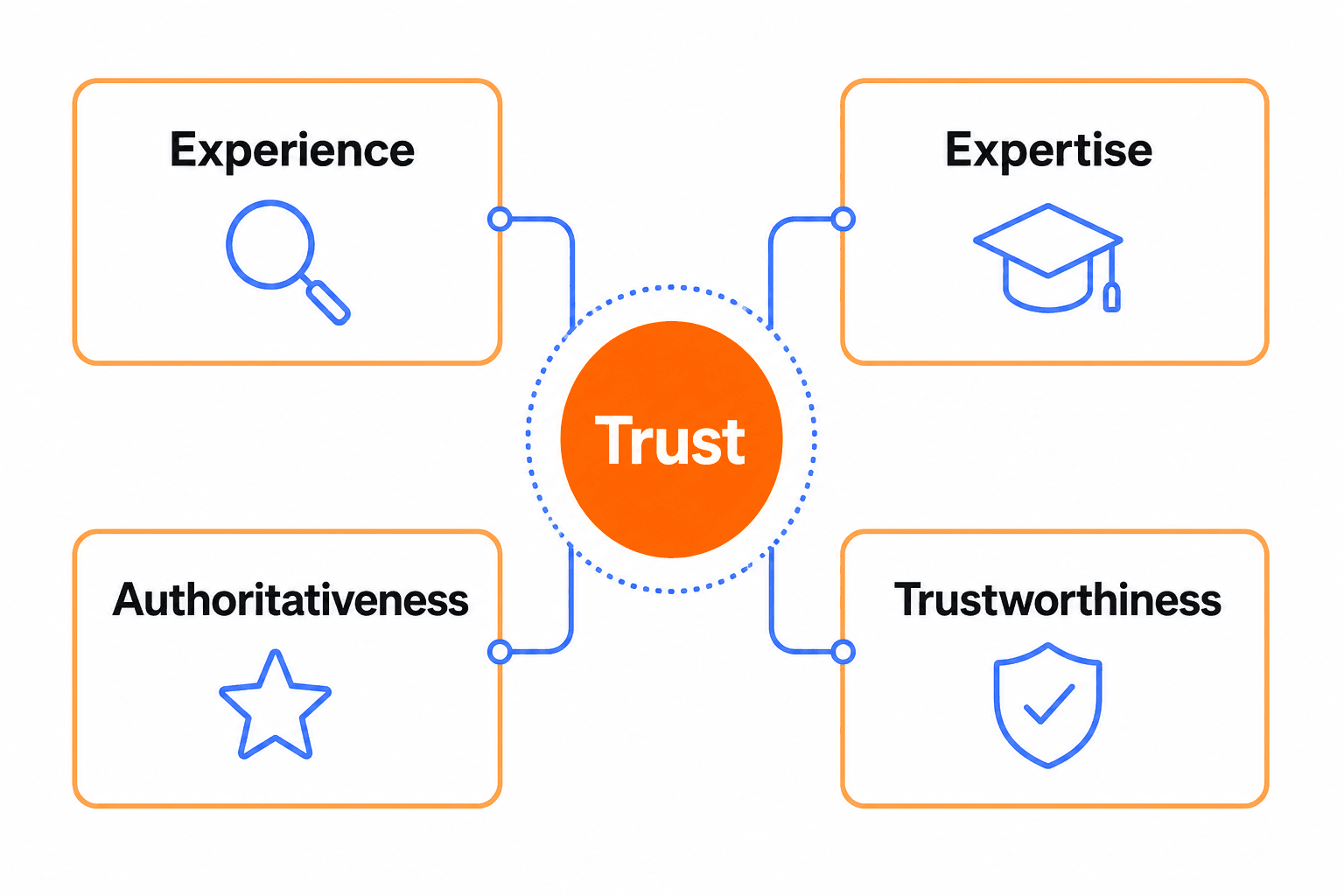
Trust is, in Google's framing, the most important of the four. The other three feed into it.
The most important thing teams get wrong: they treat E-E-A-T as a checklist of badges rather than a trust model. A bio box and a few citations do not create trust if the underlying content is vague, unsourced, or never updated.
Experience, expertise, authoritativeness, and trustworthiness in plain language
Here is how each attribute shows up practically:
Experience: You wrote about hiking a specific trail, not just summarized what other sites said about it. You used the software, visited the location, or went through the process yourself.
Expertise: Your background in the subject is visible and relevant. A financial planning article by someone with no financial background reads differently than one by a licensed advisor.
Authoritativeness: Other trusted sources treat your content or your brand as a reference. This shows up in external links, citations, mentions in industry media, and recognition in your category.
Trustworthiness: Your site is transparent about who created the content, how, and why. Claims are supported. Contact details are real. Corrections are made when needed.
Why Google added the extra E to E-A-T
Before December 15, 2022, the framework was E-A-T: expertise, authoritativeness, and trustworthiness. Google's December 2022 update added experience as a distinct attribute, recognizing that first-hand knowledge often produces more useful content than formally credentialed expertise alone. A product review from someone who spent two months using a piece of software may be more valuable than a summary from someone who read the specs sheet.
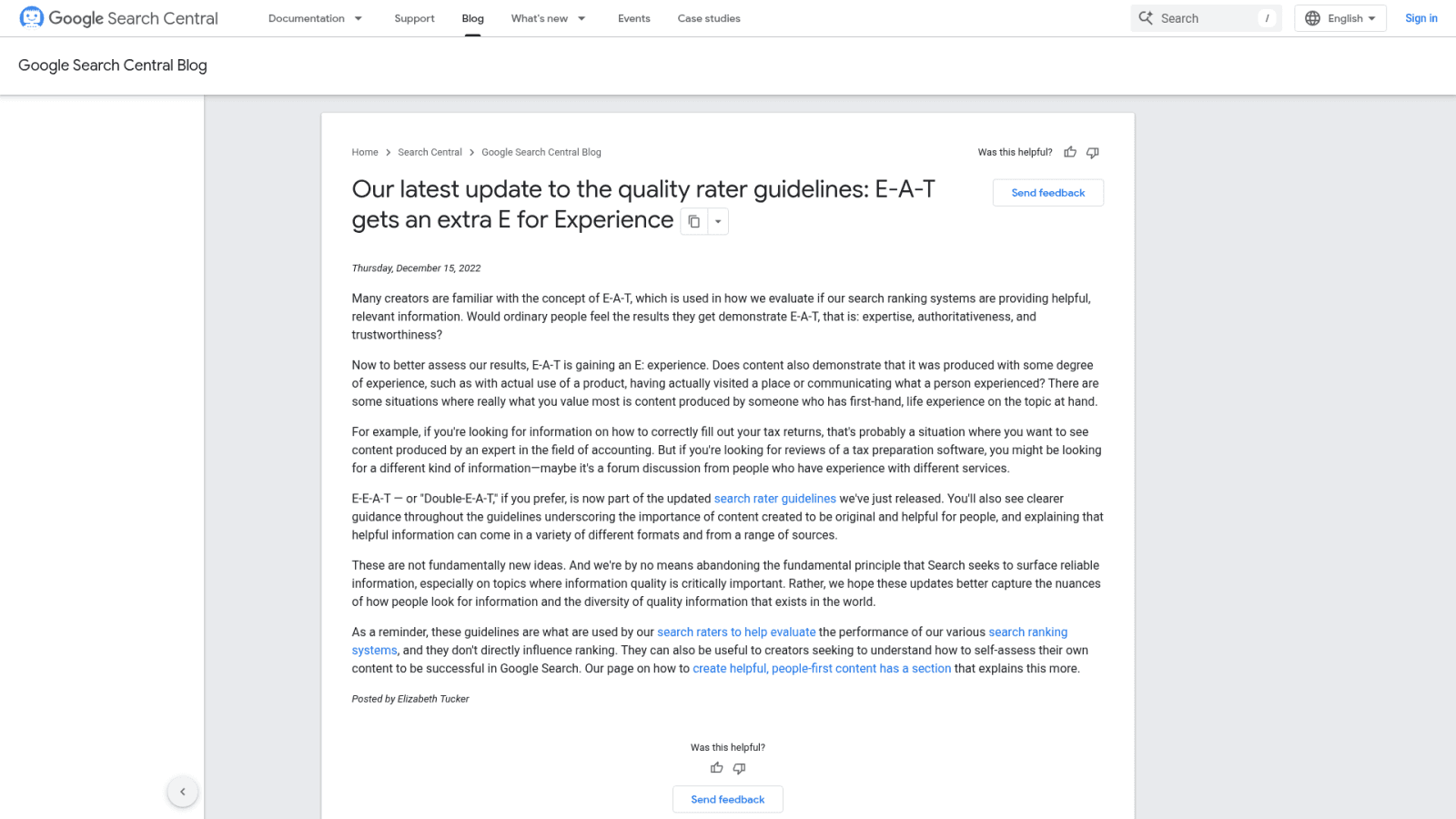
This was not a fundamental change in what Google values. It was a clarification that lived experience counts as a credibility signal.
Is E-E-A-T a direct ranking factor or a quality framework?
E-E-A-T is a quality framework, not a direct ranking factor. Google's own guidance is clear that search quality rater evaluations do not directly change the rankings of individual pages. Raters use E-E-A-T to assess whether Google's ranking systems are surfacing the right results. Their aggregated feedback helps improve the algorithms that do affect rankings.
Practically: aligning your content with E-E-A-T principles means you are building the kind of content Google's systems are designed to reward. That is worth doing, but calling it a guaranteed ranking lever overstates what the evidence supports.
Why does E-E-A-T matter for SEO and AI search visibility?
E-E-A-T matters because Google's automated systems are designed to surface content that demonstrates the qualities the framework describes. High-quality signals in authorship, sourcing, and editorial transparency correlate with the kind of content that tends to rank and get cited. The causal chain is real, even if it is not a simple switch.
How E-E-A-T affects trust, click confidence, and content usefulness
Users make fast trust judgments. A page with a named, credentialed author, cited sources, and a visible review date reads differently than one with no byline and vague references. That visible trust affects click confidence, time on page, and return visits. These are signals Google's systems measure.
For AI answer engines like Perplexity and ChatGPT, the ability to improve brand visibility in ChatGPT often correlates with content that is structured for extraction: clear definitions, sourced claims, practical frameworks, and short direct answers. E-E-A-T signals overlap significantly with the attributes AI systems use to select citable content.
User outcome | Search visibility outcome | Evidence needed |
|---|---|---|
Reader trusts the content | Page is treated as authoritative by raters | Named author, credentials, review process |
Reader clicks and stays | Positive engagement signals | Relevant, accurate, useful content |
Reader returns or shares | Brand authority builds | Consistent quality across the site |
High authorship transparency and sourced claims make content more extractable by AI systems and more trustworthy to human readers.
Why E-E-A-T matters more on YMYL topics
YMYL stands for Your Money or Your Life. These are topics where inaccurate information can cause real harm: health, finance, legal guidance, and safety. The Search Quality Rater Guidelines apply the highest E-E-A-T standards to YMYL content. As of September 2025, Google also expanded YMYL to explicitly include elections, government information, and civic trust.
If your content falls in these categories, vague authorship or unverified claims create meaningful quality risk. The bar is not higher because Google penalizes YMYL pages arbitrarily. It is higher because the real-world cost of getting it wrong is higher.
What AI answer engines tend to cite on E-E-A-T topics
AI systems that generate answers (ChatGPT, Perplexity, Google AI Overviews) tend to pull from content with clear definitions, direct answers in the first paragraph, and visible sourcing. A heading that mirrors the search query, followed by a concise 40-to-80-word answer, is more extractable than a page that buries the answer in paragraph seven.
For teams working on AI search visibility, our answer engine optimization guide and GEO guide cover the structural patterns that support citation. E-E-A-T-aligned content and AI-citation-ready content share most of the same ingredients.
How can you assess E-E-A-T on your own pages?
The fastest way to audit E-E-A-T is to look at a page through four lenses: who created it, how it was created, what evidence supports it, and what trust signals surround it. Each of these has visible, page-level indicators you can review in 15 minutes.

Who created the content and why that matters
Every page should answer this clearly: who wrote it, who reviewed it, and why are they qualified. A byline that links to a full author page with relevant background, professional affiliations, and a publication history is a real signal. A generic author box that says "The Editorial Team" with no other detail is not.
If the author uses first-person experience, the experience needs to be real and attributable. A claim like "in my testing" with no explanation of the test is not evidence.
How the content was created, reviewed, and updated
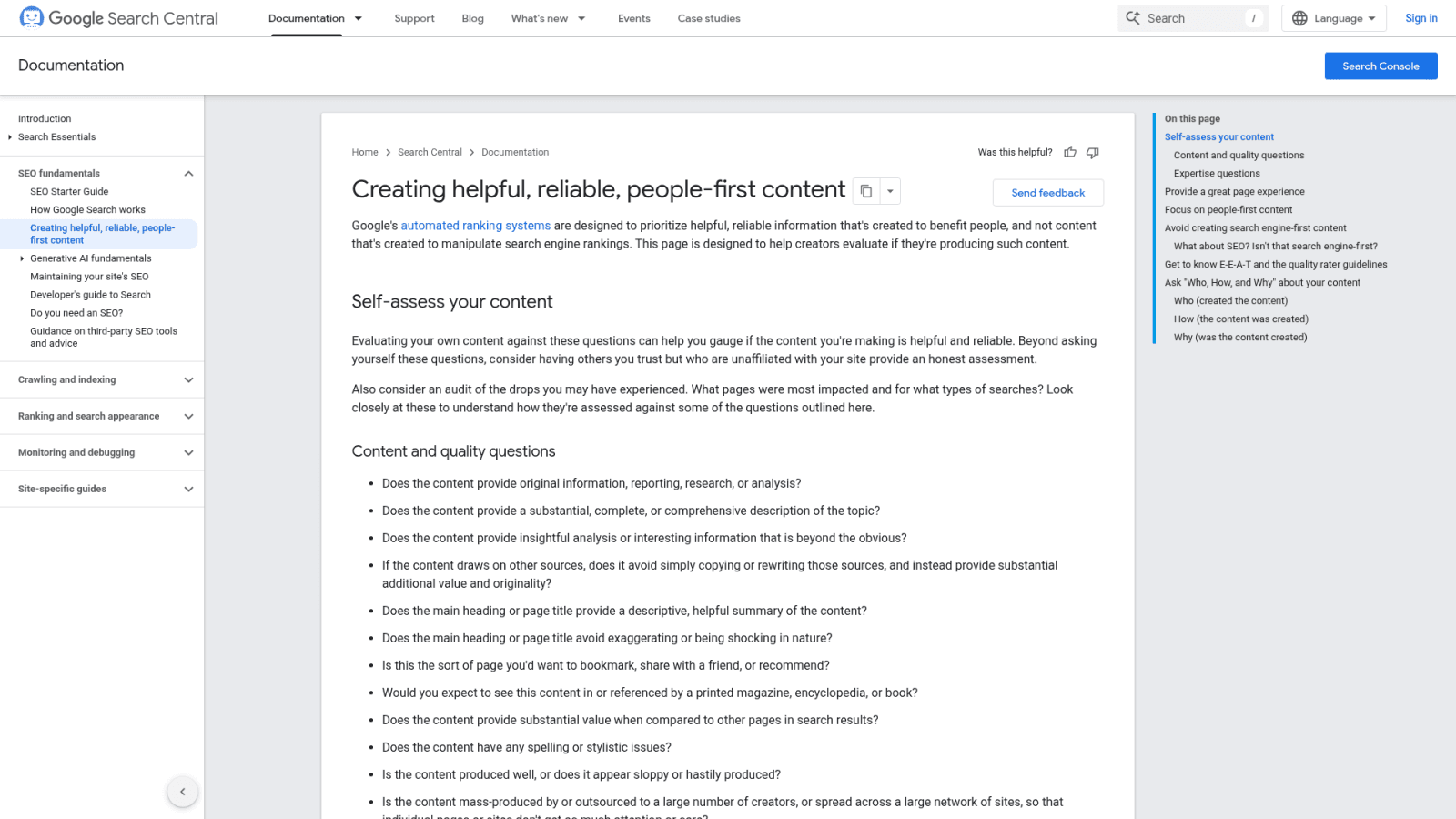
Transparency about your editorial process is underused. If a subject-matter expert reviewed the article, say so and name them. If the content was assisted by AI, disclose it and explain the human review layer that followed. Google's helpful content guidance asks teams to think about "Who, How, and Why" as the core content creation questions.
Add a visible last-updated date only when you have materially changed the content. Refreshing a date without updating the substance is a surface signal that does not build real trust.
What evidence supports the claims on the page
Every significant claim should have a traceable source: a link to a primary document, a dated statistic from an authoritative study, or a real-world example with enough detail to verify. Vague phrases like "studies show" or "experts agree" without attribution are claim-risk phrases that weaken trust.
According to Google's helpful content documentation, the "Who, How, and Why" framework applies here directly: why does this claim belong in your content, and how is it supported?
Which trust signals readers look for before they believe you
Beyond the content itself, site-level signals matter. Readers check for an About page that explains who you are, a contact page with real details, a privacy policy, and a clear indication of your editorial or business purpose. For regulated topics, professional credentials or organizational affiliations should be visible.
Third-party signals matter too: press coverage, citations from recognized sources, and reviews on platforms like G2 or Trustpilot all contribute to perceived authority outside your own pages.
What are the most effective ways to improve E-E-A-T signals?
Not all E-E-A-T improvements are equal. The fixes that matter most for most SMB and content teams are in authorship, sourcing, and site-level transparency. Here is a prioritized list.
Strengthen authorship and expert review
Create real author pages with relevant professional background, a headshot, a LinkedIn link, and a list of published work on your site.
Add a reviewer line to any article that required subject-matter expertise, and name the reviewer.
Assign articles to the right authors. A health article attributed to a marketing generalist raises a yellow flag. Match author credibility to topic sensitivity.
Link author bios to a consistent profile page across your site so the same person can accumulate a credibility trail.
Author bios alone do not lift rankings. They help readers and systems understand who is accountable for the content, which is a different and more substantive thing.
Cite stronger sources and remove weak claims
For every significant claim, work through this evidence hierarchy:
Primary sources (official documentation, original research, government data) rank highest.
Peer-reviewed studies and official reports rank second.
Reputable industry publications (with named authors and dates) rank third.
Unnamed experts, vague studies, aggregator summaries should be removed or replaced.
Remove or rewrite any sentence that contains a high-risk claim word (best, proven, guaranteed, always) unless you have a primary source to back it.
Add first-hand proof, examples, and transparent methodology
First-hand proof turns a generic guide into a credible one. Real examples, screenshots from your own workflow, process notes from actual implementation, and honest tradeoff discussions all demonstrate experience. If you tested something, explain the conditions. If you did not test it, do not write as if you did.
For teams producing content at scale, programmatic SEO for content teams covers how to maintain evidence discipline without adding proportional manual effort.
Improve site-level trust pages and editorial consistency
An E-E-A-T-weak site cannot be fixed page by page. Site-wide credibility comes from an honest About page, a visible editorial policy, working contact details, and consistent disclosure practices across every page. If your site publishes health or finance content without any professional credential disclosure, fixing one article will not close the gap.
Set a content review schedule. Outdated statistics, deprecated product references, and stale advice all reduce the perceived reliability of every page on the same domain.
Which E-E-A-T mistakes hurt content quality the most?
The most damaging mistakes are not technical. They are structural: teams treat trust as a cosmetic layer rather than a content property.
Mistake | Why it fails | How to fix it | Evidence needed |
|---|---|---|---|
Decorative author box with no substance | Signals accountability without providing it | Replace with full author page and reviewer line | Author bio linked to real profile |
Unsupported or vague claims | Creates claim risk and reader doubt | Cite primary sources or remove the claim | Dated, named source for every significant claim |
Outdated statistics and stale advice | Erodes trust at the page and domain level | Set a content review schedule | Visible last-updated date with real revision |
Generic AI copy with no review layer | Fails the Who/How/Why test | Add subject-matter review, attribution, and examples | Named reviewer, methodology note |
E-E-A-T treated as a one-page fix | Misses site-wide authority building | Apply authorship and trust standards to every page | Consistent editorial policy and disclosure |
Surface signals never substitute for substantive content. A page with perfect schema markup, an author photo, and five broken source links has the cosmetics of trust without the substance.
Confusing surface signals with real credibility
Decorative trust badges, generic bios, and author photos are visible but not credible by themselves. Real credibility requires that the person listed on the article can be found, that their background matches the topic, and that they made observable contributions to the content. A bio box that names a real person who genuinely knows the subject and reviewed the page is a trust signal. A headshot next to "content writer" with no other context is not.
Publishing unsupported claims, outdated advice, or generic AI copy
Generic AI content without a human review layer is exactly what Google's quality rater guidelines flag as low quality: content that is filler-heavy, lacks original insights, and fails the Who/How/Why evaluation. If your AI-assisted draft does not go through expert review and source checking before publishing, you are building an E-E-A-T liability. Read more about why Google is not indexing your AI content and how editorial process gaps contribute to indexing problems.
Treating E-E-A-T as a one-page fix instead of a system
One well-optimized article does not change a domain's trust profile. E-E-A-T is evaluated at the site level as well as the page level. A single high-quality guide surrounded by thin, unattributed pages still signals a weak content operation. Building real E-E-A-T means applying consistent authorship, sourcing, and transparency standards across every piece you publish.
How does Keytomic support E-E-A-T-friendly content workflows?
A note before this section: Keytomic is our platform, so this section explains where it fits and where it does not. Pricing and features were checked in July 2026; confirm current details before purchasing.
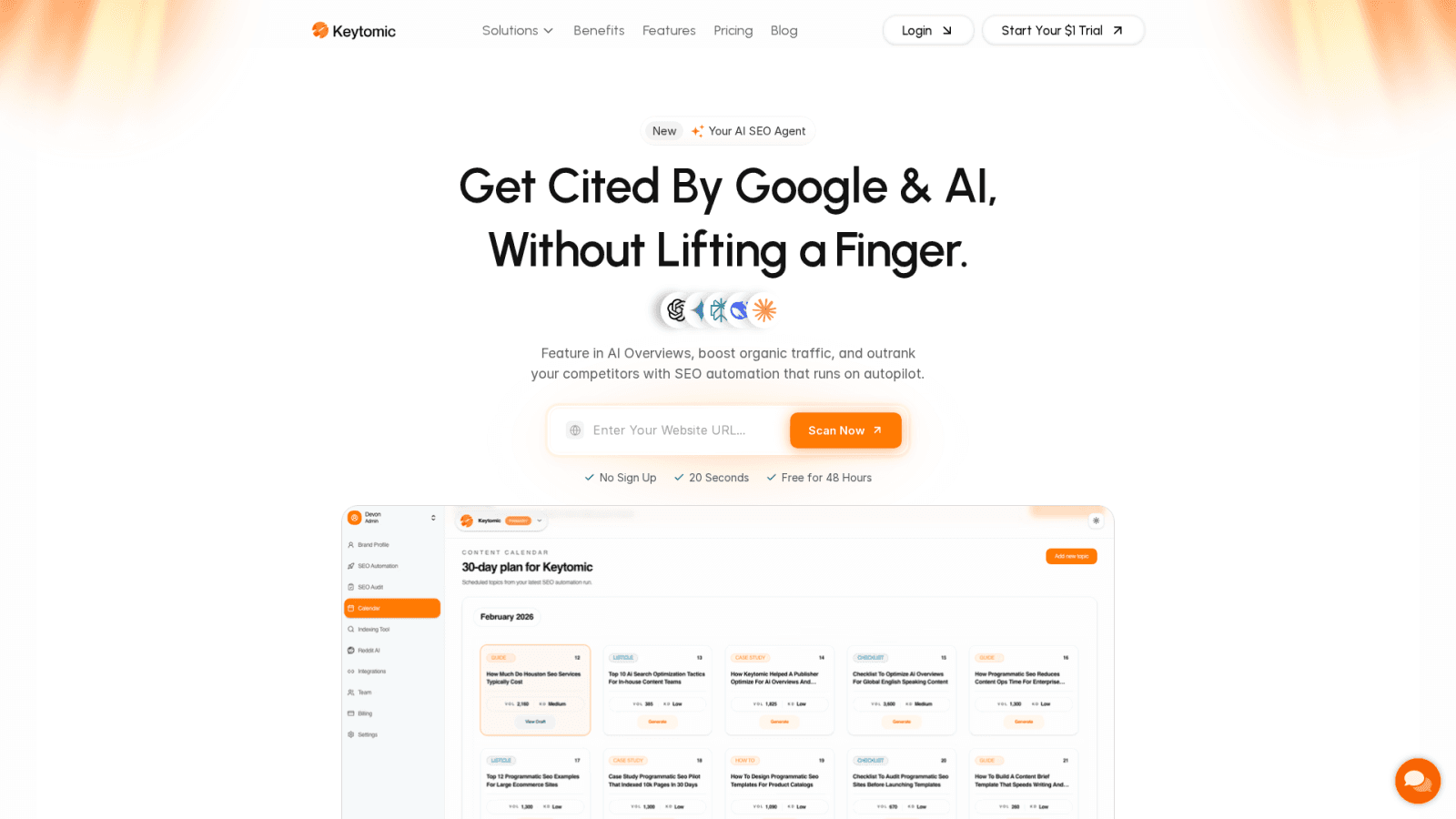
Keytomic is an AI-based autonomous SEO engine that handles keyword discovery, 30-day content roadmaps, and auto-publishing. As a SEO automation tool for Google and LLM visibility, it is designed to replace fragmented toolstacks with a unified, AI-driven workflow. What it does not do is replace the human review layer that E-E-A-T requires.
Where Keytomic helps with planning, consistency, and publishing
Keytomic's workflow support helps teams with three of the most common E-E-A-T consistency failures:
Planning: Structured 30-day content calendars mean topics are chosen with topical authority in mind, not on impulse. Consistent coverage of a topic cluster builds the site-wide authority that raters assess.
Publishing consistency: Auto-publishing capabilities remove the bottleneck that causes drafts to sit unreviewed and stale. A page that goes live promptly with a current date and accurate content is more trustworthy than one delayed for three months.
Workflow structure: By giving content teams a defined process from keyword to published article, Keytomic creates the scaffolding inside which expert review and sourcing standards can be applied consistently. Learn more about how Keytomic helps you win at SEO and AI visibility.
Where human review is still necessary
Keytomic is not a substitute for subject-matter expertise. On any topic requiring professional knowledge, regulated claims, or first-hand experience, a human reviewer needs to check accuracy, verify sources, and add the experience-layer signals that E-E-A-T demands. The tool generates structured content; it cannot generate genuine expertise.
For teams that expect fully autonomous publishing with zero editorial review, E-E-A-T quality standards will not be met regardless of the tool used. That is an honest limitation worth stating plainly.
What a practical E-E-A-T workflow looks like for lean teams
For a small team that needs to publish consistently without a large editorial staff, a practical workflow looks like this:
Keyword and topic planning via Keytomic's 30-day roadmap
AI-assisted drafting with Keytomic's content generation
Subject-matter review by a named internal or external expert
Source checking and claim cleanup before publish
Author attribution and reviewer line added to the CMS
Publishing via Keytomic's auto-publish workflow
Scheduled review at 90 days for accuracy and freshness
This process handles volume without sacrificing the review discipline E-E-A-T requires. Start your Keytomic trial to see how the planning and publishing steps work in practice. If you want to think through how to choose SEO automation tools for your team's specific workflow, that guide covers the decision criteria in detail.
Frequently asked questions about E-E-A-T
Does Google use E-E-A-T as a ranking factor?
No. E-E-A-T is a quality framework used in the Search Quality Rater Guidelines. Rater evaluations do not directly change rankings. They help Google assess whether its ranking systems are working correctly.
What is the difference between E-A-T and E-E-A-T?
E-A-T was the original framework: expertise, authoritativeness, trustworthiness. Google added experience as a fourth attribute on December 15, 2022, to recognize first-hand knowledge as a distinct credibility signal.
How do you show experience on a page?
Include specific first-hand details: real examples, testing notes, process observations, screenshots from your own workflow, or dated personal accounts. Vague claims of experience without supporting detail do not demonstrate it.
Do author bios improve rankings by themselves?
No. Author bios help readers and systems understand who created content and whether that person is qualified. They support trust when they link to a real profile with relevant background, but they do not produce ranking lifts on their own.
Does E-E-A-T matter for small business websites?
Yes. Trust signals matter on every site that publishes content people rely on. For small businesses, the most practical E-E-A-T improvements are a clear About page, named authorship, and sourced claims. The bar is proportional to the topic sensitivity.
What are examples of trust signals on a website?
Named authors with relevant background, a clear About and Contact page, a visible privacy policy, cited and dated sources, a review or editorial process disclosure, third-party mentions, and consistent content updates are all observable trust signals.
How often should E-E-A-T content be reviewed?
For fast-moving topics, every 90 days. For stable reference content, every 6 to 12 months. Always review after significant industry changes, product updates, or when statistics you cited have been superseded.
Can AI-generated content meet E-E-A-T expectations?
Yes, if it is thoroughly reviewed by a subject-matter expert, attributed to a named author who takes accountability for accuracy, and enriched with original insight and real sourcing. Generic, unreviewed AI copy does not meet E-E-A-T standards.
Three steps to turn E-E-A-T from advice into a system
Most E-E-A-T guidance stops at the list of signals. What actually moves the needle is treating it as an operating standard:
Identify pages where trust matters most. Start with your highest-traffic and highest-stakes content, especially anything touching YMYL topics or product recommendations.
Fix evidence, authorship, and review gaps first. Sourcing and authorship are higher-leverage than schema or metadata. Get those right before anything else.
Build a repeatable workflow so every new page meets the same standard. One well-optimized article does not fix a domain. Consistency across every publish does.
If your team needs to scale this process without adding headcount, Keytomic's planning and publishing workflow is worth exploring. It handles the structural discipline so your reviewers can focus on the expertise and evidence layer that no tool can replace.