The right SEO audit tool depends on the job. Use Screaming Frog SEO Spider or Sitebulb for deep crawl analysis. Use Semrush Site Audit or Ahrefs Site Audit when audits need to connect to a broader search intelligence suite. Use Google Search Console as your free, Google-native indexing baseline. And use Keytomic AI SEO platform when a lean team wants audits connected directly to planning, publishing, and AI search visibility workflows. Pricing and features were checked in July 2026 from official vendor pages. Confirm current details before purchasing because plan limits, crawl credits, and AI-search features change frequently.
Most teams searching for SEO audit tools are not looking for another site health score. They need to know which tool will actually reduce the hours spent finding, prioritizing, and fixing issues - and whether the output connects to real action.
The decision splits into five categories: broad SEO suites with audit modules, specialist desktop or cloud crawlers, enterprise-grade monitoring platforms, automation-first platforms for lean teams, and free tools that serve as a baseline. Each category solves a different problem.
This article evaluates each tool by issue coverage, automation, AI visibility readiness, crawl depth, ease of use, reporting quality, pricing transparency, and fit for small teams and agencies.
How We Evaluated These SEO Audit Tools
This list is based on official product documentation, publicly available pricing, and category knowledge. Selected prices were rechecked on September 30, 2026. No first-hand crawl tests or paid screenshots were conducted for this article. Tools were evaluated across eight criteria: issue coverage, crawl depth and limits, automation and scheduling, AI visibility readiness, ease of use, reporting and stakeholder sharing, pricing clarity, and team fit.
Tools are ranked by use-case fit, not universal superiority. The right tool is always the one that matches the actual audit job.
Pricing and Feature Freshness Disclosure
Selected pricing claims were rechecked against official vendor pages on September 30, 2026; other feature details reflect the earlier July 2026 review. Plan limits, crawl credits, and AI-search features change frequently. Confirm current details before purchasing.
The Best SEO Audit Tools at a Glance
Tool | Best For | Audit Depth | Automation | AI Visibility | Free Option | Pricing (July 2026) |
|---|---|---|---|---|---|---|
Keytomic | Lean teams: audits + execution | Technical checks + AI visibility | Bi-weekly automated audits | Yes | Free tools available | Check keytomic.com |
Semrush Site Audit | Broad SEO + AI search health | 140+ checks | Scheduled weekly | Yes (AI search health) | Limited free tier | From ~$139.95/mo |
Ahrefs Site Audit | Technical + search intelligence | 170+ issues | Scheduled | Partial | Ahrefs Webmaster Tools (own domains) | From $29/mo (Starter) |
Screaming Frog SEO Spider | Deep desktop crawling | 300+ issues | Manual + scheduled | Partial (AI integrations) | 500 URL crawl | £199/year paid license |
Sitebulb | Visual technical crawling | 300+ hints | Desktop/Cloud | Partial | Trial (no permanent free tier) | From ~$18/mo (Lite) |
Lumar | Enterprise website optimization | Millions of URLs | Continuous monitoring | Yes (GEO/AEO) | No | Custom pricing |
Google Search Console | Google indexing baseline | Index + CWV data | Alerts | No | Yes, fully free | Free |
SE Ranking Website Audit | Value-focused audit suite | 115+ metrics | Scheduled | Partial (GEO tracking) | 14-day trial | From ~$52/mo |
Moz Pro Site Crawl | Small teams, beginners | Standard crawl checks | Weekly scheduled | Partial (AI Visibility from Medium) | 7-day trial (Standard) | From $39/mo (Starter, annual) |
Botify | Enterprise log-file + crawl | Enterprise-scale log analysis | Continuous | Partial | No | Custom pricing |
Which SEO Audit Tool Should You Choose First?
The best starting point depends on the audit job.
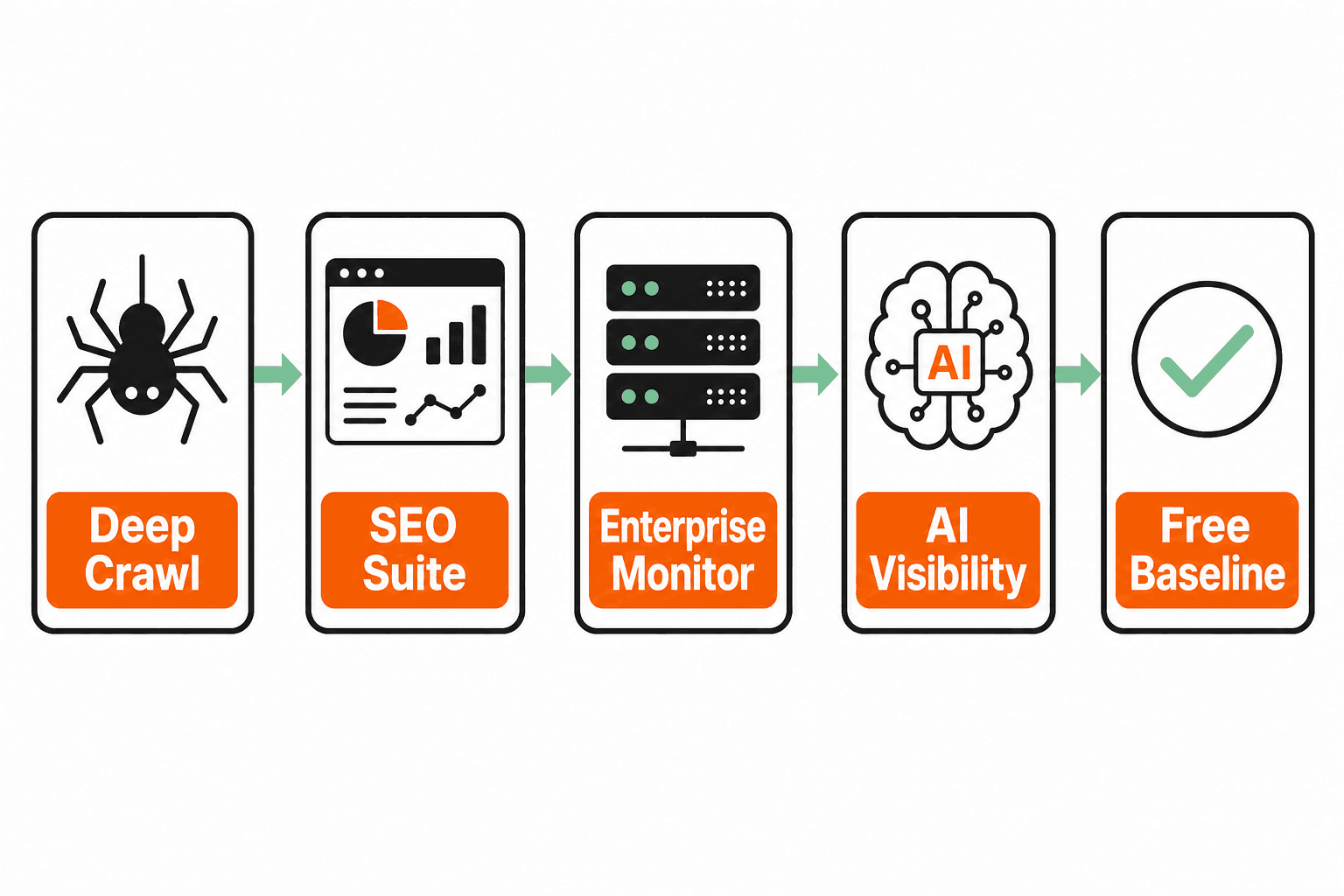
For lean teams that want fewer handoffs: Start with Keytomic. The platform connects technical checks, keyword research, content planning, and publishing in one workflow, so audit findings have a direct path to execution.
For the deepest raw technical crawling: Screaming Frog SEO Spider is the benchmark. If you need custom extraction, JavaScript rendering, and full crawl exports on any site size, it is the most capable desktop crawler available. Sitebulb is the better choice when the output needs to be understood by non-technical stakeholders or clients.
For audits inside a broad SEO suite: Semrush Site Audit and Ahrefs Site Audit both connect audit findings to keyword data, backlink context, and rank tracking. Choose based on which suite your team already uses or prefers for research.
For enterprise-scale website health monitoring: Lumar handles millions of URLs with continuous monitoring, GEO and AEO readiness checks, accessibility audits, and CI/CD pipeline integration.
For a free Google-native baseline: Google Search Console gives you indexing status, Core Web Vitals, URL inspection data, and crawl error alerts directly from Google. It is not a full crawler, but no audit stack is complete without it.
A common pairing for small teams: Google Search Console for indexing data, combined with Screaming Frog’s free 500-URL crawl for technical checks, and Keytomic for execution, planning, and AI visibility monitoring.
1. Keytomic: Best for Lean Teams That Want Audits Connected to SEO Execution
Disclosure: Keytomic is the publisher of this article. It is included because its official site positions it as an all-in-one AI SEO automation platform with technical checks, publishing workflows, and AI visibility features.
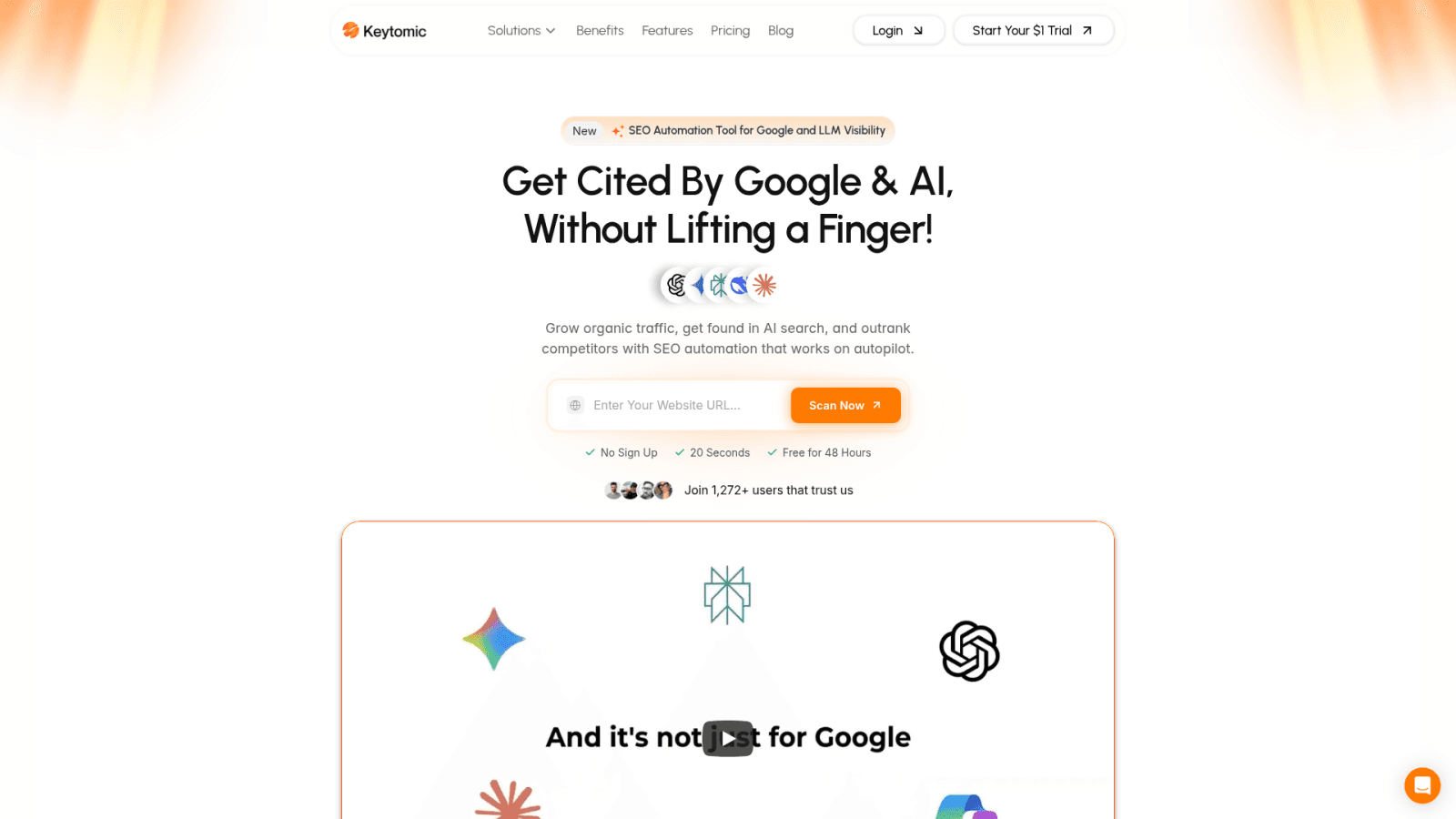
Most audit tools stop at issue detection. Keytomic is positioned differently: it connects technical health checks to the next steps of keyword research, content planning, and automated publishing, so a lean team does not have to move findings across four separate tools before anything gets fixed.
Keytomic’s platform includes bi-weekly technical audits, WordPress and Shopify integrations, and AI visibility monitoring designed to track how a site performs in AI Overviews, ChatGPT citations, and answer engine results. That combination is specifically useful for founders and small marketing teams who want a single subscription to handle audit-to-execution workflows without a fragmented tool stack.
Best for: Founders, lean marketing teams, and SEO operators who want automated audits connected to content planning, publishing, and AI search visibility.
Honest limitation: Keytomic should not be positioned as the deepest standalone crawler for raw technical SEO work. If a team needs log-file analysis, enterprise-scale crawl controls, unlimited custom extraction, or the depth of Screaming Frog or Sitebulb, those tools remain the right choice for that specific job. Keytomic is built for audit-to-execution automation, not for replacing a specialist crawler.
If your team wants fewer SEO handoffs and audit findings that connect directly to publishing and AI visibility, explore the Keytomic AI SEO platform to see how automation-first workflows differ from traditional audit-only tools.
2. Semrush Site Audit: Best Broad Audit Platform for SEO and AI-Search Health
Semrush Site Audit crawls your site and checks across 140+ technical and on-page issues organized by severity, including crawlability, HTTPS, duplicate content, Core Web Vitals, internal linking, structured data, and hreflang. Scheduled weekly audits track changes over time, and the Compare Crawls report shows progress between audit runs.
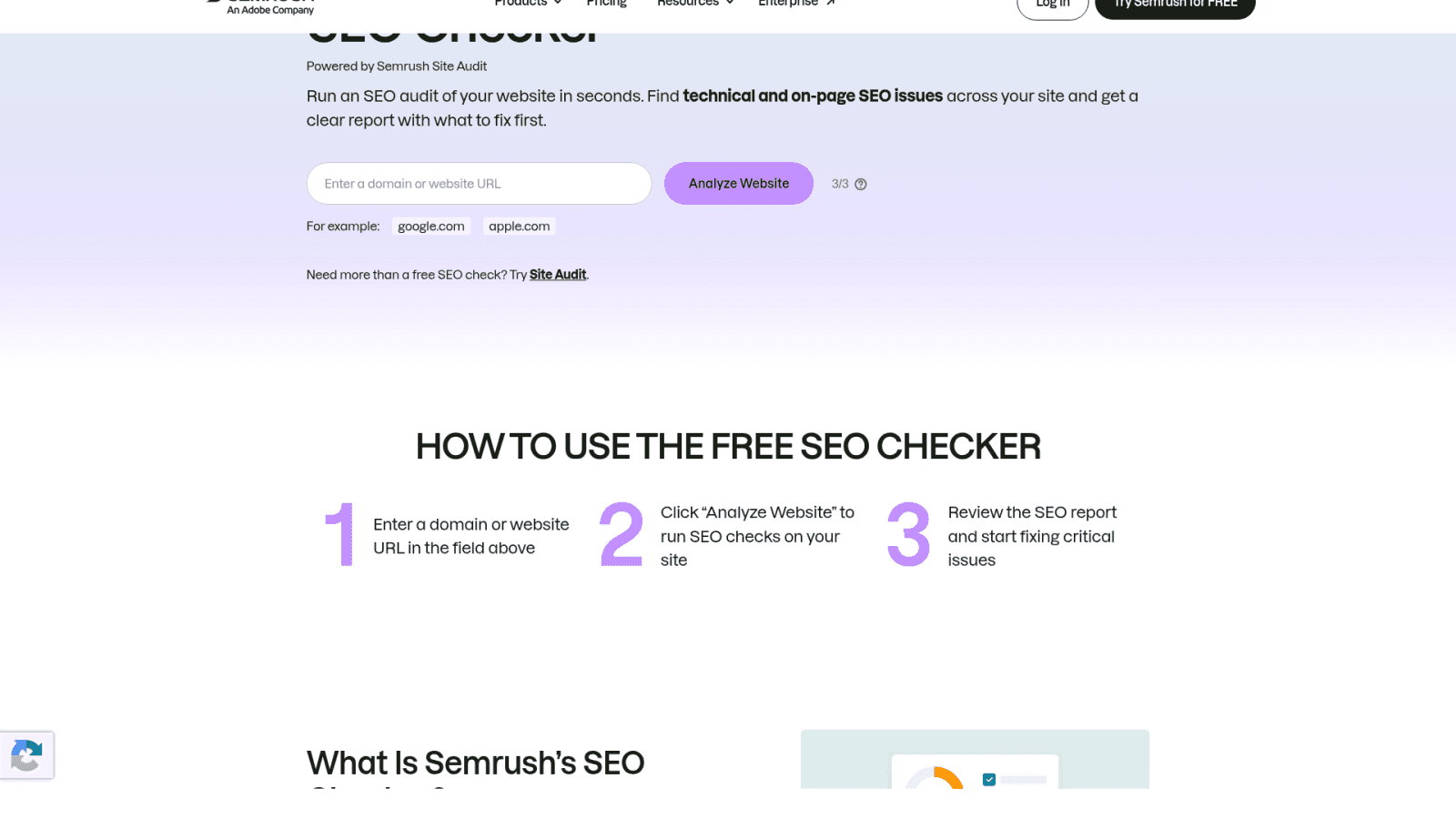
What separates Semrush from standalone crawlers is the surrounding context. When an audit flags a broken page or thin content issue, Semrush puts that finding next to keyword ranking data, backlink information, and the On Page SEO Checker. That connected view reduces the time from audit finding to informed fix decision.
Semrush has also added AI search health monitoring across its plans, which checks how a site performs for AI-driven results, a useful addition for teams focused on AI Overviews and answer engine visibility.
Best for: SEO managers and agencies that want audit findings connected to keyword research, competitor analysis, and content planning inside one platform.
Pricing: Semrush SEO Classic Pro starts at $139.95 per month, while Semrush One starts at $199.95 per month. Pricing verified September 30, 2026 on the official Semrush pricing page.
Honest limitation: Semrush is one of the more expensive entry points in this list. Teams that only need crawling and do not use keyword research, competitor analysis, or content tools regularly may find a specialist crawler more cost-effective.
3. Ahrefs Site Audit: Best for Technical Audits Inside a Search Intelligence Platform
To see how Ahrefs compares with a more focused keyword research suite that lacks a full crawler, read Ahrefs vs KWFinder site-audit comparison.
Ahrefs Site Audit identifies and helps fix 170+ technical and on-page SEO issues across categories including crawlability, indexability, redirects, on-page elements, performance, and links. Issues are prioritized by their impact on the site health score, which functions as a project management view in 2026 rather than a simple checklist.
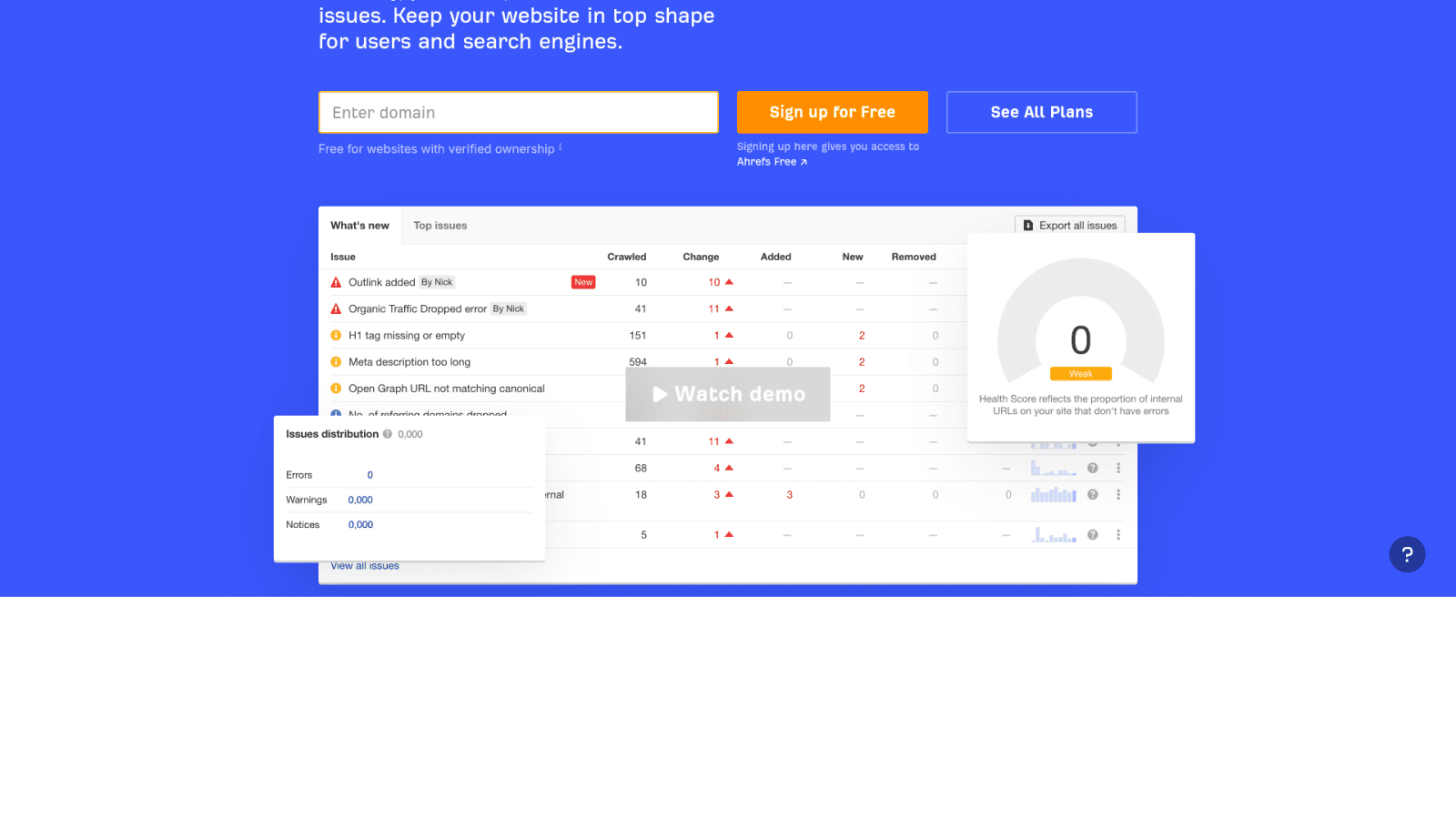
Ahrefs pairs site audit data with its search intelligence ecosystem: Site Explorer, Keywords Explorer, Content Explorer, and Rank Tracker all draw from the same crawl data. That integration is useful when an audit finding needs keyword or backlink context to prioritize correctly.
Ahrefs Webmaster Tools provides free Site Audit access for your own verified domains, which is a genuine starting point for site owners who want crawl data without a paid subscription.
Best for: SEO professionals and agencies where audit work is tied to the Ahrefs search intelligence workflow and backlink research.
Pricing: Ahrefs Starter costs $29 per month; Lite starts at $129 per month and Standard at $249 per month. Pricing verified September 30, 2026 on the official Ahrefs pricing page.
Honest limitation: Ahrefs uses a credit-based consumption model on lower tiers. On the Lite plan, 500 credits per month can run out quickly when combining audits, keyword research, and backlink checks in the same session. Teams that need unlimited exploration should look at the Standard plan or above.
4. Screaming Frog SEO Spider: Best Desktop Crawler for Technical SEOs
Screaming Frog SEO Spider is the reference-standard desktop crawler for technical SEO. It audits over 300 SEO issues across broken links, redirects, metadata, duplicate content, structured data, JavaScript rendering, hreflang, accessibility, and more. The free version crawls up to 500 URLs with no sign-up required. The paid annual license removes the URL limit and adds advanced features including JavaScript crawling, custom extraction, AI prompt integrations, and API connections to Google Analytics, Google Search Console, and PageSpeed Insights.
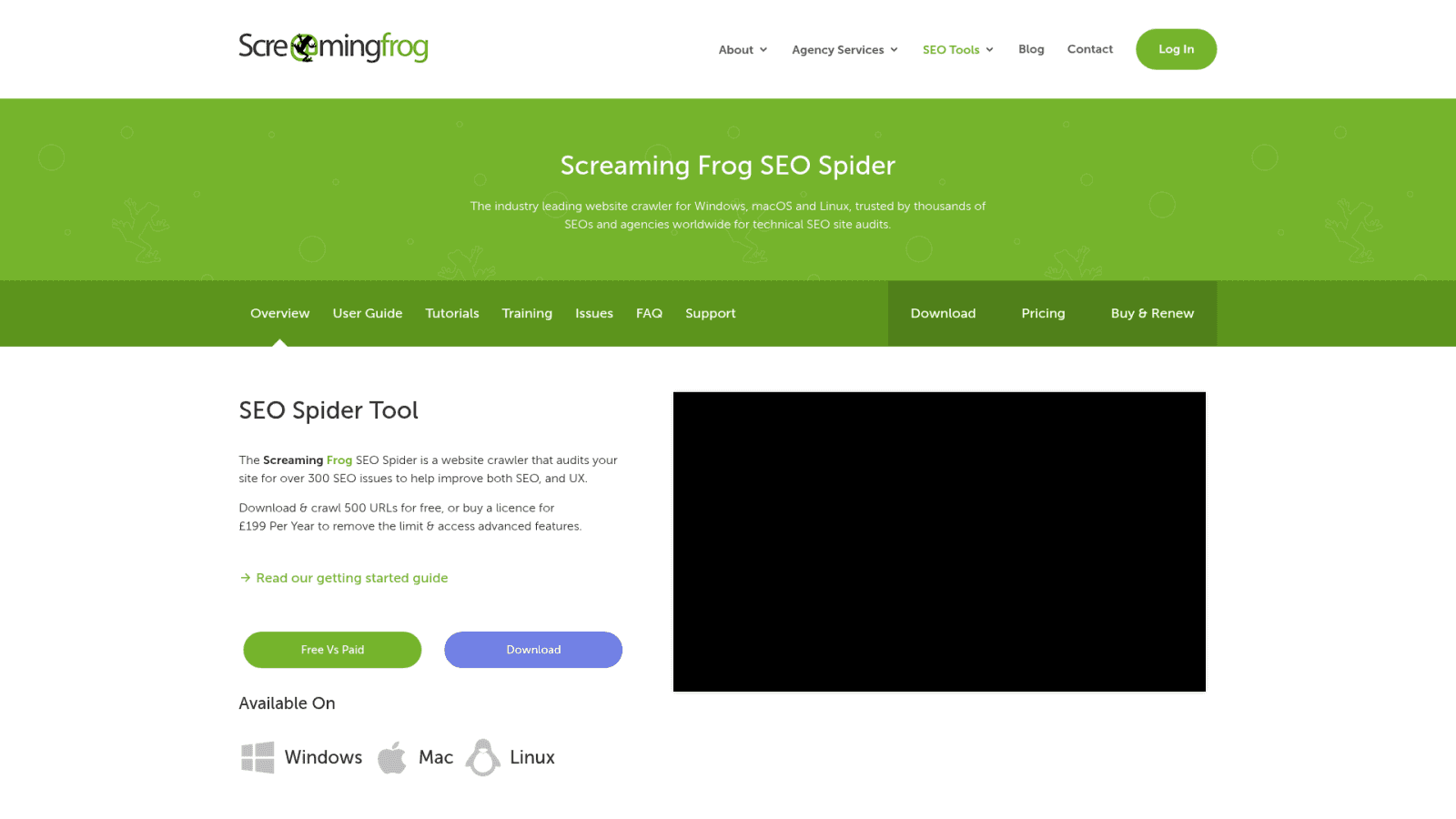
The paid license is £199 per year or $279 per year on the official pricing page. Pricing verified September 30, 2026.
Best for: Technical SEOs, agencies, and developers who need maximum crawl depth, raw data exports, and full control over every crawl configuration.
Honest limitation: Screaming Frog is a desktop tool with a meaningful learning curve. Reporting output is data-dense, which requires additional work to make client-ready. Teams that need polished stakeholder reports or cloud-based collaboration should evaluate Sitebulb alongside it.
5. Sitebulb: Best Technical Crawler for Visual Audit Reporting
Sitebulb offers both Desktop and Cloud crawling, making it the only tool in this category available in both formats. Its 300+ prioritized audit hints are written in plain language with explanations of why each issue matters, which significantly reduces the gap between audit output and non-technical reader comprehension.
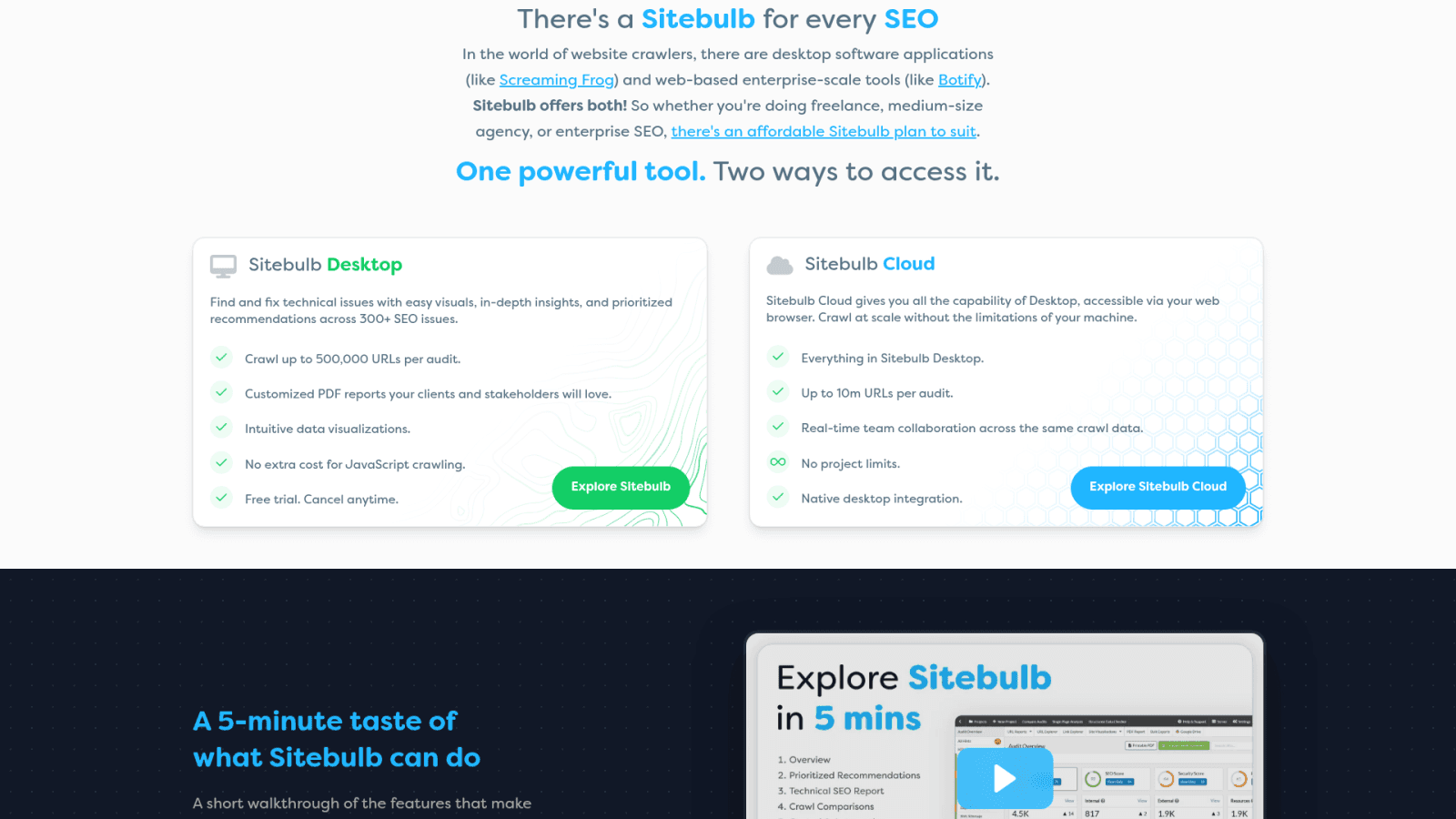
Visual diagrams, including crawl maps and internal link visualizations, make site architecture issues immediately visible. Sitebulb Cloud supports real-time collaboration and PDF reports suitable for client delivery. Desktop Pro handles sites up to 500,000 URLs per audit; Cloud handles up to 10 million URLs.
Best for: Agencies and consultants who need deep technical crawling but also need to present findings to clients or non-technical stakeholders clearly.
Pricing: Sitebulb’s public desktop pricing page calculates Lite and Pro prices interactively, so the earlier fixed dollar figures could not be confirmed. The official page describes Lite for audits up to 10,000 URLs and Pro for audits up to 500,000 URLs; Cloud starts at £95 per month. Pricing and limits checked September 30, 2026.
Honest limitation: There is no permanent free tier. Screaming Frog’s free 500-URL crawl is the better starting point for teams testing desktop crawlers on a budget. Sitebulb Cloud’s pricing is steep relative to standalone cloud alternatives.
6. Lumar: Best Enterprise Website Optimization Platform
Lumar (formerly Deepcrawl) is a cloud-based website optimization platform built for enterprise teams managing large-scale, complex sites. Its crawler handles millions of URLs at up to 450 URLs per second, covering technical SEO, generative engine optimization (GEO), answer engine optimization (AEO), AI brand visibility tracking, site speed, WCAG 2.2 accessibility, and custom analytics in a single platform.
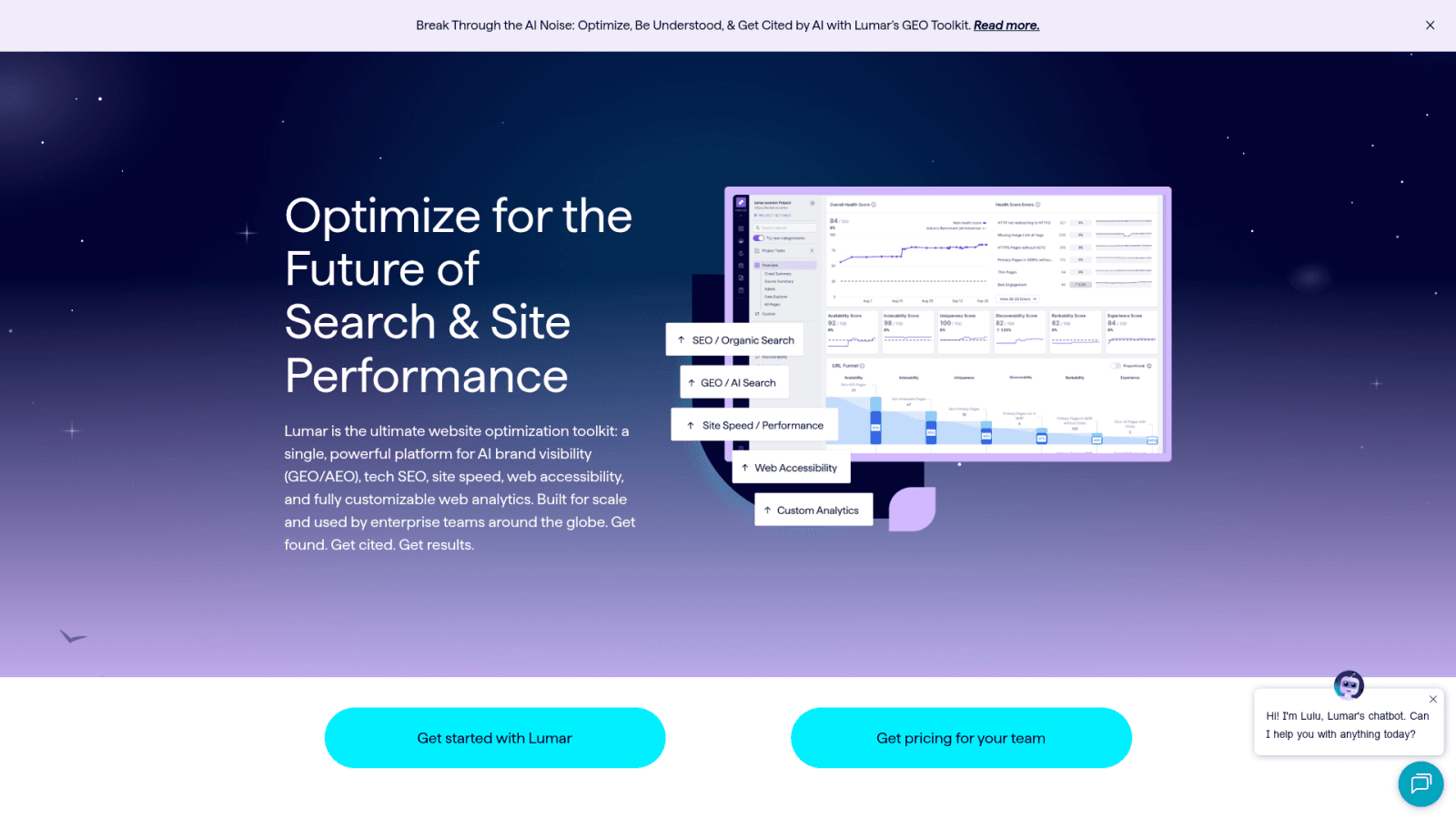
Lumar’s Protect module integrates into CI/CD pipelines to catch SEO regressions before they reach production. Monitor handles multi-domain health dashboards and alerts. The Analyze module provides deep audit and issue prioritization. That combination makes Lumar a tool for continuous website intelligence, not point-in-time audits.
Best for: Enterprise marketing teams, large agencies, and technical SEO leads managing sites with 100,000+ pages where preventing a single architectural issue justifies the investment.
Pricing: Custom pricing based on crawl volume, number of domains, and selected platform modules. Lumar does not publish a rate card. Contact Lumar directly at lumar.io/pricing for a quote.
Honest limitation: Lumar is overkill for most small sites, lean teams, and SMB agencies. The learning curve and custom pricing make it impractical unless site scale and team budget justify it.
7. Google Search Console: Best Free Source-of-Truth Tool for Google Indexing
Google Search Console is a free service from Google for monitoring, maintaining, and troubleshooting a site’s presence in Google Search. It provides URL Inspection data, index coverage reports, Core Web Vitals reports, rich results status, sitemap submission, and crawl error alerts - all sourced directly from Googlebot.
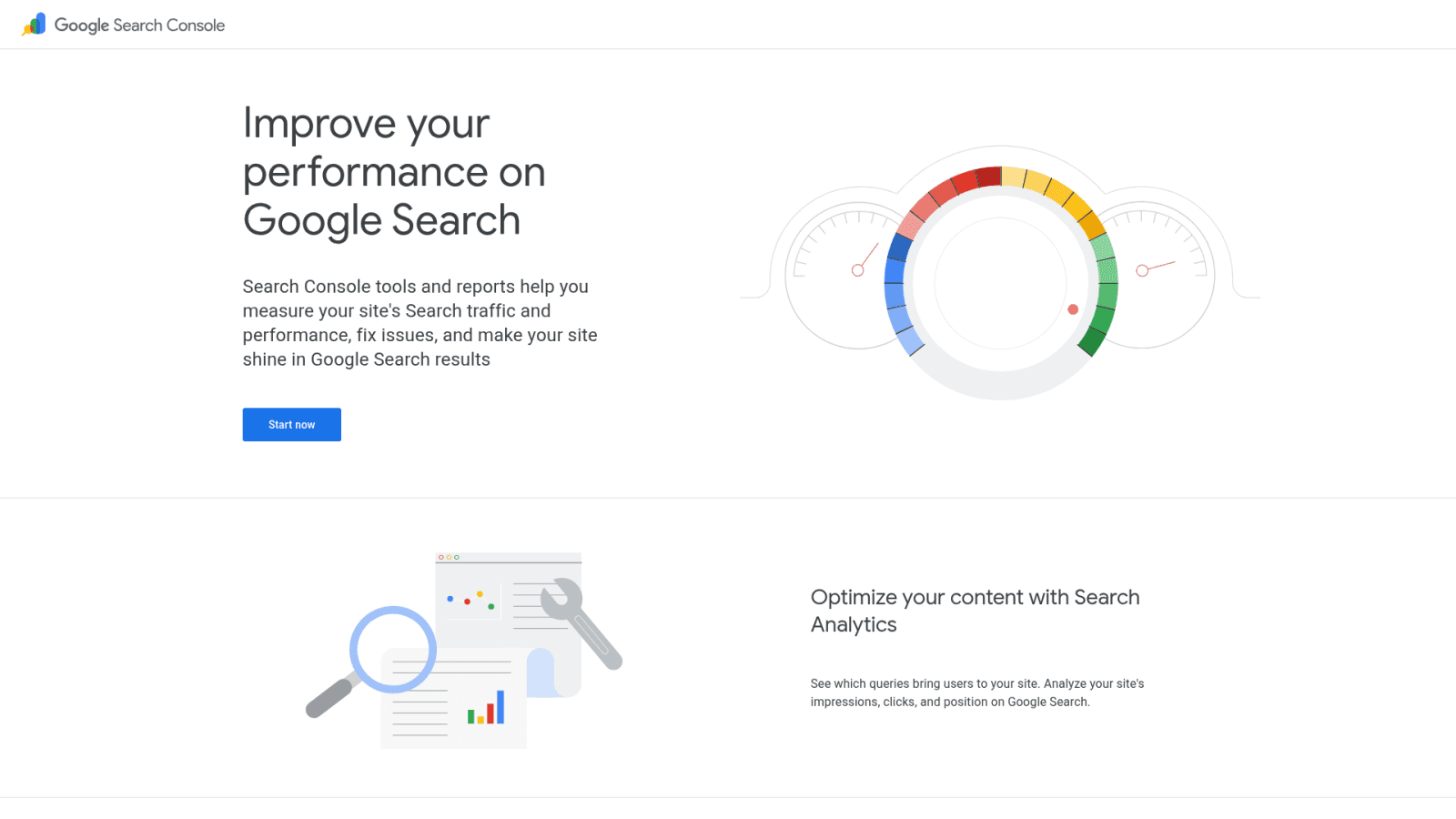
No third-party tool can replicate what GSC provides: data from Google itself. It shows exactly which pages are indexed, which are excluded and why, and how a site performs across search queries including clicks, impressions, CTR, and average position.
Best for: Every team, at every budget, as a non-negotiable baseline layer in any SEO audit stack.
Honest limitation: GSC is not a full crawler. It does not crawl every page on a site or detect all technical issues. It reports what Google has already seen, not a comprehensive view of site architecture, duplicate content, or on-page issues across every URL. Use it alongside a dedicated crawler, not as a replacement.
A practical pairing: GSC for indexing truth, Screaming Frog or Sitebulb for crawl analysis, and Keytomic for execution and AI visibility monitoring.
8. SE Ranking Website Audit: Best Value-Focused Audit and Reporting Suite
SE Ranking Website Audit covers 115+ technical checks across crawlability, Core Web Vitals, meta tags, security, redirects, internal links, images, and more. Issues are categorized as Errors, Warnings, and Notices, with a site health score that tracks improvement over time. The tool supports scheduled weekly or monthly audits, JavaScript rendering for SPA sites, audit comparison across crawl runs, and shareable guest links for client reports.
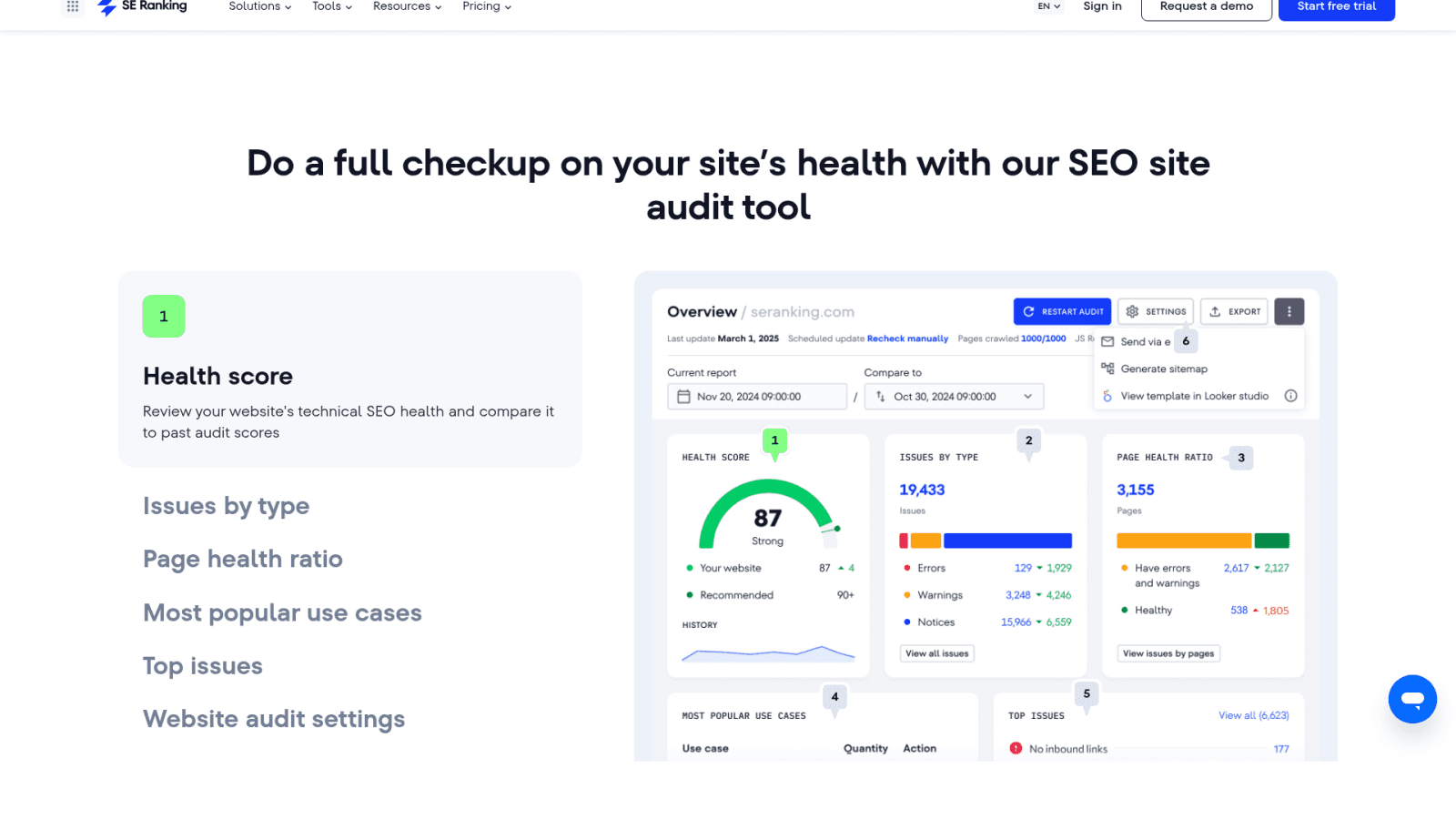
SE Ranking sits inside a broader SEO platform that includes rank tracking, AI visibility monitoring (via SE Visible), keyword research, and backlink analysis, making it a connected alternative to Semrush or Ahrefs at a lower entry price.
Best for: Agencies, small business owners, and SEO managers who want an understandable audit report, scheduled monitoring, and a full SEO suite at a more accessible price point.
Pricing: SE Ranking now lists Core at $129 per month, or $103.20 per month with annual billing, with a 14-day free trial. Pricing verified September 30, 2026 on the official SE Ranking pricing page.
Honest limitation: SE Ranking’s 115+ audit checks are solid for most sites but do not match the raw issue depth of Screaming Frog (300+ issues) or Sitebulb (300+ hints). Teams doing deep technical crawl work on complex or very large sites may need to supplement.
9. Moz Pro Site Crawl: Best for Beginners and Small Teams Starting with SEO Audits
Moz Pro Site Crawl scans tracked sites automatically and surfaces technical issues including broken links, duplicate content, missing metadata, redirect chains, and crawl errors. It is integrated with Moz’s broader platform covering keyword research, backlink analysis, rank tracking, and Domain Authority scoring. The Medium plan adds AI Visibility tracking (beta) for teams also thinking about how their brand appears in AI-generated results.
Moz Pro’s cleaner interface and education-first approach through Moz Blog and Moz Academy make it a practical starting point for teams that are newer to technical SEO or prefer a gentler learning curve over raw data depth.
Best for: Small businesses, solo practitioners, and teams new to technical SEO who want scheduled site crawls inside a beginner-friendly SEO platform.
Pricing: Moz Pro starts at $39/month billed annually (Starter). Standard is $99/month, Medium is $179/month, and Large is $299/month. A 7-day free trial is available on Standard and above. Pricing verified from multiple sources in July 2026; confirm at moz.com.
Honest limitation: Moz Pro’s crawl data and backlink index are consistently cited as smaller and less frequently updated than Ahrefs or Semrush. For advanced technical SEO or high-competition research, the data depth gap becomes a real constraint.
10. Botify: Best Enterprise Crawl and Log-File Analysis Platform
Botify is an enterprise SEO platform that combines website crawling, log-file analysis, and search engine data to provide a connected view of how Googlebot and other search bots interact with a site. Its log-file analysis capability is a meaningful differentiator: rather than only showing what a crawler found, Botify shows what Google actually crawled versus what it ignored, which is critical for managing crawl budget on very large sites.
Botify also covers structured data validation, Core Web Vitals monitoring, and integrations with analytics platforms for revenue attribution from organic traffic.
Best for: Large enterprise teams, e-commerce platforms with hundreds of thousands of pages, and technical SEO leads who need to manage crawl budget, log-file data, and site architecture at scale.
Pricing: Custom enterprise pricing. Contact Botify directly for a quote.
Honest limitation: Botify is not built for small sites or lean teams. The platform, pricing, and onboarding process are designed for enterprise buyers. Teams without dedicated technical SEO resources will find it difficult to extract full value.
What Should a Good SEO Audit Tool Check in 2026?
A technically sound audit in 2026 covers more than broken links and missing meta descriptions. To understand how to choose SEO automation software that supports full audit-to-execution workflows, it helps to map the full audit checklist first.
A useful crawler review should also check this technical audit for ecommerce category pages.
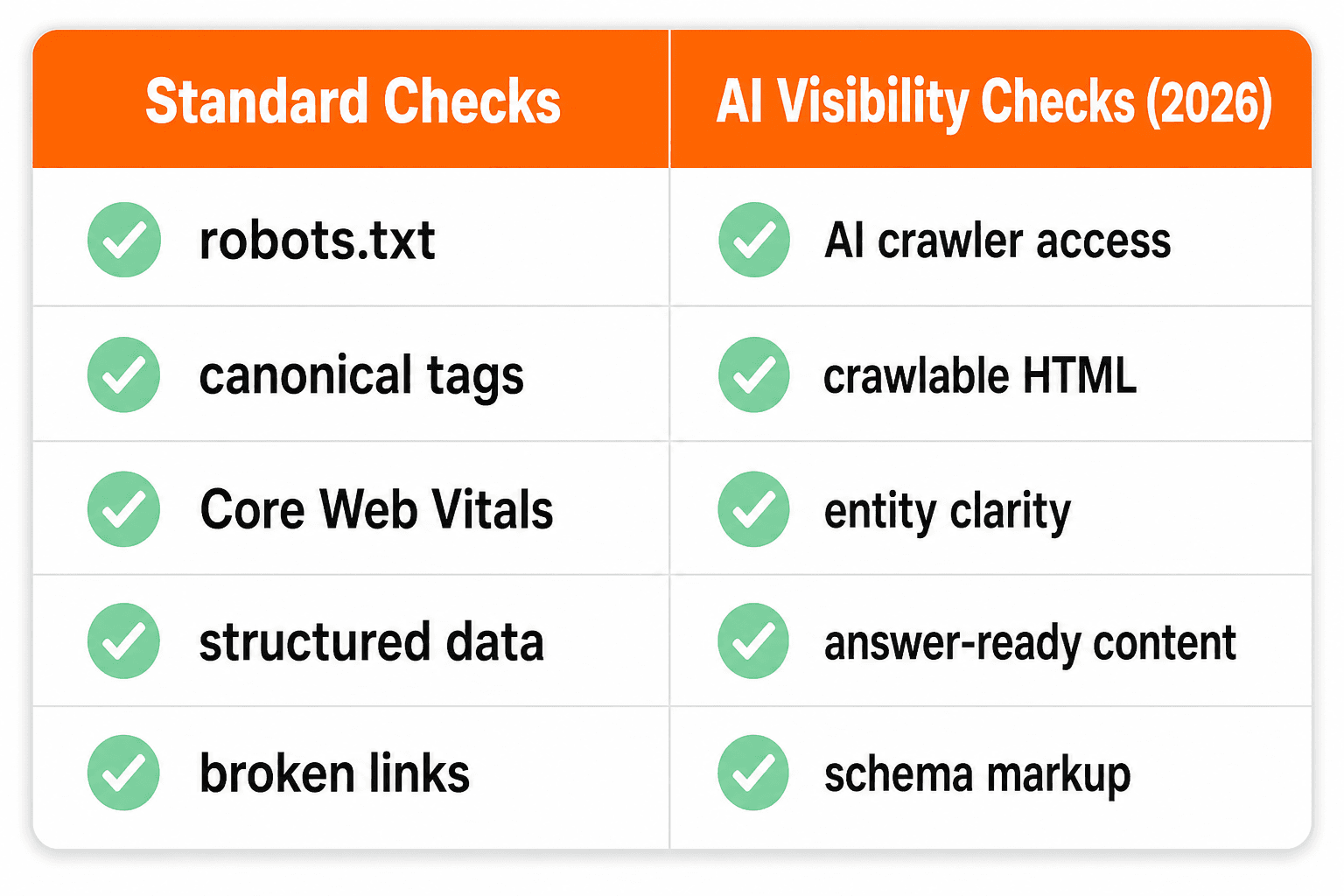
Technical and crawl checks: robots.txt, XML sitemaps, canonical tags, hreflang, redirect chains, crawl depth, orphaned pages, internal link structure, and server errors.
On-page checks: title tags, meta descriptions, heading structure, duplicate content, thin pages, and image alt text.
Performance: Core Web Vitals (LCP, CLS, INP), page speed, and mobile usability.
Structured data: Schema.org markup validity, JSON-LD implementation, and rich result eligibility.
Accessibility: WCAG 2.2 compliance issues, which affect both user experience and AI crawler interpretability.
AI visibility readiness (2026 addition): This is the category most older audit lists miss entirely. A 2026-ready audit should check whether AI crawlers like ChatGPT-User, PerplexityBot, ClaudeBot, and Google-Extended can access your content; whether your HTML is crawlable without JavaScript rendering; whether your structured data and entity clarity support AI citation; and whether answer-ready content blocks exist that AI Overviews can extract. The AI Visibility Tracker from Keytomic is one way to monitor brand appearance across AI platforms alongside technical checks. For a broader introduction to this topic, the GEO guide explains generative engine optimization criteria in detail. For citation readiness specifically, the LLM citations checklist covers what makes content sourceable by AI systems.
Free vs Paid SEO Audit Tools: When Is Free Enough?
Free tools cover the essentials for small sites. The question is where the free threshold ends and paid becomes necessary.
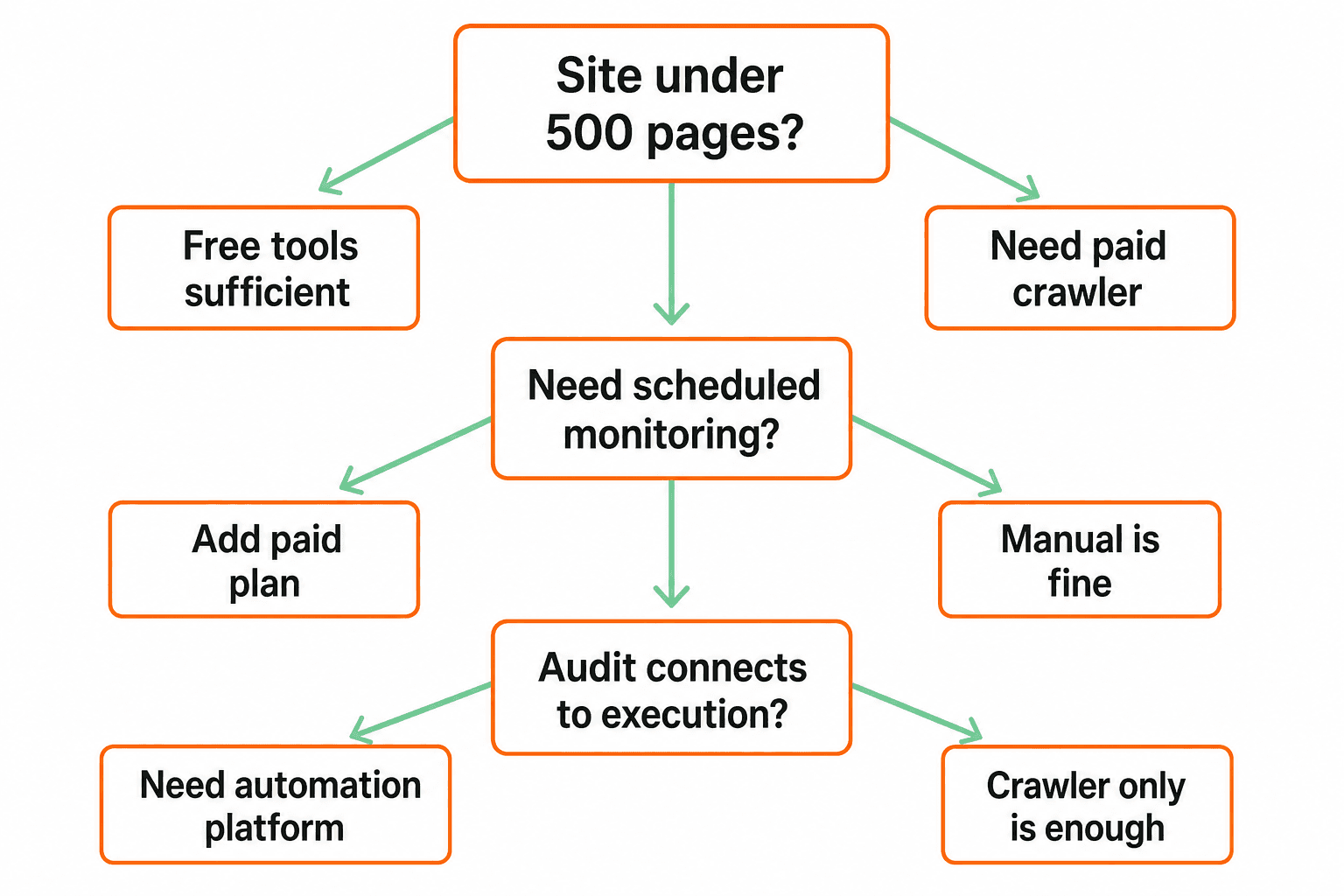
Free is enough when: The site has fewer than 500 pages, audits are infrequent, reporting is internal, and AI visibility tracking is not a priority. Google Search Console, Screaming Frog’s free 500-URL crawl, and Ahrefs Webmaster Tools (own domains only) cover most basic needs.
Keytomic also offers free technical checking tools for specific tasks: the GoogleBot Page Size Checker checks how Googlebot sees individual pages, the Canonical URL Checker validates canonical tag implementation, and the Broken Link Checker surfaces link health issues at the page level.
Paid is needed when: The site exceeds crawl limits, scheduled monitoring is required, audit findings need to be shared with clients or stakeholders, JavaScript rendering is necessary, AI visibility tracking matters, or audit data needs to connect to execution workflows.
Situation | Free Option | Upgrade Trigger |
|---|---|---|
Small site, basic checks | GSC + Screaming Frog free | Site grows past 500 pages |
Own domain monitoring | Ahrefs Webmaster Tools | Need competitor research |
Client reporting | None (manual) | Agency needs shareable reports |
AI visibility monitoring | None | AI-search focus is a priority |
Audit-to-execution workflow | None | Team needs planning + publishing |
According to Google Search Console documentation, GSC is free and provides essential indexing data directly from Google, but it is not a substitute for a full technical crawler.
When Keytomic Is Not the Right Fit
Keytomic is built for audit-to-execution automation. That positioning means it is not the right first choice for every buyer.
Choose a different tool when:
Raw crawl depth is the priority. If the job requires exporting every URL on a 2-million-page site with custom extraction rules, Screaming Frog or Sitebulb are better-suited specialist crawlers.
Log-file analysis is needed. Botify or Lumar handle log-file data and crawl budget analysis at enterprise scale. That capability is outside Keytomic’s core positioning.
Enterprise monitoring is required. Continuous monitoring across multiple domains with CI/CD integration is Lumar’s strength, not Keytomic’s.
Backlink research is the primary job. Ahrefs or Semrush have significantly deeper backlink indexes and are better for link-first SEO strategies.
Keytomic is strongest when the team needs audit findings to connect directly to content planning, publishing, and AI search visibility in a single subscription rather than managing a fragmented stack of five separate tools.
FAQs About SEO Audit Tools
What is the best SEO audit tool for 2026?
There is no single best tool. Use Keytomic for lean team audit-to-execution workflows, Screaming Frog or Sitebulb for deep crawling, Semrush or Ahrefs for audits inside broader SEO suites, and Google Search Console as a free baseline.
What is the best free SEO audit tool?
Google Search Console is the most valuable free option because data comes directly from Google. Screaming Frog’s free 500-URL crawl and Ahrefs Webmaster Tools (own domains) cover technical crawl checks at no cost.
Is Google Search Console enough for a full SEO audit?
No. GSC provides indexing, performance, and Core Web Vitals data directly from Google but does not crawl every page or detect all on-page and structural issues. Pair it with a dedicated crawler for a complete audit.
Which SEO audit tool is best for technical SEO?
Screening Frog SEO Spider is the benchmark for raw technical depth with 300+ issue checks. Sitebulb is the better choice when findings need to be explained to non-technical audiences. Lumar is the enterprise option for very large sites.
Which is better for audits, Semrush or Ahrefs?
Both cover technical and on-page audits well. Semrush checks 140+ issues and includes AI search health monitoring. Ahrefs checks 170+ issues with strong health score prioritization. Choose based on which broader platform your team already uses for research.
Which is better, Screaming Frog or Sitebulb?
Screening Frog offers greater raw depth and customization at a lower annual price. Sitebulb offers more readable reports, visual diagrams, and Cloud collaboration. Most agencies use Screaming Frog for technical work and Sitebulb for client-facing output.
Do SEO audit tools check AI search visibility?
Most do not check AI visibility natively. Semrush has added AI search health features. Lumar includes GEO and AEO metrics. SE Ranking offers AI visibility monitoring via SE Visible. Keytomic includes AI Visibility Tracker as part of its platform. Screaming Frog and Sitebulb do not natively monitor AI search presence.
How often should I run an SEO audit?
Run a full technical audit at minimum quarterly. Run lighter checks monthly for actively publishing sites. Run audits immediately after site migrations, major CMS changes, or core algorithm updates.
Are SEO audit scores accurate?
Site health scores vary by tool and methodology. They are directional indicators of technical issues, not absolute measures of ranking potential. Use the issue list and prioritization rather than comparing scores between tools.
What should I do after an SEO audit finds issues?
Prioritize by impact: fix crawl and indexing blocks first, then redirect chains and broken links, then on-page issues and structured data. Assign clear ownership and connect fixes to your publishing or development workflow to avoid issues sitting unresolved.
Final Decision Framework
Before choosing an SEO audit tool, work through five decisions:
What is the audit problem? Deep crawl analysis, ongoing monitoring, AI visibility readiness, or audit-to-execution automation each point to different tools.
How large is the site? Free tiers work for sites under 500 pages. Paid crawlers become necessary above that. Enterprise monitoring platforms are built for 100,000+ pages.
Is this a one-time crawl or ongoing monitoring? One-time: Screaming Frog. Ongoing: Semrush, SE Ranking, Sitebulb Cloud, or Lumar.
Who reads the report? Internal technical team: Screaming Frog. Non-technical client: Sitebulb. Executive stakeholder: Semrush or SE Ranking dashboard.
Does the audit need to connect to publishing, planning, and AI visibility? If yes, a specialist crawler alone is not enough. A platform that connects audit findings to execution is the more efficient path.
For lean teams that answer yes to question five, Keytomic AI SEO platform replaces the fragmented stack of crawler, content planner, publisher, and AI visibility tracker with a single automation-first subscription built for founders and small teams that want organic growth on autopilot.