Topical authority in SEO describes how reliably search engines and AI answer systems can retrieve a site as a trusted source on a specific subject. It is not a public Google score. It is built when a site demonstrates deep coverage, consistent entity relationships, clear internal links, and useful evidence across a connected set of pages on the same topic.
Most teams that struggle to rank are not publishing bad content. They are publishing disconnected content. A competitor with a smaller team can outrank an established site across an entire topic because they mapped their subject carefully, linked pages together, and covered real audience questions instead of chasing isolated keywords.
Topical authority SEO is not about article volume. It is about retrieval confidence: making it easy for Google, ChatGPT, Gemini, Perplexity, and Google AI Overviews to identify your site as the most coherent, consistent source for a subject. For teams using the Keytomic SEO automation platform, the goal is to turn topical authority from a planning concept into a repeatable publishing and internal linking workflow.
This guide explains what topical authority is, which signals build it, how to plan a topical map, and the most common mistakes that undermine it.
What Topical Authority Means in SEO
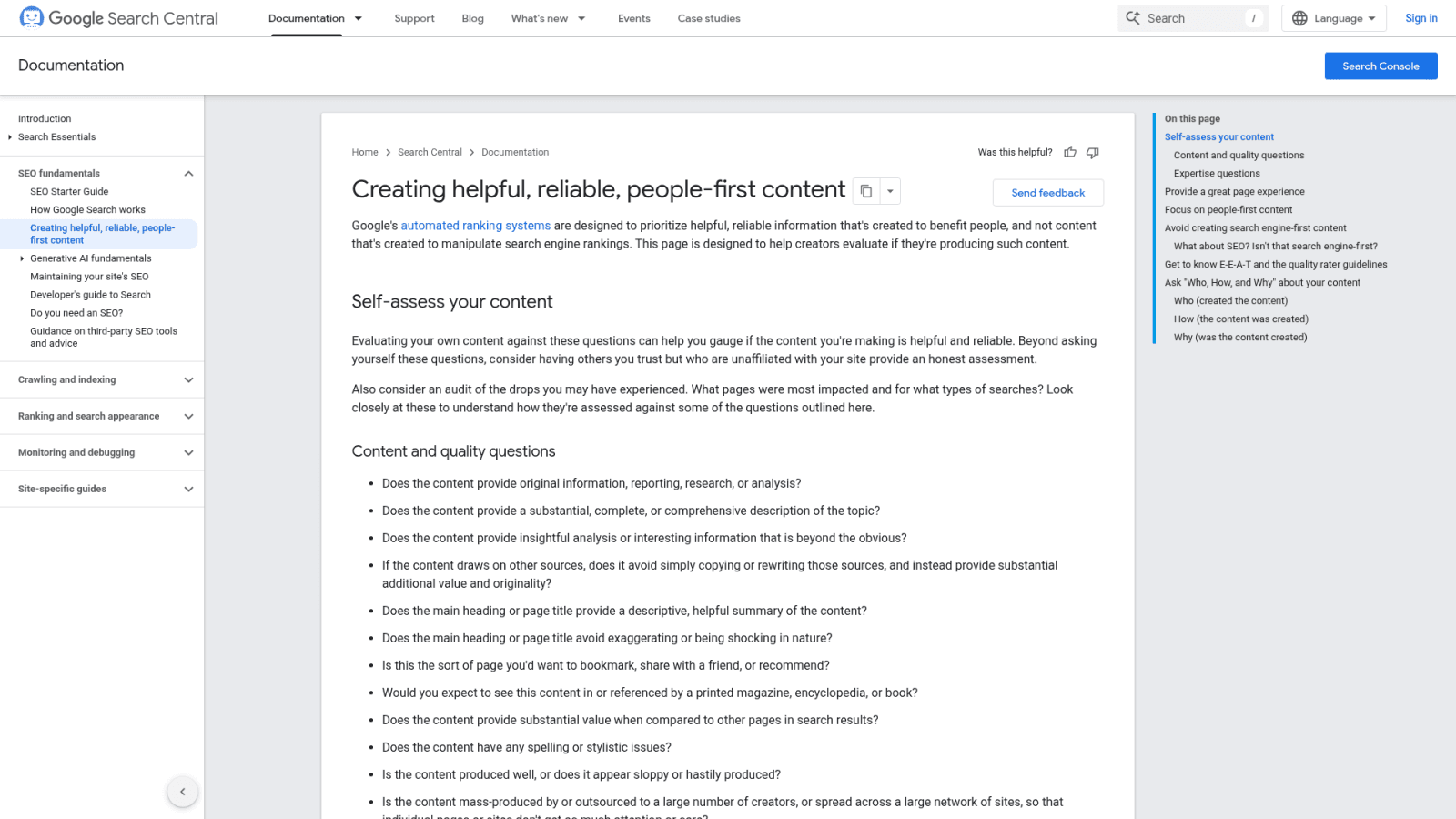
Topical authority is an SEO concept that describes the degree to which a site is seen as a reliable, complete source on a specific subject. Google's guidance consistently emphasizes helpful, reliable, people-first content and quality signals that align with Experience, Expertise, Authoritativeness, and Trustworthiness (E-E-A-T). Topical authority work is the practical layer that produces those signals at scale.
The concept is topic-specific, not sitewide. A site can have high topical authority for SEO automation and low authority for personal finance, because authority is earned through coverage depth and entity consistency within a subject, not across every subject at once.
Topical authority grows when several things align:
Deep coverage of the subject's real questions, subtopics, and related entities
Internal links that connect related pages clearly and logically
Expert input, original examples, and source-backed claims
Consistent use of the topic's core entities and attributes across pages
Technical accessibility so crawlers can actually discover and index the content
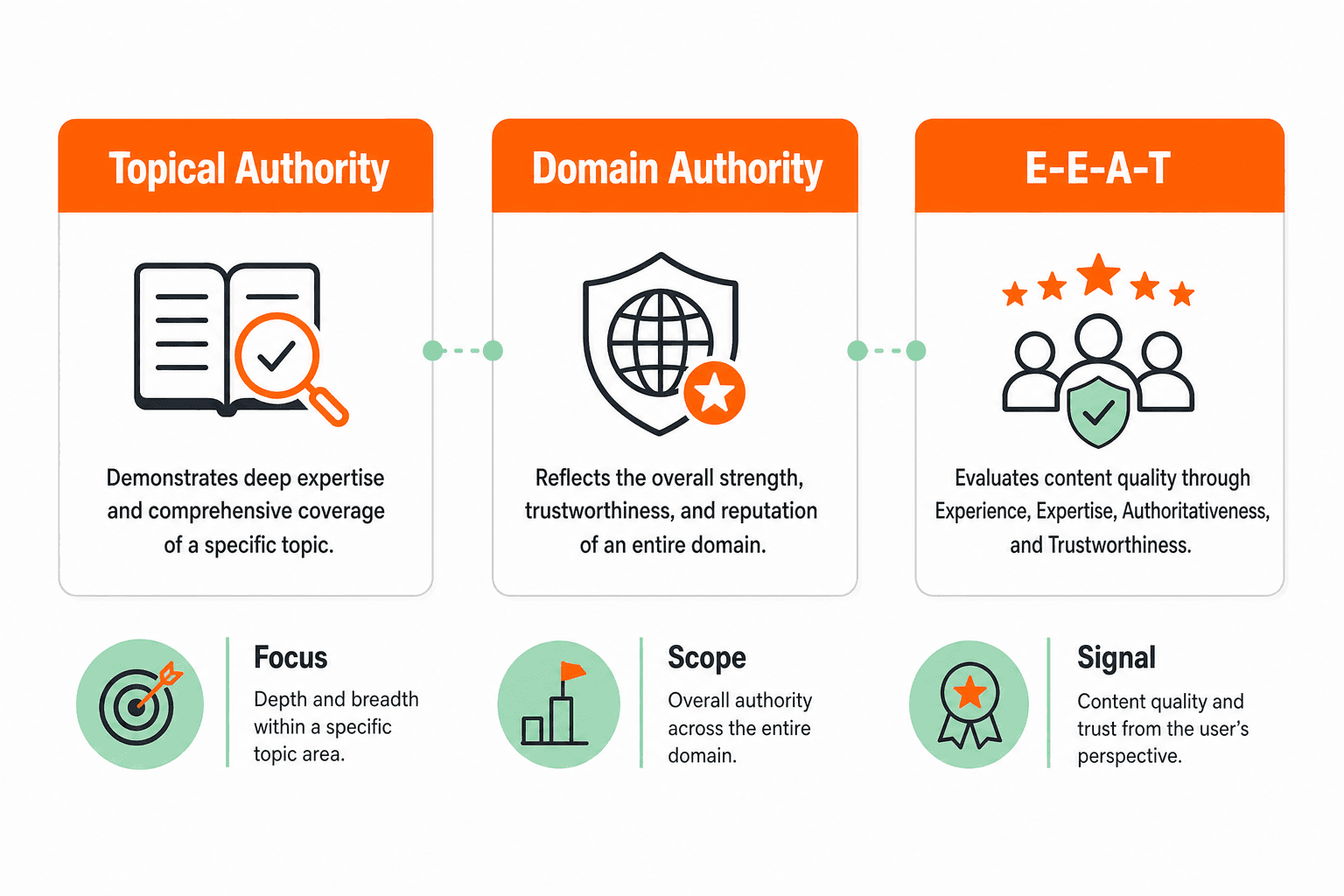
Topical Authority vs Domain Authority vs E-E-A-T
These three concepts get confused constantly. They measure different things and respond to different signals.
Concept | What it means | What improves it | Common mistake |
|---|---|---|---|
Topical authority | A site's perceived reliability on a specific subject, built through coverage depth, entity consistency, and internal linking | Publishing connected pages that cover a subject completely, linking them clearly, using consistent entities | Treating it as a replacement for domain metrics or chasing article count instead of coverage completeness |
Domain Authority / Domain Rating | Third-party link-strength metrics from tools like Moz or Ahrefs. Not a Google metric | Earning quality backlinks from relevant, trusted sites | Assuming a high DA score means Google trusts the site for every topic |
E-E-A-T | A quality evaluation concept from Google's Search Quality Rater Guidelines used by human raters to assess page quality | Real expertise, verifiable experience, credible authorship, clear trust signals | Treating E-E-A-T as a single ranking factor or a score that can be directly measured |
Why Topical Authority Matters for Google, LLMs, and AI Overviews
When a site covers one subject deeply, it can rank across a wide range of related queries instead of competing for a single keyword. Google's systems are increasingly good at recognizing whether a site genuinely covers a subject or simply targets keyword variations without adding new information.
For AI answer systems like Google AI Overviews, ChatGPT, Gemini, and Perplexity, the dynamic matters even more. Google's AI Overviews use a "query fan-out" process, splitting a single search into multiple related sub-queries and pulling citations from the pages that appear most consistently across those sub-queries. According to Search Engine Journal's analysis of Ahrefs data, covering a topic across related angles carries more weight than holding a single top-10 ranking position for one keyword. AI answer systems may be more likely to use clear, consistent, well-supported sources because extractability and topical consistency are easier for those systems to process.
The practical benefits of building topical authority include:
Ranking breadth across semantically related queries, not just one target keyword
Stronger internal link equity distributed across the entire cluster
Higher probability of being cited across multiple sub-queries in AI search experiences
Compounding content value as new cluster pages reinforce the pillar and each other
Clearer crawl paths that reduce orphan pages and improve indexing speed
Can AI Search Systems Trust a Site That Only Has One Good Page?
Sometimes. A single well-written, authoritative page can rank and even appear in an AI Overview for a specific query. But one page is a weak long-term asset compared to a connected cluster.
A single page answers one specific query. A cluster of connected pages that cover subtopics, comparisons, definitions, examples, and FAQs gives AI systems multiple citation surfaces across the fan-out sub-queries that a single prompt triggers. Sites with consistent topical coverage appear across more of those sub-queries, which means more opportunities to be selected as a source. There is no guarantee of AI citation regardless of content quality, but a connected topical footprint is a more durable and citable asset than any single standalone page.
The Signals That Build Topical Authority
Topical authority is not built by one signal. It is the cumulative output of several practical SEO decisions made consistently across a content program. These are not proprietary ranking factors. They are the same signals that Google's documentation, quality guidance, and AI search research point to repeatedly.
The core signal groups are: topic coverage, internal links, entity consistency, information gain, freshness done correctly, technical accessibility, and off-site validation through relevant backlinks.
Topic Coverage and Topical Maps
A topical map is the planning blueprint that defines what a site must cover to be complete and retrievable for a subject. It defines the pillar page (the broad overview), supporting cluster pages (focused subtopics and questions), the intent each page serves, the entities each page should address, the proof each page needs, and how pages link to each other.
Semantic SEO practitioners including Koray Tuğberk Gübür have discussed topical maps as a method for making content coverage explicit and systematic rather than reactive. The concept is that mapping coverage before writing prevents the most common failure mode: publishing pages that overlap, leave gaps, or ignore the attribute relationships that make a topic coherent.
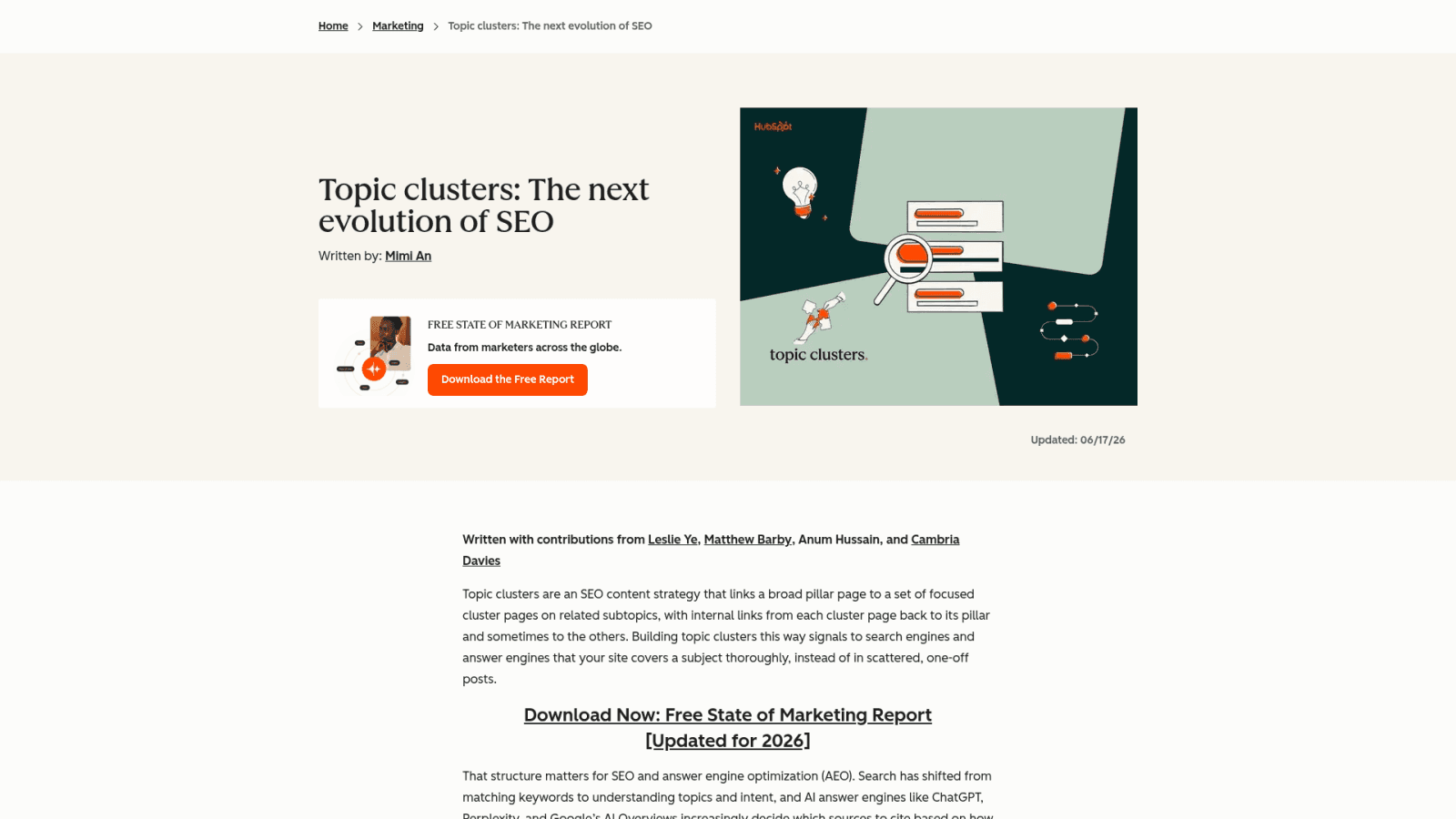
Topic clusters connect a broad pillar page to focused cluster pages through internal links, organizing topical coverage in a way that search engines and AI systems can navigate. The topical map is the planning layer that defines what those clusters should contain before anyone writes a word.
Internal Linking and Anchor Text
Internal links are the connective tissue that turns a set of related pages into a recognized topical unit. Google's link best practices confirm that descriptive anchor text and crawlable links help both users and Google understand and find related content.
Effective internal linking for topic clusters uses three patterns:
Hub to cluster: The pillar page links out to each supporting cluster page using anchor text that names the subtopic.
Cluster to hub: Every cluster page links back to the pillar page, reinforcing its role as the central authority.
Cluster to cluster: Related cluster pages link to each other where the connection adds value for the reader, without forcing links that do not fit naturally.
Every cluster page should be reachable from at least one relevant page within the cluster. Orphan pages, those with no inbound internal links, receive less crawl attention and contribute no authority back to the cluster.
Entity Consistency and Semantic SEO
Semantic SEO focuses on meaning, entity relationships, and attributes rather than repeated keyword density. An entity is a clearly defined concept, person, place, product, or idea that search engines can recognize and relate to other entities. Topical authority depends on consistent entity use across pages.
For example, a site building topical authority around SEO automation should consistently reference related entities: topic clusters, topical maps, internal linking, semantic SEO, E-E-A-T, Google Search Console, AI Overviews, content briefs, and pillar pages. Pages that target keyword variants without adding new entity attributes or answering new audience questions do not strengthen the cluster. They fragment it.
How to Build Topical Authority Step by Step
Building topical authority is a systematic process. It is not about writing more content faster. It is about covering one subject completely before expanding to another.
Step 1: Choose a Business-Relevant Topic Boundary
Start by choosing a topic area that connects directly to what your product, service, or expertise actually covers. Avoid chasing broad topics with high search volume that your brand cannot credibly and completely address.
For a SaaS brand in the SEO automation space, relevant topic boundaries include: SEO automation workflows, semantic SEO strategy, content brief generation, AI search visibility, topical maps and cluster planning, and technical SEO audits. Covering celebrity gossip because it has search volume would add no topical authority within the actual subject domain and would actively confuse search engines about what the site is about.
Topic boundary discipline is one of the most underrated decisions in content strategy. Narrow first, then expand once the first cluster is strong.
Step 2: Build a Topical Map Before Writing
Before drafting any page, map out the cluster. A simple topical map table forces the decisions that matter:
Page role | Target intent | Key entities | Proof required | Internal link target |
|---|---|---|---|---|
Pillar: What is topical authority in SEO | Informational, awareness | Topical authority, semantic SEO, topic clusters, E-E-A-T, internal linking | Google helpful content docs, HubSpot clusters source | All cluster pages |
Cluster: How to build a topical map | Informational, strategic | Topical map, pillar page, cluster page, search intent, content brief | Example map, Google link docs | Pillar, comparison cluster |
Cluster: Internal linking for SEO clusters | Informational, tactical | Anchor text, crawlable links, hub pages, orphan pages | Google link best practices | Pillar, topical map cluster |
Cluster: Topic clusters vs keyword silos | Comparison, evaluation | Topic clusters, keyword silos, content organization, semantic SEO | SEO case patterns, Google guidance | Pillar, entity cluster |
This table becomes the production queue. Each row is a page, a publishing order decision, and an internal linking plan.
Step 3: Publish the Cluster in Dependency Order
Publish the pillar page first, or publish it alongside the first group of cluster pages so new cluster pages are not immediately orphaned. Avoid publishing advanced comparison or how-to cluster pages before the foundational definitions are live.
Dependency order matters because it mirrors the way a reader (and a search engine) builds understanding: definitions first, then process and comparison, then advanced examples and FAQs. Link every new page immediately to at least one relevant page already in the cluster. An unlinked new page is effectively invisible until it earns a crawl through a sitemap or external signal.
Step 4: Link, Update, and Measure the Cluster
After publishing, use Google Search Console to monitor query impressions across the cluster. Watch for new queries appearing in impression data that the cluster does not yet have dedicated pages for. Those are coverage gaps.
Audit internal links quarterly for competitive topics. Refresh individual pages only when the information has materially changed, not to update publication dates without substance. Google's helpful content guidance is clear that content should be updated for accuracy and usefulness, not for fake freshness signals. Teams looking to automate this measurement loop should choose SEO automation software that actually saves time rather than adding more manual tracking tasks.
What Does a Topical Authority Map Look Like in Practice?
A topical map is most useful when it is concrete enough to become a publishing schedule. Below is an illustrative example for an SEO automation cluster, the kind Keytomic is designed to support.
Example Topical Map for SEO Automation
Page role | Target keyword | Key entities | Intent | Internal link role |
|---|---|---|---|---|
Pillar | SEO automation software | Keyword research, content calendar, auto-publishing, technical audits, AI visibility | Commercial, evaluation | Links to all cluster pages |
Cluster | What is topical authority in SEO | Topical authority, semantic SEO, topic clusters, topical map | Informational, awareness | Links to pillar and topical map cluster |
Cluster | How to build a topical map | Topical map, cluster pages, pillar pages, search intent | Informational, strategic | Links to pillar and internal linking cluster |
Cluster | AI search optimization | AI Overviews, LLM optimization, entity SEO, answer engine optimization | Informational, strategic | Links to pillar and topical authority cluster |
Cluster | SEO content brief generator | Content brief, semantic SEO, NLP SEO, keyword research | Informational, tool-oriented | Links to pillar and content automation cluster |
Cluster | Internal linking for SEO | Anchor text, crawlable links, hub pages, cluster pages | Informational, tactical | Links to pillar and topical map cluster |
Cluster | Technical SEO audit | Crawl errors, indexing, site architecture, technical SEO tools | Informational, tactical | Links to pillar and AI search cluster |
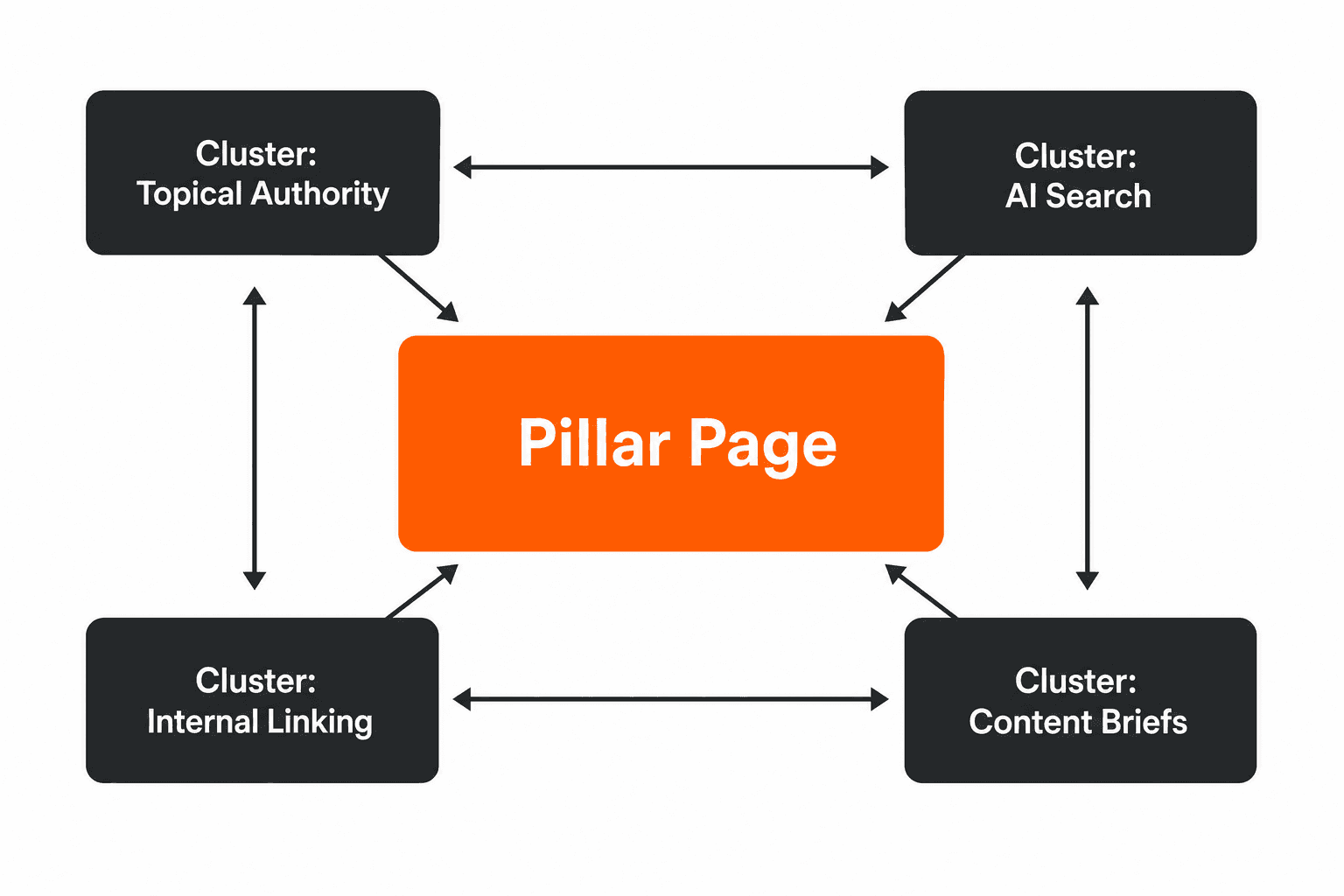
This is an illustrative example, not a required universal map. The actual topics, page roles, and link targets for any site should be driven by audience research, query data, and competitive gap analysis.
Common Mistakes That Weaken Topical Authority
Most topical authority problems come from a small number of repeated mistakes. Recognizing them before publishing is far easier than cleaning them up after.
Google's guidance on helpful content specifically calls out content created primarily for search engines, automated content generated without original value, and pages that summarize what others say without adding new expertise or proof. All of those behaviors directly undermine topical authority.
The most common mistakes:
Publishing keyword variants as separate pages without adding new attributes, intent angles, or audience questions. This creates cannibalization and dilutes the cluster's signal.
Letting cluster pages become orphans by failing to link them from the pillar or related pages immediately after publishing.
Covering unrelated topics because of search volume without checking whether the brand can credibly own that subject area.
Creating overlapping pages that answer the same question with slight variations, confusing both users and crawlers about which page to trust.
Using generic AI content that summarizes competitor articles without original examples, methodology, data, or proof. These pages may pass a quick quality check but fail to add information gain, which is what actually builds topical signal.
Making unsupported claims such as "guaranteed rankings" or "best SEO tool" without disclosed methodology and evidence. Those claims damage trust rather than building it.
How Much Content Is Enough to Build Topical Authority?
There is no fixed article count. No universal number applies across topics, industries, audiences, or competitive contexts.
The right measure is coverage completeness, not content volume. A cluster is complete enough when it answers the audience's main questions across each intent type (informational, comparison, tactical, example-based), covers the topic's core entities and their relationships, and links every page clearly within the cluster. Measuring coverage gaps against audience questions and competitor subtopics is more useful than targeting a specific article number. Start narrow, cover the topic well, then expand only when the first cluster is genuinely strong.
How Keytomic Helps Teams Plan Topical Authority Without a Fragmented SEO Stack
Keytomic is our product, so this section focuses on where it fits and where it does not.
Building topical authority requires several moving parts: keyword and topic research, cluster planning, content brief creation, publishing, internal link management, technical checks, and AI visibility monitoring. Most teams stitch these together across four to six separate tools, which creates gaps in coverage tracking and slows down execution.
Keytomic is positioned as an all-in-one SEO automation platform built to handle that workflow from keyword discovery through publishing, with features including AI keyword research, 30-day content calendars, automated publishing, semantic SEO and E-E-A-T content support, technical SEO audits, WordPress and Shopify integrations, and AI visibility tracking. The goal is turning a topical map from a spreadsheet into a live publishing queue without requiring a full SEO team to coordinate manually. For a broader look at what that workflow covers, see how Keytomic helps teams win at SEO and AI visibility.
Pricing and features were checked in July 2026. Confirm current details before purchasing at keytomic.com.
When Keytomic Is Not the Right Fit
Keytomic is not suited for every team or situation. Before choosing any platform for topical authority execution, consider these limitations:
Keytomic does not replace legal, medical, financial, or regulated expert review. Those topics require human professionals, not content automation.
No SEO software can guarantee rankings or AI citations. Anyone claiming otherwise is overstating what the technology can do.
Teams that want fully manual control over every research, writing, design, and editorial approval step may find an automated platform constraining.
Enterprise sites with complex governance requirements, multi-market publishing rules, or legal compliance workflows may need custom human-led processes that a self-serve platform cannot accommodate.
FAQs About Topical Authority in SEO
What is topical authority in SEO?
Topical authority is a site's perceived reliability on a specific subject, built through deep coverage, clear internal links, consistent entities, and useful evidence across connected pages.
Is topical authority a Google ranking factor?
Topical authority is not a public Google ranking factor or score. It is an SEO concept that describes how related signals can make a site more relevant and trustworthy for a subject.
How do you build topical authority?
You build topical authority by choosing a clear topic boundary, mapping subtopics and entities, publishing helpful pages in dependency order, linking them clearly, and updating them when information materially changes.
What is a topical map in SEO?
A topical map is a content blueprint showing the pillar page, supporting cluster pages, questions, entities, proof needs, and internal link relationships for a subject. It becomes a publishing schedule before writing starts.
What is the difference between topical authority and semantic SEO?
Semantic SEO is the method of optimizing around meaning, entities, and relationships. Topical authority is the outcome you build by applying that method consistently across a connected content cluster.
Do topic clusters still work for SEO?
Topic clusters still work when they are built around real intent, useful coverage, and clear internal links, not when they consist of thin keyword variations without new information or audience value.
How many articles do you need to build topical authority?
There is no fixed number. The right count depends on the topic's scope, the audience's main questions, competition depth, and how much unique proof each page adds. Coverage completeness matters more than volume.
Can a new website build topical authority?
Yes. A new site can build topical authority by starting with a narrow topic it can cover better than broader competitors and expanding only after the first cluster is strong and well-linked.
Does topical authority help with AI search visibility?
Topical authority may help AI search visibility because clear, consistent, well-supported content is easier for answer systems to interpret and cite across fan-out queries. AI citations are never guaranteed.
How do internal links support topical authority?
Internal links support topical authority by connecting related pages, clarifying their relationships, and helping users and Google find deeper resources on the same subject.
Next Steps: Build Authority Around One Topic Before Expanding
If you take one thing from this guide: build one strong topic network before chasing more unrelated keywords. A complete cluster on a narrow subject outperforms a fragmented library of unconnected posts every time.
Before you publish another page, work through this checklist:
Choose a specific topic boundary tied to your product, service, or expertise
Map the entities, questions, and subtopics that make the subject complete
Assign page roles: pillar, cluster, comparison, FAQ, example
Publish pages in dependency order, definitions before advanced comparisons
Link every page within the cluster immediately after publishing
Monitor Google Search Console for query expansion and coverage gaps
Refresh pages only when information materially changes, not to fake freshness
If you are ready to turn that topic into an automated content plan, the 30-day AI search optimization roadmap is a practical next step for operationalizing the strategy. Keytomic can help map, schedule, publish, and monitor the full workflow.