Most early-stage startups treating SEO as an afterthought end up pouring budget into tactics that produce zero measurable pipeline. The real problem is not effort: it is strategy. Scattered keywords, inconsistent publishing, and zero internal linking architecture quietly kill organic growth before it ever starts.
Why Early-Stage Startups Get SEO Wrong
Here's the pattern most startups follow: spend six months building the product, launch with a blog, publish four posts inspired by competitor topics, wait ninety days, see nothing move, and then conclude that "SEO takes too long." The conclusion is not wrong exactly, but the diagnosis is.
Treating SEO as a Channel for Later
Organic search compounds over time, which means the cost of starting late is not linear. A startup that begins building topical authority in month three versus month twelve does not just gain nine months of content; it gains the full compounding effect of indexed pages, internal links, and backlink equity working together. According to a 2024 Conductor survey, 91% of respondents confirmed SEO positively affected website performance and marketing goals, yet organizations with lower SEO maturity reported the smallest gains. Maturity requires time to build, which is precisely why waiting is expensive.
Copying Competitor Tactics Without a Strategy
Most early-stage founders look at what their Series B competitor is publishing and try to replicate it. The problem is that a competitor with domain authority built over three years can rank for broad terms a new domain simply cannot compete on. Copying their topic list without running a real content gap analysis means you are targeting terms where you have no realistic shot at ranking, at least not yet.
Expecting Quick Wins From Isolated Posts
A single post rarely ranks in a vacuum. What builds ranking signals is a cluster of related, interlinked content that establishes topical authority on a subject. Publishing one article on "B2B pricing strategy" and then moving to "remote team management" the following week does not create a cluster. It creates noise.
The Startup SEO Problems That Waste Time and Budget
Once you understand the mindset problem, the tactical failures start to make more sense. These are the specific mistakes that drain hours and budget without producing pipeline.
Scattered Keyword Choices
Picking keywords based on gut feel or competitor observation produces a topic list with no coherent theme. A startup covering "SaaS pricing," "cold email," and "product roadmap best practices" in the same month is not building authority in any one area. Effective automated keyword research groups terms by semantic relationship, search intent, and competitive difficulty so every piece of content reinforces the ones around it.
Symptom | Root Cause | Fix |
|---|---|---|
Articles not ranking after 6+ months | Targeting high-difficulty terms too early | Focus on low-difficulty, long-tail clusters |
High bounce rate on blog traffic | Content misaligned with search intent | Map topics to informational, commercial, or transactional intent |
No internal link equity | Pages published in isolation | Build content around topic clusters with deliberate linking |
Flat organic traffic curve | Inconsistent publishing cadence | Establish a repeatable 30-day content roadmap |
Thin Topic Coverage
One article does not equal topical authority. Google assesses whether a site covers a subject comprehensively before trusting it to rank for competitive terms in that space. A startup that publishes fifteen deeply interconnected pieces on one subject will build more credibility than a site with two hundred scattered posts touching the same topic at the surface level. Research from Averi AI confirms that companies focusing on comprehensive topic clusters see significantly faster indexing and greater AI citation likelihood than those publishing isolated content.
Inconsistent Publishing Cadence
Googlebot crawl patterns adjust to your site's publishing frequency. A site that publishes three articles one month and nothing the next sends inconsistent freshness signals. A predictable cadence, even if modest, keeps crawl rates stable and creates a content asset base that compounds month over month.
Weak Internal Linking
Internal links pass authority between pages and help search engines understand site architecture. Most startups publish each post as a standalone island. Over 65% of web pages have no backlinks pointing to them according to Ahrefs data cited by Demand Sage, which makes internal links even more critical for early-stage sites with thin external link profiles.
Chasing Vanity Metrics
Impression counts and total traffic feel good in a dashboard. They do not correlate with pipeline unless the traffic is intent-matched. A startup ranking for informational terms that attract students and researchers will see traffic grow with zero revenue impact. The metric that matters is whether organic visitors match your ideal customer profile and whether they convert into qualified leads.
What a Startup-Friendly SEO System Should Look Like
A lean, effective SEO workflow for an early-stage startup does not require a full in-house team. It requires a repeatable system with five core components.
Keyword Research Tied to Business Goals
Start with terms your buyers actually search at each stage of their journey, not just the highest-volume terms in your category. For a B2B SaaS startup, that typically means a mix of problem-aware queries at the top of the funnel and comparison or alternative queries closer to purchase. A structured seo content strategy maps keyword intent to funnel stage before a single word is written.
Topic Cluster Planning
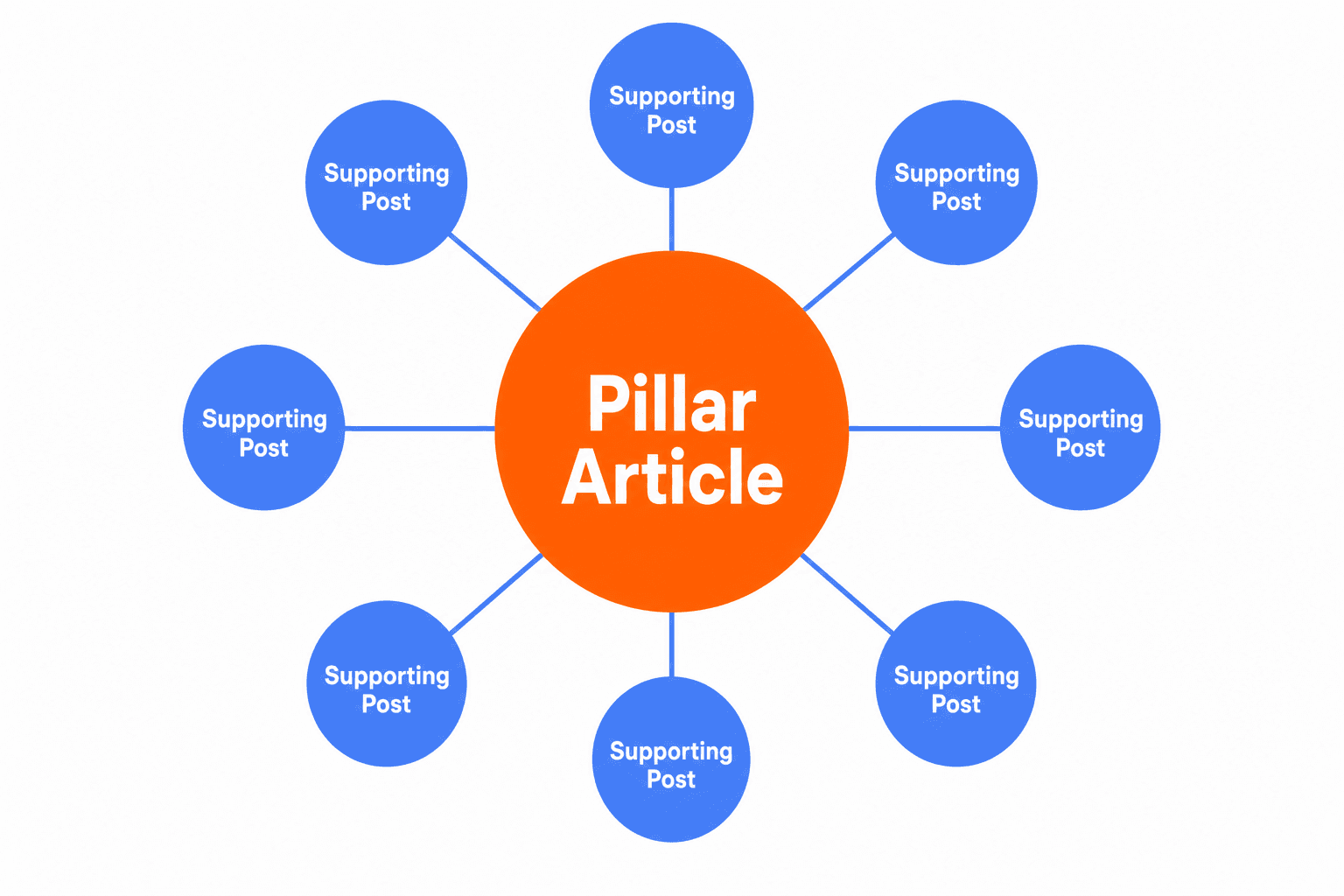
Group your keywords into clusters of eight to fifteen related terms. Each cluster should have one pillar piece covering the broad topic and supporting pieces addressing specific subtopics. Every supporting piece links back to the pillar and to at least two or three sibling posts. This architecture builds topical authority systematically.
A Realistic Publishing Cadence
For most early-stage startups, four to six articles per month is both achievable and sufficient to build momentum. Consistency beats volume. A team that publishes four well-researched posts every month for twelve months creates a stronger organic foundation than one that publishes twenty posts in a burst and then goes quiet.
Indexing and Technical Basics
Submit your sitemap to Google Search Console, fix crawl errors promptly, ensure your pages load in under three seconds, and verify that no important content is accidentally blocked in your robots.txt file. These are not optional; they are the minimum viable technical setup for any SEO program.
Ongoing Performance Review
Check which pages are gaining impressions but not clicks (title and meta description problems), which pages rank between positions six and fifteen (content depth problems), and which pages earn backlinks organically (replication opportunities). A monthly review cycle keeps the system improving without requiring a dedicated SEO analyst.
How Keytomic Automates the SEO Workflow End to End
Keytomic is built around the observation that early-stage startups do not fail at SEO because they lack effort. They fail because the workflow is too fragmented. Keyword research lives in one tool, content planning in a spreadsheet, publishing in a CMS, and performance tracking in a third platform. The coordination overhead kills consistency.
Keytomic replaces that fragmented stack with a unified, AI-driven workflow. It handles keyword discovery and cluster mapping, generates 30-day content roadmaps based on your topic priorities, and supports auto-publishing so content moves from brief to live page without manual handoffs between tools.
One dimension worth noting specifically: as AI-driven search surfaces like ChatGPT and Perplexity handle a growing share of B2B research queries, visibility in those environments requires different signals than traditional Google ranking. According to recent data, 50% of B2B software buyers now begin their purchasing journey in AI chatbots rather than Google, a 71% increase in just four months. Keytomic's Generative Engine Optimization (GEO) layer is designed to address this directly, structuring content so it surfaces in AI summaries and not just standard SERPs.
Where human judgment is still required: strategic topic selection, brand voice, and final editorial review are areas where Keytomic supports the workflow rather than replacing those decisions. The platform is built for efficiency, not for eliminating the human layer that makes content trustworthy.
How to Fix the Most Common Startup SEO Mistakes
If you recognize your current approach in the sections above, here are the practical corrections to make.
Choose Topics Based on Search Intent First
Before selecting a keyword, identify what the searcher actually wants to accomplish. An informational query needs an educational answer. A commercial query needs comparison depth or a clear recommendation. Misaligning content type with search intent is one of the most common reasons otherwise well-written content fails to rank.
Build Content Around Clusters, Not Individual Posts
Map out a cluster of ten to fifteen related topics before writing the first piece. Write the pillar article first, then create supporting content that links back to it. This signals to Google that your site has comprehensive coverage of the subject, which accelerates topical authority.
Run a Content Gap Analysis Before Planning
A content gap analysis compares your current indexed content against the full set of relevant queries your target audience searches. The gaps are your highest-opportunity topics: real search demand with no existing page competing for it on your site. Fill those systematically before expanding into new territory.
Create a Repeatable Review Process Before Publishing
Before any article goes live, check four things: Does the title match what the searcher actually wants? Does the introduction directly answer the query within the first one hundred words? Does the article link to at least two relevant internal pages? Does the meta description give a specific reason to click? A simple four-point checklist saves significant time fixing underperforming content later.
Stop Measuring Impressions as Success
Impression growth without click-through-rate improvement or conversion correlation is not progress. Set up goal tracking in Google Search Console and Google Analytics to measure which organic pages generate demo requests, newsletter signups, or trial activations. Those numbers tell you whether your SEO is building pipeline.
A Simple Startup SEO Checklist
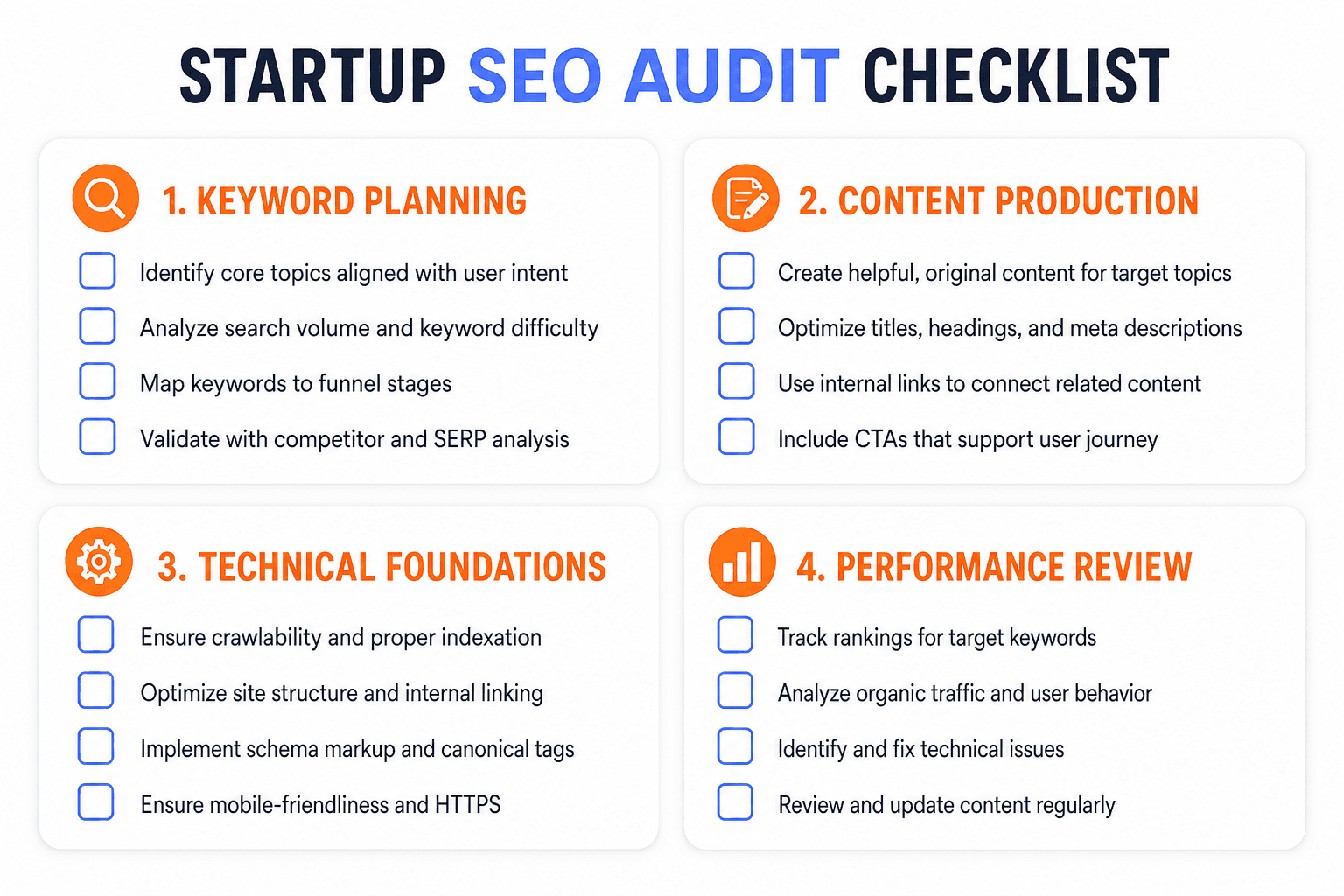
Use this checklist to audit your current approach and identify where to focus first.
Keyword and Topic Planning
All target keywords mapped to a specific funnel stage (awareness, consideration, decision)
Keywords grouped into topic clusters of eight to fifteen related terms
Content gap analysis completed against top three competitors
Low-difficulty, long-tail terms prioritized for the first three months
Content Production
Pillar article drafted for each cluster before supporting posts begin
Each article addresses a specific search intent (informational, commercial, or transactional)
Publishing cadence set at a level the team can sustain for twelve months
Every post links to at least two internal pages on publication
Technical Foundations
Sitemap submitted to Google Search Console
No important pages blocked in robots.txt
Page load time under three seconds on mobile
Crawl errors reviewed and resolved monthly
Performance Review
Monthly review of pages ranked between positions six and fifteen
Click-through rate tracked by page, not just total impressions
Conversion events (demo, trial, signup) tracked from organic traffic
AI search visibility monitored alongside traditional rank tracking
If several boxes are unchecked, that is a signal that your SEO operation needs structure before it needs more content. Building the system first, whether manually or through a platform like Keytomic, is what separates startups that compound organic growth from those that restart every six months wondering why nothing ranked.
Frequently Asked Questions
How long does SEO take to work for a startup? Most startups see measurable organic traffic growth within four to six months when publishing consistently and targeting low-difficulty, intent-matched keywords from day one.
What is a content gap analysis and why does it matter? A content gap analysis identifies search queries your audience uses that your site currently has no content for, revealing your highest-priority publishing opportunities.
How many articles should a startup publish per month? Four to six well-researched, intent-matched articles per month is a sustainable and effective starting cadence for most early-stage teams.
What is topical authority and how do startups build it? Topical authority is Google's assessment that your site comprehensively covers a subject. Build it by publishing ten to fifteen interlinked pieces on one topic before moving to the next.
Should startups optimize for AI search engines like ChatGPT and Perplexity? Yes. B2B buyers increasingly start research in AI platforms, so structuring content for Generative Engine Optimization alongside standard Google ranking is worth prioritizing now.