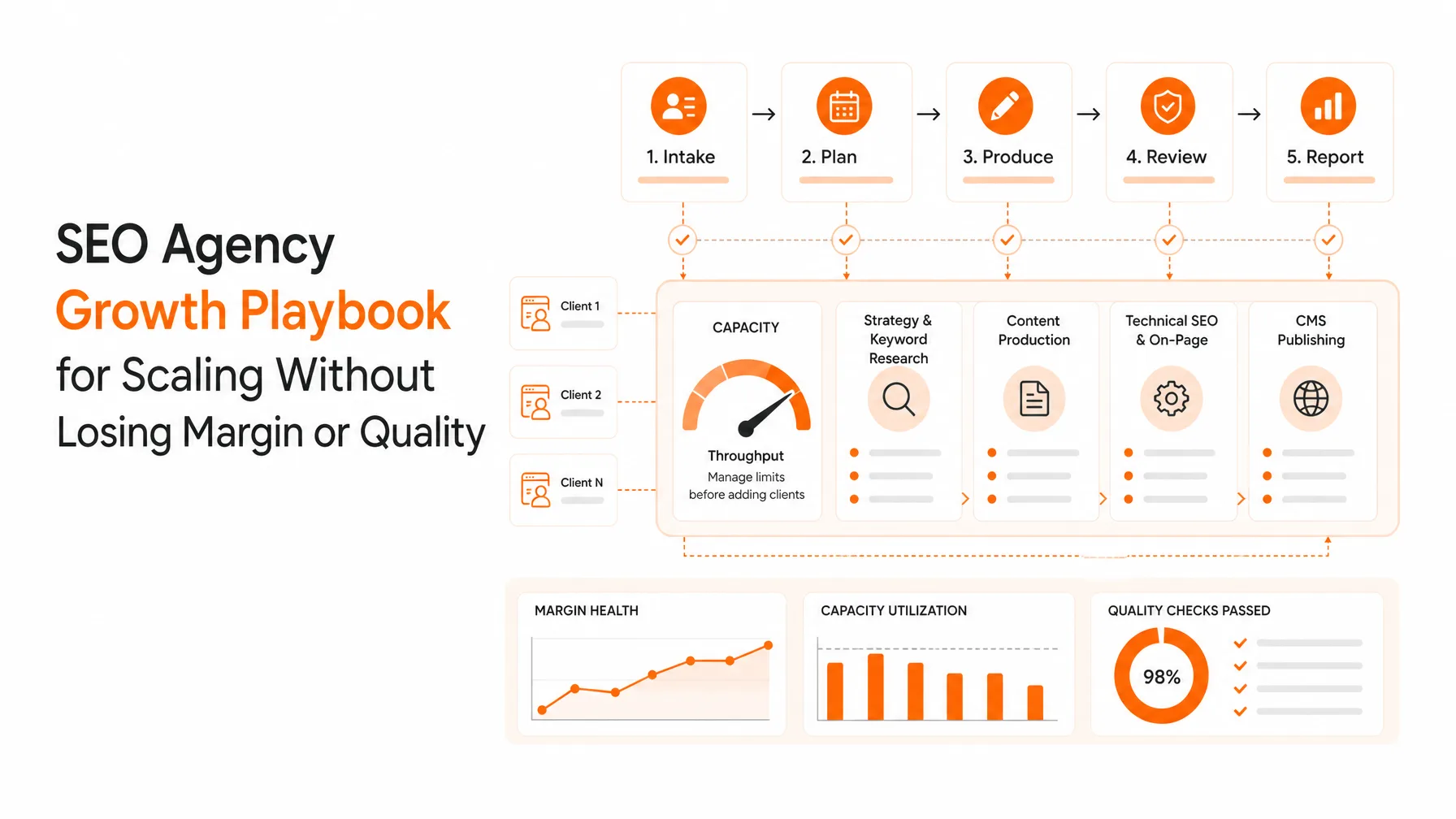
Programmatic SEO tools automate the creation of hundreds or thousands of landing pages using templates, structured data, and keyword variations. These platforms let agencies and enterprise teams scale content production without proportional increases in time or budget.
The best programmatic SEO tools combine keyword clustering, template automation, CMS integrations, and quality control to capture long-tail search traffic efficiently.
If you're managing 20 client blogs or scaling an enterprise site with thousands of SKUs, manually creating pages isn't realistic. You need a programmatic SEO tool that handles repetitive tasks while maintaining quality and SEO best practices. In this guide, we'll compare the top 9 platforms based on automation depth, integration flexibility, pricing, and content output quality.
How We Scored These Programmatic SEO Tools
We evaluated each platform using five criteria that matter most when scaling content at the agency or enterprise level.
Automation Depth
Can the tool handle end-to-end workflows from keyword research to publishing, or does it require constant manual intervention? The best programmatic SEO tools reduce human input to strategic decisions rather than repetitive tasks.
Template Flexibility
Does the platform let you build custom page templates with dynamic content insertion? Rigid templates limit your ability to differentiate pages and maintain brand voice across thousands of URLs.
CMS and Publishing Integration
Seamless connections to WordPress, Webflow, headless CMSs, or custom APIs make the difference between a 2-hour publishing workflow and a 2-minute one. We prioritized tools with native integrations or robust API support.
Content Quality Controls
Programmatic doesn't mean low-quality. Tools that include duplicate content detection, readability scoring, and E-E-A-T signals help you avoid thin content penalties. According to Google Search Central, pages must provide genuine value regardless of how they're produced.
Pricing and Scalability
We looked at cost per page, monthly subscription tiers, and whether the platform scales affordably as you grow from 100 pages to 10,000. Enterprise teams need predictable pricing; agencies need flexibility for multiple clients.
Top 9 Programmatic SEO Tools
Here's our ranked list of platforms that help agencies and enterprise teams scale content production while maintaining quality and SEO performance.
1. Keytomic
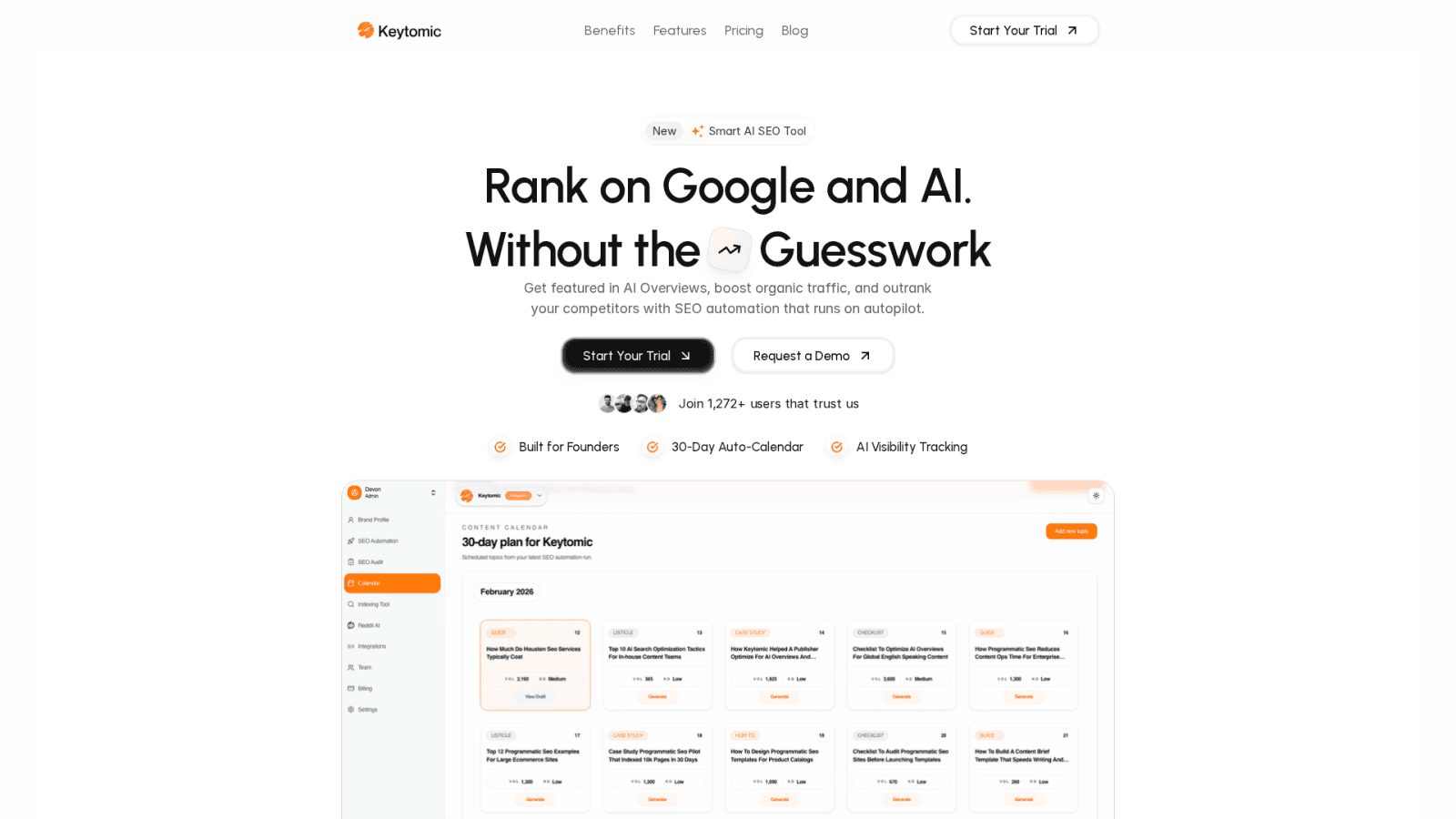
Keytomic is an autonomous SEO engine built specifically for scaling content production without adding headcount. It combines keyword discovery, 30-day content roadmaps, auto-publishing, and Generative Engine Optimization in a single platform.
Key Features
• End-to-end automation: Keytomic handles keyword research, content brief generation, AI-powered writing, and auto-publishing to your CMS • Multi-CMS support: Native integrations with WordPress, Webflow, and headless CMSs via API • GEO optimization: Content structured to rank in Google and get cited by ChatGPT, Perplexity, and Claude • Auto-indexing: Submits new pages to Google via IndexNow API, reducing crawl delays by 60-80% • Structured data automation: Automatically generates schema markup for better SERP features
Pros and Cons
Pros
• Unified platform replaces 3-5 separate SEO tools
• Built-in GEO optimization for AI search visibility
• Strong focus on E-E-A-T signals and content quality
• Transparent pricing with no hidden per-page fees
Cons
• Newer platform compared to legacy tools like Surfer or Ahrefs • Best suited for content-driven SEO strategies rather than technical audits
Pricing
Keytomic offers transparent pricing with plans starting at $299/month for agencies managing multiple clients. Enterprise plans include custom workflows and white-label options.
Best For
Agencies managing 5+ client blogs, SaaS companies scaling content velocity, and lean marketing teams replacing bloated tool stacks. If you're tired of juggling Ahrefs, Surfer, and manual publishing workflows, Keytomic consolidates everything into one system.
2. SEOmatic
SEOmatic specializes in turning templates and structured data into hundreds of SEO-optimized pages. It's designed for agencies, SaaS companies, and e-commerce brands that need to scale landing pages quickly.
Key Features
• Template builder: Create page layouts once, then populate with datasets • Dataset library: Pre-built data sources for common use cases like location pages • CMS integration: Connects to WordPress, Webflow, and custom CMSs • Bulk publishing: Generate and publish hundreds of pages simultaneously • SEO optimization: Built-in meta tag generation and keyword optimization
Pros and Cons
Pros
• Fast setup for location-based or product variation pages
• Affordable pricing compared to enterprise platforms
• No technical skills required for basic implementations
Cons
• Limited content generation capabilities compared to AI-first tools
• Requires manual data preparation and upload
• Less robust GEO optimization features
Pricing
Starts at $49/month for basic plans, with Scale plans at $199/month. Enterprise pricing available for teams needing white-label options.
Best For
Small agencies and SaaS companies needing affordable programmatic page generation for location-based content or product variations. Works well when you already have structured datasets ready.
3. seoClarity
seoClarity is an enterprise SEO platform with programmatic capabilities through its ClarityAutomate product. It's built for large teams managing thousands of URLs across complex site architectures.
Key Features
• No-code implementation: Build programmatic workflows without developer resources • SEO data APIs: Access comprehensive keyword and SERP data programmatically • Content optimization: AI-driven recommendations for on-page elements • Rank tracking at scale: Monitor thousands of keywords across locations • Site audit automation: Technical SEO checks across entire programmatic sections
Pros and Cons
Pros
• Enterprise-grade scalability for massive sites
• Deep technical SEO capabilities beyond just content
• Strong support and onboarding for complex implementations
Cons
• High cost makes it prohibitive for small agencies or startups
• Steeper learning curve than simpler tools
• Requires technical resources for advanced workflows
Pricing
Enterprise pricing only, typically $10,000+ annually depending on site size and features. Contact seoClarity for custom quotes.
Best For
Enterprise teams at e-commerce platforms, travel sites, or job boards managing 10,000+ pages. If you're a Fortune 500 company or established marketplace, seoClarity handles complexity well.
4. Surfer SEO
Surfer SEO combines on-page optimization with content generation capabilities. While not strictly a programmatic tool, its content editor and AI writing features support scaled content production.
Key Features
• Content editor: Real-time optimization based on top-ranking pages • Keyword research: Cluster semantically related terms for topical authority • Surfer AI: Generate articles based on SERP analysis and keyword targets • Audit tools: Identify optimization opportunities across existing pages • Content planner: Build editorial calendars around keyword clusters
Pros and Cons
Pros
• Strong on-page optimization guidance backed by SERP data
• User-friendly interface for writers and editors
• Good balance of automation and manual control
Cons
• Not ideal for transactional or product pages (focused on informational content)
• Higher cost relative to value compared to newer alternatives
• Limited publishing automation
Pricing
Essential plan at $99/month, Scale AI plan at $219/month. Enterprise plans available with custom pricing.
Best For
Content marketing teams creating educational content at moderate scale. Works well when you need strong on-page optimization guidance but don't require full programmatic automation.
5. Airtable
Airtable isn't an SEO tool, but it's become essential infrastructure for programmatic SEO workflows. It acts as the database layer that feeds content generation tools.
Key Features
• Flexible database structure: Store keywords, modifiers, and content data in custom fields • Automation workflows: Trigger content generation when records are marked ready • Integrations: Connects with Make, Zapier, and Webflow for publishing • Collaboration features: Multiple team members can manage datasets simultaneously • Templates: Pre-built structures for common programmatic use cases
Pros and Cons
Pros
• Highly flexible for custom workflows
• Strong integration ecosystem
• Easy to use without technical skills
Cons
• Requires pairing with other tools for actual content generation
• Manual data entry can be time-consuming
• Not built specifically for SEO
Pricing
Free plan available. Team plans start at $20/user/month. Enterprise pricing for advanced security and controls.
Best For
Agencies building custom programmatic workflows who need centralized data management. Pairs well with AI content tools and CMS integrations via Zapier or Make.
6. AirOps
AirOps focuses on enterprise-grade programmatic SEO with advanced customization and workflow automation. It's designed for teams with technical resources who need full control.
Key Features
Custom workflows: Build multi-step automation for content creation and publishing
Keyword clustering: Advanced algorithms group related terms by semantic similarity
Template customization: Deep control over content structure and variables
Performance analytics: Track rankings and traffic across programmatic sections
CMS integrations: Direct publishing to major platforms
Pros and Cons
Pros
• Enterprise-grade capabilities for complex use cases
• Strong focus on quality control and brand voice consistency
• Flexible enough to handle unusual programmatic scenarios
Cons
• Requires technical expertise to set up properly
• Higher learning curve than plug-and-play tools
• Premium pricing limits accessibility
Pricing
Custom enterprise pricing based on workflow complexity and page volume. Typically $500+/month for mid-market implementations.
Best For
Mid-market and enterprise teams with developer resources who need custom programmatic workflows. Best when standard templates don't fit your use case.
7. Frase
Frase specializes in content research and brief generation, making it useful for scaling content production even if it's not strictly programmatic.
Key Features
AI briefs: Analyze top 20 Google results to create detailed content outlines
Community insights: Scrape Quora and Reddit for audience questions
Content optimization: Real-time scoring against ranking competitors
Answer engine: Organize research into question-answer formats
Integrations: Connect with WordPress and Google Docs
Pros and Cons
Pros
• Best-in-class content research and briefing
• Intuitive interface for writers and editors
• Strong focus on answering user intent
Cons
• Limited programmatic automation features
• Requires pairing with other tools for full workflows
• Lacks publishing automation
Pricing
Basic plan at $15/month per user. Team plans start at $115/month with additional content generation credits.
Best For
Content teams scaling production who need strong research and briefing capabilities. Works well as part of a broader tool stack rather than a standalone solution.
8. Alli AI
Alli AI focuses on technical SEO automation at scale, particularly for sites with thousands of pages that need consistent optimization.
Key Features
Site-wide updates: Change meta tags, headers, and schema across your entire site from one dashboard
Schema markup automation: Add structured data to pages automatically
Broken link fixing: Identify and resolve 404 errors programmatically
Code optimization: Automated fixes for common technical issues
Multi-site management: Manage multiple client sites from one interface
Pros and Cons
Pros
• Excellent for technical SEO at scale
• Saves time on repetitive optimization tasks
• Good for agencies managing multiple clients
Cons
• Steep learning curve for non-technical users
• Less focus on content creation vs technical optimization
• Requires existing SEO knowledge to use effectively
Pricing
Custom pricing based on site size and number of pages. Typically starts around $299/month for agencies.
Best For
Agencies and enterprise teams managing technical SEO for large sites. Best when you need to implement consistent optimizations across thousands of pages quickly.
9. SurgeGraph
SurgeGraph offers affordable long-form content generation at scale, making it accessible for smaller agencies and startups.
Key Features
AI content generation: Create long-form articles based on keyword targets
Topic clustering: Group related keywords for topical authority
SERP analysis: Analyze competitors to inform content structure
Bulk generation: Create multiple articles simultaneously
Keyword research: Basic keyword discovery and difficulty scoring
Pros and Cons
Pros
• Affordable pricing for content generation at scale
• Good for long-form blog content
• Lower learning curve than enterprise platforms
Cons
• Limited programmatic features compared to specialized tools
• Content quality requires more editing than premium alternatives
• Less robust technical SEO capabilities
Pricing
Starts at $49/month for basic plans. Pro plans at $99/month include more content generation credits.
Best For
Small agencies and startups scaling blog content on a budget. Works well when content volume matters more than enterprise-grade features.
Programmatic SEO Tool Comparison Table
Tool | Best For | Starting Price | CMS Integrations | GEO Support | Automation Level |
|---|---|---|---|---|---|
Keytomic | Agencies & SaaS teams | $299/month | WordPress, Webflow, API | Yes | Full end-to-end |
SEOmatic | Location-based pages | $49/month | WordPress, Webflow | Limited | Template-based |
seoClarity | Enterprise sites 10K+ pages | $10K+/year | Major platforms | No | Technical focus |
Surfer SEO | Content optimization | $99/month | Limited | No | Hybrid manual/auto |
Airtable | Data management | $0-20/user | Via Zapier/Make | No | Database only |
AirOps | Custom workflows | $500+/month | Major platforms | Partial | High customization |
Frase | Content research | $15+/month | WordPress, Docs | No | Research focus |
Alli AI | Technical SEO | $299+/month | Major platforms | No | Technical only |
SurgeGraph | Budget content scale | $49/month | Limited | No | Basic automation |
Choosing the Right Programmatic SEO Tool
Your ideal platform depends on three factors: scale requirements, technical resources, and workflow complexity.
Consider Your Page Volume Needs
If you're creating 50-200 pages per month, tools like SEOmatic or SurgeGraph offer good value. When you're scaling to 1,000+ pages, you need enterprise-grade automation from Keytomic, seoClarity, or AirOps.
Small agencies managing 5-10 clients can often succeed with a combination of Airtable, Surfer SEO, and manual publishing. But if you're spending more than 10 hours per week on content production logistics, you're ready for full automation.
Evaluate Your Technical Resources
No-code platforms like SEOmatic and Keytomic work well for teams without developers. If you have engineering support, AirOps and custom Airtable workflows offer more flexibility.
The trend in 2026 is toward platforms that require less technical expertise. According to recent industry analysis, programmatic SEO adoption is growing fastest among small teams precisely because modern tools democratize automation that previously required developers.
Match Tools to Your Content Type
Location-based pages, product variations, and comparison pages each benefit from different approaches.
Location pages: SEOmatic, Airtable + Make/Zapier, or custom workflows
Product variations: seoClarity for e-commerce scale, SEOmatic for smaller catalogs
Comparison pages: Keytomic's GEO-optimized templates, Frase for research
Educational content: Surfer SEO, SurgeGraph, or Keytomic depending on scale
Don't fall into the trap of choosing tools based solely on features. The best programmatic SEO tool is the one your team will actually use consistently. A simpler platform you implement fully beats a complex one you barely use.
Why Agencies Choose Keytomic for Programmatic SEO
When you're managing content for multiple clients or scaling an enterprise content operation, you need a platform that handles the entire workflow without creating new bottlenecks.
Keytomic's approach differs from traditional programmatic SEO tools in three ways. First, it combines keyword research, content generation, and publishing in one system rather than requiring 3-5 separate tools. Second, it optimizes for both traditional Google search and Generative Engine Optimization, ensuring your content gets cited by ChatGPT and Perplexity. Third, it includes auto-indexing via the IndexNow API, reducing the time from publishing to ranking by 60-80%.
Agencies particularly value Keytomic's multi-client dashboard, which lets you manage 10+ client blogs without switching between platforms. The transparent pricing model means no surprise per-page fees when you scale from 100 to 1,000 pages per month.
For enterprise teams, Keytomic's API-first architecture integrates with existing tech stacks rather than requiring you to rebuild workflows. You can connect to headless CMSs, custom publishing systems, or proprietary content pipelines while maintaining the automation benefits.
Frequently Asked Questions
What's the difference between programmatic SEO and traditional SEO? Programmatic SEO uses templates and automation to create hundreds or thousands of pages targeting long-tail keywords. Traditional SEO manually optimizes individual pages.
Can programmatic SEO hurt my rankings? Yes, if executed poorly with thin content. Quality programmatic SEO requires unique data, proper internal linking, and genuine user value on every page.
How much does programmatic SEO cost? Tools range from $49-$10,000+ monthly depending on scale. Budget $300-500/month for agency-level platforms or $10K+ annually for enterprise solutions.
Do I need developers to implement programmatic SEO? Not with modern tools like Keytomic or SEOmatic. These no-code platforms handle automation without technical resources.
How long does it take to see results from programmatic SEO? Typically 2-4 months for initial rankings. Pages targeting low-competition long-tail keywords can rank faster, within 4-6 weeks.