
To scale an SEO agency, make delivery repeatable before increasing client volume. Standardize the offer, measure margin and capacity per account, build one reliable acquisition channel, and automate repetitive handoffs while keeping strategy and final quality control human. Start with one service package, one documented workflow, and one agency scorecard.
You've sold another retainer, and you're still the one running audits, approving briefs, and answering the Friday status email. Revenue is climbing. Your calendar isn't getting any lighter.
More clients don't equal SEO agency growth that lasts. If delivery hours, rework, and tool handoffs rise as fast as revenue, you've built a bigger job, not a scalable business. In this guide, scale means more revenue and more capacity without matching operational drag.
The work has also widened. Agency SEO now spans rankings, Search Console reporting, CMS publishing, and visibility in AI search, and Google's documentation on AI features says SEO fundamentals still apply there.
What scaling an SEO agency actually means
Scaling a search engine optimization (SEO) agency means growing revenue and client capacity faster than delivery hours, rework, and cost. If every new client needs a proportional amount of new labor, that's growth, not scale. I'd measure unit economics before chasing more leads.
Growth adds volume, while scaling protects unit economics
Healthy growth is a ratio problem. Logos and invoices are easy to count, but the ratios decide whether the business holds up.
| Growth | Scale |
|---|---|---|
Revenue | Rises with each new client | Rises faster than delivery cost |
Delivery hours | Rise in step with client count | Rise more slowly than client count |
Rework | Absorbed by senior people | Tracked and falling |
Gross margin | Flat or shrinking | Holding or improving |
An agency is scaling only when added client value grows faster than delivery friction and cost.
The capacity equation every agency should calculate
Here's the model I'd use: capacity = available delivery hours / average hours per client. Then subtract rework and blocked time from the hours available. It's a normal working model, not an industry standard, so feed it your own time data.
A hypothetical example: 400 delivery hours a month at 20 hours per client suggests room for 20 clients. If rework and blocked work absorb 60 hours, real capacity is 17.
Find the bottleneck before adding clients
Work usually piles up in one of four places: onboarding, content production, approvals, or reporting. Track where tasks wait, not just where they finish. The step with the longest queue is your constraint, and it's rarely the one the founder assumes.
Standardize SEO services before increasing client volume
You standardize SEO services by choosing one client profile, defining one package, documenting the delivery steps, and setting quality gates. Then you test whether someone other than the founder can run it. That test matters more than the document.
Choose a repeatable client profile and service package
Pick one client type, such as B2B SaaS sites with an existing blog.
List fixed deliverables: keyword map, content calendar, technical checks, and reporting.
Set a monthly volume, for example eight articles (a hypothetical package).
Define review stages and who signs off at each one.
Custom work makes staffing and forecasting hard because no two accounts take the same hours. A narrower offer makes SEO agency growth far easier to plan.
Document the delivery workflow and quality gates
Here's my standardization threshold: don't sell a package until another qualified person can follow its core workflow without asking the founder for every decision. Write each step as a checklist with an owner, an input, and a definition of done.
Place quality gates between steps: brief approved, draft fact-checked, page published, indexing checked.
Control scope, revisions, and change requests
State what's out of scope, such as site migrations or link building, in the proposal.
Cap revision rounds per deliverable.
Price anything outside the package as a change request with a written estimate.
Log every request, so repeated asks become a new package.
Build a delivery model that supports multiple clients
A scalable SEO agency needs four roles, even if one person holds two of them: strategy, production, review, and account management. Separating them stops senior people from doing production work by default. I wouldn't quote a standard clients-per-manager ratio, because none holds across different scopes. Sustainable SEO agency growth depends on knowing who owns each handoff.
Separate strategy, production, review, and account management
Strategy owner: keyword mapping, briefs, and technical recommendations.
Production: drafting, on-page work, and publishing to WordPress, Shopify, or Webflow.
Review: fact checks, brand voice, and final approval.
Account manager: client communication, approvals, and reporting.
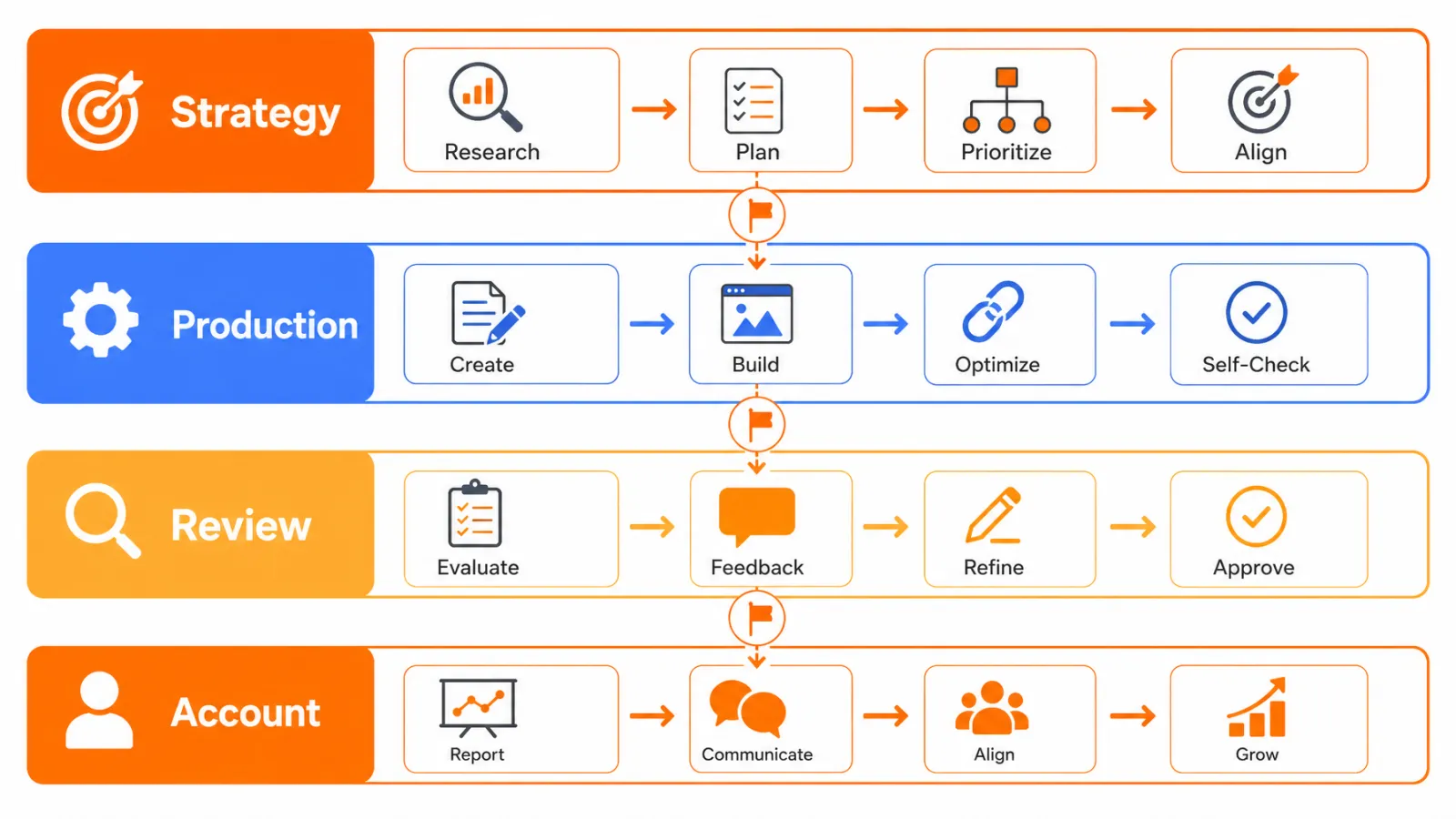
Hiring, outsourcing, and automation each fit different work. Hire for judgment, outsource overflow with clear specs, and automate repeatable steps.
Use one client onboarding and approval sequence
Build one intake form, shared status definitions, and fixed approval deadlines. Add a blocked-work log with four columns: reason, owner, next action, and client dependency.
Most agencies track what's done. Few track what's stuck, and stuck work quietly eats capacity.
Create a content and technical SEO production queue
Run one queue across clients, sorted by due date and blocker status. An AI-assisted SEO content workflow can plan the calendar, brief each article, and draft with internal links and an author profile, while your editor approves what ships. Keep technical fixes in the same queue so they don't get forgotten.
Indexing needs a caveat. Google's sitemap and crawling documentation describes how discovery works but promises no timing, so schedule a check instead of promising a date.
Create a repeatable system for getting more SEO clients
If you're asking how to get more SEO clients without overloading delivery, use one acquisition channel, build proof around one client type, and qualify leads against delivery capacity. Predictable SEO agency growth needs acquisition and delivery planned together.
Pick one acquisition channel before adding five
The main options are referrals, niche content, and partnerships or outbound prospecting. Search Engine Land's client-finding guide covers these tactics, though it doesn't prove any conversion rate.
My decision rule: if your best clients came from referrals, formalize referrals first. Attach one measurable weekly action, such as asking for two named introductions.
Turn proof into useful sales assets
Case studies need real data and client permission. A useful diagnostic, such as a short review of a prospect's top pages, often sells better than a deck. Build that proof around the one client type in your package.
Qualify prospects for fit, margin, and delivery capacity
Before accepting a retainer, check client complexity, approval burden, scope variance, technical risk, and available hours. A lead isn't attractive if its expected scope or approval load would break your current delivery model. Say no, or price the risk in.
Automate repetitive SEO workflows without automating judgment
Automate repetitive handoffs first: keyword discovery, topic sequencing, briefs, drafting, publishing, indexing notifications, and report preparation. Keep strategy, fact checking, and final approval with people. That split protects quality as you grow.
Automate research, planning, publishing, indexing, and reporting first
A common manual pattern in agency stacks looks like this:
Keywords exported from a research tool such as Semrush or Ahrefs into a spreadsheet.
Briefs built in a content tool like Frase, then pasted into a document.
Drafts moved into the CMS by hand, then submitted for indexing by hand.
Search Console data copied into a client report.
My rule: automate a task when it's repetitive, reversible, rules-based, and easy to review. The biggest gain often comes from removing handoffs between tools, not from producing more content. The safest automation target is a repetitive handoff with a visible approval point.
Keep strategy, fact checking, and final approval with people
Google's guidance on generative AI content doesn't ban content because AI helped produce it. It does warn that low-value scaled content can violate spam policies however it's made. Human review for accuracy, originality, and client context is the boundary.
Build escalation rules for quality and technical risk
Any unverified claim, statistic, or regulated topic goes to a senior reviewer.
Changes to redirects, robots rules, or templates need approval first.
Client-specific strategy calls stay with the strategist.
Repeated rework on one deliverable triggers a workflow review.
Our guide to Swhich SEO workflows are worth automating covers the line between handoffs and judgment in more detail.
How Keytomic fits an agency scaling workflow
Automation helps an SEO agency manage more clients where the same steps repeat across accounts: research, planning, drafting, publishing, indexing, and reporting. Keytomic connects those steps in one multi-client workflow. It's the product I work on, so treat these as first-party claims and verify them before you buy.
Manual workflow versus connected workflow
Manually, each step lives in a different tool, and every handoff is a chance for delay or error. Connected, one workflow carries a keyword to a published, tracked page, with a human approving what goes live.
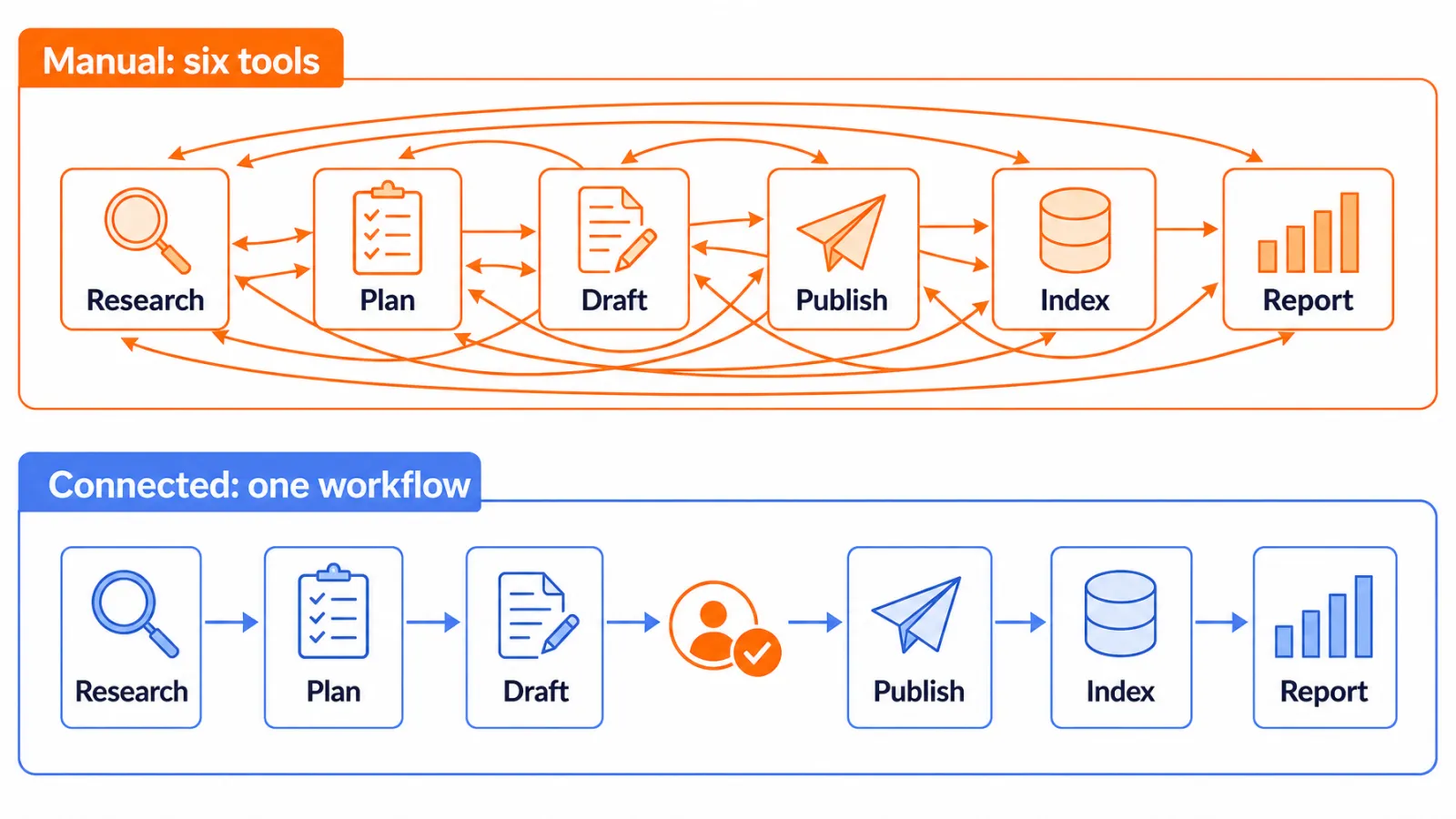
Keytomic maps keywords using live volume, difficulty, SERP data, and your Search Console data. It plans a 30-day calendar, drafts in your brand voice, and publishes to WordPress, Shopify, Webflow, Framer, and other CMSs via webhook. It then submits URLs to Google and, through IndexNow, to other search engines. The visual shows workflow coverage, not measured performance gains.
How an SEO automation tool fits into agency delivery
Most of the hours an agency loses don’t go into the work itself. They go into moving it between tools: exporting keywords to a sheet, pasting briefs into docs, copying drafts into the CMS, submitting URLs for indexing, then pulling Search Console numbers into a report. Across a dozen clients, that adds up to a part-time job nobody was hired for.
A good SEO automation tool takes over those handoffs, not the thinking. Here’s where it should help:
Research and planning: pull keyword data and the client’s Search Console data into one place and turn it into a content calendar.
Drafting: produce first drafts in each client’s brand voice, ready for an editor to review.
Publishing and indexing: push approved content straight to the CMS and submit new URLs to search engines.
Reporting: put rankings, clicks, and AI search visibility in one view per client, without copy-paste.
What it shouldn’t touch is strategy, fact checking, or the final call on what goes live. Google’s guidance on generative AI content puts the focus on accuracy and value for readers, and that still needs a person. The goal is fewer handoffs with the same review gates, not more content with less oversight.
What to look for when choosing one
Multi-client setup: separate projects, brand voices, and reports for each account.
CMS coverage: publishing to the platforms your clients actually use.
An approval step: nothing should publish without a person signing off.
Honest limits: check what it doesn’t do, such as forensic crawling or deep backlink analysis, so you know which tools to keep.
For a longer checklist, see our guide on how to choose SEO automation tools.
Track the metrics that reveal whether the agency is scaling
You know an SEO agency is scaling when revenue, margin, and delivery predictability improve together as client count rises. Track each metric by client and by service package, not just agency totals.
Metric | Group | Decision it informs |
|---|---|---|
Revenue per client | Unit economics | Pricing and package fit |
Gross margin by account | Unit economics | Which clients to keep, reprice, or exit |
Delivery hours per client | Capacity | Whether scope matches price |
Utilization | Capacity | When to hire or pause sales |
Rework hours per published deliverable | Quality | Where briefs or reviews fail |
Blocked days per client | Delivery speed | Which approvals stall work |
Content velocity and publishing consistency | Delivery speed | Whether the calendar is being met |
Client retention | Retention | Whether results and reporting hold trust |
Lead-to-client conversion rate | Acquisition | Whether channel and qualification work |
A rising client count is not evidence of scale if margin, quality, or delivery predictability is falling.
Unit economics and margin
Start with revenue per client and gross margin, because they show whether SEO agency growth is paying for itself. Set thresholds from your own baseline, since no universal benchmark exists.
Capacity, quality, and delivery speed
Rework hours and blocked days reveal hidden capacity loss better than output volume does. For search data, Search Console performance reporting covers queries, pages, impressions, and clicks. Use GA4 or your analytics system for conversion behavior.
Acquisition, retention, and client value
Track retention and lead-to-client conversion by service package, so you can see which offers bring in clients who stay. Report AI visibility as a supplement to rankings, clicks, conversions, and retention. Our note on AI search visibility reporting for agencies explains the approach.
If ChatGPT search matters to a client, confirm the site isn't blocking OAI-SearchBot, per OpenAI's crawler documentation.
Common scaling mistakes that reduce agency profitability
Agencies fail to scale profitably when sales, scope, and delivery grow out of sync. Each mistake has a visible symptom and a fix:
Underpricing: margin shrinks as clients are added. Reprice against real delivery hours.
Weak onboarding: work is blocked in the first month. Use one intake and approval sequence.
Tool sprawl: staff copy and paste between tabs. Map the workflow before buying another subscription.
Automating without review: factual or voice errors reach clients. Add approval gates.
Selling custom work before standardizing delivery
Every custom promise becomes a one-off process that only one person understands. That's how SEO agency growth stalls: the founder stays the integration layer. Package first, then sell.
Hiring before exposing the real bottleneck
I would not add another retainer until I know which existing workflow is full. Hire for the bottleneck you measured, not the one that feels loudest.
Scaling sales faster than delivery and quality control
This sales-to-delivery mismatch looks like a hiring problem, but it usually begins with poor scoping. Add the fit gate before the sales push, and add review gates before volume.
Frequently asked questions about scaling an SEO agency
How many clients can one SEO manager handle?
There's no universal number. It depends on scope, client complexity, approval speed, reporting burden, and automation. Measure hours and rework per account instead of copying a benchmark.
Can an SEO agency scale without hiring?
Partly. Packaging, workflow redesign, outsourcing, and automation raise capacity, but judgment and client accountability still need people.
What should an SEO agency automate first?
Repetitive, reversible, rules-based tasks with clear review points, such as research, calendar planning, publishing, indexing submissions, and report preparation.
How should an SEO agency price scalable services?
Price from expected scope, delivery cost, risk, and client value. I won't suggest fixed prices, because they depend on your hours and margin.
How do you standardize SEO services?
Choose one client profile, define one package, document one delivery sequence, and add quality gates between steps.
What role should an SEO agency hire first?
Hire for the bottleneck you measured, whether that's production, review, or account management, not for a universal hiring order.
How do you get more SEO clients consistently?
Use one repeatable acquisition channel, useful proof, clear qualification, and a delivery model that can fulfill the new work.
How long does it take to scale an SEO agency?
It depends on baseline margin, process maturity, pipeline, and team capacity. I wouldn't promise a fixed timeline without your own data.
Does AI-generated content hurt SEO agency results?
Google doesn't prohibit content just because AI was used, but low-value scaled content can violate spam policies however it's produced.
Is Keytomic right for every SEO agency?
No. It fits agencies wanting connected research, content, publishing, indexing, tracking, and reporting. Agencies needing forensic crawling or deep backlink analysis should keep those tools.
Decide what to fix first
Weak margin: fix packaging, scope, and client fit before buying more leads.
Delivery bottleneck: document the workflow, remove handoffs, and automate repetitive production steps.
Weak acquisition: choose one channel and build proof for one client segment.
Falling quality: add review gates before adding volume or headcount.
Fragmented tools: map the workflow and check whether a connected platform removes avoidable handoffs.
Your next step for SEO agency growth is an audit of the last 30 days of client work. Record revenue, delivery hours, rework hours, blocked days, and gross margin by account, then pick the single bottleneck to fix first. If that bottleneck is tool handoffs, review the Keytomic agency workflow and decide whether it fits.