
 WordPress
 Shopify
 Webflow
 Framer
 Wix
 Squarespace
 Lovable
Ecommerce SEO & LLM Playbook · Keytomic
How to rank ecommerce stores on Google and LLMs using Keytomic
 Written byZainab HaiOrganic Growth, Keytomic
What's in this playbook
- Why ecommerce SEO is different
- Ecommerce Keyword Research — The Revenue-First Framework
- Page Architecture — Product, Category & Blog
- Building a Topical Map for Your Store's Niche
- Content Calendar — Publishing at Scale
- AI Blog Writer — Buying Guides & Comparison Content
- Auto-Publishing to Shopify, WooCommerce & More
- Getting Products Indexed Fast
- Technical SEO Audit for Ecommerce Sites
- Backlink Strategy for Ecommerce
- Reddit Agent — Mining Product Questions
- AI Visibility — Getting Cited in ChatGPT & Google AI Mode
- Content Freshness — Keeping Product & Guide Content Current
- Analytics — Connecting SEO to Revenue
- MCP Server — Ecommerce SEO at Scale with AI
- The Ecommerce SEO Stack — Start to Finish
Ecommerce SEO is not like any other kind of SEO. You're not trying to rank one homepage or a handful of blog posts. You're trying to rank hundreds or thousands of pages simultaneously — product pages, category pages, collection pages, buying guides — each targeting different keywords at different stages of the buyer journey.
Most ecommerce stores get this wrong. They obsess over product descriptions and ignore category pages. They publish blog posts with no keyword intent. They let duplicate content pile up from faceted navigation. They have no content calendar. And they have no idea whether Google has even indexed their new products.
This playbook walks through exactly how I use Keytomic to fix all of that — from initial keyword research through to AI visibility and content freshness — with real ecommerce keyword data and a system built for scale.
Shoppers now ask LLMs too
Buyers also ask ChatGPT, Claude, Gemini, Perplexity and Google's AI Mode what to buy and where to buy it. The answer names a few stores and products. If yours isn't one of them, the shopper never sees your category page.
The inputs overlap with Google: your product and category pages, your buying guides, review sites, and the Reddit threads where buyers compare options. So each step below works for both. Where a step needs something extra for LLMs, I call it out.
If you'd rather see what Keytomic does for online stores before reading the full playbook, start with our ecommerce SEO page.
Ecommerce Keyword Research — The Revenue-First Framework
The biggest mistake I see ecommerce brands make with keyword research is chasing volume. A keyword with 50,000 monthly searches that attracts window shoppers is worth less than a keyword with 1,200 searches from people who have their credit card out.
For ecommerce SEO, I build keyword clusters around four intent layers, and I map each cluster to a specific page type before I do anything else.
The 4-Intent Keyword Framework for Ecommerce
- "buy [product] online"
- "[product] price"
- "[product name] [size/color]"
- "[product] free shipping"
- "[product] in stock"
- "best [product category]"
- "top [product] under $X"
- "[product] for [use case]"
- "[product] reviews"
- "cheap [product]"
- "how to choose [product]"
- "[product] buying guide"
- "[product A] vs [product B]"
- "what is [product type]"
- "[product] for beginners"
Master Keyword Table — Ecommerce SEO
Here's the full keyword set I research for any ecommerce store. I've used a home goods store niche here as a concrete example, but the clusters apply to any vertical.
| Keyword | Vol/mo | KD | CPC | Intent | Page Type |
|---|---|---|---|---|---|
| Site-Level & Brand Keywords | |||||
| ecommerce seo | 3,600 | 72 | $6.80 | Info | Blog/Guide |
| online store seo | 1,900 | 58 | $5.20 | Info | Blog/Guide |
| shopify seo | 5,400 | 65 | $7.10 | Info | Blog/Guide |
| woocommerce seo | 2,900 | 60 | $5.80 | Info | Blog/Guide |
| ecommerce seo agency | 880 | 67 | $18.40 | Commercial | Homepage |
| Product Page SEO Keywords | |||||
| product page seo | 1,300 | 54 | $4.90 | Info | Blog/Guide |
| optimize product descriptions for seo | 720 | 38 | $4.20 | Info | Blog/Guide |
| product schema markup | 880 | 46 | $3.80 | Info | Blog/Guide |
| ecommerce product title seo | 480 | 32 | $3.50 | Info | Blog |
| buy [product] online | varies | 20–40 | $1.20–4.00 | Transactional | Product Page |
| Category Page Keywords | |||||
| category page seo | 1,000 | 50 | $5.10 | Info | Blog |
| best [product category] [year] | varies | 45–65 | $2.00–8.00 | Commercial | Category |
| cheap [product] online | varies | 30–50 | $1.50–4.50 | Commercial | Category |
| [product] for [use case] | varies | 25–45 | $1.80–5.00 | Commercial | Category |
| ecommerce category page optimization | 390 | 36 | $4.80 | Info | Blog |
| Buying Guide & Comparison Keywords | |||||
| [product A] vs [product B] | varies | 28–48 | $2.00–6.50 | Commercial | Blog/Guide |
| [product] buying guide | varies | 25–45 | $1.80–5.20 | Info | Blog/Guide |
| best [product] under $[price] | varies | 30–55 | $1.50–4.80 | Commercial | Blog/Guide |
| how to choose [product] | varies | 22–42 | $1.20–3.80 | Info | Blog |
| [product] for beginners | varies | 18–38 | $1.00–3.50 | Info | Blog |
| Technical Ecommerce SEO | |||||
| ecommerce site structure seo | 590 | 48 | $5.40 | Info | Blog |
| canonical tag ecommerce | 480 | 40 | $3.90 | Info | Blog |
| faceted navigation seo | 720 | 52 | $4.60 | Info | Blog |
| duplicate content ecommerce | 880 | 50 | $4.20 | Info | Blog |
| ecommerce schema markup | 1,100 | 46 | $4.80 | Info | Blog |
| core web vitals ecommerce | 720 | 42 | $4.00 | Info | Blog |
| Content Strategy Keywords | |||||
| ecommerce content marketing | 1,900 | 60 | $6.20 | Info | Blog |
| ecommerce blog ideas | 720 | 38 | $3.60 | Info | Blog |
| product review seo | 590 | 40 | $3.80 | Info | Blog |
| user generated content seo | 880 | 48 | $4.20 | Info | Blog |
| Seasonal & Trend Keywords | |||||
| black friday seo ecommerce | 1,300 | 38 | $5.80 | Info | Blog |
| [product] gift guide | varies | 20–40 | $1.80–4.80 | Commercial | Blog |
| trending [product category] [year] | varies | 25–42 | $1.60–4.00 | Commercial | Blog/Category |
| new arrivals [product category] | varies | 15–32 | $1.20–3.20 | Transactional | Category |
| AI & GEO Keywords | |||||
| best [product] reddit | varies | 20–38 | $0.80–2.80 | Commercial | Blog/Product |
| where to buy [product] | varies | 18–36 | $1.50–4.00 | Transactional | Product/Category |
| is [product] worth it | varies | 16–32 | $1.20–3.60 | Commercial | Blog |
| ecommerce ai seo | 880 | 40 | $6.40 | Info | Blog |
| Link Building & Authority | |||||
| ecommerce link building | 1,000 | 58 | $6.00 | Info | Blog |
| product page backlinks | 390 | 38 | $4.80 | Info | Blog |
| ecommerce digital pr | 590 | 42 | $5.20 | Info | Blog |
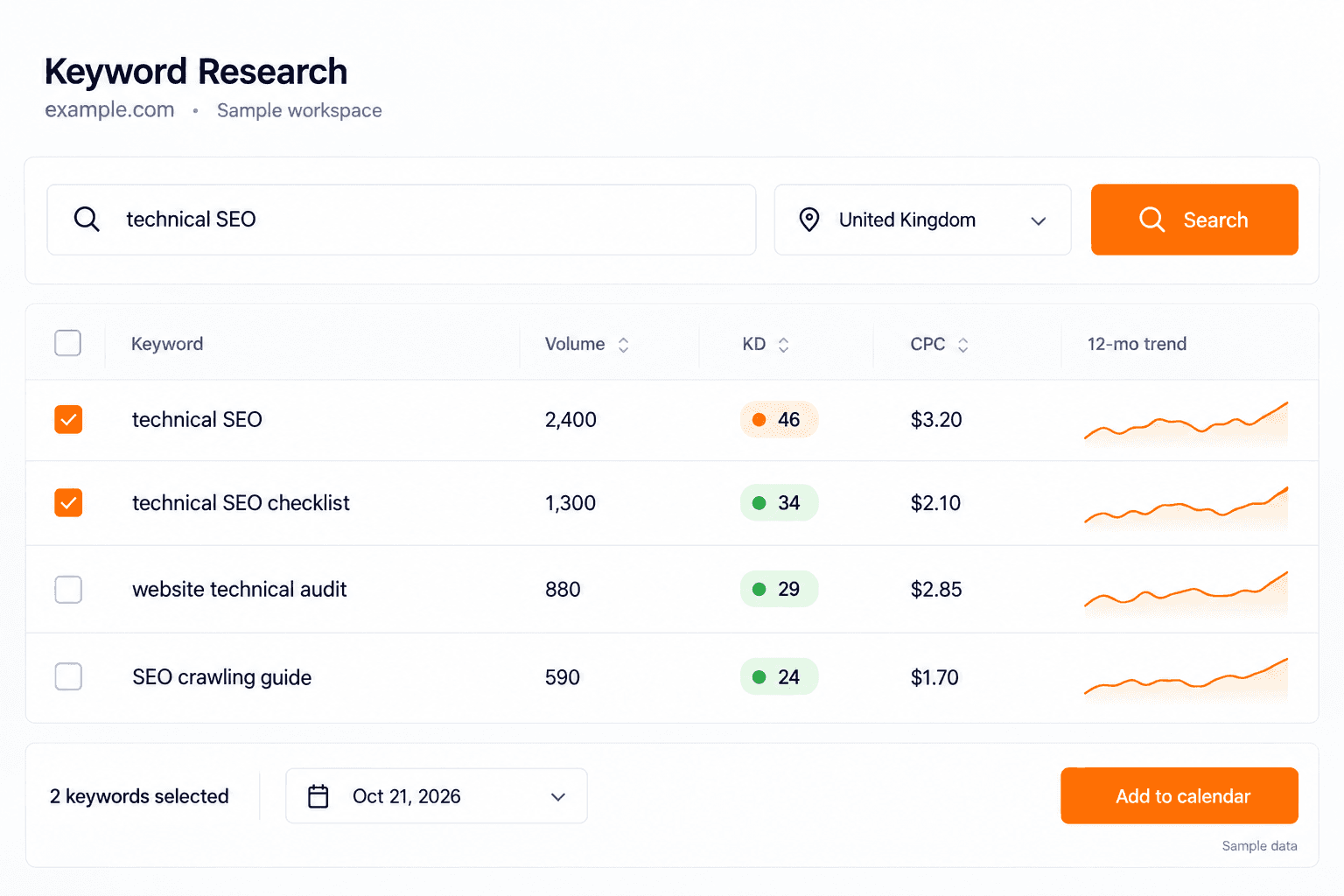
Keytomic Keyword Research
I paste the store's niche into Keytomic's keyword research tool and it generates a full keyword universe — transactional, commercial, and informational — with volume, difficulty, and CPC pre-loaded. For ecommerce, I specifically use it to build out keyword clusters by page type, then push the highest-priority clusters directly into the content calendar.
Page Architecture — Building the Three-Layer SEO System
Ecommerce SEO lives or dies by site architecture. Unlike a blog, you're managing three distinct page types — each with its own keyword strategy, schema markup, and optimization logic. Getting this wrong means competing against yourself, cannibalizing rankings, and wasting crawl budget.
/collections/all and product pages at /products/random-slug. This is a ranking disaster. URL structure is a ranking signal — fix it before anything else.The URL Architecture I Use
Homepage → Target your highest-volume category keyword
e.g.,
brandname.comtargets "minimalist home decor" or the top-level category termCategory Pages → Target commercial-intent cluster terms
e.g.,
/collections/minimalist-bedroom-furnituretargets "minimalist bedroom furniture" (1,900/mo, KD 48)Sub-Category Pages → Target long-tail commercial keywords
e.g.,
/collections/minimalist-bedside-tablestargets "minimalist bedside tables under $200"Product Pages → Target transactional, specific keywords
e.g.,
/products/oak-floating-bedside-tabletargets "oak floating bedside table" (480/mo, KD 22)Blog → Target informational and comparison keywords
e.g.,
/blog/minimalist-bedroom-ideasfeeds traffic into category and product pages
Schema Markup by Page Type
Google's Product schema is non-negotiable for ecommerce. Here's the minimum markup I apply to every product page:
"@context": "https://schema.org",
"@type": "Product",
"name": "Oak Floating Bedside Table",
"description": "Handcrafted solid oak floating bedside table...",
"brand": { "@type": "Brand", "name": "[Brand Name]" },
"offers": {
  "@type": "Offer",
  "price": "189.00",
  "priceCurrency": "USD",
  "availability": "https://schema.org/InStock"
},
"aggregateRating": {
  "@type": "AggregateRating",
  "ratingValue": "4.8",
  "reviewCount": "142"
}Building a Topical Map for Your Store's Niche
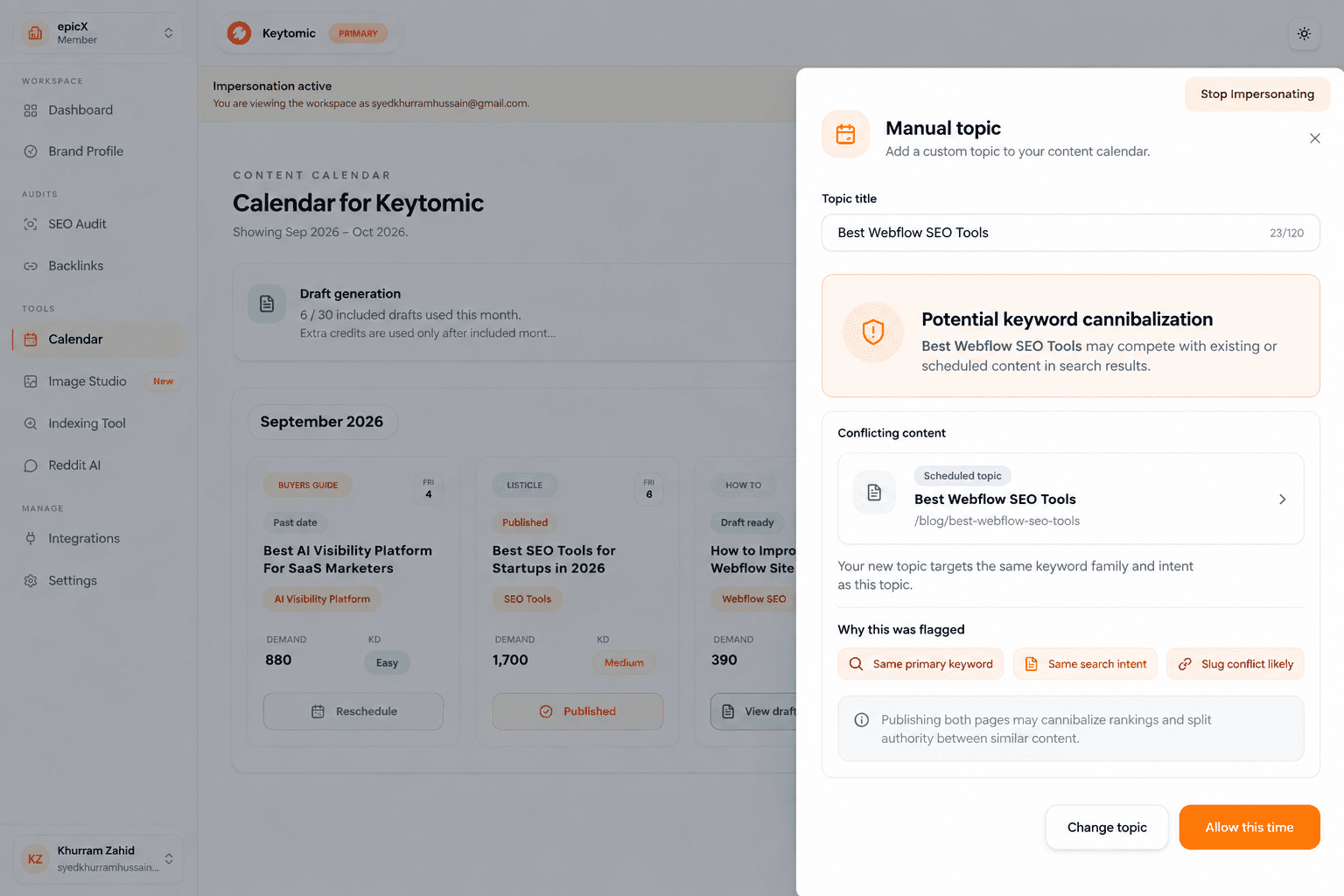
Topical authority is how ecommerce stores win SEO without massive domain authority. When you own a topic — meaning Google associates your domain with a specific niche — you rank faster, hold rankings longer, and your new pages get indexed and ranked quicker.
I use Keytomic's Topical Map builder to generate the full content universe for any niche. Here's what it outputs for a home goods/minimalist furniture store:
Topical Map — Minimalist Home Goods Store
Content Calendar — Publishing at Scale Without Burning Out
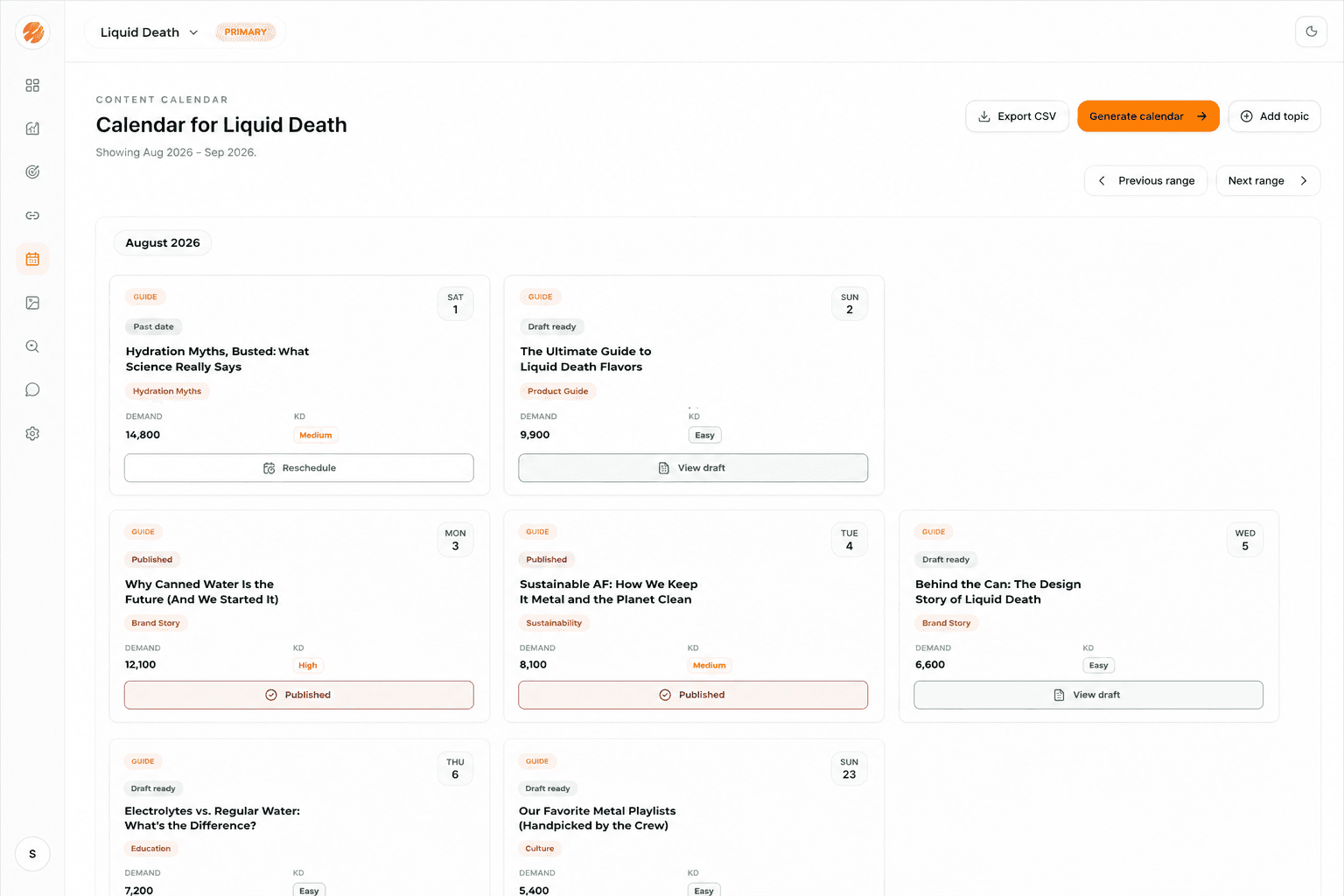
The biggest advantage ecommerce brands have over traditional publishers is product-led content — every product is a natural content opportunity. The challenge is publishing consistently across buying guides, comparisons, seasonal content, and educational posts without an army of writers.
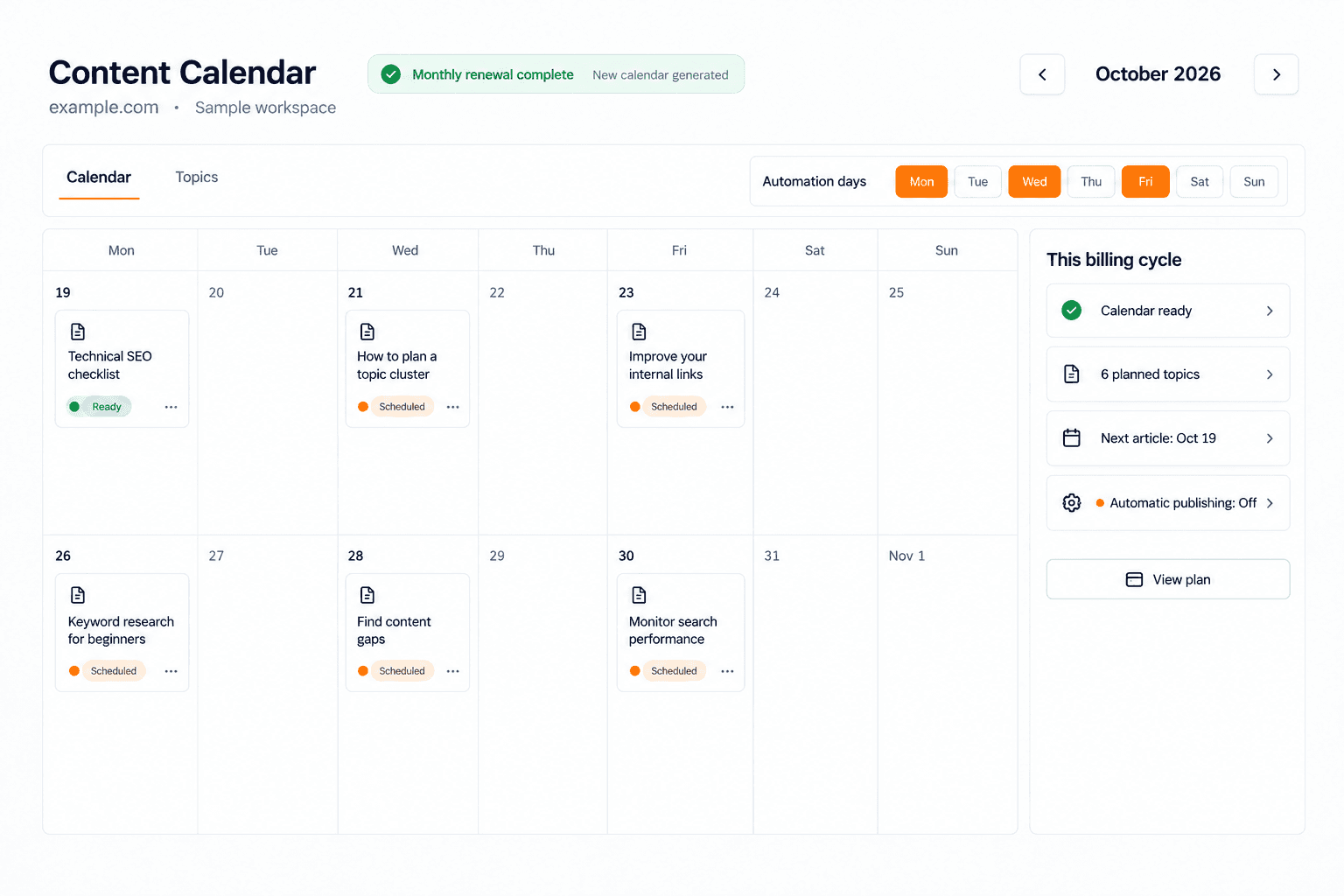
I use Keytomic's 30-day content calendar to map every content piece to a keyword cluster, intent type, and publishing date — then automate the writing and publishing pipeline.
How I Structure an Ecommerce Content Calendar
- Buying guides ("Best [category] 2026")
- Comparison posts ("[Product A] vs [B]")
- "Best under $X" listicles
- Category landing page copy
- "How to choose [product]" guides
- Trend-led content ("Japandi bedroom ideas")
- Gift guides (seasonal)
- Care/maintenance how-tos
AI Blog Writer — Buying Guides That Actually Convert
Buying guides and comparison content are the highest-converting content type for ecommerce. Someone reading "best minimalist bed frames under $500" is three days from buying. But writing them manually is incredibly time-consuming — especially when you need 50+ of them to build topical authority.
I use Keytomic's AI blog writer to generate buying guides that rank. The key difference from generic AI content: Keytomic writes from the keyword cluster context, so every guide naturally covers the full topic — not just surface-level keywords.
What Makes an Ecommerce Buying Guide Rank
- Clear H2 structure by buyer need — "Best for small rooms", "Best under $200", "Best for couples"
- Specific product recommendations with real specs — not vague "consider X" fluff
- Comparison tables with price, dimensions, materials, pros/cons
- FAQ section targeting "people also ask" questions from the SERP
- Internal links to product and category pages — this drives revenue
- Author attribution with expertise signals for Google's E-E-A-T guidelines
Auto-Publishing Directly to Your Ecommerce Platform
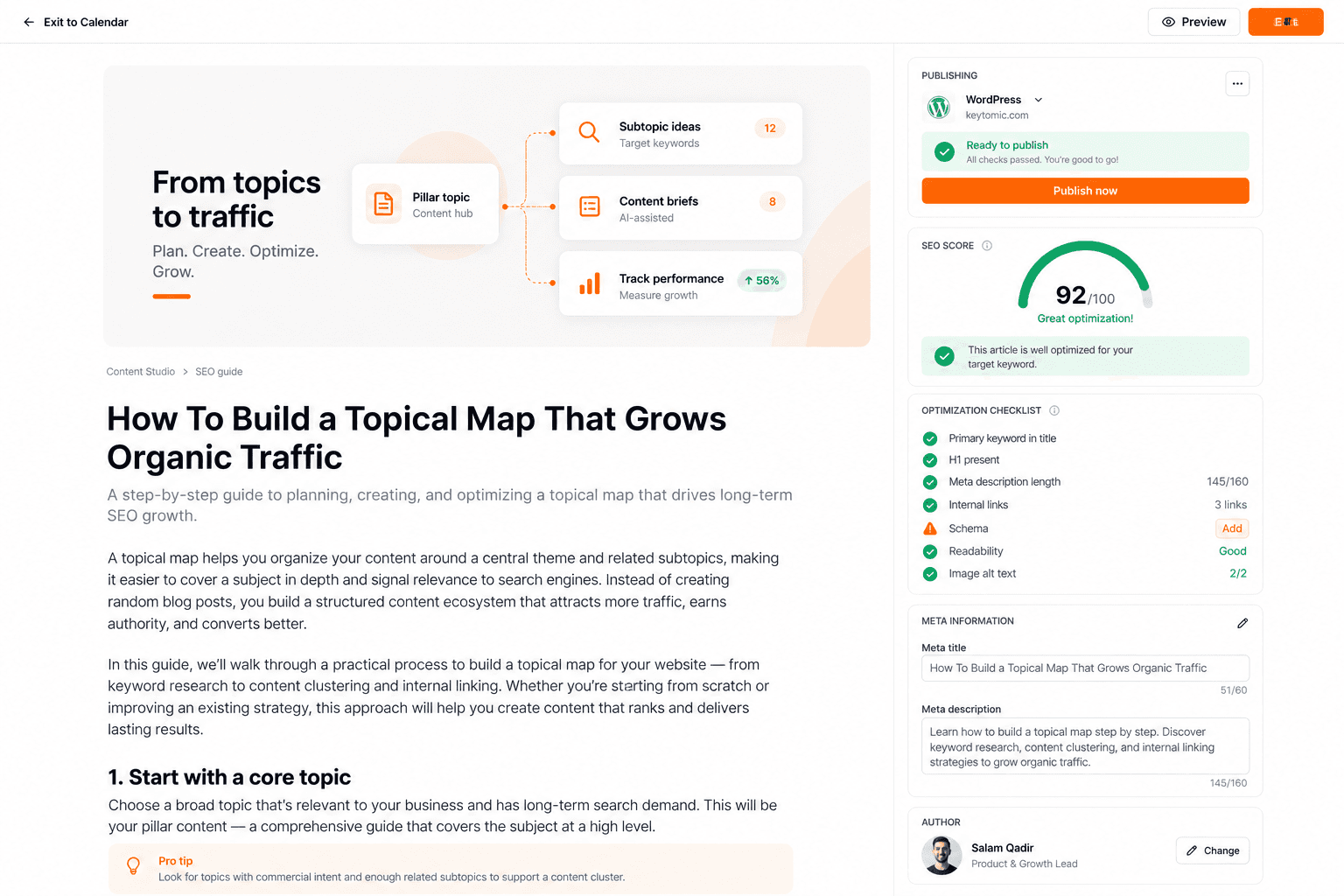
The last thing an ecommerce store owner wants is to copy-paste blog posts from a CMS into Shopify. It's slow, it's error-prone, and it's the reason most content calendars die after three weeks.
Keytomic's auto-publishing connects directly to Shopify, WooCommerce, Webflow, and more — meaning content written in Keytomic publishes to your store automatically, with the right formatting, metadata, and categories.
Platform Integrations
Publishes blog posts to Shopify Blog with tags, featured images, and SEO meta automatically.
Direct publish to WordPress with Yoast/RankMath SEO fields pre-filled from Keytomic's output.
Auto-publishes to Webflow CMS collections with full rich text and metadata.
Connect any headless commerce setup via webhook for custom publishing pipelines.
Getting New Products and Pages Indexed Fast
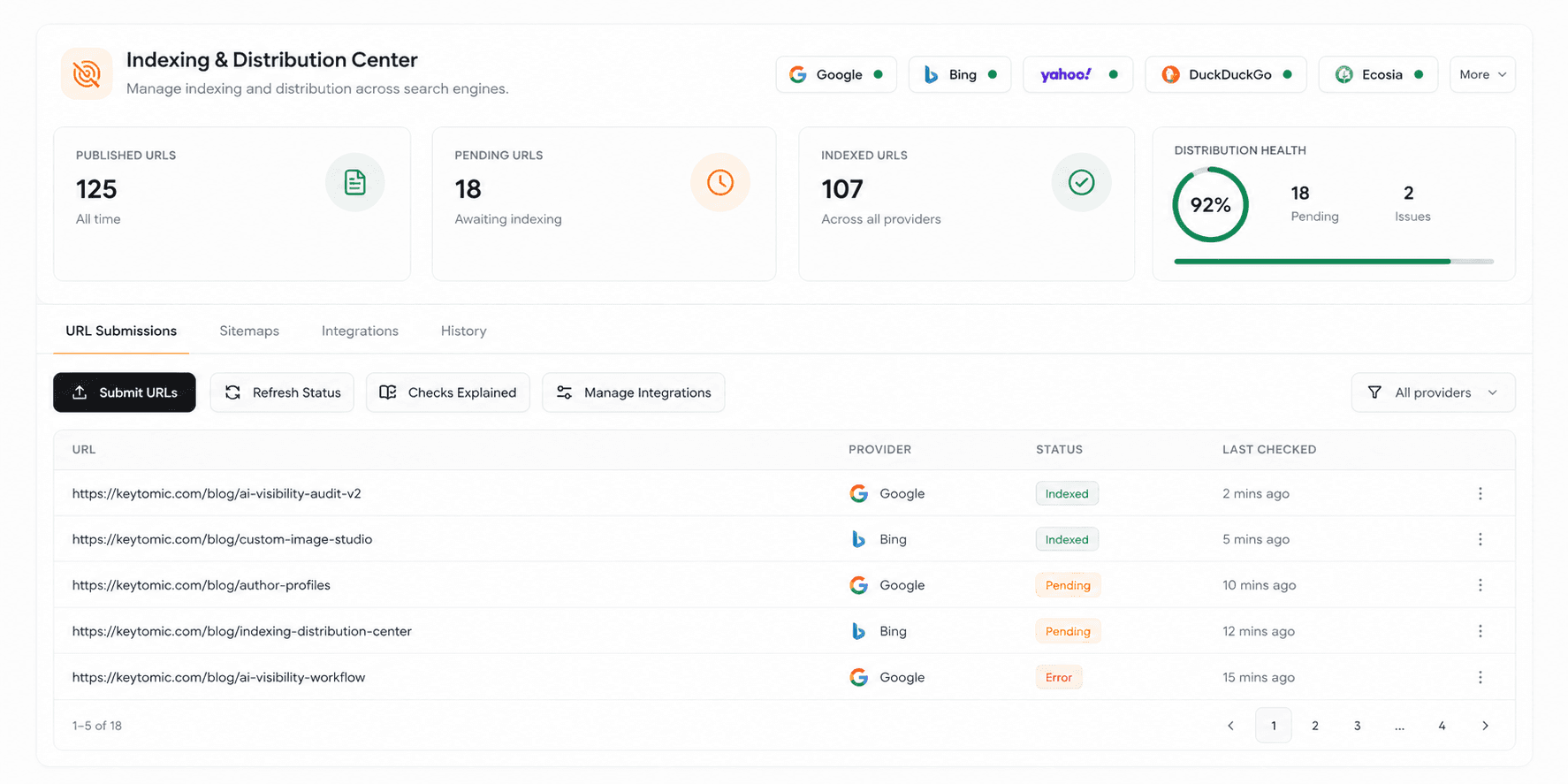
Ecommerce stores add new products constantly. If Google takes 2–4 weeks to discover and index each new product, you're losing sales every day. I've seen stores with thousands of products where 30–40% aren't indexed at all — Google hasn't even seen them.
Keytomic's indexing tool submits new URLs directly to Google's Indexing API and Bing Webmaster Tools, bypassing the standard crawl queue.
Bing matters more than most stores think. Bing's index is one of the sources behind ChatGPT search and Microsoft Copilot, so a product page Bing hasn't indexed is unlikely to show up in those answers.
The Ecommerce Indexing Priority Queue
New product pages
Submit immediately on publish — these are revenue pages. Every day unindexed is a lost sale.
New category/collection pages
Category pages drive the most organic revenue — prioritize indexing over blog content.
Updated product pages (price/stock changes)
When you update pricing or availability, submit for re-indexing so Google shows current data.
New buying guides and blog posts
Submit on publish to accelerate the ranking timeline, especially for seasonal content.
Technical SEO Audit — Ecommerce-Specific Issues
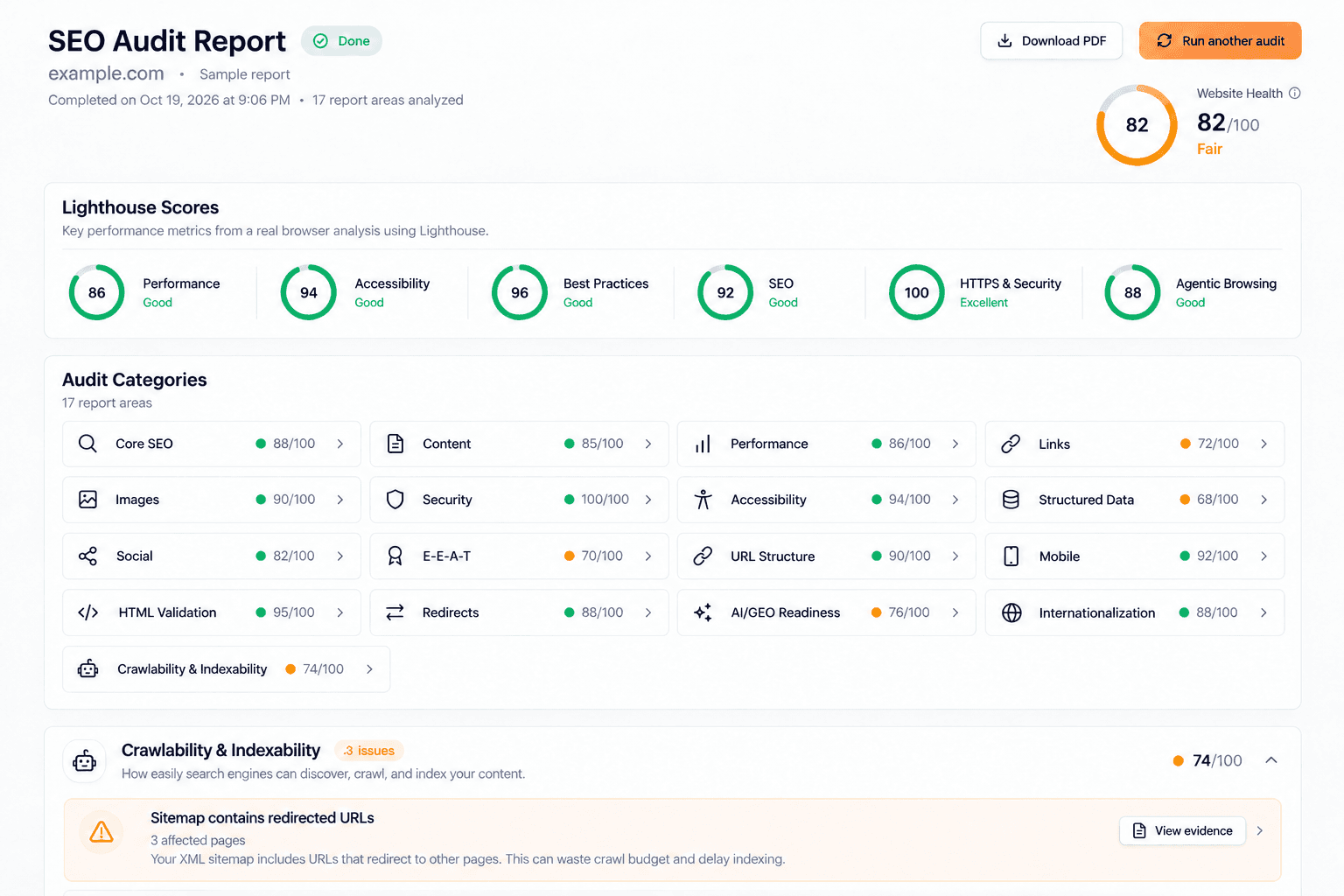
Ecommerce sites have a unique set of technical SEO problems that standard audit tools miss. Faceted navigation creating thousands of duplicate URLs. Thin product descriptions. Out-of-stock pages with no redirect strategy. Slow-loading product image carousels. I use Keytomic's Technical SEO Audit as my starting point for every new ecommerce project.
The Top Ecommerce Technical SEO Issues I Find
noindex filter combination URLs or use canonical tags pointing back to the parent category. Keytomic's audit flags every instance of this automatically.I also check that AI crawlers can reach the store. Some themes, apps and security settings block crawlers such as GPTBot, ClaudeBot and PerplexityBot in robots.txt. If they can't read your pages, LLMs can't recommend your products. Keytomic's audit covers this under AI/GEO Readiness.
For Core Web Vitals, ecommerce sites typically struggle with LCP (Largest Contentful Paint) on product pages because of unoptimized hero images. I look for LCP scores above 2.5s as a priority fix — it directly affects both ranking and conversion rate.
Backlink Strategy for Ecommerce — What Actually Works
Ecommerce link building is different from B2B or blog link building. Product pages rarely attract links organically — you need a strategy that earns links to both your editorial content (buying guides) and your domain authority more broadly.
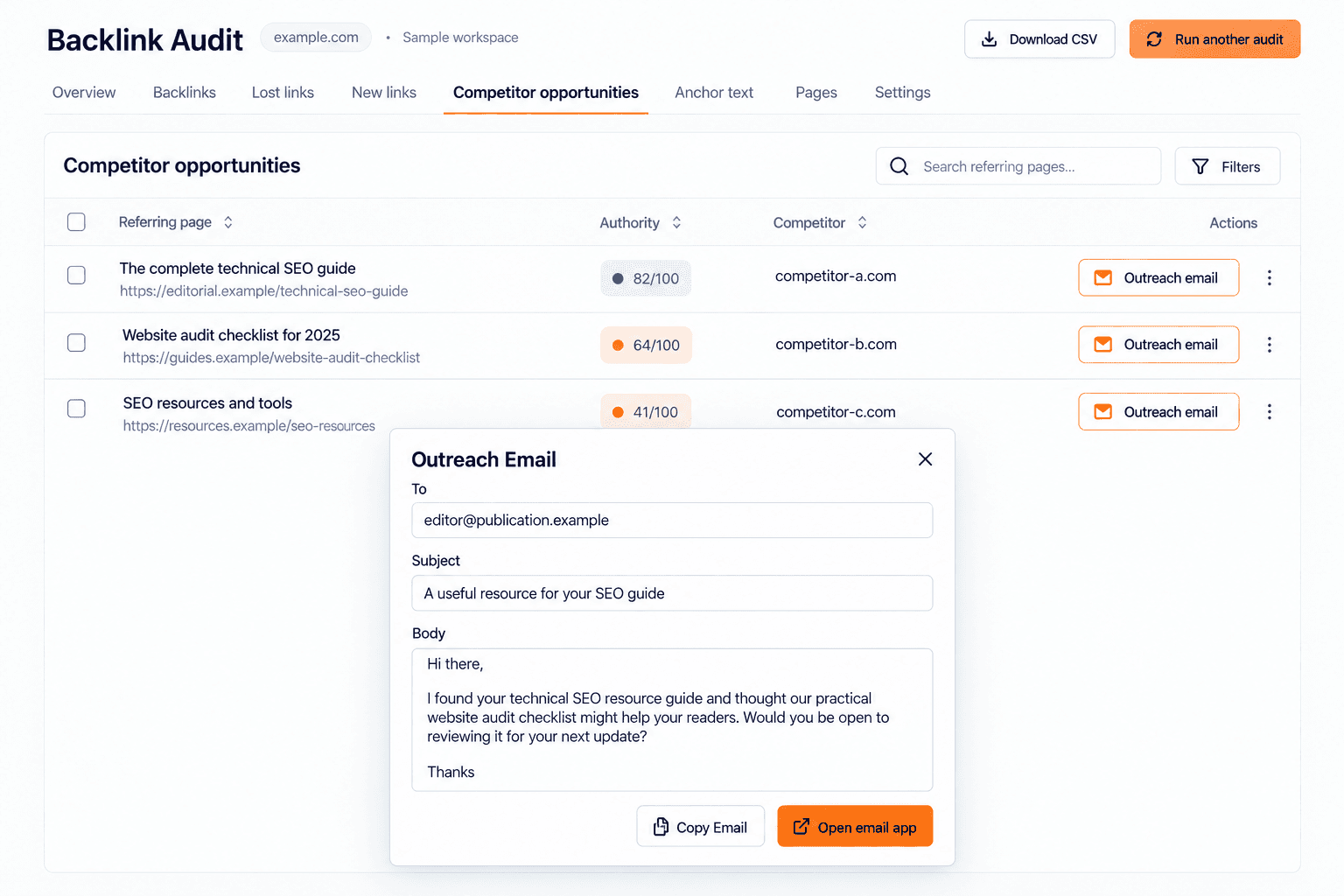
I use Keytomic's backlink audit to map the competitor link landscape first — then build a targeted outreach strategy around the content types that naturally attract links in a niche.
Ecommerce Link-Building Tactics That Work in 2026
- Digital PR: Data-driven studies ("We analyzed 500 minimalist bedrooms — here's what they have in common") earn press links and anchor your brand as an authority.
- Buying guide outreach: Find sites that rank "best [category]" and pitch to be included. These listicle links go directly to product/category pages.
- Supplier/manufacturer links: If you stock third-party brands, ask to be listed on their "where to buy" or "stockists" pages — these are often high-DA.
- Niche community mentions: Reddit, niche forums, Facebook groups. Organic mentions in these communities also drive direct traffic that converts.
- HARO/Featured.com: Respond to journalist queries about home/lifestyle topics. A quote from your brand in a major publication = a high-authority link.
Reddit Agent — Mining Real Buyer Questions
Reddit is a goldmine for ecommerce keyword research that tools don't surface. Real buyers asking "what's the difference between solid oak and oak veneer?", "is [brand name] worth it?", and "where do I buy affordable minimalist furniture in the US?" — these are your content brief ideas, your FAQ answers, and your product page copy.
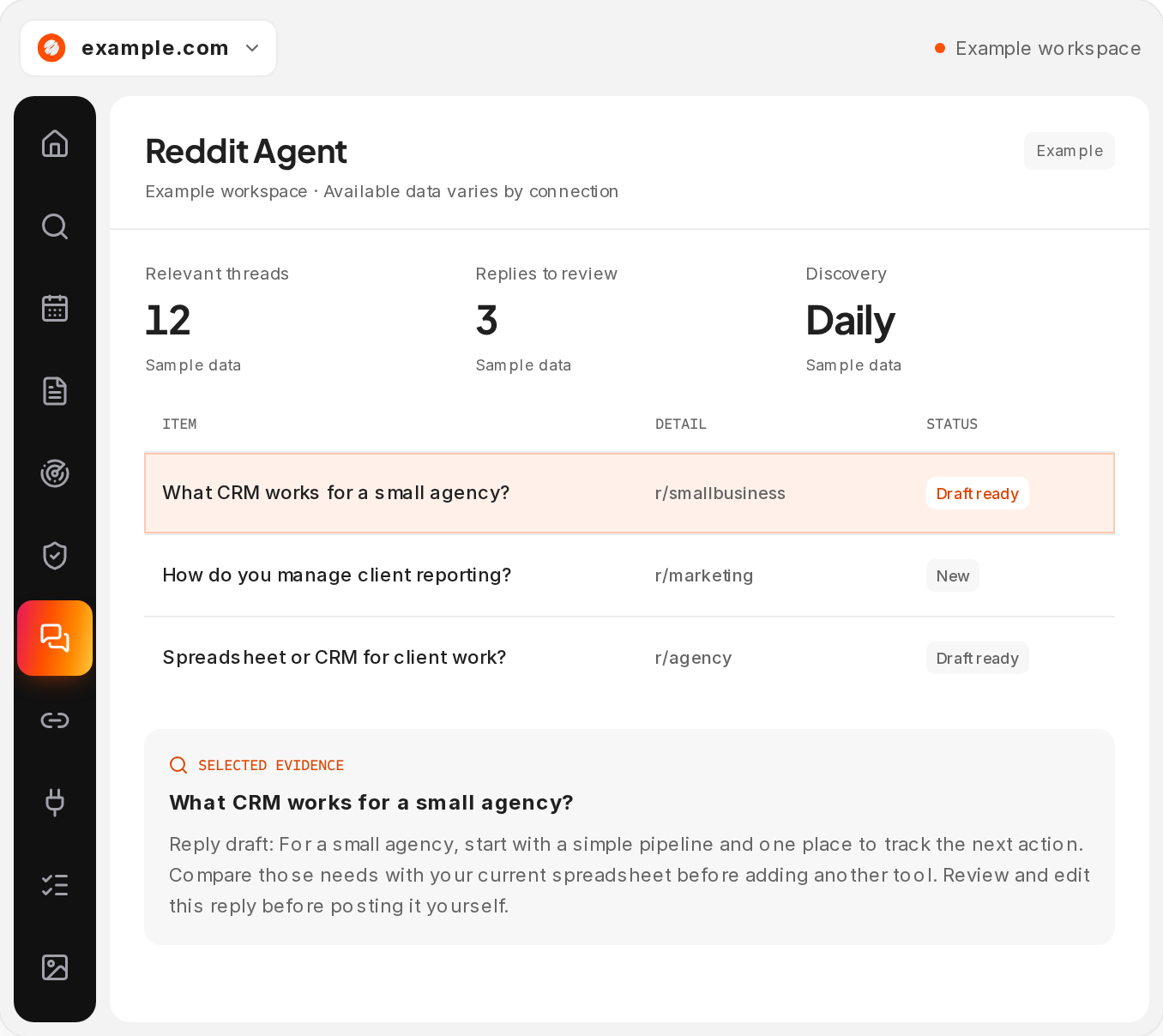
Keytomic's Reddit AI agent scans niche subreddits (r/malelivingspace, r/femalelivingspace, r/minimalism, r/InteriorDesign, r/BudgetDecorating) for product-related questions and buying conversations — then suggests content and FAQ topics based on what real shoppers are asking.
AI Visibility — Getting Your Store Cited in ChatGPT & Google AI Mode
This is the most underutilized SEO opportunity for ecommerce brands right now. When someone asks ChatGPT "what are the best minimalist furniture brands?" or Perplexity "where can I buy Japandi-style bedroom furniture?", which stores get mentioned?
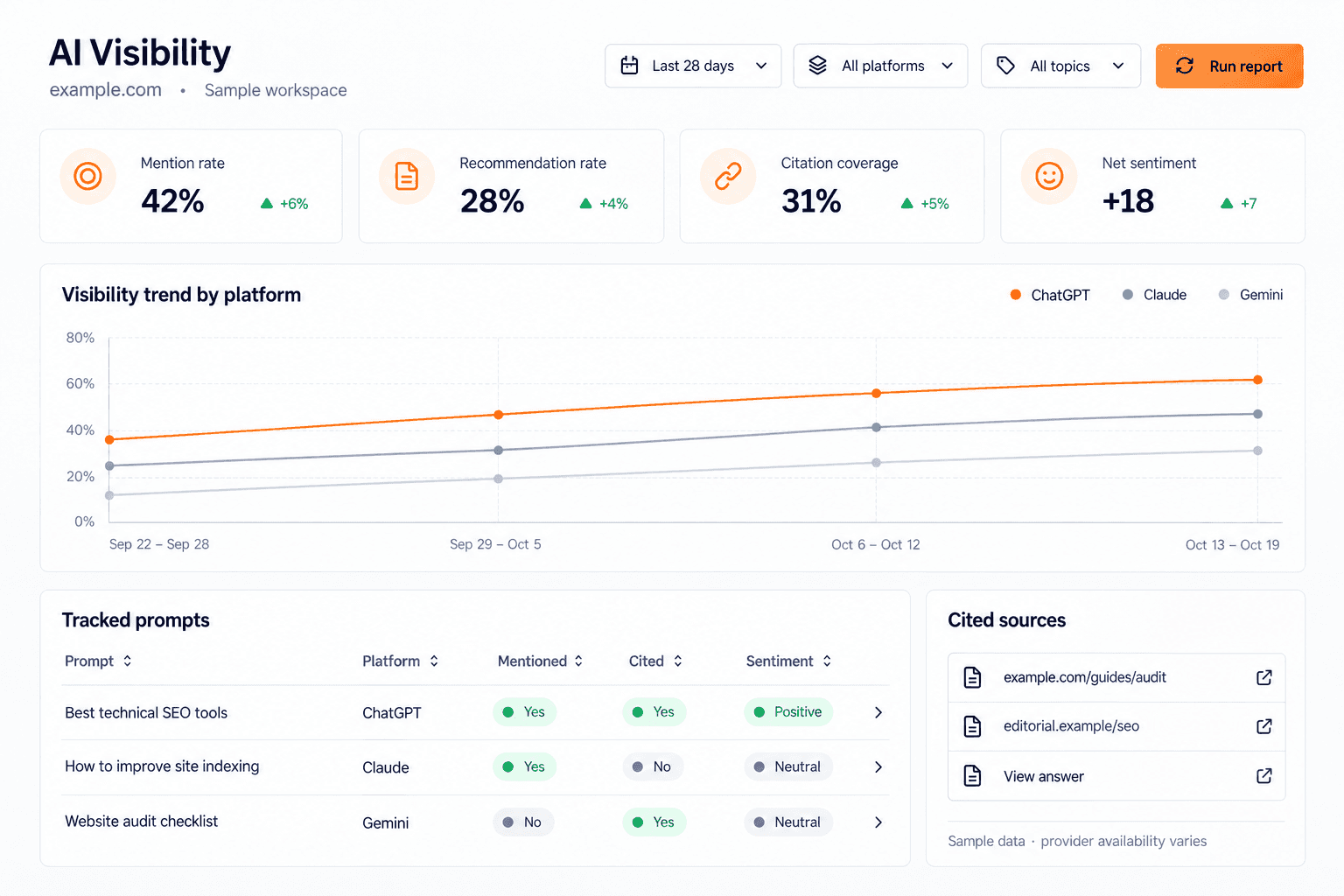
As of late 2026, most ecommerce brands have zero AI visibility — they don't appear in LLM responses at all. This is a first-mover opportunity. I use Keytomic's AI Visibility Tracker to monitor and build citation presence across ChatGPT, Claude, Gemini, and Google AI Mode.
The Prompts I Track for Ecommerce Stores
| AI Prompt | AI Engine | Goal |
|---|---|---|
| "What are the best minimalist furniture brands?" | ChatGPT, Claude, Gemini | Brand mention in recommendations |
| "Where can I buy affordable Japandi furniture online?" | Perplexity, Google AI Mode | Direct store recommendation |
| "Best online furniture stores for small apartments" | ChatGPT, Perplexity | Category citation |
| "Is [Brand Name] a good furniture brand?" | All LLMs | Reputation monitoring |
| "Minimalist bedroom furniture under $1000" | Google AI Mode | Shopping recommendation |
How to Build AI Visibility for an Ecommerce Brand
- Get cited by authoritative review sites — LLMs pull from sites like Wirecutter, The Spruce, Good Housekeeping. Getting listed in their roundups directly improves AI mentions.
- Build review signals — LLMs read Trustpilot, Google Reviews, Reddit mentions. More positive reviews = more likely to be recommended.
- Publish structured brand content — An "About" page that clearly describes what your brand sells, who it's for, and what makes it different gives LLMs the context to recommend you accurately.
- Create comparison content — "[Brand] vs [Competitor]" posts signal to AI engines that your brand is a known player in the category.
Content Freshness — Keeping Product & Buying Guide Content Current
Ecommerce content goes stale fast. Products get discontinued. Prices change. New competitors enter the market. A buying guide written in 2024 that recommends products no longer in stock is a ranking liability — Google's freshness signals reward pages that are regularly updated.
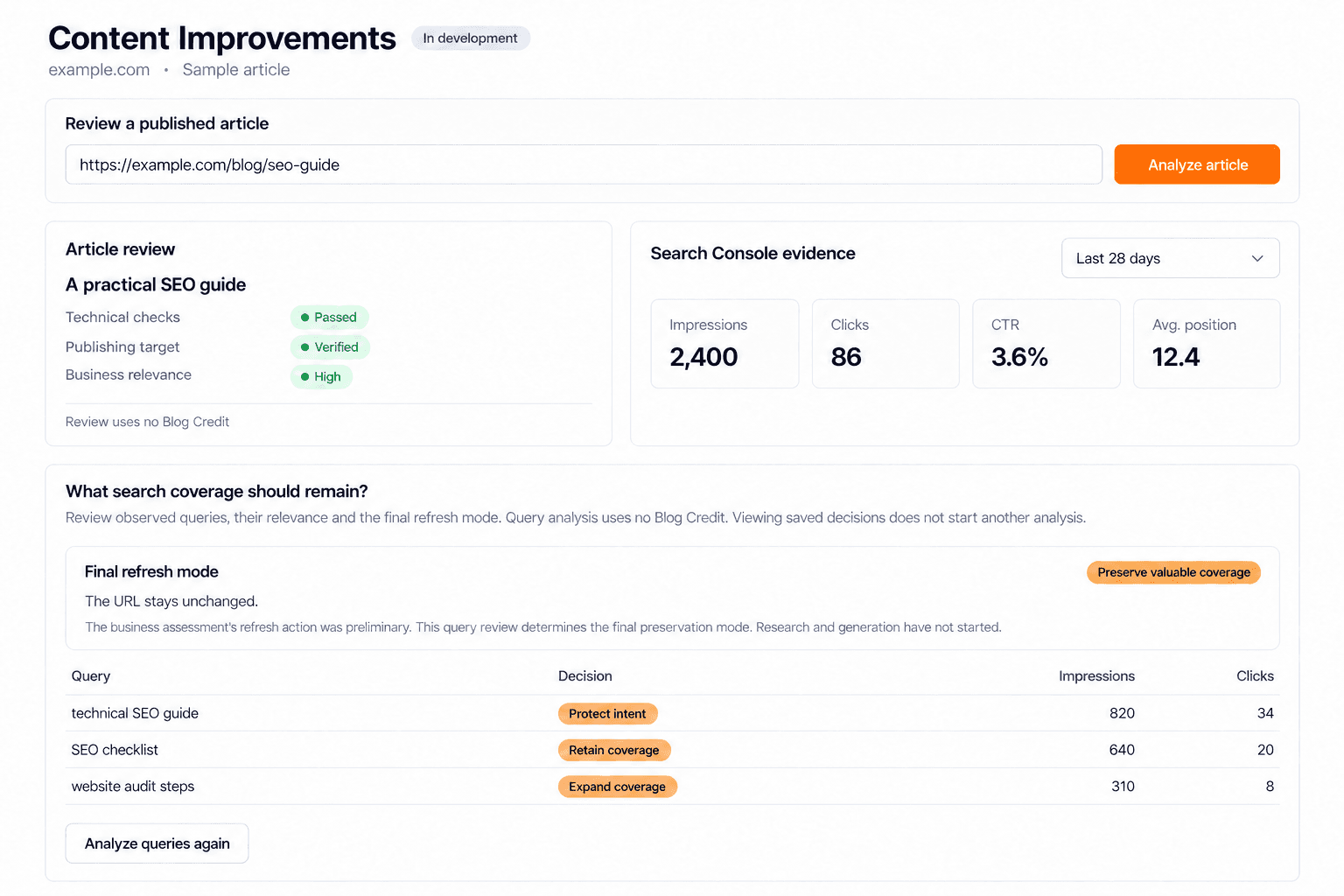
I use Keytomic's content freshness tool to automatically identify which buying guides and category pages need updating — and to push those updates on a schedule.
What Triggers a Content Refresh for Ecommerce
- Product availability changes — Guide recommends a product now out of stock
- Price updates — "Best under $200" guide has products now priced at $280
- New competitor products — A better option has launched since original publication
- Seasonal relevance — Holiday gift guides refreshed each year with new recommendations
- SERP intent shifts — The ranking pages for a keyword have changed structure or format
Analytics — Connecting Organic SEO to Revenue
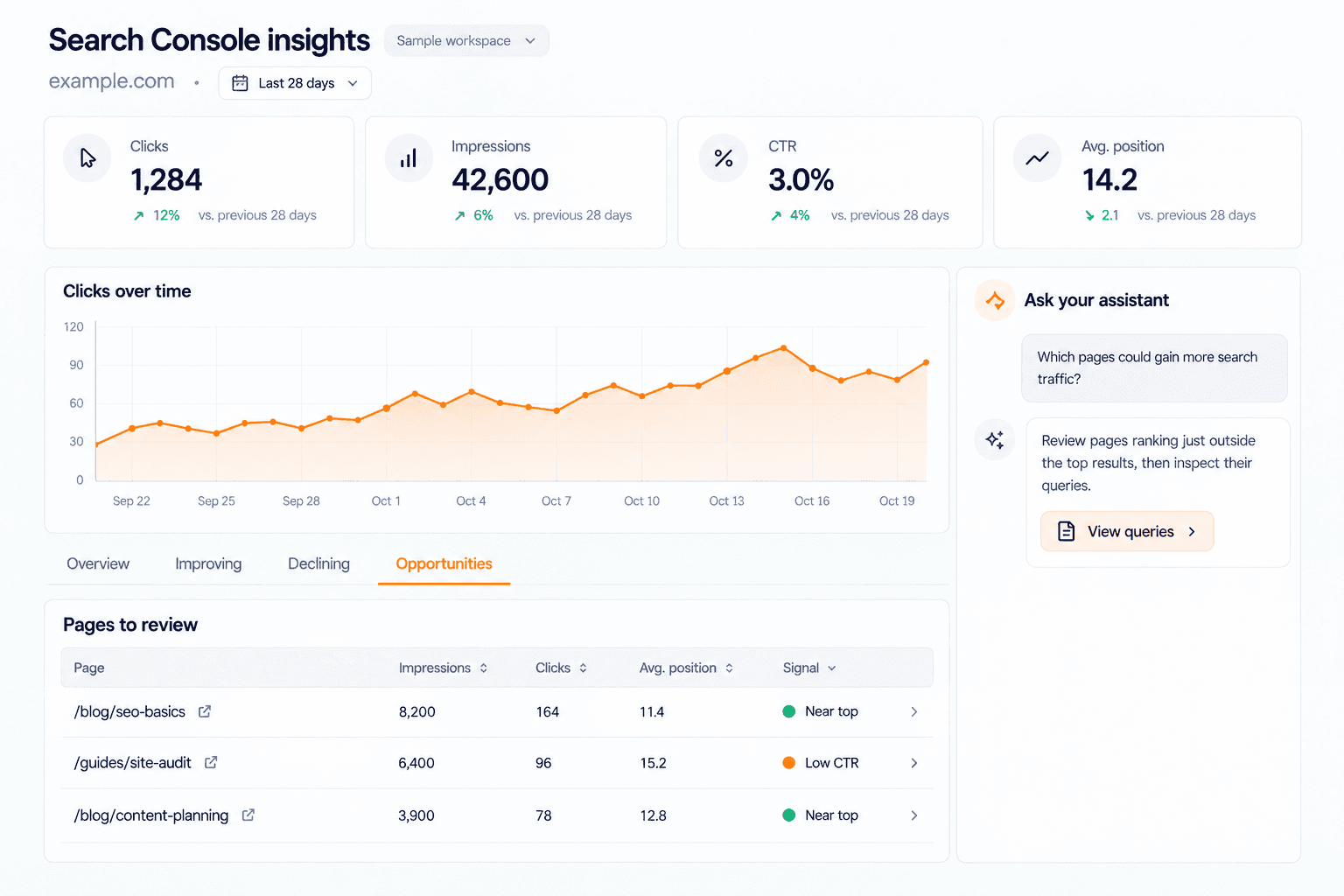
The metric most ecommerce brands track is organic sessions. The metric that matters is organic revenue. I use Keytomic's advanced analytics alongside Google Search Console to build a full picture from keyword → click → landing page → product view → purchase.
| Metric | What It Tells Me | Frequency |
|---|---|---|
| Organic sessions by page type | Which page type (product/category/blog) drives most traffic | Weekly |
| Organic revenue attribution | Which organic landing pages generate the most purchases | Weekly |
| Keyword ranking movements | Which keywords moved up/down and why | Weekly |
| Click-through rate by page | Which pages need meta title/description improvements | Monthly |
| Crawl coverage | % of product catalog indexed vs not indexed | Monthly |
| AI citation rate | How often the brand appears in LLM responses | Monthly |
MCP Server — Running Ecommerce SEO at Scale with AI
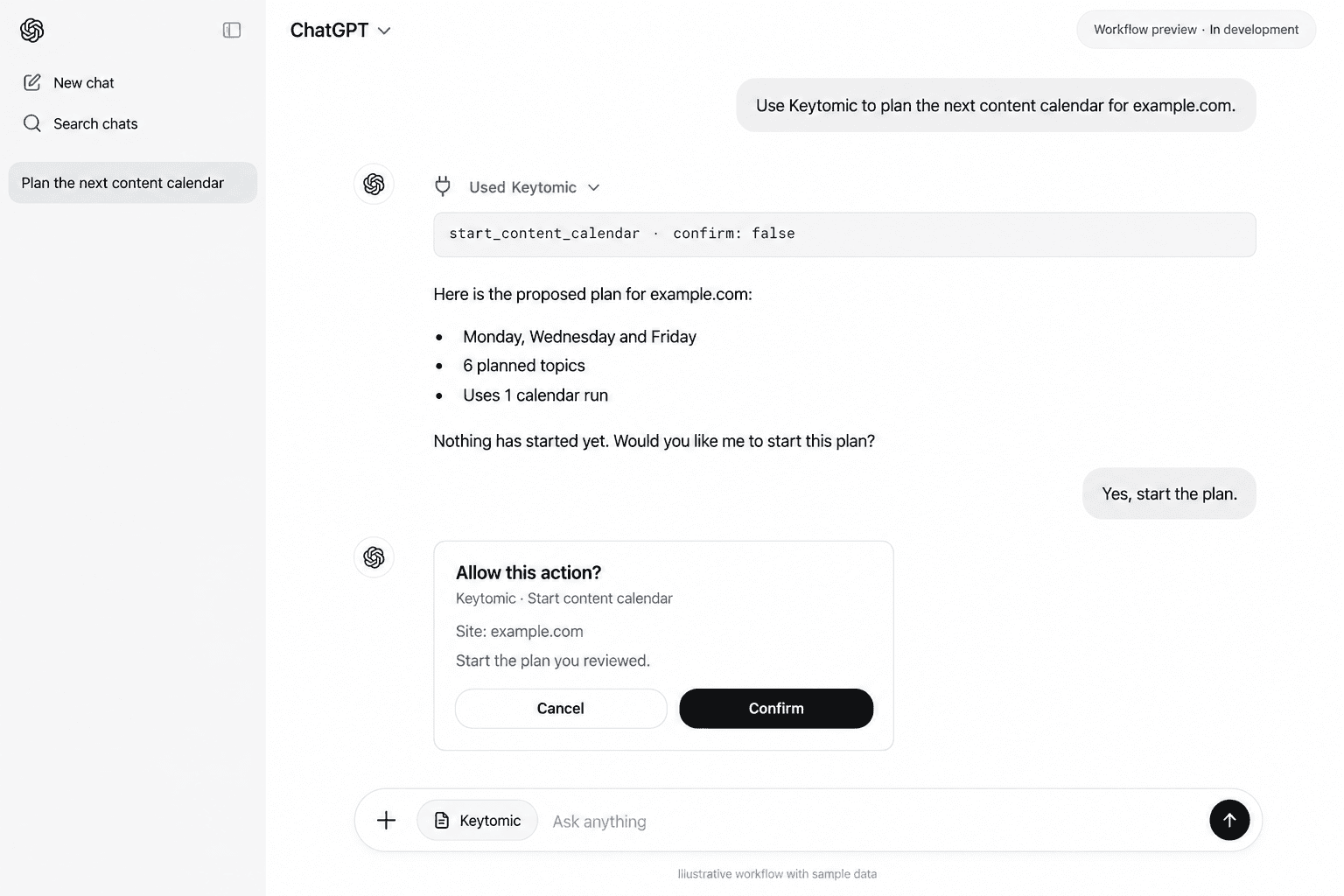
For ecommerce teams that use AI coding and content tools, Keytomic's MCP server is the final layer. It connects Keytomic directly to Claude, ChatGPT, Cursor, and other AI tools — so you can query your keyword data, audit findings, and content calendar without leaving your workflow.
Ecommerce Use Cases for the MCP Server
Query keyword data via MCP and pipe it directly into Claude or Cursor to generate SEO-optimized product descriptions at scale.
Ask "which of my category pages dropped in ranking this week?" directly in Claude — MCP pulls the data live from Keytomic.
"Show me all product pages with thin content under 150 words" — answered instantly via MCP without logging into another tool.
Add or reschedule content calendar entries, check publishing status, and trigger AI article generation via natural language.
For teams building on headless commerce (Next.js, Hydrogen), the MCP server integrates directly into the development workflow via Claude MCP and Cursor MCP, making SEO data available inside the same environment where the store is being built.
The Ecommerce SEO Stack — Start to Finish
Here's the order I work through this for every ecommerce store I onboard:
Keyword research by intent layer
Map every keyword to a page type before writing a single word.
Fix site architecture and URL structure
Category and product URLs must be clean, keyword-first, and logically nested.
Run a technical audit
Fix thin content, duplicate URLs, schema gaps, and Core Web Vitals before scaling content.
Build a topical map and content calendar
Publish 8–12 pieces of buying guide and informational content per month minimum.
Submit everything for indexing
Every new product and content page submitted on day of publish.
Build backlinks through digital PR and buying guide outreach
Target listicle inclusion and niche community mentions first.
Track AI visibility alongside traditional rankings
Monitor LLM citation presence monthly — this is where ecommerce is heading.
Keytomic handles the entire ecommerce SEO pipeline — from keyword research to auto-publishing to AI visibility tracking.
See how Keytomic works for ecommerce storesAbout the author
Organic Growth, Keytomic
Zainab Hai works in organic growth at Keytomic, running SEO experiments, writing content strategy and building keyword frameworks across industries.
Last updated: November 2026. Keyword volumes, difficulty and CPC are estimates for an example home goods store; figures vary by niche and market.
 Fernhill CRM