You typed "Ahrefs vs Ubersuggest" into Google and got fourteen articles, every single one of which was written by a team that makes money when you click their affiliate link.
This one is not that.
We tested both tools on the same domains, ran the same keyword lookups side by side, and cross-referenced the outputs against Google Search Console to see where each tool's numbers held up and where they fell apart. The goal was to figure out who should actually be using each tool, not to declare a winner for SEO clicks.
The answer is less controversial than most reviews make it sound: these are not competing products for the same buyer. They are different tools for different stages of SEO maturity. The decision tree is pretty short once you understand what each one actually is.
What These Tools Actually Are (Before We Compare Anything)
For another comparison focused on a simpler keyword suite versus Ahrefs' broader research platform, see Ahrefs vs KWFinder comparison.
Ahrefs started in 2010 as a pure backlink analysis tool built around a proprietary crawler that now ranks as one of the most active web crawlers on the internet.
Over time it grew into a full SEO platform: keyword research, rank tracking, site audits, content explorer, and now AI visibility tracking.
The company is based in Singapore, has always been subscription-only (no free trial on core features), and built its reputation on data quality rather than ease of use.
Ubersuggest started as a completely free keyword suggestion scraper that pulled autocomplete data from Google Suggest.
Neil Patel acquired it in 2017 and rebuilt it into a proper SEO platform with keyword research, site audits, backlink analysis, rank tracking, and an AI writer integration.
Its defining characteristic from day one has been price: affordable monthly plans, and a lifetime deal option that makes it one of the cheapest SEO tools available over a multi-year horizon.
Those origin stories matter. Ahrefs is a data-first tool that got a UI. Ubersuggest is an accessible tool that got data. That difference shows up everywhere in the actual product.
Quick Decision Table
Factor | Ahrefs | Ubersuggest |
|---|---|---|
Best for | SEO pros, agencies, link builders | Beginners, solo bloggers, small businesses |
Keyword database | 7 billion+ keywords, 171 countries | Smaller database, less international depth |
Backlink index | 35 trillion+ links, industry standard | Basic; functional for simple research |
Data accuracy | Industry-leading, especially backlinks | Good enough for keyword discovery; weaker for competitive analysis |
Starting price | $29/mo (Starter, very limited) / $129/mo (usable) | $29/mo or $290 lifetime |
Free option | Ahrefs Webmaster Tools (limited, site owners only) | 3 free searches/day |
Free trial | No | 7-day trial available |
Learning curve | Steep | Gentle |
AI visibility tracking | Add-on (Brand Radar) | Not available |
Content execution | No | AI Writer included (10,000 words/mo) |
Right for lean content teams | No | No (neither executes content at scale) |
Keyword Research: Where Ubersuggest Is Closer Than You Think
This is the category where Ubersuggest closes the gap the most, and where most comparisons oversimplify.
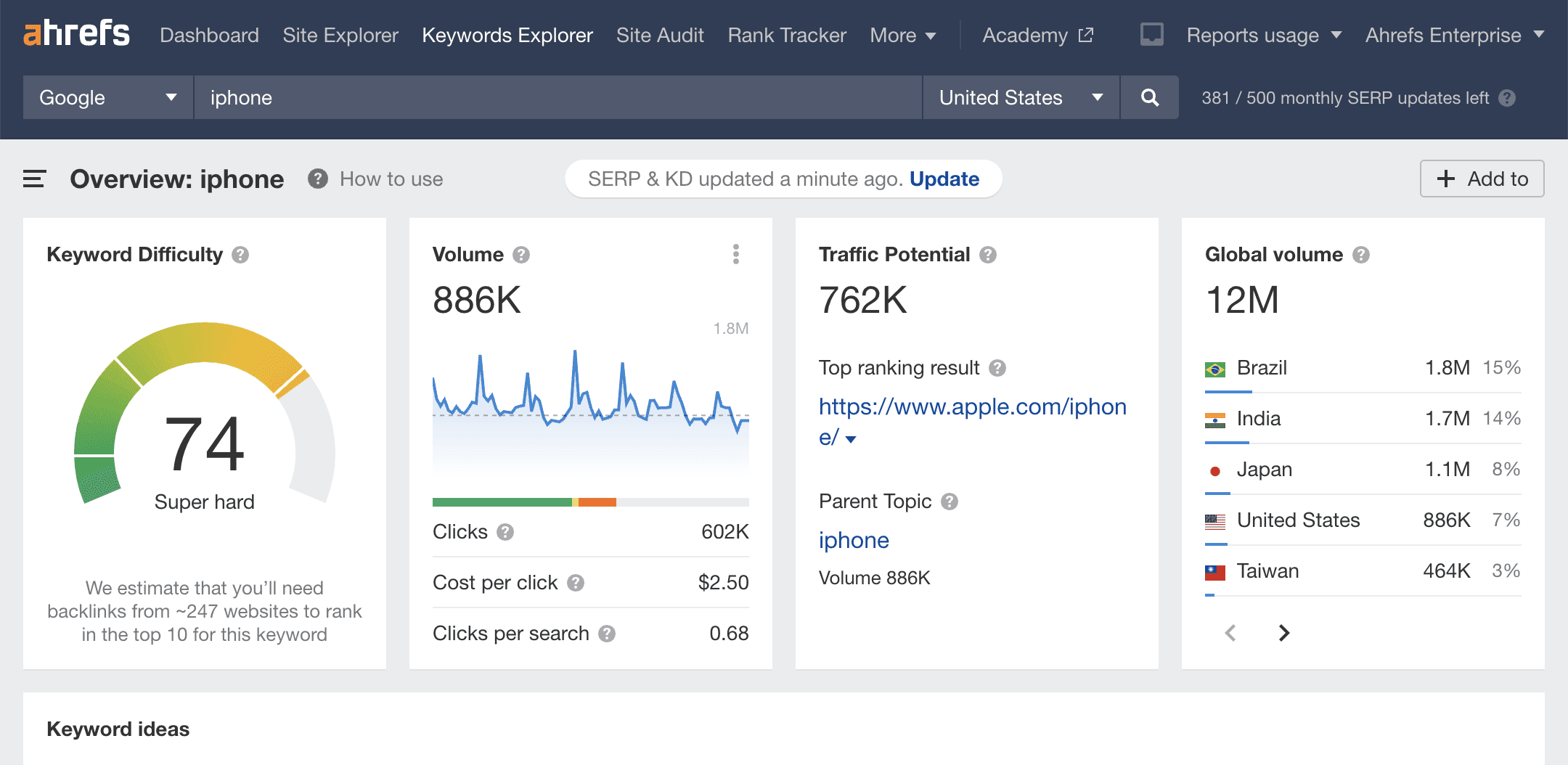
Ahrefs' Keywords Explorer is undeniably deeper. It pulls from a database of over 7 billion keywords across 171 countries, shows actual click-through data (not just search volume), calculates keyword difficulty based on the real backlink profiles of ranking pages, and gives you Traffic Potential as a separate metric from search volume.
When you look at a keyword in Ahrefs, you're seeing what it would actually take to rank for it based on who currently does.
Ubersuggest shows search volume, SEO difficulty, cost-per-click, and trend data. It's simpler. What it does well is generate a lot of related keyword ideas fast, cluster them into questions and comparisons automatically, and display everything in a visual format that doesn't require much SEO background to interpret. G2 users actually rated Ubersuggest's keyword research at 8.9 out of 10, slightly higher than Ahrefs' 8.7, which is worth noting.
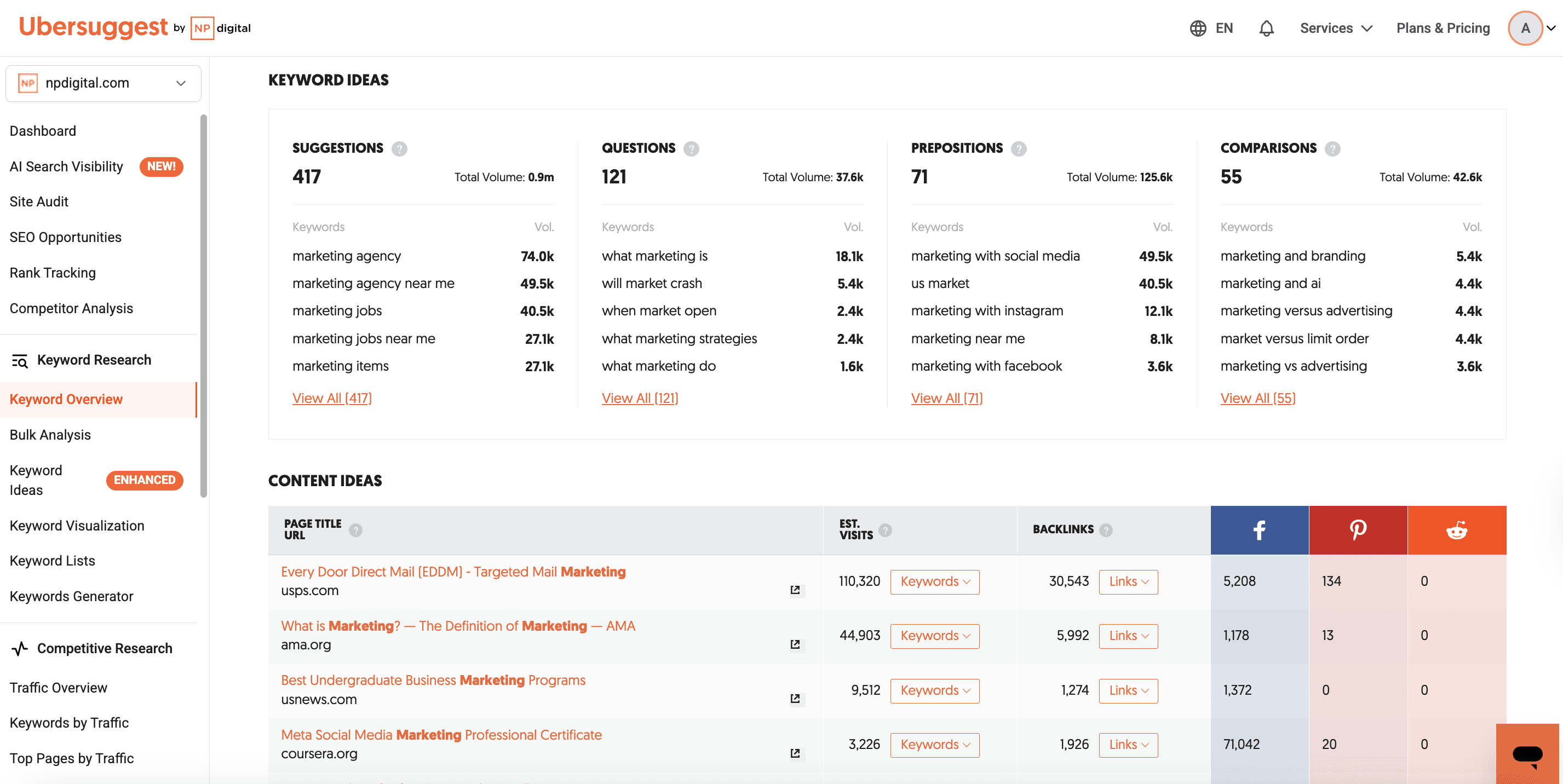
The honest difference: Ahrefs tells you whether you can realistically rank for a keyword based on competitive data. Ubersuggest tells you that the keyword exists and gives you enough to make a decision. For a beginner building a content plan for a small site, Ubersuggest is genuinely sufficient. For an SEO professional making decisions about a competitive niche with significant business stakes, Ahrefs' depth is not optional.
One accuracy note from direct testing: Ubersuggest's keyword difficulty scores are sometimes unreliable. Understanding how keyword difficulty actually works matters before trusting any tool's scores, which is why this breakdown of keyword difficulty is worth reading before you build a content plan around either tool.
Reviewers on Capterra and Trustpilot document cases where keyword difficulty doesn't reflect actual competitiveness. Ubersuggest's own documentation acknowledges that its traffic estimates are modeled approximations, not direct measurements.
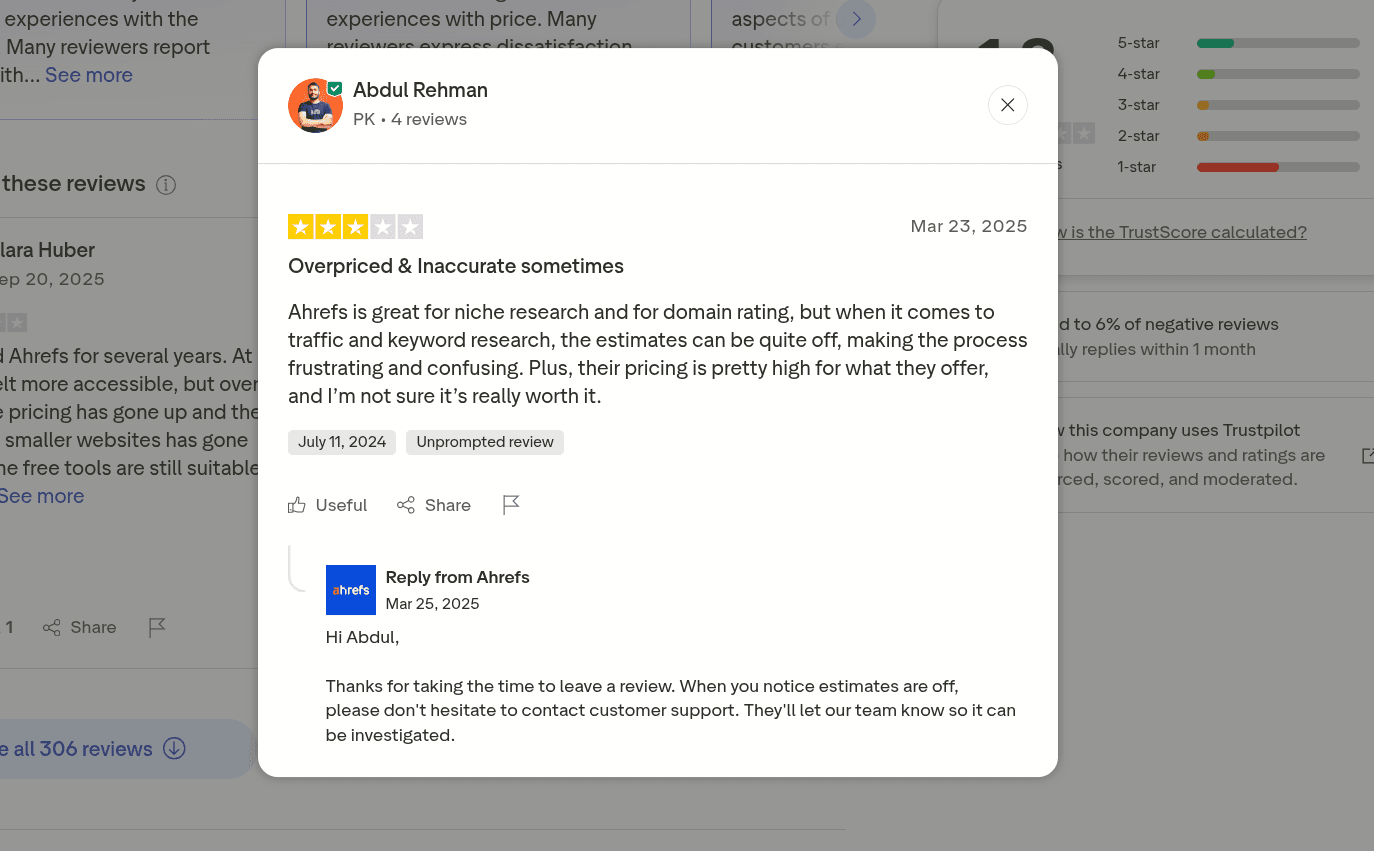
That's true of all SEO tools, but Ahrefs' model is significantly more calibrated.
Backlink Analysis: Ahrefs Has No Real Competition
This is not a close comparison.
Ahrefs built its entire business on backlink data. The AhrefsBot crawls the web continuously and maintains a live index of over 35 trillion links. When you look up a domain's backlink profile in Ahrefs, you get data that updates approximately every 15 minutes.
You get anchor text distribution, referring domain quality, dofollow vs nofollow ratios, link growth and loss over time, broken backlinks, and a Link Intersect tool that shows which sites link to your competitors but not you. The data depth is what makes Ahrefs the default tool for serious link building campaigns.
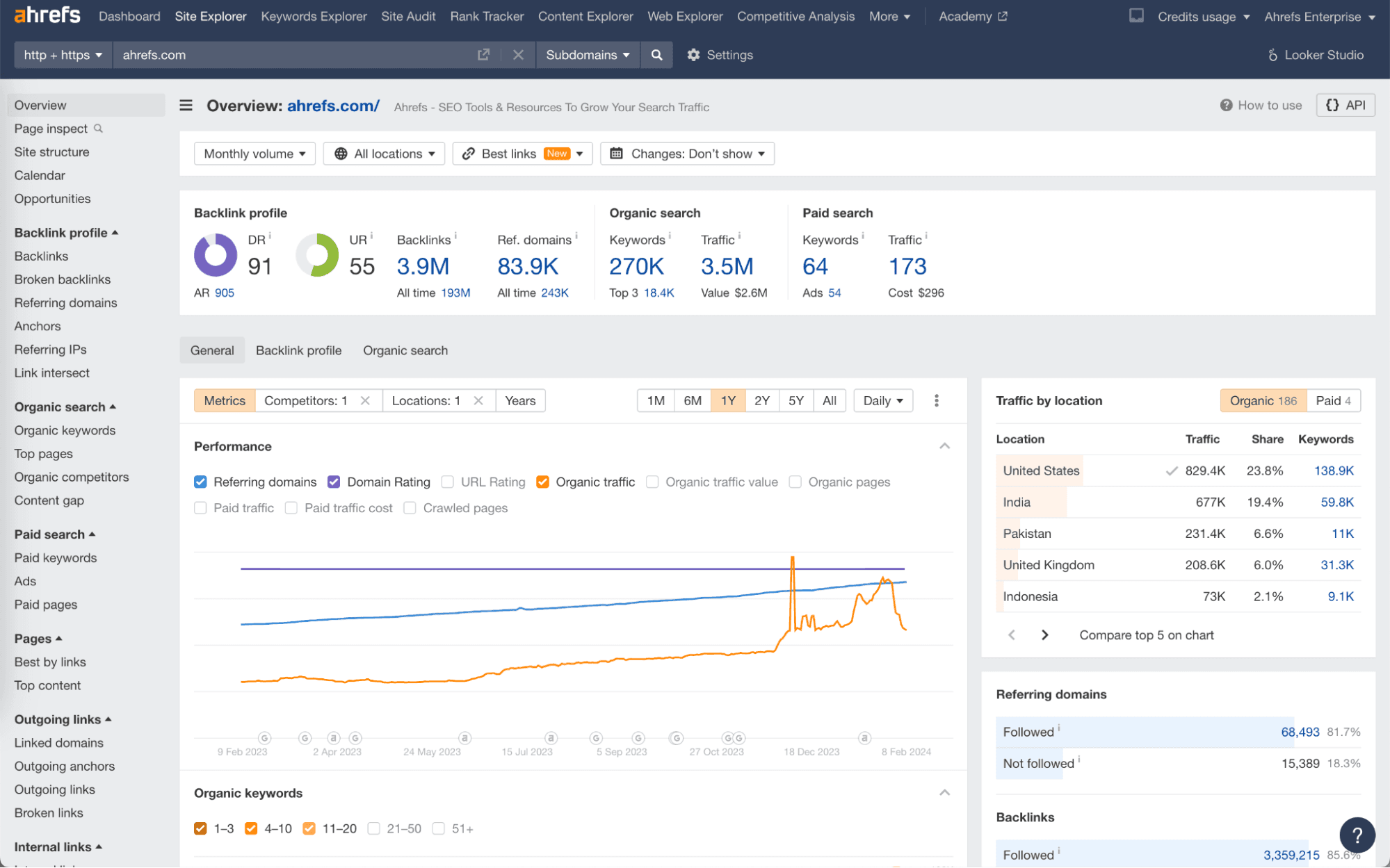
Ubersuggest shows referring domains, domain authority scores, total link counts, and basic link trends. It exports to CSV. For someone who wants to understand their own backlink profile at a high level or quickly check a competitor's authority, it's functional. For running a real link building operation, it's not.
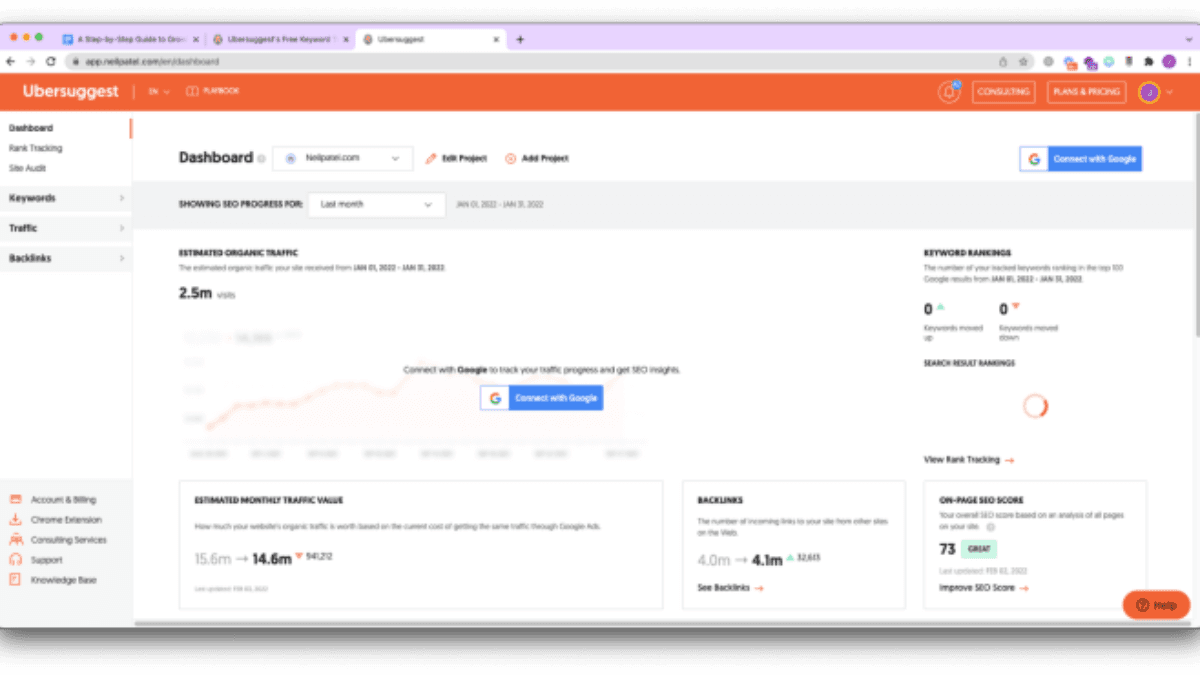
The practical gap shows up most clearly in competitive link building. Ahrefs tells you the exact sites linking to five of your competitors but not to you, filtered by authority, industry, anchor text, and link type. That level of granularity is how agencies identify link building opportunities systematically. Ubersuggest doesn't offer that workflow.
If backlink analysis is a significant part of your SEO work, Ahrefs wins this category decisively. There's no framing that changes that.
Site Audits: Closer to a Tie Than People Admit
Site audits are where the pricing difference starts to feel uncomfortable for the Ahrefs argument.
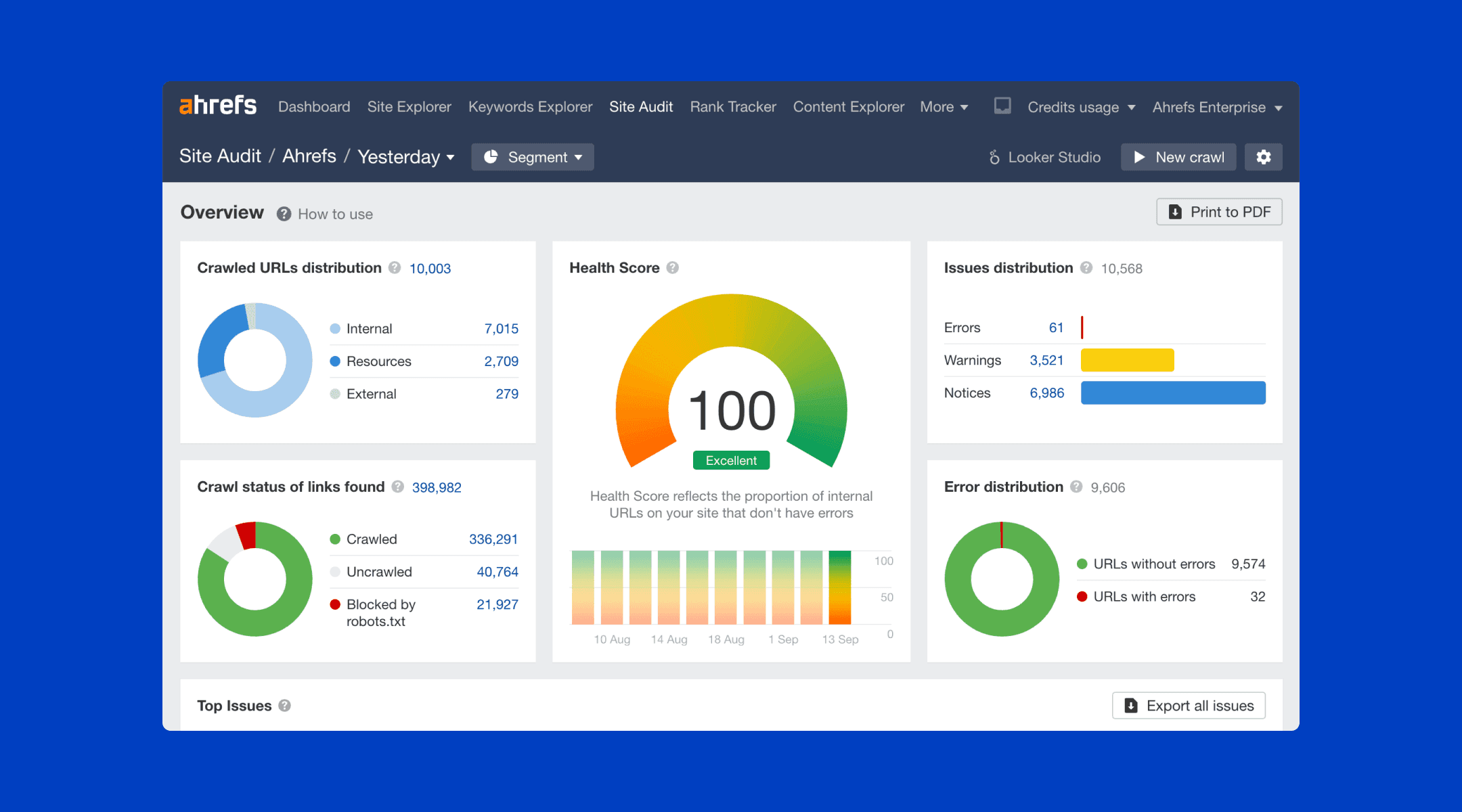
Ahrefs' site audit crawls your domain and surfaces technical SEO issues: broken links, redirect chains, missing meta tags, slow pages, canonical issues, hreflang problems, duplicate content, and more. It's comprehensive, well-organized, and integrates with Google Search Console for additional context.
Ubersuggest's site audit covers the most important technical SEO factors: crawl issues, on-page SEO errors, speed problems, and linking issues. It presents findings in a clear priority order with recommendations for each issue. It doesn't go as deep as Ahrefs, but one Capterra reviewer wrote that the site audit is great, even better than Ahrefs and Semrush for on-page SEO warnings.
That's not a universal view, but it reflects that Ubersuggest's audit is more useful than many comparison articles suggest. For a small business owner doing monthly checks on a 50-page site, Ubersuggest's audit surfaces the same priority issues that Ahrefs would.
The difference appears at larger site sizes, more complex technical configurations, or when you need historical crawl data to track improvement over time.
Rank Tracking: Ahrefs Goes Wider, Ubersuggest Goes Simpler
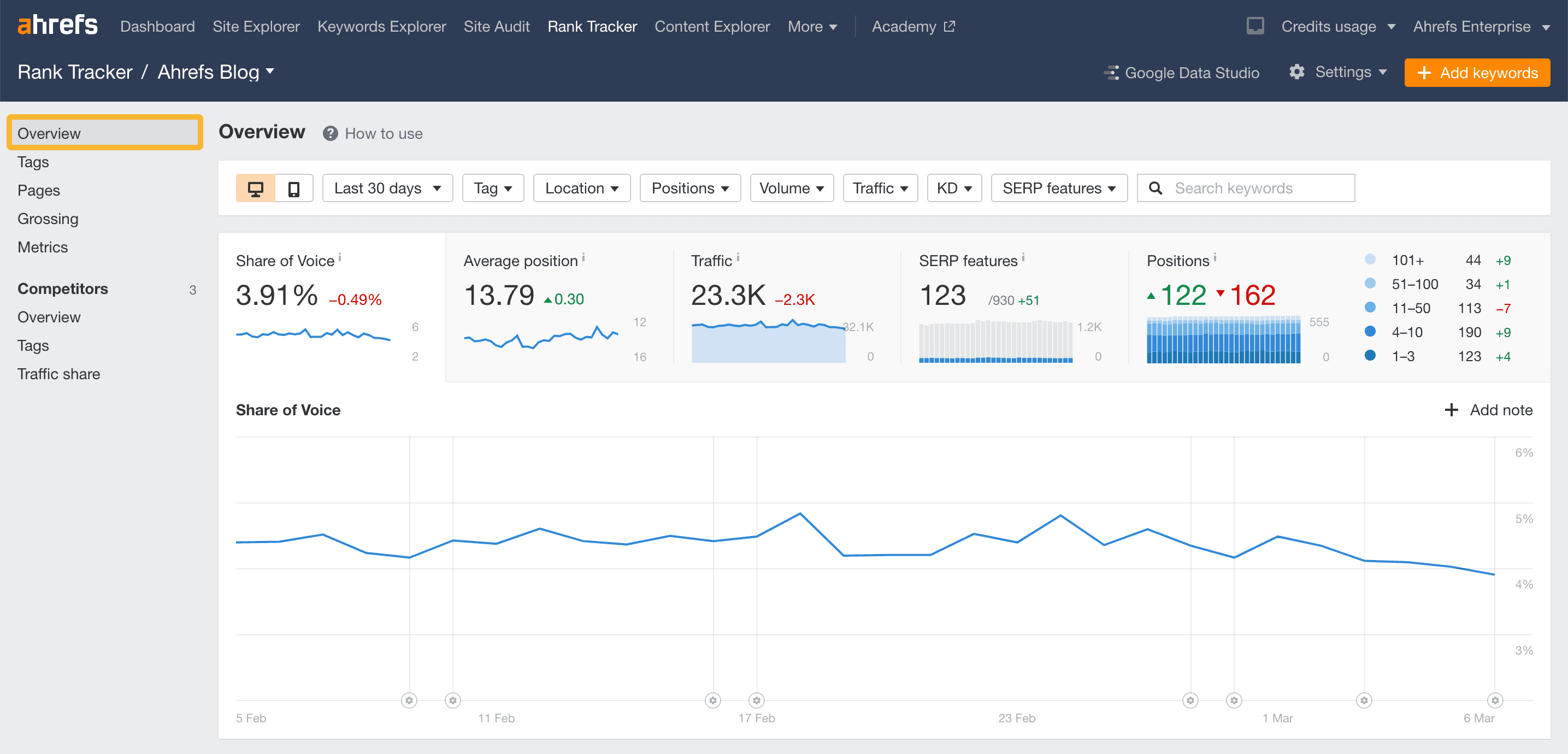
Both tools track keyword rankings over time. Ahrefs is more capable on every metric: daily updates available (with the Project Boost add-on), tracking across 190 countries, SERP feature visibility, device-level tracking, historical comparisons, and competitive benchmarking in the same view.
Ubersuggest tracks your main keywords, shows movement over time, and gives desktop vs. mobile breakdowns. For most small sites, this is sufficient. One Trustpilot reviewer noted that daily ranking updates stopped working in September 2025, which is worth checking against current platform status if you're making a decision based on that feature.
The keyword limits matter here. Ubersuggest's Individual plan tracks 150 keywords across 1 project. If you're managing a site with multiple keyword groups or multiple client projects, that's constraining fast.
Competitive Analysis: Ahrefs Pulls Further Ahead
Ahrefs has a dedicated competitive analysis toolkit that doesn't really exist in Ubersuggest at the same level.
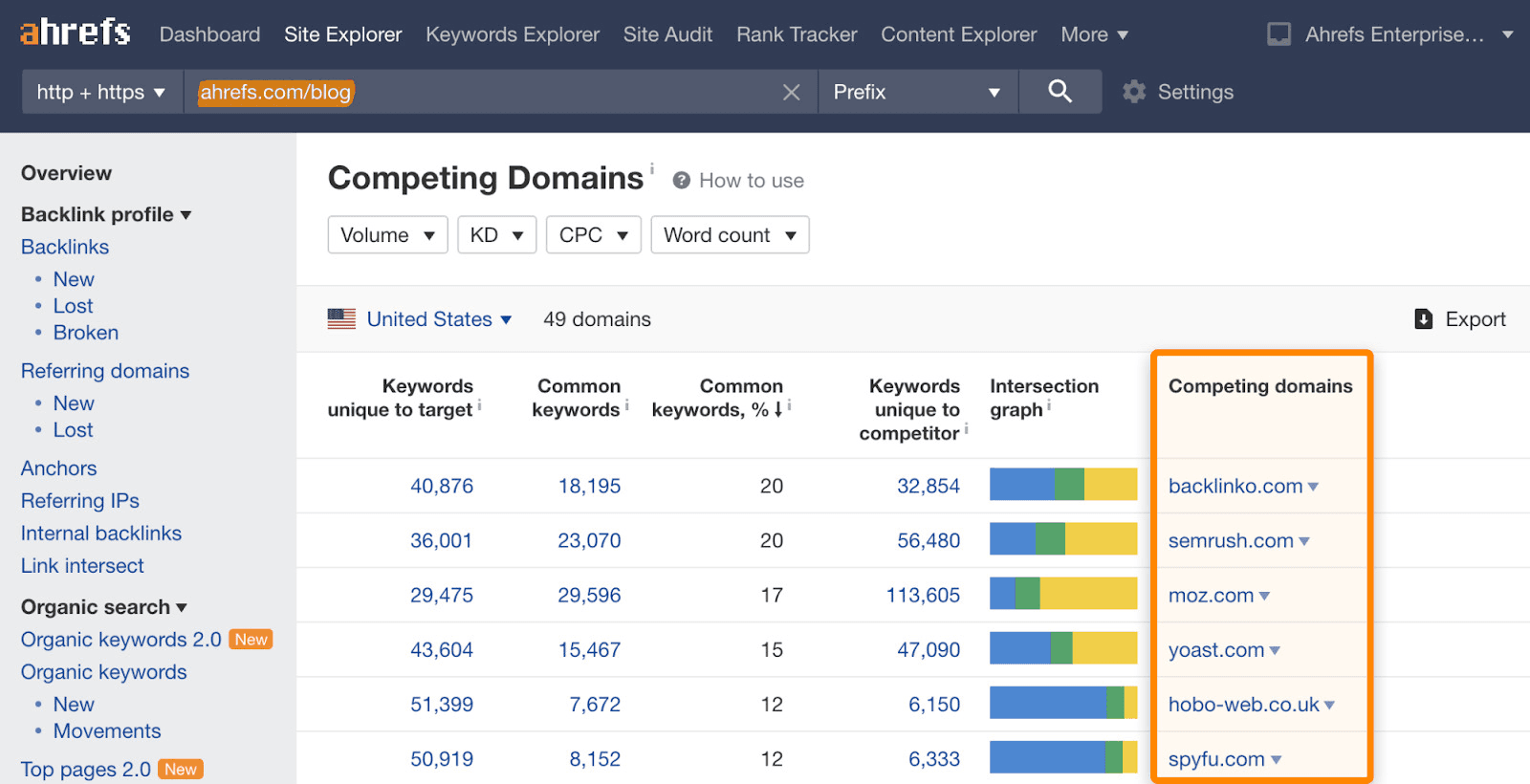
Content Gap analysis shows every keyword a set of competitors ranks for that you don't. Top Pages shows which of a competitor's pages drive the most traffic and how. Competing Domains surfaces your real search competitors, not just the ones you think you're competing with. Site Comparison shows side-by-side metrics for up to five domains.
Ubersuggest lets you enter a competitor domain to see top keywords and traffic, and it shows some keyword overlap. It's good for getting a quick competitive picture and spotting content gaps at a basic level. When a senior SEO is trying to reverse-engineer why a competitor outranks them for 50 specific terms, Ubersuggest doesn't provide the depth to answer that.
Content Research: Ubersuggest Has a Hidden Edge
Ahrefs has Content Explorer, a database of millions of indexed articles you can search by keyword, filter by organic traffic, backlinks, domain rating, and publishing date. It's a powerful tool for finding content gaps, identifying link-building targets, and understanding what's gaining traction in a niche.
Ubersuggest's Content Ideas feature shows top-performing content for a keyword including estimated traffic, backlinks, and social shares from Facebook, Reddit, and Pinterest. It's more accessible and quicker to act on for a solo blogger or content marketer who needs topic ideas fast.
The difference is depth vs. speed. Ahrefs for research. Ubersuggest for ideation.
Pricing: The Honest Numbers
This is where the comparison gets genuinely interesting.
Ahrefs Pricing
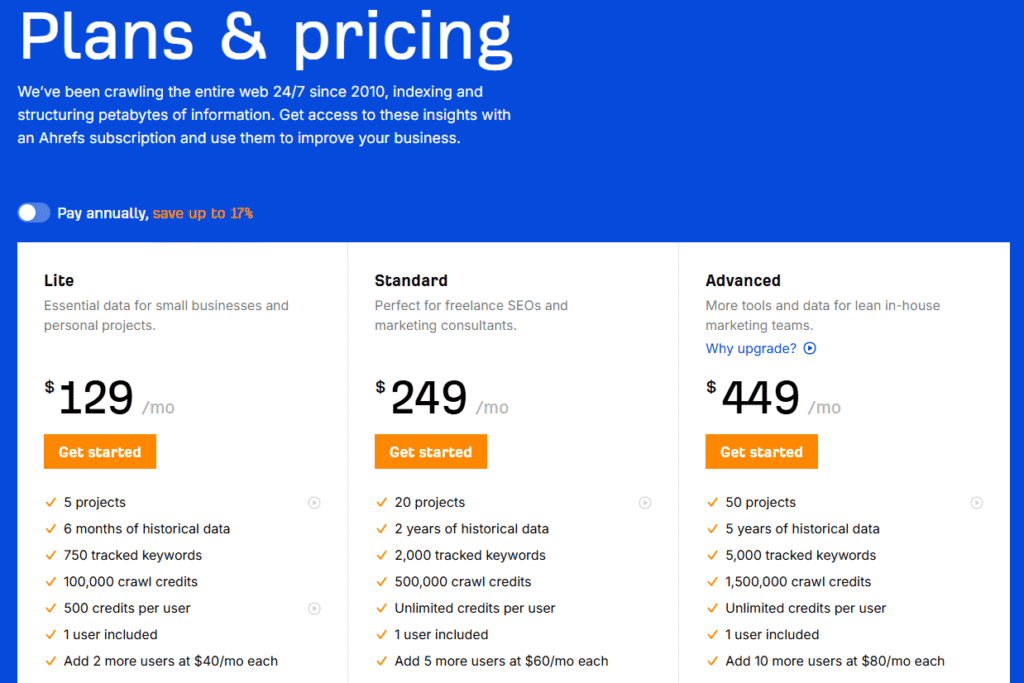
Ahrefs raised prices significantly in April 2024. The Lite plan went up 30% (from $99 to $129/month). The Standard plan jumped 39% (from $179 to $249/month). Enterprise went up 50%.
Current tiers:
Starter: $29/month. Very limited. 100 credits per month, 1 project, cannot add users or purchase additional credits. Useful for light testing, not for production work.
Lite: $129/month. 500 credits per month, 5 projects, 6 months of data history, 750 tracked keywords. Credits are consumed every time you open a report, apply filters, or request additional data in most tools. If you run through 500 credits before the month ends, you either pay $50 per additional 500 credits or wait.
Standard: $249/month. Unlimited credits. 20 projects, 2 years of history, 2,000 tracked keywords, Content Explorer, Batch Analysis, Portfolios. This is where Ahrefs becomes genuinely powerful.
Advanced: $449/month. 50 projects, 5 years of history, 5,000 tracked keywords, Looker Studio integration, Web Explorer.
Enterprise: $1,499/month. Custom limits, API access, dedicated support.
Annual plans save approximately 17%. Additional users cost $40/month on Lite, $60/month on Standard, $80/month on Advanced. Ahrefs does not offer refunds in general.
The credit system on Starter and Lite plans is a meaningful source of user frustration. Standard and above have unlimited credits, which is why most serious users are effectively priced at $249/month minimum.
Ubersuggest Pricing
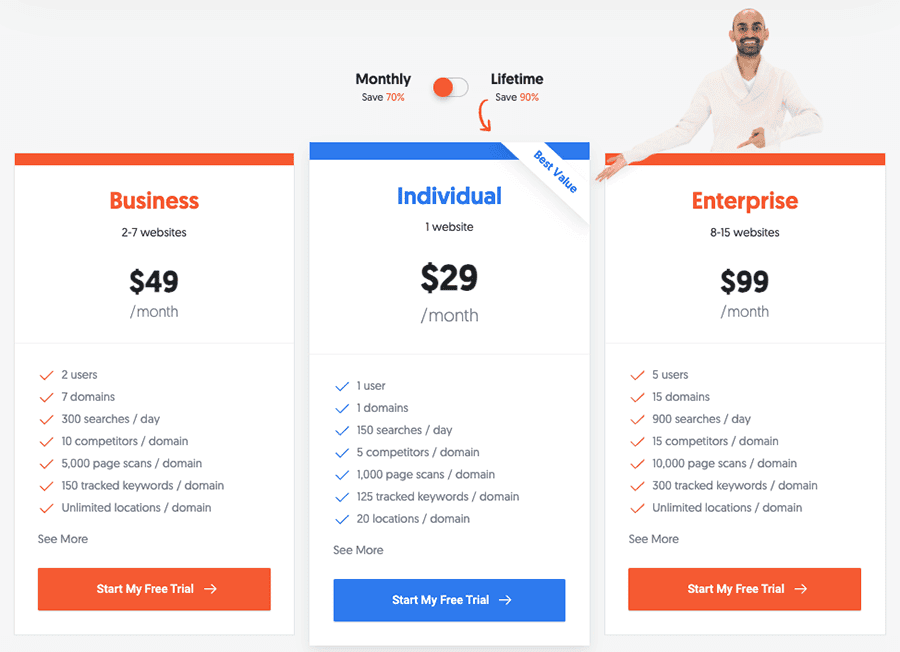
Ubersuggest has one structural feature no other SEO tool of this caliber offers: a lifetime deal.
Monthly plans:
Individual: $29/month (1 seat, 1 project, 150 tracked keywords, 100 reports/day)
Business: $49/month (3 seats, 7 projects, 700 tracked keywords, 300 reports/day)
Enterprise/Agency: $99/month (5 seats, 15 projects, 1,500 tracked keywords, 900 reports/day)
Lifetime plans:
Individual: $290 one-time
Business: $490 one-time
Enterprise/Agency: $990 one-time
At $29/month, Ubersuggest is 100 dollars cheaper per month than Ahrefs Lite for the entry plan. The lifetime deal is the most economical option in SEO tools at this feature level.
Important caveat from Ubersuggest's terms of service: the lifetime plan is defined as "for as long as npdigital.com/ubersuggest exists, at the discretion of NP Digital." Worth reading before committing.
All plans include access to the AI Writer integration (10,000 words/month) and biweekly coaching calls with Neil Patel's team.
What Real Users Say
Ahrefs on Review Platforms
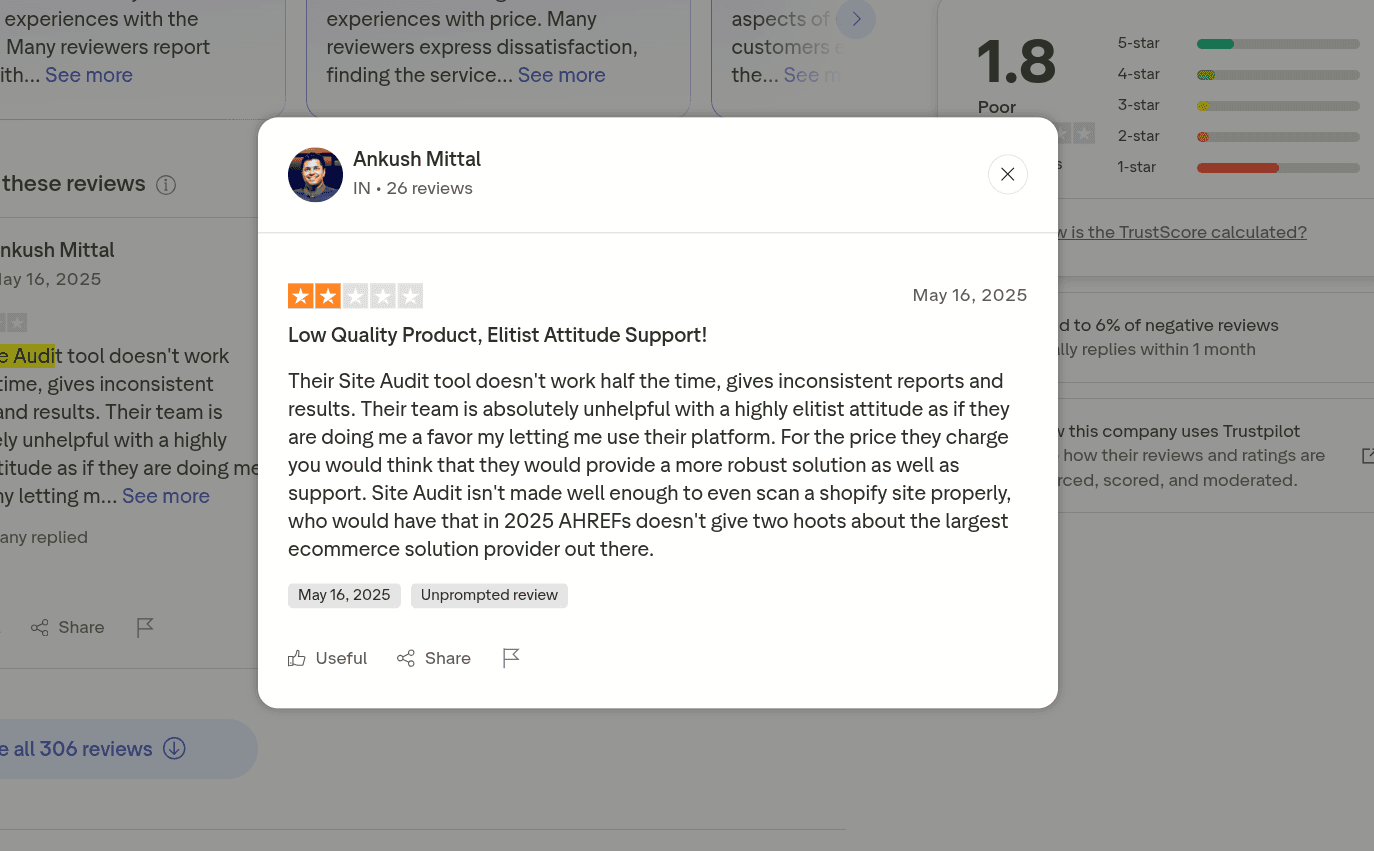
Ahrefs holds strong ratings on G2 (4.5+) and among professional SEOs who use it daily. The consistent praise covers backlink data accuracy, the depth of competitive analysis tools, and the reliability of the crawler. The consistent criticism covers the April 2024 price increases, the credit system on lower tiers, and the no-refund policy.
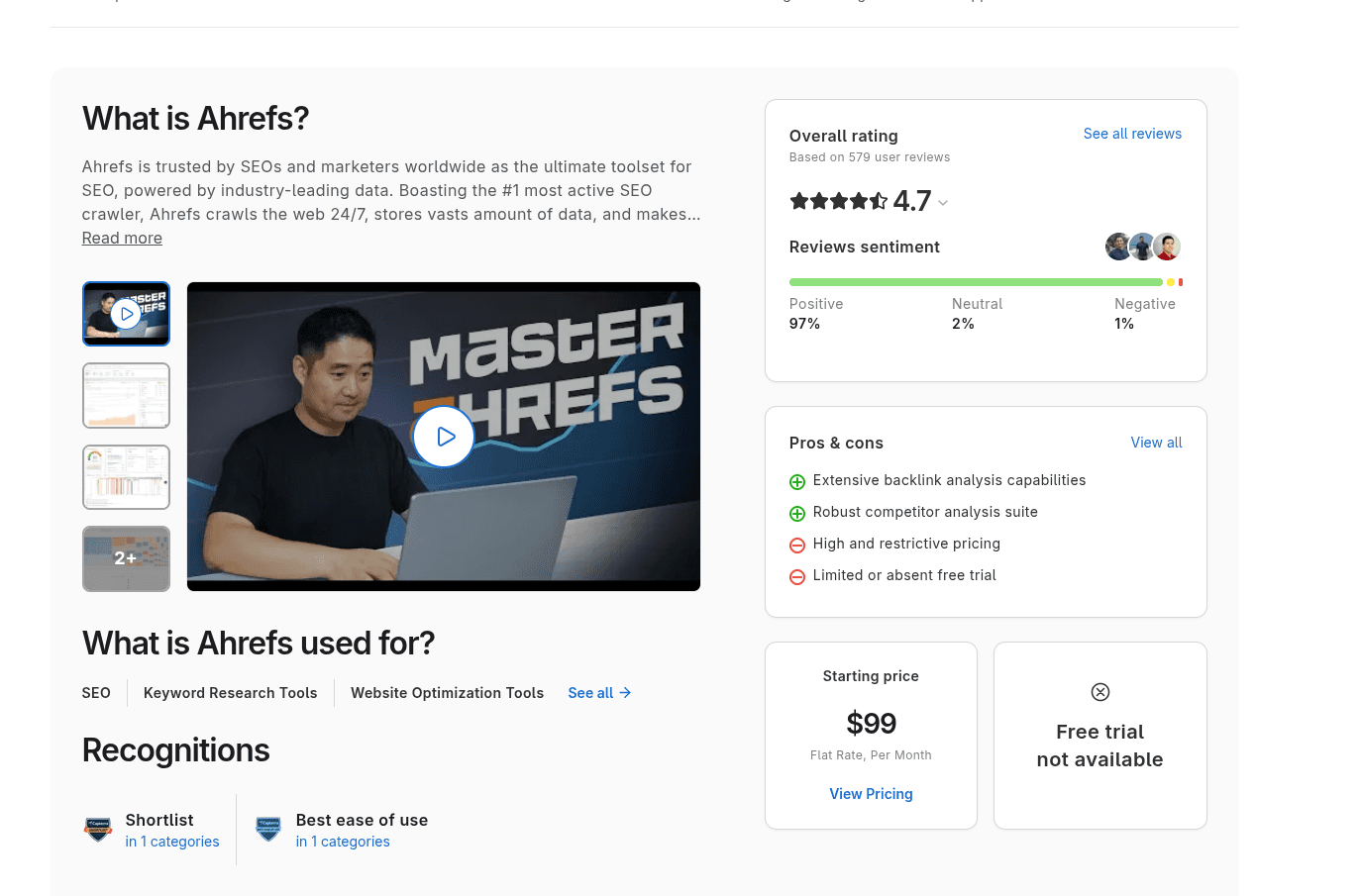
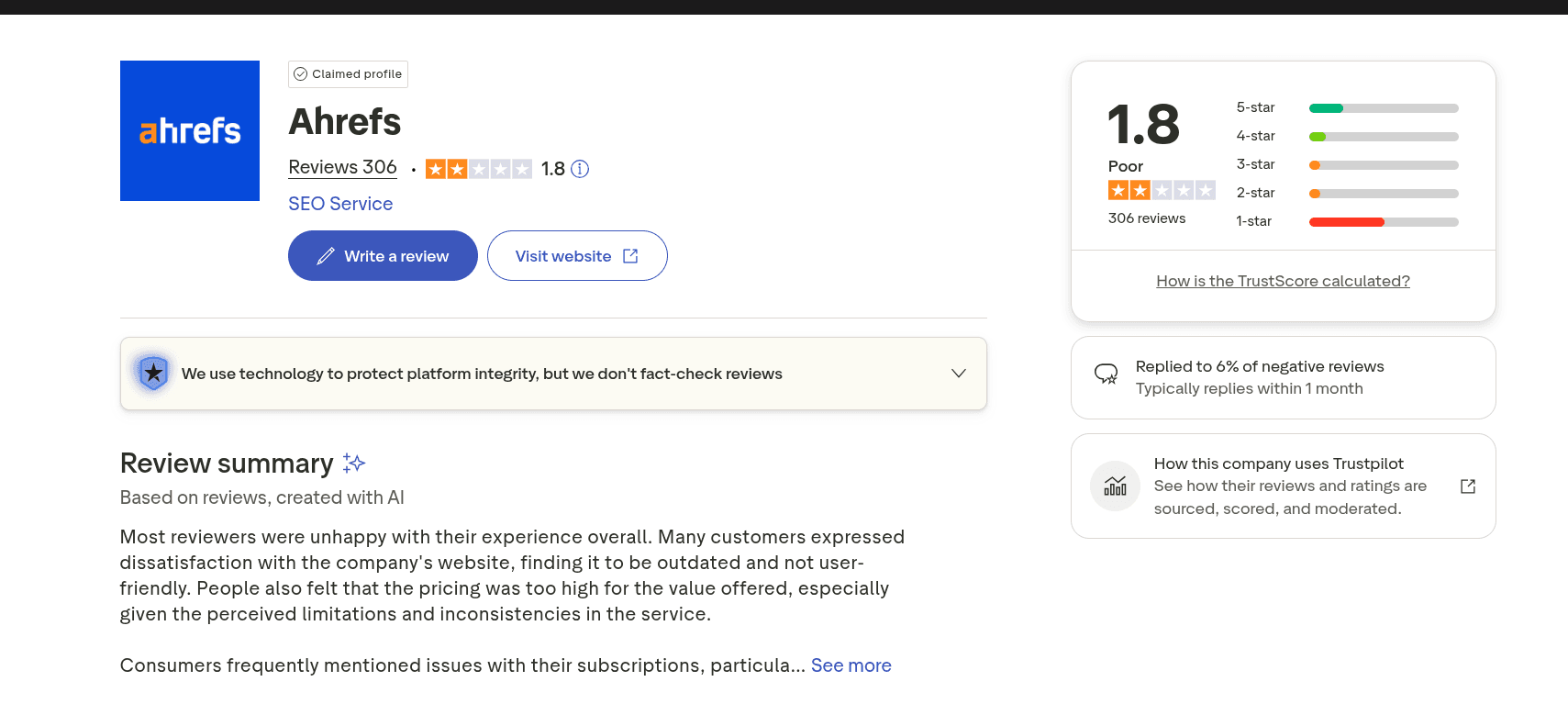
On Trustpilot, Ahrefs sits at 2.0/5 based on a significant number of reviews, most of which center on billing disputes, credit exhaustion charges, and cancellation difficulty. The gap between G2 (professionals evaluating features) and Trustpilot (users dealing with billing) tells a story worth paying attention to.
Ubersuggest on Review Platforms
Ubersuggest has a smaller review footprint than Ahrefs but generally positive sentiment around value and accessibility. Trustpilot shows active responses from the support team.
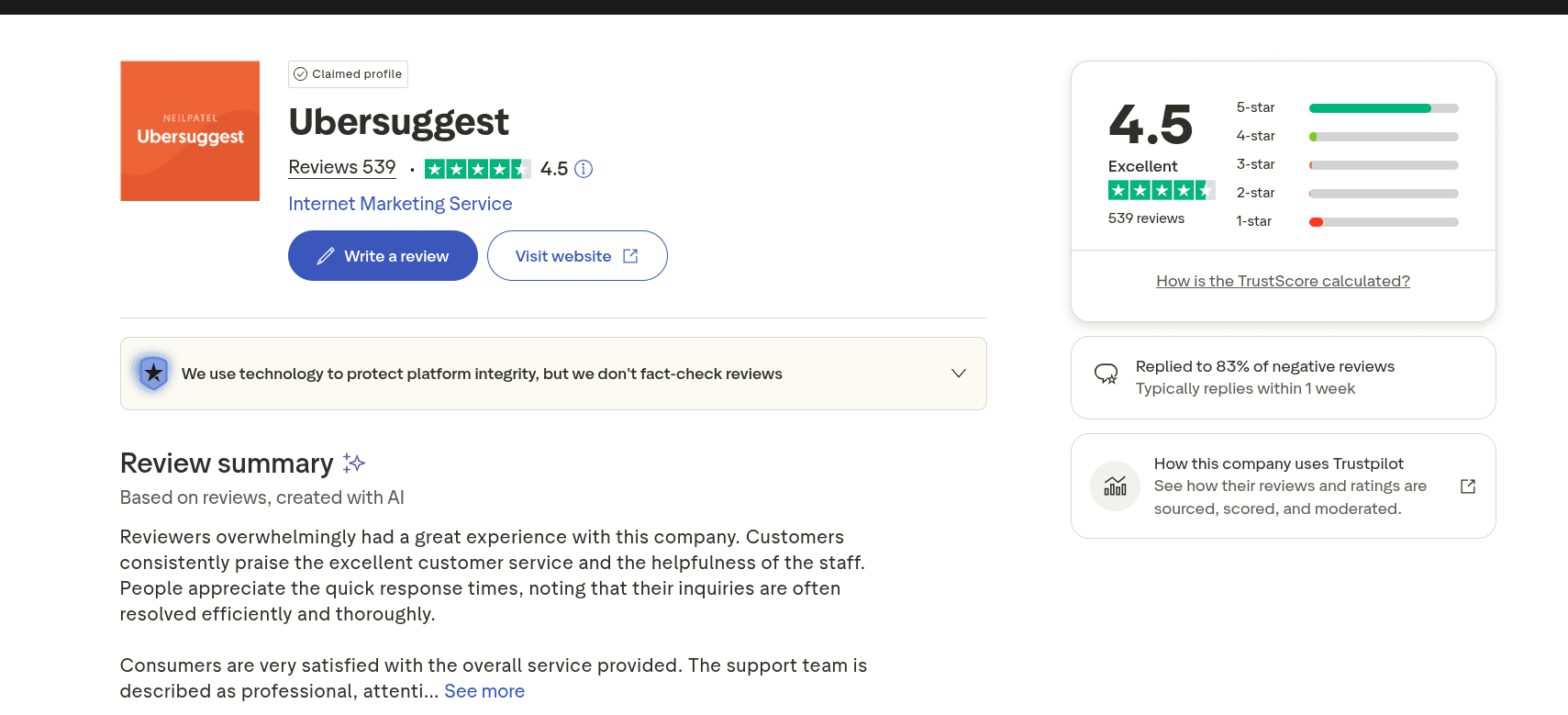
Capterra reviewers note site audit data inconsistencies. The pattern suggests Ubersuggest works well for users who treat it as a direction-setting tool, not as a ground-truth data source.
Feature Comparison Table
Feature | Ahrefs | Ubersuggest |
|---|---|---|
Keyword database size | 7B+ across 171 countries | Smaller, less international depth |
Keyword difficulty accuracy | Strong, backlink-model based | Inconsistent on competitive terms |
Click-through data | Yes (Traffic Potential metric) | No |
Backlink index | 35T+ links, industry standard | Basic, functional for beginners |
Backlink update frequency | ~15 minutes | Less frequent |
Link Intersect / Gap tools | Yes | No |
Site audit depth | Comprehensive | Covers main issues |
Rank tracking | Up to 5,000 keywords, 190 countries | Up to 1,500 keywords, fewer countries |
Daily rank updates | Add-on (Project Boost) | Yes on paid plans |
Content Explorer | Yes (Standard+) | Basic Content Ideas |
Competitive gap analysis | Yes (dedicated toolkit) | Basic |
AI content writing | No | Yes (10,000 words/mo via AI Writer) |
AI visibility tracking | Yes (Brand Radar add-on) | No |
Free option | Webmaster Tools (site owners) | 3 searches/day |
Free trial | No | 7-day trial |
Entry price (usable tier) | $129/month | $29/month |
Lifetime deal | No | Yes (from $290) |
Refund policy | No refunds generally | 30-day money-back on lifetime |
Who Should Buy Ahrefs
Ahrefs makes sense if any of these describe your situation.
You do serious link building. There is no comparable backlink analysis tool at this price point. If outreach campaigns, link prospecting, and backlink auditing are regular parts of your workflow, Ahrefs is the standard tool the industry uses. Trying to do professional link building with Ubersuggest's backlink data is like trying to do financial modeling in a basic calculator.
You manage multiple sites or clients at Standard+ level. Twenty projects with unlimited credits and Content Explorer gives you a proper agency workflow. The Lite plan is frustrating at scale due to credit limits.
You need historical data for decision-making. If you're diagnosing a site that lost rankings six months ago, or tracking a competitor's content strategy over time, Ahrefs' historical data depth (up to 5 years on Advanced) gives you what you need. Ubersuggest doesn't have equivalent historical depth.
You need accurate competitive intelligence. Content Gap, Competing Domains, Link Intersect, Top Pages at the competitor level. These are tools for people whose job is to understand why they're losing to a competitor and what specifically to do about it.
You regret buying Ahrefs if: You're primarily a content creator who needed keyword ideas and a basic site check. You'll end up using 10% of what you paid for and run into the Lite plan credit wall.
Who Should Buy Ubersuggest
Ubersuggest makes sense if any of these describe your situation.
You're new to SEO and learning as you go. The interface is designed for people who don't already know what Domain Rating means. It explains metrics, surfaces actionable recommendations without requiring you to connect the dots yourself, and doesn't overwhelm you with data you can't act on yet.
You have one or two sites you want to grow organically. The Individual lifetime plan at $290 gives you everything you need to manage keyword research, track rankings, run site audits, and generate content ideas for a single site.
You're a solo blogger or freelance writer who needs keyword direction. Ubersuggest's keyword research is genuinely solid for finding topic ideas, checking search volume, and identifying low-difficulty targets. For this use case, paying $129/month for Ahrefs is not the right call.
You want a starting point before graduating to more advanced tools. Many experienced SEOs started with Ubersuggest and moved to Ahrefs or Semrush as their needs grew more complex. That's a completely reasonable progression.
You regret buying Ubersuggest if: You need deep backlink analysis for a link building campaign. You need reliable competitive gap data to understand why you're losing specific rankings. You're managing an SEO operation at any meaningful scale.
What Both Tools Are Missing: The Execution Layer
Here's the honest problem with this entire comparison.
Both Ahrefs and Ubersuggest are research tools. Ahrefs is a very good one. Ubersuggest is a good value one. But research is not the bottleneck for most SEO teams in 2025.
The bottleneck is execution. Taking the keyword data you already have, turning it into published, indexed, optimized content at a consistent volume to actually move rankings, and doing it without burning your team's capacity on a cycle of writing, editing, formatting, uploading, submitting to indexing, and then waiting for Google to find it.
Most teams using Ahrefs know this problem intimately. They have the data. They have the keyword list. They have the competitive intelligence. They still publish two or three articles a month because production is the constraint, not research.
That's the gap both tools leave open. And it's where Keytomic operates.
Keytomic: The SEO Execution Engine Neither Tool Is
Keytomic is not an Ahrefs competitor or a Ubersuggest alternative. It answers a different question entirely: not "what should I rank for" but "how do I actually get it ranked, consistently, without it being a second full-time job."
It's an end-to-end AI SEO engine trusted by 1,200+ founders and marketers worldwide. Users report an average monthly saving of $18,701 by replacing 5 to 8 separate tools with one unified workflow. The platform holds a 4.0 rating on Trustpilot across all verified reviews.
The core shift: traditional SEO workflows require 9 to 15 manual steps to get one article from idea to indexed. Keyword research, intent analysis, competitor study, outline, draft, edit, optimize, generate images, format, upload, publish, submit to Search Console, track. Keytomic compresses that to three: approve your calendar, review the draft (optional), watch it auto-publish and auto-index.
Teams save 120+ hours per month on SEO and content production. Content gets indexed 70% faster with built-in submission (3 to 14 days vs 7 to 30 days without it). Businesses report 200 to 300% organic traffic increases within two to three months for low-competition keyword targets. Those numbers come from the detailed Keytomic feature breakdown with actual client examples, not from a landing page.
Key Features: What Ships in Every Plan
Sweet Spot Keyword Research
Most keyword tools give you a list. Keytomic gives you a prioritized execution queue. The platform analyzes your domain, your competitors, and current SERP opportunities to surface keywords where search intent, volume, and difficulty align for your domain's authority level right now. You get the keywords you can realistically rank for, not a 500-row export full of KD 80+ terms owned by enterprise sites.
A keyword with 2,000 monthly searches and KD 32 generates actual traffic. A keyword with 10,000 searches and KD 78 generates nothing if your domain can't compete. Keytomic filters for the former automatically, with intent mapping (informational, commercial, transactional, navigational), competitor keyword gap analysis, trend data, topic clustering, and SERP feature identification built in.
30-Day Rolling Content Calendar
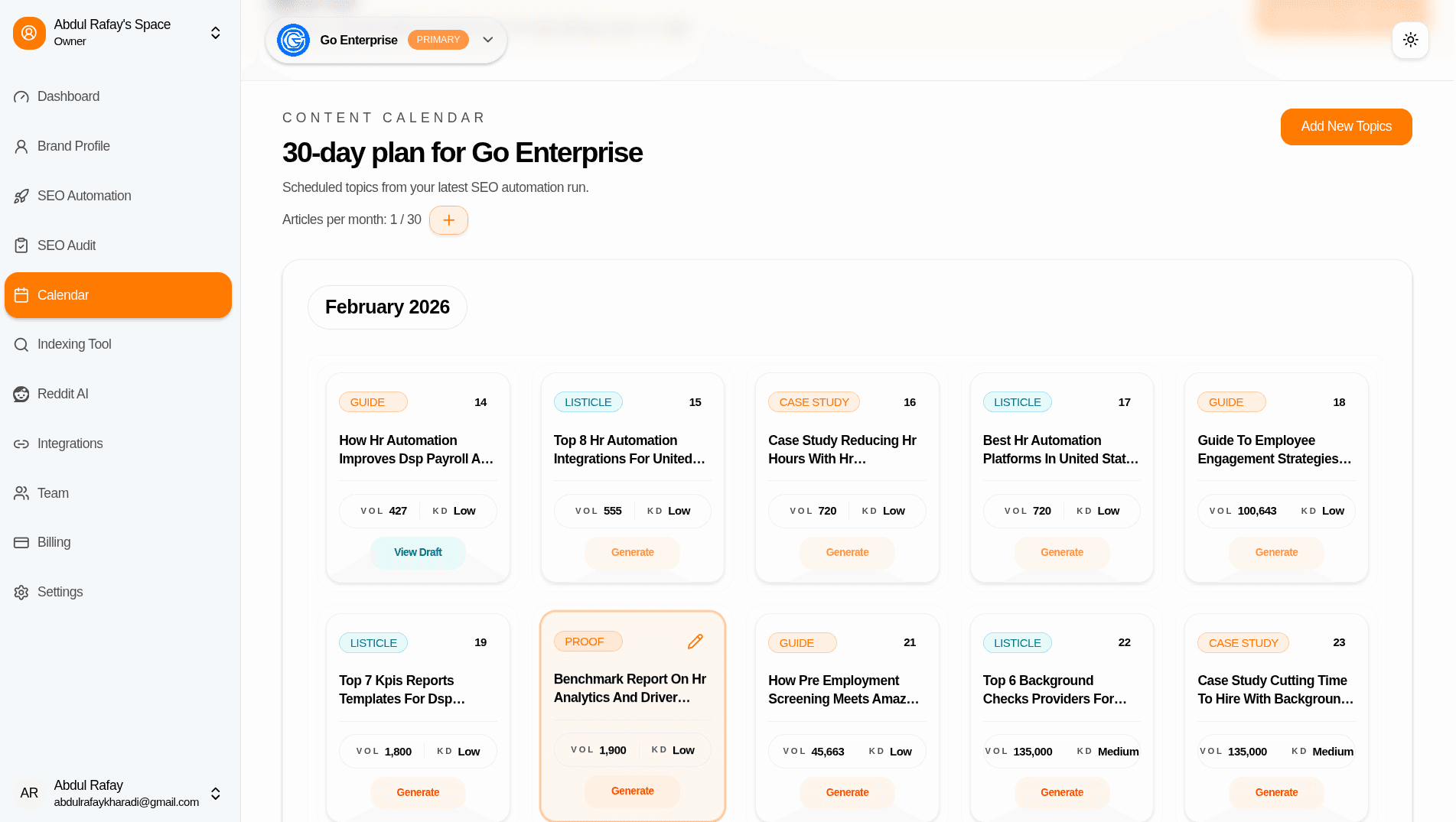
Instead of quarterly planning sessions that go stale in weeks, Keytomic maintains a continuously auto-replenishing 30-day content calendar. As articles publish, new ones fill the pipeline based on your keyword priorities. The calendar accounts for seasonal opportunities, content gap identification, and topic clustering to build topical authority over time.
This is the structural fix for teams that struggle with content consistency. The calendar never runs dry. It also sends weekly performance summaries showing what was published, what got indexed, and what's moving in rankings, no dashboard login required.
Read more: How to Auto-Schedule Publishing with a Content Calendar Template
E-E-A-T Optimized Content Generation
Every article Keytomic drafts includes the elements that Google's quality guidelines and AI citation engines specifically reward: direct answer paragraphs structured for AI Overview citation (40 to 60 words), FAQ sections with schema-ready formatting, statistics with source citations, comparison tables, entity optimization with proper brand mentions, and internal linking suggestions for topical authority.
The generation matches your brand voice. You specify tone, style, and industry context, and it applies consistently across your entire calendar. Teams report spending 2 to 3 hours reviewing each piece versus 18 hours creating from scratch. For a team publishing 12 articles per month, that's 180 hours saved on production alone.
Auto-Publishing Across CMS Platforms
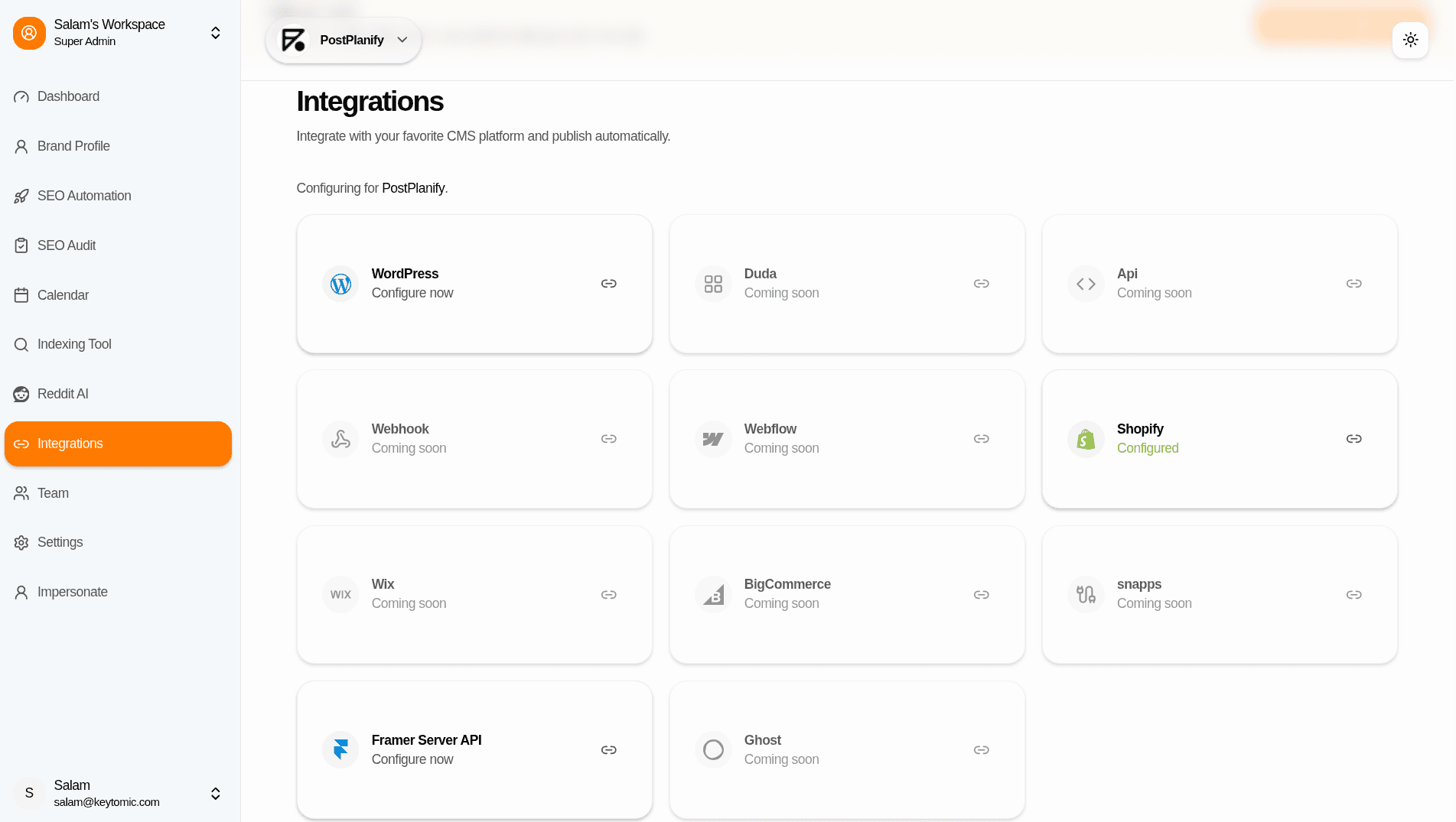
Once content is approved, Keytomic publishes directly to WordPress, Shopify, HubSpot, Framer, or Webflow without manual intervention. Image generation with proper alt text, post formatting, category assignment, scheduling, and metadata are all handled. No copy-pasting from Google Docs. No formatting fixes after uploading.
For teams managing multiple client sites, the multi-CMS support from a single dashboard is where time savings compound. Content goes where it needs to go, formatted correctly, without a human in the middle of every upload.
Auto-Indexing on Google and Bing
Publishing is not the same as being indexed. Anyone who has published a page and watched it sit undiscovered in Google for three weeks knows this gap. Keytomic submits every published page directly to Google Search Console and Bing Webmaster Tools immediately after publishing, cutting the typical indexing window by 70%. That means new content starts contributing to rankings in days, not weeks.
AI and LLM Visibility Tracking
This is the feature that has no real equivalent in either Ahrefs or Ubersuggest at the same price point.
Roughly 40% of searches now happen on AI engines: ChatGPT, Gemini, Perplexity, Claude, and Bing AI. If someone asks ChatGPT to recommend the best product in your category, you have no idea whether your brand is appearing in that answer unless you're actively tracking it. Ahrefs has a Brand Radar add-on for AI visibility. Ubersuggest has nothing. Keytomic includes AI visibility tracking across all major platforms as a core feature, not a premium add-on.
You can see which AI engines mention your brand, how often, in response to which query types, and how your visibility changes over time. As GEO (Generative Engine Optimization) becomes more central to organic growth strategy, this data becomes harder to ignore. For a closer look at how AI search reporting is evolving, this breakdown of the Bing AI Performance Report is worth reading.
Read more: How Keytomic Helps You Win at SEO and AI Visibility
Reddit AI Agent
Keytomic includes a Reddit monitoring and engagement tool that surfaces relevant threads where your product or service could naturally contribute value. It identifies high-intent discussions across relevant subreddits and gives you context to engage authentically, not spammily. For SaaS founders and B2B teams that know Reddit is a legitimate traffic and trust-building channel but don't have time to monitor it manually, this fills a real gap that neither Ahrefs nor Ubersuggest touches.
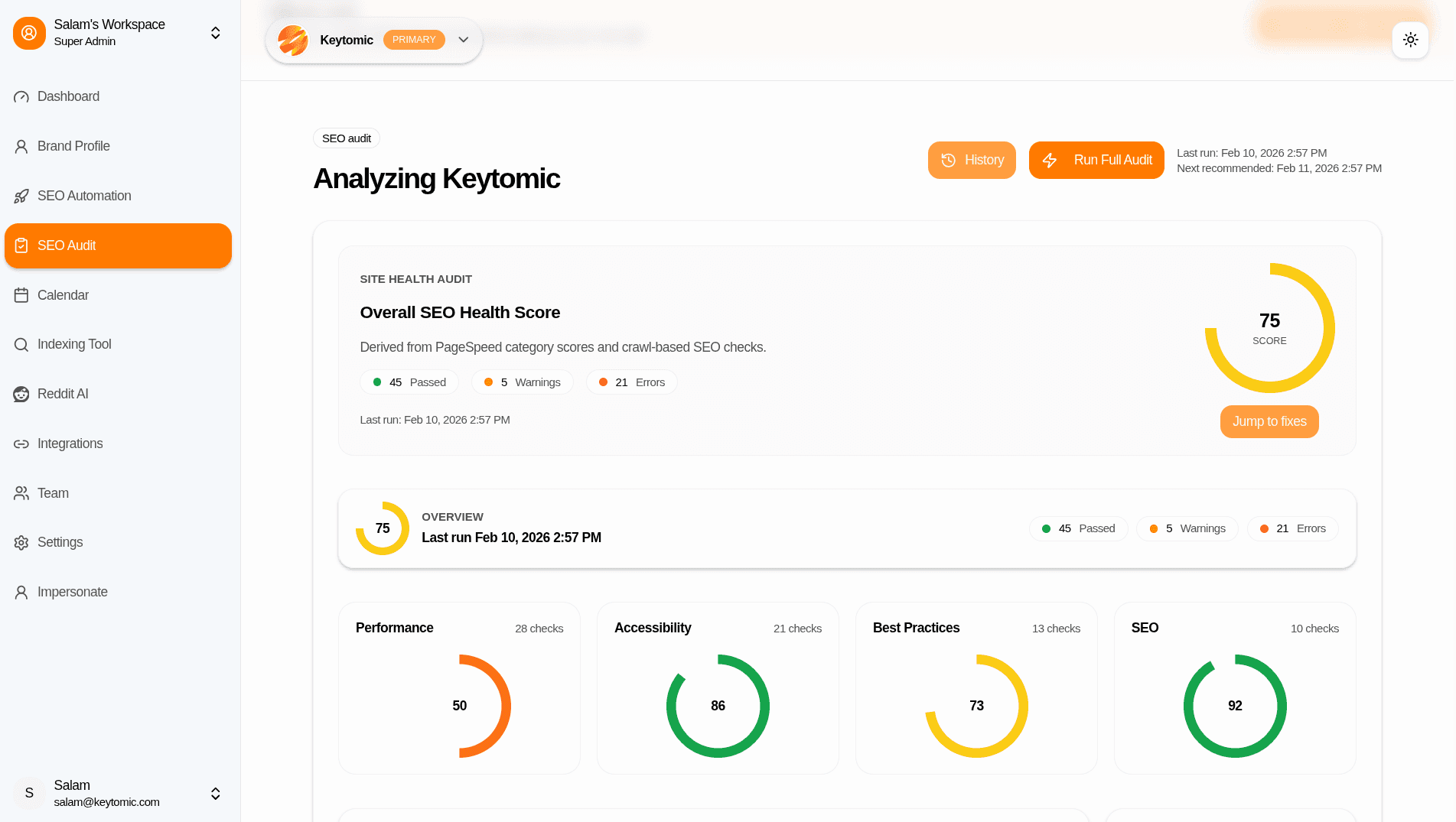
300+ Parameter SEO Audit
The built-in site audit covers over 300 technical and on-page SEO parameters: crawl health, internal linking structure, page speed, schema markup, metadata quality, duplicate content signals, canonical tags, Core Web Vitals, and parameters specific to AI search optimization. It's comprehensive enough to surface what both Ahrefs and Ubersuggest catch, plus additional checks that matter specifically for GEO performance.
Keytomic vs Ahrefs vs Ubersuggest: Side-by-Side
Function | Ahrefs | Ubersuggest | Keytomic |
|---|---|---|---|
Deep backlink analysis | Industry standard | Basic | Not the focus |
Keyword research | Excellent, data-heavy | Good, beginner-friendly | Sweet spot finder, execution-oriented |
Competitive gap analysis | Yes (dedicated toolkit) | Basic | Yes |
E-E-A-T content generation | No | Basic AI Writer | Full drafts with citations, FAQ, schema |
Auto-publishing to CMS | No | No | Yes (WordPress, Shopify, HubSpot, Framer, Webflow) |
Auto-indexing | No | No | Yes (Google + Bing) |
AI/LLM visibility tracking | Add-on (Brand Radar) | No | Yes (ChatGPT, Gemini, Perplexity, Claude) |
Reddit monitoring and engagement | No | No | Yes (Reddit AI Agent) |
30-day rolling content calendar | No | No | Yes, auto-replenishing |
Weekly performance summaries | No | No | Yes |
300+ parameter SEO audit | No | No | Yes |
Per-credit charges | Yes (Lite plan) | No | No |
Entry price | $129/month | $29/month | $99/month |
Agency plan | $1,499/month | $99/month | $999/month (unlimited capacity) |
What Keytomic Users Are Saying on Trustpilot
Keytomic holds a 4.0 rating on Trustpilot with all verified reviews at the time of writing. Here is what users have written directly.
Josh Bradford, Netherlands (verified, February 2026): "Keytomic has really helped us automate our content tasks. The AI tool is also great helping us find relevant Reddit threads. Currently we are on their basic package, but considering the tool's abilities we would be shifting to the custom package soon."
John David, United Kingdom (verified, December 2025): "Keytomic was a game changer for our content tasks. From content generation to publishing the content on our website everything is automated according to our schedule. The content scorecard, UI, usability, everything is just amazing."
Henry, United States (verified, December 2025): "We are using Keytomic since their Beta stages and we are absolutely loving it. It helped us automate our marketing strategy, from keyword research to content creation and suggestions. Everything is there. Pricing is also very affordable."
The pattern across all three reviews is consistent: teams aren't using Keytomic because of a feature list. They're using it because it closes the gap between having an SEO strategy and actually executing one without rebuilding the workflow every month.
Why SEO Teams Are Choosing Keytomic
The clearest signal from the market is that teams aren't choosing Keytomic over Ahrefs or Ubersuggest. They're choosing it instead of the 5 to 8 other tools that sit between research and published content.
The typical stack before Keytomic looks like this: a keyword research tool, a content optimization tool, an AI writing assistant, a CMS plugin for on-page SEO, a manual indexing process, and a separate rank tracker. Each of those tools does one thing. Together they cost $550 to $1,950/month in subscriptions and require 15 to 20 hours per week of team time to coordinate across. At an average loaded cost of $75/hour, that coordination overhead alone is $4,500 to $6,000/month in labor before anyone writes a word.
Keytomic at $99/month replaces that entire execution stack, which is why the $18,701 average monthly savings figure holds up when teams actually audit what they were spending before switching.
There's a second reason that's harder to quantify but shows up clearly in how rankings actually move: the SEO teams winning consistently in 2025 are not the ones with the best keyword data. They're the ones who ship the most high-quality, well-structured content into the most indexing opportunities. Keytomic's architecture is built around that reality. Ahrefs tells you what the opportunity is. Keytomic captures it.
Keytomic Pricing
Pro: $99/month (or $79/month annually). Full feature set with no tiers and no usage caps.
Agency: $999/month. Unlimited content capacity, multi-client management.
Both plans include every feature: keyword research, content calendar, E-E-A-T content generation, auto-publishing, auto-indexing, AI/LLM visibility tracking, Reddit AI agent, 300+ parameter SEO audit, and weekly performance summaries. No credits that run out mid-month. No features locked to higher plans.
14-day money-back guarantee on all plans.
When You Need More Than One Tool
Some teams run Ubersuggest for quick keyword discovery and site checks, then use Ahrefs for deep competitive work and link prospecting. For agencies managing a mix of small and enterprise clients, that combination makes economic sense: Ubersuggest Individual lifetime + Ahrefs Standard covers most research workflows for around $290 + $249/month.
A different combination that's becoming common: Ahrefs for research and competitive intelligence, Keytomic for execution. Ahrefs tells you what to target. Keytomic turns that into published, indexed content without the production bottleneck. The two tools don't overlap at all and together cover the full research-to-ranking cycle.
For teams that don't need Ahrefs-level backlink analysis, Keytomic's built-in keyword research handles content strategy well enough as a standalone, and the $99/month price versus $249/month makes that case straightforward.
Is Ubersuggest Better Than Ahrefs?
Depends entirely on what you're trying to do. The question is a bit like asking whether a Honda Civic is better than a pickup truck. For most things people actually do daily, the Civic is perfectly fine and costs a lot less to run. For hauling materials on a job site, the truck has no substitute.
Ubersuggest is better than Ahrefs if you need keyword ideas quickly, you're managing one or two sites, you're new to SEO, or you want to spend $29/month instead of $129/month. On G2, Ubersuggest's keyword research scores 8.9 versus Ahrefs' 8.7, which is a real data point worth taking seriously. For the use case of "I want to write content that ranks," Ubersuggest does the job.
Ahrefs is better than Ubersuggest the moment your work involves backlinks, serious competitive analysis, or large-scale SEO operations. The backlink index is not comparable. Ahrefs has 35 trillion links in a live-updating database. Ubersuggest has a lighter version of the same concept. For link building, competitor reverse-engineering, or running SEO campaigns across multiple client sites simultaneously, Ahrefs is the industry standard and Ubersuggest will frustrate you before long.
The short answer: Ubersuggest is better for beginners and budget-conscious users. Ahrefs is better for professionals who depend on data accuracy. Neither is objectively "better" without knowing what you're trying to accomplish.
Is Ahrefs Worth the Money?
At $129/month for the Lite plan and $249/month for Standard (where it becomes genuinely useful), Ahrefs is expensive. Whether it's worth it comes down to one question: are you making decisions with the data that justify the cost?
For a freelance SEO consultant billing $75/hour to clients, Ahrefs Standard at $249/month pays for itself in about 3.5 hours of work. If you're using the data daily for link prospecting, competitive research, and site audits, the ROI math is pretty clear.
For a solo blogger or a small business owner doing basic content marketing, it's harder to justify. The April 2024 price increases (Standard went up 39%) made this calculus worse, especially with the credit system on the Lite plan that can burn out mid-month during heavy use. A lot of users who used to be on Ahrefs Lite have migrated down to Ubersuggest or across to Semrush after that pricing change.
The honest take: Ahrefs is worth the money if SEO research is central to your revenue, specifically link building and competitive intelligence at any meaningful volume. It's not worth the money if you're using 20% of what it offers or if you're primarily looking for content ideas and a basic rank tracker. For that use case, you're overpaying.
If you want Ahrefs-level strategic insight but need execution capacity alongside it, the combination of Ahrefs Standard + Keytomic Pro still comes in under the cost of a mid-level agency retainer and covers both research and publishing end-to-end.
What Is the Most Effective SEO Tool?
There's no single answer because "effective" means different things depending on what your SEO workflow actually looks like. But we can break it down by what each category of tool does best.
For backlink analysis and competitive research, Ahrefs is the most widely respected tool among working SEO professionals. Its data depth and crawler quality are the industry benchmark.
For keyword research and content planning across all budget levels, Semrush edges Ahrefs slightly on volume and clustering features. Ubersuggest punches above its weight for the price.
For content execution at scale, which is where most teams actually lose ground, neither Ahrefs nor Ubersuggest helps. The most effective tool for actually converting keyword strategy into published, indexed, ranking content is Keytomic. It handles the entire workflow from keyword research to auto-publishing and auto-indexing, tracks AI visibility across ChatGPT, Gemini, and Perplexity, and replaces 5 to 8 separate tools at $99/month. Teams using it consistently report 200 to 300% organic traffic increases within 2 to 3 months on low-competition keyword targets.
The most effective SEO setup for a lean team in 2025 is probably: one solid research tool for competitive intelligence (Ahrefs or Semrush) plus Keytomic for execution. That covers the full cycle from data to ranked pages without a sprawling tool stack. Read more: How Keytomic Helps You Win at SEO and AI Visibility.
What Are the Best Ahrefs Alternatives?
Ahrefs is expensive and the 2024 price increases pushed a lot of users into the market for alternatives. Here are the honest options depending on why you're looking.
If you want comparable data at a lower price: Semrush is the most direct alternative. It starts at $139.95/month, covers keyword research, backlinks, site audits, and competitive analysis, and in several categories (PPC data, content tools) actually outperforms Ahrefs. It's not cheaper, but it offers more breadth for the price.
If you want basic SEO research without the budget: Ubersuggest at $29/month or $290 lifetime covers keyword research, site audits, rank tracking, and basic backlink data for users who don't need Ahrefs-level depth. The lifetime deal is genuinely hard to beat for small sites.
If you want execution alongside research: This is where the conversation shifts. Tools like Surfer SEO, Frase, and Clearscope sit between Ahrefs and a blank page, but they still leave publishing and indexing to you. This breakdown of Surfer SEO alternatives covers how the content execution landscape compares. Keytomic is different from every other Ahrefs alternative on this list because it handles the full workflow end-to-end: keyword research, 30-day rolling content calendar, E-E-A-T content generation, auto-publishing across WordPress/Shopify/HubSpot/Framer/Webflow, auto-indexing on Google and Bing, AI visibility tracking across ChatGPT, Gemini, and Perplexity, Reddit monitoring, and a 300+ parameter SEO audit. All for $99/month with no credits system and no features gated to higher tiers. If you're leaving Ahrefs because you want execution alongside research, Keytomic is the most complete answer.
If you need rank tracking and audits without the full suite: SE Ranking ($65/month) and Mangools ($29/month) offer solid rank tracking and keyword research for smaller budgets. Neither matches Ahrefs on backlinks but both are reasonable entry-level options.
The Bottom Line
The framing of "Ahrefs vs Ubersuggest" implies these tools are competing for the same user. They're not.
Ahrefs is a professional research platform for people who use SEO data as their primary input for high-stakes business decisions. The 2024 price increases made it more expensive and the credit system on lower tiers more frustrating. But the data quality, especially for backlinks and competitive analysis, remains the industry standard.
Ubersuggest is a legitimate SEO tool with an honest value proposition: solid keyword research, functional site audits, and rank tracking at a price that doesn't require a business case to justify. The lifetime deal is genuinely attractive. The data limitations are real and get more limiting as your SEO sophistication grows.
And if the bottleneck isn't research but production, you're missing a third category entirely. That's where Keytomic fits.
FAQ
Is Ubersuggest accurate enough for real SEO work?
For keyword discovery, content ideation, and basic site audits on small sites, yes. For competitive backlink analysis, keyword difficulty on contested commercial terms, or making high-stakes SEO decisions, the data quality gap with Ahrefs becomes significant. Cross-referencing Ubersuggest keyword data against Google Search Console is a good habit to develop.
Does Ahrefs have a free trial?
No. Ahrefs does not offer a free trial on any of its core plans. The Starter plan at $29/month is the closest entry point, but it's severely limited at 100 credits per month. If you're a website owner, Ahrefs Webmaster Tools gives free limited access to Site Explorer and Site Audit for your own domain only.
Is Ubersuggest's lifetime deal actually worth it?
For someone who needs basic SEO research for one to three sites over multiple years, yes. At $290 for the Individual lifetime plan, it pays for itself versus monthly plans in under 10 months. The caveat: the terms of service define "lifetime" as "for as long as npdigital.com/ubersuggest exists, at the discretion of NP Digital." Worth reading before committing.
Does Ubersuggest have a free version?
Yes. Ubersuggest offers 3 searches per day on its free version. A 7-day free trial on paid plans is also available.
Why did Ahrefs prices increase so much in 2024?
Ahrefs raised prices across all plans in April 2024, with the Standard plan increasing 39% to $249/month. It also introduced a new Starter plan at $29/month and tightened credit limits on the Lite plan. Users on legacy pricing had subscriptions moved to current pricing on renewal, which generated significant negative feedback on review platforms.
Can I use Ubersuggest for an SEO agency?
The Enterprise/Agency plan at $99/month (or $990 lifetime) gives you 15 projects and 5 user seats, functional for small agencies with a handful of clients needing basic research and reporting. For agencies doing serious link building, competitive analysis, or managing large-scale technical SEO, Ubersuggest's data depth will become limiting. Most agencies at that scale use Ahrefs or Semrush as their primary research tool.
Which is better for keyword research, Ahrefs or Ubersuggest?
Ahrefs is more accurate and covers more ground, especially for competitive terms and international markets. Ubersuggest is faster to use, better for quick ideation, and has received similar or slightly higher user satisfaction scores on G2 for keyword research specifically. The right answer depends on whether you need precision or speed, and whether you're making significant business decisions based on the data.
What does Keytomic do differently from Ahrefs and Ubersuggest?
Ahrefs and Ubersuggest are both research tools. They help you understand what to rank for. Keytomic handles execution: E-E-A-T content generation, auto-publishing to your CMS, auto-indexing on Google and Bing, and AI visibility tracking across ChatGPT, Gemini, Perplexity, and Claude. It also includes a Reddit AI agent, a 30-day rolling content calendar, and a 300+ parameter SEO audit. It's not a replacement for Ahrefs if your work centers on deep backlink analysis. It's the tool that picks up where both Ahrefs and Ubersuggest stop: actually getting content live, indexed, and visible in AI search at scale. The Pro plan starts at $99/month with a 14-day money-back guarantee.
What do SEO professionals say about Ubersuggest vs Ahrefs on Reddit?
The general Reddit consensus: Ubersuggest is recommended for beginners and budget-conscious users who need SEO fundamentals. Ahrefs is the near-universal recommendation when professionals ask what tool to use for link building and competitive analysis. Many experienced SEOs say they started with Ubersuggest and graduated to Ahrefs as their needs grew.
Should I use both tools together?
For some workflows, yes. Ubersuggest Individual lifetime ($290 one-time) for quick keyword discovery, paired with Ahrefs Standard ($249/month) for backlink research and competitive analysis, gives you broad coverage. A third option that's gaining traction: pair Ahrefs for research with Keytomic for execution, which together cover the full research-to-ranking cycle at a lower combined cost than building a separate 5 to 8 tool execution stack.
Which SEO tool offers better keyword research features?
Ahrefs wins on data depth: 7B+ keywords, click-through data, and backlink-model keyword difficulty. But Ubersuggest actually scored 8.9/10 on G2 for keyword research vs. Ahrefs' 8.7, so it's closer than most reviews admit. Either way, both tools stop at research. Keytomic takes keyword research and connects it directly to content generation, publishing, and indexing in one workflow.
Learn more: How Keytomic Helps You Win at SEO.
Which advanced SEO suite offers the best value for money?
For pure research, Semrush Standard at $199/month offers the most breadth. Ahrefs Standard at $249/month wins on backlink data quality specifically. But if value means output per dollar, Keytomic Pro at $99/month replaces 5 to 8 tools and actually executes the work that Ahrefs and Semrush leave to you. Teams report average savings of $18,701/month after switching.
What are the pricing differences between popular SEO analytics platforms?
Ubersuggest is the cheapest at $29/month (or $290 lifetime). Ahrefs starts at $129/month for a usable plan, $249/month for the full version. Semrush starts at $139.95/month. Moz Pro at $99/month. SE Ranking at $65/month. Keytomic Pro at $99/month covers execution (content generation, publishing, indexing, AI visibility tracking) that none of the research tools include.
Compare top keyword research tools for agencies.
Ahrefs Standard ($249/month, 20 projects, unlimited credits) is the go-to for competitive and backlink work. Semrush Business ($449/month) adds PPC data and reporting. Ubersuggest Agency ($99/month) works for smaller clients who don't need deep backlink research. For agencies that also need to deliver content at scale, Keytomic Agency at $999/month adds unlimited content automation, multi-CMS publishing, and AI visibility tracking across all client sites.
How do backlink analysis capabilities compare in top SEO software?
Ahrefs leads with a live index of 35T+ links updating every ~15 minutes, including Link Intersect, anchor text breakdowns, and link growth history. Semrush is a strong second. Ubersuggest covers the basics (referring domains, totals, trends) and is fine for high-level checks but won't support a real link building operation.
What's a good alternative to the leading backlink checker?
If Ahrefs pricing is the issue, Semrush is the most comparable alternative. For lower budgets, SE Ranking or Mangools cover the basics. If the real problem is getting content to rank rather than just analyzing links, Keytomic is worth looking at: it handles content generation, auto-publishing, and auto-indexing at $99/month.
Also worth reading: Top Surfer SEO Alternatives for Agencies.
Where can I find user reviews comparing two leading SEO suites?
G2 and Capterra have solid coverage for both tools: Ahrefs on G2, Ubersuggest on G2, and Ubersuggest on Capterra. Trustpilot tells a different story, especially for Ahrefs (2.0/5, mostly billing complaints). For Keytomic reviews: trustpilot.com/review/keytomic.com.
Which platform is more suitable for small business SEO management?
Ubersuggest for research and basic management: it's accessible, affordable, and doesn't require SEO expertise. The $290 lifetime plan is genuinely good value. Keytomic is the better fit if you also need content to actually get published and indexed consistently, since it automates the execution steps that most small business owners run out of time for.
Is the free version of a popular SEO tool sufficient for basic analysis?
Ubersuggest's free tier (3 searches/day) is useful for occasional keyword checks, nothing more. Ahrefs Webmaster Tools is free for site owners and covers basic technical audits and backlink data for your own domain. Neither is sufficient for ongoing keyword research or competitive tracking. If budget is tight, Ubersuggest's $29/month plan is the most practical entry point in the category.