This Search Atlas review finds a broad SEO platform that includes OTTO SEO for on-page and technical execution, plus content workflows, CMS publishing, and AI visibility tracking. It fits teams that want many SEO jobs under one subscription. Verify credits, project limits, deployment method, and approval controls first, because production changes still need human review.
If you're comparing Search Atlas, OTTO SEO, and a few Ahrefs alternatives, your workflow is probably split across research, content, audits, publishing, and reporting tools. That gets tedious fast. This Search Atlas review is meant to help you decide whether one platform can end the juggling.
The real question isn't whether the feature list is long. It's whether the credits, project limits, and live-site deployment model fit your risk tolerance and your approval process.
Here's the plan: a verdict, features, OTTO's deployment model, a pricing check, pros and cons, and a comparison with Keytomic. Keytomic publishes this comparison and is included as a potential alternative for teams evaluating approval-based SEO automation. I'll close with ideal users, alternatives criteria, and FAQs.
Search Atlas Review: Quick Verdict
Search Atlas deserves a serious look from teams that want research, content, publishing, and implementation in one place. OTTO SEO is the piece that applies fixes instead of only listing them. The catch is that credits, project limits, and deployment controls vary by plan, so the cheapest tier isn't always the right test.
Buyer type | Likely fit | Reason | Verify first |
|---|---|---|---|
One brand, small team | Conditional | Starter lists one project | Will you use research, content, and OTTO together? |
Agency with several clients | Stronger on Pro or Agency | White-label reporting starts on Pro, client portals on Agency | Do project counts cover your roster? |
Team wanting live-site automation | Good fit if governed | OTTO deploys documented fixes | Approval, rollback, and crawler visibility |
Team needing strict CMS approval | Conditional | Pixel or edge deployment sits outside your CMS | Who signs off on live changes? |
Who Search Atlas is best suited to
It suits agencies, multi-site operators, and in-house teams that value platform breadth. Is it worth it for one website? It can be, if you'll use research, content, and OTTO together; if you only need rank tracking, it's more platform than the job requires.
Where OTTO SEO adds practical value
OTTO's value is execution. Search Atlas says it deploys SEO fixes to a live site through the OTTO Pixel or Cloudflare, which can cut developer tickets for technical and on-page changes.
The main limitation buyers should investigate
The main limitation to investigate is governance. Deployed changes live outside your CMS, so you need to know who approves them, how they're rolled back, and which crawlers actually see them.
What Search Atlas and OTTO SEO Actually Are
The product names blur together, so here are plain definitions.
Search Atlas as the broader SEO platform
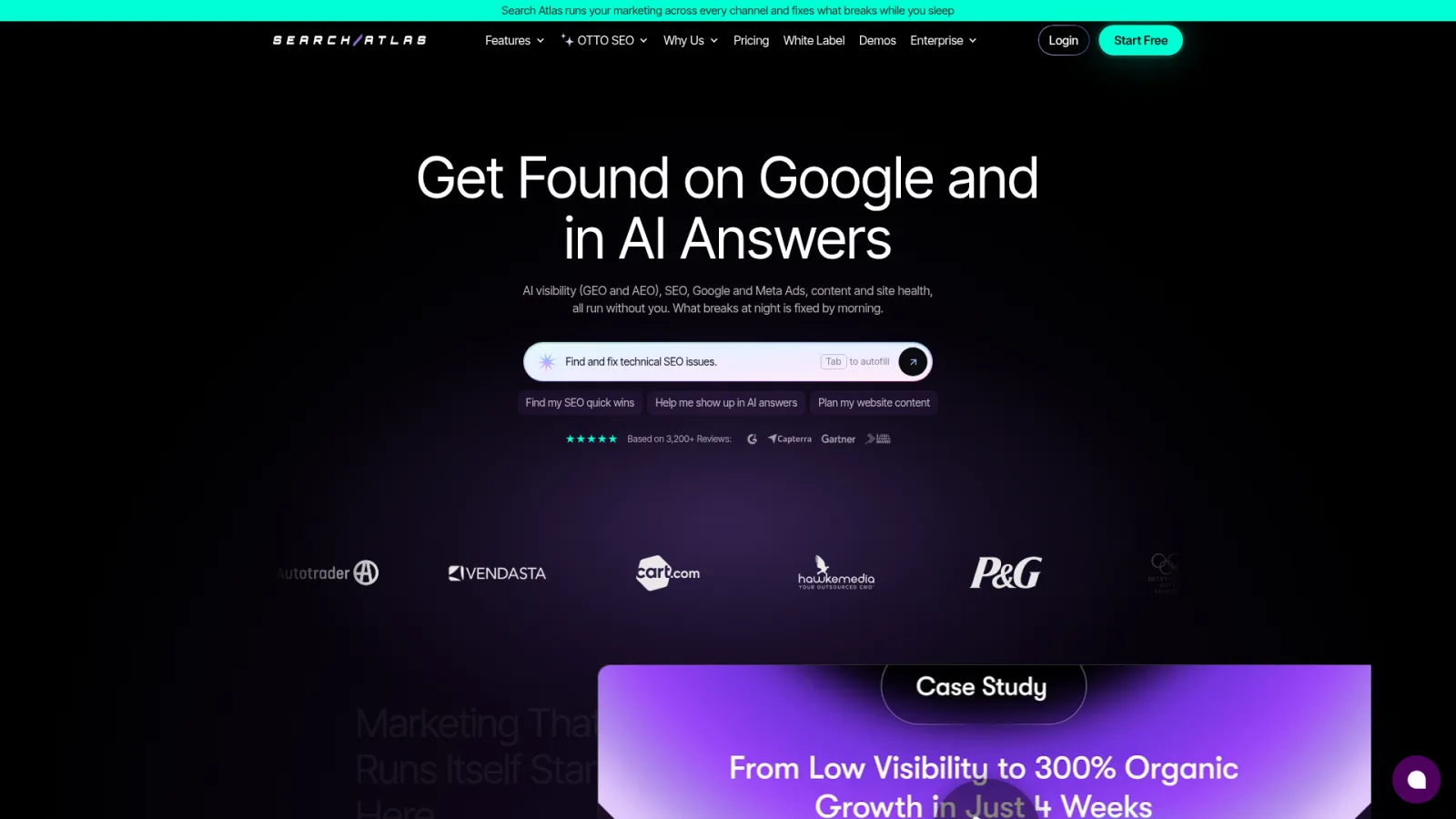
Search Atlas is the umbrella platform. Its pricing page lists OTTO, Content Genius, CMS
publishing, AI Visibility on higher tiers, white-label reporting on Pro, and client portals on Agency.
OTTO SEO as the implementation and content automation layer
OTTO SEO is the automation layer inside Search Atlas. Per Search Atlas, it connects to your site, recommends fixes and content, and pushes approved work live. Think of it as the hands, while the rest of the platform is research and reporting.
OTTO and LLM Visibility are separate functions
OTTO changes pages. Search Atlas's LLM Visibility documentation describes a separate module that measures how your brand appears in AI answers, with its own projects and quotas.
Tracking isn't implementation, and it doesn't guarantee citations. The help center also describes monthly data updates, so don't treat it as real-time.
How We Evaluated Search Atlas and OTTO SEO
Evidence and methodology
This Search Atlas review rests on documentation and publicly posted user reports, not a lab test:
Search Atlas pricing and help pages, plus Keytomic's first-party product information, were checked in October 2026.
I looked at workflow breadth, deployment model, governance, plan structure, AI visibility, content operations, CMS publishing, and agency fit.
I also read recent third-party reviews on G2, Capterra, Trustpilot, and a relevant WordPress.org support thread, cited where used below.
No universal score is published, because I don't have a reproducible scoring method.
What this review does not claim
No hands-on test, production deployment, client case study, or benchmark sits behind this article. It reflects my professional judgment as a product and growth lead, applied to published information and publicly posted user reports. Treat anything plan-dependent as something to confirm.
What does Search Atlas include beyond OTTO SEO?
A fair Search Atlas review has to separate five jobs: research, creation, implementation, measurement, and agency operations. More jobs means more plan gating.
Keyword research, rank tracking, and site auditing
Search Atlas covers keyword research, rank tracking, and site auditing, with tracked keywords and audit pages varying by plan. Those limits matter more than the feature names. If you rely on content gap analysis or keyword gap analysis, confirm the exact workflow during a trial.
How the research tools compare to Ahrefs and Semrush
Search Atlas publishes its own research metrics alongside the usual keyword and rank data: Domain Power, an authority score built from Google Search Console traffic and ranking data rather than a link-count proxy, and Topical Dominance, a 0–100 score for how completely a site covers a topic. Specialist tools like Ahrefs and Semrush generally carry deeper, longer-running backlink and keyword indexes, since research is their whole product rather than one module among several. If backlink-index depth or historical keyword data is the deciding factor, test it against your current tool before switching; if the deciding factor is doing research, content, and publishing without exporting between tools, that's where Search Atlas's breadth is the point.
Content workflows and CMS publishing
Content Genius handles AI-assisted drafting, and the pricing page lists CMS publishing. Because credits are shared, article volume competes with audits and other tasks.
AI use isn't the risk by itself. Google's guidance on generative AI content points to low-value, scaled pages as the problem, so editorial review still matters.
AI visibility, local SEO, reporting, and agency features
AI visibility sits on higher tiers, so check whether your plan includes it and which platforms, such as ChatGPT, Gemini, and Perplexity, are covered. White-label reporting starts on Pro and client portals on Agency.
This review did not verify the depth of local SEO or Google Business Profile tooling. Confirm that before buying for multi-location clients.
What does OTTO SEO change on a live website?
This is the OTTO SEO review question that matters most, because the word 'automatic' hides how fixes actually reach a page.
Deployment methods and live-site states
According to Search Atlas's OTTO deployment documentation, OTTO deploys fixes through the OTTO Pixel or a Cloudflare integration. The pixel is client-side JavaScript seen by JavaScript-rendering bots like Googlebot. Cloudflare modifies HTML at the edge, so all crawlers see it.
The same help article notes that AI crawlers and non-JavaScript bots only see edge-rendered content, not JavaScript-injected fixes. That matters if AI visibility is your goal. Google's documentation on JavaScript-generated structured data explains why rendered output needs testing.
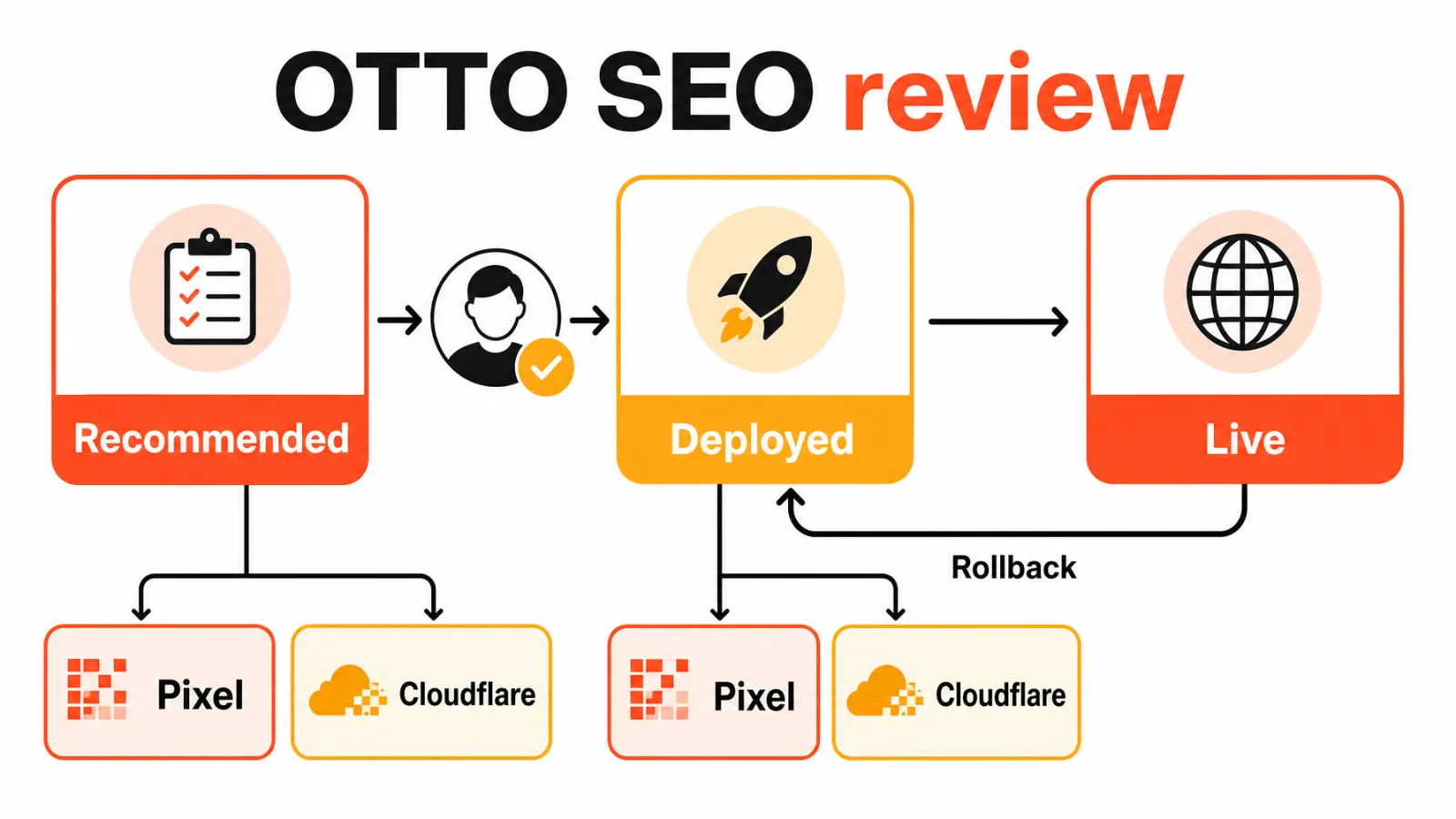
Fixes move from recommended to deployed to live. I wouldn't treat 'deployed' as 'verified live' until you've checked the rendered page.
Approval, auto-deployment, and human review
Search Atlas's OTTO page describes approving or editing optimizations individually, bulk actions, custom instructions, and rollback. Approval and manual deployment controls may differ by account, so confirm yours before connecting a production site.
I'd keep a human on net-new pages, high-traffic URLs, and structural changes like canonicals and redirects.
Rollback, caching, and CMS conflict considerations
Rollback is documented, but Search Atlas's OTTO troubleshooting guide also covers cache plugins blocking deployments and conflicts with manual backend edits. It notes that OTTO can roll back meta data after a project sync, audit refresh, or conflicting rule.
Before connecting a live site, confirm:
CMS compatibility and deployment method
Approval settings
Cache behavior
Rollback process
Schema conflicts
Who owns final sign-off
After launch, watch Google Search Console performance metrics for impressions, clicks, CTR, and position on changed pages.
What recent reviews say about OTTO's live-site changes
Independent complaints give the governance question above a concrete shape. A WordPress.org support thread titled "Huge Rip Off" (April 2026) describes Google Search Console reporting schema errors after OTTO's plugin added markup site-wide, with the poster saying the changes "don't actually exist" on the real site — visible to Google, not to a person checking the page.
On Trustpilot, a 1-star review from Drew Rigler (September 2026) says the company "take[s] zero accountability for the technical damage their platform inflicts," describing software problems that broke a client site. Other recent reviews on the same page describe difficulty stopping billing after deciding to cancel.
Treat these as self-reported, unverified complaints rather than an average experience — G2 (4.6/5) and Capterra (4.7/5) run well above Trustpilot here. But they describe the exact failure mode the deployment section above warns about: a fix that looks live in the dashboard but reads differently to a crawler than to a person, with no CMS record of the change.
That's the specific risk an approval-based, CMS-native workflow is designed to prevent — not because any platform is bug-free, but because a change that goes through your own CMS leaves a normal edit history, and nothing publishes until a person approves it there. That's Keytomic's design choice, not a guarantee against every failure mode; verify it holds up on your own site before relying on it.
Search Atlas pricing and plan considerations
Search Atlas pricing and feature availability were checked in October 2026. Plans, credits, limits, and integrations may change, so confirm the current terms before subscribing.
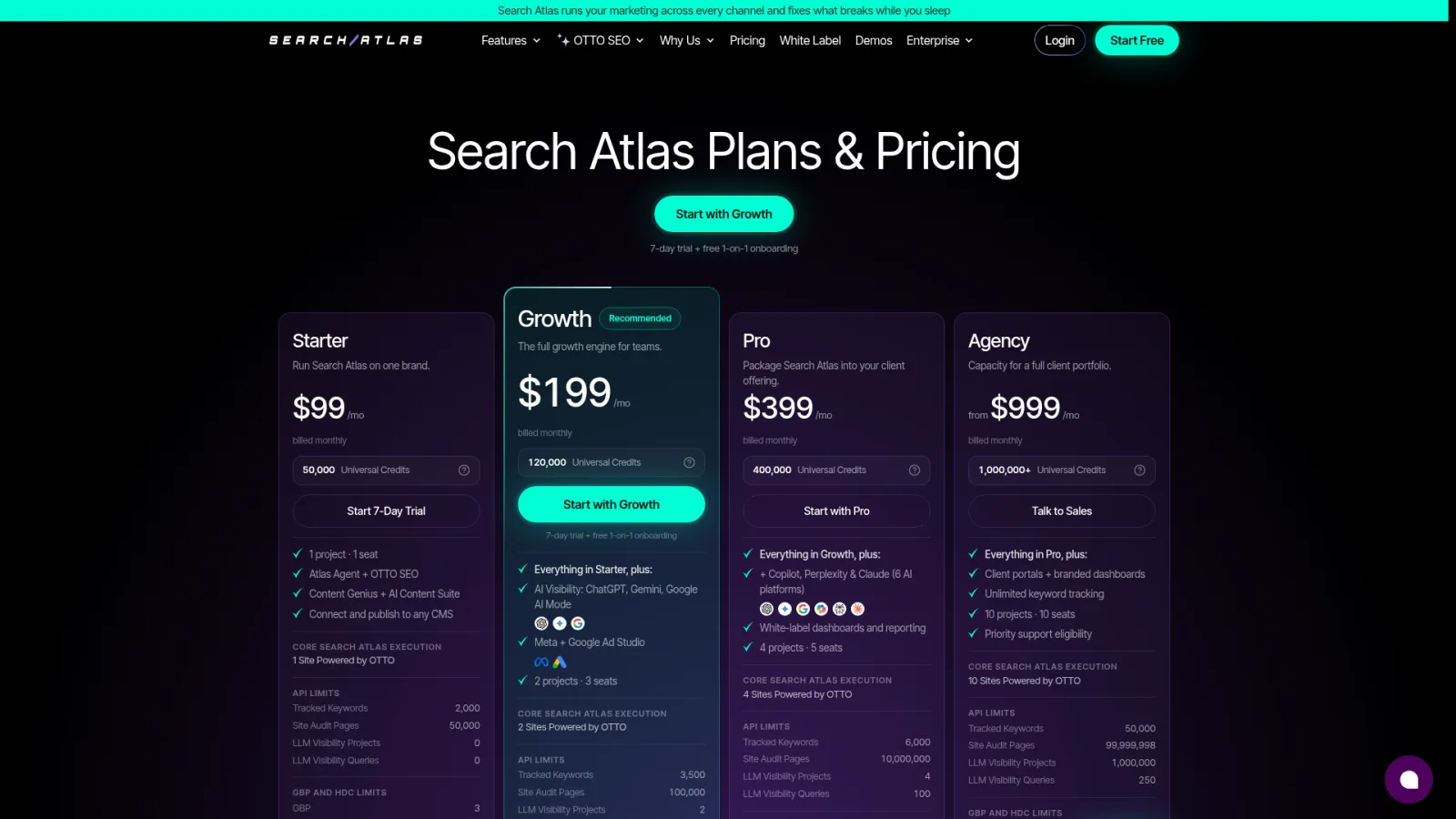
Published monthly plan structure
Search Atlas's current pricing and plan limits list four plans at the time checked:
Starter: $99 per month, 1 project, 1 seat, 50,000 Universal Credits
Growth: $199 per month, 2 projects, 3 seats, 120,000 credits, AI visibility
Pro: $399 per month, 4 projects, 5 seats, 400,000 credits, white-label reporting
Agency: from $999 per month, 10+ projects, 10 seats, 1,000,000+ credits, client portals
Annual billing is offered at a lower effective monthly rate, so confirm the current discount.
Credits, sites, projects, and AI visibility limits
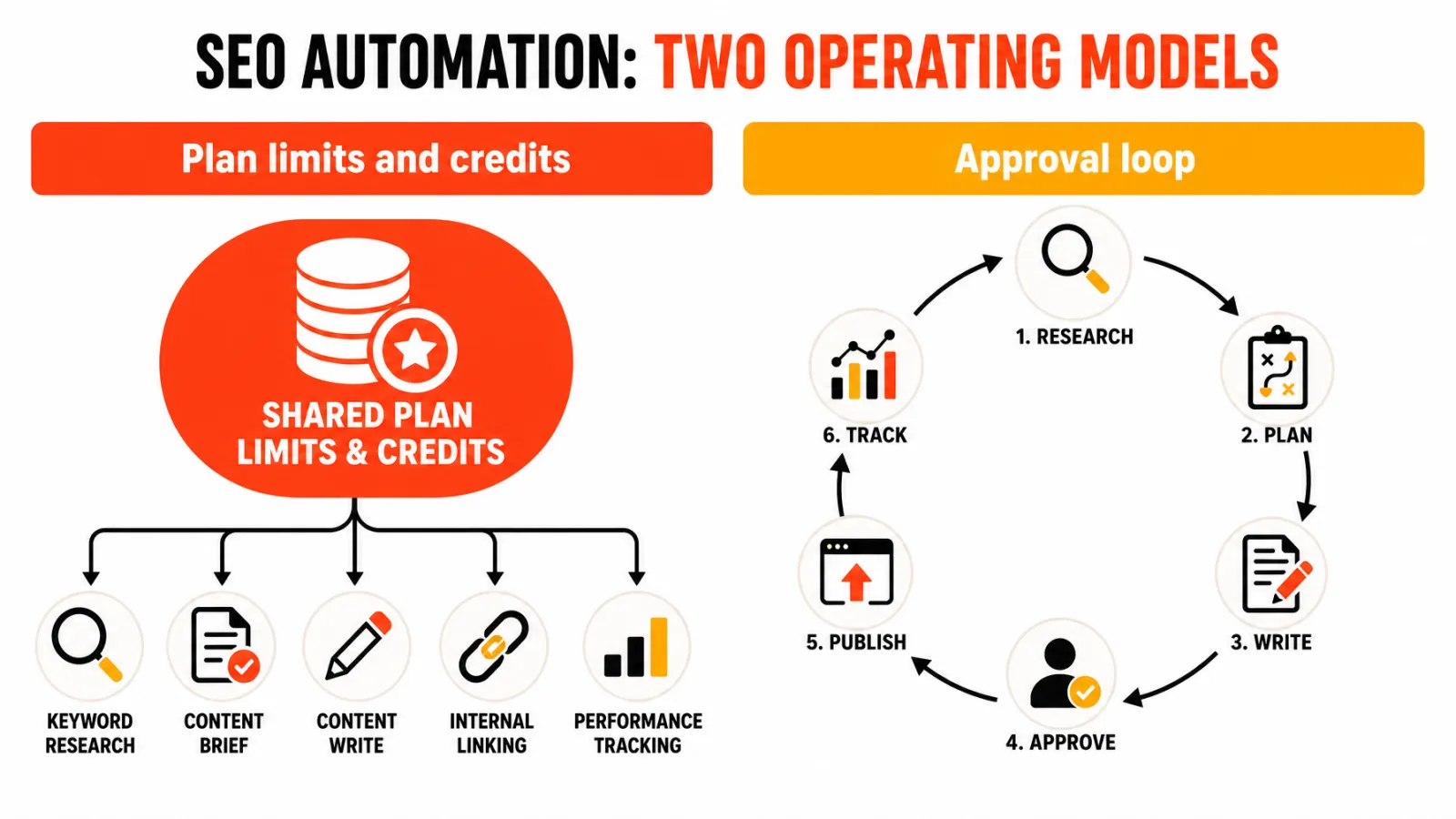
Universal Credits work as one shared pool. Audits, articles, rank checks, publishing, and AI visibility all draw on the same capacity.
I wouldn't calculate per-action costs without a stable official method. Ask onboarding to run representative tasks and record what each one consumes. Remember that OTTO projects and LLM Visibility projects are separate, so one site can need both.
Questions to ask before subscribing
How many OTTO sites does my plan include, and what do extra sites cost?
Which AI platforms are covered, and how often does the data update?
Which tasks consume credits, and what happens at the limit?
Do I need white-label reporting or client portals?
What approval controls does my account have?
Search Atlas pros and cons
A balanced Search Atlas review treats these as fit considerations drawn from documentation and user reports, not defects.
What third-party ratings say
Independent review platforms show a wide spread. Search Atlas sits at 4.6/5 on G2 (164 reviews) and around 4.7/5 on Capterra (88 reviews), but closer to 3.3/5 on Trustpilot — a gap worth noticing rather than averaging away. G2 and Capterra lean toward paying customers who completed onboarding; Trustpilot carries more of the billing, cancellation, and technical-damage complaints referenced above. Read a handful of recent reviews on each platform yourself before trusting any single number.
Potential strengths
Broad coverage across research, content, publishing, OTTO, and AI visibility
OTTO applies fixes instead of only reporting them
Agency features, with white-label reporting on Pro and client portals on Agency
Documented rollback and deployment controls
Strong G2 and Capterra ratings among completed-onboarding customers
Potential tradeoffs
Shared credits require capacity planning
Plan gating affects AI visibility and white-label reporting
Pixel or edge deployment sits outside your CMS
Breadth adds a learning curve for small teams
A cluster of recent Trustpilot reviews cite billing, cancellation, and live-site technical issues
Who should be cautious
Be careful if you need a narrow tool, CMS-only approvals, or predictable per-task costs. Teams with strict governance should test deployment on one low-risk site first, and should read the Trustpilot and WordPress.org reports above before connecting a production site.
Search Atlas vs Keytomic: Which workflow fits your team?
Keytomic publishes this comparison, so weigh it accordingly. In this Search Atlas review I'm comparing operating models, not feature counts. Search Atlas details come from its pricing and documentation, Keytomic details from its published positioning, and I flag what I couldn't verify. See Keytomic's full Search Atlas vs. Keytomic comparison for a deeper side-by-side on pricing and workflow.
Evaluation area | Search Atlas and OTTO SEO | Keytomic | Buyer question |
|---|---|---|---|
Keyword research | Included, limits vary by plan | Part of the workflow | Which limits apply? |
Topical planning | Not verified in this review | Topical mapping | Does it map topics to pages? |
Content creation | Content Genius, shared credits | AI-assisted, with approval | What needs review? |
Technical SEO | Site auditing plus OTTO deployment | Technical SEO audits | Audited or deployed? |
CMS publishing | Listed on pricing page | CMS publishing | Which CMSs are supported? |
Backlinks | Scope not verified | Backlink opportunities | Discovery or execution? |
AI visibility | LLM Visibility, higher tiers, monthly updates | Google and AI answer engine monitoring | What cadence and coverage? |
Governance | Approval and rollback, confirm per account | Approval-based workflow | What goes live unreviewed? |
Research, topical planning, and content production
Search Atlas ties content to a shared credit pool and plan limits. Keytomic positions research, topical mapping, and AI-assisted drafting as one connected workflow with approval before publishing. Both still need editorial review for facts and brand voice.
Technical audits, CMS publishing, and backlink opportunities
Search Atlas can deploy fixes live through OTTO. Keytomic runs technical SEO audits, CMS publishing, and backlink discovery inside one approval-based system. Search Atlas fits if live-site execution is the point; Keytomic fits if changes should pass your review first.
AI search visibility and approval controls
Both cover AI visibility. Search Atlas does it through LLM Visibility on higher tiers, and Keytomic through visibility monitoring across Google and AI answer engines. Compare cadence and platform coverage directly, and check Keytomic pricing against the Search Atlas plans above.
Here's Keytomic's limitation: an approval-based workflow is slower by design than automatic edge deployment. Confirm its current CMS connections, plan limits, and content allowances too.
Which teams should choose Search Atlas or OTTO SEO?
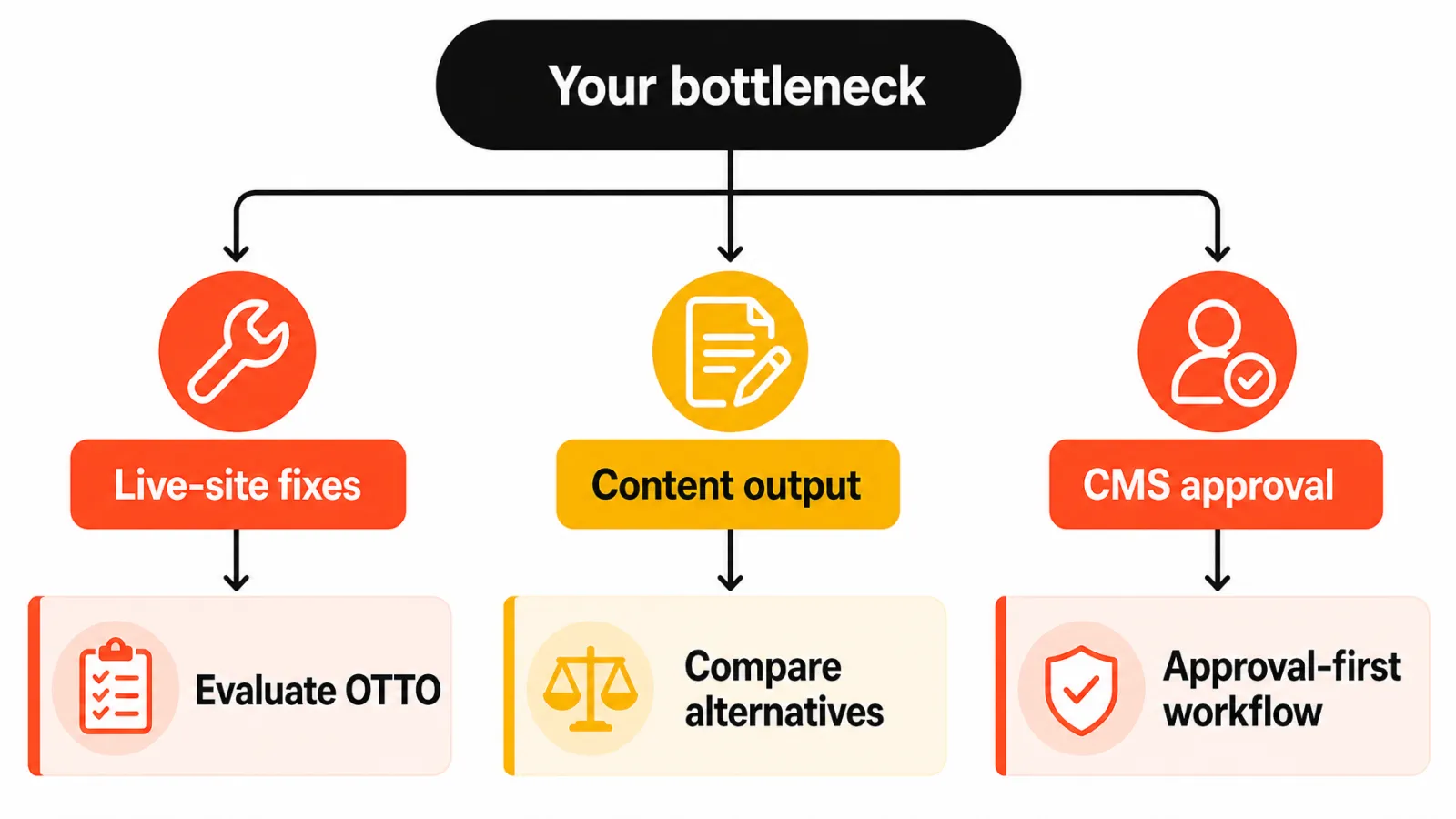
Use this as a decision tree, not a verdict. The right answer depends on how many sites you run and how much live-site risk you'll accept.
Choose Search Atlas when platform breadth is the priority
Agencies: Pro starts white-label reporting and Agency adds client portals. See Keytomic for agencies or compare SEO automation software for agencies for multi-client workflows.
Founders and small teams: Starter works if one project covers you.
Ecommerce brands: Verify deployment on product and collection templates.
Local businesses: Confirm Google Business Profile depth first.
Enterprise teams: Check sign-off and governance requirements.
Choose it when you need documented live-site automation
If developer tickets are your bottleneck and you accept pixel or edge deployment, OTTO is the reason to buy. Pick the Cloudflare route if AI crawler visibility matters.
Reconsider when you need a narrower approval-first workflow
Reconsider Search Atlas if any of these describe your team:
Your bottleneck is content production, not live-site implementation.
Every page change must stay inside your own CMS review before it goes live.
Shared credits across research, content, and deployment make cost forecasting painful.
The live-review reports above make you want a smaller blast radius while you evaluate.
When should you consider a Search Atlas alternative?
Search Atlas alternatives aren't automatically better. The right category depends on your bottleneck, and how to choose SEO automation software covers automation scope and human review in more detail.
Your main bottleneck is content production rather than implementation
Choose a different category when briefs, drafting, and publishing queues matter more than live-site fixes.
You need simpler pricing or a narrower workflow
Choose a different category when plan tiers and shared credits add more forecasting work than you want.
You need to keep more changes inside your CMS approval process
Choose a different category when editors must approve every page change before it reaches production.
Frequently Asked Questions About Search Atlas and OTTO SEO
What is Search Atlas?
Search Atlas is a broad SEO platform covering keyword research, content, publishing, site auditing, and AI visibility, with OTTO SEO as its automation layer. Plan limits vary.
What is OTTO SEO?
OTTO SEO is Search Atlas's automation layer. It recommends and deploys technical, on-page, and content fixes to a connected site through the OTTO Pixel or Cloudflare.
Is OTTO SEO part of Search Atlas?
Yes. OTTO SEO is a feature set inside Search Atlas, with its own site project limits by plan. LLM Visibility is a separate module with separate quotas.
How much does Search Atlas cost?
Published plans start at $99 per month for Starter, $199 for Growth, $399 for Pro, and from $999 for Agency. Confirm current terms before subscribing.
Does Search Atlas include AI visibility tracking?
Yes, on higher tiers. LLM Visibility measures brand mentions in AI answers, with monthly data updates. Confirm your plan's platform coverage; tracking doesn't guarantee citations.
Can OTTO SEO make changes automatically?
OTTO SEO can deploy fixes to a live site, and Search Atlas documents approval and manual deployment controls. Confirm which controls your account has before connecting production.
Can OTTO SEO changes be rolled back?
Yes. Search Atlas documents rollback for OTTO deployments, but cache plugins, manual CMS edits, and syncs can cause conflicts, so validate rollback on one site first.
What do independent reviews say about Search Atlas?
G2 (4.6/5) and Capterra (4.7/5) run high among customers who completed onboarding. Trustpilot runs lower, around 3.3/5, with recent reviews describing billing and cancellation friction and, in at least one case, live-site schema errors after an OTTO deployment. Read recent reviews on each platform before deciding.
Is Search Atlas suitable for agencies?
Often, on Pro or Agency. White-label reporting starts on Pro and client portals on Agency, but check project and seat limits against your client roster.
Is Search Atlas worth it for one website?
It can be, if you'll use research, content, and OTTO together. For rank tracking alone, Starter's single project and shared credits may be more platform than needed.
Is Keytomic a Search Atlas alternative?
Yes, for teams wanting approval-based SEO automation across research, planning, content, publishing, audits, and visibility tracking. Keytomic publishes this comparison, so verify details independently.
How to make the final decision
Pick the platform whose operating model matches your governance needs, not the one with the longest feature list.
Match the platform to the bottleneck
Name what's slowing you down: research depth, implementation, content production, publishing, AI visibility, reporting, or multi-client operations.
Validate the highest-risk workflow first
For OTTO, test deployment, approval, cache behavior, schema, and rollback on one site. For Keytomic, verify current CMS connections, plan limits, and content allowances.
Start with one site and a defined review process
Decide who approves changes and how you'll measure them in Google Search Console. After this Search Atlas review, a fair next step is to read Keytomic pricing and compare its workflow with your own.