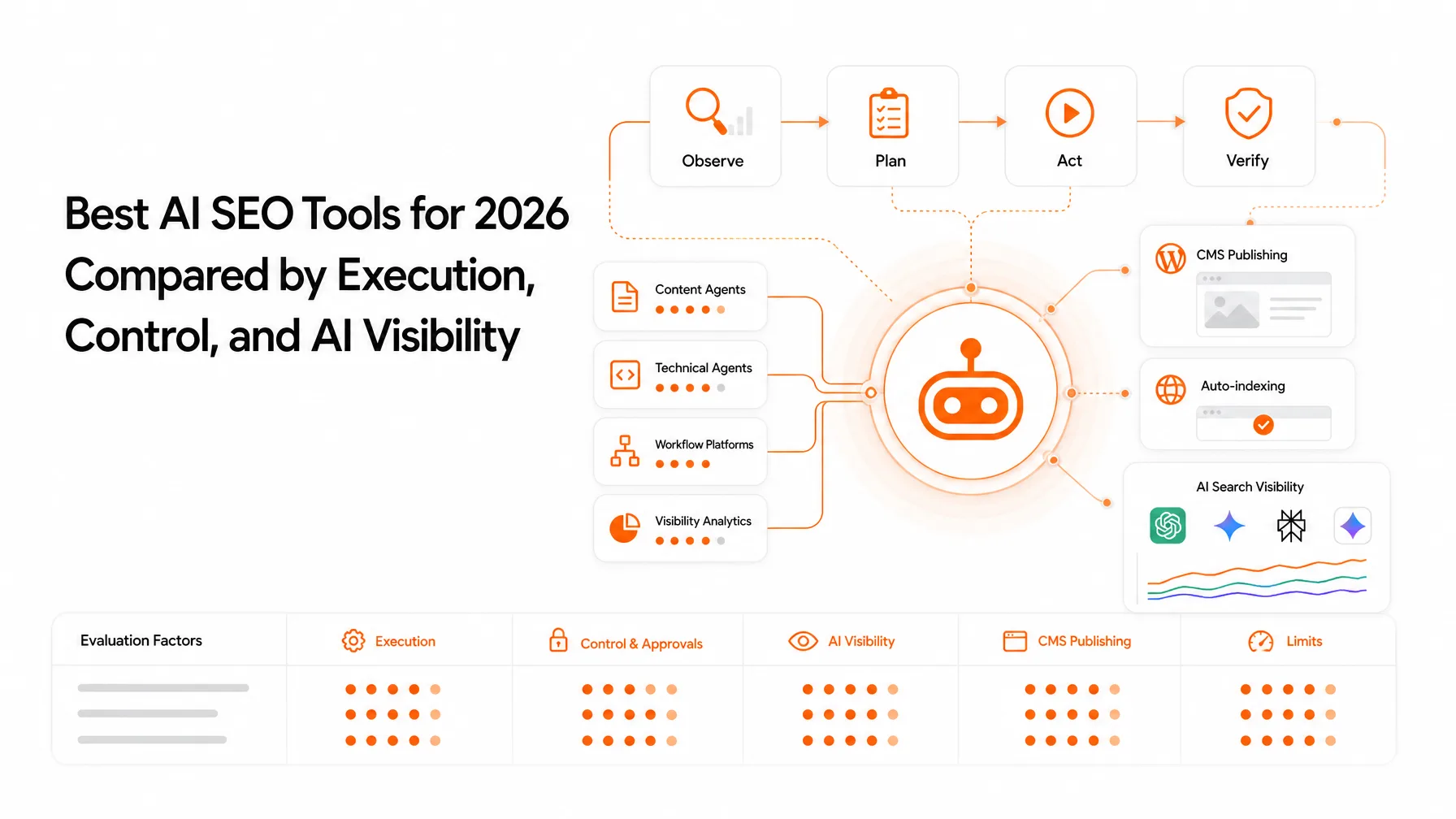
SEO automation statistics for 2026 show one clear gap: AI use is close to universal, but full automation is almost nonexistent. In Keyword.com's 2026 State of AI in SEO survey, 87% of respondents use AI regularly or centrally in their SEO work. Only 1% describe that work as fully automated.
That gap is the real story. You've got a keyword tool in one tab, an AI writer in another, your CMS in a third, and Search Console beside a reporting sheet. Each tool uses AI, but none of them hands work to the next. That's AI assistance, not automation, and most AI SEO statistics count the two as the same thing.
Key SEO automation statistics: a quick overview
87% of SEO professionals use AI regularly or as a central part of delivery (Keyword.com, 97 responses, 2026).
1% describe their SEO work as fully automated (Keyword.com, same sample).
70% name poor output, hallucinations or quality-control time as their biggest AI limit (Keyword.com, same sample).
60% of marketers use AI for keyword research, the most common SEO use (Semrush, 100 marketers, 2026).
About 1 in 5 marketers use AI to draft full articles, while 34% use it to refresh existing content (Semrush, same sample).
22% say SEO and AI search are fully integrated across strategy, execution and reporting (Semrush, 481 marketers, 2026).
40% check AI search visibility by typing prompts manually (Semrush, same sample).
77% see AI search as an extension of SEO, not a separate channel (Semrush, same sample).
What do the 2026 SEO automation statistics actually show?
AI use is widespread, full automation is rare, and every figure depends on how the survey defined automation. Treat each number below as one study's result, not a market census.
Four terms keep the data honest. AI-assisted work means a person prompts and reviews. Task automation means software executes one step. Workflow automation connects steps and removes handoffs. Full automation means no routine human involvement. Most SEO statistics roundups blur these lines.
AI adoption is high, but full workflow automation is rare
Keyword.com's State of AI in SEO report analyzed 97 usable responses from SEO agencies, in-house teams, freelancers, consultants and platform teams. In that survey, 87% use AI regularly or as a central part of delivery, and 1% describe their work as fully automated. Seventy percent named poor output, hallucinations or quality-control time as their biggest limits.
That's a small vendor sample. Read it as a directional signal about maturity, not a global benchmark.
Source | Published | Sample | What it measured | Result |
|---|---|---|---|---|
2026 | 97 usable responses from agencies, in-house teams, freelancers and consultants | Regular or central AI use | 87% | |
2026 | Same sample | Work described as fully automated | 1% | |
Early 2026 | 100 marketers | AI used for keyword research | 60% | |
2026 | 481 marketers after an attention-check filter | SEO and AI search fully integrated | 22% |
Adoption is not the same as end-to-end automation.
The statistic that matters is execution depth
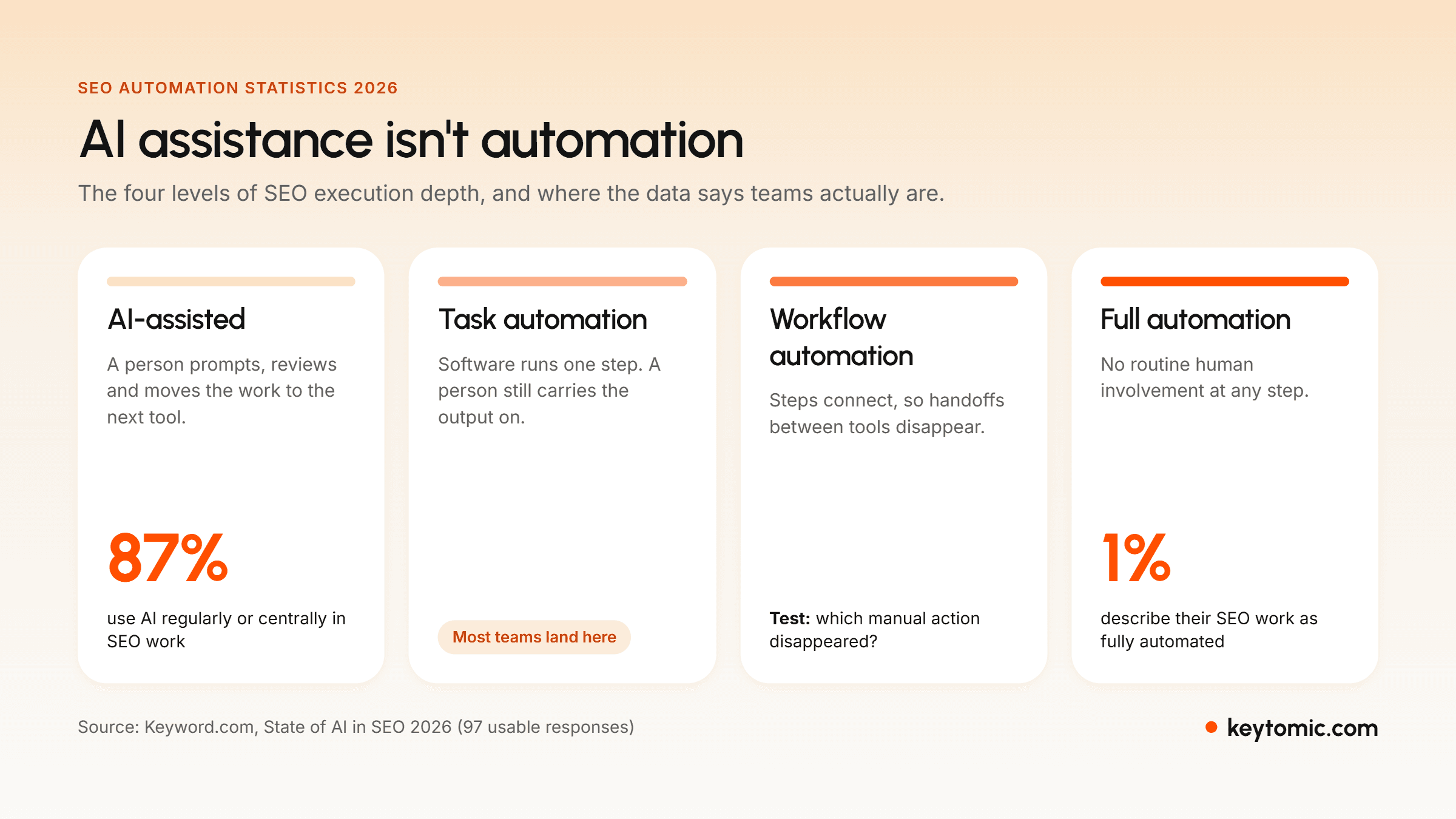
The 87% and 1% figures sit at opposite ends of one scale, and the gap between them is where the work is. Most teams land in the middle: AI drafts or suggests, then a person moves the output to the next tool by hand. That's assistance, and it leaves every handoff in place.
To see AI assistance vs SEO automation in practice, ask one question: which manual action disappeared? If the answer is none, and the output just arrived faster, you bought assistance. Connected SEO automation software removes those handoffs, so research, drafting, publishing and indexing run as one workflow.
AI SEO statistics: how teams use AI and automation in 2026
Keyword research, ideation, briefs, refreshes and metadata are mostly AI-assisted, and usage drops as a task gets closer to judgment. Semrush's survey of 100 marketers shows that task-level pattern. It's a small sample, so treat it as a snapshot.
Keyword research and content planning lead adoption
60% use AI for keyword research.
48% use it to brainstorm content ideas.
38% use it for briefs and outlines.
These tasks have clear inputs, which is why they come first. Still, "uses AI for" doesn't mean "automates from input to output."
Drafting and refreshing content remain human-assisted
Semrush reports that 34% use AI to refresh existing content, 26% for titles and meta descriptions, and 24% for secondary keywords. Only about 1 in 5 use it to draft full articles. Keyword.com's 70% figure on quality and hallucination limits explains the caution.
Measurement and workflow integration lag behind adoption
In Semrush's study of 481 marketers, 22% say SEO and AI search are fully integrated across strategy, execution and reporting. Another 40% check AI visibility by typing prompts manually, and 13% have no consistent approach. Measurement is the least automated layer.
SEO task automation statistics: which tasks are automated most?
The safest first targets are repeatable, low-judgment tasks with clear inputs and outputs. Only some categories here have survey numbers, so the rest are labeled as a workflow framework, not a statistic.
Research and analysis tasks
Keyword discovery, clustering, SERP analysis and technical crawls fit rules and models well. The measured signal is the 60% keyword research figure above. No survey here measures who decides which page owns each keyword, and that decision should stay with a person.
Content operations and optimization tasks
Briefs (38%), metadata (26%) and internal linking suggestions are common candidates. The value shows up when steps connect, which is the point of SEO automation workflows from research to publishing: brief, draft, links and sources moving without a copy-paste step.
Publishing, indexing, reporting and AI visibility tasks
CMS publishing and reporting pulls are mechanical, so they automate well. Indexing needs care: Google's crawling and indexing documentation treats sitemaps and submissions as signals, not guarantees. Don't trust any tool that promises a fixed indexing time.
The matrix below is an editorial framework, not survey data.
Task | Typical automation level | Human checkpoint | KPI |
|---|---|---|---|
Keyword discovery and clustering | AI-assisted or rule-based | Decide which page owns each keyword | Keywords mapped to pages |
Content briefs | AI-assisted | Check intent and sources | Brief-to-publish time |
Internal linking | Rule-based | Check anchor relevance | Links added per page |
CMS publishing | Workflow-executed | Approve before going live | Manual posting hours removed |
Indexing submission | Workflow-executed | Review index status, expect no guarantees | URLs submitted vs indexed |
Reporting | Rule-based | Interpret what changed | Reporting hours per client |
AI visibility tracking | Workflow-executed | Choose prompts, judge sources | Mentions and citations per prompt set |
Judge task automation by the manual action removed, not by the number of features listed.
SEO automation time-savings statistics: what the data can and can't prove
Automation can raise capacity, but the available studies don't support one time-saving percentage for every team. Keyword.com's respondents report saving time and delivering more with the same resources, yet those are self-reported answers from 97 people.
What the available time-saving data can and cannot prove
Survey answers show perceived savings. They don't show quality, rankings or revenue, and they don't isolate automation from other changes in a team's process. Ignore any SEO statistics roundup that quotes a universal "saves X%" figure or an industry market size without a method.
Measure hours removed, pages shipped and business outcomes separately
Here's a simple ROI formula. It's an editorial framework, not a published benchmark.

Step | Calculation |
|---|---|
1. Labor saved | (Baseline hours per workflow − automated hours) × loaded hourly cost |
2. Add | Avoided tool cost |
3. Subtract | Automation cost + added review time |
= | Net automation ROI |
Baseline hours means the real time per published page, including handoffs. Loaded hourly cost means salary plus overhead. Then track pages shipped per month, and later indexing, rankings and conversions. Hours saved is an efficiency metric; traffic and revenue are outcomes.
Generative engine optimization (GEO) statistics and what they mean for visibility
Generative engine optimization (GEO) adds visibility inside AI answers to your measurement model, but Google's guidance still points site owners to standard technical and people-first SEO. Treat the relationship between SEO and GEO as one system with two sets of metrics, not two budgets.
Traditional SEO remains the foundation for Google AI features
Google's AI features guidance says normal Search fundamentals still apply to AI Overviews and AI Mode. Be skeptical of any pitch for special GEO markup aimed at Google. In Semrush's 481-marketer study, 77% describe AI search as an extension of SEO, while 15% call it separate.
AI visibility is not the same as AI referral traffic
A brand mention in ChatGPT, a cited source link in Perplexity and a click to your site are three different events. Treating a citation as traffic is the most common mistake in reading AI SEO statistics. Citation share and referral traffic are related, but they aren't equivalent metrics.
Measure mentions, citations, clicks and conversions separately
Build the measurement ladder in this order:

Prompt visibility: does your brand appear for a fixed prompt set?
Citation: is your URL named as a source?
Click: does the answer send a visit?
Qualified visit: does that visitor match your audience?
Conversion: did they sign up or enquire?
Use a fixed prompt list on a schedule, because AI visibility tracking across search assistants is only useful when results are comparable over time. Keep tracking Google rankings and clicks in Search Console alongside it.
What are the benefits and limits of SEO automation?
Automation is strongest where work is repetitive and measurable. Facts, strategy, brand judgment and high-risk decisions still need human control.
Automate repeatable work with clear inputs and outputs
Automate keyword mapping; review the page assignment.
Automate brief creation; review intent and sources.
Automate CMS publishing; review what goes live.
Automate reporting pulls; review the interpretation.
Automate index submission; review index status.
Keep facts, strategy, brand judgment and regulated work under review
Keep a task manual when errors are expensive. That covers factual claims, regulated topics, topic selection, brand positioning and specialist backlink decisions. Google's guidance on generative AI content doesn't treat AI use as the problem; low-value content produced at scale is.
Why more AI use doesn't automatically mean better SEO
Volume amplifies whatever process sits underneath it. Weak briefs produce weak pages faster. A team that publishes 40 unreviewed pages a month hasn't removed risk; it has automated it.
How Keytomic fits the 2026 SEO automation workflow
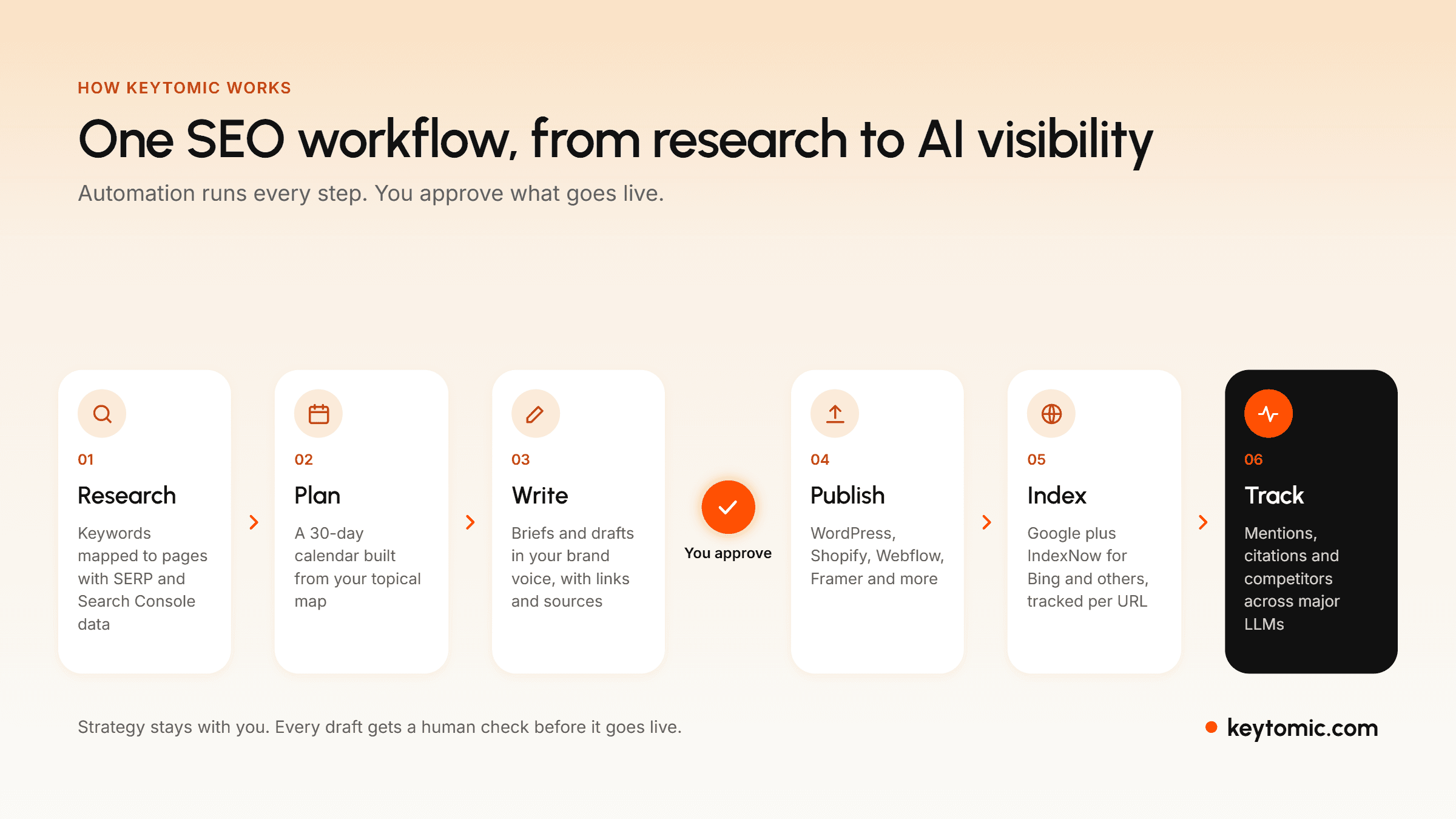
Keytomic is the product discussed in this section, and I work on it as Product & Growth Lead. It's an AI SEO automation platform built around one workflow: research, plan, write, publish, index and track, with a person approving what goes live.
Map demand to pages before producing content
Keytomic's keyword research maps keywords to pages using live volume, difficulty and SERP data plus your Google Search Console data. Its topical map builds from your central entity and orders what to publish first. Strategy choices stay with you.
Connect planning, writing, publishing, indexing and visibility tracking
From there, it plans a 30-day calendar, briefs each article and drafts in your brand voice with internal links, sources and an author profile. Drafts publish, or arrive as drafts, in WordPress, Shopify, Webflow, Framer and other CMSs via webhook.
New URLs go to Google, and through IndexNow to Bing, Yandex, DuckDuckGo and Brave, with index status tracked per URL. An AI visibility tracker then runs your prompts across major LLMs on a schedule and tracks mentions, citations and competitors.
Plans start at $99/month with a 3-day trial; see Keytomic pricing and trial details. Pricing and product details were checked against official pages in October 2026. Plans, features, integrations and availability can change, so verify current details before buying.
When Keytomic is not the right fit
Keytomic doesn't replace a forensic crawler or a deep backlink database for specialist work. Every draft still needs a human check for facts, brand voice and anything regulated. Submitting a URL also doesn't guarantee indexing, rankings or citations.
How we chose these SEO automation statistics
We only included statistics with a named source, a stated sample size and a clear definition of what was measured. Each figure is reported as one study's result, not a market-wide number, and we never combine percentages from different surveys.
We sorted every stat by automation depth: AI-assisted work, single-task automation, connected workflow automation and full automation. Where no survey measures something, such as the task matrix and the ROI formula, we label it as an editorial framework.
We review this page quarterly and update figures when new studies publish. Sources were last checked in October 2026.
SEO automation statistics FAQ
What is SEO automation?
Software or workflows that run recurring SEO tasks with less manual triggering. AI assistance suggests, task automation executes one step, and workflow automation connects the steps.
What percentage of SEO professionals use AI in 2026?
In Keyword.com's 2026 survey of 97 usable responses, 87% use AI regularly or centrally. That's one vendor survey, not a universal figure.
What percentage of SEO work is fully automated?
Only 1% of Keyword.com's respondents described their work as fully automated. Most teams still review outputs and decide task by task.
Which SEO tasks are most commonly automated?
In Semrush's early-2026 survey, keyword research (60%), idea brainstorming (48%) and briefs (38%) led. Those are AI-assisted uses, not fully automated tasks.
What percentage of marketers use AI for SEO tasks?
In Semrush's early-2026 survey of 100 marketers, 60% use AI for keyword research, 48% for content ideas and 38% for briefs and outlines. Only about 1 in 5 use it to draft full articles.
How many SEO teams track AI search visibility?
Few track it systematically. In Semrush's study of 481 marketers, 22% have SEO and AI search fully integrated, 40% check AI visibility by typing prompts manually, and 13% have no consistent approach.
Does SEO automation reduce costs?
It can cut manual effort or tool sprawl. Savings depend on your baseline hours, volume, software cost and review time, and no universal percentage is supported.
How should a team measure SEO automation ROI?
Subtract automated hours from baseline hours, multiply by loaded hourly cost, add avoided tool cost and subtract automation cost. Track pages shipped, indexing, rankings and conversions separately.
Does SEO automation replace SEO specialists?
No. It reduces repetitive execution, while strategy, judgment and review remain human responsibilities.
What is the difference between SEO and GEO?
SEO covers search visibility broadly; GEO usually means visibility in generative AI answers. In Semrush's survey, 77% see AI search as an extension of SEO.
How to use these statistics to decide what to automate first
Start from your bottleneck, not from the adoption numbers:
If the bottleneck is research or ideation, automate discovery and planning first.
If the bottleneck is publishing and handoffs, prioritize connected CMS, indexing and reporting workflows.
If the bottleneck is quality or risk, keep human approval and fix your evidence process before raising volume.
Whichever you pick, measure three things: the manual step removed, the quality checkpoint kept and the business outcome affected. Then run one workflow end to end, and use the pricing and trial details above to see how it maps to your own team.