Table of Contents
Share Article
Top 10 SEO Companies in Austin Worth Hiring in 2026
Top 10 SEO Companies in Austin Worth Hiring in 2026
Top 10 SEO Companies in Austin Worth Hiring in 2026

Salam Qadir
Product & Growth Lead

I ranked the top 10 SEO companies in Austin for 2026 by service depth, pricing, GEO readiness, and real client fit. Find the right partner here.
We reviewed the top SEO companies in Austin worth hiring in 2026, comparing pricing, specialties, and verified client feedback so you do not have to dig through ten browser tabs to figure out who is actually good.
Here is something most lists like this will not tell you. Almost every "best SEO agencies in Austin" article currently ranking on Google is published by one of the agencies featured on its own list, and that agency ranks itself number one.
We are not going to do that. Keytomic, the AI SEO platform publishing this page, is included below. It is not ranked first. The number one spot went to a different, independently verified agency, and we explain exactly why in the next section.
This list also covers something most comparisons skip entirely: AI-driven SEO platforms, including options that come with a dedicated human team managing them for you.
If you are choosing between a $5,000 a month agency retainer and doing everything yourself, there is a real middle option now, and most lists pretend it does not exist.
Why Austin businesses look for SEO partners in 2026
Austin's growth has been aggressive. The city's tech industry has expanded at roughly 18.5% year-over-year according to industry analysis, bringing hundreds of new SaaS companies, healthcare platforms, real estate firms, and ecommerce brands all competing for the same search real estate.
The budget pressure is equally real. Most SMBs and mid-market companies can't justify building a full in-house SEO team. According to a 2026 industry report, 40% of small businesses now outsource their local SEO efforts, reflecting that SEO has become too specialized to treat as a side task.
What's changed most in 2026 is the search environment itself. AI Overviews now trigger on approximately 48% of all tracked queries, a 58% increase year-over-year according to BrightEdge's analysis. That means ranking on page one no longer guarantees the click.
Brands that aren't appearing inside AI-generated answers from ChatGPT, Perplexity, and Google AI Mode are invisible to a growing share of buyers.
For Austin businesses, the criteria for choosing an SEO partner have expanded beyond keyword rankings. You now need an agency that understands generative engine optimization and can close content gaps that affect both traditional search and AI citation.
Evaluation Criterion | Why It Matters in 2026 |
|---|---|
Technical SEO capability | Site health, crawlability, and Core Web Vitals still drive rankings |
Content strategy depth | Topic clusters, content gap analysis, and editorial planning |
GEO and AI visibility | Optimization for ChatGPT, Perplexity, and Google AI Overviews |
Reporting transparency | Attribution, organic KPIs, and honest goal-setting |
Contract flexibility | Month-to-month vs. locked retainers |
Pricing fit | Local agencies vs. national firms with Austin presence |
Agencies that cover all six columns are rare. Most specialize in two or three and rely on partners or bolt-ons for the rest.

Top 10 SEO companies in Austin in 2026
The following agencies appear consistently across Clutch, Semrush's agency directory, DesignRush, and multiple independent reviews. I've ranked them by overall service depth, client fit breadth, and how clearly they demonstrate measurable outcomes.
1. Propellic

Propellic is headquartered in Austin and built its reputation around data-driven SEO and paid media integration, particularly for travel brands, funded SaaS startups, and lifestyle ecommerce companies. It holds a 5.0 rating on Clutch and has expanded its AI search optimization capabilities in 2026 to help clients earn visibility in LLM-driven platforms.
Key Services:
Organic SEO and technical auditing
Paid media aligned with organic strategy
Advanced competitor keyword analysis
AI search optimization for LLM platforms
Pros and Cons:
Pros:
Perfect 5.0 Clutch rating with strong client retention signals
Enterprise-level technical SEO for growing brands
Integrated organic and paid strategy reduces attribution gaps
Cons:
Minimum budget around $5,000/month puts it out of reach for early-stage businesses
Focus on specific verticals (travel, SaaS, lifestyle) means less fit for hyperlocal service businesses
Pricing: Starting around $1,000/month with typical engagements from $5,000/month for full-service retainers.
Best For: Funded startups, travel brands, and ecommerce companies that want SEO tightly integrated with paid acquisition.
2. Keytomic

Keytomic is an AI-native SEO platform that combines automated keyword research, content production, technical audits, and AI-search visibility tracking into a single system, built to handle the execution work a traditional agency would otherwise staff manually.
Best for: Austin businesses that want agency-level SEO output without committing to a $1,500 to $5,000 a month traditional retainer, whether they want to run it themselves or have it fully managed for them.
Here is the part most lists like this miss entirely.
Every other agency on this page only offers one buying model: hire a team, pay a retainer, wait for monthly reporting.
Keytomic represents a different category. Its platform runs SEO workflows, including keyword research, content generation with built-in E-E-A-T signals, technical audits, auto-publishing, auto-indexing, and AI-visibility tracking across ChatGPT, Gemini, and Perplexity, as an automated system rather than a team of people doing the same tasks by hand.
This matters specifically in Austin's market because the competition here is dense. Several national agencies on this list maintain Austin offices specifically because the city's tech and services sector is that competitive, and businesses without a large marketing budget are often priced out of working with the established players on this page.
Keytomic offers two ways to access the platform.
A self-serve Pro Plan at $99 a month, where your team runs the platform directly using the full automation suite.
And a fully managed Agency Plan at $999 a month, where a dedicated Keytomic operator handles strategy, execution, and reporting on your behalf, functionally replacing what a traditional agency retainer does, at roughly a fifth of what agencies like Victorious or WebFX charge as their stated minimum monthly spend. Custom plans are also available for businesses with multi-location, multi-brand, or higher-volume content needs.
This makes Keytomic genuinely different from everything else on this list. It is not a cheaper version of an agency. It is a different operating model entirely: automation-first, with an optional human layer, rather than human-first, with optional automation.
What's included: automated keyword research and content generation built on semantic SEO and E-E-A-T standards, technical SEO audits with auto-indexing, AI visibility tracking across ChatGPT, Gemini, and Perplexity, a Reddit AI Agent for organic community-driven brand mentions, and direct CMS publishing to WordPress, Shopify, Webflow, and other platforms.
The verdict: For an Austin business deciding between a $5,000 a month traditional agency retainer and doing SEO entirely in-house, Keytomic's $999 Agency Plan sits as a genuine middle option, agency-level execution and reporting at a fraction of the typical local agency minimum spend.
Pricing: $99/month self-serve, $999/month fully managed, custom pricing available on request.
Read More: SEO Pricing In Chicago: What Agencies Actually Charge In 2026
3. Thrive Internet Marketing Agency
Thrive has been in the market since 2005 and carries national recognition alongside strong local Austin presence. It's consistently named a top agency by Clutch across multiple categories and runs a month-to-month contract model. Thrive has invested in a dedicated R&D team focused on GEO, helping clients earn visibility in Google AI Overviews, Gemini, and ChatGPT.
Key Services:
Full-service SEO including AI SEO and GEO
PPC, social media, and reputation management
Proprietary Thrive Stats and Thrive Score tools (150+ marketing factors)
Content marketing and web design
Pros and Cons:
Pros:
Proven track record across small businesses and multi-location enterprises
No long-term contracts
Documented AI traffic growth: one client recorded a 4,302% increase in traffic from AI platforms between January and October 2025
Cons:
Headquarters outside Austin (Arlington, TX) may reduce local market nuance
Wide service breadth can add cost for businesses that only need focused SEO
Pricing: Custom pricing; no long-term commitment required.
Best For: Multi-location businesses, SMBs needing both SEO and reputation management, and brands investing in AI search visibility.
4. Neon Ambition
Neon Ambition is a true Austin-native agency founded in the city and focused on lead generation for established businesses. It holds a 4.9-star rating and maintains a 96% client retention rate after initial contracts, which signals genuine delivery rather than strong sales. The team operates with low client-to-manager ratios, which clients consistently cite as a differentiator.
Key Services:
Performance-first SEO (keyword research, technical SEO, content strategy)
PPC management and paid social
Conversion rate optimization
App Store Optimization (ASO)
Pros and Cons:
Pros:
Deeply embedded in Austin's local market
Strong focus on revenue impact, not just traffic
Senior-level staff managing accounts (low account-to-manager ratio)
Cons:
Less emphasis on AI/GEO-specific workflows compared to some competitors
Best suited for established businesses; may be over-engineered for early-stage startups
Pricing: Not publicly listed; contact required.
Best For: Established Austin businesses in legal, real estate, healthcare, and professional services that need a consistent lead pipeline from organic search.
5. Siege Media
Siege Media is headquartered in Austin with additional offices in San Diego, New York, and Chicago. It raised a $30 million Series A in June 2025 and has been on the Inc. 5000 list six times. The agency specializes in content-led SEO for SaaS, fintech, and ecommerce brands, using proprietary technology (BlueprintIQ and DataFlywheel) to build scalable editorial systems. It also delivers LLM citation optimization for AI search visibility.
Key Services:
Enterprise content strategy and creation
Technical SEO and product-led SEO
Digital PR and link building
Generative engine optimization for LLM citations
Pros and Cons:
Pros:
Exceptionally strong content quality and scalable editorial frameworks
Documented results with enterprise clients including Microsoft and Google
GEO capability built into core content process
Cons:
Minimum $5,000/month budget; best for Series B-D or $10M+ ARR companies
Less suitable for local Austin service businesses
Pricing: Starting at $5,000/month.
Best For: SaaS companies, fintech brands, and ecommerce businesses where organic content is a primary acquisition channel.
6. Funnel Boost Media
Funnel Boost Media is a veteran-owned, Forbes-recognized agency based in San Antonio with active service coverage in Austin. It holds Clutch ratings above 4.8 and focuses predominantly on local SEO, Google Business Profile optimization, and PPC for small-to-mid-size businesses. Around 70% of its service focus is SEO, with GEO capabilities now added to its offering.
Key Services:
Local SEO and Google Business Profile management
PPC campaign management
Conversion-focused web design
Generative engine optimization
Pros and Cons:
Pros:
Strong track record with home services, healthcare, and local businesses
Transparent reporting; client-owned accounts and assets
No setup fees and accessible pricing
Cons:
Headquartered in San Antonio; some Austin clients may prefer a closer local presence
Less relevant for SaaS or national content-driven brands
Pricing: Starting around $1,000/month.
Best For: Austin-area local service businesses (HVAC, legal, medical, home remodeling) that need strong local pack rankings and lead generation.
Read More: Best Content Automation Tools for Agencies in Dallas 2026 Guide
7. Blackhawk Digital Marketing
Blackhawk is a fully Austin-based agency founded in 2016 with a team of 20 and a client list that includes Duracell, Buc-ee's, and Keller Williams. It focuses on the local and SMB community across Central Texas and works across 30+ industries. The agency runs four SEO pillars: on-site, technical, local, and content optimization.
Key Services:
On-site and technical SEO
Local SEO and Google Business Profile
Website development (WordPress, Shopify)
Google Ads and social campaigns
Pros and Cons:
Pros:
Genuinely Austin-native with deep Central Texas market knowledge
Broad industry experience across 30+ verticals
Hands-on execution model
Cons:
Less documentation of AI/GEO-specific capabilities than larger competitors
Service depth may not match enterprise-scale demands
Pricing: Varies by scope; contact required.
Best For: Local Austin businesses and Central Texas SMBs looking for an agency with genuine roots in the market.
8. EWR Digital
EWR Digital is a full-service Austin agency with documented expertise across local, enterprise, and technical SEO. It serves clients from wellness centers to software companies and appears consistently on Clutch's Austin rankings. The agency covers content strategy, web design, and paid media alongside SEO.
Key Services:
Local and enterprise SEO
Technical SEO audits
Content strategy and web design
Paid media management
Pros and Cons:
Pros:
Strong Clutch reviews across multiple industries
Flexible pricing tiers starting at $1,500/month
Data-driven approach with clear KPI frameworks
Cons:
AI search optimization capabilities are less prominently featured compared to competitors
Content volume and velocity may lag behind content-specialist agencies
Pricing: Local SEO packages start at $1,500/month.
Best For: Wellness centers, professional services, and growing businesses needing a dependable full-service partner.
9. Coalition Technologies
Coalition Technologies is a nationally recognized SEO and web design agency with an Austin presence. Its headquarters is in Los Angeles, but it actively serves Austin clients with Austin-centric keyword targeting and technical auditing. It carries a 97% client retention rate and 99% customer satisfaction score according to company data and holds 700+ documented case studies.
Key Services:
eCommerce SEO and technical auditing
Multi-location and national SEO
Web design and development
Google Shopping and PPC
Pros and Cons:
Pros:
Extensive case study library across ecommerce and service industries
Month-to-month contract option available
Strong technical capabilities backed by a large team
Cons:
LA headquarters means the Austin team may not carry the same local market depth as native agencies
Best suited for ecommerce; less tailored to B2B SaaS or local service businesses
Pricing: Starting around $1,000/month; varies by project scope.
Best For: eCommerce brands and multi-location businesses seeking national-scale SEO execution with Austin-market delivery.
10. Victorious
Victorious is a premium SEO-only agency (San Francisco-based) with a meaningful Austin client base. It dedicates 80% of its service capacity to SEO, which enables a level of specialization that full-service agencies can't match. Victorious is known for data-first methodology, rigorous keyword research, and transparent monthly reporting.
Key Services:
Pure-play SEO (on-page, technical, link building)
Rigorous keyword research and content planning
Transparent monthly reporting
eCommerce and enterprise SEO
Pros and Cons:
Pros:
Deep SEO specialization; no distraction from other service lines
Transparent reporting praised consistently in client reviews
Strong fit for established brands with serious organic revenue goals
Cons:
Minimum $5,000/month with $300+/hour consulting rates makes it inaccessible for most SMBs
Limited GEO and AI-specific capabilities compared to agencies actively investing in that area
Pricing: $5,000/month minimum.
Best For: Established eCommerce brands and enterprise companies where organic search is a primary revenue driver.
How to compare Austin SEO companies without overpaying
Most Austin SEO agencies will show you the same proof points: Clutch ratings, traffic case studies, and a list of services. That surface-level comparison rarely tells you what you actually need to know before signing a retainer.
Strategy depth and content workflow
Ask how the agency runs keyword research and content planning before it writes a single piece. Agencies that skip a proper content gap analysis and jump straight to publishing are likely filling a content calendar rather than building topical authority.
The best agencies map your keyword universe first, identify what competitors cover that you don't, and produce a sequenced plan before any execution begins.
Technical SEO capability
This is where agencies diverge sharply. Some handle technical SEO as a checkbox during onboarding audits and never revisit it. Real technical SEO is ongoing: Core Web Vitals, crawl efficiency, internal linking structure, schema markup, and indexing health all degrade over time. Ask specifically whether the agency has developers on staff or outsources technical work.
Reporting and attribution
Clarity on how the agency reports determines whether you can actually measure ROI. Look for reporting that connects organic sessions to leads or revenue, not just keyword position movement. Agencies that deliver ranking reports without tying them to business outcomes are making themselves look busy without proving impact.
Communication cadence
In my experience, communication breakdowns are the most common reason clients leave agencies. Monthly check-ins are the minimum. If the agency doesn't have a structured update process, expect frustration when you're trying to understand why traffic dropped after an algorithm update.
What to Ask | Red Flag Response | Green Flag Response |
|---|---|---|
How do you approach content planning? | "We publish X posts per month" | "We start with a topic cluster map and content gap analysis" |
How is technical SEO handled? | "We run an audit at onboarding" | "Technical reviews happen quarterly with a developer on our team" |
How do you measure success? | "We track keyword rankings" | "We tie organic sessions to leads and report on attributed revenue" |
What's your GEO approach? | "That's still new, we're watching it" | "We actively structure content for AI citation and track AI share of voice" |
Verdict: The agencies that answer the GEO question confidently in 2026 are the ones worth a serious conversation.
What agencies usually miss: content planning and AI visibility
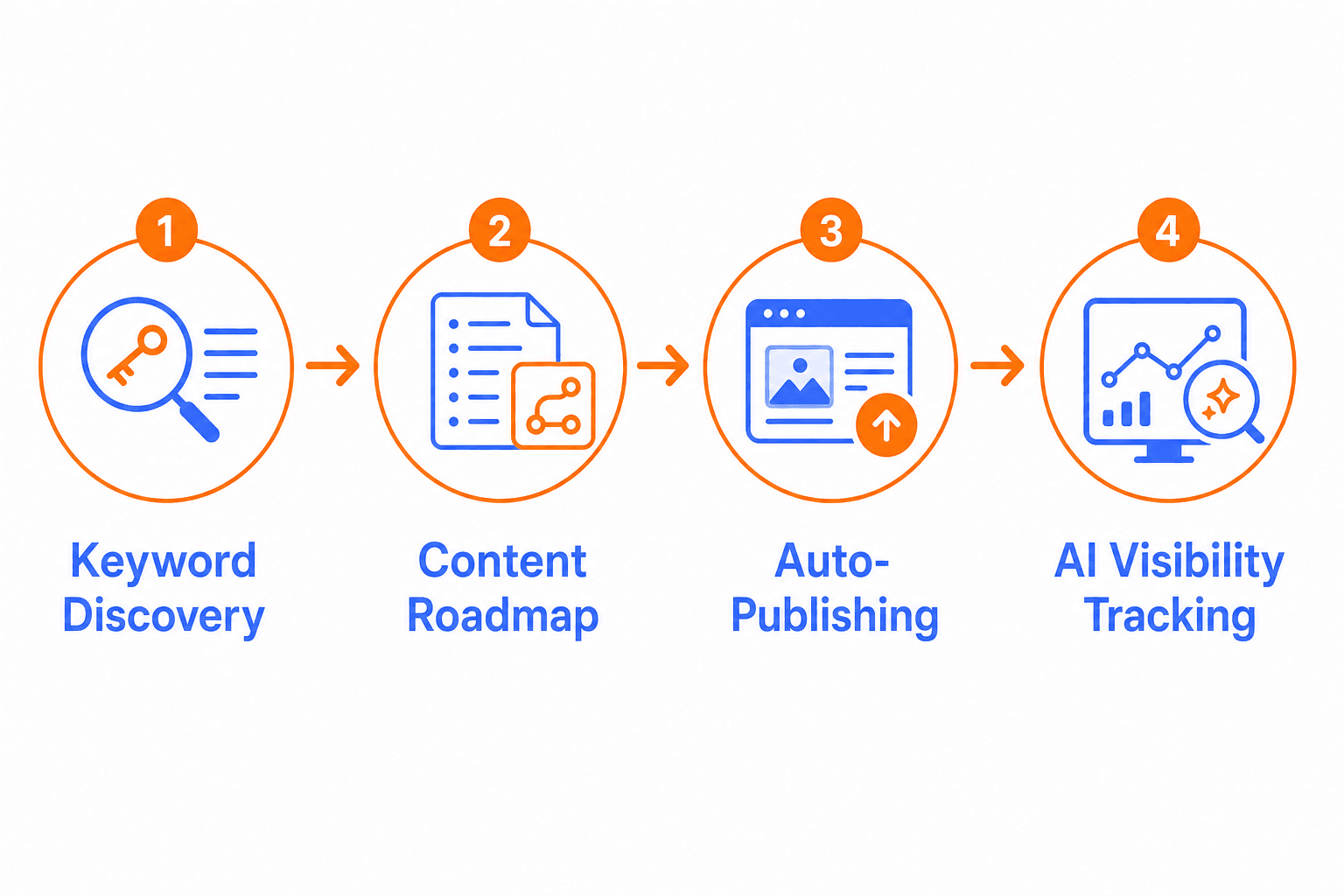
Here is the pattern I see most often: an Austin business hires an SEO agency, gets a solid technical audit, sees some ranking improvements in months two and three, and then watches organic traffic plateau by month six. The reason is almost always the same. The agency never built a real content strategy.
Why content gap analysis is non-negotiable in 2026
Content gap analysis is the process of identifying topics your competitors rank for that you don't. Most agencies run a version of it during onboarding and never revisit it. The problem is that search intent shifts, competitors publish new content, and your own existing pages decay in relevance over time.
A proper content gap audit should happen at least quarterly. It should identify missing topic clusters, pages that are losing ranking momentum, and new keyword opportunities your competitors are capturing. Skipping this step is one of the most reliable ways to fall behind on organic reach.
Generative engine optimization is now part of the job
AI-referred sessions jumped 527% year-over-year in the first five months of 2025, according to Previsible's AI Traffic Report. HubSpot's 2026 State of Marketing report found that 50% of consumers now use AI-powered search, with 44% calling it their primary source for product discovery.
That traffic doesn't behave like traditional organic. It's higher-intent and faster to convert. But it only reaches brands that are structured to be cited. Content with specific statistics, expert attribution, and clear factual sourcing achieves measurably higher AI citation rates. Comparison content leads all formats at 32.5% of AI citations, according to Previsible's data.
If your agency doesn't have a clear answer for how it structures content for AI retrieval, that's a significant gap. Generative engine optimization isn't a separate service layer you add on top. It's a content structuring discipline that should influence every piece of content the agency produces.
FAQs about choosing an SEO company in Austin
How much does an SEO agency in Austin typically cost? Most Austin SEO agencies start between $1,000 and $3,000/month for SMBs. Enterprise and premium agencies like Victorious or Propellic start at $5,000/month.
How long does SEO take to produce results in Austin's market? Most businesses see measurable organic traction within three to six months. Competitive verticals like legal, real estate, and SaaS typically take six to twelve months for meaningful ranking gains.
Should I choose a local Austin agency or a national firm with an Austin presence? Local agencies bring deeper market context. National firms often bring more resources and specialization. The right choice depends on whether local market knowledge or channel depth matters more for your goals.
What is generative engine optimization and why do I need it in 2026? GEO is structuring content to appear in AI-generated search responses from ChatGPT, Perplexity, and Google AI Overviews. With AI search usage growing rapidly, visibility in those answers is becoming as important as traditional rankings.
How do I evaluate an Austin SEO agency's reporting quality before signing? Ask for a sample report and check whether it ties keyword data to traffic, leads, and revenue. Reporting that stops at rankings without connecting to business outcomes is a warning sign.
We reviewed the top SEO companies in Austin worth hiring in 2026, comparing pricing, specialties, and verified client feedback so you do not have to dig through ten browser tabs to figure out who is actually good.
Here is something most lists like this will not tell you. Almost every "best SEO agencies in Austin" article currently ranking on Google is published by one of the agencies featured on its own list, and that agency ranks itself number one.
We are not going to do that. Keytomic, the AI SEO platform publishing this page, is included below. It is not ranked first. The number one spot went to a different, independently verified agency, and we explain exactly why in the next section.
This list also covers something most comparisons skip entirely: AI-driven SEO platforms, including options that come with a dedicated human team managing them for you.
If you are choosing between a $5,000 a month agency retainer and doing everything yourself, there is a real middle option now, and most lists pretend it does not exist.
Why Austin businesses look for SEO partners in 2026
Austin's growth has been aggressive. The city's tech industry has expanded at roughly 18.5% year-over-year according to industry analysis, bringing hundreds of new SaaS companies, healthcare platforms, real estate firms, and ecommerce brands all competing for the same search real estate.
The budget pressure is equally real. Most SMBs and mid-market companies can't justify building a full in-house SEO team. According to a 2026 industry report, 40% of small businesses now outsource their local SEO efforts, reflecting that SEO has become too specialized to treat as a side task.
What's changed most in 2026 is the search environment itself. AI Overviews now trigger on approximately 48% of all tracked queries, a 58% increase year-over-year according to BrightEdge's analysis. That means ranking on page one no longer guarantees the click.
Brands that aren't appearing inside AI-generated answers from ChatGPT, Perplexity, and Google AI Mode are invisible to a growing share of buyers.
For Austin businesses, the criteria for choosing an SEO partner have expanded beyond keyword rankings. You now need an agency that understands generative engine optimization and can close content gaps that affect both traditional search and AI citation.
Evaluation Criterion | Why It Matters in 2026 |
|---|---|
Technical SEO capability | Site health, crawlability, and Core Web Vitals still drive rankings |
Content strategy depth | Topic clusters, content gap analysis, and editorial planning |
GEO and AI visibility | Optimization for ChatGPT, Perplexity, and Google AI Overviews |
Reporting transparency | Attribution, organic KPIs, and honest goal-setting |
Contract flexibility | Month-to-month vs. locked retainers |
Pricing fit | Local agencies vs. national firms with Austin presence |
Agencies that cover all six columns are rare. Most specialize in two or three and rely on partners or bolt-ons for the rest.
Top 10 SEO companies in Austin in 2026
The following agencies appear consistently across Clutch, Semrush's agency directory, DesignRush, and multiple independent reviews. I've ranked them by overall service depth, client fit breadth, and how clearly they demonstrate measurable outcomes.
1. Propellic
Propellic is headquartered in Austin and built its reputation around data-driven SEO and paid media integration, particularly for travel brands, funded SaaS startups, and lifestyle ecommerce companies. It holds a 5.0 rating on Clutch and has expanded its AI search optimization capabilities in 2026 to help clients earn visibility in LLM-driven platforms.
Key Services:
Organic SEO and technical auditing
Paid media aligned with organic strategy
Advanced competitor keyword analysis
AI search optimization for LLM platforms
Pros and Cons:
Pros:
Perfect 5.0 Clutch rating with strong client retention signals
Enterprise-level technical SEO for growing brands
Integrated organic and paid strategy reduces attribution gaps
Cons:
Minimum budget around $5,000/month puts it out of reach for early-stage businesses
Focus on specific verticals (travel, SaaS, lifestyle) means less fit for hyperlocal service businesses
Pricing: Starting around $1,000/month with typical engagements from $5,000/month for full-service retainers.
Best For: Funded startups, travel brands, and ecommerce companies that want SEO tightly integrated with paid acquisition.
2. Keytomic
Keytomic is an AI-native SEO platform that combines automated keyword research, content production, technical audits, and AI-search visibility tracking into a single system, built to handle the execution work a traditional agency would otherwise staff manually.
Best for: Austin businesses that want agency-level SEO output without committing to a $1,500 to $5,000 a month traditional retainer, whether they want to run it themselves or have it fully managed for them.
Here is the part most lists like this miss entirely.
Every other agency on this page only offers one buying model: hire a team, pay a retainer, wait for monthly reporting.
Keytomic represents a different category. Its platform runs SEO workflows, including keyword research, content generation with built-in E-E-A-T signals, technical audits, auto-publishing, auto-indexing, and AI-visibility tracking across ChatGPT, Gemini, and Perplexity, as an automated system rather than a team of people doing the same tasks by hand.
This matters specifically in Austin's market because the competition here is dense. Several national agencies on this list maintain Austin offices specifically because the city's tech and services sector is that competitive, and businesses without a large marketing budget are often priced out of working with the established players on this page.
Keytomic offers two ways to access the platform.
A self-serve Pro Plan at $99 a month, where your team runs the platform directly using the full automation suite.
And a fully managed Agency Plan at $999 a month, where a dedicated Keytomic operator handles strategy, execution, and reporting on your behalf, functionally replacing what a traditional agency retainer does, at roughly a fifth of what agencies like Victorious or WebFX charge as their stated minimum monthly spend. Custom plans are also available for businesses with multi-location, multi-brand, or higher-volume content needs.
This makes Keytomic genuinely different from everything else on this list. It is not a cheaper version of an agency. It is a different operating model entirely: automation-first, with an optional human layer, rather than human-first, with optional automation.
What's included: automated keyword research and content generation built on semantic SEO and E-E-A-T standards, technical SEO audits with auto-indexing, AI visibility tracking across ChatGPT, Gemini, and Perplexity, a Reddit AI Agent for organic community-driven brand mentions, and direct CMS publishing to WordPress, Shopify, Webflow, and other platforms.
The verdict: For an Austin business deciding between a $5,000 a month traditional agency retainer and doing SEO entirely in-house, Keytomic's $999 Agency Plan sits as a genuine middle option, agency-level execution and reporting at a fraction of the typical local agency minimum spend.
Pricing: $99/month self-serve, $999/month fully managed, custom pricing available on request.
Read More: SEO Pricing In Chicago: What Agencies Actually Charge In 2026
3. Thrive Internet Marketing Agency
Thrive has been in the market since 2005 and carries national recognition alongside strong local Austin presence. It's consistently named a top agency by Clutch across multiple categories and runs a month-to-month contract model. Thrive has invested in a dedicated R&D team focused on GEO, helping clients earn visibility in Google AI Overviews, Gemini, and ChatGPT.
Key Services:
Full-service SEO including AI SEO and GEO
PPC, social media, and reputation management
Proprietary Thrive Stats and Thrive Score tools (150+ marketing factors)
Content marketing and web design
Pros and Cons:
Pros:
Proven track record across small businesses and multi-location enterprises
No long-term contracts
Documented AI traffic growth: one client recorded a 4,302% increase in traffic from AI platforms between January and October 2025
Cons:
Headquarters outside Austin (Arlington, TX) may reduce local market nuance
Wide service breadth can add cost for businesses that only need focused SEO
Pricing: Custom pricing; no long-term commitment required.
Best For: Multi-location businesses, SMBs needing both SEO and reputation management, and brands investing in AI search visibility.
4. Neon Ambition
Neon Ambition is a true Austin-native agency founded in the city and focused on lead generation for established businesses. It holds a 4.9-star rating and maintains a 96% client retention rate after initial contracts, which signals genuine delivery rather than strong sales. The team operates with low client-to-manager ratios, which clients consistently cite as a differentiator.
Key Services:
Performance-first SEO (keyword research, technical SEO, content strategy)
PPC management and paid social
Conversion rate optimization
App Store Optimization (ASO)
Pros and Cons:
Pros:
Deeply embedded in Austin's local market
Strong focus on revenue impact, not just traffic
Senior-level staff managing accounts (low account-to-manager ratio)
Cons:
Less emphasis on AI/GEO-specific workflows compared to some competitors
Best suited for established businesses; may be over-engineered for early-stage startups
Pricing: Not publicly listed; contact required.
Best For: Established Austin businesses in legal, real estate, healthcare, and professional services that need a consistent lead pipeline from organic search.
5. Siege Media
Siege Media is headquartered in Austin with additional offices in San Diego, New York, and Chicago. It raised a $30 million Series A in June 2025 and has been on the Inc. 5000 list six times. The agency specializes in content-led SEO for SaaS, fintech, and ecommerce brands, using proprietary technology (BlueprintIQ and DataFlywheel) to build scalable editorial systems. It also delivers LLM citation optimization for AI search visibility.
Key Services:
Enterprise content strategy and creation
Technical SEO and product-led SEO
Digital PR and link building
Generative engine optimization for LLM citations
Pros and Cons:
Pros:
Exceptionally strong content quality and scalable editorial frameworks
Documented results with enterprise clients including Microsoft and Google
GEO capability built into core content process
Cons:
Minimum $5,000/month budget; best for Series B-D or $10M+ ARR companies
Less suitable for local Austin service businesses
Pricing: Starting at $5,000/month.
Best For: SaaS companies, fintech brands, and ecommerce businesses where organic content is a primary acquisition channel.
6. Funnel Boost Media
Funnel Boost Media is a veteran-owned, Forbes-recognized agency based in San Antonio with active service coverage in Austin. It holds Clutch ratings above 4.8 and focuses predominantly on local SEO, Google Business Profile optimization, and PPC for small-to-mid-size businesses. Around 70% of its service focus is SEO, with GEO capabilities now added to its offering.
Key Services:
Local SEO and Google Business Profile management
PPC campaign management
Conversion-focused web design
Generative engine optimization
Pros and Cons:
Pros:
Strong track record with home services, healthcare, and local businesses
Transparent reporting; client-owned accounts and assets
No setup fees and accessible pricing
Cons:
Headquartered in San Antonio; some Austin clients may prefer a closer local presence
Less relevant for SaaS or national content-driven brands
Pricing: Starting around $1,000/month.
Best For: Austin-area local service businesses (HVAC, legal, medical, home remodeling) that need strong local pack rankings and lead generation.
Read More: Best Content Automation Tools for Agencies in Dallas 2026 Guide
7. Blackhawk Digital Marketing
Blackhawk is a fully Austin-based agency founded in 2016 with a team of 20 and a client list that includes Duracell, Buc-ee's, and Keller Williams. It focuses on the local and SMB community across Central Texas and works across 30+ industries. The agency runs four SEO pillars: on-site, technical, local, and content optimization.
Key Services:
On-site and technical SEO
Local SEO and Google Business Profile
Website development (WordPress, Shopify)
Google Ads and social campaigns
Pros and Cons:
Pros:
Genuinely Austin-native with deep Central Texas market knowledge
Broad industry experience across 30+ verticals
Hands-on execution model
Cons:
Less documentation of AI/GEO-specific capabilities than larger competitors
Service depth may not match enterprise-scale demands
Pricing: Varies by scope; contact required.
Best For: Local Austin businesses and Central Texas SMBs looking for an agency with genuine roots in the market.
8. EWR Digital
EWR Digital is a full-service Austin agency with documented expertise across local, enterprise, and technical SEO. It serves clients from wellness centers to software companies and appears consistently on Clutch's Austin rankings. The agency covers content strategy, web design, and paid media alongside SEO.
Key Services:
Local and enterprise SEO
Technical SEO audits
Content strategy and web design
Paid media management
Pros and Cons:
Pros:
Strong Clutch reviews across multiple industries
Flexible pricing tiers starting at $1,500/month
Data-driven approach with clear KPI frameworks
Cons:
AI search optimization capabilities are less prominently featured compared to competitors
Content volume and velocity may lag behind content-specialist agencies
Pricing: Local SEO packages start at $1,500/month.
Best For: Wellness centers, professional services, and growing businesses needing a dependable full-service partner.
9. Coalition Technologies
Coalition Technologies is a nationally recognized SEO and web design agency with an Austin presence. Its headquarters is in Los Angeles, but it actively serves Austin clients with Austin-centric keyword targeting and technical auditing. It carries a 97% client retention rate and 99% customer satisfaction score according to company data and holds 700+ documented case studies.
Key Services:
eCommerce SEO and technical auditing
Multi-location and national SEO
Web design and development
Google Shopping and PPC
Pros and Cons:
Pros:
Extensive case study library across ecommerce and service industries
Month-to-month contract option available
Strong technical capabilities backed by a large team
Cons:
LA headquarters means the Austin team may not carry the same local market depth as native agencies
Best suited for ecommerce; less tailored to B2B SaaS or local service businesses
Pricing: Starting around $1,000/month; varies by project scope.
Best For: eCommerce brands and multi-location businesses seeking national-scale SEO execution with Austin-market delivery.
10. Victorious
Victorious is a premium SEO-only agency (San Francisco-based) with a meaningful Austin client base. It dedicates 80% of its service capacity to SEO, which enables a level of specialization that full-service agencies can't match. Victorious is known for data-first methodology, rigorous keyword research, and transparent monthly reporting.
Key Services:
Pure-play SEO (on-page, technical, link building)
Rigorous keyword research and content planning
Transparent monthly reporting
eCommerce and enterprise SEO
Pros and Cons:
Pros:
Deep SEO specialization; no distraction from other service lines
Transparent reporting praised consistently in client reviews
Strong fit for established brands with serious organic revenue goals
Cons:
Minimum $5,000/month with $300+/hour consulting rates makes it inaccessible for most SMBs
Limited GEO and AI-specific capabilities compared to agencies actively investing in that area
Pricing: $5,000/month minimum.
Best For: Established eCommerce brands and enterprise companies where organic search is a primary revenue driver.
How to compare Austin SEO companies without overpaying
Most Austin SEO agencies will show you the same proof points: Clutch ratings, traffic case studies, and a list of services. That surface-level comparison rarely tells you what you actually need to know before signing a retainer.
Strategy depth and content workflow
Ask how the agency runs keyword research and content planning before it writes a single piece. Agencies that skip a proper content gap analysis and jump straight to publishing are likely filling a content calendar rather than building topical authority.
The best agencies map your keyword universe first, identify what competitors cover that you don't, and produce a sequenced plan before any execution begins.
Technical SEO capability
This is where agencies diverge sharply. Some handle technical SEO as a checkbox during onboarding audits and never revisit it. Real technical SEO is ongoing: Core Web Vitals, crawl efficiency, internal linking structure, schema markup, and indexing health all degrade over time. Ask specifically whether the agency has developers on staff or outsources technical work.
Reporting and attribution
Clarity on how the agency reports determines whether you can actually measure ROI. Look for reporting that connects organic sessions to leads or revenue, not just keyword position movement. Agencies that deliver ranking reports without tying them to business outcomes are making themselves look busy without proving impact.
Communication cadence
In my experience, communication breakdowns are the most common reason clients leave agencies. Monthly check-ins are the minimum. If the agency doesn't have a structured update process, expect frustration when you're trying to understand why traffic dropped after an algorithm update.
What to Ask | Red Flag Response | Green Flag Response |
|---|---|---|
How do you approach content planning? | "We publish X posts per month" | "We start with a topic cluster map and content gap analysis" |
How is technical SEO handled? | "We run an audit at onboarding" | "Technical reviews happen quarterly with a developer on our team" |
How do you measure success? | "We track keyword rankings" | "We tie organic sessions to leads and report on attributed revenue" |
What's your GEO approach? | "That's still new, we're watching it" | "We actively structure content for AI citation and track AI share of voice" |
Verdict: The agencies that answer the GEO question confidently in 2026 are the ones worth a serious conversation.
What agencies usually miss: content planning and AI visibility
Here is the pattern I see most often: an Austin business hires an SEO agency, gets a solid technical audit, sees some ranking improvements in months two and three, and then watches organic traffic plateau by month six. The reason is almost always the same. The agency never built a real content strategy.
Why content gap analysis is non-negotiable in 2026
Content gap analysis is the process of identifying topics your competitors rank for that you don't. Most agencies run a version of it during onboarding and never revisit it. The problem is that search intent shifts, competitors publish new content, and your own existing pages decay in relevance over time.
A proper content gap audit should happen at least quarterly. It should identify missing topic clusters, pages that are losing ranking momentum, and new keyword opportunities your competitors are capturing. Skipping this step is one of the most reliable ways to fall behind on organic reach.
Generative engine optimization is now part of the job
AI-referred sessions jumped 527% year-over-year in the first five months of 2025, according to Previsible's AI Traffic Report. HubSpot's 2026 State of Marketing report found that 50% of consumers now use AI-powered search, with 44% calling it their primary source for product discovery.
That traffic doesn't behave like traditional organic. It's higher-intent and faster to convert. But it only reaches brands that are structured to be cited. Content with specific statistics, expert attribution, and clear factual sourcing achieves measurably higher AI citation rates. Comparison content leads all formats at 32.5% of AI citations, according to Previsible's data.
If your agency doesn't have a clear answer for how it structures content for AI retrieval, that's a significant gap. Generative engine optimization isn't a separate service layer you add on top. It's a content structuring discipline that should influence every piece of content the agency produces.
FAQs about choosing an SEO company in Austin
How much does an SEO agency in Austin typically cost? Most Austin SEO agencies start between $1,000 and $3,000/month for SMBs. Enterprise and premium agencies like Victorious or Propellic start at $5,000/month.
How long does SEO take to produce results in Austin's market? Most businesses see measurable organic traction within three to six months. Competitive verticals like legal, real estate, and SaaS typically take six to twelve months for meaningful ranking gains.
Should I choose a local Austin agency or a national firm with an Austin presence? Local agencies bring deeper market context. National firms often bring more resources and specialization. The right choice depends on whether local market knowledge or channel depth matters more for your goals.
What is generative engine optimization and why do I need it in 2026? GEO is structuring content to appear in AI-generated search responses from ChatGPT, Perplexity, and Google AI Overviews. With AI search usage growing rapidly, visibility in those answers is becoming as important as traditional rankings.
How do I evaluate an Austin SEO agency's reporting quality before signing? Ask for a sample report and check whether it ties keyword data to traffic, leads, and revenue. Reporting that stops at rankings without connecting to business outcomes is a warning sign.
Salam Qadir
Product & Growth Lead
Product & Growth Lead
Salam Qadir is a Product and Growth Lead at Keytomic, an AI SEO automation platform. He has worked in SEO and digital marketing for over seven years across SaaS products, service businesses, and content operations.
Salam Qadir is a Product and Growth Lead at Keytomic, an AI SEO automation platform. He has worked in SEO and digital marketing for over seven years across SaaS products, service businesses, and content operations.
FREE AI Visibility Audit

Is Your Brand Visible in AI Searches?
Free AI Visibility Audit → See where you appear (and where competitors appear).
Read More From Our Blog...
Best AI Tools for Increasing Visibility in LLMs 2026

Peec AI vs Keytomic (2026): Which AI Visibility Platform Is Better?

Top 10 best AI SEO tools for content automation in 2026

Start Getting Cited By Google
and AI Searches on Auto-Pilot


AI SEO agents research keywords, write & publish ranking content, track AI citations, and grow your brand visibility — while you focus on the business.


Trusted by 300+ users

4.5
Start Getting Cited By Google
and AI Searches on Auto-Pilot
Automate your SEO to rank faster, and showing up in AI search, without the guesswork.
Trusted by 300+ users
4.5
Start Getting Cited By Google
and AI Searches on Auto-Pilot
AI SEO agents research keywords, write & publish ranking content, track AI citations, and grow your brand visibility — while you focus on the business.
Trusted by 300+ users