SEO in 2027 runs on connected data. The teams moving fastest are not the ones with the biggest toolstacks — they are the ones whose AI assistant can actually read their rankings, crawl their site, and return a prioritized fix list without anyone switching tabs.
That is what an SEO MCP server does. And if you are building an AI SEO agent or running SEO automation workflows, connecting the right MCP server is the foundational step that makes everything else faster.
This is a ranked, research-based guide to the best SEO MCP servers available right now — who each one is for, what it can and cannot do, and where to start if you are connecting your first one today.
What Is an SEO MCP Server?
MCP stands for Model Context Protocol. It is an open standard, originally published by Anthropic, that lets AI assistants connect to outside tools and data sources through a standardized interface.
An SEO MCP server is a server that exposes SEO tools, data, or workflows through that protocol. Once you connect one to Claude, ChatGPT, Cursor, or any other MCP-compatible assistant, the assistant can call it like a tool — pulling keyword data, running audits, querying Search Console, or reading rank-tracking history — in plain language, without you needing to log in to a separate platform.
Without MCP, an AI assistant answers from training data. With an SEO MCP connected, the same assistant becomes operational: it can answer from your actual numbers. This is the core shift that separates automated SEO from guesswork.
What to Look for in an SEO MCP Server in 2027
Most lists stop at naming tools. But by 2027, the practical question is not just what data a server exposes — it is what your assistant can do with it:
Read vs. read-write: Does the server only pull data, or can it take actions (submit a sitemap, update a setting, trigger a crawl)?
Your data vs. a keyword database: Some servers connect to your own Search Console and site audits. Others wrap a third-party keyword API. The distinction matters because your own data is always more accurate than an estimate.
Setup complexity: Remote servers (hosted) connect with a URL and a sign-in. Local servers require you to run Node.js, manage API keys, and keep a process running. Both have tradeoffs.
AI compatibility: Not all servers work in all clients. Most now support Claude, ChatGPT, and Cursor. Confirm the client you use before committing.
GEO/AI visibility coverage: By 2027, AI search visibility (ChatGPT, Perplexity, Google AI Overviews) has become a standard reporting deliverable. A server that only handles Google rankings is showing its age.
The Best SEO MCP Servers in 2027
# | Server | Best for | Deployment | Starting price |
|---|---|---|---|---|
1 | Keytomic | Your own GSC + full site audit, zero setup | Remote | Included in paid plans |
2 | SE Ranking | All-in-one keyword, backlink, and AI visibility | Remote | $129/mo |
3 | Semrush | Keyword research and competitive intelligence | Remote | Subscription + API |
4 | Ahrefs | Backlink analysis and keyword data | Remote | From $129/mo |
5 | DataForSEO | Raw SERP and keyword data at scale | Remote/Local | Pay-as-you-go |
6 | Google Search Console MCP | Free GSC data for any team | Local | Free |
7 | Screaming Frog | Technical crawling from a desktop app | Desktop app | $279/yr |
8 | Serpstat | Budget-friendly full-stack keyword and audit data | Remote/Local | From $129/mo |
9 | SEOMCP.io | Pay-per-call SEO data for developers | Remote | Pay-as-you-go |
10 | Firecrawl | Page content extraction for content tasks | Remote | Free tier available |
1. Keytomic MCP — Best for Your Own Site Data
Best for: SEO teams and agencies who want to query their own Google Search Console data and run full technical audits directly from their AI assistant, with zero API keys or local setup.
MCP URL: https://app.keytomic.com/mcp
Works with: Claude, ChatGPT, Cursor, Claude Code, Codex, Gemini CLI, Windsurf
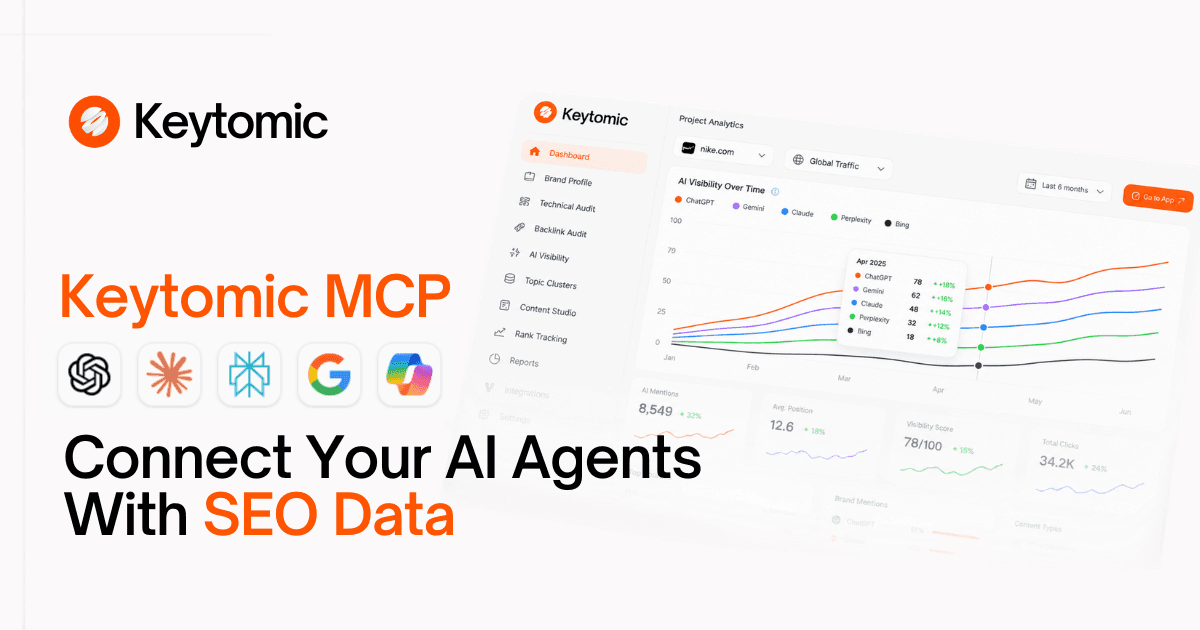
Most SEO MCP servers fall into one of two categories: keyword-database wrappers that give you estimated industry data, or open-source local servers you have to host and maintain yourself. Keytomic sits in a different lane entirely.
The Keytomic MCP connects your AI assistant directly to your own site's data — real Search Console clicks, impressions, and positions; a live technical SEO audit of your whole site; indexing status and sitemap health; Core Web Vitals and on-page issues. The output is not raw data dumped into a chat. It is ranked, actionable insight: quick-win keywords closest to page 1, pages losing traffic sorted by clicks at stake, broken links and orphan pages grouped by severity.
What Keytomic MCP Can Do
From Search Console:
Quick wins — queries ranked 5–20 with real impressions, with the page and the recommended fix for each
Decaying pages — traffic drops against the prior period, ranked by clicks lost
CTR gaps — pages with high impressions and underperforming click-through rates
Keyword cannibalization — queries where two of your URLs compete
Rank movement — every keyword that gained, dropped, appeared, or vanished since last month
Device and country segments — mobile vs. desktop performance by page and country
From a full site crawl:
Status code errors (4xx, 5xx), redirect chains, missing titles and meta descriptions
Duplicate H1s, thin and near-duplicate pages
Index coverage — noindex tags, canonical conflicts, robots.txt blocks
Core Web Vitals — LCP, INP, CLS on your top pages
Broken internal links and orphan pages
Canonical, hreflang, schema, robots.txt, and XML sitemap validation
Indexing actions:
URL inspection — live Google index status for any URL
Sitemap health — your sitemaps in Search Console with their status and errors
Submit a sitemap — trigger a submission from a single prompt
Sync sitemaps — submit every sitemap Keytomic found on your site in one step
What Makes It Different in 2027
Three things set Keytomic apart from every other server in this list:
1. Your real data, not estimates. Every other commercial SEO MCP server wraps a keyword or backlink database — useful, but still an estimate. Keytomic reads the actual clicks, positions, and impressions your site gets from Google via the Google Search Console integration. When it tells you a keyword is at position 9.4 with 3,120 impressions, that is your real number.
2. Answers ranked by what to do first. Every prompt comes back with a prioritized list — not a raw export you have to sort. Quick wins are already sorted by clicks at stake. Crawl issues are grouped by severity. Technical fixes are written in plain language, highest impact first.
3. One URL, no keys, any client. Paste https://app.keytomic.com/mcp into Claude, ChatGPT, Cursor, or any MCP-compatible assistant. Sign in with your Keytomic account. No API keys to generate, no Node.js to install, no process to keep running. Setup takes about a minute.
It is also the only server on this list that covers every project on your account from a single connection — useful for agencies running multi-client SEO.
Ready-to-Use Prompts
Pricing: Included in all paid Keytomic plans. No extra cost, no API credit metering. See Keytomic pricing.
2. SE Ranking MCP — Best All-in-One Commercial SEO Data
Best for: In-house teams and agencies that need keyword research, backlinks, rank tracking, site audits, and AI search visibility all in one server.
Deployment: Remote (hosted) | Starting price: $129/mo or $50 pay-as-you-go

SE Ranking's MCP server is the most comprehensive third-party SEO data server available in 2027. With 180+ tools exposed through a single connection, it covers keyword research, domain analysis, backlinks, rank tracking, site audits, and — critically — AI search visibility across ChatGPT, Google AI Overviews, and Perplexity. It supports a 14-day free trial with 100,000 API credits, which is enough to run substantive research before committing.
What it does well:
5.4B keyword database across 188 countries
Backlink analysis and domain research
Website audits with on-page scoring
AI search visibility tracking (GEO) — how often your brand appears in AI-generated answers
Rank tracking with competitive gap data
Watch out for: Like most commercial data MCPs, SE Ranking works on domain and industry data, not your live site-specific Search Console numbers. For actual click and impression data on your own site, pair it with a GSC-connected server like Keytomic.
3. Semrush MCP — Best for Keyword Research and Competitive Intelligence
Best for: Teams already on Semrush that want to bring keyword and competitive research into their AI workflow.
Deployment: Remote (hosted, official) | Starting price: Requires a Semrush subscription plus API package access
Semrush's official MCP server brings keyword data, domain analysis, trend data, backlinks, and competitive traffic intelligence into Claude, ChatGPT, or Cursor. The API-unit metering model means heavy keyword research sessions can consume credits quickly on large projects.
What it does well:
Keyword volume, difficulty, intent, and related-term data
Competitive domain traffic and keyword gap analysis
Trend intelligence and seasonal patterns
Market-level competitive data
Limitations: Read-only. No write actions. No direct Search Console connection. Works best as a companion to a site-specific server like Keytomic.
4. Ahrefs MCP — Best for Backlink Research
Best for: Link builders, content marketers, and SEOs who need deep backlink data and keyword research from a trusted index.
Deployment: Remote (official) | Starting price: Lite plan ($129/mo) and above

Ahrefs operates the deepest backlink index in the SEO industry — 35+ trillion backlinks across 456 billion indexed pages. Their official remote MCP server puts that data behind natural-language prompts, making it the clear first choice when backlink analysis and competitor link profiles are a core workflow. Their Ahrefs alternatives page shows where Keytomic fills the gaps Ahrefs leaves in publishing and automation.
What it does well:
Backlink profiling and link-building research
Keyword research with difficulty scores and traffic estimates
Competitor content gap analysis
Brand Radar monitoring for AI search mentions
Limitations: Read-only. API units are metered. Starts at 50 API units minimum per call.
5. DataForSEO MCP — Best Raw Data for Developers and Agencies
Best for: Agencies running at scale, developers building custom SEO pipelines, and technical teams that need raw SERP and keyword data billed per call.
Deployment: Remote or local (Node.js) | Starting price: Pay-as-you-go, $50 minimum deposit; SERP data from $0.0006/query

DataForSEO is infrastructure, not a dashboard. Their MCP server gives your AI assistant access to the same SERP, keyword, backlink, on-page, and content analysis APIs that power dozens of other SEO tools. No seat license, no subscription ceiling — you pay per API call.
What it does well:
Real-time SERP data across multiple search engines
Keyword data at scale (volume, CPC, intent, SERP features)
Backlink data and domain metrics
On-page analysis and content data
Limitations: More technical setup than hosted options. Best suited for teams comfortable with API-first workflows. For teams that want a no-code equivalent with your own site data, the Keytomic MCP is the zero-setup alternative.
6. Google Search Console MCP (Community) — Best Free Option
Best for: Any SEO team that wants free access to their own GSC data inside an AI assistant, and is comfortable with a local Node.js setup.
Deployment: Local | Starting price: Free (MIT licensed)
The community-maintained GSC MCP server gives your AI assistant direct read access to your Google Search Console data — queries, pages, devices, countries, and performance metrics. It requires running a local Node.js process and generating your own Google Cloud credentials, but costs nothing and has no metering.
For reference, see the Google Search Console integration Keytomic uses to give you GSC data without any local setup — for teams that want the same data without the configuration overhead.
What it does well:
Clicks, impressions, CTR, and position data from your own property
Date-range comparisons
Query and page filtering
Limitations: Requires Node.js, credential setup, and a process kept running. Read-only. Only sees your own GSC data.
7. Screaming Frog MCP — Best for Technical Crawl Workflows
Best for: Technical SEOs already using Screaming Frog SEO Spider who want to trigger and query crawls from their AI assistant.
Deployment: Local (desktop app) | Starting price: $279/yr (paid SEO Spider license, v24+)
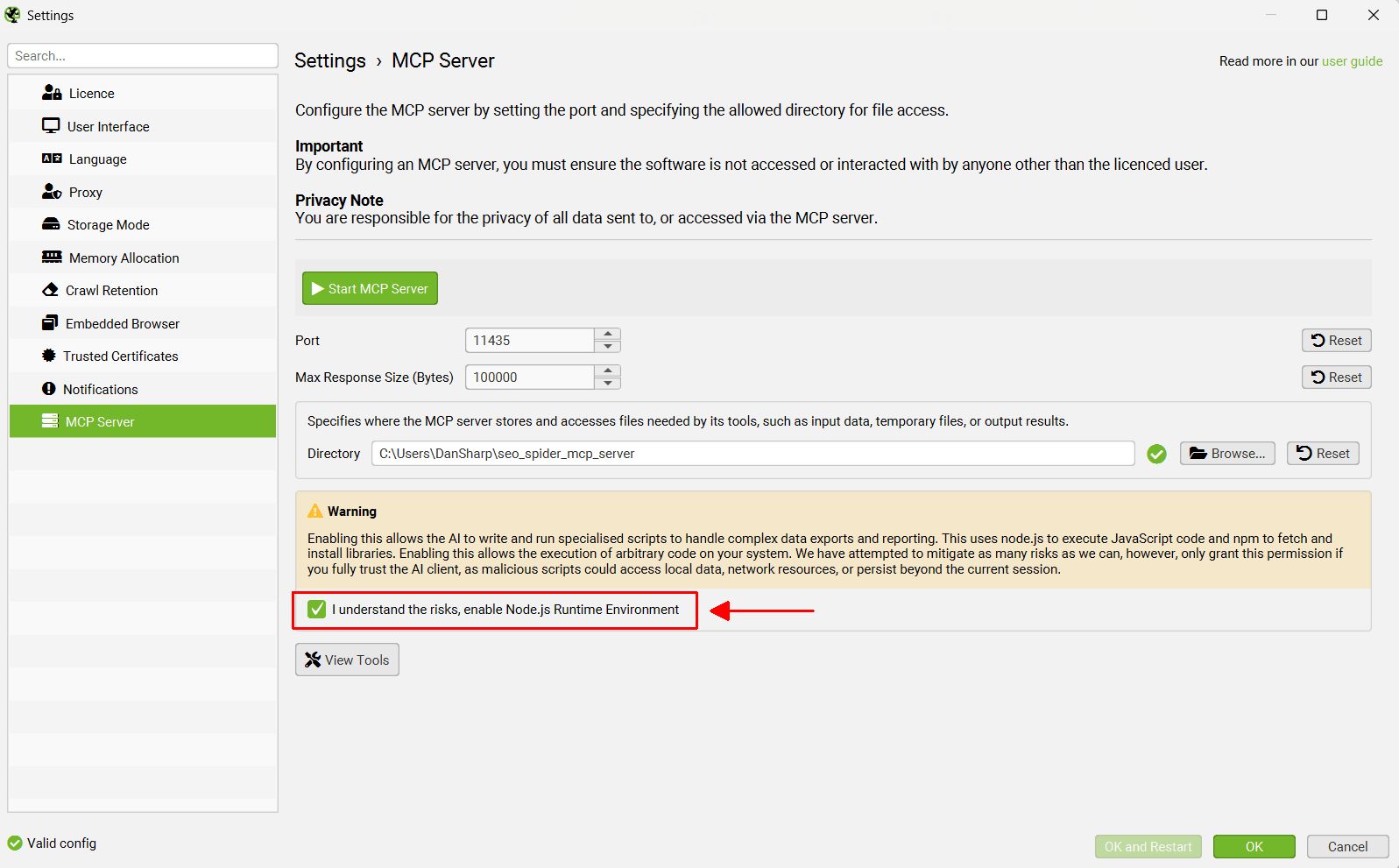
Screaming Frog's MCP integration runs inside the desktop app from version 24 onwards. It exposes crawl control, analysis, and exports to MCP-compatible clients. If your technical SEO workflow is already built around SEO Spider, this brings that data into your AI workflow without a separate server.
What it does well:
Desktop-quality crawl data for technical audits
Custom extraction and export through the MCP interface
Optional Node.js scripting integration
Limitations: Only runs while the desktop app is open. Requires a paid license. Local only. For a hosted alternative with a comparable technical SEO audit delivered from chat, Keytomic's MCP runs the same checks — status codes, redirects, canonicals, Core Web Vitals — remotely from any client.
8. Serpstat MCP — Best Budget-Friendly Full-Stack Option
Best for: Teams on a tighter budget that need keyword research, competitor analysis, rank tracking, AI Overview data, and audits in one server.
Deployment: Remote (OAuth) or local (npm) | Starting price: Team plan from $129/mo; 7-day trial available
Serpstat's MCP server covers keyword research, intent clustering, backlinks, site audits, rank tracking, and AI Overview monitoring in one connection. The OAuth-based remote setup is low-friction. Their HTTP and STDIO modes give flexibility for different development environments.
What it does well:
Keyword research with intent clustering
AI Overview monitoring
Site audits and backlink analysis
Pre-built Claude skill integrations
9. SEOMCP.io — Best Pay-Per-Call SEO Data for Developers
Best for: Developers and technical teams who want pay-as-you-go access to SERP, keyword, backlink, and on-page data without a subscription.
Deployment: Remote | Starting price: Pay-as-you-go; SERP from $0.00054/query, keyword volume from $0.054/1,000 keywords
SEOMCP.io is a clean, API-first SEO data service with an MCP server that exposes twelve data APIs as natural-language tools. Connect with claude mcp add seomcp --transport http https://mcp.seomcp.io and your assistant can query organic SERP results, keyword volumes, backlink profiles, domain data, AI LLM responses (ChatGPT, Gemini, Perplexity), and more — all billed per request.
What it does well:
SERP data across Google, Bing, YouTube, and other engines
Keyword volume, CPC, and competition data
AI optimization data — what LLMs say and which brands they mention
Domain and technology analysis
No subscription required; quiet months cost nothing
Limitations: Developer-first setup. No dashboard or pre-built reporting. Best combined with a site-data server like Keytomic for a complete workflow.
10. Firecrawl MCP — Best for Content and Extraction Tasks
Best for: Content teams that need the actual text of a web page pulled reliably for content gap analysis, summarization, or competitive research.
Deployment: Remote | Starting price: Free tier; Hobby at $19/mo

Firecrawl is a web scraper, not a keyword tool. But for content-led SEO workflows — content gap analysis, extracting top-ranking page content, or pulling structured data from any URL — it fills a gap that pure keyword servers leave open. Connect it alongside a keyword server and a GSC server for a complete research stack.
What it does well:
Pull clean markdown from any page, JavaScript-rendered or not
Search the web and return full-page content in one call
Crawl entire sites and extract structured data
Interact with pages (click, scroll, fill forms)
Limitations: Not an SEO tool — no keyword data, no rank tracking, no audits. Purely a data extraction layer.
How to Build the Right SEO MCP Stack in 2027
No single server covers everything. The working pattern among advanced SEO teams in 2027 is a 2–4 server stack.
For individual practitioners or small teams
Start with Keytomic (your own site data, zero setup)
Add SE Ranking or Ahrefs depending on your primary workflow (keyword research vs. backlink analysis)
For agencies managing multiple clients
Keytomic for every client project from one connection
DataForSEO or SEOMCP.io for at-scale SERP and keyword data
SE Ranking for AI search visibility reporting
For in-house SEO teams
Keytomic for live site data and weekly quick-win workflows
SE Ranking or Semrush for competitive keyword and market intelligence
Firecrawl for content research and competitive page extraction
The one question that decides your stack
Ask: "Do I need data about my own site, or data about the market?"
Your own site data — what you rank for, what's breaking, where you're losing clicks — comes from your Search Console and your crawl. Keytomic's MCP is built specifically for this. If you are building recurring SEO automation workflows, this is the data layer to start with.
Market data — competitor keywords, backlink profiles, industry trends — comes from commercial indexes. SE Ranking, Ahrefs, Semrush, and Serpstat all cover this.
Most productive SEO workflows need both. Wire them together and your AI assistant becomes the analyst you always wanted — one that reads your actual numbers and acts on them.
What Most SEO MCP Get Wrong
Most SEO MCP servers are read-only. They pull data and surface it in chat, but they cannot take action on your behalf. Submitting a sitemap, updating a setting, triggering a crawl — these are write operations, and most servers do not support them.
By 2027, the most useful SEO MCP servers are starting to blur this line. Keytomic's MCP can submit sitemaps, sync sitemap lists, and update settings in your Keytomic projects. These write capabilities are still the exception, not the rule — but they represent where the ecosystem is heading.
The other gap: AI search visibility. Google's market share has compressed as ChatGPT, Perplexity, and Gemini handle more queries directly. By 2027, appearing in AI-generated answers — what practitioners call GEO (Generative Engine Optimization) or AEO (Answer Engine Optimization) — is a standard deliverable alongside traditional rankings. You can run an AI visibility audit to see where you stand. Of the servers on this list, SE Ranking and Keytomic's AI Visibility Tracker both cover this. Most keyword-data servers do not.
The third gap: your own data vs. a keyword estimate. Every keyword database returns estimates — modeled search volumes, estimated traffic, approximate difficulty scores. Your own Search Console data returns the actual clicks, positions, and impressions your site receives. These are different things. The best SEO MCP stack uses both: your own data for diagnosis and prioritization, third-party data for discovery and competitive research.
Frequently Asked Questions
What is the best SEO MCP server?
There is no universal best — the right server depends on the job. For working on your own site's data with zero setup, Keytomic is the most practical option. For keyword and competitive research, SE Ranking, Ahrefs, or Semrush depending on your priorities. For raw SERP data at scale, DataForSEO or SEOMCP.io.
What is the best free SEO MCP server?
The community-maintained Google Search Console MCP is free and MIT licensed, giving you direct access to your own GSC data. Keytomic offers a free trial with full MCP access included.
Can I use multiple SEO MCP servers at once?
Yes. Most MCP-compatible assistants support multiple simultaneous server connections. Claude, ChatGPT, and Cursor all allow this. Connecting 2–3 servers (for example, Keytomic + SE Ranking + Firecrawl) is the typical working stack.
Do SEO MCP servers change my site?
Most do not. The majority are read-only data servers. Keytomic's MCP can take limited actions (submit sitemaps, update Keytomic settings) but does not modify your site's content, code, or CMS settings.
What AI assistants work with SEO MCP servers?
Claude, ChatGPT, Cursor, Claude Code, Codex, Gemini CLI, and Windsurf all support remote MCP servers. Any assistant that implements the open MCP standard can connect to any compliant server.
Ahrefs vs Semrush vs DataForSEO MCP — which should I pick?
Ahrefs if backlink research is your primary workflow. Semrush if you need keyword research, trend data, and competitive traffic intelligence in one subscription. DataForSEO or SEOMCP.io if you want pay-per-call pricing without a seat license — best for agencies and developers building custom pipelines.
Is there an SEO MCP server that covers AI search visibility?
SE Ranking's MCP includes AI search visibility data covering ChatGPT, Google AI Overviews, and other AI answer engines. Keytomic's broader platform includes an AI Visibility Tracker monitoring your brand's appearance across ChatGPT, Claude, Gemini, and Google AI Mode.
Is MCP better than a direct SEO API?
It depends on the job. MCP suits conversational, ad hoc access to data; a direct API suits deterministic batch jobs, engineering-owned pipelines, and anything you need to test and log in code. Many teams use both. See the broader comparison in our guide to SEO automation.
Summary
SEO MCP servers in 2027 have matured from a developer curiosity into a practical part of how SEO teams work. Your AI assistant can now read your actual site data and act on it, without leaving the chat.
The short version:
Best for your own site data: Keytomic
Best all-in-one keyword + GEO data: SE Ranking
Best for backlinks: Ahrefs
Best for keyword research and competitive intelligence: Semrush
Best for raw data at scale: DataForSEO / SEOMCP.io
Best free option: Community GSC MCP
Best for technical crawls: Screaming Frog
Start with what your workflow actually needs. If you are doing SEO on your own site and want fast wins from your real Search Console data, Keytomic's MCP is one URL and one sign-in away. If you want to go deeper on the automation layer, read our guide on how to build an SEO AI agent.