An AI SEO agent is usually the better fit when your team can set strategy and review output but needs repeatable research, content, publishing, and visibility workflows.
An SEO agency is a better fit when you need specialist judgment, complex implementation, outreach, or someone else to own execution.
A hybrid model can combine automated production with human strategy and review.
You're choosing between another software subscription and an outside team, and either way someone on your side still has to approve strategy and sign off on what goes live. Most comparisons skip that part.
The real question isn't whether AI can perform SEO tasks. It's which tasks can be automated safely, who reviews them, and who owns the result.
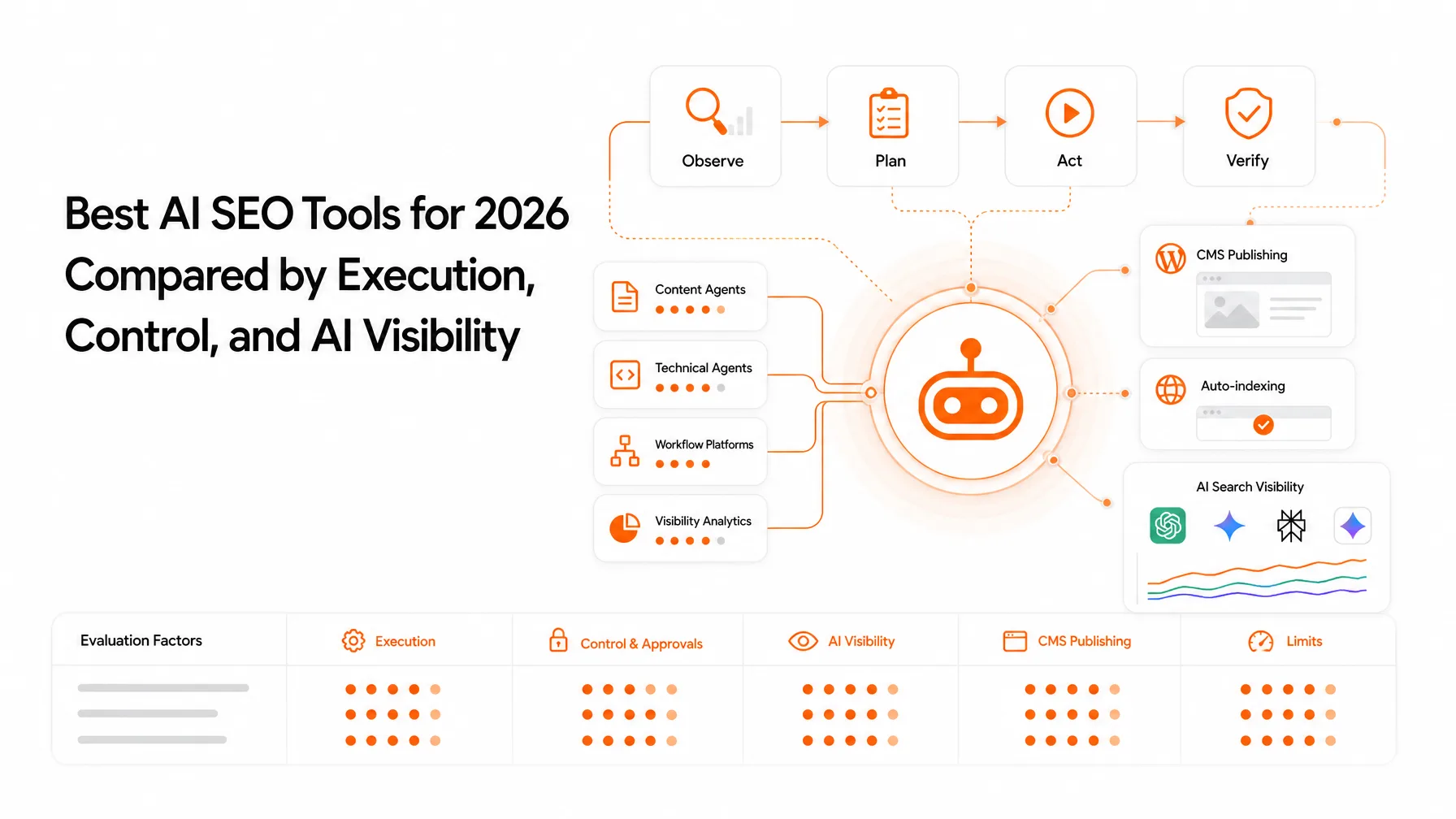
I'll compare cost structure, expertise, control, publishing workflow, scalability, and AI search visibility, then show when a hybrid beats picking a side. One disclosure: the Keytomic SEO automation platform publishes this page and appears later as one example of the software model, alongside an honest look at when a traditional SEO agency is the smarter call.
AI SEO Agent vs SEO Agency: Quick Comparison
Both are delivery models, not rival technologies. An AI SEO agent is software that performs or coordinates repeatable SEO tasks, while an SEO agency is a human-led service provider.
How I evaluated them: public product documentation, official pricing pages, Google Search guidance, and buyer criteria covering cost structure, control, oversight, scalability, and implementation. This isn't a hands-on test of every AI SEO platform or SEO agency.
Choose by the work you need done
Keyword research, briefs, drafting, publishing, and monitoring repeat every week, so they suit software. Migrations, outreach, and strategy calls depend on judgment and relationships, so they lean toward people.
Criterion | AI SEO agent | Agency | What to verify |
|---|---|---|---|
Cost model | Recurring subscription | Retainer, project fee, or a mix | Plan limits, scope, internal review time |
Strategy | Your team sets direction | Human-led, depth varies | Who makes final priority calls |
Execution speed | Repeatable tasks on demand | Depends on team capacity | Turnaround terms |
Human oversight | You approve output | Agency reviews, you approve | Who signs off before publishing |
Implementation | Supported integrations and permissions | Set by statement of work | Who edits the site and rolls back |
Scalability | Repeats across projects within plan limits | Scales with headcount | Seats, sites, accounts |
AI search visibility | Depends on the product | Depends on agency scope | What's measured and how |
Best fit | Teams that can direct and review | Teams needing specialists or accountable execution | Your internal capacity |
How to read the comparison
Look at the last column first. Questions like who approves a change and who can roll it back often decide more than feature counts.
I'd treat this as an operating-model decision, not a simple tool comparison.
What an AI SEO Agent Actually Does
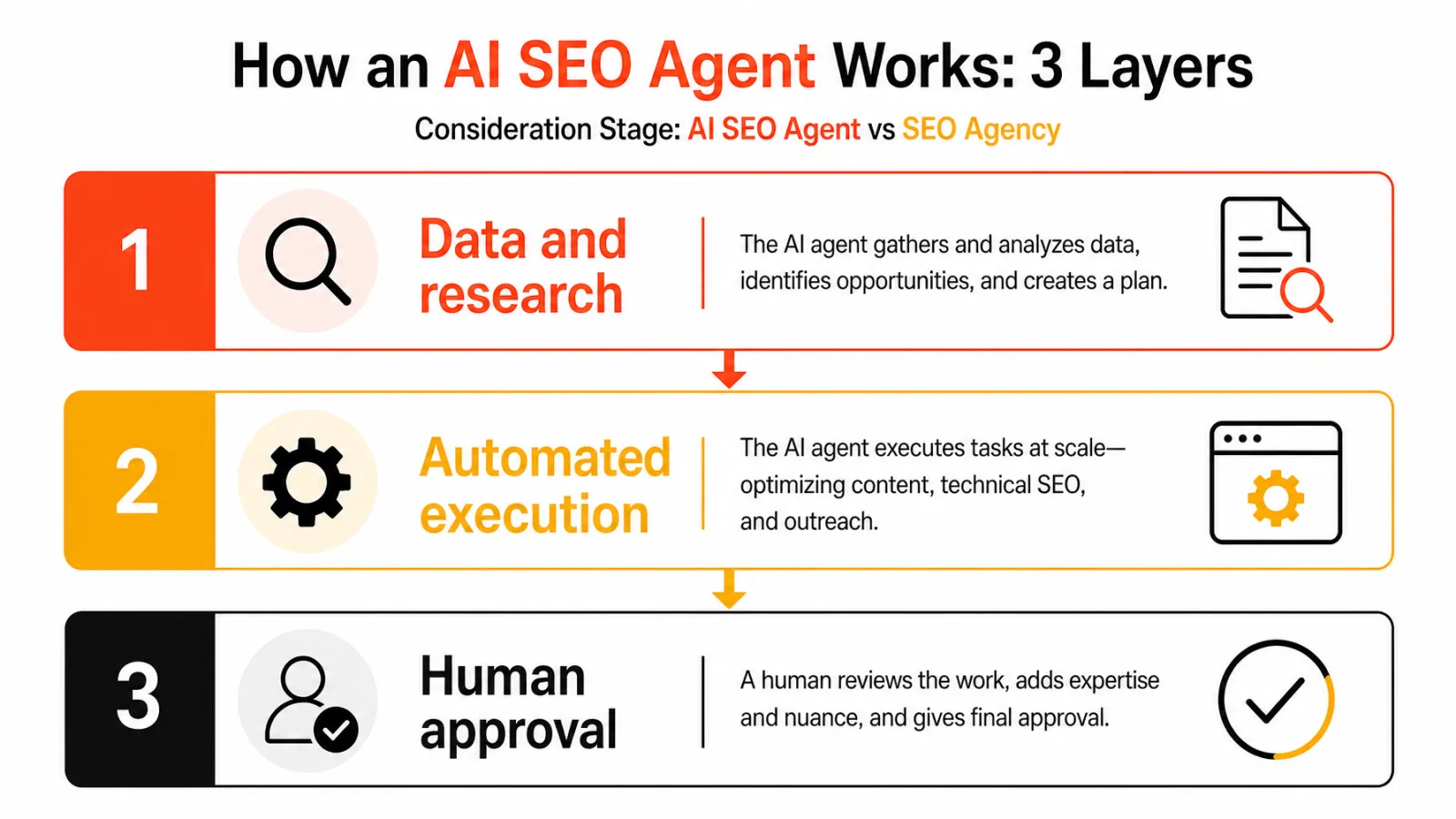
An AI SEO agent coordinates or executes repeatable SEO tasks inside a connected workflow. Picture three layers: data and research, automated execution, and human approval. The first two move fast, but the third decides whether output is safe to publish.
From keyword research to visibility monitoring
Depending on the product, an agent can cover these stages:
Keyword research and topical planning
Content briefs and drafts
Technical audits that flag issues
CMS publishing, where the product supports it
Indexing support and Google Search Console reporting
Google and AI search visibility tracking
Those stages are the repeatable core of SEO automation workflows, so approval gates and measurement ownership matter as much as the automation.
What still needs human approval
The word agent doesn't prove autonomous publishing, safe execution, or guaranteed results. Google's guidance on generative AI content focuses on accuracy, originality, and usefulness, not on whether AI was involved.
Strategy, fact-checking, brand positioning, regulated content, and high-risk technical changes should stay with people.
AI SEO agent versus AI SEO tool
A tool reports, an agent performs or coordinates tasks, and an agency provides a human-led service. Plenty of AI SEO software is really a dashboard with a chat window, so ask what it can actually change.
For broader criteria, see how to choose SEO automation software, and for terminology, read agentic SEO explained.
What an SEO Agency Provides
An SEO agency sells human capacity, judgment, and coordination, and often hands-on execution. The exact scope lives in the statement of work, so strategy, deliverables, and reporting aren't the same thing as outcomes.
Strategy and specialist execution
A good engagement brings someone who can prioritize, spot problems early, and explain tradeoffs plainly. Depending on the contract, that can include:
Strategy and prioritization
Technical SEO recommendations or fixes
Content planning and editorial review
Link acquisition or digital PR
Reporting and interpretation
Access, accountability, and stakeholder management
Agencies also give you a named contact, a communication cadence, and someone chasing developers, legal, or brand teams. Ask who owns implementation when a recommendation needs one of those approvals, because that's where plans stall.
Where agency scope varies
Services differ by contract. Don't assume every SEO agency includes link building, technical implementation, content publishing, or AI search work; confirm each line item. Agencies aren't slow or opaque by default, either.
AI SEO Agent vs SEO Agency: Feature-by-Feature Comparison
A listed capability isn't a performance claim. This matrix adds what to verify and a buyer test for each layer.
Layer | AI SEO agent | Agency | What to verify before buying | Buyer test |
|---|---|---|---|---|
Strategy and keyword research | Automates research and keyword mapping; your team sets direction | Human-led; depth depends on scope | Data sources, who sets priorities | Can you explain why each topic was chosen? |
Content and CMS publishing | Drafts and stages content; publishing depends on supported CMS | Editorial support varies | Permissions, approval gates, rollback | Who approves, and who can undo a live change? |
Technical SEO | Audits flag issues; fixes need a developer | May advise or implement | Who edits the site | Who makes the change? |
Links | Surfaces opportunities where supported | Outreach only if in scope | Methods and reporting | How are links earned and reported? |
Reporting and AI visibility | Collects data on a schedule | Interprets results; AI work varies | Metric definitions | How is each result measured? |
SEO strategy and keyword research
Software handles clustering, gap analysis, and keyword mapping quickly. Deciding which topics fit the business is still judgment, whether it comes from your team or an agency.
Content production and CMS publishing
An agent can draft and stage content, but verify the CMS connection on the vendor's official page before assuming it. Agencies may write, edit, or only advise, so check the contract.
Technical SEO, links, and implementation
Audits find problems; developers fix them. Software can surface backlink opportunities, but outreach and digital PR are human work that only some agencies include.
Reporting and AI search visibility
Keep five signals separate: being mentioned, being cited, appearing in a Google AI feature, earning a click, and converting. ChatGPT, Perplexity, Gemini, and Claude each behave differently, and vendors define these signals in different ways.
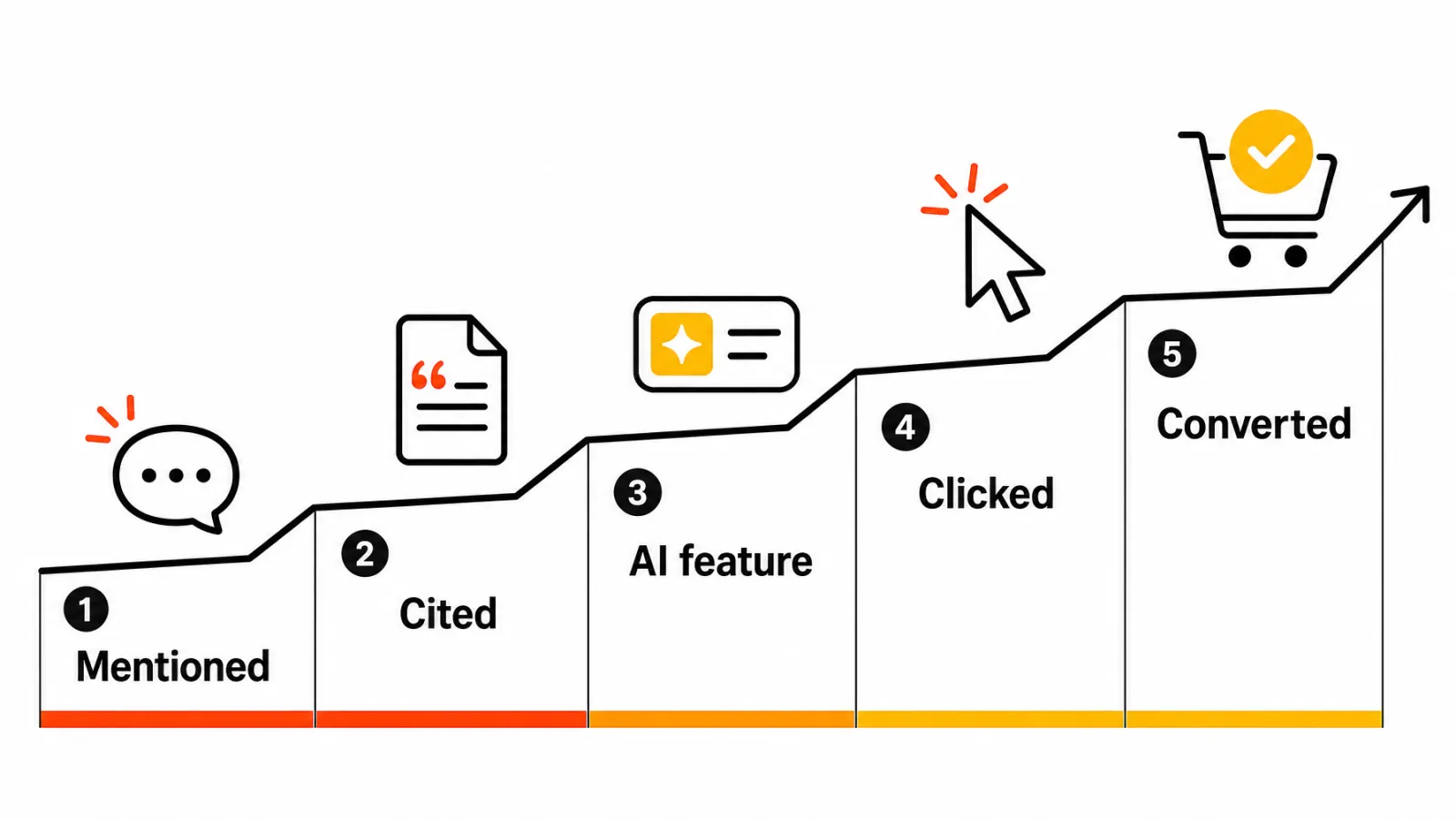
Google Search Console's performance reports give you clicks, impressions, queries, and pages as a baseline. Google says standard SEO fundamentals still apply in Google's guidance on AI features and websites, and inclusion isn't guaranteed.
What changes the total cost, control, and scalability?
Recurring price versus internal operating cost
Software fees are easy to inspect, while SEO agency costs depend on scope, team, contract, and implementation rights. I won't publish a universal agency range, and neither model is automatically cheaper.
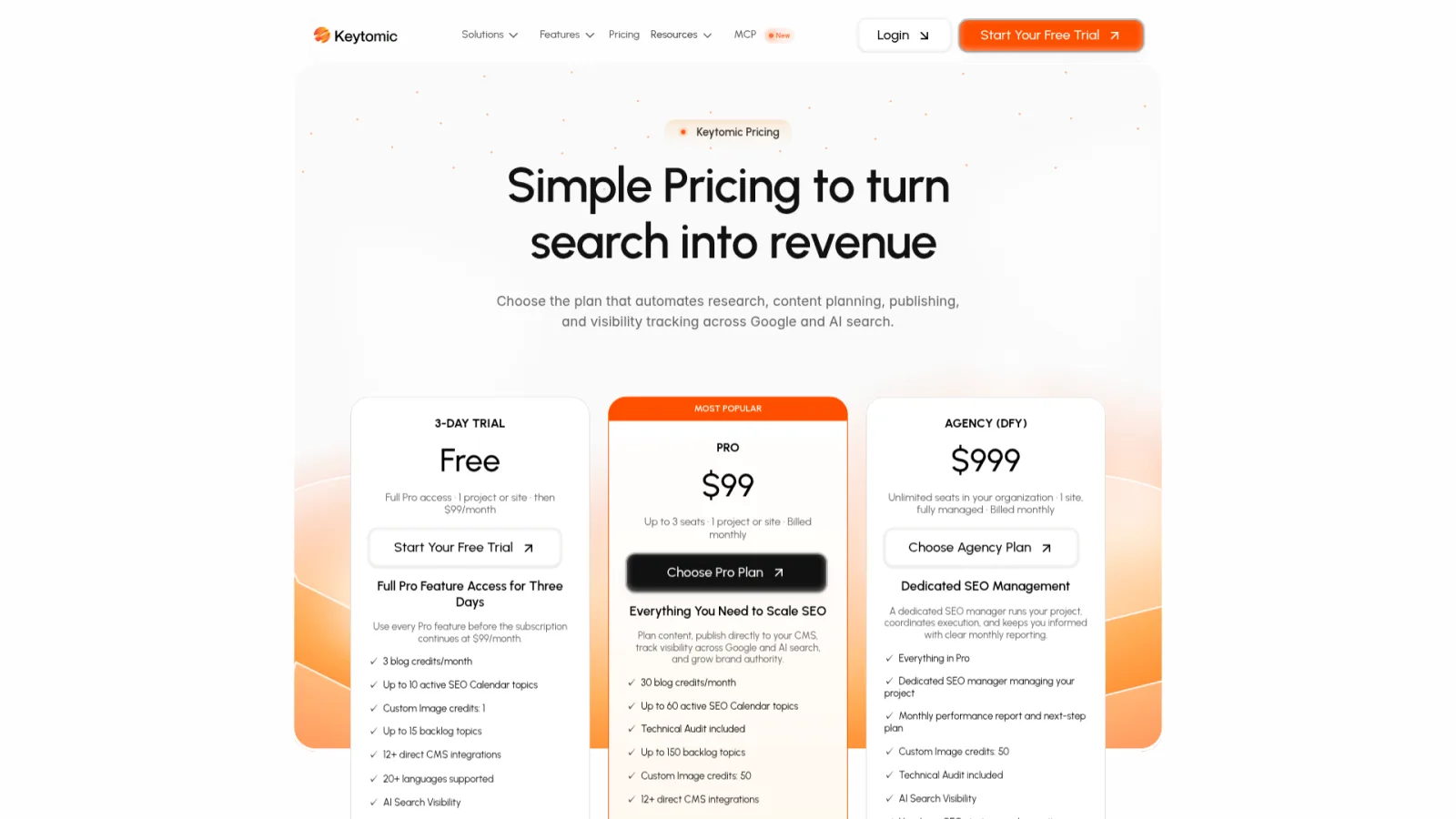
Here's a planning framework, not a market benchmark: total cost equals the direct fee plus internal review, implementation, coordination, and switching cost. As of October 2026, Keytomic pricing and plan details list a 3-day trial, a Pro plan at $99 monthly, and an Agency plan at $999 monthly that includes dedicated SEO management.
Pricing and product details were checked in October 2026. Plans, features, integrations, and availability can change, so verify current details before buying.
Approval capacity and governance
Control comes down to who reviews. Software can produce more drafts than your team can responsibly read, so count weekly approval capacity before you count credits.
With an agency, ask who approves recommendations on your side and how quickly changes get implemented.
Multi-site and multi-client scaling
Software scales by repeating a workflow across projects within plan limits, so check seats and sites before mapping clients. Agencies scale with headcount and contract scope. For multi-client work, ask who has capacity to review each account, not just who can produce output.
Is an AI SEO agent better than an SEO agency for a small team?
It depends on three questions. Can we review the output? Can we implement technical changes? Do we need specialist relationships or accountability?
Choose an AI SEO agent if your work is repeatable
You publish often and the workflow repeats
Someone can review drafts and approve changes
You're juggling fragmented tools and want fewer handoffs
You manage several sites and need a consistent process
Choose an SEO agency if the work is complex or high-touch
You're planning a complex migration
You need technical SEO beyond internal capacity
Regulated content needs specialist review
You want outreach or digital PR handled for you
You want someone else to own execution
Use a hybrid model when execution and judgment are split
Let software handle research, briefs, drafting, publishing stages, and monitoring, while your team or an agency owns strategy, facts, brand judgment, and exceptions. Write the handoff down: who proposes, who approves, who publishes, and who measures.
How Keytomic supports an approval-based SEO workflow
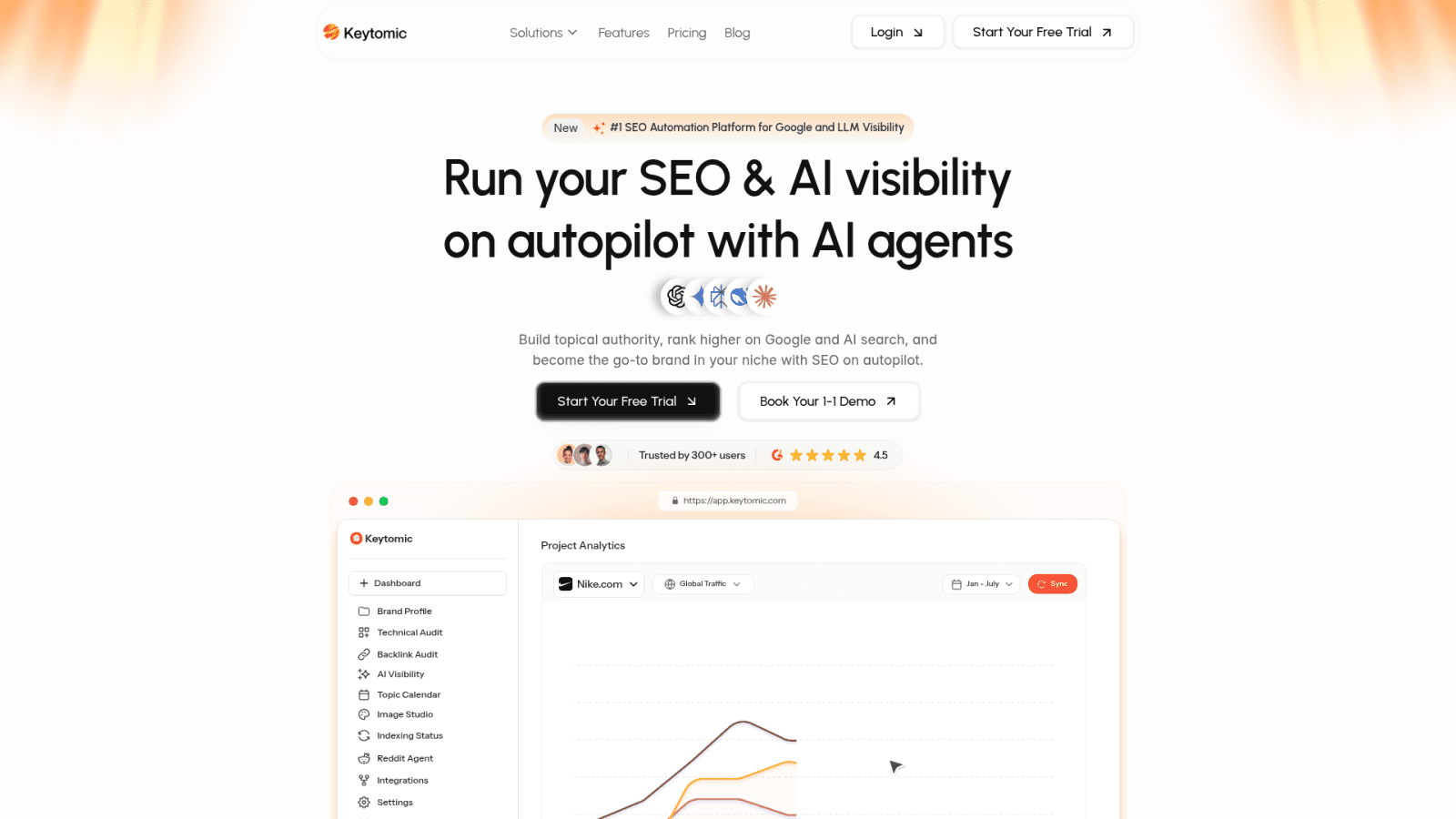
Disclosure: Keytomic publishes this comparison and is included as an example of the software model discussed. It positions itself as a connected workflow from research and planning through writing, publishing, indexing, and tracking, while its terms put review and publishing responsibility on the customer and make no guarantee of rankings, traffic, citations, or conversions.
Research and planning before content production
Keytomic combines keyword research and topical planning, so topics start from a plan instead of a blank page. Strategic topic selection still needs human judgment based on your business goals.
Drafting, publishing, indexing, and tracking
From there, the workflow covers content creation, technical audits, CMS publishing, indexing, backlink opportunities, and visibility tracking across Google and AI search. The point is the approval boundary: the platform stages the work, and your team decides what ships.
When Keytomic is not the right fit
Keytomic isn't a substitute for every forensic crawler, specialist backlink database, developer, legal reviewer, or strategic agency relationship. Drafts still need factual, brand, and regulated-content review. For migrations or heavy outreach, an agency is likely the better fit.
Questions to ask before choosing an SEO delivery model
Use these as a checklist, and ask an ownership question for every feature question.
Questions about goals and ownership
What are we trying to achieve, and who owns that goal internally?
Who sets strategy, and who approves content before it goes live?
Who makes technical changes, and who can roll them back?
Questions about proof and reporting
Which data is connected, such as Google Search Console?
How are rankings, clicks, AI visibility, and conversions defined?
Can the provider show verifiable examples of work?
Questions about access, risk, and exit
What permissions are needed, and can I revoke them?
How are errors corrected, and what fits our budget and publishing volume?
What happens to workflows, content, and access if I leave?
Frequently Asked Questions
What is the difference between an AI SEO agent and an SEO agency?
An AI SEO agent is software that performs or coordinates repeatable SEO tasks, while a human-led service provider delivers strategy, expertise, and often execution.
Can an AI SEO agent replace an SEO agency?
Sometimes for repeatable execution, but not automatically. It depends on your capacity for strategy, review, technical implementation, and accountability.
Is an AI SEO agent better for a small business?
It can be, if the work is repeatable and someone can review the output. Without a reviewer, the risk rises.
Which SEO tasks should stay human?
Strategy, fact-checking, brand positioning, regulated content, high-risk technical changes, and specialist outreach should stay human, even when software handles drafts and monitoring.
Do AI SEO agents publish content automatically?
Some products support publishing, but verify the approval, permission, and CMS workflow for each one. Don't generalize from one product to the category.
Are SEO agencies more expensive than AI SEO software?
The pricing models differ, so compare total cost rather than assuming either is cheaper. Include internal review, implementation, and switching costs.
How do I measure whether an AI SEO workflow is working?
Track Search Console impressions, clicks, queries, pages, and indexing status, plus conversions and clearly defined AI visibility signals. Don't treat citations as conversions.
Can I use an AI SEO agent and an SEO agency together?
Yes, if responsibilities and handoffs are explicit. For example, software handles recurring production while the agency owns strategy or complex implementation.
What should I ask before buying AI SEO software?
Ask about permissions, data sources, approval gates, CMS support, rollback, reporting definitions, pricing limits, and human review requirements.
What should an SEO agency prove before I hire it?
It should prove scope, responsible people, implementation rights, reporting definitions, communication cadence, contract terms, and verifiable examples of work.
Make the decision by assigning the work, not by choosing the hype
Here's the operating rule I'd use. Automate repeatable tasks when your team can review them, bring in an SEO agency when specialist judgment, implementation, relationships, or accountability are central, and combine both when the handoffs are clear.
Your next step is practical: map your current SEO workflow, find the most repetitive stage, and check whether an approval-based platform like Keytomic or agency support fits that stage. The right model is the one where every task, and its approver, is easy to name.