Key Takeaways
AI visibility tracking tools measure a chosen set of prompts and show brand mentions and cited sources across the answer engines your plan supports.
Entry-plan coverage differs from vendor-wide coverage: Otterly Lite includes four engines and charges $9/month extra for Gemini and $29/month for Claude, while Peec Starter covers three selected models.
Among plans with a stated daily limit, prompt caps run from 15 (Otterly Lite) to 75 (SE Visible Basic), so the sample you can afford shapes what you learn.
A prompt check, a brand mention, a cited URL and a referral visit are four different measurements, and Google's generative AI reports cover only Google surfaces.
Keep prompt-level answers and cited sources, because a score alone doesn't tell you what to fix.
Choose an AI visibility tracker by the engines your plan actually covers, the number of prompts it samples, the source evidence it keeps and the full monthly bill. The right plan is the one whose documented sample answers your business question, not the one with the longest feature list.
If you're an SEO manager, you've probably been asked whether the brand shows up in ChatGPT, and your rank tracker had nothing to say. AI visibility tracking tools fill that gap, but they sample different prompts (a prompt is one tracked question), cover different engines on entry plans and price very differently.
This article is for SEO managers and marketing teams buying software for recurring tracking, with founders a close second. I compare nine tools at plan level, using the prompt, citation and export terms that matter when you defend a budget. After 7+ years across SaaS, product marketing, SEO and AI search, I weigh every plan by whether it leads to a content decision.
Prices and features are current as of November 2026.
Keytomic is our product and the publisher of this article.
What is an AI visibility tracking tool?
An AI visibility tracking tool is software that monitors how your brand appears in AI-generated answers across engines like ChatGPT, Perplexity, Gemini and Google AI Overviews. It runs a defined set of prompts on a schedule, records whether your brand is mentioned or cited in the response, and shows how your presence compares to competitors over time. Unlike a rank tracker, which measures position on a results page, an AI visibility tracker measures whether your brand is named inside the answer itself — a fundamentally different signal as search shifts from links to synthesized responses. For a broader look at how these tools fit into the category, see our guide to AI visibility tools.
Quick picks
Best for daily monitoring across multiple projects: SE Visible by SE Ranking
Best for prompt-focused tracking with selectable models: Peec AI
Best for a low-cost daily baseline: Otterly.AI
Best for investigating cited sources by owner: Scrunch AI
Best for pairing monitoring with planning and publishing: Keytomic
Best for choosing a snapshot schedule: Search Atlas
Best for researching a broad indexed set of AI answers: Ahrefs Brand Radar
Best for Semrush-based workflows with CSV exports: Semrush AI Visibility Toolkit
Best for enterprise prompt research: Profound
How we chose
I ranked nine tools on four criteria: named engine coverage, prompt capacity and cadence, citation and competitive evidence, and price with workflow fit. The lens is a typical SEO manager who needs recurring monitoring, so documented daily capacity and named engines carry the most weight, then source evidence, then cost. I used official product, pricing and help pages, researched in November 2026. This is an editorial method, and the order reflects fit rather than a score.

AI visibility tracking tools compared
SE Visible leads Peec for this buyer on documented Basic versus Starter prompt capacity, project count and monthly price. Every cell below is a fact from that vendor's own pages, and each engine cell describes the named plan, not everything the vendor offers elsewhere. The order is a fit judgment, so a higher row doesn't win every column.
Rank | Tool | Best for | Supported engines | Prompt and cadence | Citation or reporting | Plan cost and workflow |
|---|---|---|---|---|---|---|
1 | SE Visible | Multi-project daily monitoring | ChatGPT, Gemini, AI Mode, AI Overviews (Basic) | 75 daily; five projects | API, Looker Studio | $89/month, monthly billing |
2 | Peec AI | Selectable models | Three selected models (Starter) | 50 daily; one project | Agency credit unit documented | $95/month Starter |
3 | Otterly.AI | Low-cost baseline | ChatGPT, AI Overviews, Perplexity, Copilot; Gemini and Claude add-ons | 15 daily | Citation tracking | $29/month Lite |
4 | Scrunch AI | Cited-source owners | ChatGPT, Perplexity, AI Overviews, Copilot (Core) | 125 prompts; 5,000 responses/month | Brand, competitor, third-party filters | $250/month Core |
5 | Keytomic | Tracking plus publishing | ChatGPT, Perplexity, Gemini named | User-defined, scheduled | Full answers, cited sources, competitors | $99/month Pro; one site |
6 | Search Atlas | Snapshot schedule | ChatGPT, Gemini, Perplexity, Copilot, AI Mode, Grok documented; plan-gated | Selectable snapshot frequency | URL-level citations, mention share | $199/month Growth |
7 | Ahrefs Brand Radar | Broad indexed research | Multiple AI indexes; Claude for custom prompts | Custom prompts; checks metered | Cited pages, AI Visibility Index | $199/month per index; $699/month all-platform |
8 | Semrush AI Visibility Toolkit | CSV-driven workflow | ChatGPT Search, AI Mode, Gemini (prompt tracking) | 25 prompts; daily updates | Cited pages; 10 daily CSV exports | $99/month toolkit |
9 | Profound | Enterprise research | ChatGPT, Gemini, AI Overviews in trial; up to nine on Enterprise | 50 daily for seven-day trial | Prompt Volumes research (Enterprise) | Trial; custom Enterprise |
Best AI tools for LLM visibility tracking
Every card below follows the same order: a descriptive opening, Best for, key facts, price, pros and cons. I write each con as a fit trade-off against the other tools.
1. SE Visible by SE Ranking
I rank SE Visible by SE Ranking first because Basic gives a recurring tracker the most documented daily capacity for the money. It runs 75 daily prompts across five projects and names four engines: ChatGPT, Gemini, Google AI Mode and AI Overviews. That list doesn't include Claude or Perplexity, which matters if those are on yours.

Best for: Daily monitoring across multiple projects. It wins on prompt capacity and cadence: 75 daily prompts and five projects for $89/month.
Key facts: API and Looker Studio access are included, and each project includes one location.
Price: $89/month, billed monthly.
Pros:
Highest daily prompt allowance among plans with a stated daily limit
Five projects, plus API and Looker Studio access for reporting
Cons:
One location per project on Basic, so location-specific tracking is limited
2. Peec AI
Peec AI is the closest rival to SE Visible for a small team, with a smaller sample at a slightly higher price. Starter tracks 50 prompts daily on three models you select, and the listed options include ChatGPT, Gemini and AI Overviews. Claude and Perplexity appear under Enterprise in the plan comparison. See how it stacks up in our Peec AI vs Keytomic comparison.

Best for: Prompt-focused daily monitoring with selectable models. It wins on model choice: you pick three models for 50 daily prompts.
Key facts: Starter includes one project. Agency plans run on credits, a separate mechanic from Starter: one prompt on one model for one day costs one credit, so 10 prompts on three models for a day uses 30 credits.
Price: $95/month for Starter.
Pros:
You choose which three models your 50 daily prompts run on
The documented credit unit lets agencies calculate usage
Cons:
One project on Starter
$6 more than SE Visible Basic for 25 fewer daily prompts
3. Otterly.AI
Otterly.AI has the lowest entry price in this set. Lite covers 15 daily prompts across ChatGPT, Google AI Overviews, Perplexity and Copilot, with citation tracking included. Gemini and Claude are paid add-ons, so the plan you see first isn't the plan most teams end up with. For a detailed side-by-side, read our Keytomic vs Otterly AI comparison.

Best for: A lower-cost daily baseline. It wins on entry price: $29/month for 15 daily prompts on four named engines.
Key facts: On Lite, Gemini costs an extra $9/month and Claude an extra $29/month. Neither is included in the base price.
Price: $29/month for Lite, billed monthly; $67/month with both add-ons.
Pros:
Lowest entry price among the plans compared
Citation source tracking on the entry plan
Cons:
A 15-prompt cap, the smallest daily sample here
Adding Gemini and Claude more than doubles the bill
4. Scrunch AI
Scrunch AI earns its place on citation detail. Its citation dashboard separates brand, competitor and third-party sources, so you can see who owns the URL an engine cites. Core includes 125 prompts, 5,000 monthly responses, one workspace, five users and four engines: ChatGPT, Perplexity, Google AI Overviews and Copilot. For more on how to act on this data, see our guide to LLM citations tracking.

Source owner matters for the next action. A cited third-party page points to outreach or a mention-earning play, while a cited page of your own points to a content review.
Best for: Investigating which brand, competitor and third-party URLs are cited. It wins on citation evidence: source-owner filters on a 125-prompt Core plan.
Key facts: Core allows five users in one workspace.
Price: $250/month for Core.
Pros:
Source-owner filters separate brand, competitor and third-party citations
Five users share one workspace

Cons:
Gemini, Claude and API access are Enterprise features
More than double the price of SE Visible Basic
5. Keytomic
Disclosure: Keytomic is our product and the publisher of this article.
Keytomic's AI visibility tracker runs the prompts you define on a schedule, then records the full response, the cited sources and the competing brands, with trends over time. The feature page names ChatGPT, Perplexity and Gemini. I rank it fifth because I put daily prompt capacity first for recurring monitoring, and Keytomic's strength sits in the workflow around the tracker.

Best for: Combining visibility monitoring with SEO planning and CMS publishing. It wins on workflow fit: Pro bundles AI search visibility, content planning, CMS publishing and a technical audit for $99/month.
Key facts: Pro covers one site and up to three seats. The trial lasts three days.
Price: $99/month, billed monthly.
Pros:
Full answer context: responses, cited sources and competing brands in one view
Content planning and publishing in the same plan as tracking
Cons:
Built for one site, so not the best choice for teams managing several client sites; SE Visible Basic offers five projects
6. Search Atlas
Search Atlas documents its AI visibility product, QUEST, with URL-level citations, mention share and a selectable snapshot frequency. The documented platform list includes ChatGPT, Gemini, Perplexity, Copilot, AI Mode and Grok, and availability depends on plan.
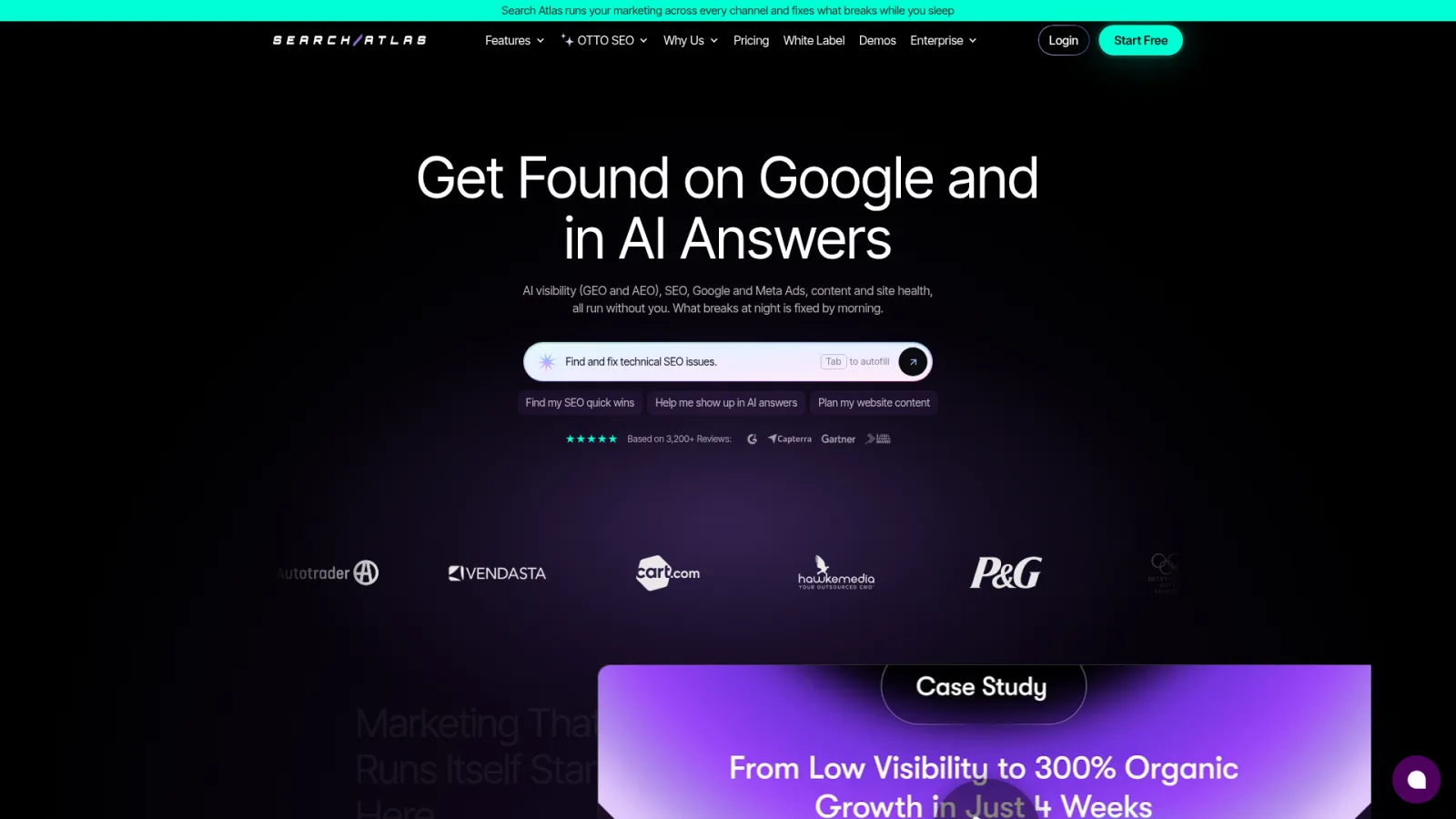
Best for: Choosing a snapshot schedule inside a broader SEO platform. It wins on cadence control: analysis frequency is selectable from daily through monthly.
Key facts: Growth unlocks the AI Visibility features.
Price: $199/month for Growth.
Pros:
URL-level citations and mention share in the documentation
A schedule you set, from daily to monthly
Cons:
Broader engine access is plan-gated
The entry point for AI visibility features is more than double SE Visible Basic's price
7. Ahrefs Brand Radar
Ahrefs Brand Radar splits its offer in two. The AI Visibility Index researches brand mentions and cited pages across a broad indexed set of AI answers, while custom prompts track your own questions. A single AI index costs $199/month, and all-platform index access costs $699/month and includes 2,500 checks.

Best for: Researching a broad indexed set of AI answers and cited pages. It wins on breadth: separate index products at $199/month each or $699/month for all platforms.
Key facts: Custom prompt packages start at $50/month for 2,500 checks, with plan requirements. Claude is available for custom prompts at eight checks per run, so 2,500 checks cover 312 Claude runs.
Price: $199/month per index; $699/month all-platform; prompt packages from $50/month.
Pros:
Index research and custom prompts as separate products
Claude available for custom prompts
Cons:
You budget separately for the index and the prompt-check package, plus plan requirements
Metered checks make cost depend on engine and run count
8. Semrush AI Visibility Toolkit
The standalone Semrush AI Visibility Toolkit costs $99/month and includes 25 tracked prompts and 10 CSV exports daily. Its prompt tracking documentation names ChatGPT Search, Google AI Mode and Gemini, with daily updates, competitor comparison and cited pages. Brand Performance reporting draws on a broader database with different platform coverage, so don't read the two as one list.
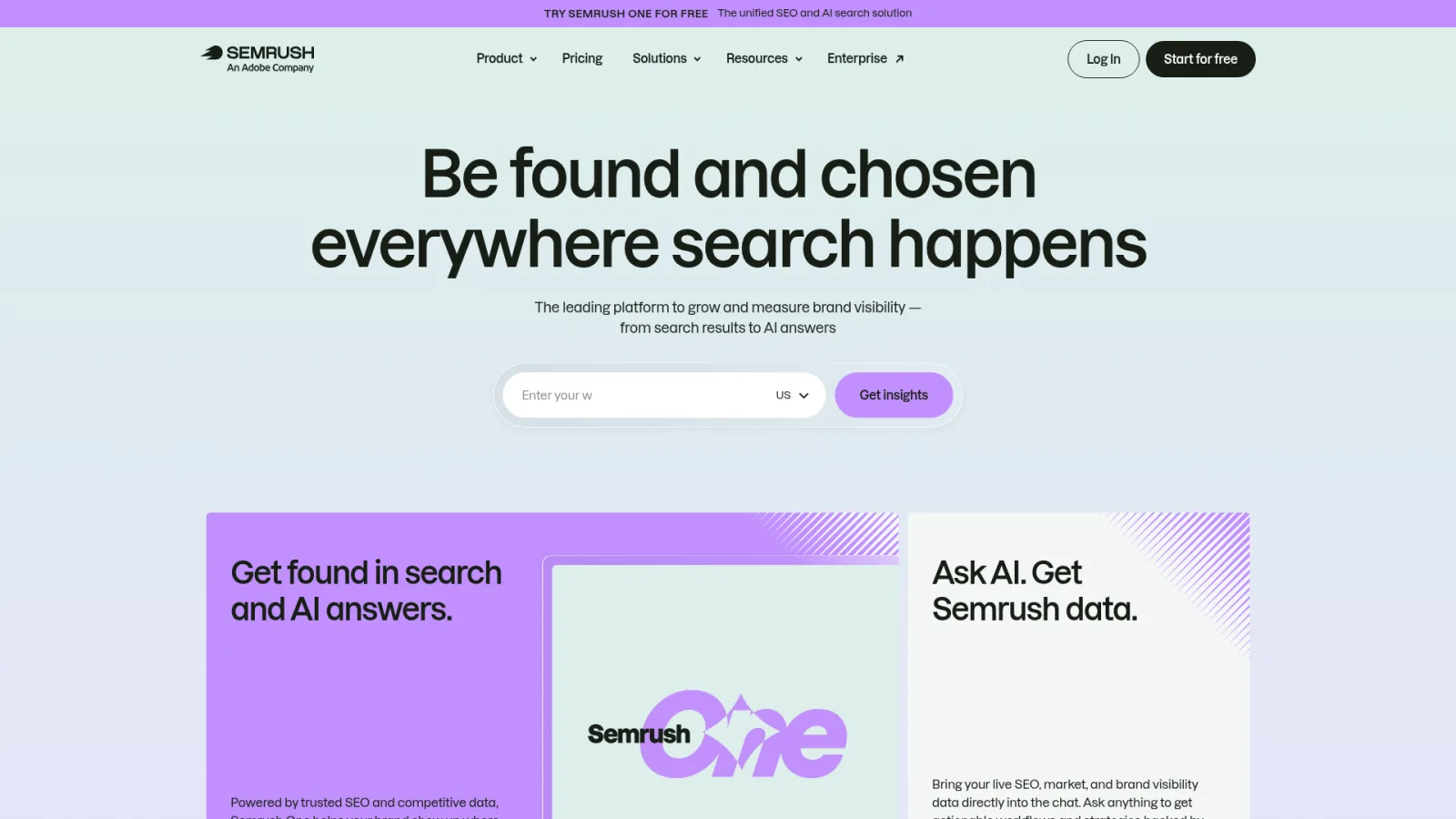
Best for: A Semrush-oriented workflow with CSV exports. It wins on reporting output: 10 daily CSV exports plus cited-page inspection.
Key facts: Prompt tracking and Brand Performance have separate coverage.
Price: $99/month for the toolkit.
Pros:
10 CSV exports daily for analysis outside the tool
Competitor comparison and cited pages with daily updates
Cons:
25 tracked prompts, a third of SE Visible Basic's 75, at $10 more per month
9. Profound
Profound's current pricing page leads with a seven-day trial of 50 daily prompts across ChatGPT, Gemini and Google AI Overviews. Ongoing tracking sits on Enterprise, which is custom priced, with daily tracking and capability for up to nine answer engines. Prompt Volumes research is available to Enterprise customers. See the full breakdown in our Profound vs Keytomic comparison.

Best for: Enterprise prompt research and custom monitoring. It wins on research depth: Prompt Volumes research and up to nine engines on Enterprise.
Key facts: The trial includes 50 daily prompts and lasts seven days.
Price: Seven-day trial; ongoing Enterprise pricing is custom.
Pros:
Up to nine answer engines on Enterprise
Prompt Volumes research for Enterprise customers
Cons:
Trial tracking lasts seven days, and ongoing daily tracking requires custom-priced Enterprise, so there's no listed monthly price to budget against
What do these tools track across AI answer engines?
The same engine name can mean different things on different plans. Otterly Lite includes ChatGPT, Google AI Overviews, Perplexity and Copilot, while Gemini ($9/month) and Claude ($29/month) are add-ons. Scrunch Core names four engines and holds Gemini and Claude for Enterprise, so I read every row as plan-level coverage.

AI Overviews, Gemini and AI Mode are separate Google surfaces, and ChatGPT, Perplexity and Claude each need their own coverage. Then separate the measurements:
Prompt check: one tracked question run on one engine.
Brand mention: your name appears in the answer text.
Citation: the answer links a source URL, yours or someone else's.
Referral visit: a person clicks through and lands on your site.
Scrunch's source-owner filter shows why this matters: a mention without your URL cited is a different problem from a competitor's page being cited. For a checklist on improving your citation rate, see our LLM citations checklist.
How should you choose a tool for your team?
Pick the engines and prompt set first, then compare plans on the full monthly bill. That order stops a cheap headline price from deciding a shortlist the engines can't support.
Write down the engines your buyers use and the prompts that mirror their questions.
Inspect raw answers and cited sources in each tool, since a score hides what changed.
Compare prompt limits, project or site counts and the complete bill, add-ons included.
For agencies, price the unit: Peec documents one credit per prompt, per model, per day.
Example: Otterly Lite plus Gemini and Claude is $29 + $9 + $29 = $67/month before tax, for 15 prompts. That's a plan calculation from Otterly's pricing, not a customer result.
Once a finding appears, move to an action. Keytomic's SEO automation workflows cover how to turn a cited-page gap into an editorial task.
How Keytomic fits into an AI visibility workflow
I treat visibility tracking as the start of a workflow, not a dashboard to admire. Here's the sequence I'd follow with Keytomic's tracker:
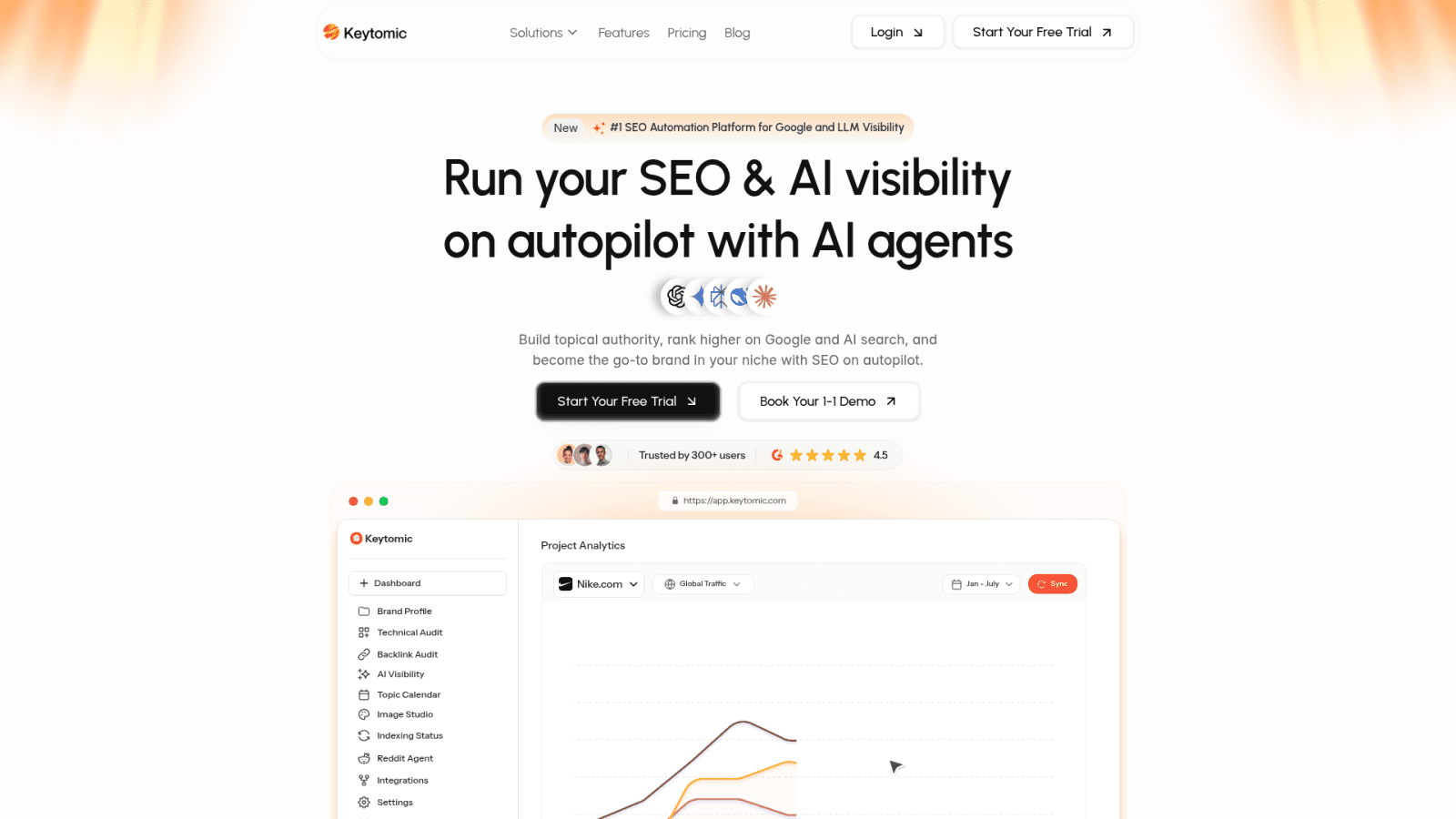
Define the buyer questions you want to track as prompts, and set the schedule.
Review full responses and cited sources, not just whether your name appears.
Inspect which competing brands show up.
Use content planning and CMS publishing to turn the gap into the next editorial action.
Step 4 is a recommended workflow, not an automated integration, and no tracker can promise a mention or citation. Choosing which prompts matter still takes human judgment about your business goals.
Keytomic Pro costs $99/month billed monthly for one site and up to three seats, and it includes AI search visibility, content planning, CMS publishing and a technical audit. Teams that fit that scope can see how SEO automation for marketing teams ties these pieces together. Start a free Keytomic trial to see the tracker alongside your own prompts.
Frequently asked questions about LLM visibility tracking
Can a brand be mentioned without its website being cited?
Yes. A mention is your brand name appearing in the answer text, while a citation is a source link the engine attaches to that answer. These are independent signals: an engine can name your brand without linking to you, or cite a competitor's page while mentioning your brand. Record both separately and treat a gap between mention rate and citation rate as a content and authority problem worth diagnosing on its own.
Does Google Search Console show visibility in ChatGPT?
Google's 2026 generative AI performance reports show impressions, pages, countries, devices and dates for Google's generative Search and Discover features only — not ChatGPT or Perplexity mentions. To track visibility in ChatGPT you need a dedicated AI visibility tracking tool that queries the platform directly, records the full response and logs whether your brand or domain appears.
Do all plans monitor Claude and Perplexity?
No, and the gaps are significant. Otterly Lite charges $29/month extra for Claude, and Peec lists Claude and Perplexity under Enterprise in its plan comparison. Scrunch Core also holds Claude for Enterprise. Coverage is plan-specific, so check the named plan's engine list before you sign up — not the vendor's broadest possible coverage, which may require a much higher tier.
How often should I review tracked prompts?
Weekly is my operational judgment, not an industry standard. Keep the prompt set fixed and read trends across weeks instead of reacting to a single day's answers, since AI engines vary their responses between runs. A weekly review is frequent enough to catch meaningful shifts and infrequent enough to see genuine trends rather than noise. Revisit the prompt set itself every quarter to reflect changes in how buyers search.
Can visibility scores be compared directly between vendors?
Not directly. Scores are comparable only when the prompt set, engines, timing and metric definitions match across both tools. Different vendors weight mention rate, citation rate and sentiment differently, so a 72 from one tool and a 68 from another measure different things. When comparing tools, use raw answers and cited sources as the common currency rather than proprietary scores.
Which tracking tool should you choose?
Choose by the question you need answered, then by the plan that samples it.
Several projects tracked daily: SE Visible by SE Ranking, with 75 daily prompts across five projects at $89/month.
A small, low-cost sample: Otterly.AI, with 15 daily prompts from $29/month before add-ons.
Which URLs engines cite, and who owns them: Scrunch AI, with source-owner filters on Core at $250/month.
Monitoring next to content planning and publishing: Keytomic, whose Pro plan bundles those workflows; teams can see SEO automation for SEO teams.
If none of those fit, the engine list decides. Peec, Search Atlas, Ahrefs Brand Radar, Semrush and Profound each lead on a different row of the table.
Whatever you pick, start with a fixed prompt set, keep the answers and cited sources, and read trends weekly. A tracker earns its price when its sample answers a business question you actually have.
Resources
Internal resources
External resources
About the author
Salam Qadir, Product & Growth Lead
Salam Qadir is a product owner and growth strategist with 7+ years of experience working across SaaS, product marketing, SEO, and AI search. He focuses on shaping product positioning, developing go-to-market strategies, and building sustainable growth systems for technology products and teams. His work sits at the intersection of product, marketing, and search, helping companies turn technology into clear market propositions and measurable growth opportunities.