Table of Contents
Share Article
LLM Citation Tracker How to Measure AI Search Visibility
LLM Citation Tracker How to Measure AI Search Visibility
LLM Citation Tracker How to Measure AI Search Visibility

Ahsan Iqbal
Marketing Growth Expert
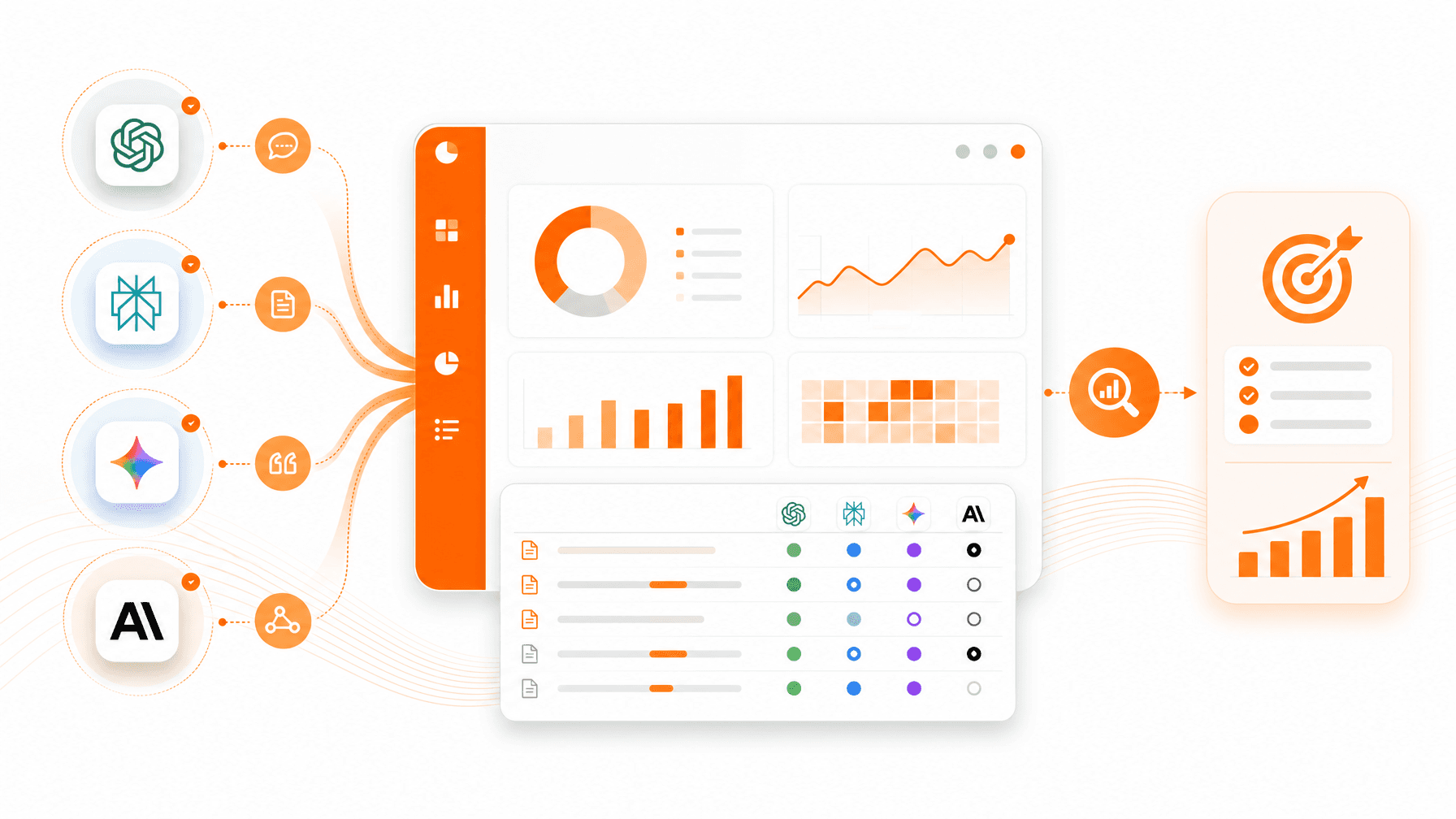
Learn what an LLM citation tracker measures, which AI platforms to monitor, and how to turn citation data into SEO actions.
An LLM citation tracker records when AI platforms mention your brand, cite your URLs, recommend your product, and cite competitors for the prompts that matter to your business.
The most useful reports separate citations from mentions and show the engine, prompt, cited page, citation position, source type, competitor, and change over time.
Use repeated, controlled prompt runs across relevant platforms, then connect each citation gap to a content, entity, technical, or authority action.
You open ChatGPT or Perplexity, search a category question your buyers ask every day, and see a competitor cited where your brand should be. You take a screenshot. A week later you check again and the answer is different. You have no record of what changed, no baseline, and no clear next step.
“Are we mentioned?” is only the first question. The more useful questions are: which URL was cited, does that page actually support the answer, which competitor page filled the gap, and what should the team do next?
AI answer surfaces and measurement methods are changing fast. This guide uses current vendor documentation and controlled sampling methodology rather than one-off screenshots or unsupported statistics. Where platform behavior needs verification, that is stated directly.
What Does an LLM Citation Tracker Actually Measure?
An LLM citation tracker is a measurement system that records how AI platforms reference your brand, pages, and competitors in generated answers. It distinguishes between several distinct signals that are easy to conflate but answer different questions.
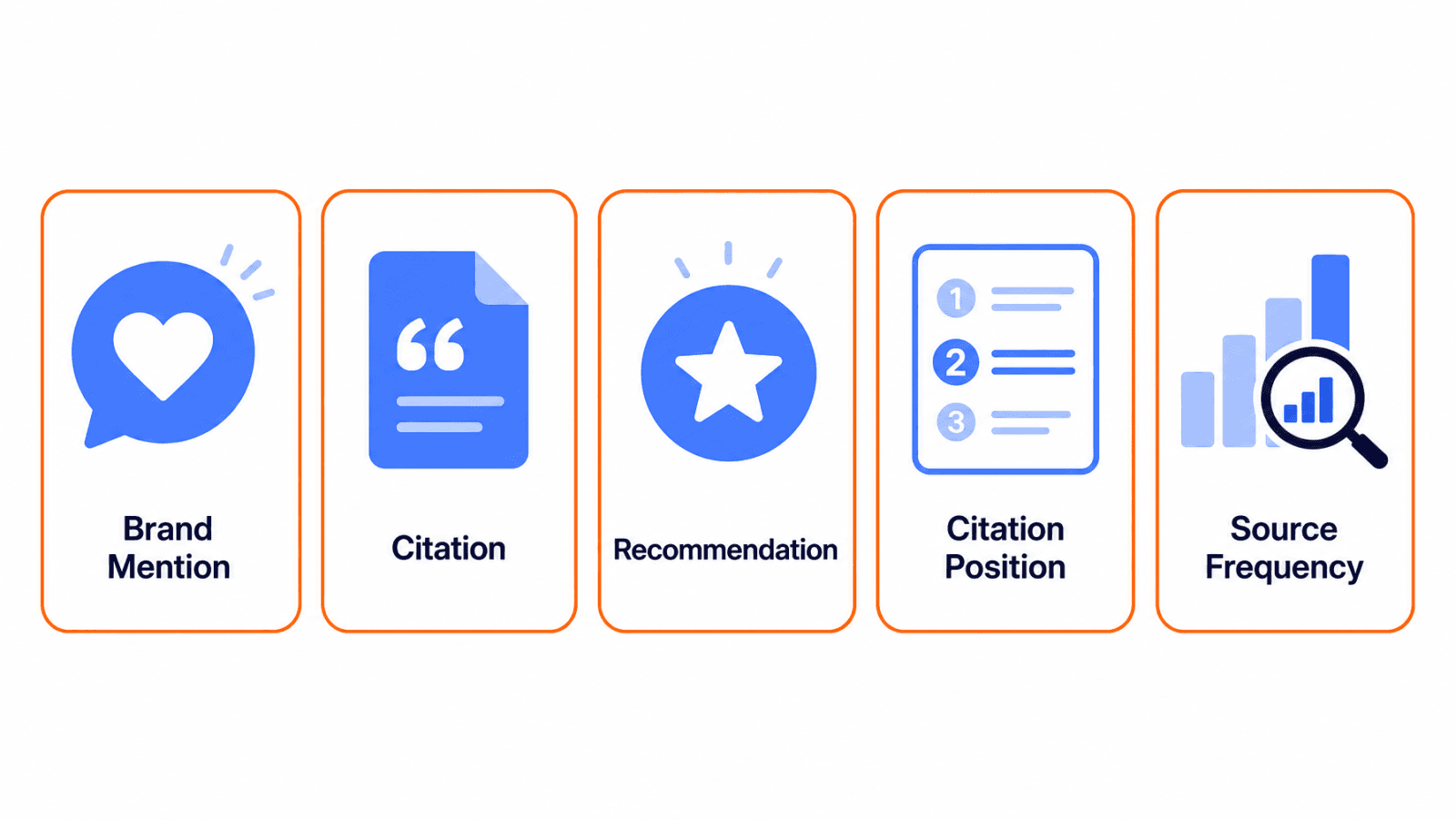
The table below separates the five core signals a tracker should record:
Signal | Definition | Example |
|---|---|---|
Brand mention | Brand name appears in the AI answer text | “…tools like Acme are popular…” |
Citation | A URL is surfaced as a named source or inline link | Source panel shows acme.com/guide |
Recommendation | The AI explicitly recommends the brand for a use case | “For small teams, Acme is a good starting point” |
Citation position | The order or placement of the cited source | First source listed in Sources panel |
Source frequency | How often a specific URL is cited across a prompt set | /pricing cited in 8 of 20 prompts |
Sentiment | Whether the surrounding context is positive, neutral, or negative | “Acme is reliable but expensive” |
A brand can be mentioned without its website being cited. A page can be cited without the brand being recommended. A recommendation can appear without a URL. These are not interchangeable signals, and averaging them into a single visibility score hides the differences that matter for action.
Citation, Mention, Recommendation, and Ranking Are Different Signals
A citation is a traceable source reference: the AI platform surfaces a URL, a domain, or an annotated source that the user can follow. A mention is brand inclusion in answer text without a verifiable link. A recommendation is an explicit directional suggestion by the AI. A ranking in this context refers to the position or prominence of a citation within the answer.
Why this matters: a brand with high mention rate but low citation rate may be recognized but not trusted enough to surface as a source. A brand cited frequently but recommended rarely may be used as evidence rather than a preferred option. Neither pattern points to the same fix.
What Source-Level Tracking Adds
URL-level tracking goes one step further than brand-level monitoring. It records which specific page was cited, what type of source it is (owned, competitor, publisher, directory, review, government, academic), and whether the cited page actually supports the answer it was pulled for.
A useful audit asks three questions about every cited URL:
Does this page directly answer the prompt it was cited for?
Are the facts current, or is the page stale?
Is the brand described accurately on the page?
If a competitor’s product comparison page is cited instead of your own, that is a content gap, not a domain authority problem.
What an LLM Citation Tracker Cannot Prove
One prompt run does not prove stable visibility. Research on citation variability across ChatGPT, Google AI Overview, and Perplexity supports using repeated sampling rather than relying on a single AI answer run, because model outputs vary by prompt wording, session, location, interface, model version, and time of query.
A tracker also cannot prove causation. A rise in citations after a content update is a correlation worth noting, not a confirmed signal that the update caused the change.
Why Do LLM Citations Matter for Search Visibility?
Citations in AI-generated answers create a verifiable path from the answer to your page. A mention creates awareness. A citation gives the user a reason and a route to visit your site.
This matters at the consideration stage because buyers using ChatGPT, Perplexity, or Google AI Overviews to evaluate options are often forming their shortlist before visiting any brand website. If your URL does not appear in those answers, you are absent from a decision that is already in progress.
How Citations Influence Brand Discovery
The discovery path through AI search differs from traditional search. A user asking “what’s the best tool for AI citation tracking” in Perplexity gets a synthesized answer with cited sources. Those sources become the first filter in their evaluation. A brand cited in that answer gets a visit. A brand mentioned but not cited may create recall without generating traffic.
Citation tracking is most useful when it turns visibility evidence into a prioritized action, not when it produces one blended score.
Why Citation Tracking Complements Traditional SEO
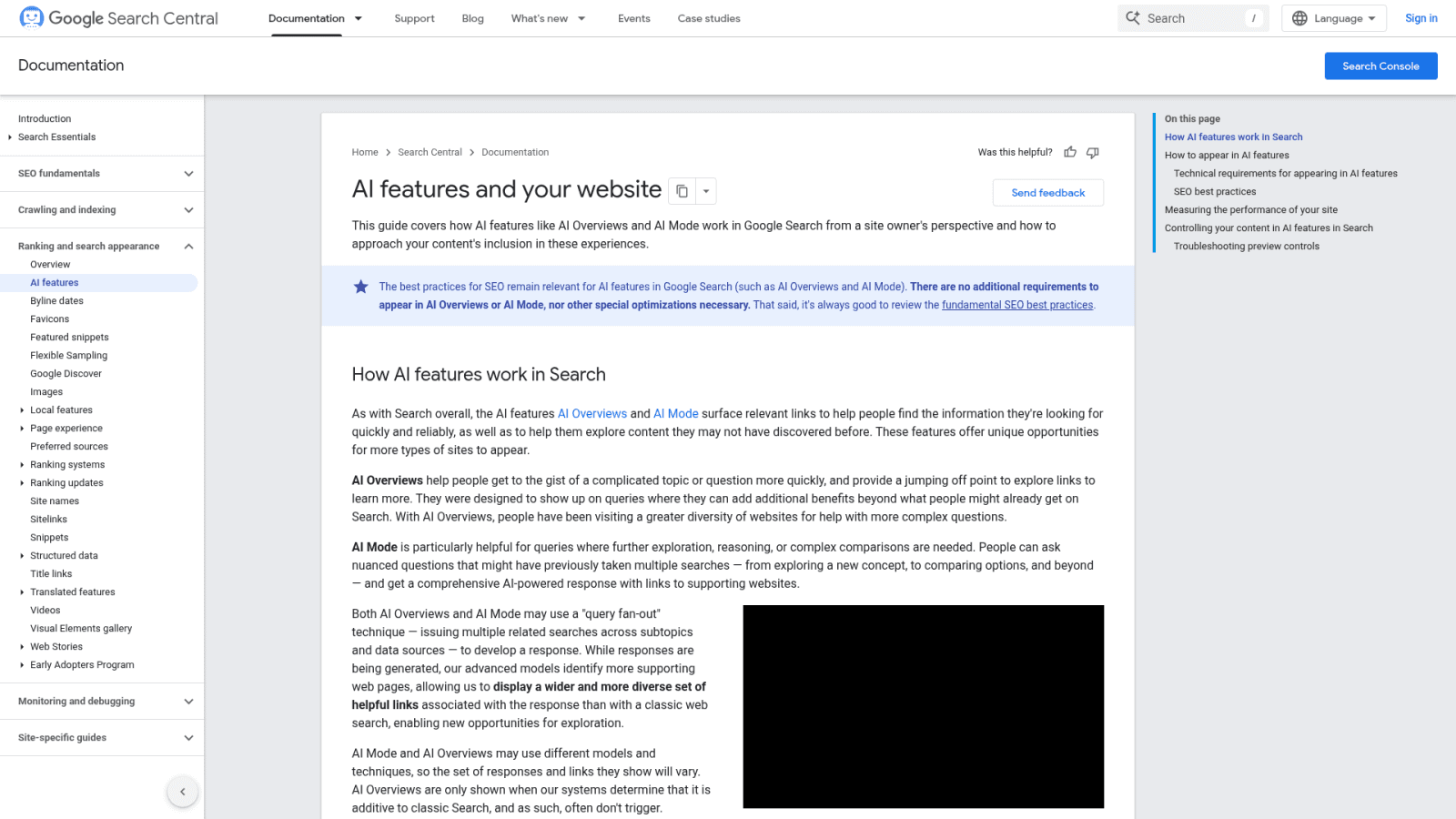
Google’s documentation on AI features and your website states that AI Overviews and AI Mode surface supporting links and that standard indexing and Search eligibility remain foundational. This means traditional SEO and AI citation tracking are not alternatives: they share dependencies on indexing, page quality, and entity clarity, while measuring different layers of visibility.
Google Search Console shows clicks and impressions from traditional results. An LLM citations tracker shows which pages AI platforms reference and for which prompts. You need both views to understand the full picture, and AI search monitoring platforms and SEO strategy work best when they inform each other.
When Citation Data Is Useful for a Marketing Team
The metric-to-decision map below shows how citation findings translate into actions:
Observation | Likely Decision |
|---|---|
Brand cited, but for an outdated page | Page refresh or redirect |
Competitor cited, brand absent | Content gap or entity clarification |
Brand mentioned but no URL cited | Source acquisition or page authority work |
Negative sentiment around citation | Representation accuracy review |
Low prompt coverage | Expand content to match buyer question patterns |
Stale page cited | Update facts and internal date signals |
Every row in this table is an action queue item. If your tracker does not produce rows like these, it is reporting, not diagnosing.
Which AI Platforms Should an LLM Citation Tracker Monitor?
Different platforms expose different citation signals, use different retrieval contexts, and behave differently across prompt types. Treating them as identical produces misleading aggregates.
Platform | Citation format | Source exposure | Measurement notes |
|---|---|---|---|
ChatGPT Search | Inline citations and Sources panel | Yes, when Search mode is active | Non-search ChatGPT answers may not include citations |
Perplexity | Numbered inline citations | Yes, web-grounded by default in most interfaces | Consumer and API behavior may differ |
Gemini (consumer) | Grounding annotations | Varies by query and mode | Distinct from Gemini API grounding behavior |
Supporting links surfaced below answer | Yes, indexed pages only | Requires standard Search indexing and eligibility | |
Claude (with web search) | Direct citations when web search is used | Yes, when web search is active | Not all Claude answers use web search |
Platform coverage differences matter: an analysis of 3.7 million AI citations found that 91% of cited URLs appear in just one LLM, meaning strong performance on one platform tells you almost nothing about the others.
The right tracker monitors platforms your buyers actually use, records the citation format each platform uses, and flags when measurement is unavailable rather than filling gaps with assumptions.
ChatGPT and ChatGPT Search
ChatGPT Search can display inline citations or a Sources panel when search mode is active. According to the OpenAI Help Center documentation on ChatGPT Search, top placement cannot be guaranteed. Standard conversational ChatGPT responses without Search mode active do not reliably produce cited sources, so tracking must specify whether Search mode was used in each prompt run.
Perplexity and Source-First Answers
Perplexity is designed as a web-grounded answer platform with built-in numbered citations. The Perplexity developer documentation confirms web-grounded answers with built-in citations in its API context. Consumer interface behavior should be verified against the current product before drawing conclusions about citation completeness.
Gemini and Google AI Overviews
These are two distinct surfaces. Gemini API grounding documentation explains that Gemini grounding uses Google Search to provide real-time information and citation annotations in grounded responses. Google AI Overviews is a separate feature within Google Search. Google Search Central states that standard indexing and Search eligibility remain foundational for AI feature inclusion, meaning pages blocked from indexing are unlikely to appear.
Claude and Other AI Answer Surfaces
According to Anthropic’s official announcement on Claude web search, Claude provides direct citations when information is incorporated from the web. Citations are not present in every Claude answer: they appear when Claude uses web search or research features. Mark other AI surfaces as requiring current vendor verification before including them in a tracking scope.
Which Metrics Should You Track in AI Search?
A minimum viable AI citation dashboard tracks six core metrics and separates them by platform and prompt. Do not average citation rate and mention rate together: they answer different questions and have different implications for action.
Core LLM Citation Metrics
Citation rate: Prompts with at least one owned URL cited, divided by total eligible prompts. A brand cited in 8 of 20 prompts has a 40% citation rate for that prompt set.
Mention rate: Prompts where the brand name appears in the answer text, divided by total prompts. Higher than citation rate for most brands.
Source frequency: Count of how many times a specific URL is cited across the full prompt set. Reveals which pages carry the most retrieval weight.
Citation position: The order the source appears in the Sources panel or citation list. First position signals more prominence than fifth.
Share of voice: Your brand citations divided by total brand citations across all tracked competitors for the same prompt set.
Prompt coverage: The percentage of your target prompt universe that has been run and recorded at least once.
Context and Quality Metrics
Sentiment: Whether the surrounding answer text about your brand is positive, neutral, or negative.
Representation accuracy: Whether the AI describes your product, category, pricing, and positioning correctly.
Source type: Owned page, third-party publisher, directory, review site, forum, academic, or government source.
Page freshness: Whether the cited page has been recently updated or contains outdated facts.
How to Read the Metrics Without Overclaiming
A blended visibility score hides important differences. A brand with 80% mention rate and 15% citation rate has a very different problem than a brand with 40% mention rate and 35% citation rate. Platform-level and prompt-level views must remain separate in the reporting layer.
SparkToro research running nearly 3,000 prompts across multiple AI platforms found that these produce identical brand recommendations less than 1 in 100 times. This means “AI rankings” are not stable positions, making aggregate citation rate across a prompt sample more meaningful than any single run.
How Do AI Citation Tracking Tools Work?
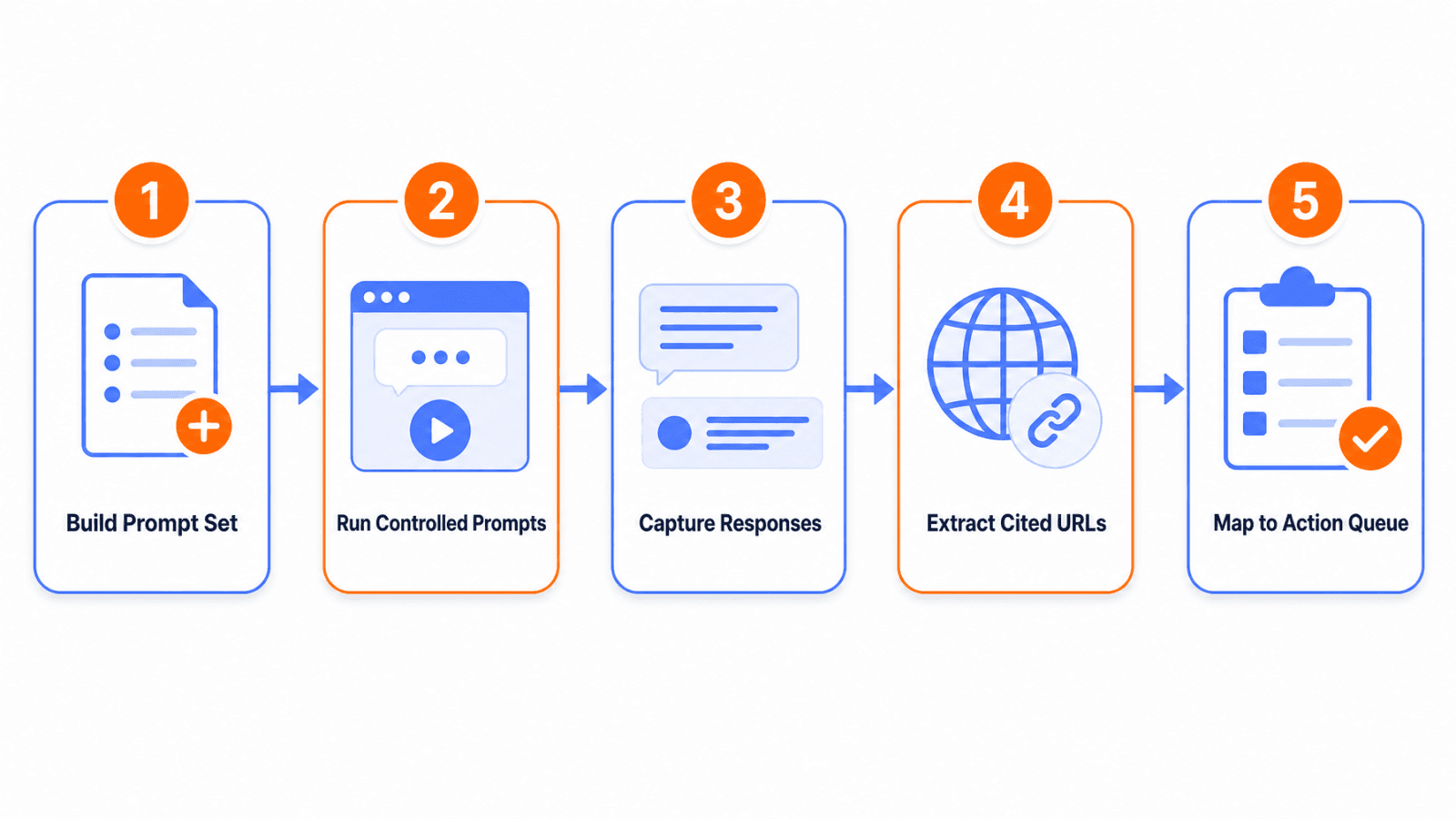
AI citation tracking tools work by submitting controlled prompts to AI platforms, capturing the full response, extracting cited sources, tagging entities, and comparing results over time. The process only produces useful data when runs are repeatable and conditions are fixed.
Build a Prompt Set From Real Buyer Intent
Start with non-branded category prompts that match real buyer questions: problem prompts (“how do I track where my brand appears in AI answers?”), comparison prompts (“what are the best AI visibility tools?”), and alternatives prompts (“alternatives to [competitor]”).
Avoid starting with branded prompts. Asking “tell me about [my brand]” inflates apparent visibility without reflecting how buyers discover new options. Include at least 15 to 20 prompts before drawing conclusions from the data.
Create a Baseline With Repeatable Runs
Each prompt run should record:
Exact prompt text (fixed wording, no variations)
Platform and interface (ChatGPT Search, Perplexity, Gemini, Claude with web search)
Date and approximate time
Region and language setting
Model version or interface where available
Full response text
All cited URLs extracted
Competitor brands and URLs mentioned
Reviewer name or ID
Repeated sampling across multiple sessions is more reliable than a single run, because academic research on citation variability shows that AI answers differ across sessions even for identical prompts.
Inspect Cited Pages and Competitor Gaps
For every URL appearing in your citation record, classify it as: owned, competitor, publisher, directory, forum, review, government, academic, or other. Then run a citation-support check:
Does this page directly answer the prompt it was cited for?
Are the facts current?
Is the brand, product, or entity described accurately?
Would a buyer trust this page as a source?
If a competitor page passes all four checks and your equivalent page fails one or more, you have a specific content improvement target, not a general authority problem.
Turn Findings Into an SEO and GEO Action Queue
Map each finding to a specific fix:
Competitor cited for a definition query, your site absent: create or improve your definition content and clarify entity attributes.
Your page cited but representation is inaccurate: update the page to reflect current product facts.
Your page cited from a stale post: refresh the page with current data and update the modified date after a real editorial review.
Your page ranks on Google but is not cited in AI answers: check crawlability, structured data, and whether the page provides a direct answer to the prompt. See schema markup and AI visibility for the technical layer.
Third-party reviews cite a competitor favorably: identify comparable earned coverage opportunities for your brand. Fabricated reviews are not an option.
This is the gap most standalone trackers leave: they produce a dashboard but do not connect each finding to a content planning or publishing step. For more on the full execution loop, Keytomic’s GEO guide covers the relationship between GEO measurement and content action.
Why Is Your Brand Missing From LLM Citations?
If your brand does not appear in AI citations for prompts that are directly relevant to what you do, one or more of the following factors is usually contributing. None of them guarantees citation if fixed, but each one reduces the barriers that prevent AI platforms from treating your pages as reliable sources.
Your Site Does Not Clearly Define the Entity
AI platforms build answers from their understanding of what a brand is, who it serves, what category it belongs to, and what makes it different. If your site does not consistently define these attributes across your homepage, about page, product pages, and blog content, the model has to fill the gaps or default to competitors that explain themselves more clearly.
Entity clarity requires consistency across owned and third-party pages. Your About page says one thing, a press release says another, and a directory listing has an outdated description. That inconsistency reduces confidence in the entity. To address this, improve brand visibility in AI search engines covers entity signals and what content changes support clearer recognition.
Your Content Answers Keywords but Not Buyer Questions
Keyword coverage and prompt coverage are not the same. A page optimized for “AI citation tracking software” may rank on Google for that phrase but fail to answer the question “how do I know if my brand is being cited in ChatGPT?” The latter is the actual buyer question that feeds into AI-generated answers.
Direct answer blocks, comparison tables, definition sections, and decision guidance give AI platforms extractable content that matches the prompt. Content that buries the answer in paragraph five after three paragraphs of context is less likely to be cited than content that answers in the first sentence.
Your Strongest Evidence Exists on Other Pages
Third-party sources, independent reviews, documentation, and original research frequently carry more weight in AI citation patterns than first-party content alone. This is not because first-party content is ignored: it is because AI platforms cross-reference multiple sources when forming answers.
Building credible third-party coverage through genuine product reviews, earned media, and accurate directory listings contributes to citation patterns over time. Do not fabricate reviews or case studies: the risk is real, the benefit is not.
Your Pages Are Stale, Unclear, or Difficult to Retrieve
Pages that have not been updated, contain factual errors, use inconsistent internal links, or lack visible authorship give AI platforms reasons to prefer fresher, cleaner alternatives. Google Search Central confirms that standard indexing and Search eligibility are foundational for AI feature inclusion. A page that cannot be crawled and indexed cannot be cited.
Check: Is the page indexed? Does the response reflect current product facts? Is there visible authorship and a clear publication or review date? Does the page structure help a reader (and an AI) find the direct answer?
How Keytomic Fits an AI Search Visibility Workflow
Most brands that start tracking AI citations discover the same problem: the tracker shows a gap, but there is no clear path from the gap to the fix. Visibility measurement is only useful when it connects to execution.
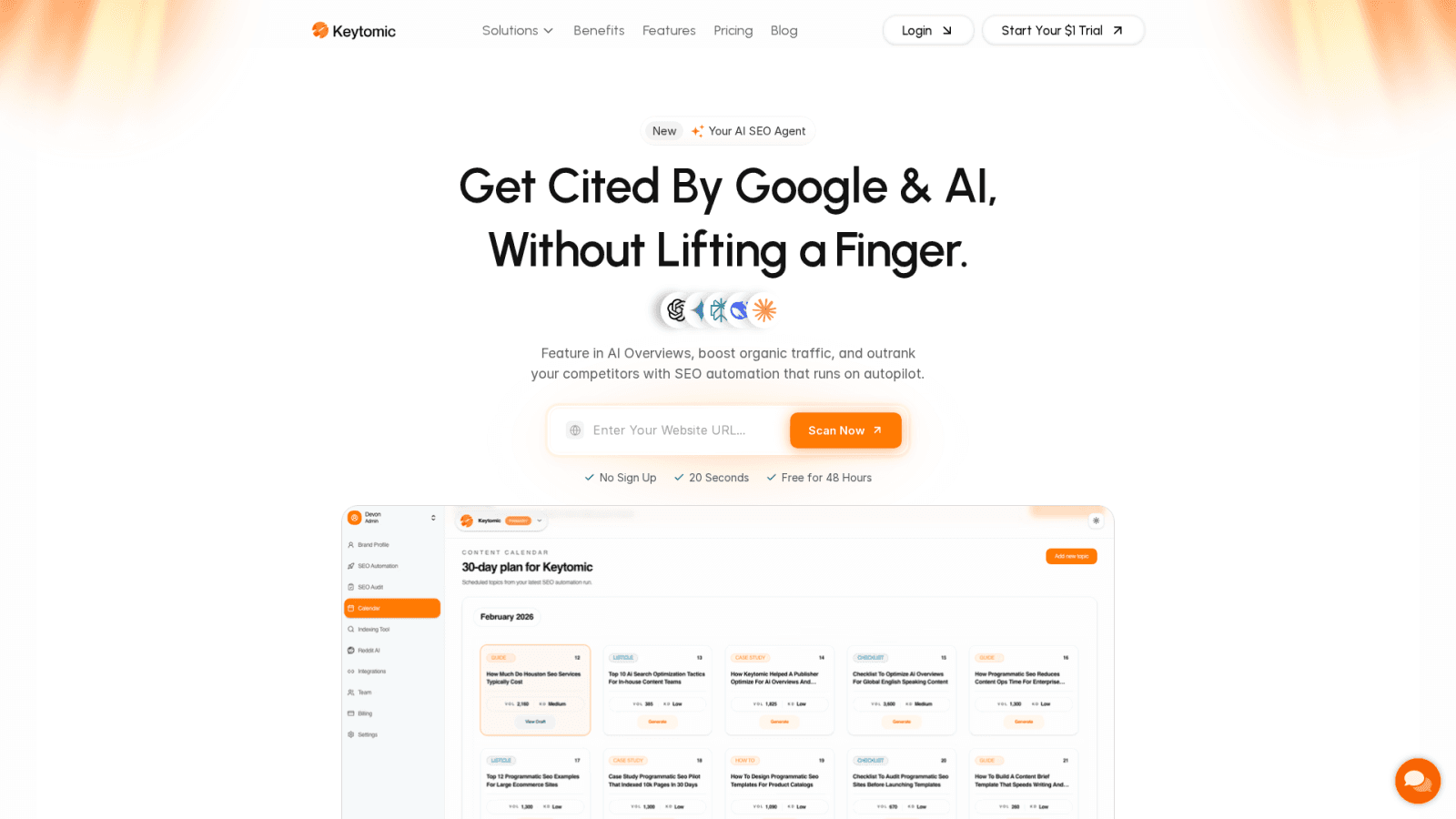
Keytomic’s SEO and AI visibility platform is designed to close that loop. Rather than treating citation monitoring as a separate reporting layer, Keytomic connects visibility signals to the keyword discovery, content planning, content production, CMS publishing, and indexing steps that actually change what AI platforms find when they retrieve sources.
Disclosure: Keytomic publishes this guide and is discussed as one possible workflow option. Feature and availability references were checked against public product pages in August 2026. Confirm current functionality before making a purchase decision.
From Visibility Measurement to Content Execution
The workflow runs as follows: Keytomic’s AI Visibility Tracker records citation and mention signals across ChatGPT, Gemini, Perplexity, and Claude. When a citation gap is identified, the keyword discovery and 30-day content roadmap features identify the prompt-level content needed to fill it. The content production step creates drafts aligned with E-E-A-T protocols. Auto-publishing sends the finished article to the CMS, and indexing workflows reduce time-to-visibility for new pages. The tracker then monitors whether the gap closes.
This handoff from “competitor cited for a prompt” to “topic gap identified” to “content planned, published, and rechecked” is what separates a measurement workflow from a reporting dashboard.
What Keytomic’s AI Visibility Tracker Publicly Shows
The current public product page describes tracking across ChatGPT, Gemini, Perplexity, and Claude, with signals for citation, mention, recommendation, and weekly trend changes. The platform also supports share-of-voice tracking against competitors and connects to a broader content automation workflow. Recheck current functionality at keytomic.com/ai-visibility-tracker before making a purchase decision, because product features evolve.
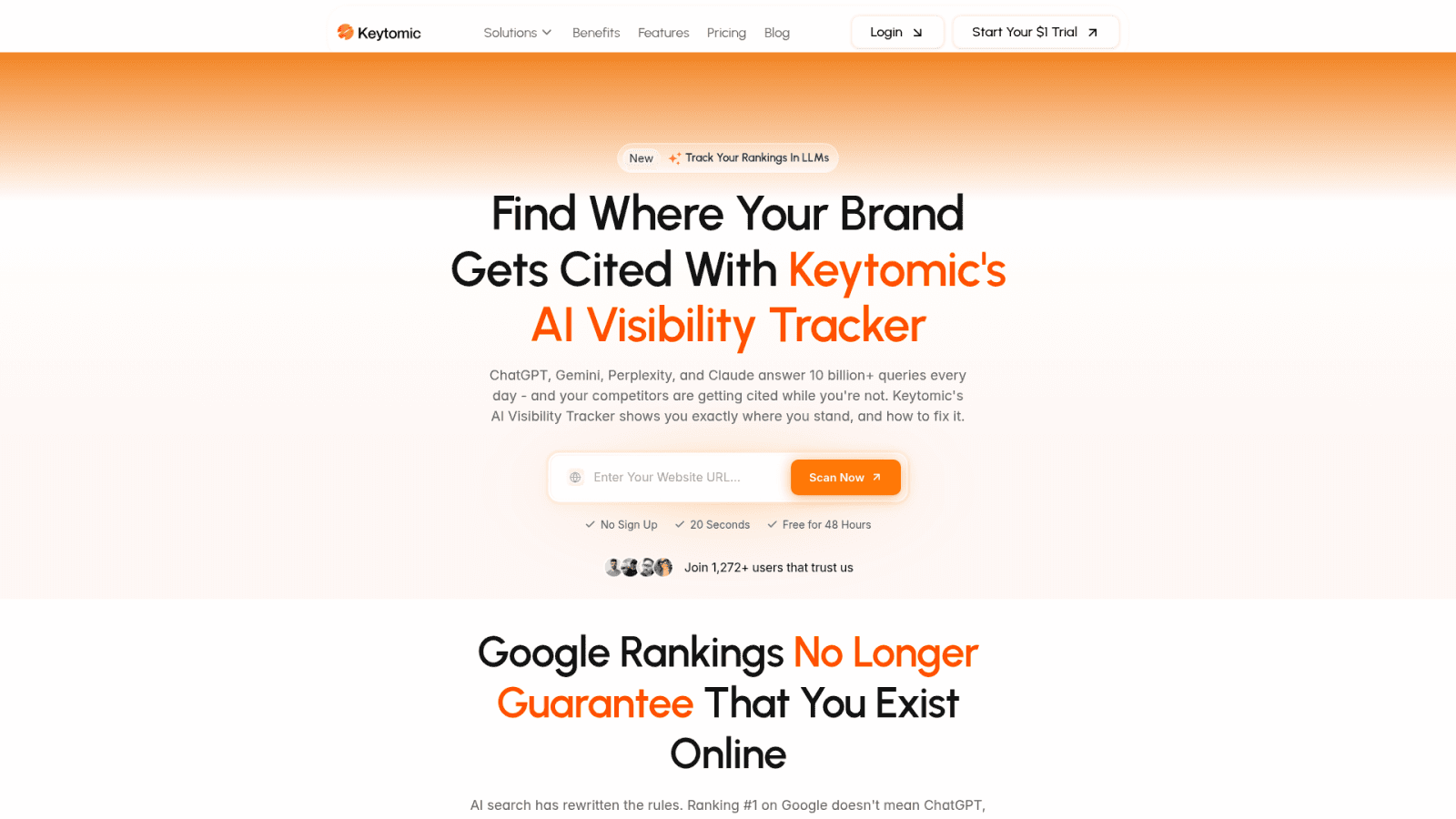
For teams evaluating AI tools for increasing visibility in LLMs more broadly, the Keytomic blog covers the category with comparisons across several platforms.
When Keytomic Is Not the Right Fit
A team that needs only specialist enterprise AI-intelligence analytics, with deep prompt-set customization, multi-user research workflows, and export-ready data for client reporting at scale, may prefer a narrower monitoring platform focused exclusively on that function. Keytomic’s strength is the unified workflow: measurement connected to execution. Teams that have the execution side covered and want only the measurement layer should evaluate dedicated AI visibility tools alongside the unified option.
LLM Citation Tracker FAQ
What is an LLM citation tracker?
An LLM citation tracker is a system that records when AI platforms cite your URLs, mention your brand, or recommend your product in generated answers. It differs from brand monitoring by focusing on source-level references and from traditional rank tracking by measuring AI answer surfaces rather than Google SERP positions.
What is the difference between an AI citation and a brand mention?
A citation includes a traceable source reference, typically a URL or annotated link that the user can follow. A mention is brand inclusion in answer text without a verifiable link. A brand can be mentioned frequently while being cited rarely, which signals recognition without source-level trust.
How often should you track AI citations?
A consistent cadence matters more than a specific frequency. For most teams, weekly or biweekly runs across a fixed prompt set provide enough signal to detect trends without overwhelming review capacity. High-volatility categories or brands running active content campaigns may benefit from more frequent sampling.
Can an LLM citation tracker replace Google rank tracking?
No. An LLM citation tracker measures a different visibility layer and should be used alongside Google Search Console and traditional rank data. Neither replaces the other: they report on different surfaces with different ranking factors and different buyer behaviors.
Which AI platforms should a small business monitor first?
Start with the platforms your buyers actually use and the surfaces that display cited sources. For most B2B and SMB audiences, Perplexity and ChatGPT Search are practical starting points because both display citations in their standard interfaces. Add Gemini and Claude as capacity allows.
How accurate are AI citation tracking tools?
Accuracy depends on prompt sampling size, response capture method, source parsing quality, platform access, and how consistently runs are repeated. No tool produces perfect accuracy because AI answers vary across sessions. Require methodology disclosure from any tool before using its data for client reporting or strategic decisions.
Can AI citation tracking show why a competitor is cited?
Yes, when the tool records cited URLs and the response context around them. Inspecting the competitor’s cited page, checking whether it directly answers the prompt, and assessing its source type and freshness gives you a diagnostic starting point. The data supports hypothesis formation, not certainty about model reasoning.
Does getting cited in AI search guarantee traffic or sales?
No. Citation is a visibility and referral opportunity, not a guaranteed conversion signal. A cited URL can generate a visit, but conversion depends on the page’s relevance, clarity, and offer quality. Track AI referral traffic separately using analytics dimensions, and do not conflate citation rate with revenue impact.
Does AI citation tracking measure third-party mentions?
Yes, when the tracker captures the full response and cited sources, it records both owned pages and third-party URLs cited alongside your brand. Tracking source type (owned versus earned versus competitor) is a core part of useful citation monitoring.
Does Keytomic monitor LLM citations?
Yes, based on current public product pages checked in August 2026. Keytomic’s AI Visibility Tracker tracks citation, mention, recommendation, and weekly trend signals across ChatGPT, Gemini, Perplexity, and Claude. Keytomic is the publisher of this guide and is discussed as one workflow option. Verify current coverage and features at the product page before making a decision.
How Should You Choose an LLM Citation Tracking Approach?
The right approach depends on your current prompt volume, reporting needs, editorial capacity, and whether measurement or execution is your primary bottleneck.
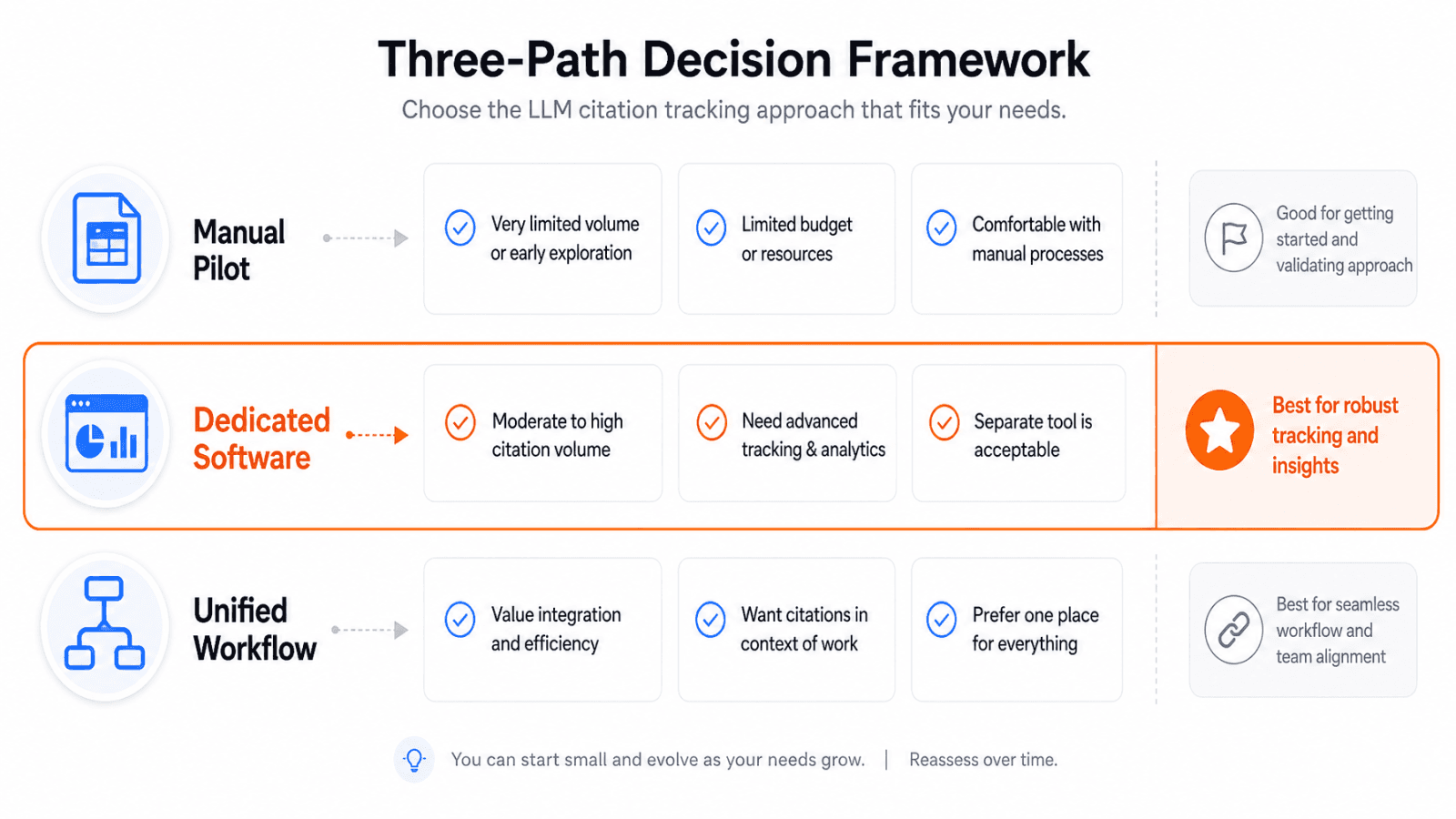
Choose Manual Tracking for a Small Validation Pilot
If you are not yet sure whether AI citation tracking will produce actionable data for your category, start with a manual pilot before investing in software. Record the following fields in a spreadsheet for each prompt run:
Prompt text (exact and fixed)
Platform and interface
Date and region
Full response text
Brand mention: yes or no
Cited URL or none
Competitor brands cited
Sentiment: positive, neutral, or negative
Next action
Run the same prompts weekly for four weeks. If you find consistent citation gaps, the data justifies moving to dedicated software.
Choose Dedicated Software for Reporting Depth
If your team needs larger prompt sets, historical trend views, competitor citation monitoring, structured exports, or specialist analytics dashboards, a dedicated AI citation tracking tool makes sense. Require any vendor to disclose its sampling methodology, platform access method, and update frequency before signing a contract. Verify current tool coverage at each vendor’s official product page.
Choose a Unified Workflow When Execution Is the Bottleneck
If your team can identify citation gaps but struggles to act on them through content planning, production, publishing, and indexing, a unified platform connects those steps. When the gap between “we know what to fix” and “the fix is live and indexed” is weeks or months, measurement alone does not move results.
Keytomic is built for teams where execution is the constraint. If your citation gaps are clear and you need content in place to fill them, book a Keytomic demo to see how the visibility-to-execution workflow operates, or start a Keytomic trial to test it directly.
An LLM citations tracker is valuable when it explains which sources shape AI answers and tells the team exactly what to do next. Measurement without execution is just a more detailed record of what you already knew was wrong.
An LLM citation tracker records when AI platforms mention your brand, cite your URLs, recommend your product, and cite competitors for the prompts that matter to your business.
The most useful reports separate citations from mentions and show the engine, prompt, cited page, citation position, source type, competitor, and change over time.
Use repeated, controlled prompt runs across relevant platforms, then connect each citation gap to a content, entity, technical, or authority action.
You open ChatGPT or Perplexity, search a category question your buyers ask every day, and see a competitor cited where your brand should be. You take a screenshot. A week later you check again and the answer is different. You have no record of what changed, no baseline, and no clear next step.
“Are we mentioned?” is only the first question. The more useful questions are: which URL was cited, does that page actually support the answer, which competitor page filled the gap, and what should the team do next?
AI answer surfaces and measurement methods are changing fast. This guide uses current vendor documentation and controlled sampling methodology rather than one-off screenshots or unsupported statistics. Where platform behavior needs verification, that is stated directly.
What Does an LLM Citation Tracker Actually Measure?
An LLM citation tracker is a measurement system that records how AI platforms reference your brand, pages, and competitors in generated answers. It distinguishes between several distinct signals that are easy to conflate but answer different questions.
The table below separates the five core signals a tracker should record:
Signal | Definition | Example |
|---|---|---|
Brand mention | Brand name appears in the AI answer text | “…tools like Acme are popular…” |
Citation | A URL is surfaced as a named source or inline link | Source panel shows acme.com/guide |
Recommendation | The AI explicitly recommends the brand for a use case | “For small teams, Acme is a good starting point” |
Citation position | The order or placement of the cited source | First source listed in Sources panel |
Source frequency | How often a specific URL is cited across a prompt set | /pricing cited in 8 of 20 prompts |
Sentiment | Whether the surrounding context is positive, neutral, or negative | “Acme is reliable but expensive” |
A brand can be mentioned without its website being cited. A page can be cited without the brand being recommended. A recommendation can appear without a URL. These are not interchangeable signals, and averaging them into a single visibility score hides the differences that matter for action.
Citation, Mention, Recommendation, and Ranking Are Different Signals
A citation is a traceable source reference: the AI platform surfaces a URL, a domain, or an annotated source that the user can follow. A mention is brand inclusion in answer text without a verifiable link. A recommendation is an explicit directional suggestion by the AI. A ranking in this context refers to the position or prominence of a citation within the answer.
Why this matters: a brand with high mention rate but low citation rate may be recognized but not trusted enough to surface as a source. A brand cited frequently but recommended rarely may be used as evidence rather than a preferred option. Neither pattern points to the same fix.
What Source-Level Tracking Adds
URL-level tracking goes one step further than brand-level monitoring. It records which specific page was cited, what type of source it is (owned, competitor, publisher, directory, review, government, academic), and whether the cited page actually supports the answer it was pulled for.
A useful audit asks three questions about every cited URL:
Does this page directly answer the prompt it was cited for?
Are the facts current, or is the page stale?
Is the brand described accurately on the page?
If a competitor’s product comparison page is cited instead of your own, that is a content gap, not a domain authority problem.
What an LLM Citation Tracker Cannot Prove
One prompt run does not prove stable visibility. Research on citation variability across ChatGPT, Google AI Overview, and Perplexity supports using repeated sampling rather than relying on a single AI answer run, because model outputs vary by prompt wording, session, location, interface, model version, and time of query.
A tracker also cannot prove causation. A rise in citations after a content update is a correlation worth noting, not a confirmed signal that the update caused the change.
Why Do LLM Citations Matter for Search Visibility?
Citations in AI-generated answers create a verifiable path from the answer to your page. A mention creates awareness. A citation gives the user a reason and a route to visit your site.
This matters at the consideration stage because buyers using ChatGPT, Perplexity, or Google AI Overviews to evaluate options are often forming their shortlist before visiting any brand website. If your URL does not appear in those answers, you are absent from a decision that is already in progress.
How Citations Influence Brand Discovery
The discovery path through AI search differs from traditional search. A user asking “what’s the best tool for AI citation tracking” in Perplexity gets a synthesized answer with cited sources. Those sources become the first filter in their evaluation. A brand cited in that answer gets a visit. A brand mentioned but not cited may create recall without generating traffic.
Citation tracking is most useful when it turns visibility evidence into a prioritized action, not when it produces one blended score.
Why Citation Tracking Complements Traditional SEO
Google’s documentation on AI features and your website states that AI Overviews and AI Mode surface supporting links and that standard indexing and Search eligibility remain foundational. This means traditional SEO and AI citation tracking are not alternatives: they share dependencies on indexing, page quality, and entity clarity, while measuring different layers of visibility.
Google Search Console shows clicks and impressions from traditional results. An LLM citations tracker shows which pages AI platforms reference and for which prompts. You need both views to understand the full picture, and AI search monitoring platforms and SEO strategy work best when they inform each other.
When Citation Data Is Useful for a Marketing Team
The metric-to-decision map below shows how citation findings translate into actions:
Observation | Likely Decision |
|---|---|
Brand cited, but for an outdated page | Page refresh or redirect |
Competitor cited, brand absent | Content gap or entity clarification |
Brand mentioned but no URL cited | Source acquisition or page authority work |
Negative sentiment around citation | Representation accuracy review |
Low prompt coverage | Expand content to match buyer question patterns |
Stale page cited | Update facts and internal date signals |
Every row in this table is an action queue item. If your tracker does not produce rows like these, it is reporting, not diagnosing.
Which AI Platforms Should an LLM Citation Tracker Monitor?
Different platforms expose different citation signals, use different retrieval contexts, and behave differently across prompt types. Treating them as identical produces misleading aggregates.
Platform | Citation format | Source exposure | Measurement notes |
|---|---|---|---|
ChatGPT Search | Inline citations and Sources panel | Yes, when Search mode is active | Non-search ChatGPT answers may not include citations |
Perplexity | Numbered inline citations | Yes, web-grounded by default in most interfaces | Consumer and API behavior may differ |
Gemini (consumer) | Grounding annotations | Varies by query and mode | Distinct from Gemini API grounding behavior |
Supporting links surfaced below answer | Yes, indexed pages only | Requires standard Search indexing and eligibility | |
Claude (with web search) | Direct citations when web search is used | Yes, when web search is active | Not all Claude answers use web search |
Platform coverage differences matter: an analysis of 3.7 million AI citations found that 91% of cited URLs appear in just one LLM, meaning strong performance on one platform tells you almost nothing about the others.
The right tracker monitors platforms your buyers actually use, records the citation format each platform uses, and flags when measurement is unavailable rather than filling gaps with assumptions.
ChatGPT and ChatGPT Search
ChatGPT Search can display inline citations or a Sources panel when search mode is active. According to the OpenAI Help Center documentation on ChatGPT Search, top placement cannot be guaranteed. Standard conversational ChatGPT responses without Search mode active do not reliably produce cited sources, so tracking must specify whether Search mode was used in each prompt run.
Perplexity and Source-First Answers
Perplexity is designed as a web-grounded answer platform with built-in numbered citations. The Perplexity developer documentation confirms web-grounded answers with built-in citations in its API context. Consumer interface behavior should be verified against the current product before drawing conclusions about citation completeness.
Gemini and Google AI Overviews
These are two distinct surfaces. Gemini API grounding documentation explains that Gemini grounding uses Google Search to provide real-time information and citation annotations in grounded responses. Google AI Overviews is a separate feature within Google Search. Google Search Central states that standard indexing and Search eligibility remain foundational for AI feature inclusion, meaning pages blocked from indexing are unlikely to appear.
Claude and Other AI Answer Surfaces
According to Anthropic’s official announcement on Claude web search, Claude provides direct citations when information is incorporated from the web. Citations are not present in every Claude answer: they appear when Claude uses web search or research features. Mark other AI surfaces as requiring current vendor verification before including them in a tracking scope.
Which Metrics Should You Track in AI Search?
A minimum viable AI citation dashboard tracks six core metrics and separates them by platform and prompt. Do not average citation rate and mention rate together: they answer different questions and have different implications for action.
Core LLM Citation Metrics
Citation rate: Prompts with at least one owned URL cited, divided by total eligible prompts. A brand cited in 8 of 20 prompts has a 40% citation rate for that prompt set.
Mention rate: Prompts where the brand name appears in the answer text, divided by total prompts. Higher than citation rate for most brands.
Source frequency: Count of how many times a specific URL is cited across the full prompt set. Reveals which pages carry the most retrieval weight.
Citation position: The order the source appears in the Sources panel or citation list. First position signals more prominence than fifth.
Share of voice: Your brand citations divided by total brand citations across all tracked competitors for the same prompt set.
Prompt coverage: The percentage of your target prompt universe that has been run and recorded at least once.
Context and Quality Metrics
Sentiment: Whether the surrounding answer text about your brand is positive, neutral, or negative.
Representation accuracy: Whether the AI describes your product, category, pricing, and positioning correctly.
Source type: Owned page, third-party publisher, directory, review site, forum, academic, or government source.
Page freshness: Whether the cited page has been recently updated or contains outdated facts.
How to Read the Metrics Without Overclaiming
A blended visibility score hides important differences. A brand with 80% mention rate and 15% citation rate has a very different problem than a brand with 40% mention rate and 35% citation rate. Platform-level and prompt-level views must remain separate in the reporting layer.
SparkToro research running nearly 3,000 prompts across multiple AI platforms found that these produce identical brand recommendations less than 1 in 100 times. This means “AI rankings” are not stable positions, making aggregate citation rate across a prompt sample more meaningful than any single run.
How Do AI Citation Tracking Tools Work?
AI citation tracking tools work by submitting controlled prompts to AI platforms, capturing the full response, extracting cited sources, tagging entities, and comparing results over time. The process only produces useful data when runs are repeatable and conditions are fixed.
Build a Prompt Set From Real Buyer Intent
Start with non-branded category prompts that match real buyer questions: problem prompts (“how do I track where my brand appears in AI answers?”), comparison prompts (“what are the best AI visibility tools?”), and alternatives prompts (“alternatives to [competitor]”).
Avoid starting with branded prompts. Asking “tell me about [my brand]” inflates apparent visibility without reflecting how buyers discover new options. Include at least 15 to 20 prompts before drawing conclusions from the data.
Create a Baseline With Repeatable Runs
Each prompt run should record:
Exact prompt text (fixed wording, no variations)
Platform and interface (ChatGPT Search, Perplexity, Gemini, Claude with web search)
Date and approximate time
Region and language setting
Model version or interface where available
Full response text
All cited URLs extracted
Competitor brands and URLs mentioned
Reviewer name or ID
Repeated sampling across multiple sessions is more reliable than a single run, because academic research on citation variability shows that AI answers differ across sessions even for identical prompts.
Inspect Cited Pages and Competitor Gaps
For every URL appearing in your citation record, classify it as: owned, competitor, publisher, directory, forum, review, government, academic, or other. Then run a citation-support check:
Does this page directly answer the prompt it was cited for?
Are the facts current?
Is the brand, product, or entity described accurately?
Would a buyer trust this page as a source?
If a competitor page passes all four checks and your equivalent page fails one or more, you have a specific content improvement target, not a general authority problem.
Turn Findings Into an SEO and GEO Action Queue
Map each finding to a specific fix:
Competitor cited for a definition query, your site absent: create or improve your definition content and clarify entity attributes.
Your page cited but representation is inaccurate: update the page to reflect current product facts.
Your page cited from a stale post: refresh the page with current data and update the modified date after a real editorial review.
Your page ranks on Google but is not cited in AI answers: check crawlability, structured data, and whether the page provides a direct answer to the prompt. See schema markup and AI visibility for the technical layer.
Third-party reviews cite a competitor favorably: identify comparable earned coverage opportunities for your brand. Fabricated reviews are not an option.
This is the gap most standalone trackers leave: they produce a dashboard but do not connect each finding to a content planning or publishing step. For more on the full execution loop, Keytomic’s GEO guide covers the relationship between GEO measurement and content action.
Why Is Your Brand Missing From LLM Citations?
If your brand does not appear in AI citations for prompts that are directly relevant to what you do, one or more of the following factors is usually contributing. None of them guarantees citation if fixed, but each one reduces the barriers that prevent AI platforms from treating your pages as reliable sources.
Your Site Does Not Clearly Define the Entity
AI platforms build answers from their understanding of what a brand is, who it serves, what category it belongs to, and what makes it different. If your site does not consistently define these attributes across your homepage, about page, product pages, and blog content, the model has to fill the gaps or default to competitors that explain themselves more clearly.
Entity clarity requires consistency across owned and third-party pages. Your About page says one thing, a press release says another, and a directory listing has an outdated description. That inconsistency reduces confidence in the entity. To address this, improve brand visibility in AI search engines covers entity signals and what content changes support clearer recognition.
Your Content Answers Keywords but Not Buyer Questions
Keyword coverage and prompt coverage are not the same. A page optimized for “AI citation tracking software” may rank on Google for that phrase but fail to answer the question “how do I know if my brand is being cited in ChatGPT?” The latter is the actual buyer question that feeds into AI-generated answers.
Direct answer blocks, comparison tables, definition sections, and decision guidance give AI platforms extractable content that matches the prompt. Content that buries the answer in paragraph five after three paragraphs of context is less likely to be cited than content that answers in the first sentence.
Your Strongest Evidence Exists on Other Pages
Third-party sources, independent reviews, documentation, and original research frequently carry more weight in AI citation patterns than first-party content alone. This is not because first-party content is ignored: it is because AI platforms cross-reference multiple sources when forming answers.
Building credible third-party coverage through genuine product reviews, earned media, and accurate directory listings contributes to citation patterns over time. Do not fabricate reviews or case studies: the risk is real, the benefit is not.
Your Pages Are Stale, Unclear, or Difficult to Retrieve
Pages that have not been updated, contain factual errors, use inconsistent internal links, or lack visible authorship give AI platforms reasons to prefer fresher, cleaner alternatives. Google Search Central confirms that standard indexing and Search eligibility are foundational for AI feature inclusion. A page that cannot be crawled and indexed cannot be cited.
Check: Is the page indexed? Does the response reflect current product facts? Is there visible authorship and a clear publication or review date? Does the page structure help a reader (and an AI) find the direct answer?
How Keytomic Fits an AI Search Visibility Workflow
Most brands that start tracking AI citations discover the same problem: the tracker shows a gap, but there is no clear path from the gap to the fix. Visibility measurement is only useful when it connects to execution.
Keytomic’s SEO and AI visibility platform is designed to close that loop. Rather than treating citation monitoring as a separate reporting layer, Keytomic connects visibility signals to the keyword discovery, content planning, content production, CMS publishing, and indexing steps that actually change what AI platforms find when they retrieve sources.
Disclosure: Keytomic publishes this guide and is discussed as one possible workflow option. Feature and availability references were checked against public product pages in August 2026. Confirm current functionality before making a purchase decision.
From Visibility Measurement to Content Execution
The workflow runs as follows: Keytomic’s AI Visibility Tracker records citation and mention signals across ChatGPT, Gemini, Perplexity, and Claude. When a citation gap is identified, the keyword discovery and 30-day content roadmap features identify the prompt-level content needed to fill it. The content production step creates drafts aligned with E-E-A-T protocols. Auto-publishing sends the finished article to the CMS, and indexing workflows reduce time-to-visibility for new pages. The tracker then monitors whether the gap closes.
This handoff from “competitor cited for a prompt” to “topic gap identified” to “content planned, published, and rechecked” is what separates a measurement workflow from a reporting dashboard.
What Keytomic’s AI Visibility Tracker Publicly Shows
The current public product page describes tracking across ChatGPT, Gemini, Perplexity, and Claude, with signals for citation, mention, recommendation, and weekly trend changes. The platform also supports share-of-voice tracking against competitors and connects to a broader content automation workflow. Recheck current functionality at keytomic.com/ai-visibility-tracker before making a purchase decision, because product features evolve.
For teams evaluating AI tools for increasing visibility in LLMs more broadly, the Keytomic blog covers the category with comparisons across several platforms.
When Keytomic Is Not the Right Fit
A team that needs only specialist enterprise AI-intelligence analytics, with deep prompt-set customization, multi-user research workflows, and export-ready data for client reporting at scale, may prefer a narrower monitoring platform focused exclusively on that function. Keytomic’s strength is the unified workflow: measurement connected to execution. Teams that have the execution side covered and want only the measurement layer should evaluate dedicated AI visibility tools alongside the unified option.
LLM Citation Tracker FAQ
What is an LLM citation tracker?
An LLM citation tracker is a system that records when AI platforms cite your URLs, mention your brand, or recommend your product in generated answers. It differs from brand monitoring by focusing on source-level references and from traditional rank tracking by measuring AI answer surfaces rather than Google SERP positions.
What is the difference between an AI citation and a brand mention?
A citation includes a traceable source reference, typically a URL or annotated link that the user can follow. A mention is brand inclusion in answer text without a verifiable link. A brand can be mentioned frequently while being cited rarely, which signals recognition without source-level trust.
How often should you track AI citations?
A consistent cadence matters more than a specific frequency. For most teams, weekly or biweekly runs across a fixed prompt set provide enough signal to detect trends without overwhelming review capacity. High-volatility categories or brands running active content campaigns may benefit from more frequent sampling.
Can an LLM citation tracker replace Google rank tracking?
No. An LLM citation tracker measures a different visibility layer and should be used alongside Google Search Console and traditional rank data. Neither replaces the other: they report on different surfaces with different ranking factors and different buyer behaviors.
Which AI platforms should a small business monitor first?
Start with the platforms your buyers actually use and the surfaces that display cited sources. For most B2B and SMB audiences, Perplexity and ChatGPT Search are practical starting points because both display citations in their standard interfaces. Add Gemini and Claude as capacity allows.
How accurate are AI citation tracking tools?
Accuracy depends on prompt sampling size, response capture method, source parsing quality, platform access, and how consistently runs are repeated. No tool produces perfect accuracy because AI answers vary across sessions. Require methodology disclosure from any tool before using its data for client reporting or strategic decisions.
Can AI citation tracking show why a competitor is cited?
Yes, when the tool records cited URLs and the response context around them. Inspecting the competitor’s cited page, checking whether it directly answers the prompt, and assessing its source type and freshness gives you a diagnostic starting point. The data supports hypothesis formation, not certainty about model reasoning.
Does getting cited in AI search guarantee traffic or sales?
No. Citation is a visibility and referral opportunity, not a guaranteed conversion signal. A cited URL can generate a visit, but conversion depends on the page’s relevance, clarity, and offer quality. Track AI referral traffic separately using analytics dimensions, and do not conflate citation rate with revenue impact.
Does AI citation tracking measure third-party mentions?
Yes, when the tracker captures the full response and cited sources, it records both owned pages and third-party URLs cited alongside your brand. Tracking source type (owned versus earned versus competitor) is a core part of useful citation monitoring.
Does Keytomic monitor LLM citations?
Yes, based on current public product pages checked in August 2026. Keytomic’s AI Visibility Tracker tracks citation, mention, recommendation, and weekly trend signals across ChatGPT, Gemini, Perplexity, and Claude. Keytomic is the publisher of this guide and is discussed as one workflow option. Verify current coverage and features at the product page before making a decision.
How Should You Choose an LLM Citation Tracking Approach?
The right approach depends on your current prompt volume, reporting needs, editorial capacity, and whether measurement or execution is your primary bottleneck.
Choose Manual Tracking for a Small Validation Pilot
If you are not yet sure whether AI citation tracking will produce actionable data for your category, start with a manual pilot before investing in software. Record the following fields in a spreadsheet for each prompt run:
Prompt text (exact and fixed)
Platform and interface
Date and region
Full response text
Brand mention: yes or no
Cited URL or none
Competitor brands cited
Sentiment: positive, neutral, or negative
Next action
Run the same prompts weekly for four weeks. If you find consistent citation gaps, the data justifies moving to dedicated software.
Choose Dedicated Software for Reporting Depth
If your team needs larger prompt sets, historical trend views, competitor citation monitoring, structured exports, or specialist analytics dashboards, a dedicated AI citation tracking tool makes sense. Require any vendor to disclose its sampling methodology, platform access method, and update frequency before signing a contract. Verify current tool coverage at each vendor’s official product page.
Choose a Unified Workflow When Execution Is the Bottleneck
If your team can identify citation gaps but struggles to act on them through content planning, production, publishing, and indexing, a unified platform connects those steps. When the gap between “we know what to fix” and “the fix is live and indexed” is weeks or months, measurement alone does not move results.
Keytomic is built for teams where execution is the constraint. If your citation gaps are clear and you need content in place to fill them, book a Keytomic demo to see how the visibility-to-execution workflow operates, or start a Keytomic trial to test it directly.
An LLM citations tracker is valuable when it explains which sources shape AI answers and tells the team exactly what to do next. Measurement without execution is just a more detailed record of what you already knew was wrong.
FREE AI Visibility Audit

Is Your Brand Visible in AI Searches?
Free AI Visibility Audit → See where you appear (and where competitors appear).
Read More From Our Blog...
Best AI Tools for Increasing Visibility in LLMs 2026

Peec AI vs Keytomic (2026): Which AI Visibility Platform Is Better?

Top 10 best AI SEO tools for content automation in 2026

Start Getting Cited By Google
and AI Searches on Auto-Pilot


AI SEO agents research keywords, write & publish ranking content, track AI citations, and grow your brand visibility — while you focus on the business.


Trusted by 300+ users
4.5
Start Getting Cited By Google
and AI Searches on Auto-Pilot
Automate your SEO to rank faster, and showing up in AI search, without the guesswork.
Trusted by 300+ users
4.5
Start Getting Cited By Google
and AI Searches on Auto-Pilot
AI SEO agents research keywords, write & publish ranking content, track AI citations, and grow your brand visibility — while you focus on the business.
Trusted by 300+ users