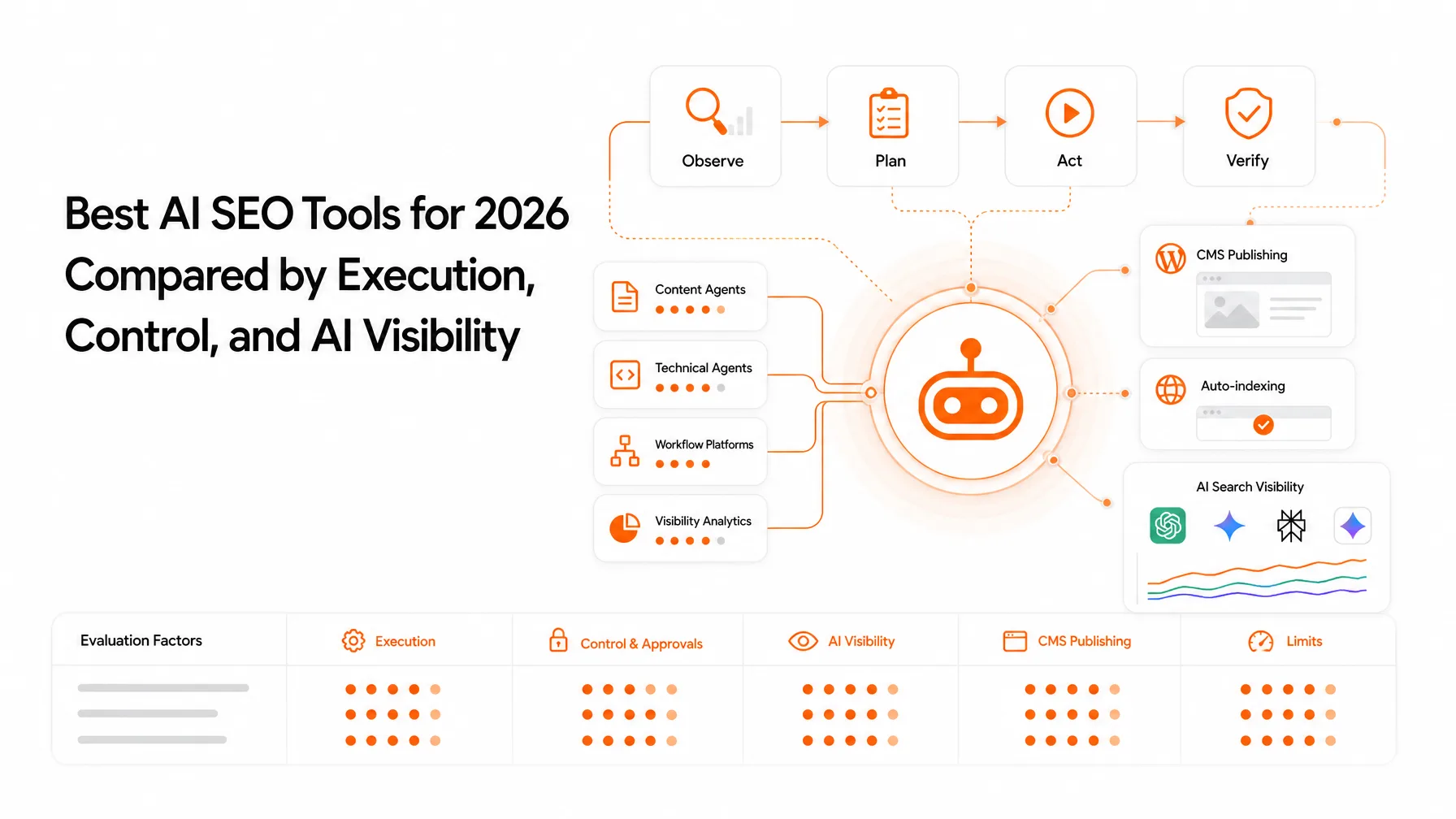
To run an AI visibility audit, test a fixed set of buyer-focused prompts across the AI platforms your audience uses, then record brand mentions, recommendations, citations, competitors, accuracy, sentiment, and cited URLs. Repeat the same runs under documented conditions and turn each gap into a content, technical, entity, or authority action.
An AI visibility audit is a structured review of how often, how accurately, and with what evidence AI platforms mention or cite your brand across a fixed set of prompts — measured separately from your Google Search Console rankings.
You ask ChatGPT a buyer question in your category, and a competitor shows up instead of you. The frustrating part isn't the omission. It's not knowing whether that answer would appear again tomorrow, or why it appeared at all.
Here's the catch: one screenshot isn't a baseline. The same prompt can produce different answers across platforms, sessions, modes, locations, and dates, which is why academic research on response variability supports repeated sampling. OpenAI's ChatGPT Search documentation also notes that citations can be incomplete, outdated, or incorrect.
This audit method covers signals, scope, prompts, runs, scoring, diagnosis, and fixes. For context on how AI search visibility sits alongside traditional SEO, see our guide on AEO vs SEO. For platform-specific guides, see our posts on ranking in Gemini, ranking in Perplexity, and tracking ChatGPT brand mentions.
What should an AI visibility audit measure?
An AI visibility audit measures how often, how accurately, and with what evidence AI platforms present your brand across a fixed set of prompts. It's a sampled observation of AI answers, not a ranking, a traffic figure, or a revenue forecast.
AI visibility is not the same as a Google ranking
Google says standard SEO fundamentals still apply to AI features: indexing, crawlability, internal links, textual content, and structured data. Its documentation on AI features and your website also says these features can use query fan-out, and that results vary by model and technique.
So Google Search Console data still matters. It just answers a different question than an AI search visibility audit does: a ranking is a position in a list, while AI visibility is presence inside a generated answer.
Separate mentions, citations, recommendations, and accuracy
Each signal points to a different fix, so don't collapse them into one score.
Signal | What it means | What a gap usually suggests |
|---|---|---|
Mention | Your brand is named in the answer text | Weak category or entity association |
Citation | A URL you own is listed as a source | A page isn't retrieved or doesn't answer the prompt |
Recommendation | Your brand is suggested as a buying option | Thin comparison or proof content |
Accuracy | The description matches reality | Outdated or inconsistent brand facts |
Google ranking | Your page's position in Google results | Standard SEO and indexing issues |
What one AI response cannot prove
A single response can't prove stable visibility, explain model reasoning, or predict clicks. A citation, a visible answer, a click, and a conversion are four separate events, so treat AI referral traffic as a downstream metric, not a proxy for visibility.
Set the scope before you run the audit
Lock the scope before the first prompt, or later comparisons won't hold up. Every AI visibility audit should start with the same short setup.
Choose platforms, interfaces, regions, and languages
Pick the surfaces your customers actually use: ChatGPT, Perplexity, Gemini, Claude, Google AI Overviews, and Google AI Mode. Track them separately, because one platform's citation behavior doesn't transfer to another. Consumer interfaces and APIs aren't interchangeable either, so check each platform's current official documentation first.
Define the audience, category, competitors, and business locations
Name the customer segment and the category language buyers use.
Pick three to five real competitors, not every brand in the space.
List the locations and languages you serve. For local businesses, see our guide on AI visibility for local businesses — the scoping principles are the same but the prompt set shifts to location and service-based queries.
Decide which business lines are in scope.
Record the baseline conditions
Platform, interface, and model or search mode
Locale and language
Account state (logged in or out, memory on or off)
Date and time of each run
Reviewer name
How do you build a prompt set that reflects real buyer questions?
I recommend treating the prompt set as the audit's unit of analysis. Pull wording from Search Console queries, sales calls, support tickets, customer interviews, and competitor comparisons, then freeze it for the baseline.
Cover discovery, problem, comparison, alternative, and purchase prompts
These five categories are an editorial framework, and the examples below are illustrative.
Discovery: 'What are good SEO automation platforms for small teams?'
Problem: 'How do I find out whether AI search engines mention my brand?'
Comparison: 'Compare [your brand] and [competitor] for agencies.'
Alternative: 'What are alternatives to [competitor]?'
Purchase: 'Which tool should a founder pick to monitor AI citations?'
There's no universal prompt count. A starting set of 20 to 30 prompts is workable; scale it with category breadth and how many answers your team can review properly.
Use branded prompts as a diagnostic, not as the baseline
Branded prompts tell you whether AI describes you correctly once someone knows your name. They can inflate visibility, though, so keep them in a separate diagnostic set and build your baseline from non-branded prompts.
Create a prompt matrix with fixed fields
Give every prompt a row: prompt text, category, funnel stage, expected signal, platform, mode, and locale. Keep a second, exploratory set for new wording so the baseline never drifts.
Run the audit across AI search platforms
Now the actual runs. Whether you're doing a manual LLM visibility audit in a spreadsheet or using a tool, the discipline is identical.
Use the same prompt and documented settings
Paste the exact prompt text each time and log the conditions you recorded in scope. If a platform changes its interface mid-audit, note the date so you can separate product changes from visibility changes.
Capture the complete answer and every cited source
For each run, save a raw-evidence record:
Prompt and category
Platform, interface, locale, and date
Full answer text
Every cited URL, in order
Brands and competitors named
Reviewer notes and next action
Also record when no answer or no citation is returned. That's data, not a failed run.
Repeat runs instead of relying on one screenshot
Run each prompt several times and compare. A screenshot is useful as evidence of a specific run, but it's not proof of a stable position.
Score brand visibility and citation quality
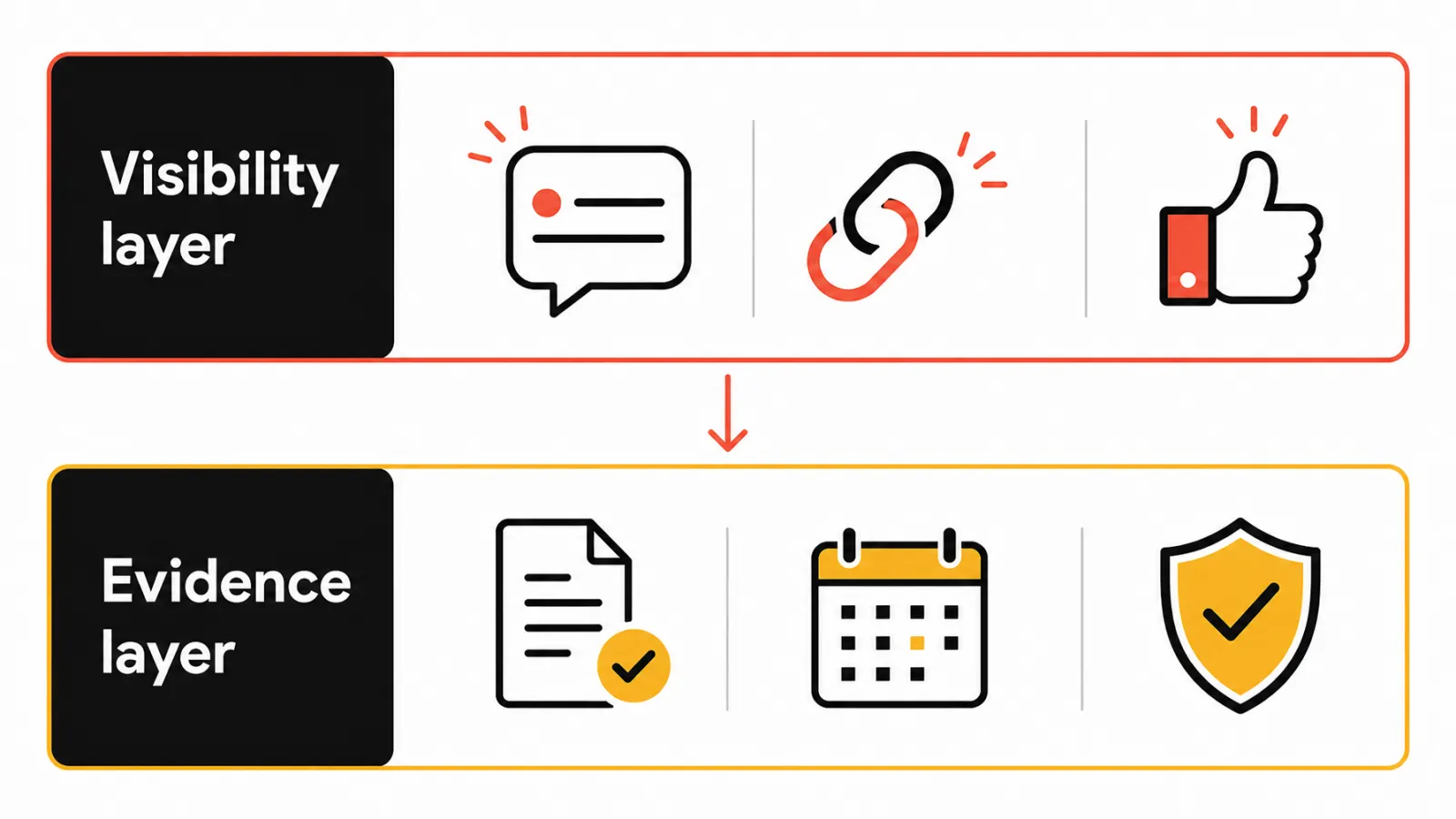
Score in two layers: a visibility layer (did you appear?) and an evidence-quality layer (was the source relevant, current, accurate, and yours?). This stops a high mention rate from hiding weak citations. For deeper definitions, see Keytomic's LLM citation tracking framework.
Calculate mention rate, citation rate, recommendation rate, and share of voice
Mention rate: responses naming your brand divided by total responses.
Citation rate: responses citing a URL you own divided by total responses.
Recommendation rate: responses recommending your brand divided by total responses.
Share of voice: your mentions divided by mentions of all tracked brands, within the same prompt set.
Here's an illustrative example, not a benchmark: if your brand is named in 8 of 40 recorded responses, mention rate is 20%. If 3 of those also cite your domain, citation rate is 7.5%. Keep the two numbers separate, because AI citation tracking only makes sense when you know which signal moved.
Check source quality, citation support, and representation accuracy
Opening the cited page matters more than counting URLs. Ask three questions:
Does the page answer the prompt directly?
Are its facts current?
Is your brand described accurately?
Add one more: does the cited page actually support the specific claim in the answer? Many checklists stop at whether a URL appeared.
Report sample size, confidence, and limitations
State the number of prompts, runs per prompt, and platforms behind every figure. Don't read a trend into small swings, and have a person review any sentiment coding rather than presenting automated sentiment as fact.
Why does an AI system mention a competitor instead of your brand?
The audit shows likely contributing conditions, not hidden model reasoning. Treat each cause below as a hypothesis, then run the test that goes with it.
Entity clarity and brand consistency gaps
Is your brand described the same way on your site, profiles, and third-party pages? Test it by comparing name, category, and offer wording across five or six sources.
Content and buyer-question coverage gaps
Does a page of yours answer the exact prompt? Open the competitor's cited page and check whether it answers directly, with current facts, in a format you don't match.
Crawlability, indexing, internal links, and structured data
Can your page be found and read? Check indexing in Search Console, internal links to the page, and whether Google's introduction to structured data matches visible content. Structured data may reduce ambiguity, but it doesn't guarantee citations.
Third-party source and authority gaps
Which non-owned sources get cited, such as reviews, directories, or publications? If you're absent there, that's a lead for genuine coverage. One missing citation doesn't prove an authority problem, though.
Turn audit findings into an AI search optimization action plan
An audit that stops at reporting is a dashboard, not a plan. Use if-then logic and give every finding one owner. For the broader playbook on how to improve brand visibility in AI answers, that guide covers the cross-platform execution side.
Map each observation to one concrete fix
If you see this | Likely gap | Then do this | Owner |
|---|---|---|---|
Competitor cited for a comparison prompt | Content | Create or improve a comparison page | Content |
Brand mentioned, never cited | Retrieval | Add an answer-first page and internal links | SEO |
Inaccurate description | Entity facts | Update pages and profiles | Product marketing |
Cited page not indexed | Technical | Fix indexability barriers | Technical SEO |
Absent from third-party sources | Authority | Pursue genuine external coverage | PR |
For content execution, our complete guide to Generative Engine Optimization covers how to structure pages and clusters for AI search specifically.
Prioritize impact, confidence, effort, and business value
Score each fix from 1 to 5 on those four factors. Start with high-value, high-confidence, low-effort items. Remember these actions may improve eligibility or source clarity; none can promise a citation.
Re-run the same prompt set after real changes
Repeat the baseline prompts after meaningful updates, and on a monthly or quarterly rhythm. Consistent AI visibility tracking depends on comparing like with like.
AI visibility audit checklist
Before the audit
Lock platforms, modes, locales, languages, and competitors
Freeze the baseline prompt set
Set up the raw-evidence template (or try the [free AI search visibility tools](https://keytomic.com/free-tools) as a starting point)
During each run
Save full answers, timestamps, and conditions
Log every cited URL and competitor
Record no-answer and no-citation results
Repeat each prompt
After the audit
Open each cited page: does it support the specific answer?
Classify gaps and assign owners
Check indexing against [Google's AI features guidance](https://developers.google.com/search/docs/appearance/ai-features)
Schedule the rerun date
Frequently asked questions about AI visibility audits
What is an AI visibility audit?
A repeatable review of how AI platforms mention, cite, recommend, and describe your brand across a fixed prompt set, recorded under documented conditions.
What does an AI visibility audit measure?
Mention rate, citation rate, recommendation rate, share of voice, accuracy, sentiment, and cited-source quality. It samples answers; it doesn't measure traffic or revenue.
What is the difference between an AI mention and an AI citation?
A mention names your brand in the answer text. A citation lists a URL as a source. An answer can have either without the other.
Which AI platforms should an audit include?
Start with the platforms your buyers use, such as ChatGPT, Perplexity, Gemini, Claude, and Google AI Overviews, and verify each platform's current documentation first.
How many prompts should you use in an AI visibility audit?
There's no universal number. A starting set of 20 to 30 buyer prompts is workable; scale it with category breadth and review capacity.
How often should you repeat an AI visibility audit?
Monthly or quarterly is a reasonable starting cadence. Also re-run after meaningful content or technical changes.
Why does an AI platform mention a competitor instead of my brand?
Possible causes include entity inconsistency, content gaps, retrieval barriers, or stronger third-party sources. Inspect the cited page before drawing conclusions.
Can AI visibility tracking replace Google Search Console?
Search Console measures your Google Search performance, while AI visibility tracking samples answers across platforms. They answer different questions, so use both.
Can an AI visibility audit guarantee citations or recommendations?
Independent AI systems produce their own answers, so no audit or action can guarantee citations. Fixes may improve eligibility and clarity.
How can Keytomic support AI visibility monitoring?
Keytomic connects AI visibility monitoring with keyword research, topical planning, content workflows, technical audits, and publishing. Availability varies by plan, and human review is still needed.
Choose the next step based on your audit maturity
Pick the route that matches where your bottleneck actually is.
Manual pilot: Use a spreadsheet to validate your prompts and fields on one product line.
Dedicated tracking: Choose a tracker when you need deeper, repeated measurement across platforms.
Unified workflow: Choose a connected workflow when turning findings into content and technical work is the slow part.
An AI visibility audit only pays off when the findings become work. The gap most teams hit isn't measurement — it's the handoff from observation to content brief, technical fix, and recheck. Keytomic's AI Visibility Tracker connects those steps in one workflow, so if you're finding that's where audits stall for you, it's worth exploring. The Keytomic demo walks through the full loop.