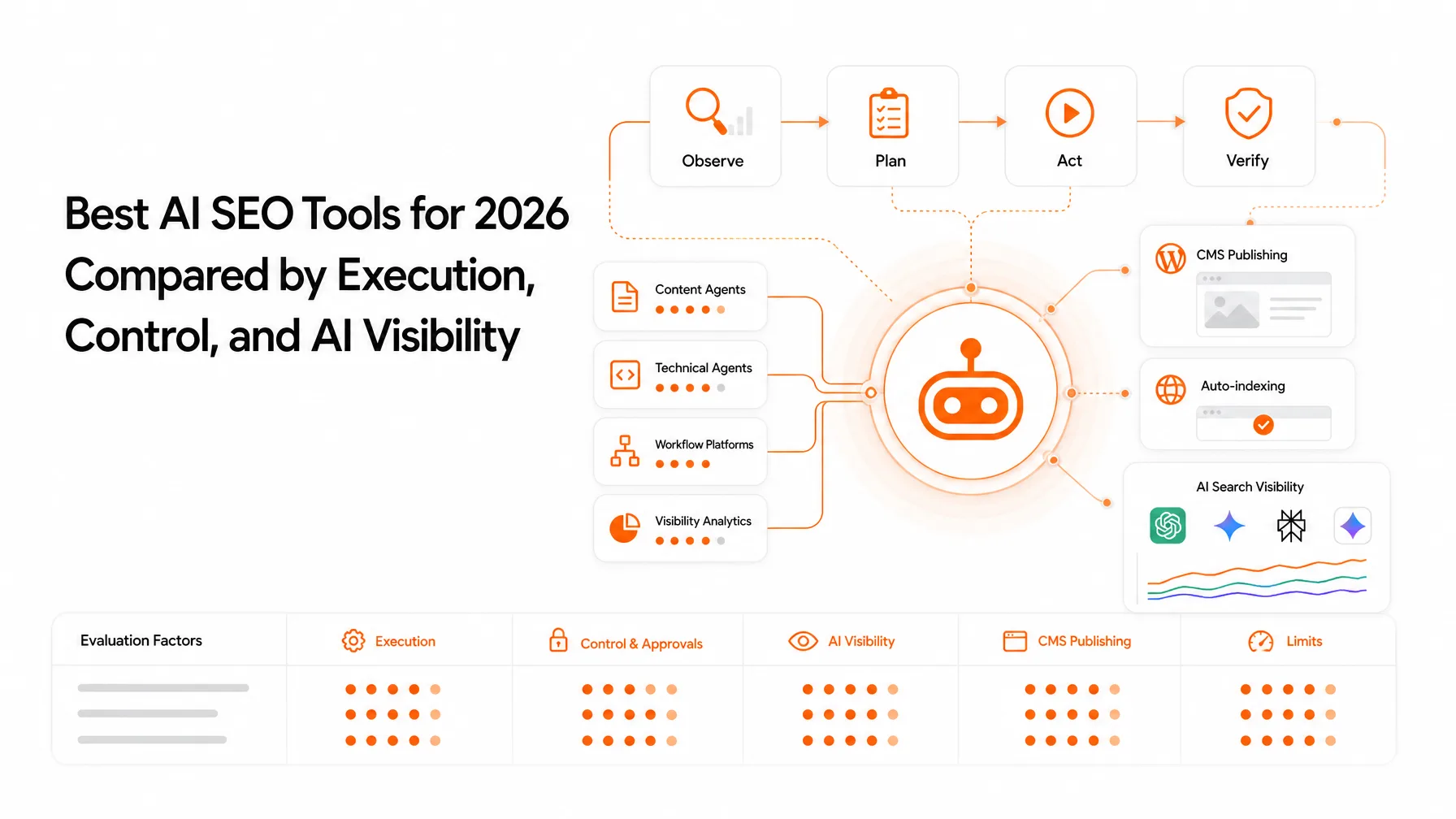
Automated SEO uses software for repeatable, data-heavy work such as keyword discovery, content briefs, publishing workflows, audits, and reporting. Manual SEO keeps strategy, fact checking, brand judgment, outreach, and high-risk changes with people. For most teams, the practical answer is hybrid: automate execution, and keep approval gates where quality, trust, or reversibility are at stake.
You've got keyword data in one tool, priorities in a spreadsheet, briefs in a doc, drafts in your CMS, and a Google Search Console tab open to check whether any of it worked. Every handoff costs a little time and a little context.
Here's the thing: the real question behind automated SEO vs manual SEO isn't humans versus software. It's which decisions need judgment and which handoffs are just eating your week. I'm a Product & Growth Lead working across SaaS, SEO, and AI search, so expect opinions about where that line sits.
Below, I define both approaches, compare them task by task, and lay out an approval-based hybrid model. I'll also cover what to automate first and when manual SEO is still the better call.
SEO Automation vs Manual SEO: Quick Comparison
The difference comes down to three things: who performs the work, who makes the decision, and whether the output repeats. These are working definitions, not industry standards.
What automated SEO means in practice
Automated SEO means software handles defined, recurring work such as keyword discovery, clustering, briefs, audits, scheduled publishing, and reporting. A person still sets goals and approves what ships.
What manual SEO means in practice
Manual SEO means people perform and interpret each step. They may use tools, but they choose priorities, write or review the output, and move work between systems by hand.
Automated, manual, or hybrid: the short decision rule
If work repeats and follows written rules, automate it. If it needs original expertise or is hard to undo, keep a person in charge. Most teams end up with hybrid SEO (the same split shows up when you compare AI SEO tools vs traditional SEO tools), and Google's guidance on generative AI content points the same way: AI use isn't banned outright, but accuracy and human fact checking matter.
Dimension | Automated SEO | Manual SEO |
|---|---|---|
Speed | Fast on repeatable work | Limited by team hours and handoffs |
Control | Set by rules and approval gates | Direct, step by step |
Scalability | Handles volume without matching headcount | Scales with people |
Consistency | Same process every run | Varies by person and workload |
Quality assurance | Needs human review of facts and fit | Depends on reviewer capacity |
Cost model | Software plus setup and review | Labor plus coordination |
Risk | Bad inputs can repeat at volume | Slower, but judgment catches context |
How I'm comparing: this looks at workflow allocation, not vendor rankings. The criteria are speed, scalability, control, consistency, quality assurance, total workflow cost, reversibility, and strategic context. There's no score or winner, because the right model depends on task risk, team capacity, and the oversight you need.
What Manual SEO Involves
Manual SEO can still use software. The difference is that a person interprets the data, picks priorities, and carries every handoff between tools.
Research, prioritization, and strategic direction
Keyword research, SERP analysis, competitor review, and topical maps all end with someone deciding what to publish first, usually with topical authority in mind. That judgment is the most valuable part of manual SEO, and the hardest to automate.
Content, on-page optimization, and publishing
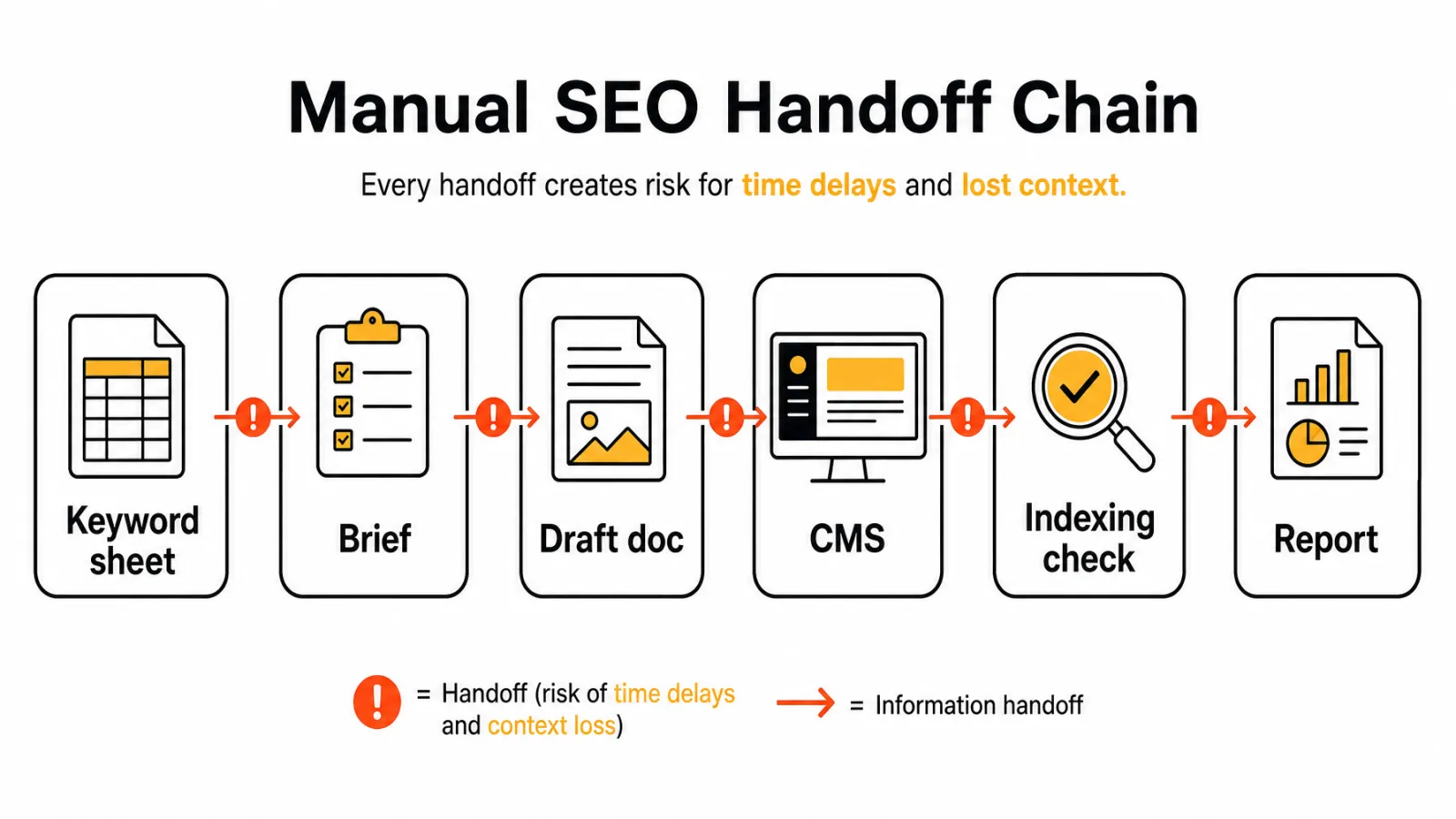
Briefs, drafts, on-page edits, internal links, and CMS entry come next. The hidden cost isn't writing time, it's the chain of handoffs: keyword sheet to brief, brief to doc, doc to CMS, CMS to indexing check, then a report.
Technical audits, outreach, and performance interpretation
Audits, link outreach, and Google Search Console reviews need context a tool doesn't have. Google's SEO Starter Guide is a good reminder that crawlability and indexability matter, while no one can promise rankings.
What SEO Automation Can Handle
Vendors often blur three different things: a tool that recommends an action, a workflow that routes it for approval, and a system that carries the approved action through to an output. Only the last one changes anything on your site.
Repetitive research and data processing
Keyword discovery, clustering, SERP pulls, content gap checks, and cannibalization flags are rules-heavy and data-heavy. Software handles the volume. You decide which gaps matter to the business.
Content briefs, drafting, internal workflows, and CMS publishing
Briefs, first drafts, internal link suggestions, and approval routing can all be generated or moved for you. A tool can suggest a link without applying it, and that gap is where editorial control lives. Publishing to your CMS should wait for a human yes.
Monitoring, reporting, technical checks, and AI visibility tracking
Technical audits, Search Console reporting, and AI search visibility tracking run well on a schedule. One correction on indexing: Google's Indexing API documentation limits it to JobPosting and livestream video pages, so it isn't a way to submit ordinary blog posts. If new pages stall, start with why Google isn't indexing your AI content.
Also, Google's generative AI search guidance says standard SEO fundamentals still apply. Visibility tracking measures mentions and citations; it can't guarantee them.
Manual SEO vs Automated SEO: The Tradeoffs That Matter
There's no winner here. Both approaches fail on bad inputs, weak processes, and thin review. What differs is where they fail.
Speed and scalability versus context and judgment
Automation wins on throughput: more keywords processed, more briefs prepared, more reports sent. People win on context, like knowing a keyword is off-brand or a competitor angle is a trap.
Consistency and repeatability versus originality and brand nuance
Software runs the same process every time, which helps with formatting, checks, and cadence. It won't invent a genuine point of view, so originality and brand nuance stay with your editors.
Tool cost versus labor, setup, review, and rework
Skip the software-price-versus-salary comparison. Use a formula instead: total workflow cost equals subscription or service cost, plus setup, review, implementation, specialist support, and rework. Automation isn't cheaper if review and cleanup eat the savings. For the buy-versus-outsource angle, see automated SEO software vs automated SEO services.
Detection and recommendations versus irreversible changes
I judge automation on two axes: repeatability and reversibility. A draft or a report is easy to undo. A mass redirect, a page deletion, or a brand claim isn't, so it needs a stronger approval gate.
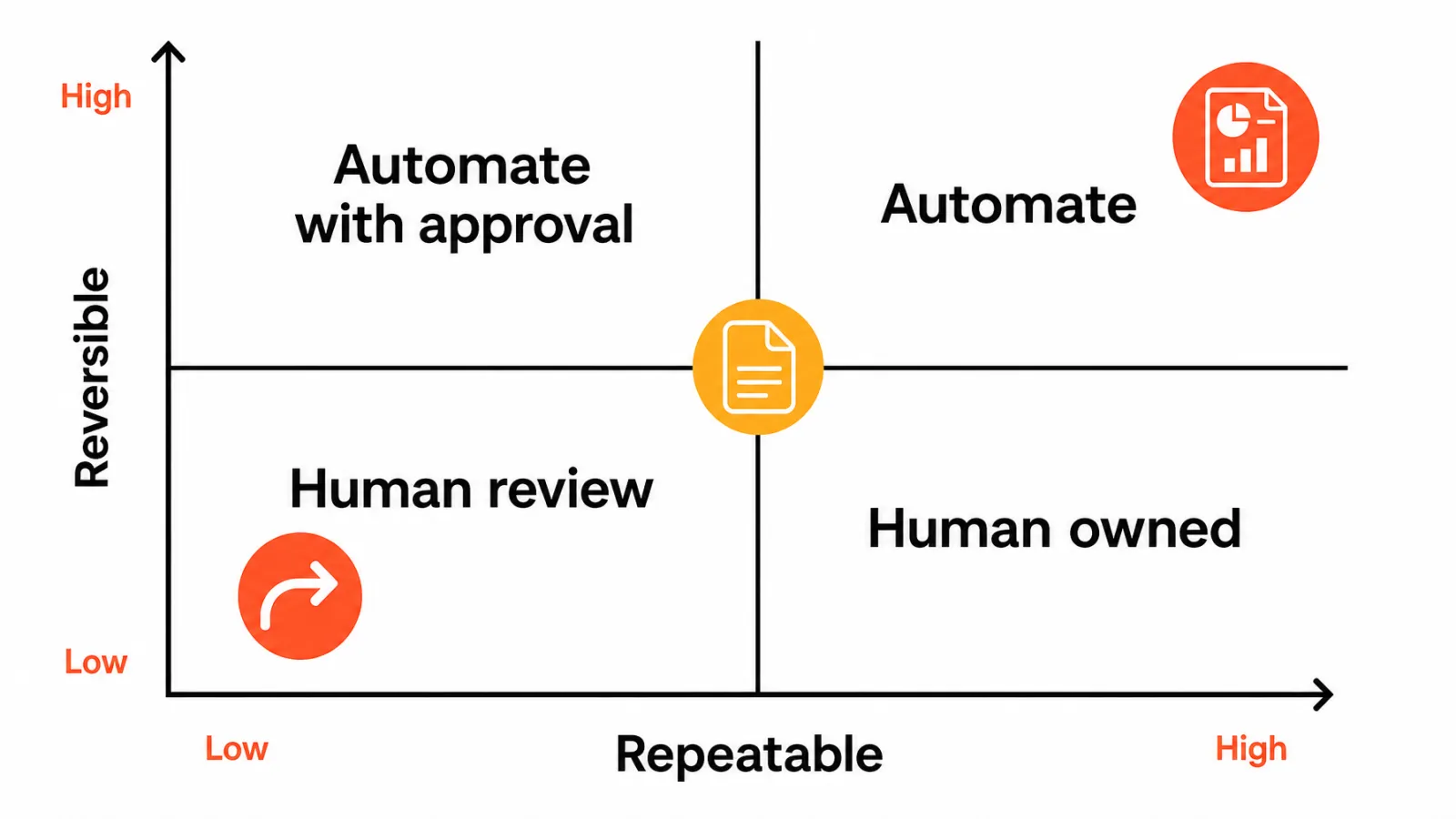
Detection and recommendations are low risk. Execution on live pages is where the gate belongs.
Which SEO Tasks Should You Automate First?
Start with tasks that repeat, follow written rules, and are easy to reverse
Run every candidate task through four questions:
Does it repeat?
Can the rules be written down?
Is the result reversible?
Is the outcome measurable?
If all four answers are yes, automate it. I'd begin with reporting, monitoring, keyword clustering, and brief preparation, and these SEO automation workflows worth automating show how that looks in practice.
Keep strategy, fact checking, and sensitive decisions human
Topic selection, factual claims, and sensitive subjects stay with people. Google's spam policies on scaled content abuse target pages produced at volume mainly to manipulate rankings. Automation without review is how teams drift toward that line.
Use an approval matrix before anything reaches the CMS
Here's the matrix I'd start from. Adjust it to your own risk tolerance.
Task | Automation level | Human checkpoint |
|---|---|---|
Reporting and monitoring | Automate | Spot-check metrics each month |
Keyword clustering and briefs | Automate | Approve topic and angle |
Draft content | Assist | Fact check, brand voice, intent fit |
Internal link suggestions | Assist | Approve relevance before applying |
Technical audit alerts | Detect only | Specialist reviews before fixes |
Redirects, deletions, migrations | Keep manual | Human owns the decision |
Regulated or sensitive claims | Keep manual | Expert review before publishing |
How to Combine Automation With Human SEO Expertise
A practical approval-based SEO workflow
Automation should stop before high-risk actions unless the owner explicitly approves them. A five-part flow works for most teams:
Trigger: a schedule, a new keyword cluster, or an audit alert.
Inputs: Search Console data, keyword data, and brand guidelines.
Automated steps: research, clustering, and a brief or draft.
Human checkpoint: approve priorities, facts, and brand fit.
Output: publish, monitor, and revise, including refreshes when content decay sets in.
What to review before publishing
Facts and sources behind every claim
Match with search intent
Brand voice and product claims
Internal links and anchors
Technical basics such as canonicals and indexability
What to measure after the workflow goes live
Track handoffs removed, review time per page, and Search Console impressions, clicks, and indexing status. Watch AI search visibility too, using one of the AI visibility tools built for it, but treat it as a signal, not a promise.
When Manual SEO Is Still the Better Choice
Lean manual when mistakes are costly, context is scarce, or changes are hard to undo. Keep these out of unattended automation:
Regulated or sensitive claims
Mass redirects
Page deletion
Major architecture changes
Unverified product claims
Regulated, high-stakes, or legally sensitive topics
Health, finance, and legal pages deserve expert review. Treat that as editorial risk control, not a universal legal rule, and get specialist input for your market.
Migrations, architecture changes, and specialist technical work
Migrations, redirect maps, and site architecture changes are hard to reverse. Let automation flag issues, and have a specialist make the call.
Original research, brand positioning, and expert-led content
If the page depends on your data, your opinion, or your expertise, a person should write it. Automation can still prepare sources and structure.
Frequently Asked Questions About Automated and Manual SEO
Can SEO be fully automated?
No. Repeatable execution can be automated, but strategy, fact checking, high-risk changes, and final approval still need a named owner.
Does Google penalize automated SEO content?
Not automatically. Google focuses on helpfulness, accuracy, and E-E-A-T, and targets scaled content made mainly to manipulate rankings, so human review matters.
Is automated SEO cheaper than manual SEO?
Not automatically. Compare total workflow cost: subscription plus setup, review, implementation, specialist support, and rework, not software price against salary.
How much human oversight does SEO automation need?
Enough to approve content, claims, brand fit, and high-risk changes before anything is published or implemented.
Does automated SEO replace SEO professionals?
Usually not. It reduces repetitive execution, which makes strategy, governance, and review more valuable. Agentic SEO pushes further on execution, but still relies on human oversight.
Which SEO tasks should be automated first?
Recurring, rules-based, measurable, and reversible work: reporting, monitoring, clustering, and draft preparation.
Is SEO automation suitable for agencies?
Yes, when the platform supports your sites, permissions, reporting, CMS workflows, and approval process. Here's how Keytomic works for agencies. Verify each platform claim against official documentation.
Can automation preserve brand voice?
It can support consistency, but it can't replace human review of positioning, tone, claims, and audience fit.
What should never be automated in SEO?
High-risk or hard-to-reverse actions: regulated claims, mass redirects, page deletion, major architecture changes, and unverified product claims.
How should a team choose an SEO automation platform?
Match it to your workflow: connected research-to-publishing steps, approval control, CMS support, reporting, and visibility tracking. Verify pricing and limits on official pages.
Automated or Manual SEO: Which Approach Fits Your Team?
Here's the decision framework I'd use:
Choose manual SEO when the work depends on original expertise, sensitive judgment, specialist implementation, or hard-to-reverse changes.
Choose automation-supported SEO when the work repeats, follows written rules, produces measurable output, and creates avoidable handoffs.
Choose a hybrid model when you need more throughput but can't compromise on strategy, facts, brand control, or approval gates.
If you're weighing automated SEO against a hands-on process, start with the four-question test, then use this guide on how to choose SEO automation software to evaluate platforms. When you're ready to see an approval-based workflow in action, book a Keytomic demo.