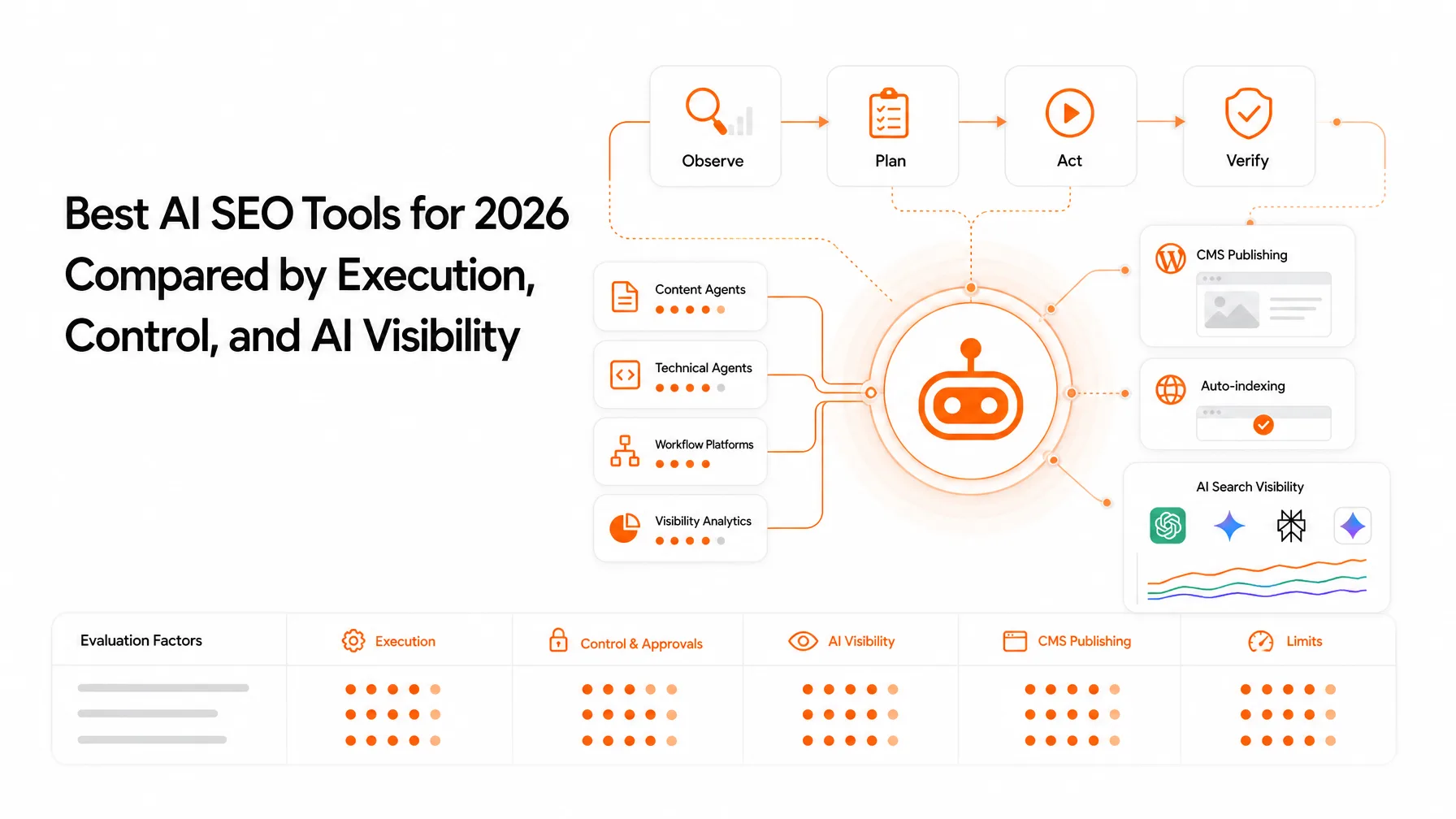
The best Webflow SEO tool for most small sites is Webflow itself, paired with Google Search Console. Webflow already manages titles, descriptions, canonicals, redirects, XML sitemaps, alt text and schema.
When a site grows, the right addition depends on the work Webflow still leaves undone: use FluidSEO for bulk edits, Screaming Frog for an independent technical crawl, Ahrefs or Semrush for market intelligence, and Keytomic when the bottleneck is turning a content plan into published Webflow CMS pages.
I have spent seven years working across SEO, product and organic growth for more than 50 SaaS, technology and service brands. I lead product and growth at Keytomic, which appears in this article. You should weigh my view of it with that relationship in mind. I have put competing tools ahead of Keytomic for the jobs they do better, and linked the vendor documentation behind the current feature and pricing claims.
A note on evidence: this is a buyer's comparison, not a controlled ranking experiment. I checked official documentation, plans and Webflow Marketplace listings on October 4, 2026. The images are screenshots of public product and app pages, not proof of a logged-in test. I explain where I would use each tool; I do not claim a measured result where I have no test record.
Key takeaways
Start with Webflow and Search Console. Core page SEO is native, while Search Console supplies Google's own query and indexing data. A second app needs to solve a named gap.
Keep Webflow's three SEO tiers separate. Core controls come with the site; AI-assisted audits require an eligible paid plan and use AI credits; Webflow AEO needs a Team or Enterprise Platform plan, and its analytics needs Analyze. Do not price all three as “included.”
For execution, choose the bottleneck. FluidSEO speeds up bulk edits inside Webflow; Keytomic connects topic planning to Webflow CMS publishing; Schema Flow keeps structured data mapped to CMS fields; AutoLink.ai tackles existing internal-link debt.
For independent evidence, leave the Designer. Screaming Frog crawls the published site, while Ahrefs and Semrush show demand, competitors and backlinks that Webflow cannot infer from its own pages.
Most sites need two or three tools. A small site can stop at Webflow and Search Console. Add a specialist only when you can name the recurring task it will remove.
The ten picks at a glance
Webflow SEO and AEO — best starting point for site controls and eligible AI-assisted audits.
Keytomic — best for research-to-publishing workflows around a Webflow CMS.
FluidSEO — best for bulk metadata and image work inside Webflow.
Screaming Frog — best independent technical crawl.
Graphite — best Webflow-native mix of metadata, schema and AI-search controls.
Ahrefs — best for competitor, keyword and backlink research.
Semrush — best broad SEO research, monitoring and reporting suite.
Schema Flow — best for structured data mapped to CMS fields.
AutoLink.ai — best for an internal-link backlog across many pages.
AI SEO Copilot — best free, simple on-page guidance inside the Designer.
The free tool I would not omit: Google Search Console is not a Webflow app, but it is the first measurement connection I would make. It reports clicks, impressions, queries and indexing from Google itself. Its absence from a ten-product roundup should never be read as a reason to skip it.
Comparison: the job, the handoff, and the real starting point
Tool | Gap it covers beyond basic Webflow | Where the work happens | What still needs a person or second tool | Public starting point |
|---|---|---|---|---|
Webflow SEO + AEO | Site controls and eligible AI-assisted fixes | Webflow | Research, off-site data and content strategy | Core controls included; AI and AEO eligibility varies |
Keytomic | Topic planning through CMS publishing and visibility | Keytomic + Webflow CMS | Editorial review; specialist link index | |
FluidSEO | Repetitive metadata, alt text and CSV updates | Webflow app | Strategy and competitor data | |
Screaming Frog | Deep crawl and migration QA | Desktop crawler | Fixes on the site | |
Graphite | Bulk metadata, robots, schema and AI tracking | Webflow app | Keyword strategy and editorial output | |
Ahrefs | Keywords, competing pages and backlinks | External suite | Webflow implementation and publishing | |
Semrush | Research, positions, audits and reporting | External suite | Webflow implementation; full AI toolkit may need another plan | |
Schema Flow | Repeatable CMS schema mapping | Webflow app | Choosing the right schema and validation | |
AutoLink.ai | Discovering and applying internal links | Webflow app | Relevance rules and editorial QA | |
AI SEO Copilot | Basic on-page guidance | Webflow Designer | Research, scale and execution outside the page |
A starting price is not a comparison of equal units. Ahrefs Starter has 200 monthly report credits and no report exports; FluidSEO Business charges per user; Keytomic Pro covers one site and 30 blog credits; a Webflow AEO buyer needs to check Platform and Analyze eligibility. Count the whole workflow before choosing the cheapest-looking row. Ahrefs Starter limits, Webflow AEO requirements.
How I evaluated the tools: Gap Coverage and Designer Friction
I ask two questions before adding software to a Webflow site. Gap Coverage asks whether the product does a job the existing stack cannot do well. Designer Friction asks how many manual steps it adds between finding an issue and shipping the fix.
A product that repeats a native SEO score but adds another dashboard has weak gap coverage. A product that lets an editor update 150 CMS items through one mapped rule may have high gap coverage even if it has only one feature.
The seven gaps I check are search intelligence, content strategy, content execution, technical diagnostics, bulk operations, authority research, and AI-search measurement. The comparison table names the primary gap for each product. These are workflow categories, not a made-up numerical score. A specialist can be excellent while covering only one gap.
I also ask whether a product acts on the site, prepares work for someone else, or only observes. Screaming Frog observes and diagnoses. FluidSEO acts inside Webflow. Ahrefs informs decisions. Keytomic prepares and publishes CMS content. That distinction is more useful than calling all four “SEO automation.”
What Webflow already does, and the part plans change
Webflow's native controls cover page titles, meta descriptions, canonicals, redirects, XML sitemaps, robots directives, alt text and schema input. Its Audit panel can identify missing metadata, alt text and schema and generate suggestions with Webflow AI.
There are limits: AI features require an eligible paid Site or Workspace plan, use AI credits, and currently generate for the primary locale. The Audit panel does not check alt text for images inside CMS content, components or lightboxes, so do not assume a clean audit means every image is covered.
Webflow AEO is another tier. Its agents can recommend and apply accepted metadata, schema, alt-text and broken-link changes. Its analytics can show AI-answer mentions, bot visits and AI-referred visitor activity.
It requires a Team or Enterprise Platform plan, and AEO analytics also needs Analyze. That may make Graphite or a separate AI visibility tracker more relevant for a team on a lower Webflow plan. Compare access and measurement depth before buying either.
1. Webflow SEO + AEO — best native foundation
Best for: every Webflow site, with the paid AI and AEO layers chosen by plan.
Gap Coverage: site controls and on-site recommendations.
Designer Friction: none for native settings.
Pricing: base SEO settings come with Webflow; AI audits and AEO have distinct eligibility and usage conditions.

The first tool is the platform itself because installing an app to write a title tag rarely makes sense. Configure the CMS template's title and description fields, review canonical patterns, enable the sitemap, and check redirects whenever a slug changes. These are site settings, not reasons to add a subscription.
Webflow's AI layer can speed up missing-field work, but the editor still has to review what it generates.
Where I would use it: on a ten-page marketing site, I would configure native fields, connect Search Console, inspect the live output, and stop. On a larger paid Workspace I would also trial the Audit panel on a sample of CMS and static pages before paying for a second on-page audit app.
On Team or Enterprise, I would compare AEO's analytics with any external AI tracker using the same prompt set and time window.
What it does well: changes live in the source CMS; editors can review suggestions before publishing; dynamic templates reduce per-page work; redirects, sitemaps and robots settings sit near site management.
Where it falls short: it does not supply a backlink index or serious competitor intelligence, and its audits do not cover every kind of CMS image alt text. Eligibility for the newer AEO features is also materially different from eligibility for ordinary page settings.
My call: use Webflow first. Add another product for a defined task that the native stack cannot complete at the scale or depth you need.
2. Keytomic — best for content planning through Webflow CMS publishing
Best for: founders, SaaS teams and agencies with a publishing bottleneck.
Gap Coverage: search opportunities, topical planning, drafts, CMS publishing and measurement.
Designer Friction: the work moves through Keytomic, then into a selected Webflow collection.
Pricing: Pro $99/month, currently one site, up to three seats and 30 blog credits.

I work on Keytomic, so I can describe the intended Webflow workflow directly: connect the site, select a CMS collection, map its content fields, approve a topic and draft, then publish the finished item into Webflow.
The integration guide explains the collection and field mapping. Keytomic's job is not to replace Webflow's title-tag input; it is to connect the decision about what to publish to the work of getting that page live.
Its wider suite also includes technical audits and AI visibility tracking, but I would still use specialist tools when a technical crawl or backlink investigation needs more depth.

The integration is a CMS publishing connection, not an app that sits inside Webflow Designer.
Where I would use it: take one real cluster from AI keyword research, shape it into a topical map, edit the draft from the AI blog writer, then use automated CMS publishing to send the approved item to Webflow. Verify the rendered heading order, internal links, image alt text, canonical and schema on the live URL. Review the next topic against AI visibility and citations and Search Console data, rather than treating publication as the finish line.
Pros: the strategy-to-publish path is connected; a Webflow site can keep its existing design and CMS; technical audit and visibility features sit in the same workspace; editors can review before a page goes live.
Cons: generated articles still need factual and brand review; 30 blog credits are a ceiling for higher-volume teams; one Pro plan covers one site; Ahrefs has deeper backlink research and Screaming Frog has a more specialized crawler. Keytomic's independent review base is also much smaller than those established products, so I would test the exact workflow during the trial rather than rely on averages from a small sample. Keytomic pricing, G2 review listing.
My call: use Keytomic when strategy and publication are disconnected. If the site already has a healthy editorial pipeline and only needs bulk metadata edits, choose FluidSEO instead. For a Webflow-based software business, the SaaS SEO workflow and Webflow platform guide show how to connect these decisions to product pages.
3. FluidSEO — best for bulk Webflow work
Best for: marketers and agencies updating many static or CMS pages.
Gap Coverage: bulk metadata, alt text, audits and selected schema tasks.
Designer Friction: low; it runs as a Webflow app. Pricing: free entry, Business $24 per user/month, Agency $65/month.
FluidSEO deserves its place because it solves a real operational problem: the work is already decided, but someone has to repeat it across hundreds of pages. Its Marketplace listing documents page audits, AI metadata, image alt text, schema and CSV-based updates.
The Webflow integration guide describes the bulk SEO flow: export current values, edit the spreadsheet, import it, review the changes, then publish. It also documents CMS-image alt text support, which is relevant because Webflow's native Audit panel does not check all CMS images.

The Marketplace preview shows the app's audit and update controls inside Webflow.
Where I would use it: a hypothetical 120-page refresh with inconsistent titles, descriptions and OG fields. I would export a sample, edit ten rows first, import and inspect the actual published HTML, then process the rest. That ten-page gate matters: a bad spreadsheet rule can replicate a mistake faster than manual editing can.
I would use the alt-text function only after checking samples for product names and contextual meaning.
Pros: native Webflow context; CSV changes save time at scale; CMS image support; a clear agency plan; no separate research suite to learn.
Cons: a bulk updater does not decide which keywords matter; the editor still owns QA; generated text can become repetitive; it overlaps native AI audits, so small sites may pay for duplicate capability.
The advertised Agency price covers unlimited users and sites, but compare the plan with the actual number of editors before subscribing.
My call: buy when page-by-page maintenance is a recurring cost. Skip it if your site is small enough to fix in one afternoon.
4. Screaming Frog — best independent technical crawl
Best for: migrations, redesigns and technical audits on sizable sites. Gap Coverage: diagnostics on the published output. Designer Friction: higher, because it operates outside Webflow. Pricing: 500 URLs free; a paid annual licence is needed for unrestricted crawls and advanced functions. The vendor offers currency selection, so check your local price.
A Webflow editor shows the configuration you intended. A crawler shows the URLs, redirects, headings, directives and links you actually published. That is why I still open Screaming Frog before and after a migration.
It can find broken internal links, redirect chains, missing titles, duplicate metadata, canonical conflicts and orphan candidates; its paid version also supports JavaScript rendering, structured-data validation and connections to Search Console, Analytics and PageSpeed Insights. SEO Spider feature list.

The crawler is an independent view of the published site, not a Webflow configuration panel.
Where I would use it: before a Webflow redesign, save a crawl of the current live site. After launch, crawl the new domain and compare indexable URLs, titles, canonicals, redirect destinations and internal link targets.
If the page count changed unexpectedly, investigate before deciding the migration is finished. Schedule later crawls when the site is large enough that regressions can hide for weeks.
Pros: deep technical evidence; CMS-agnostic; useful migration comparison; generous free small-site crawl.
Cons: it diagnoses but does not publish a fix; the interface has a learning curve; large crawls need a capable machine; it is more tool than a ten-page founder site requires.
My call: my first specialist pick when I do not trust the site's technical output. For routine checks between deeper crawls, an automated technical SEO audit can keep a smaller issue queue visible.
5. Graphite — best Webflow-native SEO and AEO utility
Best for: teams wanting metadata, robots, schema and AI tracking close to Webflow. Gap Coverage: bulk on-page management and AI-search monitoring. Designer Friction: low. Pricing: the Webflow Marketplace listing shows a free plan; verify limits for the AI Tracker before choosing it on price.
Graphite's current listing documents a bulk metadata editor, robots.txt builder, schema builder and AI Tracker. It says the tracker can show share of voice and raw answers across ChatGPT, Perplexity, Google AI Overviews, Claude and Gemini. That is a broader pitch than an old-style “SEO score” app.
It may be useful for a team that cannot access Webflow's higher-tier AEO analytics or wants a different AI measurement view.

The app preview shows its AI tracking, robots and schema interfaces.
Where I would use it: compare ten purchase-intent prompts in Graphite with what your team observes manually, then inspect the cited URLs and exact answer context. Separately, use bulk metadata for a small controlled set of pages before applying it sitewide.
I would not assume that a vendor's “visibility score” is interchangeable with Webflow AEO's metrics or an independent citation count.
Pros: Webflow-native workflow; multiple utility jobs in one app; AI answer context is more useful than a brand-mention tally alone.
Cons: several features overlap FluidSEO and native Webflow; the free listing does not disclose every tracking allowance; the schema builder still needs validation; robots controls can cause serious crawl mistakes if applied indiscriminately.
My call: compare Graphite, FluidSEO and native Webflow on the same task. Keep the one that removes the most work for your plan and team, rather than installing all three.
6. Ahrefs — best competitor and backlink intelligence
Best for: SEOs who need external search and authority data.
Gap Coverage: keywords, competitor pages, link profiles and content gaps.
Designer Friction: medium; research stays outside Webflow.
Pricing: Starter $29/month; Lite $129/month. The Starter plan has 200 monthly report credits, one unverified project and no report exports.
Ahrefs is here because the CMS cannot tell you which rival pages attract demand or which sites link to them. Site Explorer and Keywords Explorer help identify opportunities; Site Audit adds a second technical lens; Brand Radar is a separate AI-search product with its own scope and price. It is a research instrument, not a Webflow publishing app.

Ahrefs brings market and link data into the decision; the implementation still happens elsewhere.
Where I would use it: select a competitor's strongest comparison or solution page, inspect the queries and links, and ask whether your Webflow site has a credible answer. I would then brief one page, map it to a product or comparison destination, and check after publication whether impressions and referring links move.
That process uses Ahrefs for external evidence and Search Console for first-party results. I would not buy the $29 Starter tier expecting unlimited exports or an agency workflow.
Pros: strong competitive and backlink research; useful search-demand discovery; independent site audit; good fit for prioritizing commercial pages.
Cons: Starter credit limits are real; adding seats and higher data limits raises spend; it does not fix or publish Webflow pages; third-party traffic estimates must be checked against your own Search Console data.
My call: choose it when you do not know what competitors have earned and why. If you already know what to publish but cannot get it live, more research is not the immediate purchase.
7. Semrush — best broad research and monitoring suite
Best for: marketing teams running several SEO jobs from one account.
Gap Coverage: keywords, competitors, auditing, position tracking and reporting.
Designer Friction: medium.
Pricing: SEO Toolkit Pro $139.95/month. Semrush One is the fuller SEO-plus-AI-visibility bundle, starting at $199.95/month; the dedicated AI Visibility Toolkit is separately priced. Check the exact features on your chosen plan rather than treating “Semrush” as one subscription.
Semrush makes sense when the Webflow team needs a monitoring system more than a new CMS app. Position Tracking, Site Audit, Keyword Magic and competitor reports can create a common operating view for multiple stakeholders. It has broader marketing coverage than Ahrefs; that breadth also makes plan comparison and onboarding more involved.

The suite covers research and monitoring; it does not turn Webflow metadata or CMS items into live changes on its own.
Where I would use it: track a defined set of commercial terms, crawl the site weekly, review lost-visibility pages, then send specific updates to an owner in Webflow. If AI visibility is a buying requirement, I would compare Semrush One and the AI Visibility Toolkit against the basic SEO plan using the same prompts, markets and reporting needs. A $139.95 entry price and a $199.95 integrated bundle do different jobs.
Pros: broad keyword and technical coverage; useful reporting for teams; recurring audits and rank checks; established training ecosystem.
Cons: extra products and seats change the real cost; the interface takes time to learn; recommendations still need implementation; a small Webflow site can buy far more software than it needs.
My call: buy for a team that needs one research and reporting suite. For a marketing team whose actual backlog is publication, evaluate the execution gap separately.
8. Schema Flow — best schema mapped across CMS collections
Best for: blogs, directories, resource libraries and other template-driven Webflow sites.
Gap Coverage: repeatable structured data tied to CMS fields.
Designer Friction: low after mapping. Pricing: Starter free for up to ten published schemas; Pro currently promoted at $79 lifetime. The displayed Pro price is promotional, so use the linked page before buying.
Webflow can add schema, including AI-generated markup, but a site with hundreds of CMS records needs a repeatable mapping, not hundreds of hand-edited blocks. Webflow's Schema Flow integration guide says the app maps collection fields to schema properties and keeps JSON-LD current when CMS content changes.
That is the useful difference: a title or author update can flow into the structured data instead of leaving stale markup behind.

Schema Flow focuses on mapping schema to dynamic Webflow content.
Where I would use it: on a resource library with Article pages, map headline, image, author and dates to the matching CMS fields. Publish one sample page and validate the rendered JSON-LD before applying the template to the whole collection.
Check that the theme, Webflow native fields and app are not all emitting overlapping Article or Organization objects. The free Article schema generator or FAQ schema generator is enough for a single static page when a mapped app would be excess.
Pros: CMS mapping removes repeated code edits; pricing is attractive if the site uses many schema objects; Webflow-specific workflow. Cons: markup quality still depends on field quality; duplicate output needs checking; schema alone does not guarantee a rich result or an AI citation; a small brochure site may need no extra app.
My call: choose it when structured data must stay correct across many dynamic records. See our schema and AI visibility guide for why accurate entity information matters more than the sheer number of schema types.
9. AutoLink.ai — best for an existing internal-link backlog
Best for: Webflow libraries with many related pages and weak contextual links.
Gap Coverage: discovering, suggesting and applying internal links.
Designer Friction: low once connected.
Pricing: listed as free on Webflow Marketplace; check the app for any plan or usage limits before building a workflow around it.
An internal-link tool is useful only if it adds connections a reader would actually follow. AutoLink.ai's Marketplace listing describes contextual suggestions, a one-click assistant, broken-link detection and campaigns that can implement links based on rules. Those are plausible time savers for a 300-post blog. They are unnecessary for a ten-page site whose important links can be reviewed manually.

The app proposes links from existing content; editorial relevance remains the deciding rule.
Where I would use it: first identify pages with commercial intent that have few inbound links from the blog. Feed those destination pages into a campaign, review suggested anchors in context, and approve a small batch. Crawl afterwards to check repeated anchors, wrong destinations and links inserted into irrelevant sentences.
I would cap links per page and avoid adding every possible match to the same target. For new content, contextual links can also be planned earlier with semantic SEO automation.
Pros: focused job; Webflow-specific integration; one-click application; can surface neglected pages.
Cons: automated relevance claims are the vendor's claims, not proof of reader value; too many exact-match links can make copy worse; campaigns need review and a way to undo mistakes.
My call: use it when internal-link debt is measurable. If the site is still small, write the links by hand while editing the page.
10. AI SEO Copilot — best free, simple on-page guidance
Best for: a founder or designer who wants plain-language checks inside Webflow.
Gap Coverage: introductory on-page guidance.
Designer Friction: very low.
Pricing: free and open source according to its Webflow listing.
AI SEO Copilot is the lightest recommendation here, and that is both its appeal and its limit. The Marketplace listing documents 18 on-page checks, keyword presence detection, a score and GPT-powered recommendations. A beginner may appreciate the explanation in the Designer.
An experienced SEO who already uses Webflow's Audit panel may see substantial overlap.

The free app is designed to explain on-page issues where the page is edited.
Where I would use it: let a new Webflow editor run it on one live page, ask them to explain which recommendation changes the page for a reader, and ignore any suggestion that only raises a score. Then compare the same page with Webflow's native Audit panel. If both flag the same issue, keep the workflow that is easier for the team to maintain.
Pros: free; runs in the Designer; accessible language; open-source codebase. Cons: it does not replace a crawl, backlink index or content plan; scores can make minor wording changes look more important than search intent; its primary value may disappear as native Webflow guidance improves.
My call: a useful learning aid, not a required part of a mature Webflow SEO stack. If your team needs deeper Webflow-native guidance, compare it with Semflow before committing to another scoring layer.
Which tools overlap, and which tools can work together?
The ten products are not ten subscriptions I recommend buying. Some pairs solve different stages; others duplicate one another.
If you already have… | Add this only when… | Why the distinction matters |
|---|---|---|
Webflow native Audit | FluidSEO or Graphite | You need bulk workflows, CMS-image coverage or specific AI tracking beyond your current plan |
FluidSEO | Graphite | Its AI answer data or robots controls justify a second app; basic metadata editing alone does not |
Webflow schema | Schema Flow | Many CMS pages need field mapping and repeatable updates |
Keytomic | Ahrefs | You need deeper backlink or competitor intelligence than the content workflow provides |
Semrush | Screaming Frog | A migration or technical investigation needs crawl detail and configurations beyond a suite audit |
AutoLink.ai | Keytomic linking | You have existing link debt as well as links needed in newly produced content |
The test is practical: write down the exact job, the current manual steps, the tool's steps, and who reviews the result. If you cannot show a removed handoff, you may be buying a second view of the same backlog.
If you are deciding whether Webflow is the right CMS in the first place, the CMS for SEO comparison is a better starting point. If you already chose Webflow and want to compare the wider execution category, use the SEO automation software guide. This article answers the narrower question of which tools belong around a Webflow site.
My Webflow SEO stack by site size and problem
A new or small business site: Webflow's native controls and Google Search Console. Publish a useful page, check indexation, and understand which queries create impressions. Buy nothing else until the next constraint is clear.
A content-led SaaS site with a small team: Webflow, a content execution layer such as Keytomic, and Search Console. Add Ahrefs when competitive and backlink questions become frequent enough to justify it. Connect the article to product and comparison pages; the SaaS SEO workflow needs more than a blog calendar. A founder-led SEO workflow may be the right starting point when nobody owns publishing full time.
An agency maintaining many Webflow sites: Webflow, FluidSEO for repetitive on-site work, and a research/reporting suite such as Semrush or Ahrefs. Add a content execution tool only when publishing is the bottleneck. Evaluate seats, site allowances and approvals across clients; the agency workflow is a separate buying decision from metadata editing.
A large CMS library or migration: Webflow, Screaming Frog, Search Console and, if needed, Schema Flow. Crawl before and after major changes. The decisive risk is not whether an editor sees a good SEO score; it is whether templates emit correct canonicals, links, redirects and structured data across thousands of URLs.
A team measuring AI visibility: first check eligibility and cost for Webflow AEO. Compare Graphite or a specialist AI visibility tracker on the same prompts and markets. Keep the underlying cited URLs and answer context, not just a share-of-voice number. The AI visibility guide covers that measurement problem more deeply.
How I would trial a Webflow SEO tool in one afternoon
Pick a page you were already going to improve and record its current title, description, canonical, schema, internal links, Search Console queries and indexed status. Then test the software on a real task rather than a demo project.
Define the task. Examples: update metadata across 40 CMS pages, publish one approved article to Webflow, audit a migration, or add links to five underlinked pages.
Count the manual handoffs. Record every export, copy, field remap, approval and publish action. A tool that moves work into a prettier dashboard but leaves every handoff intact has not solved the problem.
Inspect the published output. Check the live HTML, not only the in-app score. Crawl the changed URLs and validate schema when relevant.
Review one failure case. Give the tool an unusual product name, a CMS item missing an image, or a page with a deliberately wrong canonical. See whether it flags uncertainty or confidently produces a mistake.
Check reversibility and cost. Ask what happens to site changes when the subscription ends, which plan carries the needed feature, and whether seats, sites, prompts or credits change the price.
If the tool saves an editor two hours but creates an extra hour of QA, measure the net result. If it can publish 30 drafts but only five survive review, price it per accepted page, not per draft credit. Those are the numbers a Webflow team can actually use to choose.
FAQ
What is the best SEO tool for Webflow?
Start with Webflow's native SEO controls and Google Search Console. Add FluidSEO for bulk on-site work, Screaming Frog for technical crawling, Ahrefs or Semrush for external search intelligence, and Keytomic for a connected content planning and publishing workflow. The best additional tool depends on the task your team cannot complete efficiently.
Does Webflow need SEO plugins?
No. Webflow already supports titles, descriptions, canonicals, redirects, XML sitemaps, alt text and schema. Webflow calls extensions Apps. Add one when a specific job, such as bulk editing or CMS schema mapping, remains slow or unreliable with the native controls.
Are Webflow's AI SEO and AEO features free?
Do not assume so. Webflow's AI-assisted audits require an eligible paid Site or Workspace plan and consume AI credits. Webflow AEO requires a Team or Enterprise Platform plan, while its analytics also requires Analyze. Check the current requirements for your account.
What is the best free Webflow SEO stack?
Webflow's native settings plus Google Search Console cover basic site controls, query performance and indexing. AI SEO Copilot can add free in-Designer guidance, but test it against Webflow's native Audit panel before making it part of every editorial process.
What should I use for Webflow keyword research?
Ahrefs and Semrush are strong options when you need competitor, keyword and backlink data. Keytomic fits when keyword discovery needs to flow into topical planning and Webflow CMS publishing. Search Console shows the queries your existing site already earns; it is not a full competitor keyword database.
Can Keytomic publish directly to Webflow?
Yes. The Webflow integration maps approved content to a selected CMS collection and its fields. Review the rendered URL after publishing, especially headings, links, images, metadata and schema.
Is Webflow good for technical SEO?
Webflow offers strong native controls, but their configuration should be checked on published pages. Screaming Frog is useful for independent crawls, especially before and after migrations, redesigns and large CMS changes.
Can a Webflow site appear in ChatGPT and AI answers?
Yes, a crawlable Webflow site can be discovered and cited. Webflow AEO and third-party trackers can measure parts of that visibility, but none can guarantee a citation. Clear answers, accurate information, accessible pages and credible sources matter more than a special AI-specific schema. See Google's AI features guidance and our brand visibility guide.
Disclosure: Salam Qadir is Product & Growth Lead at Keytomic. Keytomic is included in this comparison. Prices and availability were checked against linked official sources on October 4, 2026; vendor plans can change.