To get SEO clients, pick a specific buyer and offer, build proof around a real problem, and commit to one repeatable outreach channel. Sell a focused diagnostic instead of vague SEO help, then qualify each prospect on goals, scope, budget, authority, and your delivery capacity. That's how to get SEO clients without promising rankings.
You know how to do SEO. What you don't have yet is a predictable way to get someone to pay for it, and that gap shows up as a vague services page, scattered outreach, and referrals that arrive whenever they feel like it.
Learning how to get SEO clients rarely comes down to a missing tactic. It's usually a mismatch between buyer, offer, proof, channel, and sales process, and that mismatch keeps SEO client acquisition stuck.
Here's the sequence this guide follows: choose a niche, package an offer, build proof, pick one channel, run a useful audit, qualify the lead, and connect delivery to automation with a platform like Keytomic. It's an editorial framework from a product and growth perspective, not an industry benchmark, and it isn't a promise of a client in 30 days.
Why Getting SEO Clients Requires More Than SEO Skill
Prospects buy a business problem, not a list of SEO tasks
Nobody wakes up wanting keyword research and link building. They want more qualified enquiries, a site that survives a migration, or a content plan that doesn't stall. Knowing how to get SEO clients starts with naming that problem before you name your tasks.
It also keeps you honest. Google's guidance on hiring an SEO is clear that nobody can guarantee a number-one ranking.
Generic positioning makes every provider look interchangeable
"SEO services for growing businesses" describes half the market. When every provider sounds alike, prospects compare on price because it's the only visible difference. A narrow promise gives them something else to weigh.
Acquisition and delivery must support each other
Winning work you can't fulfil is its own kind of failure. Late deliverables and squeezed margins hurt retention more than a slow month of sales. I'd treat SEO agency delivery and capacity planning as part of selling, not something that starts after the contract.
Choose a Specific SEO Client Niche and Service Offer
Pick a segment before you write a single outreach message. SaaS, ecommerce, local businesses, professional services, and other agencies all buy SEO differently, and the honest answer to how to get SEO clients is usually narrower than you'd like.
Pick a buyer you can understand and reach
Score each candidate segment from 1 to 5 on five points:
Access: can you reach the decision-maker?
Pain: is the problem visible and costly?
Proof potential: can you show the problem from public information?
Scope clarity: can you define the work in one sentence?
Delivery ability: can you fulfil it with your current hours and tools?
The highest total wins. Treat this as an editorial fit test, not a market benchmark.
Package one painful problem into a clear offer
Use a simple formula: buyer plus problem plus deliverable plus evidence plus next step. A hypothetical example: for ecommerce stores with thin category pages, a category content plan and technical clean-up roadmap, backed by a public teardown, starting with a short call.
That's an offer a stranger can understand in one read.
Define who is not a fit before you start outreach
Write the not-fit rule now, while you're not desperate for revenue. Walk away from prospects who:
Want a guaranteed ranking or traffic number
Can't give access to the site, Google Search Console, or the CMS
Have nobody who can approve work
Sit outside your niche or delivery ability
Have a budget that can't support the scope
Build Proof That Makes Prospects Trust Your SEO Expertise
Trust is what's missing for most new offers. If you're wondering how to get SEO clients without a portfolio, think ladder, not leap.
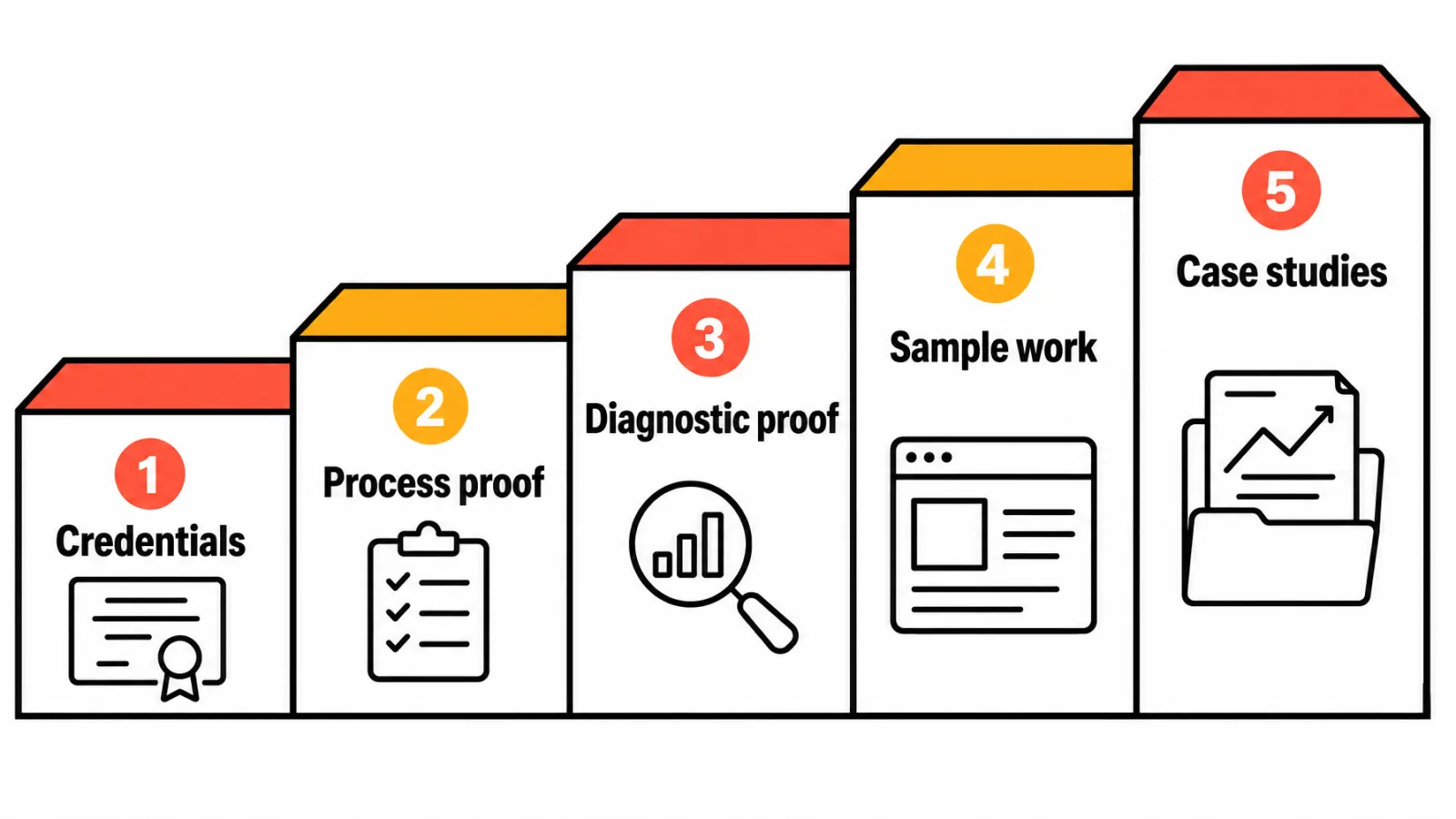
Use an evidence ladder when you lack case studies
Climb as far as your real evidence allows:
Credentials: your role, years of experience, and focus areas, stated only as far as you can verify them.
Process proof: a documented workflow, checklist, or sample content brief.
Diagnostic proof: a teardown built only from public information.
Sample deliverables: anonymized, or clearly labeled as hypothetical.
Permissioned case studies: verified outcomes, published with client approval.
Never imply a measured result you don't have.
Turn audits and sample deliverables into proof
A well-scoped audit shows how you think. Anonymize screenshots, and don't use private Search Console or Google Analytics 4 (GA4) data without permission. When you do have outcomes, report them as SEO KPIs clients can understand rather than rank screenshots alone.
Publish useful content that answers buyer questions
Write for the questions your niche asks before hiring: what a technical clean-up involves, how long results take, what a fair scope looks like. Pages like that work as SEO lead generation and as a trust signal before the first call.
Where to Find Qualified SEO Prospects
Working out how to find SEO clients is really a channel decision. Common SEO client-finding tactics are well documented, but none has verified universal performance numbers, so this table compares tradeoffs, not conversion rates.
Channel | Speed to conversation | Trust level | Effort | Main risk |
|---|---|---|---|---|
Referrals and partners | Medium | High | Low to medium | Irregular volume |
LinkedIn and communities | Medium | Medium | Medium | Slow if your profile is vague |
Local networking | Medium | High | Medium | Limited to your area |
Cold email | Fast | Low at first | Medium to high | Poor relevance, compliance issues |
Marketplaces such as Upwork | Fast | Low | Medium | Crowded, price-driven, scope-sensitive |
SEO content | Slow | Builds over time | High | Takes longer than outreach |
Start with referrals and complementary partners
Referrals transfer trust, so begin there. Web designers, developers, PR consultants, conversion specialists, and other agencies all meet people who need SEO but don't sell it.
Use LinkedIn, communities, and local networks with context
LinkedIn works when your profile names one buyer and one problem, and you contribute where that buyer already talks. Local SEO providers can add in-person networking, since business owners often prefer meeting someone nearby.
Use cold email and marketplaces carefully
Cold email works only when it's targeted and relevant to the recipient. For a U.S.-specific note, the FTC's CAN-SPAM compliance guide says the law covers commercial email, including business-to-business messages. This is general information, not legal advice, and rules vary by country.
A hypothetical cold email to a local e-commerce store might read:
Subject: Quick observation about [Store Name]'s category pages
Hi [Name], I noticed your [product category] pages aren't appearing in the top results for searches your buyers are likely running. I put together three specific observations — happy to share them on a 15-minute call if that's useful. No pitch, just a look at what I found.
Marketplaces like Upwork can help you collect early proof, but expect crowded listings and scope that drifts.
Choose one primary channel for the next 30 days
Pick by starting conditions. If you have warm contacts, use referrals; if you have strong public proof, use LinkedIn; if you have time and a tight niche list, test targeted outreach. Spreading across six channels usually produces six weak attempts.
Create an SEO Audit or Teardown That Starts a Sales Conversation
A short, personal audit is the most direct way to turn how to get SEO clients into a real conversation. The goal is a conversation, not unpaid implementation.
Review the business problem before reviewing every technical detail
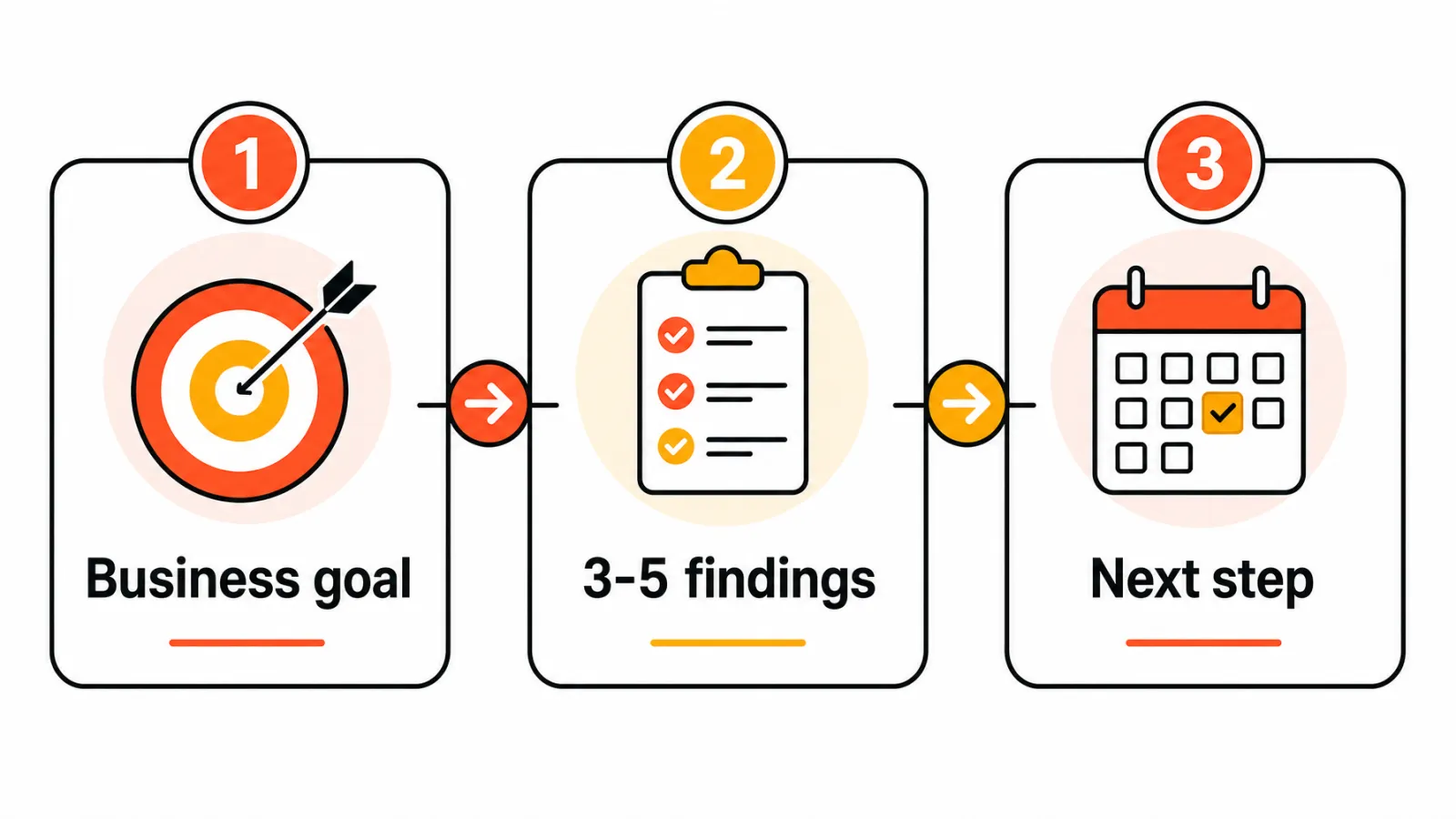
Start with the prospect's commercial goal, then look only where that goal could be blocked. Google's Search Console performance report covers queries, pages, clicks, and impressions, and GA4 can show conversion paths if the prospect shares access.
Show three to five prioritized opportunities
For each finding, give four things:
Evidence: what you saw and where
Impact: why it matters to the goal
Effort: how heavy the fix is
Next action: what you'd do first
End with a decision path, not a giant unpaid report
Set a stop point. Once the audit proves a relevant problem and a plausible next step, stop researching and invite a call or a paid diagnostic.
A free SEO audit for prospects is fine when it's short and specific. A 50-page generic report isn't.
Run a Simple SEO Sales Process From Discovery Call to Proposal
A good SEO sales process is calm and consultative. You're deciding whether you can help, not chasing every call to a close.
Qualify goals, urgency, authority, scope, and constraints
Ask about:
Business goals and how the site supports them
Past SEO work and current acquisition channels
Who decides, and who must approve changes
Timeline, budget range, and technical constraints
How success will be measured
Capacity: what approval and implementation access can the client provide each month?
That last question protects your delivery.
Present priorities before deliverables
Lead with what matters most and why, then map deliverables to those priorities. Clients can approve a priority; a list of tasks just invites haggling over line items.
Set expectations without ranking guarantees
Your SEO proposal should state what's included, what's excluded, client responsibilities, approval points, reporting, and review timing. Google's SEO Starter Guide notes that search changes can take anywhere from hours to months, so promise process, not positions.
Follow up with a useful next step
After the call, send a short recap, one relevant finding, and a decision date. A follow-up that adds value gets answered more often than one that asks whether they've had a chance to look.
What Should an SEO Client Acquisition System Include?
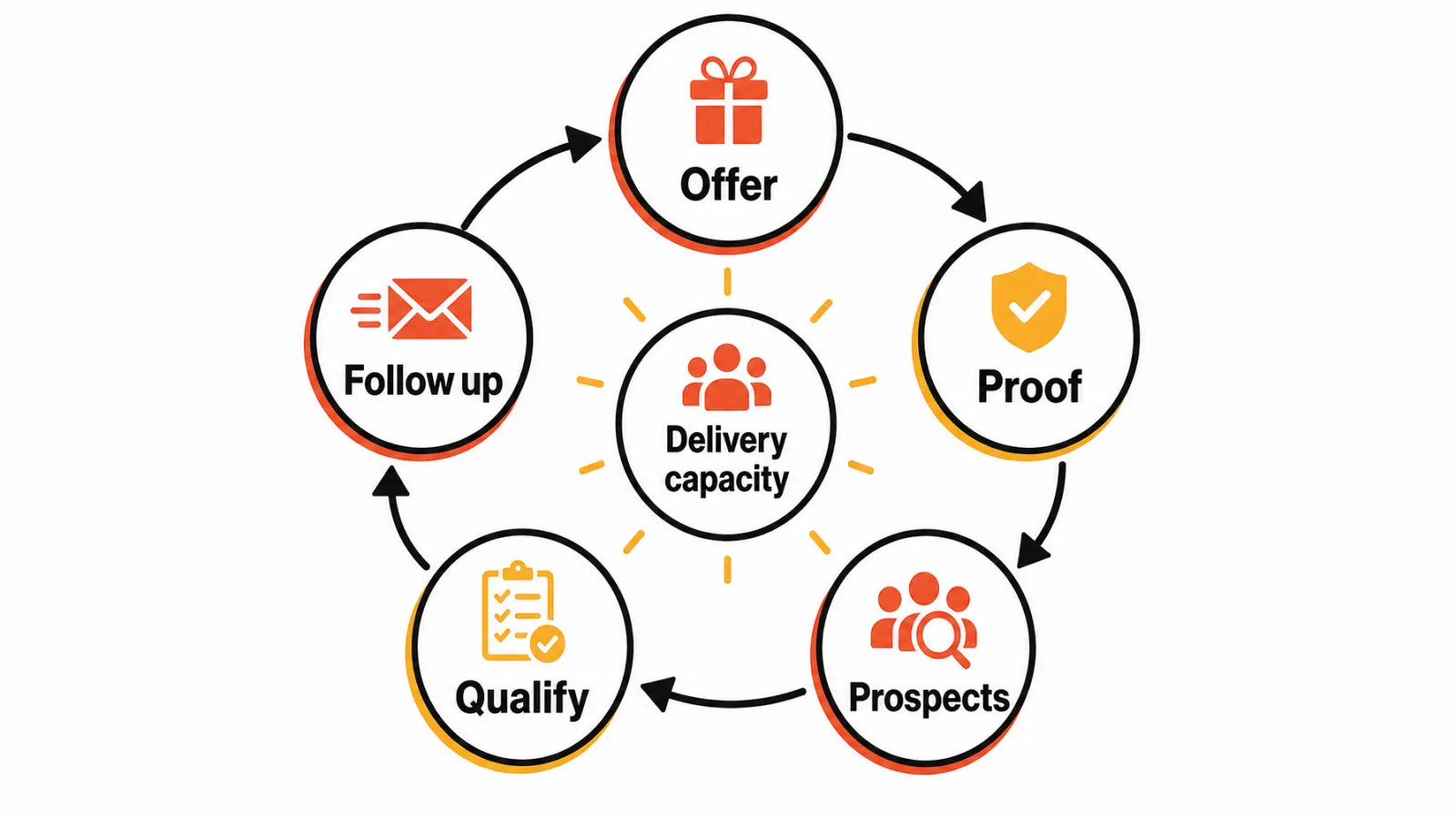
An SEO client acquisition system is five connected parts that move a stranger from first contact to signed work without relying on luck.
Positioning, proof, pipeline, qualification, and follow-up
Offer: one buyer, one problem, one deliverable
Evidence asset: a teardown, sample, or case study
Prospect source: one primary channel
Qualification step: the fit test and discovery questions
Follow-up loop: a scheduled next step for every open lead
A simple weekly scorecard
Track conversations started, qualified opportunities, proposals sent, follow-ups pending, and spare delivery hours. Skip industry benchmarks; your own trend matters more than anyone's average.
How SEO Automation Helps You Deliver After the Sale
Automation matters once your acquisition system produces qualified work, because every new client multiplies research, planning, publishing, and reporting. That's the part of SEO agency growth that sales tactics ignore.
Automate repetitive research, planning, publishing, and reporting tasks
Good candidates are the repeatable handoffs:
Keyword research and topical planning
Content briefs and first drafts
Technical audit checks
CMS publishing
Visibility and performance reporting
Compare SEO workflows worth automating against your own process before buying anything.
Keep strategy, fact checking, approvals, and client judgment human
Automation shouldn't choose a client's strategy, verify claims, or approve final copy. Topic selection still needs judgment about business goals, and every draft needs a human editor.
Where Keytomic may fit an agency workflow
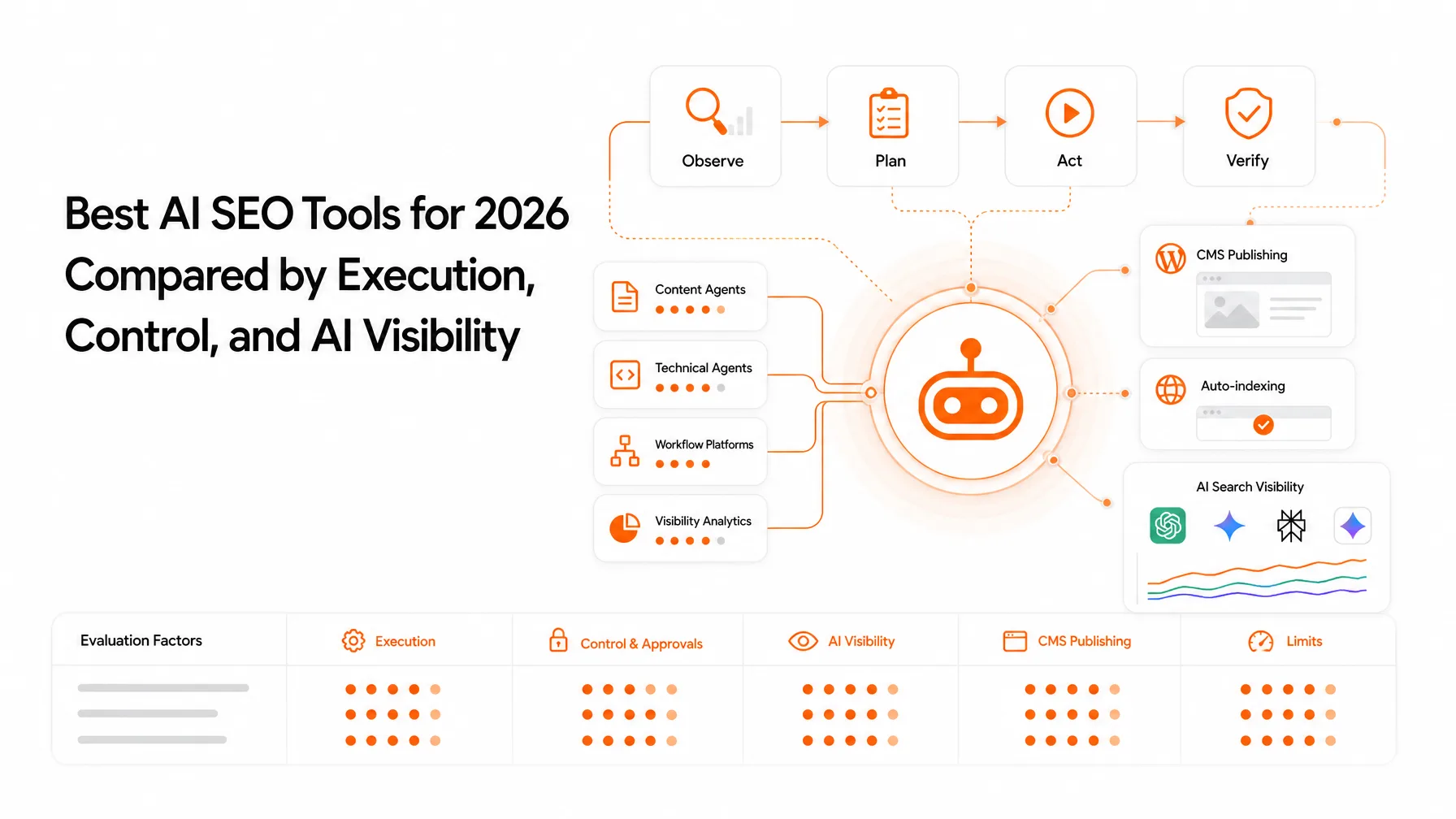
Keytomic is an AI-powered SEO automation platform that combines keyword research, topical planning, AI-assisted content creation, technical SEO audits, backlink opportunities, CMS publishing, and visibility monitoring across Google and AI answer engines in one approval-based workflow. For client management and reporting details, check Keytomic's agency SEO workflow.
It supports delivery after the sale. It doesn't find you clients.
Common Mistakes That Make SEO Client Acquisition Harder
Most stalled attempts at how to get SEO clients repeat the same four errors.
Selling vague services to everyone
Symptom: prospects say "send me a quote" and vanish. Fix: sell one defined offer to one defined buyer.
Promising rankings, traffic, or leads
Google states that no one can guarantee a top ranking, and prospects who've been burned know it. Promise a process, a scope, and a reporting rhythm.
Offering too much free work
Symptom: you've done a week of research before the first call. Fix: cap the audit at three to five findings and invite a paid diagnostic.
Scaling sales before delivery is ready
Symptom: you close three clients and can't serve any of them well. Fix: standardize the offer, check capacity, and underprice nothing just to win the deal.
A 30-Day Plan for Landing Your First or Next SEO Client
Here's how to get SEO clients in a 30-day operating plan. It's a schedule for producing assets and conversations, not a guaranteed result.
Week | Objective | Asset | Measure |
|---|---|---|---|
1 | Choose buyer, problem, and offer | One-line offer and not-fit rule | Offer reads clearly to a stranger |
2 | Build proof and prospect list | One proof asset, researched prospects | Prospects matching your fit test |
3 | Start conversations | Focused audits, discovery call invitations | Conversations started |
4 | Run calls and send proposals | Proposals and follow-ups | Qualified opportunities, spare capacity |
Week 1: Choose the buyer, problem, and offer
Score your segments, write the offer formula, and set your not-fit rule.
Week 2: Create proof and a prospect list
Build one teardown or sample deliverable, then research prospects who match your fit test.
Week 3: Start conversations and deliver focused audits
Use your chosen channel, send relevant messages, and offer short audits or discovery calls.
Week 4: Run calls, send proposals, and review the pipeline
Run discovery calls, send proposals, follow up, and review fit and capacity before taking on more.
When Keytomic Is and Is Not the Right Fit for SEO Client Work

When a connected SEO workflow can help
You juggle separate tools for research, content, audits, publishing, and reporting
Your client work is repeatable enough to standardize
Delivery capacity, not demand, is limiting growth
What still requires human judgment
Positioning, sales judgment, fact checking, client strategy, and final approvals stay with you. Teams needing deep strategy consulting, specialist forensic technical work, or fully human delivery will want additional tools or services alongside any platform.
The next step for agencies and freelancers
Map your current delivery stack against the workflow above. If the overlap is real, try Keytomic on one client project before moving more.
Frequently Asked Questions About Getting SEO Clients
How do I get my first SEO client with no experience?
Start with a narrow offer, one public teardown or sample deliverable, and warm contacts. Credible proof can begin without a big portfolio, as long as you label examples honestly.
Where is the best place to find SEO clients?
It depends on existing trust. Referrals and partners usually carry the most trust, while LinkedIn, local networking, and cold email suit different starting conditions. Pick one channel and test it.
Should I offer a free SEO audit?
Yes, if it's short, personalized, and ends with a decision path. Limit it to three to five findings, and offer a paid diagnostic for deeper work.
How do I get SEO clients on LinkedIn?
Narrow your profile to one buyer and problem, share useful teardowns, and comment where your buyers talk. Then message people with a relevant observation, not a pitch.
Can cold email help me find SEO clients?
It can, when targeted and relevant. Laws differ by region; in the U.S., the FTC covers B2B commercial email under CAN-SPAM. This isn't legal advice, so check your market.
How much should I charge for SEO services?
Price against scope, effort, and business value, not a universal rate. Define deliverables and review cadence first, then quote a diagnostic, project, or retainer you can deliver profitably.
How long does it take to get an SEO client?
There's no reliable fixed timeline. It depends on your trust, offer, channel, and sales cycle. Treat 30 days as an operating plan for starting conversations, not a guarantee.
What should I include in an SEO proposal?
Include goals, priorities, deliverables, exclusions, client responsibilities, approval points, reporting cadence, and review timing. State plainly that rankings can't be guaranteed.
How do I turn one SEO client into recurring work?
Show progress against the goals agreed in discovery, review priorities regularly, and propose the next-highest-impact work. Standardized delivery makes retainers easier to sustain.
Getting SEO Clients Comes Down to One Weak Link at a Time
Knowing how to get SEO clients mostly means fixing the weakest link first. No clear niche: narrow the buyer and problem before sending more outreach. No proof: build one diagnostic asset before increasing volume. No conversations: improve the prospect source, message relevance, and follow-up.
Once delivery becomes the bottleneck — the good problem — that's when automation earns its place. The repeatable work: keyword research, content briefs, publishing, reporting. The human work: strategy, client judgment, final approvals. Getting those proportions right is what lets you take on more without the quality dropping.
If delivery is your bottleneck, compare your current stack against Keytomic's agency SEO workflow and review current pricing when you're ready to see where the overlap is.