Table of Contents
Share Article
AI SEO Agents What They Automate and How to Choose One
AI SEO Agents What They Automate and How to Choose One
AI SEO Agents What They Automate and How to Choose One


Learn what AI SEO agents actually automate, how they differ from AI writing tools, and 5 key criteria for choosing the right one for your team.
An AI SEO agent is an autonomous system that handles the full SEO pipeline - from keyword discovery and content briefing through to CMS publishing and post-publish monitoring - without requiring a human handoff at every step. Most tools labeled "AI SEO" only cover one or two of these stages. A true agent connects all six: research, strategy, draft, optimize, publish, and monitor. When evaluating options, the right question is not which tool has the most features, but how many pipeline stages it completes without you.
If you are currently managing three to five separate SEO tools, you already know what the fragmentation feels like. Keyword research in one tab, content briefs in another, publishing through a CMS export, and rank tracking somewhere else entirely. Each handoff is manual. Each tool requires someone to take the output and feed it into the next step.
The market is full of tools calling themselves AI SEO agents, but most are AI writers with a keyword field attached. That distinction matters more than it sounds, because the wrong choice means adding another point solution to an already fragmented stack rather than replacing it.
This article covers what genuine agentic SEO systems actually automate at each pipeline stage, and the five evaluation criteria that separate full-pipeline agents from point solutions. The agentic SEO category changed significantly in 2025 and into 2026, and many comparisons circulating online are already outdated.
What an AI SEO Agent Actually Does vs. an AI Writing Tool
An AI SEO agent autonomously plans, decides, and executes multi-step SEO tasks. It does not wait for a prompt. It initiates its own tasks, chains multiple steps together, and acts on data without a human triggering each stage.
An AI writing tool, by contrast, responds to a prompt and generates text. It cannot initiate, iterate, or monitor. You give it an input; it gives you an output. That is the full extent of its autonomy.
Ahrefs and Semrush are data platforms with AI-assisted features. They surface information and provide recommendations, but require a human operator to act on that data. They do not initiate, execute, or monitor tasks on their own.
Capability | Traditional SEO Tool | AI SEO Agent |
|---|---|---|
Keyword research | Shows data | Initiates and maps automatically |
Content briefing | Requires manual input | Generates from SERP data |
Draft generation | Requires separate tool | Executes within pipeline |
On-page optimization | Recommendations only | Applies changes |
CMS publishing | Manual export | Direct publish |
Post-publish monitoring | Periodic reports | Continuous, with alerts |
A tool tells you what to do; an agent does it.
The Six Stages a True Agent Automates
Most platforms cover only one or two of these stages. Here is what a full pipeline looks like:
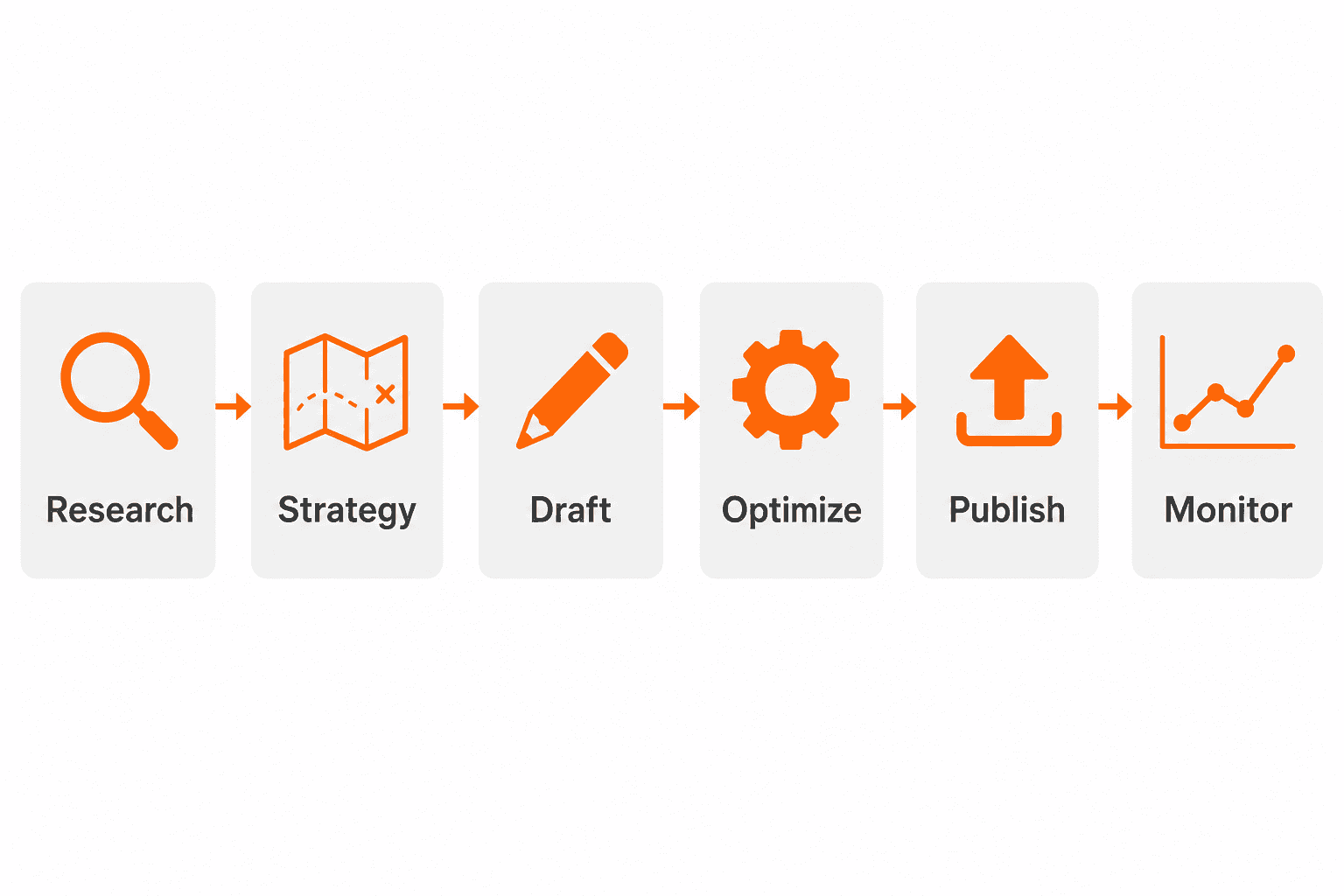
Keyword research and SERP analysis. The agent scans competitor content, search intent signals, and SERP data to identify rankable keyword clusters automatically. No manual export, no spreadsheet filtering.
Content strategy and briefing. From the keyword map, the agent generates a structured brief complete with heading hierarchy, semantic entity coverage, and citation-friendly formatting.
Draft generation. The draft flows directly from the brief without a manual handoff. The agent does not wait for a writer to open a new doc.
On-page optimization and schema. Before or during publishing, the agent applies schema markup, meta tags, image alt text, and internal links. Simple optimizations like meta descriptions achieve higher consistency than complex content restructuring.
CMS publishing. Content publishes directly to WordPress, Shopify, or a connected headless CMS. Platforms using Bing URL Submission API can notify search engines of new content immediately after publish, which is a valid submission channel for general content pages.
Monitoring and recovery. The agent tracks rankings across Google and AI citation surfaces including AI Overviews, ChatGPT, and Perplexity. Some platforms detect content decay and generate specific content fixes autonomously.
Why Agentic SEO Is Not the Same as AI-Assisted SEO
Agentic means autonomous reasoning, multi-step execution, and persistent memory. The system decides what to do next based on live data, without a human at the keyboard for each decision.
AI-assisted means a human triggers each task and AI completes it. The operator remains in the loop at every stage. Most tools on the market today, including many marketed as agents, are AI-assisted at best. They accelerate individual tasks rather than replacing the workflow coordination between them.
The distinction is practically important for buyers. An AI-assisted keyword tool still requires someone to take the output, interpret it, write a brief, hand it to a writer, and then follow up on publishing. An agentic system handles the coordination itself.
What Do AI SEO Agents Automate A Stage-by-Stage Breakdown
According to Aira's 2025 State of SEO Report covering 2,500 practitioners, 86% of SEO professionals have integrated AI into their workflows, up from 65% in 2024. Despite that adoption, most teams are still stitching together multiple tools across the pipeline rather than running a connected agent workflow.
Keyword Discovery and Topical Mapping
A genuine AI SEO agent scans competitor sites, SERP data, and intent signals to identify rankable keyword clusters without any manual trigger. It surfaces the gap between what your site covers and what your competitors rank for, then prioritizes topics by difficulty, intent match, and business relevance.
The difference from manual keyword research in tools like Ahrefs or Semrush is not the data quality. Those platforms have deep keyword databases. The difference is that an agent acts on the data and builds a content plan from it. Human validation of strategic priorities is still recommended, particularly for topics tied to specific business goals or product positioning. For multilingual sites, multilingual SEO content planning adds another coordination layer that agents handle through per-language cluster mapping.
Content Brief and Draft Generation
Agents produce structured briefs with heading hierarchies, semantic entity coverage, and citation-friendly formatting designed for both Google rankings and AI citation surfaces. The brief stage flows directly into draft generation without a manual handoff.
In practice, this means the agent does not deliver a brief and then stop. It generates the first draft within the same pipeline, using the brief as the instruction set. Brand voice and factual accuracy still benefit from human review before publish. No current AI SEO agent fully replicates a brand's editorial voice without at least one round of editorial oversight.
On-Page Optimization Schema and Internal Linking
During or before publishing, agents apply schema markup, meta tags, image alt text, and internal links. Structured, rule-based optimizations like meta descriptions and schema injection achieve high consistency. Complex content restructuring, such as reorganizing an existing long-form article's heading hierarchy or merging two competing pages, requires more human judgment and has lower automation accuracy.
The practical implication: if you are evaluating an agent for meta-tag management and schema injection at scale, automation works well. If the primary need is nuanced editorial restructuring of existing content, plan for human involvement alongside the agent output.
CMS Publishing and Auto-Indexing
Agents push content directly to WordPress, Shopify, and connected CMS platforms with structured data already applied. For teams using WordPress, understanding best SEO plugins for WordPress helps clarify where the agent layer ends and the plugin infrastructure layer begins.
One important clarification on indexing claims: Google's Indexing API is scoped to job postings and livestream pages for most publishers, not standard blog content. Any vendor claiming their tool sends general blog posts to Google via the Indexing API should be asked to explain the mechanism. The Bing URL Submission API is a confirmed valid channel for general content pages and is how responsible platforms accelerate discovery. For a full breakdown of indexing governance and what claims to scrutinize, the guide on how to evaluate SEO automation tools for indexing and governance covers this directly.
Monitoring Content Decay and Recovery
Post-publish tracking across Google rankings and AI citation surfaces is where the agent vs. tool distinction becomes most visible in practice. An AI writing tool stops at the draft. A true agent continues monitoring after publication.
Content decay, where a page loses ranking positions over time due to competitor updates, SERP changes, or freshness signals, is detectable automatically. Some platforms flag the decay and generate specific content fixes for review. Not all platforms do this equally. Knowing how to rank in LLMs matters here because AI citation surfaces like ChatGPT, Perplexity, and Google AI Overviews each source content differently, and a genuine agent should track visibility across all of them, not just traditional Google rankings.
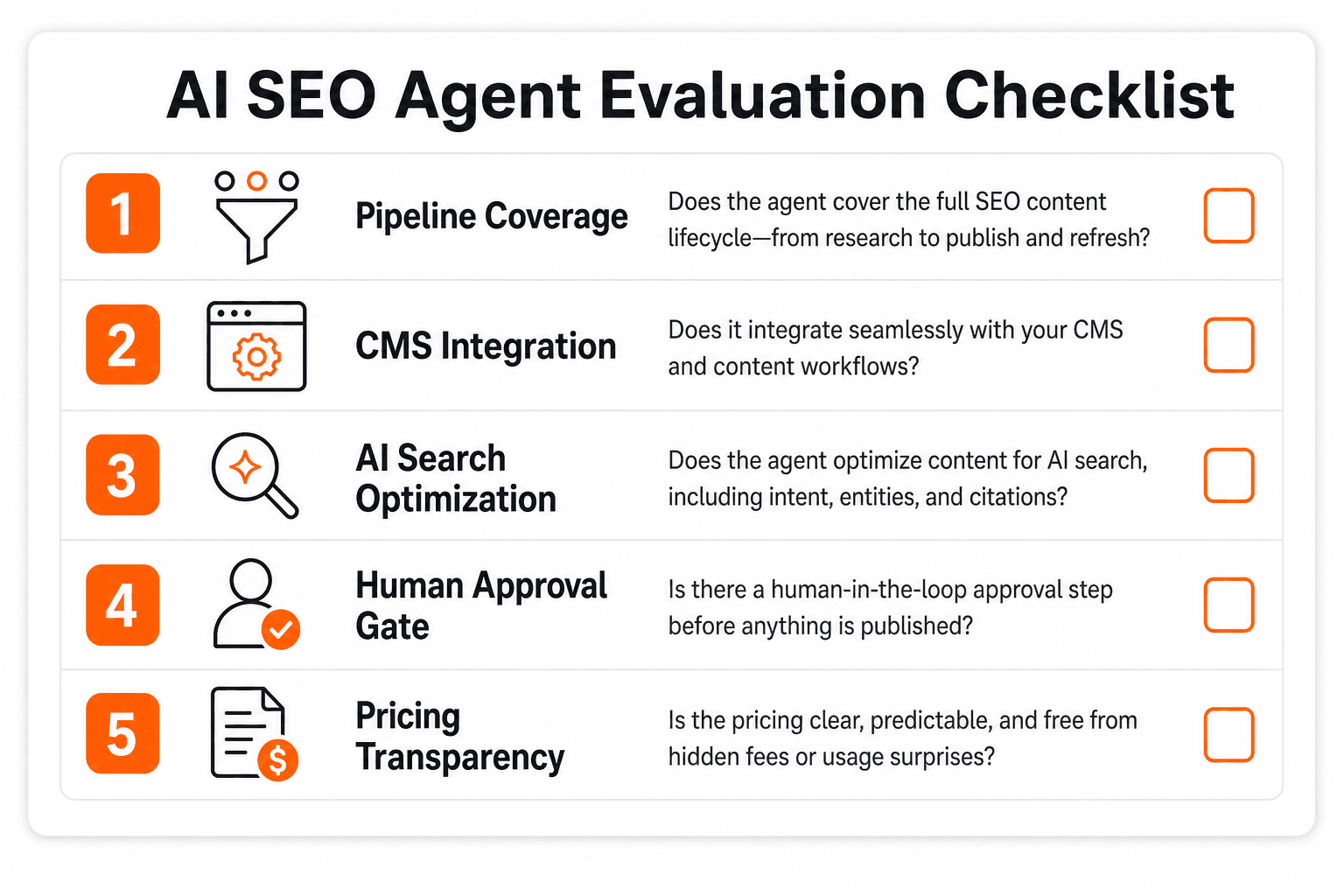
How to Evaluate an AI SEO Agent The Five Criteria That Matter
Most buyers evaluate tools by feature count. The right filter is pipeline depth and integration fit. A tool with 40 features that covers two pipeline stages still requires manual coordination of the other four.
Pricing and feature details for tools mentioned in this article were last checked in July 2026. Confirm current plans on each vendor's official pricing page before making a purchase decision.
1. How Many Pipeline Stages Does It Cover
Map every tool you are considering against the six stages: keyword research, content briefing, draft generation, on-page optimization, CMS publishing, and monitoring. A tool covering two stages still requires a human to manage the handoffs between the remaining four.
A useful exercise before buying: write out your current workflow and mark which stages consume the most team time. Then evaluate which stages each tool under consideration actually replaces versus which ones it assists. If the tool requires a CSV export at any stage, that stage is not automated.
2. Does It Integrate With Your CMS and Analytics Stack
Check for native integration with your specific CMS, whether that is WordPress, Shopify, Webflow, HubSpot, or a headless CMS. Then check analytics: does the platform pull data from Google Search Console, GA4, and Bing Webmaster Tools natively, or does it require a manual data export to move information?
If a platform requires CSV exports to move data between systems, it is adding busywork rather than removing it. True integration means the data flows without a human in the middle. For full context on evaluating integration depth and indexing claims, the guide on how to evaluate SEO automation tools for indexing and governance is worth reading before you commit to a platform.
3. Does It Optimize for AI Search as Well as Google
Ranking in traditional Google results is no longer the full picture. AI-referred sessions are growing materially across surfaces including Google AI Overviews, ChatGPT, and Perplexity. Each platform sources content differently: ChatGPT primarily uses Bing's index, Perplexity uses a custom index, and Google AI Overviews draw from Google's own index. Optimizing for one does not guarantee visibility on all three.
A genuine AI SEO agent should produce content structured for citation across multiple AI surfaces: entity density, schema markup, citation-friendly formatting, and direct answer blocks that AI engines extract reliably. For teams wanting to understand ranking in AI search engines at a technical level, the platform you choose should have clear documentation on its GEO and AEO optimization approach, not just keyword optimization. Understanding how to rank in LLMs is increasingly a baseline requirement, not an advanced consideration.
4. What Controls Does It Give You Before It Publishes
Human approval gates, draft review workflows, duplicate-topic checks, and keyword cannibalization prevention are not nice-to-have features. They are the governance layer that separates responsible AI publishing from content spam at scale.
As Search Engine Land has noted in its guidance on agentic AI workflows, review processes must be built into workflows from day one, not added as afterthoughts. Autonomous publishing without review gates carries real risk: thin content, off-brand claims, keyword cannibalization, and compliance issues are the most common failure modes at scale. Any platform that defaults to fully autonomous publishing without an approval step should be evaluated carefully.
5. Is the Pricing Model Transparent and the Scope Honest
Check pricing pages directly before committing. This category changes frequently, and plans described in third-party comparisons may be outdated within weeks. If a vendor cannot show you a pricing page with clear plan tiers, that is a signal worth noting.
Two specific questions to ask any vendor: First, which pipeline stages does the tool complete without human input, and which require operator action? Second, how does the platform handle indexing? Any vendor claiming Google Indexing API for standard blog pages should be asked to explain the scope, since that API is limited to specific page types per Google's official documentation.
Choose the platform that automates the most pipeline stages your team currently handles manually, integrates natively with your CMS, and gives you a human approval gate before anything goes live.
The Honest Tradeoffs What AI SEO Agents Cannot Do Well Yet
Most vendor articles on agentic SEO skip this section. I would rather you go in with clear expectations.
Brand voice refinement still needs a human editor. No current AI SEO agent fully replicates a brand's editorial voice without review. The output is consistently structured and on-topic, but the last 20% of voice authenticity comes from an editor who knows the brand.
Complex content restructuring has materially lower accuracy than simple optimizations. Schema injection and meta tag generation work well at scale. Restructuring an existing article's heading hierarchy, merging two competing pages, or rewriting a cornerstone guide requires human judgment alongside the automation.
Algorithm updates require human strategic interpretation. Agents adapt to ranking signals, but they cannot anticipate business-level pivots. When Google releases a core update, someone with strategic context needs to decide whether the response is a content refresh, a topic consolidation, or a change in positioning.
Strategic topic selection needs business context. An agent can identify what topics your competitors rank for and what the SERP rewards. It cannot know which topics align with a product pivot, a new market entry, or a funding round. That input has to come from the team.
Governance at scale requires defined approval gates. Thin content and keyword cannibalization are real risks when agents publish without oversight. Compliance issues, unapproved claims, and tone drift also surface at scale without an editorial checkpoint.
AI citation surfaces are not a monolith. ChatGPT uses Bing's index, Perplexity uses a custom index, and Google AI Overviews draw from Google's own index. Optimizing for one surface does not guarantee visibility across all three. Your agent should track each surface separately.
How Founders and Marketing Teams Use Keytomic as an AI SEO Agent
Disclosure: Keytomic is the platform that powers this article.
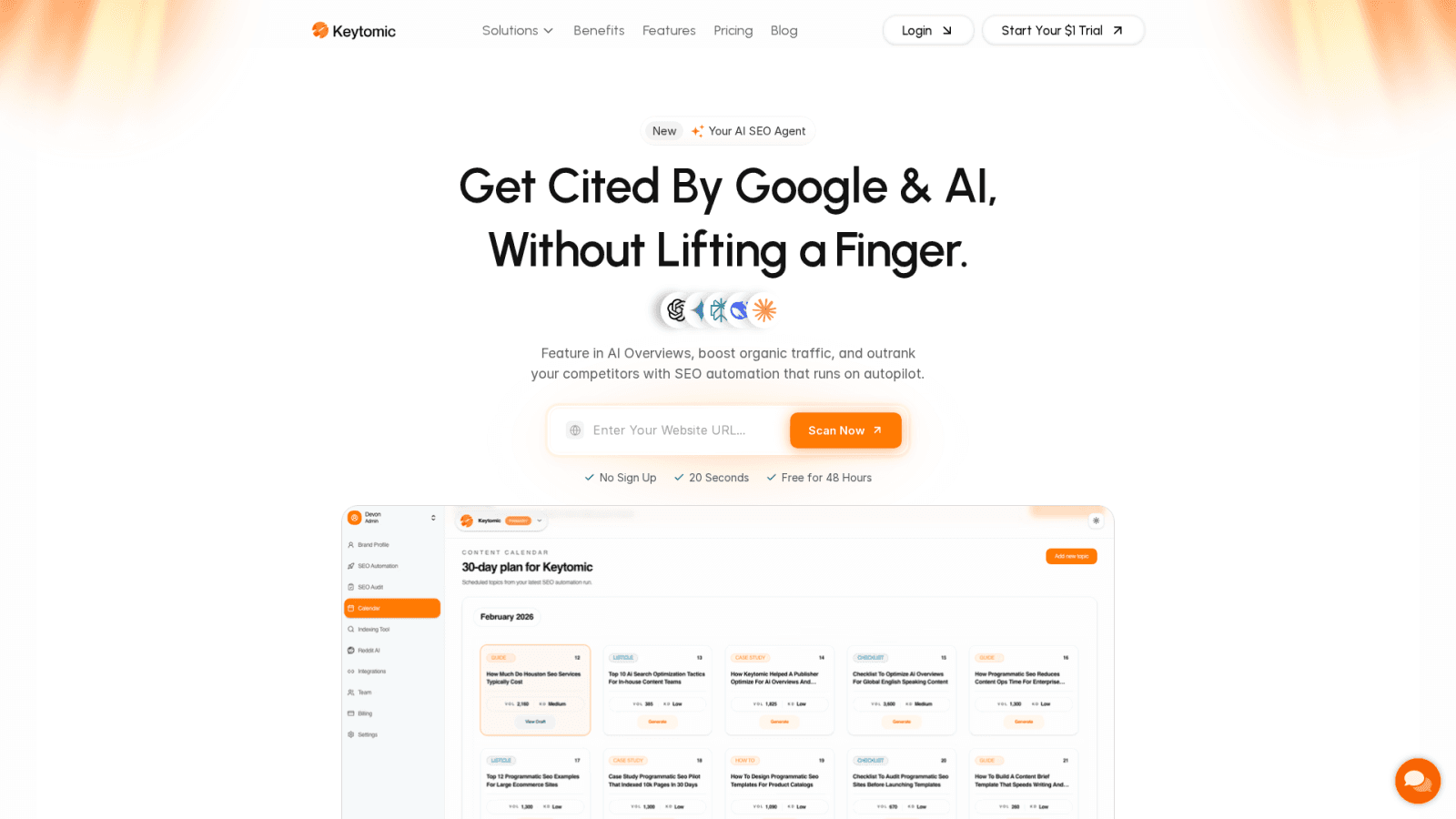
In my experience working with teams using Keytomic, the clearest value comes not from any single feature but from the handoff elimination. The agent scans the site, niche, and competitors to map content opportunities, then generates a 30-day content roadmap automatically. From there, teams approve the calendar and key drafts once, and the rest publishes directly to WordPress, Shopify, or a connected CMS.
What makes Keytomic's AI SEO engine different from AI writing tools in this category is the pipeline coverage. Content is structured for both Google rankings and AI citation surfaces including AI Overviews, ChatGPT, and Gemini, with E-E-A-T and semantic SEO guidelines applied throughout. You are not getting a draft and then manually adding schema, internal links, and meta tags. Those elements are applied within the publishing workflow.
For teams that want to understand how Keytomic replaces fragmented SEO toolstacks, the comparison is clearest against the Ahrefs or Semrush plus separate content tool setup. Many teams find they can downgrade their data platform subscription significantly once keyword research and content planning are handled by the agent.
When Keytomic Is Not the Right Fit
I want to be direct here, because this matters for buyers making an honest evaluation.
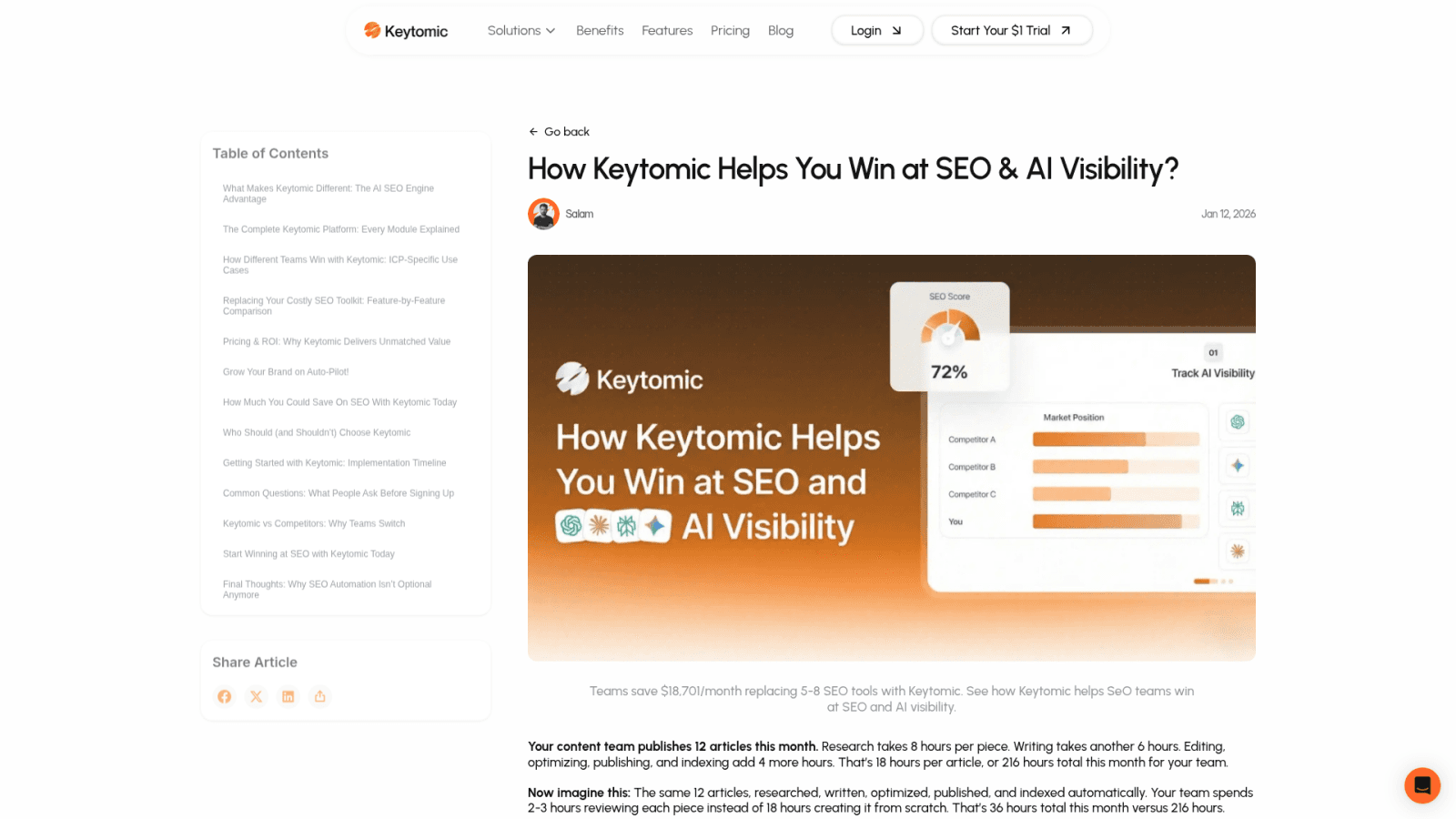
Teams that primarily need deep standalone backlink index analysis should pair Keytomic with a dedicated link research tool or use Ahrefs or Semrush for that specific function. Keytomic is an SEO execution platform, not a backlink database.
Teams at very low publishing volume (fewer than four articles per month) where manual oversight is strongly preferred may find the automation layer exceeds their immediate needs. The platform is designed for consistent publishing cadence, not occasional single-article production.
Teams requiring white-label reseller arrangements should confirm this is available before committing. Verify current plan details directly on keytomic.com.
Start your SEO on autopilot with Keytomic if the full-pipeline approach fits your team's workflow and publishing volume.
Frequently Asked Questions About AI SEO Agents
What is an AI SEO agent? An AI SEO agent is an autonomous system that plans, executes, and iterates across the full SEO pipeline - keyword research, content creation, optimization, publishing, and monitoring - without requiring a manual handoff between each stage.
How is an AI SEO agent different from an AI writing tool? An AI writing tool generates content when prompted. An AI SEO agent initiates its own tasks, chains multiple steps together, and acts on data without waiting for a human to trigger each stage.
What does agentic SEO mean? Agentic SEO refers to using autonomous AI systems to manage SEO workflows end-to-end. The term signals that the system makes decisions and executes tasks independently, rather than assisting a human operator at each step.
Can an AI SEO agent replace an SEO team? Not entirely. Agents handle high-volume, repetitive, and data-driven tasks well. Strategic decisions, brand voice, compliance oversight, and creative judgment still benefit from experienced human input.
What tasks do AI SEO agents automate most reliably? Keyword clustering, content briefing, draft generation, schema markup, meta tag creation, CMS publishing, and rank monitoring. Accuracy is highest for structured, rule-based tasks and lower for nuanced content restructuring.
Are Ahrefs and Semrush AI SEO agents? No. Both are data platforms with AI-assisted features. They surface information and provide recommendations but require a human operator to act on that data. They do not initiate, execute, or monitor tasks autonomously.
How do AI SEO agents help with AI Overviews and Perplexity? By structuring content with entity coverage, schema markup, and citation-friendly formatting that AI engines extract reliably. Some platforms also track AI citation rates across surfaces like ChatGPT, Perplexity, and Google AI Overviews.
What are the risks of using an autonomous SEO agent without review gates? Thin content, keyword cannibalization, off-brand claims, and compliance issues are the most common risks at scale. Human approval checkpoints built into the workflow before publish significantly reduce these risks.
How do I know if a tool is a real AI SEO agent or just an AI writer? Ask how many pipeline stages it completes without manual intervention. A real agent covers research, briefing, drafting, optimization, publishing, and monitoring in one connected workflow. A writing tool covers drafting only.
Does using an AI SEO agent affect content quality? It depends on the platform and approval workflow. Agents with human review gates and governance features produce consistent quality at scale. Agents running fully autonomously without editorial checks carry higher quality risk, particularly for brand voice and factual accuracy.
Before You Choose an AI SEO Agent
Map your current workflow: which of the six pipeline stages does your team handle manually, and which consume the most time?
Confirm CMS and analytics integration before committing. If data movement requires a CSV export, it is not automation.
Check AI search coverage: does the platform optimize for Google AI Overviews, Perplexity, and ChatGPT separately or as a unified output?
Require a human approval gate, especially for publish actions. Build your review checkpoint into the workflow from day one.
Verify pricing directly on the vendor's page with a freshness check. Plans and features in this category change frequently.
Run a 30-day pilot on a real content cluster before committing to a full migration.
Start your SEO on autopilot with Keytomic and see what a full-pipeline agent looks like in practice.
An AI SEO agent is an autonomous system that handles the full SEO pipeline - from keyword discovery and content briefing through to CMS publishing and post-publish monitoring - without requiring a human handoff at every step. Most tools labeled "AI SEO" only cover one or two of these stages. A true agent connects all six: research, strategy, draft, optimize, publish, and monitor. When evaluating options, the right question is not which tool has the most features, but how many pipeline stages it completes without you.
If you are currently managing three to five separate SEO tools, you already know what the fragmentation feels like. Keyword research in one tab, content briefs in another, publishing through a CMS export, and rank tracking somewhere else entirely. Each handoff is manual. Each tool requires someone to take the output and feed it into the next step.
The market is full of tools calling themselves AI SEO agents, but most are AI writers with a keyword field attached. That distinction matters more than it sounds, because the wrong choice means adding another point solution to an already fragmented stack rather than replacing it.
This article covers what genuine agentic SEO systems actually automate at each pipeline stage, and the five evaluation criteria that separate full-pipeline agents from point solutions. The agentic SEO category changed significantly in 2025 and into 2026, and many comparisons circulating online are already outdated.
What an AI SEO Agent Actually Does vs. an AI Writing Tool
An AI SEO agent autonomously plans, decides, and executes multi-step SEO tasks. It does not wait for a prompt. It initiates its own tasks, chains multiple steps together, and acts on data without a human triggering each stage.
An AI writing tool, by contrast, responds to a prompt and generates text. It cannot initiate, iterate, or monitor. You give it an input; it gives you an output. That is the full extent of its autonomy.
Ahrefs and Semrush are data platforms with AI-assisted features. They surface information and provide recommendations, but require a human operator to act on that data. They do not initiate, execute, or monitor tasks on their own.
Capability | Traditional SEO Tool | AI SEO Agent |
|---|---|---|
Keyword research | Shows data | Initiates and maps automatically |
Content briefing | Requires manual input | Generates from SERP data |
Draft generation | Requires separate tool | Executes within pipeline |
On-page optimization | Recommendations only | Applies changes |
CMS publishing | Manual export | Direct publish |
Post-publish monitoring | Periodic reports | Continuous, with alerts |
A tool tells you what to do; an agent does it.
The Six Stages a True Agent Automates
Most platforms cover only one or two of these stages. Here is what a full pipeline looks like:
Keyword research and SERP analysis. The agent scans competitor content, search intent signals, and SERP data to identify rankable keyword clusters automatically. No manual export, no spreadsheet filtering.
Content strategy and briefing. From the keyword map, the agent generates a structured brief complete with heading hierarchy, semantic entity coverage, and citation-friendly formatting.
Draft generation. The draft flows directly from the brief without a manual handoff. The agent does not wait for a writer to open a new doc.
On-page optimization and schema. Before or during publishing, the agent applies schema markup, meta tags, image alt text, and internal links. Simple optimizations like meta descriptions achieve higher consistency than complex content restructuring.
CMS publishing. Content publishes directly to WordPress, Shopify, or a connected headless CMS. Platforms using Bing URL Submission API can notify search engines of new content immediately after publish, which is a valid submission channel for general content pages.
Monitoring and recovery. The agent tracks rankings across Google and AI citation surfaces including AI Overviews, ChatGPT, and Perplexity. Some platforms detect content decay and generate specific content fixes autonomously.
Why Agentic SEO Is Not the Same as AI-Assisted SEO
Agentic means autonomous reasoning, multi-step execution, and persistent memory. The system decides what to do next based on live data, without a human at the keyboard for each decision.
AI-assisted means a human triggers each task and AI completes it. The operator remains in the loop at every stage. Most tools on the market today, including many marketed as agents, are AI-assisted at best. They accelerate individual tasks rather than replacing the workflow coordination between them.
The distinction is practically important for buyers. An AI-assisted keyword tool still requires someone to take the output, interpret it, write a brief, hand it to a writer, and then follow up on publishing. An agentic system handles the coordination itself.
What Do AI SEO Agents Automate A Stage-by-Stage Breakdown
According to Aira's 2025 State of SEO Report covering 2,500 practitioners, 86% of SEO professionals have integrated AI into their workflows, up from 65% in 2024. Despite that adoption, most teams are still stitching together multiple tools across the pipeline rather than running a connected agent workflow.
Keyword Discovery and Topical Mapping
A genuine AI SEO agent scans competitor sites, SERP data, and intent signals to identify rankable keyword clusters without any manual trigger. It surfaces the gap between what your site covers and what your competitors rank for, then prioritizes topics by difficulty, intent match, and business relevance.
The difference from manual keyword research in tools like Ahrefs or Semrush is not the data quality. Those platforms have deep keyword databases. The difference is that an agent acts on the data and builds a content plan from it. Human validation of strategic priorities is still recommended, particularly for topics tied to specific business goals or product positioning. For multilingual sites, multilingual SEO content planning adds another coordination layer that agents handle through per-language cluster mapping.
Content Brief and Draft Generation
Agents produce structured briefs with heading hierarchies, semantic entity coverage, and citation-friendly formatting designed for both Google rankings and AI citation surfaces. The brief stage flows directly into draft generation without a manual handoff.
In practice, this means the agent does not deliver a brief and then stop. It generates the first draft within the same pipeline, using the brief as the instruction set. Brand voice and factual accuracy still benefit from human review before publish. No current AI SEO agent fully replicates a brand's editorial voice without at least one round of editorial oversight.
On-Page Optimization Schema and Internal Linking
During or before publishing, agents apply schema markup, meta tags, image alt text, and internal links. Structured, rule-based optimizations like meta descriptions and schema injection achieve high consistency. Complex content restructuring, such as reorganizing an existing long-form article's heading hierarchy or merging two competing pages, requires more human judgment and has lower automation accuracy.
The practical implication: if you are evaluating an agent for meta-tag management and schema injection at scale, automation works well. If the primary need is nuanced editorial restructuring of existing content, plan for human involvement alongside the agent output.
CMS Publishing and Auto-Indexing
Agents push content directly to WordPress, Shopify, and connected CMS platforms with structured data already applied. For teams using WordPress, understanding best SEO plugins for WordPress helps clarify where the agent layer ends and the plugin infrastructure layer begins.
One important clarification on indexing claims: Google's Indexing API is scoped to job postings and livestream pages for most publishers, not standard blog content. Any vendor claiming their tool sends general blog posts to Google via the Indexing API should be asked to explain the mechanism. The Bing URL Submission API is a confirmed valid channel for general content pages and is how responsible platforms accelerate discovery. For a full breakdown of indexing governance and what claims to scrutinize, the guide on how to evaluate SEO automation tools for indexing and governance covers this directly.
Monitoring Content Decay and Recovery
Post-publish tracking across Google rankings and AI citation surfaces is where the agent vs. tool distinction becomes most visible in practice. An AI writing tool stops at the draft. A true agent continues monitoring after publication.
Content decay, where a page loses ranking positions over time due to competitor updates, SERP changes, or freshness signals, is detectable automatically. Some platforms flag the decay and generate specific content fixes for review. Not all platforms do this equally. Knowing how to rank in LLMs matters here because AI citation surfaces like ChatGPT, Perplexity, and Google AI Overviews each source content differently, and a genuine agent should track visibility across all of them, not just traditional Google rankings.
How to Evaluate an AI SEO Agent The Five Criteria That Matter
Most buyers evaluate tools by feature count. The right filter is pipeline depth and integration fit. A tool with 40 features that covers two pipeline stages still requires manual coordination of the other four.
Pricing and feature details for tools mentioned in this article were last checked in July 2026. Confirm current plans on each vendor's official pricing page before making a purchase decision.
1. How Many Pipeline Stages Does It Cover
Map every tool you are considering against the six stages: keyword research, content briefing, draft generation, on-page optimization, CMS publishing, and monitoring. A tool covering two stages still requires a human to manage the handoffs between the remaining four.
A useful exercise before buying: write out your current workflow and mark which stages consume the most team time. Then evaluate which stages each tool under consideration actually replaces versus which ones it assists. If the tool requires a CSV export at any stage, that stage is not automated.
2. Does It Integrate With Your CMS and Analytics Stack
Check for native integration with your specific CMS, whether that is WordPress, Shopify, Webflow, HubSpot, or a headless CMS. Then check analytics: does the platform pull data from Google Search Console, GA4, and Bing Webmaster Tools natively, or does it require a manual data export to move information?
If a platform requires CSV exports to move data between systems, it is adding busywork rather than removing it. True integration means the data flows without a human in the middle. For full context on evaluating integration depth and indexing claims, the guide on how to evaluate SEO automation tools for indexing and governance is worth reading before you commit to a platform.
3. Does It Optimize for AI Search as Well as Google
Ranking in traditional Google results is no longer the full picture. AI-referred sessions are growing materially across surfaces including Google AI Overviews, ChatGPT, and Perplexity. Each platform sources content differently: ChatGPT primarily uses Bing's index, Perplexity uses a custom index, and Google AI Overviews draw from Google's own index. Optimizing for one does not guarantee visibility on all three.
A genuine AI SEO agent should produce content structured for citation across multiple AI surfaces: entity density, schema markup, citation-friendly formatting, and direct answer blocks that AI engines extract reliably. For teams wanting to understand ranking in AI search engines at a technical level, the platform you choose should have clear documentation on its GEO and AEO optimization approach, not just keyword optimization. Understanding how to rank in LLMs is increasingly a baseline requirement, not an advanced consideration.
4. What Controls Does It Give You Before It Publishes
Human approval gates, draft review workflows, duplicate-topic checks, and keyword cannibalization prevention are not nice-to-have features. They are the governance layer that separates responsible AI publishing from content spam at scale.
As Search Engine Land has noted in its guidance on agentic AI workflows, review processes must be built into workflows from day one, not added as afterthoughts. Autonomous publishing without review gates carries real risk: thin content, off-brand claims, keyword cannibalization, and compliance issues are the most common failure modes at scale. Any platform that defaults to fully autonomous publishing without an approval step should be evaluated carefully.
5. Is the Pricing Model Transparent and the Scope Honest
Check pricing pages directly before committing. This category changes frequently, and plans described in third-party comparisons may be outdated within weeks. If a vendor cannot show you a pricing page with clear plan tiers, that is a signal worth noting.
Two specific questions to ask any vendor: First, which pipeline stages does the tool complete without human input, and which require operator action? Second, how does the platform handle indexing? Any vendor claiming Google Indexing API for standard blog pages should be asked to explain the scope, since that API is limited to specific page types per Google's official documentation.
Choose the platform that automates the most pipeline stages your team currently handles manually, integrates natively with your CMS, and gives you a human approval gate before anything goes live.
The Honest Tradeoffs What AI SEO Agents Cannot Do Well Yet
Most vendor articles on agentic SEO skip this section. I would rather you go in with clear expectations.
Brand voice refinement still needs a human editor. No current AI SEO agent fully replicates a brand's editorial voice without review. The output is consistently structured and on-topic, but the last 20% of voice authenticity comes from an editor who knows the brand.
Complex content restructuring has materially lower accuracy than simple optimizations. Schema injection and meta tag generation work well at scale. Restructuring an existing article's heading hierarchy, merging two competing pages, or rewriting a cornerstone guide requires human judgment alongside the automation.
Algorithm updates require human strategic interpretation. Agents adapt to ranking signals, but they cannot anticipate business-level pivots. When Google releases a core update, someone with strategic context needs to decide whether the response is a content refresh, a topic consolidation, or a change in positioning.
Strategic topic selection needs business context. An agent can identify what topics your competitors rank for and what the SERP rewards. It cannot know which topics align with a product pivot, a new market entry, or a funding round. That input has to come from the team.
Governance at scale requires defined approval gates. Thin content and keyword cannibalization are real risks when agents publish without oversight. Compliance issues, unapproved claims, and tone drift also surface at scale without an editorial checkpoint.
AI citation surfaces are not a monolith. ChatGPT uses Bing's index, Perplexity uses a custom index, and Google AI Overviews draw from Google's own index. Optimizing for one surface does not guarantee visibility across all three. Your agent should track each surface separately.
How Founders and Marketing Teams Use Keytomic as an AI SEO Agent
Disclosure: Keytomic is the platform that powers this article.
In my experience working with teams using Keytomic, the clearest value comes not from any single feature but from the handoff elimination. The agent scans the site, niche, and competitors to map content opportunities, then generates a 30-day content roadmap automatically. From there, teams approve the calendar and key drafts once, and the rest publishes directly to WordPress, Shopify, or a connected CMS.
What makes Keytomic's AI SEO engine different from AI writing tools in this category is the pipeline coverage. Content is structured for both Google rankings and AI citation surfaces including AI Overviews, ChatGPT, and Gemini, with E-E-A-T and semantic SEO guidelines applied throughout. You are not getting a draft and then manually adding schema, internal links, and meta tags. Those elements are applied within the publishing workflow.
For teams that want to understand how Keytomic replaces fragmented SEO toolstacks, the comparison is clearest against the Ahrefs or Semrush plus separate content tool setup. Many teams find they can downgrade their data platform subscription significantly once keyword research and content planning are handled by the agent.
When Keytomic Is Not the Right Fit
I want to be direct here, because this matters for buyers making an honest evaluation.
Teams that primarily need deep standalone backlink index analysis should pair Keytomic with a dedicated link research tool or use Ahrefs or Semrush for that specific function. Keytomic is an SEO execution platform, not a backlink database.
Teams at very low publishing volume (fewer than four articles per month) where manual oversight is strongly preferred may find the automation layer exceeds their immediate needs. The platform is designed for consistent publishing cadence, not occasional single-article production.
Teams requiring white-label reseller arrangements should confirm this is available before committing. Verify current plan details directly on keytomic.com.
Start your SEO on autopilot with Keytomic if the full-pipeline approach fits your team's workflow and publishing volume.
Frequently Asked Questions About AI SEO Agents
What is an AI SEO agent? An AI SEO agent is an autonomous system that plans, executes, and iterates across the full SEO pipeline - keyword research, content creation, optimization, publishing, and monitoring - without requiring a manual handoff between each stage.
How is an AI SEO agent different from an AI writing tool? An AI writing tool generates content when prompted. An AI SEO agent initiates its own tasks, chains multiple steps together, and acts on data without waiting for a human to trigger each stage.
What does agentic SEO mean? Agentic SEO refers to using autonomous AI systems to manage SEO workflows end-to-end. The term signals that the system makes decisions and executes tasks independently, rather than assisting a human operator at each step.
Can an AI SEO agent replace an SEO team? Not entirely. Agents handle high-volume, repetitive, and data-driven tasks well. Strategic decisions, brand voice, compliance oversight, and creative judgment still benefit from experienced human input.
What tasks do AI SEO agents automate most reliably? Keyword clustering, content briefing, draft generation, schema markup, meta tag creation, CMS publishing, and rank monitoring. Accuracy is highest for structured, rule-based tasks and lower for nuanced content restructuring.
Are Ahrefs and Semrush AI SEO agents? No. Both are data platforms with AI-assisted features. They surface information and provide recommendations but require a human operator to act on that data. They do not initiate, execute, or monitor tasks autonomously.
How do AI SEO agents help with AI Overviews and Perplexity? By structuring content with entity coverage, schema markup, and citation-friendly formatting that AI engines extract reliably. Some platforms also track AI citation rates across surfaces like ChatGPT, Perplexity, and Google AI Overviews.
What are the risks of using an autonomous SEO agent without review gates? Thin content, keyword cannibalization, off-brand claims, and compliance issues are the most common risks at scale. Human approval checkpoints built into the workflow before publish significantly reduce these risks.
How do I know if a tool is a real AI SEO agent or just an AI writer? Ask how many pipeline stages it completes without manual intervention. A real agent covers research, briefing, drafting, optimization, publishing, and monitoring in one connected workflow. A writing tool covers drafting only.
Does using an AI SEO agent affect content quality? It depends on the platform and approval workflow. Agents with human review gates and governance features produce consistent quality at scale. Agents running fully autonomously without editorial checks carry higher quality risk, particularly for brand voice and factual accuracy.
Before You Choose an AI SEO Agent
Map your current workflow: which of the six pipeline stages does your team handle manually, and which consume the most time?
Confirm CMS and analytics integration before committing. If data movement requires a CSV export, it is not automation.
Check AI search coverage: does the platform optimize for Google AI Overviews, Perplexity, and ChatGPT separately or as a unified output?
Require a human approval gate, especially for publish actions. Build your review checkpoint into the workflow from day one.
Verify pricing directly on the vendor's page with a freshness check. Plans and features in this category change frequently.
Run a 30-day pilot on a real content cluster before committing to a full migration.
Start your SEO on autopilot with Keytomic and see what a full-pipeline agent looks like in practice.
FREE AI Visibility Audit
Is Your Brand Visible in AI Searches?
Free AI Visibility Audit → See where you appear (and where competitors appear).
Read More From Our Blog...
12 Best AI Tools for Ecommerce SEO and AI Visibility in 2026
Ecommerce Category Page SEO: Best Practices for 2026
Best AI Tools for Increasing Visibility in LLMs 2026

Start Getting Cited By Google
and AI Searches on Auto-Pilot


AI SEO agents research keywords, write & publish ranking content, track AI citations, and grow your brand visibility — while you focus on the business.


Trusted by 300+ users

4.5
Start Getting Cited By Google
and AI Searches on Auto-Pilot
Automate your SEO to rank faster, and showing up in AI search, without the guesswork.
Trusted by 300+ users
4.5
Start Getting Cited By Google
and AI Searches on Auto-Pilot
AI SEO agents research keywords, write & publish ranking content, track AI citations, and grow your brand visibility — while you focus on the business.
Trusted by 300+ users