To improve your chances of being cited in Perplexity, make each page easy to retrieve and verify. Answer the target question directly, back important claims with evidence, keep the page crawlable, and build clear topic and entity context. Then track cited URLs, brand mentions, prompt coverage, and referral activity separately, because Perplexity doesn't work like a standard Google position tracker.
Perplexity SEO is the practice of making your pages retrievable, answer-first, and verifiable so Perplexity's AI cites them as sources. Unlike traditional SEO, it measures visibility through cited URLs and brand mentions in generated answers rather than ranked positions on a results page.
You rank in Google, but when you ask Perplexity, the AI search and answer platform, your own buying question, your brand either isn't there or you can't tell whether it is. That's an annoying blind spot, and it's why I treat Perplexity SEO as a measurement problem as much as a content one. I work in product and growth at Keytomic, so I tend to think in workflows, not bags of tricks.
"Rank in Perplexity" is shorthand. Usually it means your page shows up in the answer's source list, or your brand gets named in the answer. Those are different outcomes, and they need different fixes. For context on how this fits the broader shift toward AI answer engines, our guide on AEO vs SEO is a useful starting point — and for the Gemini-specific picture, see our guide on ranking in Gemini.
Here's the plan: understand how retrieval works, tighten page structure and evidence, verify crawler access, build a prompt set, and measure repeatedly. One honest caveat up front: no ethical method can guarantee that an independent platform will cite your page.
What does it actually mean to rank in Perplexity?
Ranking in Perplexity means being cited, named, or recommended inside a synthesized answer, not holding a numbered slot on a results page. Perplexity searches the web, synthesizes information, and shows source links, so the unit of visibility is the answer itself. ChatGPT, Gemini, and Claude each present sources in their own way, so every AI search engine is its own measurement surface.
Citation, mention, and source visibility are different outcomes
A citation is a linked source. A mention is an unlinked reference to your brand. I'd also track a third layer: the visit or conversion that follows.
Cited source: your URL appears in the answer's source list.
Named brand: the answer mentions you, with or without a link.
Resulting visit: someone clicks through and does something useful.
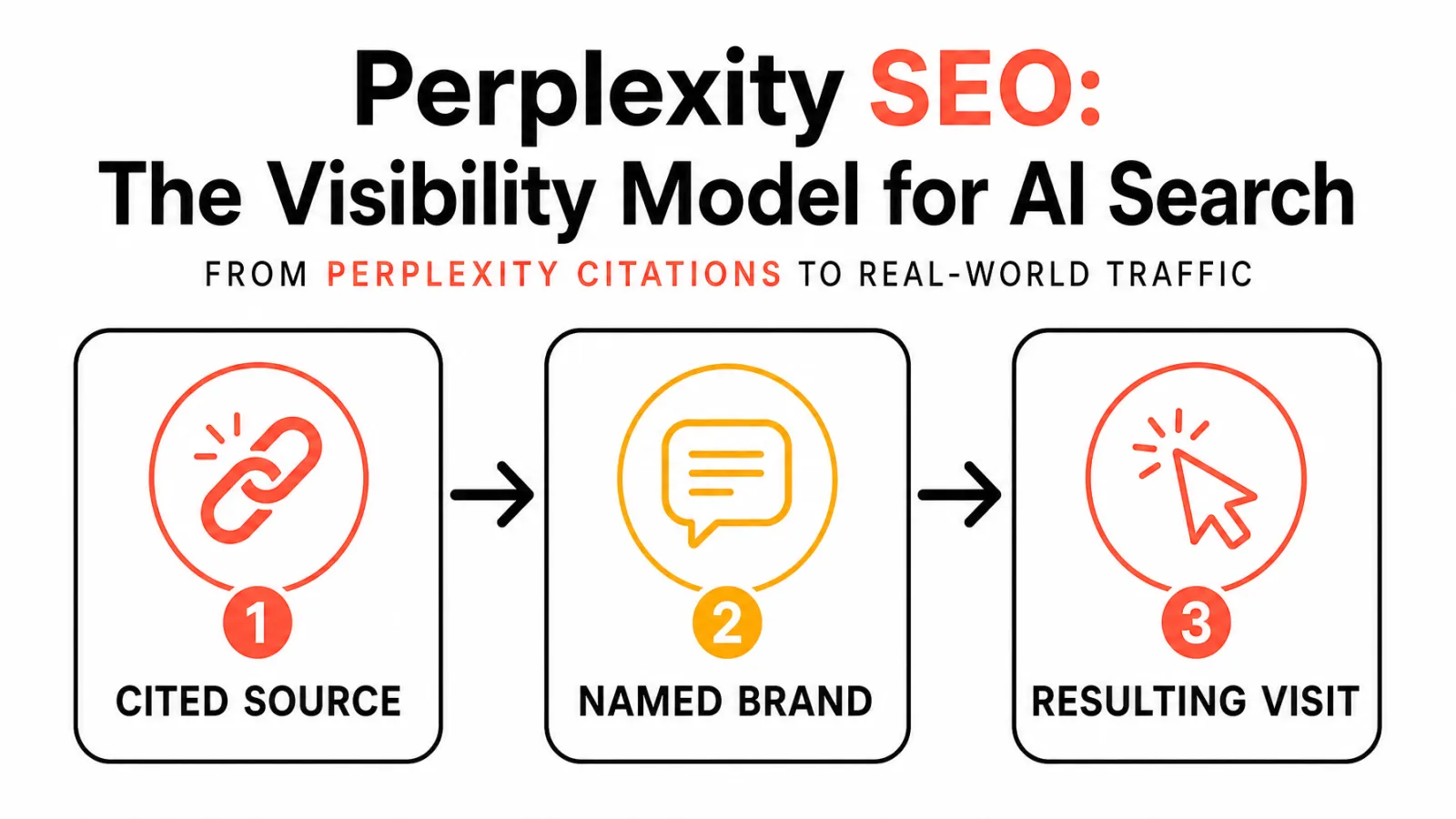
A brand can be named without a cited page, or cited without being recommended. Collapsing those into one score hides where the real gap is.
Why a Google position does not equal Perplexity visibility
A Google position tells you where a page sits on a results page. It says little about whether Perplexity retrieved that page for a specific question. Traditional SEO can support discovery, but I wouldn't assume one predicts the other.
Scale matters too. Perplexity's CEO reportedly disclosed 780 million monthly queries in May 2025, according to Axis Intelligence's Perplexity statistics roundup. That's well below Google, but it's enough to justify a separate check, which is why Perplexity SEO needs its own scorecard.
How does Perplexity find and select sources?
Perplexity retrieves web sources, synthesizes them into an answer, and displays links to the sources it used. Beyond that, the public documentation is thinner than most SEO guides suggest.
Web retrieval, synthesis, and source links
Perplexity's Help Center describes Pro Search as running web searches, reading what it finds, and building an answer with source links. For you, the practical consequence is straightforward. Your page has to be retrievable for the question and easy to verify against the claim.
Pages that bury the point or can't be fetched are harder to cite. That's an inference, not a documented rule, but it's a safe one to design around.
What Perplexity's crawler documentation confirms
Perplexity's official crawler documentation separates two user agents. PerplexityBot helps surface and link websites in Perplexity search. Perplexity-User may fetch a page after a user request.

The same documentation covers robots.txt and WAF handling. Check it for current user-agent strings and IP ranges before you change any rule, because those details can change.
What remains unverified about source selection
The official documentation reviewed here doesn't publish a ranking formula. Freshness, authority, backlinks, and page speed are plausible influences, but I'd label them hypotheses to test, so most Perplexity SEO advice deserves that same caution.
What is documented | What is a reasonable test | What not to claim |
|---|---|---|
Perplexity searches the web, synthesizes an answer, and shows source links. | Compare answer claims against the cited pages for a fixed prompt set. | A fixed source count or a conventional position order. |
PerplexityBot helps surface and link sites; Perplexity-User may fetch a page after a user request. | Check logs and WAF rules for both user agents. | That a crawler visit guarantees a citation. |
No public weighting of freshness, authority, backlinks, or page speed in the reviewed documentation. | Update one page, then re-run the same prompts on a schedule. | That any single factor is a confirmed Perplexity rule. |
What should you change on a page so Perplexity can retrieve and cite it?
Change the page so the answer, its conditions, and its evidence are easy to find and quote. None of this is a Perplexity-specific trick. It's careful, answer-first writing that also happens to suit AI search optimization.
Put the answer and conditions near the top
Put the direct answer in the first paragraph, with its scope and limits right beside it. Readers and retrieval systems both get the point without scrolling.
Here's a before and after. Before: "We help teams achieve better visibility in the age of AI." After: "AI search visibility means being cited or named in answers from tools like Perplexity. For a small SaaS team, it starts with crawlable pages that answer one question each and name their sources."
Use question-shaped headings and extractable sections
Headings that mirror real questions make a section easy to lift out and quote. Keep paragraphs short and use a table or bullets when they genuinely help. No specific paragraph length is a documented Perplexity requirement, so write for clarity, not a formula.
Add evidence, attribution, and original information
Cite primary sources for any claim a reader would want to verify, and add original examples, data, or screenshots only when you've checked them. Google's people-first content guidance points the same way: original, useful content with real human oversight. Perplexity SEO content earns trust the way any good page does, by showing its work.
Connect the page to a focused topic cluster
Link related pages so the topic and entity relationships are obvious. A guide, two or three supporting pages, and one commercial page that fits the intent beat ten loosely related posts. This is the practical core of topical authority and a key part of Generative Engine Optimization.
How should you strengthen technical and entity signals?
Strengthen technical and entity signals by confirming the page is reachable, readable, and clearly attributed to a real author and organization. The technical side of Perplexity SEO is mostly access hygiene, and it's the cheapest place to find a blocker.
Confirm crawlability, indexability, rendering, and canonicalization
Crawlability means bots can fetch the page. Indexability means the page is allowed into a search index. Rendering means the key text appears in the HTML a bot actually sees, and canonicalization means one URL is declared the preferred version.
Run this check before you publish or edit anything:
Check server logs or a technical audit for PerplexityBot and Perplexity-User requests.
Review robots.txt and WAF rules against the official crawler documentation.
Confirm an HTTP 200 status, a consistent canonical URL, and key text in rendered HTML.
Confirm the page is listed in your XML sitemap.
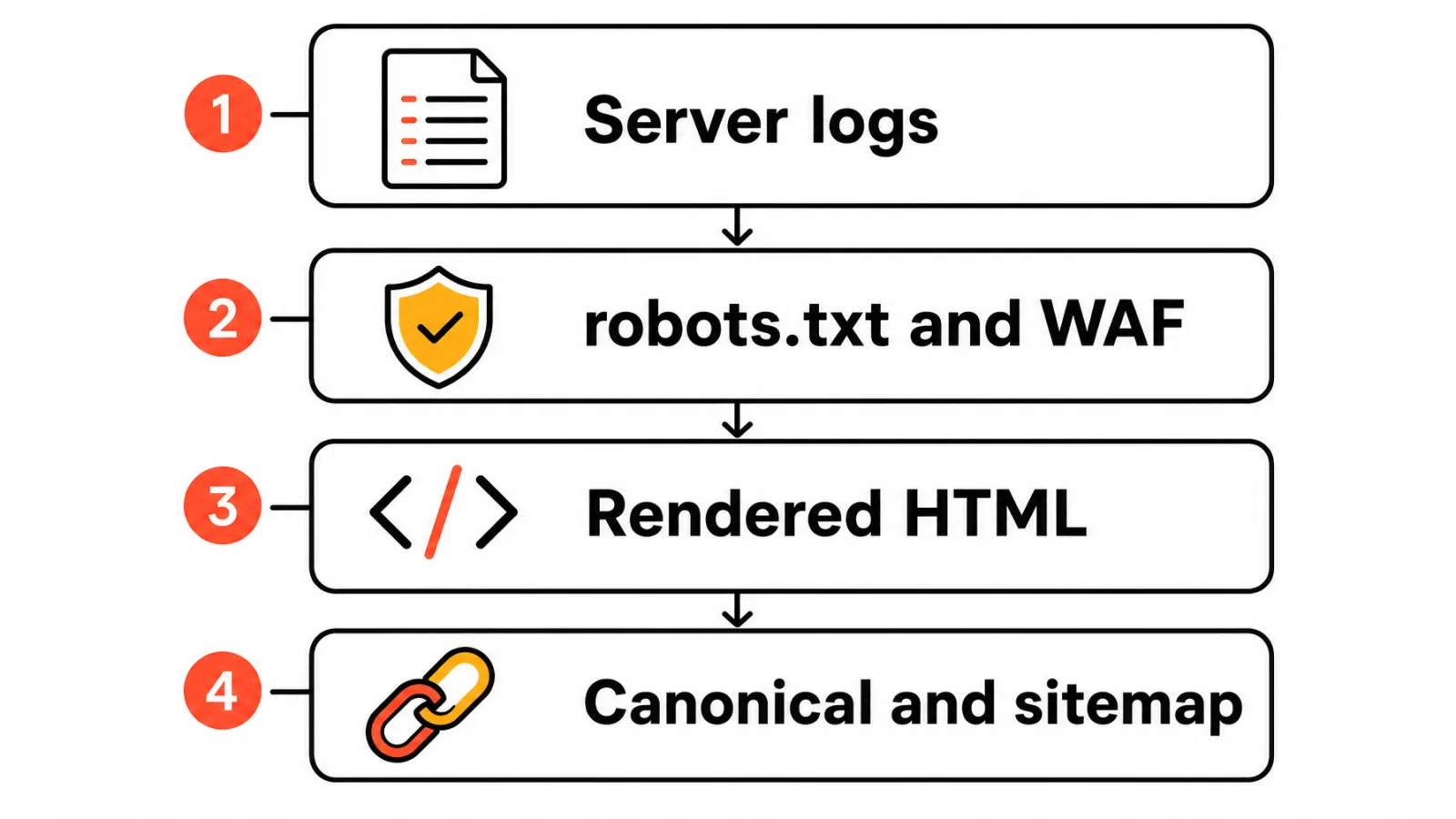
Notice that schema isn't on the list. Start with access, because markup can't help a page nobody can fetch.
Make the author, organization, and subject entity clear
Entity consistency means your organization name, product description, author identity, and factual claims agree everywhere they appear. That covers your site and the trusted profiles that describe you. It's also where E-E-A-T shows up in practice: a real author, a real publisher, and claims that don't contradict each other.
Use accurate structured data without treating it as a shortcut
Use structured data when it accurately describes visible page content, such as Article, Organization, Person, or BreadcrumbList. For a fuller picture of how structured data intersects with AI visibility, that post covers what markup does and doesn't do in AI search. Google's generative AI search guidance says no special schema is required for its AI features and no llms.txt file is needed for Google Search. That's Google evidence, so treat markup as general SEO hygiene, not a Perplexity lever.
How do you build a Perplexity-focused content strategy?
Build the strategy from the questions your buyers ask, then give each question a page, evidence, and a role in conversion. A Perplexity SEO strategy that starts with "publish more" usually ends with more pages nobody cites. For the broader cross-platform picture, our guide on how to improve brand visibility in AI answers covers the full cross-engine approach.
Map the questions buyers actually ask
Group prompts into classes, then decide what each one needs:
Category: what is this, and who is it for?
Problem: why is this happening, and how do I fix it?
Use case: how do I do this in my situation?
Comparison: how do options differ?
Brand: what does this company actually do?
For each class, note the reader need, the page type, the evidence required, and the conversion role. That table-in-your-head keeps pages purposeful.
Create supporting pages around one entity and problem space
Pick one entity and one problem space, then support it with pages that each answer a distinct question. If you're also working on AI visibility for local businesses, the same entity-and-problem-space approach applies there too.
Refresh claims and build legitimate corroboration
Refresh statistics, screenshots, and product details when they change. For third-party corroboration, contribute something useful: data, expert input, or documentation others reference. The same Google guidance cautions against manufactured mentions, and I'd treat that as a hard line.
How can you measure whether your site is visible in Perplexity?
You can track Perplexity citations by running a fixed prompt set on a schedule and logging cited URLs, brand mentions, and competitors for every run. Perplexity SEO measurement only works when the method stays constant.
Track citations, mentions, recommendations, source URLs, and sentiment separately
Keep each outcome in its own column. A mention without a cited URL points to a retrieval or page problem. A citation with poor sentiment points to an entity or accuracy problem.
Keytomic's AI Visibility Tracker automates this — running scheduled prompt monitoring, tracking citation sources, competitor appearances, and visibility trends across Perplexity and other AI platforms. For a deeper look at how to build and interpret this kind of data, our guide on LLM citation tracking walks through the methodology.
Use a fixed prompt methodology instead of one-off checks
One manual check is a sample, not a result. Answers can vary by wording, mode, time, location, and account context, so record each run the same way.
Field | What to record | Why it matters |
|---|---|---|
Prompt and class | Exact wording; category, problem, comparison, or brand | Keeps runs comparable |
Run date and mode | Date, platform mode, market, language | Answers vary by time and settings |
Brand mention | Named or not, with or without a link | Separates mentions from citations |
Cited URL | Which of your pages, if any, appeared | Shows which page earns a source slot |
Competitor presence | Which rivals appear and where | Reveals source gaps |
Sentiment and accuracy | How the answer describes you | Flags entity problems |
Next action | Fix, test, or leave alone | Turns observation into work |
Separate AI visibility from referral traffic and conversions
Referral traffic and conversions are downstream results, so log them apart from visibility. Where your analytics shows Perplexity referrals, record them, but don't claim a citation caused a sale unless the path supports it.
Also keep Google data in its own lane. Search Console's Generative AI performance report covers Google's generative AI features, not Perplexity.
Common Perplexity SEO Mistakes and How to Fix Them
Most Perplexity SEO mistakes are operational: pages that are hard to fetch, hard to verify, or hard to quote. Each one has a clear fix.
Burying the answer under branding or filler
If the answer sits below a long brand story, it's harder to extract. Lead with the answer, then add context. Thin pages with no evidence have the same problem.
Blocking crawlers or publishing content that cannot be verified
If a robots.txt rule or WAF blocks the documented user agents, the page may not be fetched. Review the official crawler guidance and your own access policy. Unsupported claims also give an answer engine nothing safe to cite, so name your sources.
Chasing keyword density, llms.txt, or guaranteed shortcuts
Keyword stuffing and llms.txt aren't documented levers for Perplexity, and Google says llms.txt isn't needed for Google Search. Cut promises, too. Replace "This page will be cited within 30 days" with "This page answers one question and cites its sources; we'll re-run the prompt set monthly."
Automating publication without human review
AI assistance isn't the problem; unreviewed, unoriginal output is. Keep a human checking facts, entity details, and claims before anything goes live. That protects quality and cuts the risk of publishing something you can't stand behind.
Frequently asked questions about Perplexity SEO
Does Perplexity have rankings like Google?
Not in a documented, Google-style sense. Measure visibility through citations, mentions, and prompt outcomes instead of assuming ten-result positions, since answers are synthesized from retrieved sources.
How does Perplexity choose which sources to cite?
It searches the web, reads sources, and links those it used. The complete weighting system isn't established by the official documentation reviewed, so treat factor lists as hypotheses.
Can ranking in Google help with Perplexity?
Foundational technical and content SEO can support discoverability. A Google position isn't a guarantee of a Perplexity citation, so measure each platform separately.
Should I allow PerplexityBot in robots.txt?
Review Perplexity's official crawler guidance and your own access policy first. PerplexityBot helps surface sites in Perplexity search, so blocking it may limit visibility.
Do backlinks matter for Perplexity citations?
No confirmed Perplexity backlink weight has been documented. External corroboration may support authority, but treat stronger claims as hypotheses and test them.
Does structured data help Perplexity cite a page?
Accurate structured data supports general search understanding, but it isn't a documented Perplexity shortcut. Google also says no special schema is needed for its generative AI features.
Do I need llms.txt to appear in Perplexity?
No universal requirement appears in the documentation reviewed, and Google says it isn't needed for Google Search. Don't treat it as a ranking lever.
Can Perplexity cite AI-generated content?
AI assistance doesn't decide eligibility on its own. The page still needs to be useful, accurate, original where appropriate, and human-reviewed before publishing.
How long does it take to appear in Perplexity answers?
There's no reliable universal timeframe. Check crawl access, indexing, and query fit, then compare repeated prompt runs instead of expecting results in days or months.
How can I track Perplexity citations?
Use a fixed prompt set, record cited URLs and mentions across repeated runs, and keep these observations separate from Google Search Console data. Keytomic's AI Visibility Tracker automates this across Perplexity and other AI platforms.
Your next Perplexity visibility check
Start with a Perplexity SEO check you can finish in an afternoon: three steps, one decision rule.
Verify access and page eligibility
Confirm the page returns HTTP 200, renders its key text, has a consistent canonical, and isn't blocked for the documented user agents. If a page can't be retrieved, nothing else matters yet.
Run a repeatable prompt baseline
Build 10 to 20 prompts across your prompt classes and log each run in the same format. The free AI visibility tracker is an optional low-friction way to set a first baseline across ChatGPT, Gemini, Perplexity, and Claude.
Turn the largest evidence or content gap into the next action
Use this decision rule:
Not retrievable: fix access.
Retrievable but not cited: improve question fit and evidence.
Cited but misrepresented: fix entity facts and source accuracy.
Visible but not converting: review intent and offer alignment.
Perplexity SEO is fundamentally a measurement discipline. Once your pages are retrievable and answer-first, the work shifts to prompt logs, cited-source analysis, and iterative content fixes. Keytomic's AI Visibility Tracker runs that loop automatically — so if your prompt set is growing past what's manageable in a spreadsheet, it's worth a look. The Keytomic demo shows the full workflow.