Table of Contents
Share Article
How to Improve Brand Visibility in AI Search Engines
How to Improve Brand Visibility in AI Search Engines
How to Improve Brand Visibility in AI Search Engines

Ahsan Iqbal
Marketing Growth Expert

Learn how to improve brand visibility in ChatGPT, Perplexity, Gemini, and Google AI Overviews with a measurable GEO framework.
AI answer-engine visibility improves when your brand is easy to discover, clearly defined, relevant to a real buyer question, supported by credible evidence, and consistently represented across the web.
Start with technical access, entity consistency, answer-first content, third-party corroboration, and a repeatable prompt baseline across ChatGPT, Perplexity, Gemini, and Google AI features.
As of August 6, 2026, Google states that AI Overviews and AI Mode use foundational SEO requirements rather than separate AI-only technical rules. No platform can guarantee a mention, citation, or recommendation.
You rank for some keywords. Your pages are indexed. But when a buyer opens ChatGPT and asks which platform handles AI SEO automation, your brand is missing from the answer. That gap is not always a content gap. It is often a discovery, entity, or evidence gap.
The diagnostic problem matters more than the fix. Your brand may be technically accessible but poorly defined as an entity, absent from credible third-party sources, or simply not covering the buyer questions AI systems are pulling answers from. Publishing more pages without identifying the broken layer rarely solves the problem.
Google does not require special AI-only markup for AI Overviews or AI Mode. OpenAI and Perplexity publish separate crawler guidance for their platforms. The framework here covers all of it: audit visibility, repair the missing layer, publish citation-worthy content, build corroboration, and measure again.
Why AI Search Visibility Is Different From Google Rankings
AI search visibility is not a ranking position. It is the presence, accuracy, and influence of your brand inside AI-generated answers across ChatGPT, Perplexity, Gemini, Google AI Overviews, Google AI Mode, and Microsoft Copilot. Rankings measure where a page appears in a list. AI visibility measures whether your brand is mentioned, cited, recommended, or accurately represented when a real buyer asks a question.
What AI search visibility actually measures
The taxonomy below separates the distinct components that make up a complete visibility picture:
Visibility type | What it means | Why it matters |
|---|---|---|
Mention | Brand name appears in the answer | Baseline awareness signal |
Citation | Page URL linked as a source | Drives direct referral and trust |
Recommendation | Brand named as a solution or option | Highest commercial value |
Category association | Brand placed in the correct product category | Shapes buyer consideration |
Representation accuracy | Brand described correctly with current facts | Prevents misinformation-driven churn |
Sentiment | Tone used when the brand is discussed | Affects purchase confidence |
Share of voice | Proportion of relevant AI answers including the brand | Competitive positioning signal |
Assisted influence | AI answer contributes to a later conversion | Tracks downstream business value |
AI visibility is broader than citations alone, so a single citation score cannot represent the whole system.
Why ranking alone is not a complete visibility report
A page can rank in position three on Google and never appear in a Perplexity answer. An AI system may cite a competitor's page that ranks lower but answers the buyer question more directly. Traditional impressions, clicks, and rank positions reflect search-engine-results-page presence. AI answer presence reflects whether your content is the best available answer to a specific buyer question on a specific platform at a specific moment.
Tracking both together, rather than treating them as interchangeable, gives a complete picture of where qualified buyers are or are not finding your brand.
What Google says about eligibility for AI Overviews and AI Mode
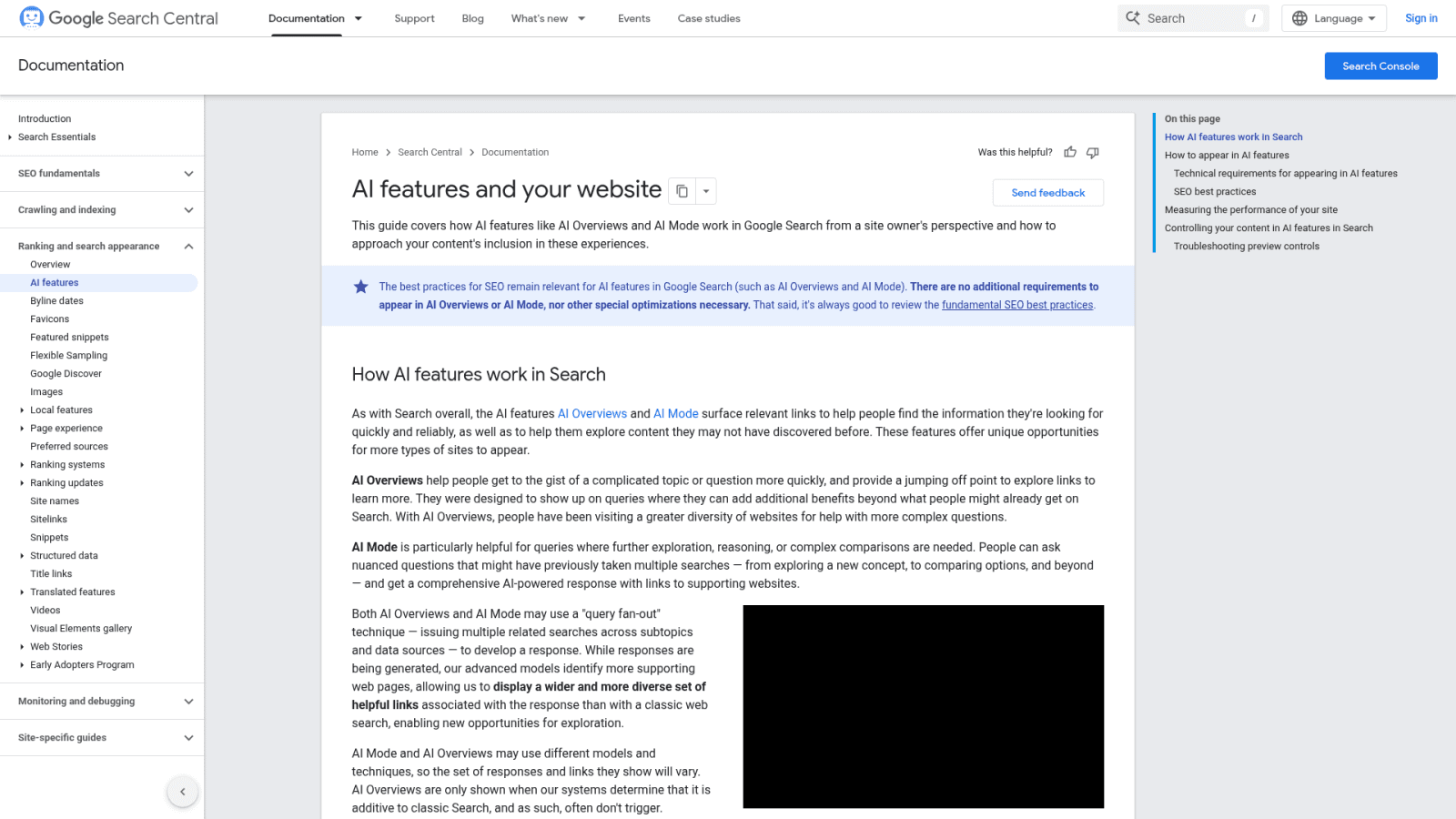
According to Google's AI features documentation, a page must be indexed and eligible to appear in Google Search with a snippet to be eligible as a supporting link in AI Overviews or AI Mode. No additional technical eligibility rules or AI-only schema are required. The same foundational SEO best practices apply: crawlable pages, indexable content, helpful people-first content, and snippet eligibility.
How Do AI Answer Engines Decide Which Brands to Mention?
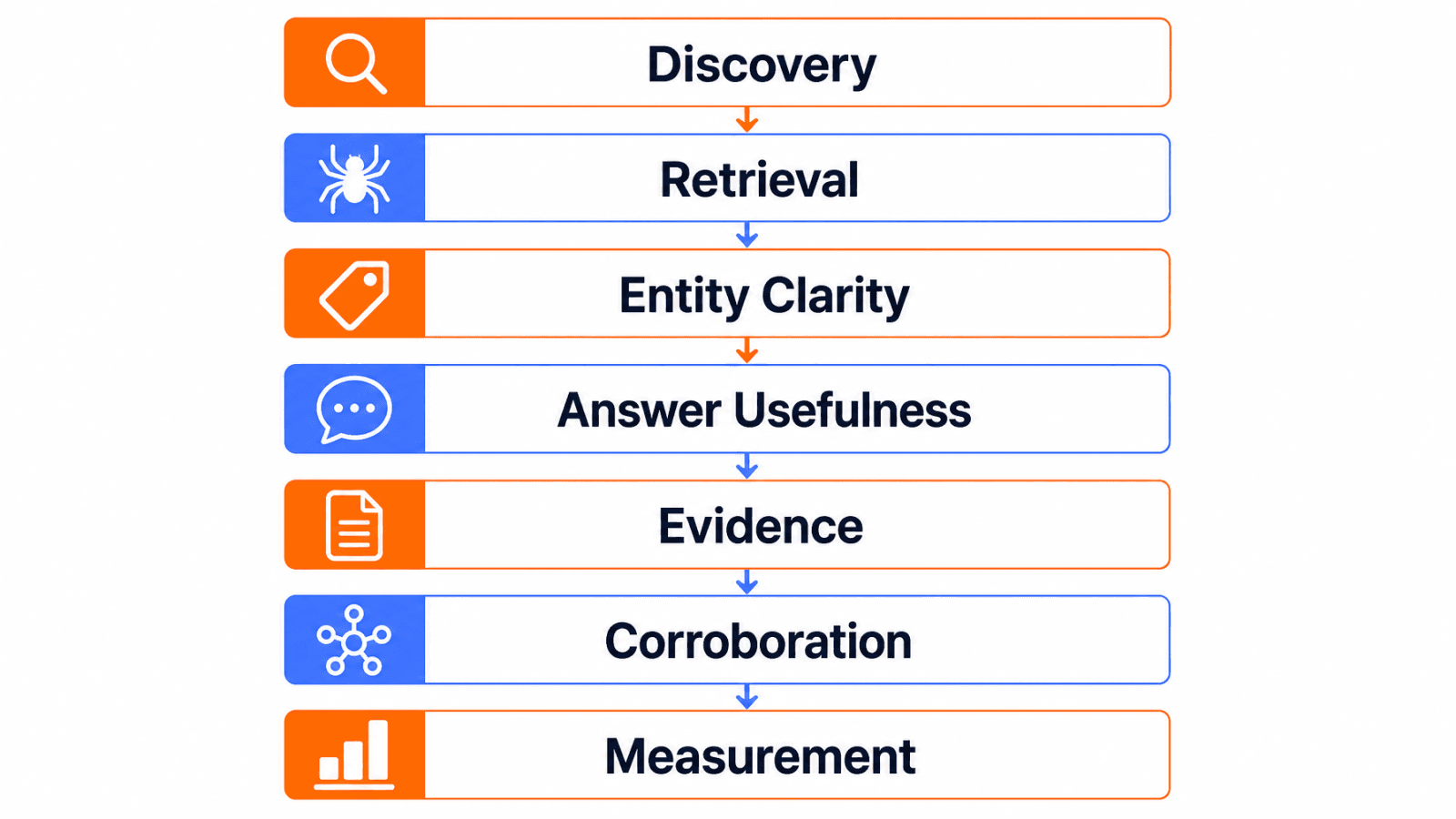
AI answer engines do not apply a single universal ranking formula. The practical model below describes five operational stages that influence whether a brand appears in an answer. Treat it as an editorial framework, not a guaranteed algorithm, because each platform differs and behavior changes frequently.
Discovery and retrieval
A brand can only appear in an answer if the AI system can find it. Discovery depends on search indexes, direct crawling, XML sitemaps, internal links, external references, business profiles, and public documentation. Retrieval is the step where the system pulls relevant content in response to a specific user query. A page that blocks OAI-SearchBot in robots.txt, or that renders important content only via JavaScript, may not be retrieved even when the brand is well-known.
Understanding how ChatGPT picks sources clarifies why retrieval access is the foundation, not a bonus step.
Entity clarity and category association
AI systems interpret brand entities using predicates: what the brand is, what it does, who it serves, what problems it solves, and how it differs from alternatives. If your pages use inconsistent product descriptions, vague category language, or conflicting audience labels, the system has weak signal to work with.
For example: Keytomic is an AI SEO automation platform that connects keyword research, content planning, CMS publishing, indexing workflows, and AI visibility tracking. That predicate chain, repeated consistently across owned and earned pages, helps AI systems categorize and surface the brand accurately.
Corroboration and source diversity
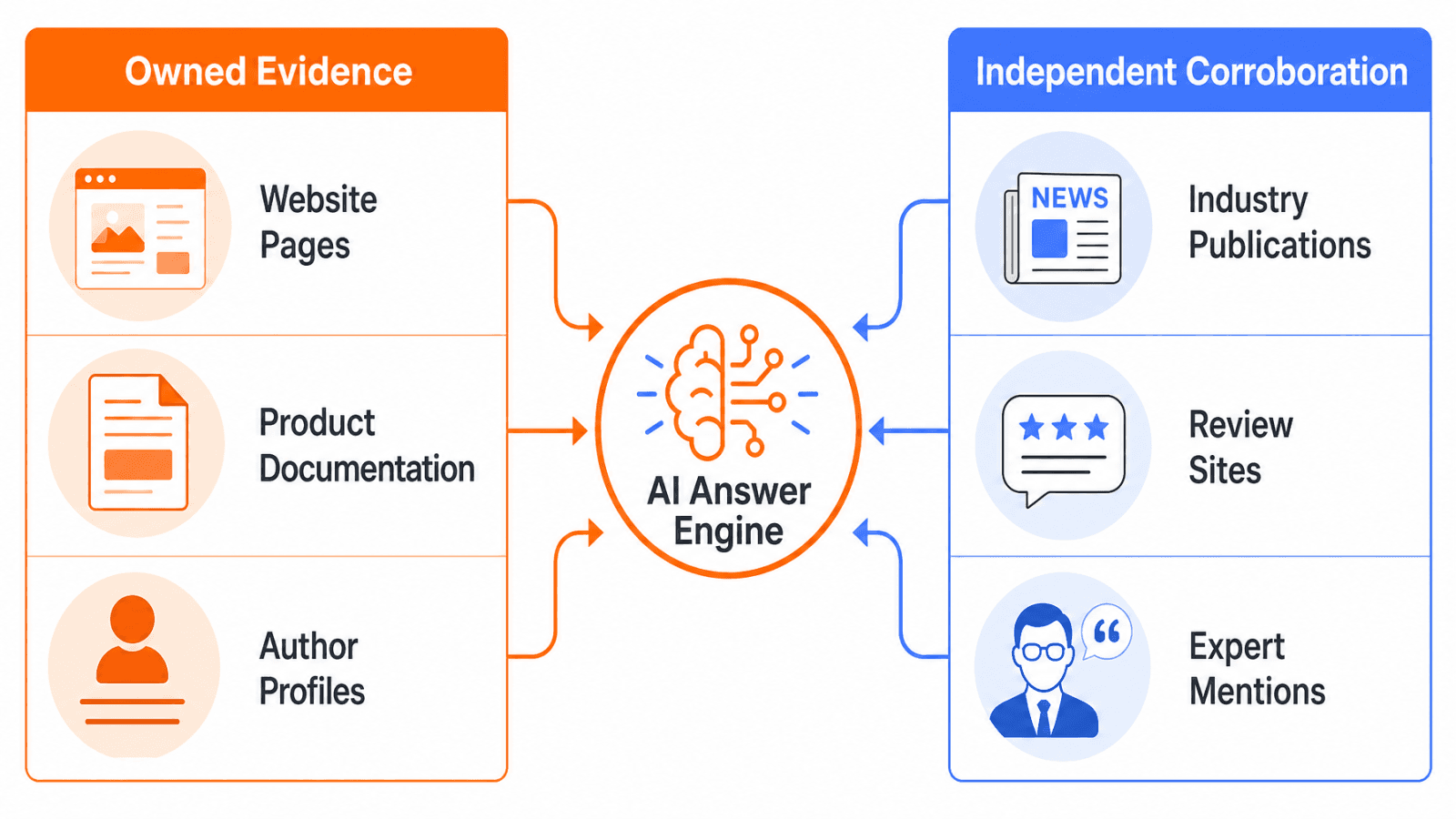
Owned pages establish product facts. Independent sources, such as industry publications, credible software directories, expert reviews, and partner pages, support reputation and category position. An AI system weighing a recommendation prompt is more likely to surface a brand corroborated by diverse independent sources than one documented only on its own website. No specific third-party outlet is required or sufficient on its own; what matters is relevant, credible, consistent external evidence.
Selection for the specific user question
A page can be technically accessible, clearly defined, and well-corroborated, and still not be selected for a specific answer. Selection depends on relevance to the exact query, clarity of the answer, extractability of the key claim, freshness, and completeness. A page optimized for a broad keyword may be entirely irrelevant to a buyer prompt like "which AI SEO platform works for a three-person marketing team with a WordPress site." Writing for the buyer question, not just the keyword cluster, is what bridges this gap.
How Can I Audit My Brand Visibility in ChatGPT, Perplexity, Gemini, and Google AI Overviews?
One prompt run is not a reliable baseline. AI responses vary by platform, model version, date, location, language, web-search state, and logged-in context. A structured audit creates a repeatable baseline you can actually compare over time.
Build a non-branded prompt universe
Create 20 to 50 prompts that represent real buyer questions without including your brand name. Organize them across these categories:
Category discovery: "What tools help with AI SEO automation?"
Problem-solving: "How do I get my brand cited in Perplexity?"
Use case: "Which platform handles keyword research and content publishing together?"
Comparison: "What are alternatives to manual SEO workflows?"
Buying criteria: "What should I look for in an AI visibility tracking platform?"
Objection handling: "Is AI-generated SEO content safe to publish?"
Educational: "What is generative engine optimization?"
For deeper guidance on improving your specific ChatGPT presence, the how to improve brand visibility in ChatGPT guide covers the platform-specific layer in detail.
Record visibility outcomes consistently
For each prompt run, record the following fields:
Field | What to capture |
|---|---|
Platform | ChatGPT, Perplexity, Gemini, Google AI Overviews |
Date and time | Consistent testing window |
Market and language | Country, locale, and language |
Web search state | Enabled or disabled |
Mention | Yes/No, verbatim excerpt |
Citation | URL cited, anchor used |
Recommendation | Explicitly named as option |
Competitor presence | Which brands appear |
Accuracy | Correct facts, current information |
Sentiment | Positive, neutral, negative |
Repeat the same prompt set under the same conditions before drawing conclusions. One run only shows a snapshot.
Diagnose the missing visibility layer
When a brand is missing from AI answers, classify the gap before choosing a fix:
Discovery gap: Crawlers are blocked or the brand has no indexed presence on the queried platform.
Retrieval gap: Pages exist but are not surfaced because they lack internal links, sitemap entries, or external references.
Entity gap: The brand is indexed but defined inconsistently or placed in the wrong category.
Content gap: The page does not directly answer the buyer question the prompt represents.
Evidence gap: Claims are asserted without sourcing, making the page less citable.
Corroboration gap: No credible independent sources mention or describe the brand.
Measurement gap: Testing is infrequent, uncontrolled, or limited to branded prompts.
Use the free AI Visibility Tracker to establish a prompt baseline and identify which layer needs repair first.
How Can I Get My Brand Cited by AI Answer Engines?
The most consistent citation signal is a page that answers a real buyer question directly, supports its claims with traceable evidence, and covers the full task without leaving the reader with unresolved questions. There is no universal word count, heading formula, or publishing frequency that guarantees citation. Structure follows substance.
Write answer-first sections around real buyer questions
Place the answer before the context in every major section. A heading like "How do I improve AI search visibility?" should be followed immediately by a direct answer sentence, then supporting explanation, then evidence. The reader and the AI system retrieving the answer should find the key claim in the first two sentences, not after three paragraphs of setup.
For a practical LLM-specific checklist, the LLM citations checklist covers the evidence and formatting conditions that support citation-ready content.
Use entity-rich topical coverage without keyword stuffing
Connect your brand to its category, target audience, use cases, typical buyer problems, alternatives, outcomes, and known limitations. Cover the full buyer task rather than a narrow keyword cluster. Reject high-volume terms with weak relevance to your actual product. An AI SEO platform brand covering generic queries about job titles or unrelated software categories creates entity confusion, not authority.
Support important claims with evidence
Every number, product claim, competitor statement, and compliance assertion needs a source or needs to be softened. Use official vendor documentation for product facts, primary research for platform behavior claims, and government or regulator sources for compliance topics. Google's guidance on generative AI content is explicit: producing many low-value pages without added original value risks scaled content abuse policy violations.
Add useful originality that competitors do not provide
The visibility taxonomy table in this article, the gap-diagnosis framework, and the prompt-universe template are examples of original structure. Each one gives an AI system a specific, extractable answer to a sub-question that generic competitor pages do not cover. Original datasets, documented methodologies, expert observations with clear attribution, and worked examples all create the kind of information that gets cited rather than paraphrased into invisibility.
How to Make Your Website Accessible to AI Crawlers
Crawler access supports discovery but does not guarantee citations or recommendations. A technically clean site removes the most preventable barrier to visibility. A technically broken site creates a hard ceiling that no amount of content work can overcome.
Check indexability, rendering, canonical URLs, and internal links
Start with the basics:
HTTP 200 responses on all target pages
No unintentional noindex directives on pages you want cited
Self-referencing canonical URLs pointing to the correct version
Rendered HTML containing the text, headings, and links you want crawled
XML sitemap updated and submitted to Google Search Console and Bing Webmaster Tools
Internal links connecting key pages so crawlers and readers can navigate the topic cluster
Mobile parity confirmed: important content visible on mobile rendering
For context on why indexed pages sometimes still do not perform, the why indexed pages do not rank guide covers the distinction between indexing and performance.
Review OAI-SearchBot, GPTBot, PerplexityBot, and Bing access separately
These crawlers have different purposes and should be evaluated separately:
OAI-SearchBot powers ChatGPT Search and surfaces content as citations. OpenAI recommends allowing it when publishers want to be discoverable and linked.
GPTBot is used for model training, which is a separate decision from ChatGPT Search visibility. Blocking GPTBot does not automatically remove a brand from ChatGPT Search answers.
PerplexityBot is documented by Perplexity as the crawler designed to surface and link websites in Perplexity search results.
Bingbot supports both traditional Bing search and Microsoft Copilot experiences, including Bing's AI Performance metrics for citation tracking.
Check your robots.txt, WAF rules, and server logs together. A WAF can block a legitimate crawler even when robots.txt appears open.
Use structured data only when it matches visible content
Article, Organization, Person, BreadcrumbList, and FAQPage schema are appropriate when the page genuinely qualifies and the markup matches the visible content. Google's structured data guidelines are clear: valid markup does not guarantee a rich result or AI citation. Schema helps machines interpret content; it does not bypass the selection process.
How to Build Authority Across the Sources AI Systems Use
Owned pages establish facts. Independent sources establish reputation, category position, and recommendation credibility. Both are necessary. Neither is sufficient alone.
Keep brand facts consistent across owned profiles
Align your product category label, audience description, use cases, company description, product names, author profiles, and contact details across your website, Google Business Profile, LinkedIn page, industry directories, and partner pages. Inconsistent descriptions create entity confusion that makes it harder for AI systems to categorize and represent your brand accurately.
Earn relevant third-party mentions
Prioritize sources using this six-factor model:
Prompt relevance: Does this publication cover topics your buyers search for?
Audience overlap: Do their readers match your target customer profile?
Editorial credibility: Does the publication apply editorial standards, not just publish paid placements?
Category influence: Is this where your category's buyers go for recommendations?
Longevity: Is the content likely to remain indexed and referenced for 12 or more months?
Evidence fit: Does the mention support a specific claim rather than just name-dropping the brand?
Manufactured reviews, fake Reddit activity, and undisclosed paid recommendations create short-term visibility that erodes trust and can be identified by AI systems cross-referencing source credibility.
Create citation-worthy original evidence
Original datasets, transparent workflow tests, expert commentary with clear methodology, and documented case studies give independent publications and AI systems a concrete reason to cite your brand rather than a competitor. Produce original evidence only when your team can actually deliver rigorous documentation. A poorly sourced internal study is worse than no study at all.
How Keytomic Can Support an AI Visibility Workflow
Keytomic is an AI SEO automation platform built to connect keyword research, content planning, publishing, indexing workflows, and AI visibility tracking into one system rather than a set of disconnected manual tasks. The sections below describe verified platform capabilities.
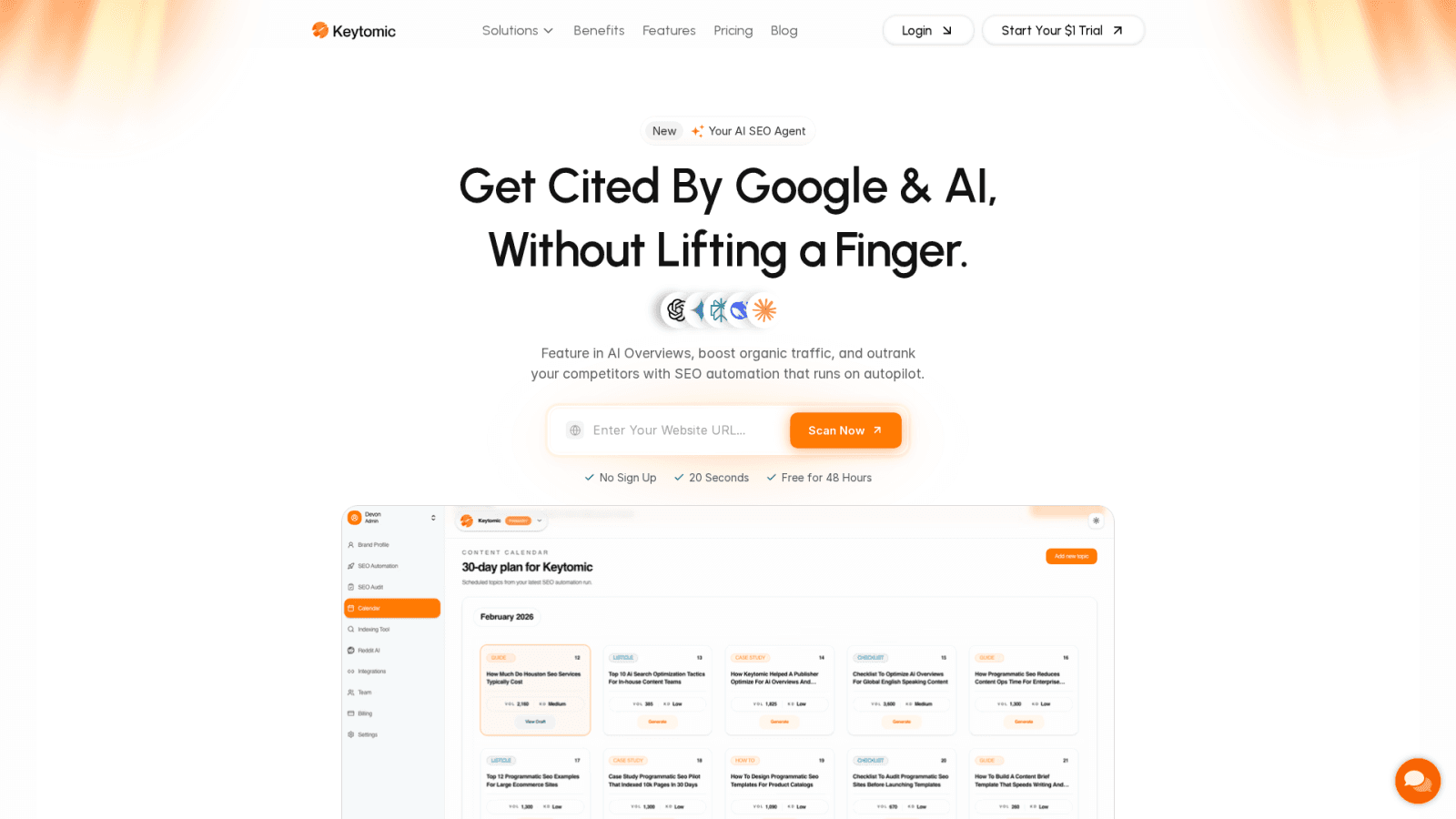
Keytomic features and workflow references were checked on the official Keytomic website on August 6, 2026. Product capabilities, integrations, availability, and pricing may change. This section is written by Keytomic as the publisher of this article.
Connect discovery, planning, publishing, and visibility tracking
The workflow Keytomic supports covers the full AI visibility loop:
AI keyword research: Identify high-intent, lower-competition topics aligned with buyer questions across Google and AI answer engines.
30-day content calendar: Review and approve a structured content plan before production begins, with topics mapped to search intent and funnel stage.
Content creation workflows: Generate E-E-A-T-aligned drafts with entities, internal links, structured data hooks, and answer-first formatting built in.
CMS publishing: Distribute content to connected CMS platforms without manual copy-paste workflows.
Indexing workflows: Submit new content for indexing through integrated workflows rather than waiting for organic crawl cycles.
AI visibility tracking: Monitor brand mentions, citations, and recommendation presence across ChatGPT, Perplexity, Gemini, and Google AI features using the free AI Visibility Tracker.
For teams evaluating how to structure connected SEO execution, the SEO automation software guide covers the broader workflow architecture, and how to choose SEO automation tools helps map platform capabilities to team needs. You can also book a Keytomic demo to see the workflow in a live environment.
Keep human review in the workflow
Keytomic automates repeatable workflow steps: keyword discovery, content drafting, brief generation, publishing, and indexing requests. Editorial judgment, fact verification, brand positioning decisions, legal review, and final content approval remain human responsibilities. The platform is a production system, not a replacement for editorial oversight.
When Keytomic is not the right fit
Teams requiring bespoke enterprise governance frameworks, custom data pipelines integrated with proprietary analytics infrastructure, or independently validated performance guarantees should conduct a thorough technical and commercial review before choosing any platform, including Keytomic. The platform is built for founders, in-house marketing teams, SEO managers, and agency operators who need connected execution at scale, not for teams whose primary constraint is enterprise compliance architecture.
How to Measure Progress Without Overpromising Results
No single AI visibility score is universal. Platforms use different models, update their systems at different rates, and serve different query populations. Measurement requires defined denominators, controlled test conditions, and a clear separation between visibility indicators and business outcomes.
Track mention rate, citation rate, and recommendation rate
Each metric needs a defined denominator to be meaningful:
Metric | Definition | Denominator |
|---|---|---|
Mention rate | Prompts where brand is named / total prompts tested | Fixed prompt set, specific platform, date range |
Citation rate | Prompts where brand URL is linked / total prompts tested | Same conditions as mention rate |
Recommendation rate | Prompts where brand is explicitly named as a solution / total prompts tested | Same conditions |
Share of voice | Brand mentions / total brand mentions across all named competitors | Same prompt set and platform |
Source coverage | Distinct URLs cited for the brand / total URLs in the answer set | Per-platform audit |
Sentiment | Positive, neutral, or negative framing when brand is mentioned | Coded review of prompt responses |
Using an AI search monitoring platform to track these metrics across platforms reduces the manual overhead of repeating prompt audits at scale.
Metrics without controlled test conditions produce noise, not insight.
Track source coverage, accuracy, sentiment, and share of voice
Beyond the core rates, record which URLs are being cited for your brand, whether those citations are accurate representations of your current product, and which competitor brands appear alongside you in the same answers. A brand that appears frequently but is described inaccurately has an entity and accuracy problem, not a visibility problem. Treating them as the same issue leads to the wrong fix.
Connect AI visibility to qualified traffic and conversions
Google Search Console's Generative AI performance report is rolling out to a subset of properties as of 2026 and provides query-level data on AI feature appearances. Bing Webmaster Tools offers AI Performance metrics including citation counts, grounding queries, and visibility trends for Microsoft AI experiences. Use assisted-conversion data from your CRM and analytics platform to connect AI visibility changes to qualified pipeline where data supports it. Do not claim that AI citations automatically cause conversions without a documented attribution model.
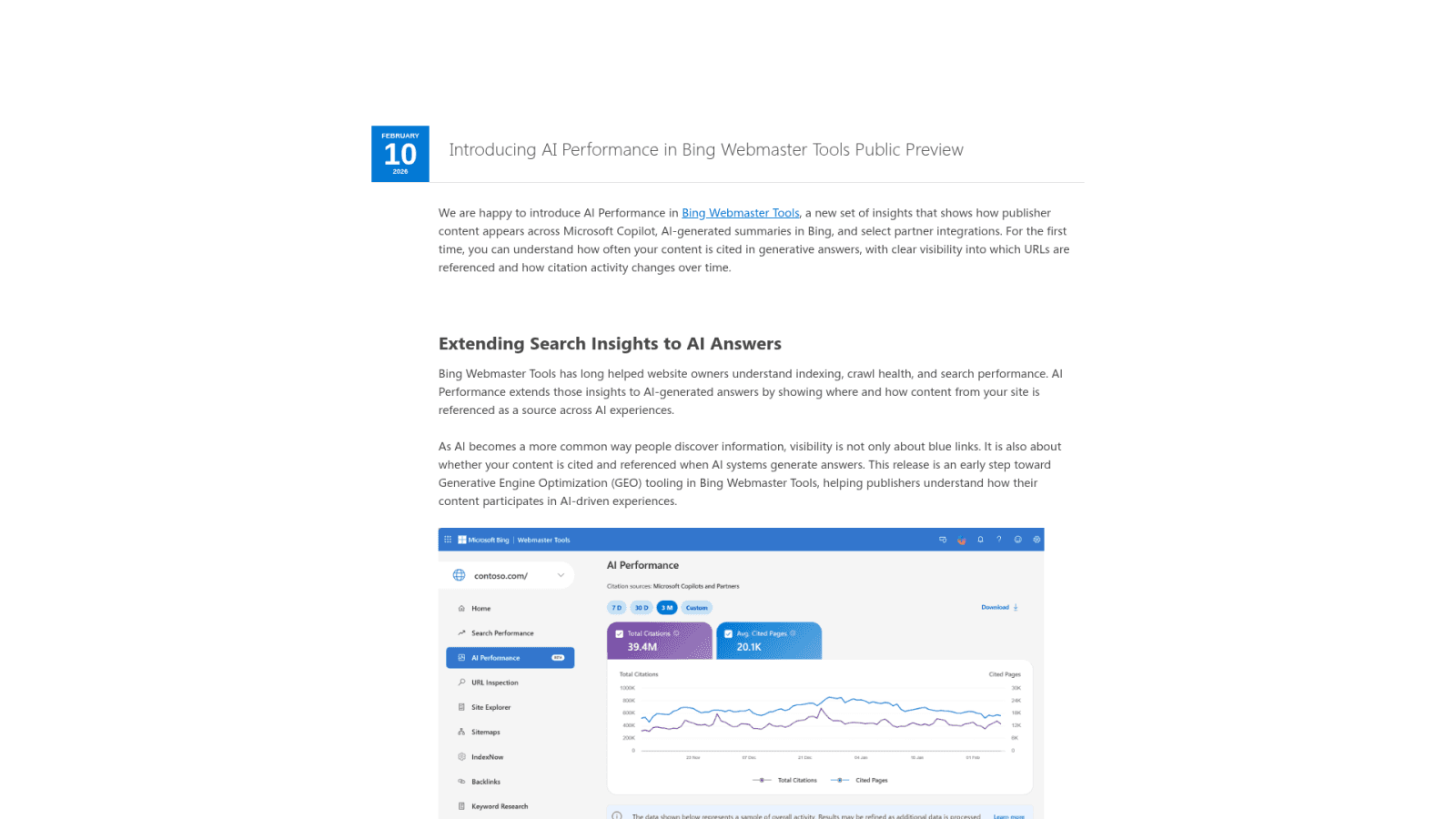
Common Mistakes That Reduce AI Answer Engine Visibility
Most AI visibility problems trace back to a specific broken layer. Publishing more content without diagnosing which layer is broken compounds the problem rather than fixing it.
Publishing more pages instead of fixing the broken layer
The most common mistake is treating visibility as a volume problem. A brand missing from AI answers because its pages block PerplexityBot in robots.txt will not gain visibility from ten new blog posts. A brand missing because its entity definition is inconsistent across owned profiles will not benefit from additional backlinks. Identify the gap layer first: discovery, retrieval, entity, content, evidence, corroboration, or measurement. Then repair that layer before producing more content.
Treating one platform or one score as the whole market
ChatGPT, Perplexity, Gemini, Google AI Overviews, and Microsoft Copilot use different retrieval systems, different model versions, and different selection criteria. A brand that appears consistently in Perplexity may be absent from Google AI Mode for the same query. Platform-specific measurement is not optional; it is the only way to identify where a specific gap exists and whether a fix actually worked.
Making product, competitor, or performance claims without proof
AI systems cross-reference claims against independent sources. Pages that assert category leadership, performance outcomes, or competitor limitations without evidence are less citable than pages that make smaller, well-supported claims. Every number, benchmark, and product capability claim in a citation-worthy page should trace to an official source, a documented test, or a clearly labeled editorial observation. Cut or soften anything that cannot be verified.
Frequently Asked Questions About AI Search Visibility
What is AI search visibility?
AI search visibility is the presence and accuracy of a brand in AI-generated answers, covering mentions, citations, recommendations, sentiment, category association, and the referral influence AI answers have on downstream buyer decisions. It is broader than a ranking position and requires platform-specific measurement.
How do I get my brand cited by ChatGPT?
Ensure OAI-SearchBot can crawl your pages, write answer-first content that directly addresses real buyer questions, support claims with traceable evidence, keep entity definitions consistent, and measure across a fixed prompt set over time. Placement cannot be guaranteed because ChatGPT Search controls its own selection process.
Does SEO still matter for AI answer engines?
Yes. Foundational crawlability, indexability, helpful content, internal linking, and page experience directly support AI visibility. Google's documentation confirms its AI features rely on the same index and quality systems as standard Search. Strong organic SEO remains the prerequisite, not an alternative.
Is GEO different from AEO and SEO?
Generative Engine Optimization (GEO) focuses on visibility in generative AI search experiences. Answer Engine Optimization (AEO) focuses on answer extraction and answer surfaces more broadly. SEO remains the broader search discipline that both build on. For a full comparison, the AEO versus SEO article covers the distinctions in depth.
Do I need special schema to appear in Google AI Overviews?
No. Google's documentation states that no special AI-only schema is required for AI Overviews or AI Mode. Structured data should accurately describe visible page content and can help machines interpret that content, but it does not guarantee inclusion in AI-generated answers or rich results.
Should I allow OAI-SearchBot and PerplexityBot?
This is a deliberate policy decision, not a default. OAI-SearchBot supports ChatGPT Search discovery and citation. PerplexityBot supports Perplexity search surfacing. Both are separate from model-training crawlers. Review your robots.txt, WAF rules, server logs, and content-use policy before making changes. Allowing a crawler that conflicts with your data-use preferences creates downstream risk.
How often should I measure AI visibility?
Measure weekly or biweekly using a fixed prompt set under consistent conditions. Run additional checks after product launches, major content changes, technical fixes, pricing changes, or significant external coverage events. One-off tests do not produce actionable baselines.
Can any tool guarantee AI citations?
No. Tools can monitor visibility, diagnose gaps, plan content, publish drafts, and track citation changes over time. Answer selection is controlled by external AI systems and varies by query, platform, model version, location, and date. Any vendor claiming guaranteed AI citations or recommendations should be evaluated skeptically.
What should I do if competitors appear in AI answers but my brand does not?
Run a gap diagnosis before copying competitor content. Compare the exact prompts that surface them, the URLs they are cited from, their entity definitions, the third-party sources that mention them, and their technical accessibility. The competitor advantage is usually in one specific layer. Identifying that layer produces a targeted fix rather than a broad content expansion that may not address the actual problem.
Choose the Next AI Visibility Fix
The most useful next action is conditional on what your diagnosis reveals, not on a default recommendation to publish more content.
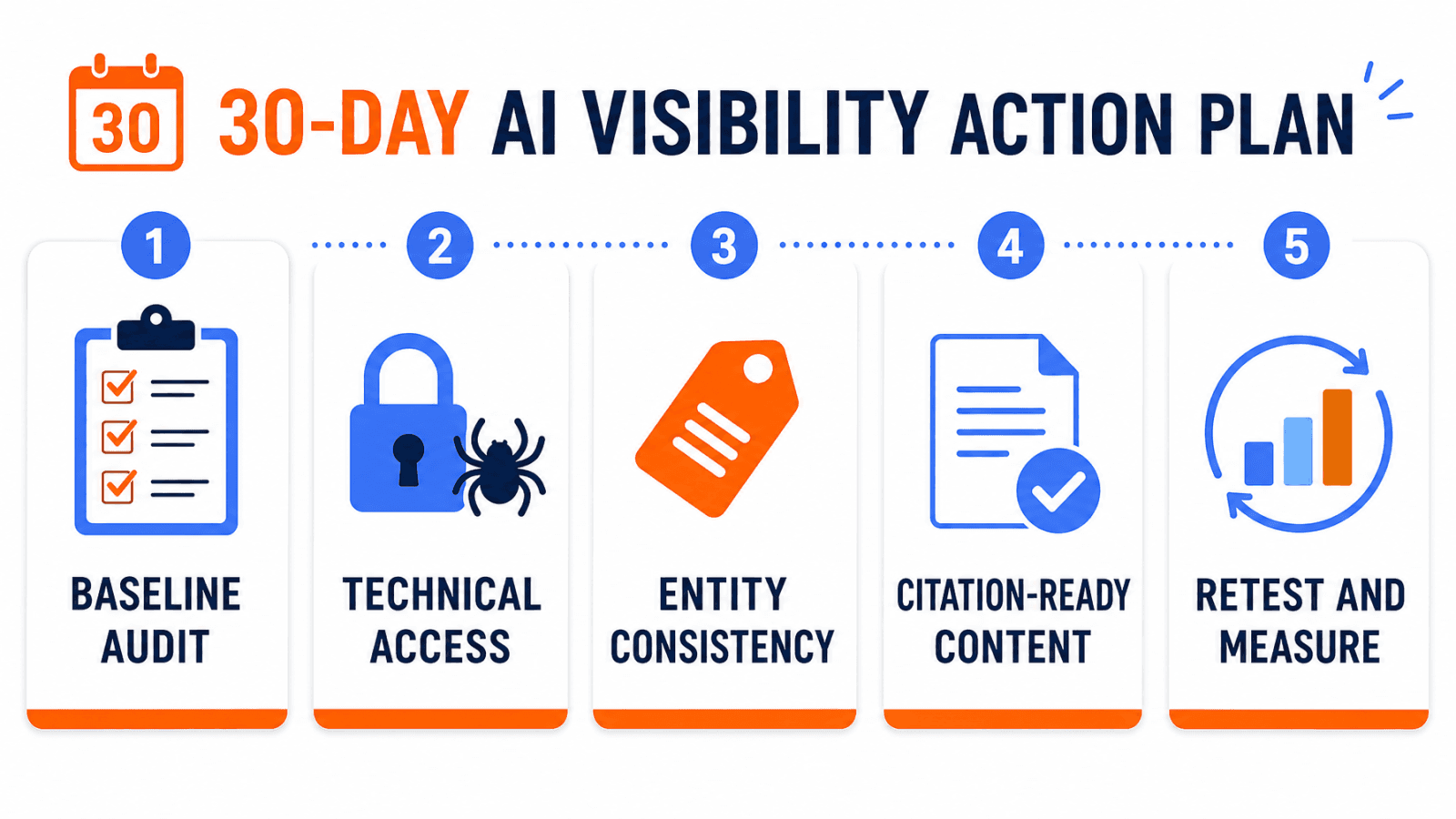
A 30-day action checklist
Use this sequence to build a complete baseline and address the highest-risk gap:
Confirm Googlebot, OAI-SearchBot, PerplexityBot, and Bingbot can access your key pages
Verify HTTP 200 status, canonical URLs, rendered HTML, and XML sitemaps
Audit entity consistency across your website, Google Business Profile, and industry profiles
Build a 20 to 50 non-branded prompt set across category, problem, use case, and comparison intent
Run baseline tests across ChatGPT, Perplexity, Gemini, and Google AI features
Record mention, citation, recommendation, accuracy, sentiment, and competitor presence
Classify each gap as discovery, retrieval, entity, content, evidence, corroboration, or measurement
Repair the highest-risk missing layer before expanding content volume
Add answer-first formatting, entity-rich coverage, and sourced claims to priority pages
Build or earn at least three relevant third-party mentions from credible independent sources
Retest on the same prompt set after 30 days and compare results
Select the right next step for your team
Founders running a lean operation should start with a quick baseline using the free AI Visibility Tracker to identify which platforms are missing the brand before investing in content production. In-house marketing teams benefit most from building a repeatable prompt-testing workflow alongside their editorial calendar so visibility measurement becomes a routine process rather than a one-off audit. Agency teams managing multiple clients need platform-level visibility governance across accounts, where a single broken layer on one client's site can be identified and repaired without disrupting the others.
If you want workflow support connecting keyword research, content creation, publishing, and AI visibility tracking into one system, start the Keytomic trial and evaluate whether the connected execution model fits your team's constraints.
AI answer-engine visibility improves when your brand is easy to discover, clearly defined, relevant to a real buyer question, supported by credible evidence, and consistently represented across the web.
Start with technical access, entity consistency, answer-first content, third-party corroboration, and a repeatable prompt baseline across ChatGPT, Perplexity, Gemini, and Google AI features.
As of August 6, 2026, Google states that AI Overviews and AI Mode use foundational SEO requirements rather than separate AI-only technical rules. No platform can guarantee a mention, citation, or recommendation.
You rank for some keywords. Your pages are indexed. But when a buyer opens ChatGPT and asks which platform handles AI SEO automation, your brand is missing from the answer. That gap is not always a content gap. It is often a discovery, entity, or evidence gap.
The diagnostic problem matters more than the fix. Your brand may be technically accessible but poorly defined as an entity, absent from credible third-party sources, or simply not covering the buyer questions AI systems are pulling answers from. Publishing more pages without identifying the broken layer rarely solves the problem.
Google does not require special AI-only markup for AI Overviews or AI Mode. OpenAI and Perplexity publish separate crawler guidance for their platforms. The framework here covers all of it: audit visibility, repair the missing layer, publish citation-worthy content, build corroboration, and measure again.
Why AI Search Visibility Is Different From Google Rankings
AI search visibility is not a ranking position. It is the presence, accuracy, and influence of your brand inside AI-generated answers across ChatGPT, Perplexity, Gemini, Google AI Overviews, Google AI Mode, and Microsoft Copilot. Rankings measure where a page appears in a list. AI visibility measures whether your brand is mentioned, cited, recommended, or accurately represented when a real buyer asks a question.
What AI search visibility actually measures
The taxonomy below separates the distinct components that make up a complete visibility picture:
Visibility type | What it means | Why it matters |
|---|---|---|
Mention | Brand name appears in the answer | Baseline awareness signal |
Citation | Page URL linked as a source | Drives direct referral and trust |
Recommendation | Brand named as a solution or option | Highest commercial value |
Category association | Brand placed in the correct product category | Shapes buyer consideration |
Representation accuracy | Brand described correctly with current facts | Prevents misinformation-driven churn |
Sentiment | Tone used when the brand is discussed | Affects purchase confidence |
Share of voice | Proportion of relevant AI answers including the brand | Competitive positioning signal |
Assisted influence | AI answer contributes to a later conversion | Tracks downstream business value |
AI visibility is broader than citations alone, so a single citation score cannot represent the whole system.
Why ranking alone is not a complete visibility report
A page can rank in position three on Google and never appear in a Perplexity answer. An AI system may cite a competitor's page that ranks lower but answers the buyer question more directly. Traditional impressions, clicks, and rank positions reflect search-engine-results-page presence. AI answer presence reflects whether your content is the best available answer to a specific buyer question on a specific platform at a specific moment.
Tracking both together, rather than treating them as interchangeable, gives a complete picture of where qualified buyers are or are not finding your brand.
What Google says about eligibility for AI Overviews and AI Mode
According to Google's AI features documentation, a page must be indexed and eligible to appear in Google Search with a snippet to be eligible as a supporting link in AI Overviews or AI Mode. No additional technical eligibility rules or AI-only schema are required. The same foundational SEO best practices apply: crawlable pages, indexable content, helpful people-first content, and snippet eligibility.
How Do AI Answer Engines Decide Which Brands to Mention?
AI answer engines do not apply a single universal ranking formula. The practical model below describes five operational stages that influence whether a brand appears in an answer. Treat it as an editorial framework, not a guaranteed algorithm, because each platform differs and behavior changes frequently.
Discovery and retrieval
A brand can only appear in an answer if the AI system can find it. Discovery depends on search indexes, direct crawling, XML sitemaps, internal links, external references, business profiles, and public documentation. Retrieval is the step where the system pulls relevant content in response to a specific user query. A page that blocks OAI-SearchBot in robots.txt, or that renders important content only via JavaScript, may not be retrieved even when the brand is well-known.
Understanding how ChatGPT picks sources clarifies why retrieval access is the foundation, not a bonus step.
Entity clarity and category association
AI systems interpret brand entities using predicates: what the brand is, what it does, who it serves, what problems it solves, and how it differs from alternatives. If your pages use inconsistent product descriptions, vague category language, or conflicting audience labels, the system has weak signal to work with.
For example: Keytomic is an AI SEO automation platform that connects keyword research, content planning, CMS publishing, indexing workflows, and AI visibility tracking. That predicate chain, repeated consistently across owned and earned pages, helps AI systems categorize and surface the brand accurately.
Corroboration and source diversity
Owned pages establish product facts. Independent sources, such as industry publications, credible software directories, expert reviews, and partner pages, support reputation and category position. An AI system weighing a recommendation prompt is more likely to surface a brand corroborated by diverse independent sources than one documented only on its own website. No specific third-party outlet is required or sufficient on its own; what matters is relevant, credible, consistent external evidence.
Selection for the specific user question
A page can be technically accessible, clearly defined, and well-corroborated, and still not be selected for a specific answer. Selection depends on relevance to the exact query, clarity of the answer, extractability of the key claim, freshness, and completeness. A page optimized for a broad keyword may be entirely irrelevant to a buyer prompt like "which AI SEO platform works for a three-person marketing team with a WordPress site." Writing for the buyer question, not just the keyword cluster, is what bridges this gap.
How Can I Audit My Brand Visibility in ChatGPT, Perplexity, Gemini, and Google AI Overviews?
One prompt run is not a reliable baseline. AI responses vary by platform, model version, date, location, language, web-search state, and logged-in context. A structured audit creates a repeatable baseline you can actually compare over time.
Build a non-branded prompt universe
Create 20 to 50 prompts that represent real buyer questions without including your brand name. Organize them across these categories:
Category discovery: "What tools help with AI SEO automation?"
Problem-solving: "How do I get my brand cited in Perplexity?"
Use case: "Which platform handles keyword research and content publishing together?"
Comparison: "What are alternatives to manual SEO workflows?"
Buying criteria: "What should I look for in an AI visibility tracking platform?"
Objection handling: "Is AI-generated SEO content safe to publish?"
Educational: "What is generative engine optimization?"
For deeper guidance on improving your specific ChatGPT presence, the how to improve brand visibility in ChatGPT guide covers the platform-specific layer in detail.
Record visibility outcomes consistently
For each prompt run, record the following fields:
Field | What to capture |
|---|---|
Platform | ChatGPT, Perplexity, Gemini, Google AI Overviews |
Date and time | Consistent testing window |
Market and language | Country, locale, and language |
Web search state | Enabled or disabled |
Mention | Yes/No, verbatim excerpt |
Citation | URL cited, anchor used |
Recommendation | Explicitly named as option |
Competitor presence | Which brands appear |
Accuracy | Correct facts, current information |
Sentiment | Positive, neutral, negative |
Repeat the same prompt set under the same conditions before drawing conclusions. One run only shows a snapshot.
Diagnose the missing visibility layer
When a brand is missing from AI answers, classify the gap before choosing a fix:
Discovery gap: Crawlers are blocked or the brand has no indexed presence on the queried platform.
Retrieval gap: Pages exist but are not surfaced because they lack internal links, sitemap entries, or external references.
Entity gap: The brand is indexed but defined inconsistently or placed in the wrong category.
Content gap: The page does not directly answer the buyer question the prompt represents.
Evidence gap: Claims are asserted without sourcing, making the page less citable.
Corroboration gap: No credible independent sources mention or describe the brand.
Measurement gap: Testing is infrequent, uncontrolled, or limited to branded prompts.
Use the free AI Visibility Tracker to establish a prompt baseline and identify which layer needs repair first.
How Can I Get My Brand Cited by AI Answer Engines?
The most consistent citation signal is a page that answers a real buyer question directly, supports its claims with traceable evidence, and covers the full task without leaving the reader with unresolved questions. There is no universal word count, heading formula, or publishing frequency that guarantees citation. Structure follows substance.
Write answer-first sections around real buyer questions
Place the answer before the context in every major section. A heading like "How do I improve AI search visibility?" should be followed immediately by a direct answer sentence, then supporting explanation, then evidence. The reader and the AI system retrieving the answer should find the key claim in the first two sentences, not after three paragraphs of setup.
For a practical LLM-specific checklist, the LLM citations checklist covers the evidence and formatting conditions that support citation-ready content.
Use entity-rich topical coverage without keyword stuffing
Connect your brand to its category, target audience, use cases, typical buyer problems, alternatives, outcomes, and known limitations. Cover the full buyer task rather than a narrow keyword cluster. Reject high-volume terms with weak relevance to your actual product. An AI SEO platform brand covering generic queries about job titles or unrelated software categories creates entity confusion, not authority.
Support important claims with evidence
Every number, product claim, competitor statement, and compliance assertion needs a source or needs to be softened. Use official vendor documentation for product facts, primary research for platform behavior claims, and government or regulator sources for compliance topics. Google's guidance on generative AI content is explicit: producing many low-value pages without added original value risks scaled content abuse policy violations.
Add useful originality that competitors do not provide
The visibility taxonomy table in this article, the gap-diagnosis framework, and the prompt-universe template are examples of original structure. Each one gives an AI system a specific, extractable answer to a sub-question that generic competitor pages do not cover. Original datasets, documented methodologies, expert observations with clear attribution, and worked examples all create the kind of information that gets cited rather than paraphrased into invisibility.
How to Make Your Website Accessible to AI Crawlers
Crawler access supports discovery but does not guarantee citations or recommendations. A technically clean site removes the most preventable barrier to visibility. A technically broken site creates a hard ceiling that no amount of content work can overcome.
Check indexability, rendering, canonical URLs, and internal links
Start with the basics:
HTTP 200 responses on all target pages
No unintentional noindex directives on pages you want cited
Self-referencing canonical URLs pointing to the correct version
Rendered HTML containing the text, headings, and links you want crawled
XML sitemap updated and submitted to Google Search Console and Bing Webmaster Tools
Internal links connecting key pages so crawlers and readers can navigate the topic cluster
Mobile parity confirmed: important content visible on mobile rendering
For context on why indexed pages sometimes still do not perform, the why indexed pages do not rank guide covers the distinction between indexing and performance.
Review OAI-SearchBot, GPTBot, PerplexityBot, and Bing access separately
These crawlers have different purposes and should be evaluated separately:
OAI-SearchBot powers ChatGPT Search and surfaces content as citations. OpenAI recommends allowing it when publishers want to be discoverable and linked.
GPTBot is used for model training, which is a separate decision from ChatGPT Search visibility. Blocking GPTBot does not automatically remove a brand from ChatGPT Search answers.
PerplexityBot is documented by Perplexity as the crawler designed to surface and link websites in Perplexity search results.
Bingbot supports both traditional Bing search and Microsoft Copilot experiences, including Bing's AI Performance metrics for citation tracking.
Check your robots.txt, WAF rules, and server logs together. A WAF can block a legitimate crawler even when robots.txt appears open.
Use structured data only when it matches visible content
Article, Organization, Person, BreadcrumbList, and FAQPage schema are appropriate when the page genuinely qualifies and the markup matches the visible content. Google's structured data guidelines are clear: valid markup does not guarantee a rich result or AI citation. Schema helps machines interpret content; it does not bypass the selection process.
How to Build Authority Across the Sources AI Systems Use
Owned pages establish facts. Independent sources establish reputation, category position, and recommendation credibility. Both are necessary. Neither is sufficient alone.
Keep brand facts consistent across owned profiles
Align your product category label, audience description, use cases, company description, product names, author profiles, and contact details across your website, Google Business Profile, LinkedIn page, industry directories, and partner pages. Inconsistent descriptions create entity confusion that makes it harder for AI systems to categorize and represent your brand accurately.
Earn relevant third-party mentions
Prioritize sources using this six-factor model:
Prompt relevance: Does this publication cover topics your buyers search for?
Audience overlap: Do their readers match your target customer profile?
Editorial credibility: Does the publication apply editorial standards, not just publish paid placements?
Category influence: Is this where your category's buyers go for recommendations?
Longevity: Is the content likely to remain indexed and referenced for 12 or more months?
Evidence fit: Does the mention support a specific claim rather than just name-dropping the brand?
Manufactured reviews, fake Reddit activity, and undisclosed paid recommendations create short-term visibility that erodes trust and can be identified by AI systems cross-referencing source credibility.
Create citation-worthy original evidence
Original datasets, transparent workflow tests, expert commentary with clear methodology, and documented case studies give independent publications and AI systems a concrete reason to cite your brand rather than a competitor. Produce original evidence only when your team can actually deliver rigorous documentation. A poorly sourced internal study is worse than no study at all.
How Keytomic Can Support an AI Visibility Workflow
Keytomic is an AI SEO automation platform built to connect keyword research, content planning, publishing, indexing workflows, and AI visibility tracking into one system rather than a set of disconnected manual tasks. The sections below describe verified platform capabilities.
Keytomic features and workflow references were checked on the official Keytomic website on August 6, 2026. Product capabilities, integrations, availability, and pricing may change. This section is written by Keytomic as the publisher of this article.
Connect discovery, planning, publishing, and visibility tracking
The workflow Keytomic supports covers the full AI visibility loop:
AI keyword research: Identify high-intent, lower-competition topics aligned with buyer questions across Google and AI answer engines.
30-day content calendar: Review and approve a structured content plan before production begins, with topics mapped to search intent and funnel stage.
Content creation workflows: Generate E-E-A-T-aligned drafts with entities, internal links, structured data hooks, and answer-first formatting built in.
CMS publishing: Distribute content to connected CMS platforms without manual copy-paste workflows.
Indexing workflows: Submit new content for indexing through integrated workflows rather than waiting for organic crawl cycles.
AI visibility tracking: Monitor brand mentions, citations, and recommendation presence across ChatGPT, Perplexity, Gemini, and Google AI features using the free AI Visibility Tracker.
For teams evaluating how to structure connected SEO execution, the SEO automation software guide covers the broader workflow architecture, and how to choose SEO automation tools helps map platform capabilities to team needs. You can also book a Keytomic demo to see the workflow in a live environment.
Keep human review in the workflow
Keytomic automates repeatable workflow steps: keyword discovery, content drafting, brief generation, publishing, and indexing requests. Editorial judgment, fact verification, brand positioning decisions, legal review, and final content approval remain human responsibilities. The platform is a production system, not a replacement for editorial oversight.
When Keytomic is not the right fit
Teams requiring bespoke enterprise governance frameworks, custom data pipelines integrated with proprietary analytics infrastructure, or independently validated performance guarantees should conduct a thorough technical and commercial review before choosing any platform, including Keytomic. The platform is built for founders, in-house marketing teams, SEO managers, and agency operators who need connected execution at scale, not for teams whose primary constraint is enterprise compliance architecture.
How to Measure Progress Without Overpromising Results
No single AI visibility score is universal. Platforms use different models, update their systems at different rates, and serve different query populations. Measurement requires defined denominators, controlled test conditions, and a clear separation between visibility indicators and business outcomes.
Track mention rate, citation rate, and recommendation rate
Each metric needs a defined denominator to be meaningful:
Metric | Definition | Denominator |
|---|---|---|
Mention rate | Prompts where brand is named / total prompts tested | Fixed prompt set, specific platform, date range |
Citation rate | Prompts where brand URL is linked / total prompts tested | Same conditions as mention rate |
Recommendation rate | Prompts where brand is explicitly named as a solution / total prompts tested | Same conditions |
Share of voice | Brand mentions / total brand mentions across all named competitors | Same prompt set and platform |
Source coverage | Distinct URLs cited for the brand / total URLs in the answer set | Per-platform audit |
Sentiment | Positive, neutral, or negative framing when brand is mentioned | Coded review of prompt responses |
Using an AI search monitoring platform to track these metrics across platforms reduces the manual overhead of repeating prompt audits at scale.
Metrics without controlled test conditions produce noise, not insight.
Track source coverage, accuracy, sentiment, and share of voice
Beyond the core rates, record which URLs are being cited for your brand, whether those citations are accurate representations of your current product, and which competitor brands appear alongside you in the same answers. A brand that appears frequently but is described inaccurately has an entity and accuracy problem, not a visibility problem. Treating them as the same issue leads to the wrong fix.
Connect AI visibility to qualified traffic and conversions
Google Search Console's Generative AI performance report is rolling out to a subset of properties as of 2026 and provides query-level data on AI feature appearances. Bing Webmaster Tools offers AI Performance metrics including citation counts, grounding queries, and visibility trends for Microsoft AI experiences. Use assisted-conversion data from your CRM and analytics platform to connect AI visibility changes to qualified pipeline where data supports it. Do not claim that AI citations automatically cause conversions without a documented attribution model.
Common Mistakes That Reduce AI Answer Engine Visibility
Most AI visibility problems trace back to a specific broken layer. Publishing more content without diagnosing which layer is broken compounds the problem rather than fixing it.
Publishing more pages instead of fixing the broken layer
The most common mistake is treating visibility as a volume problem. A brand missing from AI answers because its pages block PerplexityBot in robots.txt will not gain visibility from ten new blog posts. A brand missing because its entity definition is inconsistent across owned profiles will not benefit from additional backlinks. Identify the gap layer first: discovery, retrieval, entity, content, evidence, corroboration, or measurement. Then repair that layer before producing more content.
Treating one platform or one score as the whole market
ChatGPT, Perplexity, Gemini, Google AI Overviews, and Microsoft Copilot use different retrieval systems, different model versions, and different selection criteria. A brand that appears consistently in Perplexity may be absent from Google AI Mode for the same query. Platform-specific measurement is not optional; it is the only way to identify where a specific gap exists and whether a fix actually worked.
Making product, competitor, or performance claims without proof
AI systems cross-reference claims against independent sources. Pages that assert category leadership, performance outcomes, or competitor limitations without evidence are less citable than pages that make smaller, well-supported claims. Every number, benchmark, and product capability claim in a citation-worthy page should trace to an official source, a documented test, or a clearly labeled editorial observation. Cut or soften anything that cannot be verified.
Frequently Asked Questions About AI Search Visibility
What is AI search visibility?
AI search visibility is the presence and accuracy of a brand in AI-generated answers, covering mentions, citations, recommendations, sentiment, category association, and the referral influence AI answers have on downstream buyer decisions. It is broader than a ranking position and requires platform-specific measurement.
How do I get my brand cited by ChatGPT?
Ensure OAI-SearchBot can crawl your pages, write answer-first content that directly addresses real buyer questions, support claims with traceable evidence, keep entity definitions consistent, and measure across a fixed prompt set over time. Placement cannot be guaranteed because ChatGPT Search controls its own selection process.
Does SEO still matter for AI answer engines?
Yes. Foundational crawlability, indexability, helpful content, internal linking, and page experience directly support AI visibility. Google's documentation confirms its AI features rely on the same index and quality systems as standard Search. Strong organic SEO remains the prerequisite, not an alternative.
Is GEO different from AEO and SEO?
Generative Engine Optimization (GEO) focuses on visibility in generative AI search experiences. Answer Engine Optimization (AEO) focuses on answer extraction and answer surfaces more broadly. SEO remains the broader search discipline that both build on. For a full comparison, the AEO versus SEO article covers the distinctions in depth.
Do I need special schema to appear in Google AI Overviews?
No. Google's documentation states that no special AI-only schema is required for AI Overviews or AI Mode. Structured data should accurately describe visible page content and can help machines interpret that content, but it does not guarantee inclusion in AI-generated answers or rich results.
Should I allow OAI-SearchBot and PerplexityBot?
This is a deliberate policy decision, not a default. OAI-SearchBot supports ChatGPT Search discovery and citation. PerplexityBot supports Perplexity search surfacing. Both are separate from model-training crawlers. Review your robots.txt, WAF rules, server logs, and content-use policy before making changes. Allowing a crawler that conflicts with your data-use preferences creates downstream risk.
How often should I measure AI visibility?
Measure weekly or biweekly using a fixed prompt set under consistent conditions. Run additional checks after product launches, major content changes, technical fixes, pricing changes, or significant external coverage events. One-off tests do not produce actionable baselines.
Can any tool guarantee AI citations?
No. Tools can monitor visibility, diagnose gaps, plan content, publish drafts, and track citation changes over time. Answer selection is controlled by external AI systems and varies by query, platform, model version, location, and date. Any vendor claiming guaranteed AI citations or recommendations should be evaluated skeptically.
What should I do if competitors appear in AI answers but my brand does not?
Run a gap diagnosis before copying competitor content. Compare the exact prompts that surface them, the URLs they are cited from, their entity definitions, the third-party sources that mention them, and their technical accessibility. The competitor advantage is usually in one specific layer. Identifying that layer produces a targeted fix rather than a broad content expansion that may not address the actual problem.
Choose the Next AI Visibility Fix
The most useful next action is conditional on what your diagnosis reveals, not on a default recommendation to publish more content.
A 30-day action checklist
Use this sequence to build a complete baseline and address the highest-risk gap:
Confirm Googlebot, OAI-SearchBot, PerplexityBot, and Bingbot can access your key pages
Verify HTTP 200 status, canonical URLs, rendered HTML, and XML sitemaps
Audit entity consistency across your website, Google Business Profile, and industry profiles
Build a 20 to 50 non-branded prompt set across category, problem, use case, and comparison intent
Run baseline tests across ChatGPT, Perplexity, Gemini, and Google AI features
Record mention, citation, recommendation, accuracy, sentiment, and competitor presence
Classify each gap as discovery, retrieval, entity, content, evidence, corroboration, or measurement
Repair the highest-risk missing layer before expanding content volume
Add answer-first formatting, entity-rich coverage, and sourced claims to priority pages
Build or earn at least three relevant third-party mentions from credible independent sources
Retest on the same prompt set after 30 days and compare results
Select the right next step for your team
Founders running a lean operation should start with a quick baseline using the free AI Visibility Tracker to identify which platforms are missing the brand before investing in content production. In-house marketing teams benefit most from building a repeatable prompt-testing workflow alongside their editorial calendar so visibility measurement becomes a routine process rather than a one-off audit. Agency teams managing multiple clients need platform-level visibility governance across accounts, where a single broken layer on one client's site can be identified and repaired without disrupting the others.
If you want workflow support connecting keyword research, content creation, publishing, and AI visibility tracking into one system, start the Keytomic trial and evaluate whether the connected execution model fits your team's constraints.
FREE AI Visibility Audit
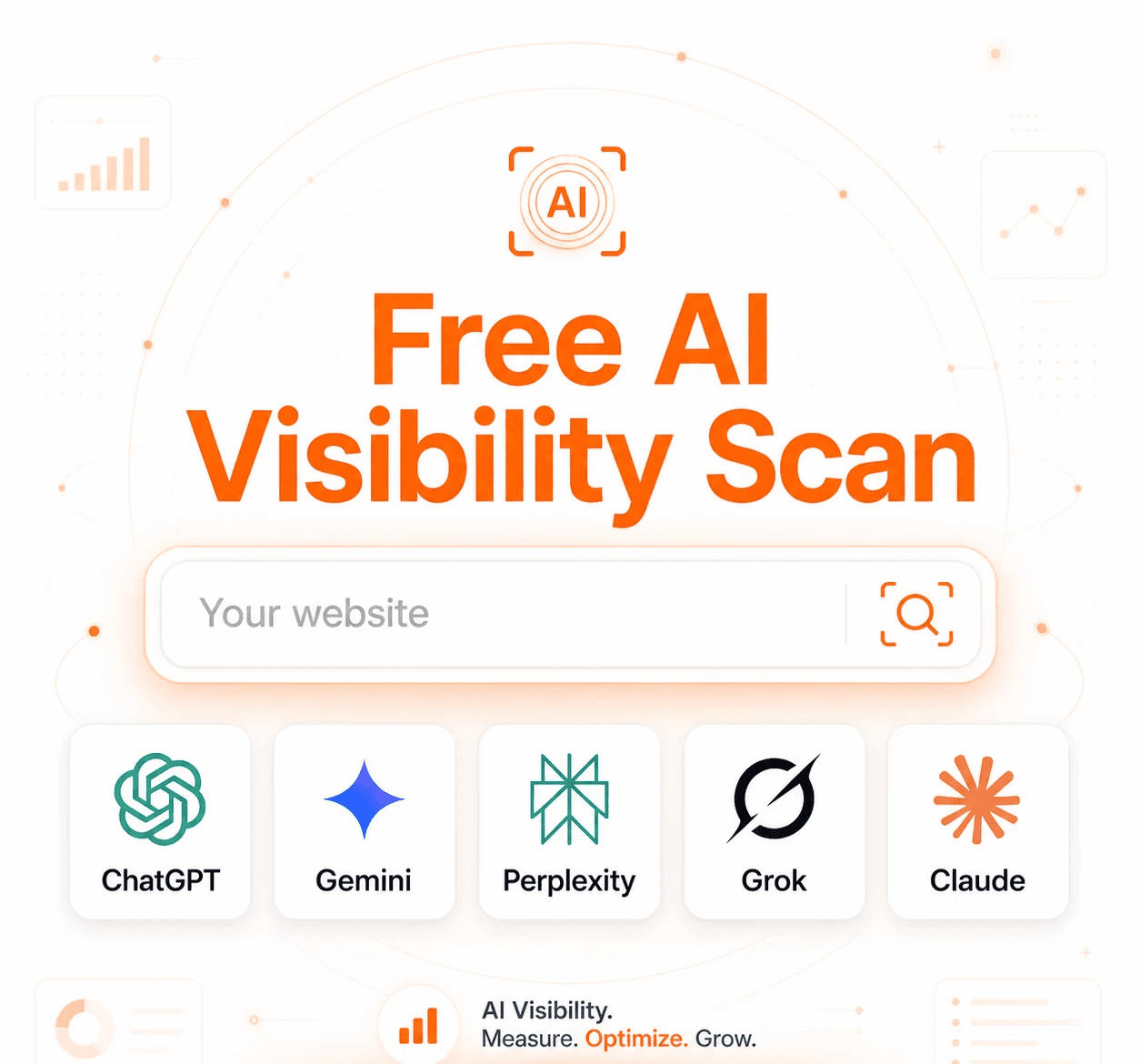
Is Your Brand Visible in AI Searches?
Free AI Visibility Audit → See where you appear (and where competitors appear).
Read More From Our Blog...
Best AI Tools for Increasing Visibility in LLMs 2026

Peec AI vs Keytomic (2026): Which AI Visibility Platform Is Better?

Top 10 best AI SEO tools for content automation in 2026

Start Getting Cited By Google
and AI Searches on Auto-Pilot


AI SEO agents research keywords, write & publish ranking content, track AI citations, and grow your brand visibility — while you focus on the business.


Trusted by 300+ users

4.5
Start Getting Cited By Google
and AI Searches on Auto-Pilot
Automate your SEO to rank faster, and showing up in AI search, without the guesswork.
Trusted by 300+ users
4.5
Start Getting Cited By Google
and AI Searches on Auto-Pilot
AI SEO agents research keywords, write & publish ranking content, track AI citations, and grow your brand visibility — while you focus on the business.
Trusted by 300+ users