You can't guarantee a position or citation in Google Gemini. To improve visibility, make your content crawlable, indexed, directly relevant to the questions people ask, easy to verify, and backed by clear entity and author signals.
Measure Gemini mentions and cited sources across a repeatable prompt set, and use Google Search Console for Google AI feature visibility where the report is available.
If your pages already rank in Google but you can't tell whether Google Gemini ever mentions your brand, you're flying blind. There's no tidy rank tracker for it, and that gap is easy to miss.
Here's the catch: "ranking in Gemini" can mean a source link, a brand mention, a recommendation, or visibility in Google AI Overviews. They're related, but they aren't the same outcome.
This guide walks through a practical Gemini SEO workflow: clarify the surface, build topical coverage, fix technical access, strengthen evidence, and measure prompts. Google's published guidance on AI features supports foundational SEO, unique content, and measurement, but it doesn't include a full Gemini citation formula. To understand how this sits within the broader shift from traditional SEO to AI answers, our guide on AEO vs SEO is a useful starting point.
Can you actually rank in Gemini?
Not in the way you rank on a results page. "Ranking" is shorthand for being shown, mentioned, or cited, and no official source promises a guaranteed position or citation for any of those. For a broader look at how to improve brand visibility in AI answers across platforms, that guide covers the cross-engine picture. If you're working on Gemini visibility specifically for a local business, our guide on AI visibility for local businesses covers the local-specific layer.
Gemini sources, Google AI Overviews, and Google Search are different surfaces
Gemini Help on related sources says sources and related links may appear for some responses, and those links aren't always the exact pages used to write the answer. Google AI Overviews and AI Mode live inside Google Search. For the Search side, see our Google AI Overviews visibility framework.
Surface | Visible outcome | Measurement method |
|---|---|---|
Gemini Apps | Answer text, sometimes source or related links | Repeatable prompt log |
Google AI Overviews | Generative summary in Search with links | Search Console generative AI report, where available |
Google AI Mode | Generative Search experience with links | Search Console generative AI report, where available |
Google Search | Ranked results | Search Console queries, clicks, positions |
Ranking, mentioning, recommending, and citing are not the same outcome
Ranking: your page's position in an ordered results list.
Mentioning: your brand is named in an answer, with or without a link.
Recommending: your brand is suggested as an option for the user's need.
Citing: your URL appears as a source.
What you can influence and what you cannot control
You can influence eligibility, relevance, evidence, and entity clarity. You can't control which model answers, which passage gets quoted, or how often competitors appear. That split is the backbone of any sensible Gemini SEO plan.
How does Gemini select information and sources?
Google hasn't published a complete formula for standalone Gemini source selection, so any "seven ranking factors" list is a guess. What Google documents applies to Search AI features; the rest is reasonable inference, and I'll label it that way.
Relevance to the prompt and the user's context
A page that answers the full question, including likely follow-ups, is more useful in an AI answer. Google's AI Search documentation discusses query fan-out, but I'd treat standalone Gemini behavior as a hypothesis.
Crawlability, indexability, and source availability
Crawlable, indexed pages are a prerequisite for Google Search features. That isn't proof that standalone Gemini retrieves every indexed page.
Reliability, freshness, entity clarity, and corroboration
Reliable sources, clear entities, and independent corroboration make claims easier to trust. Freshness may matter when a query depends on current information; it doesn't always win.
You can influence: crawl access, intent coverage, evidence quality, entity consistency, and measurement.
You can't control: model selection, the exact quoted passage, whether sources display, and competitor frequency.
Step 1: Build topical authority around the questions Gemini may expand
Start with the buyer's problem, then map the questions around it. A Gemini SEO plan built this way beats a pile of keyword variants, and it isn't about hitting a magic page count. For a deeper framework on building this kind of coverage, our complete guide to Generative Engine Optimization walks through the full approach.
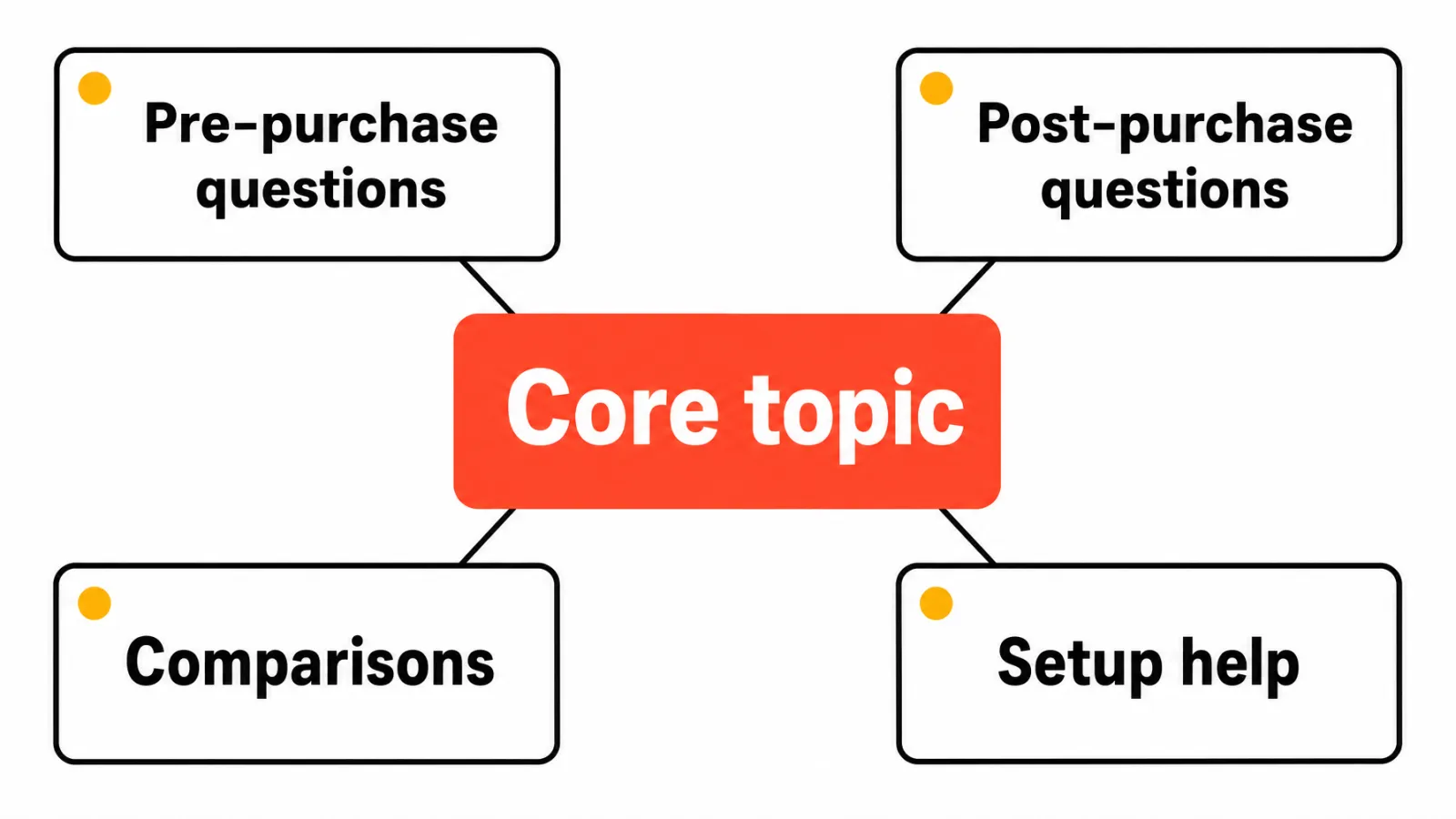
Map the core topic and follow-up questions
Here's an illustrative example (not a case study) for an invoicing app aimed at freelancers:
Name the core problem: sending invoices faster.
List pre-purchase questions (pricing, comparisons) and post-purchase ones (setup, integrations, troubleshooting).
Group overlapping wording under one intent.
Give a question its own URL only if it needs a full answer. Otherwise, a heading or a sentence is enough.
Connect supporting pages with useful internal links
Link each supporting page to its pillar and nearest siblings with descriptive anchors. Keytomic's semantic SEO automation page describes entity coverage, query fan-out, and answer-first structure, which is the kind of check worth running on any topic map.
Add original evidence instead of repeating common summaries
Google's AI search content guidance points to unique content and good page experience. Add what only you have: product data, process notes, and expert review. If you don't have it, don't fake it.
Step 2: Make each page easy to understand, quote, and verify
A page is easier to cite when a reader, or a retrieval system, can find the answer and check it fast. None of this is a trigger. It's good editing, and it's the core of Gemini SEO at the page level.
Answer the heading before adding context
Open each section with a one or two sentence answer, then add nuance. Define terms in plain words the first time they appear.
Put definitions, claims, comparisons, and procedures near their sources
Keep evidence next to the claim. Here's a before and after:
Vague: "Schema helps AI search."
Specific: "Google says no special schema is required for generative AI search, and markup must match visible content."
Use structured data only when it matches visible content
Google says there's no special schema requirement for its generative AI search features, and structured data must match visible content. For a full breakdown of how structured data intersects with AI visibility, that post covers what markup actually does and doesn't do in AI search. Use it for applicable Search features. Don't expect a markup type to earn AI citations.
Review AI-assisted drafts for accuracy and originality
Google's guidance on AI-generated content says AI assistance isn't automatically against its guidelines, but content made mainly to manipulate rankings is the concern. Treat E-E-A-T as a quality framework, not a switch. Before publishing, check that:
Every fact and number has a source.
A named author with a real profile is attached.
A human added analysis the draft didn't have.
Step 3: Fix technical access before chasing Gemini citations
Technical access is prerequisite hygiene for Google Search AI features, not a citation guarantee. Fix it first, because no amount of editing helps a page Google can't index. This is the least glamorous part of Gemini SEO, and it's often where the problem lives.
Check indexing, robots.txt, noindex, and nosnippet directives
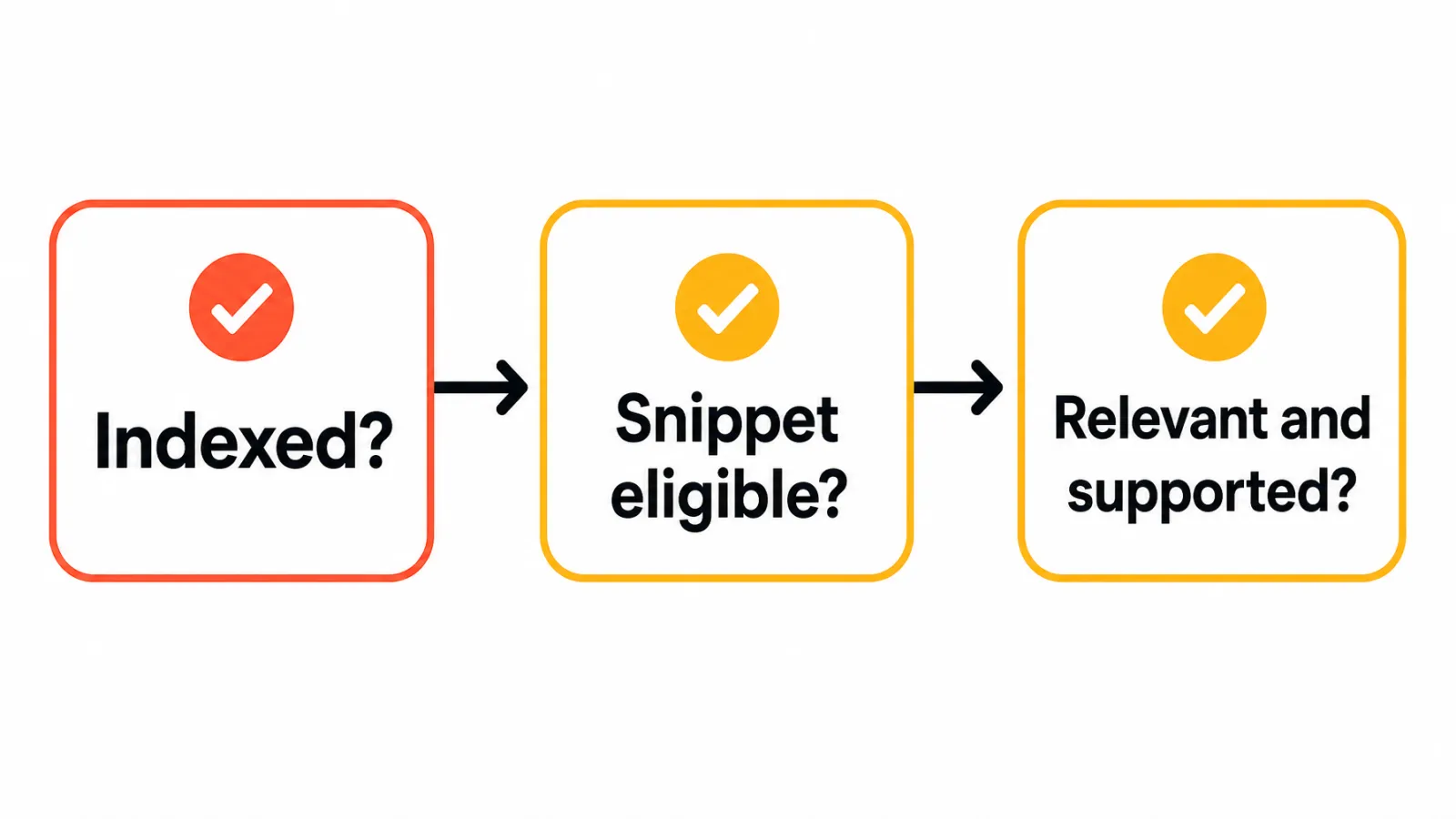
Work down this path:
Not indexed: check robots.txt blocks, noindex tags, and canonical conflicts.
Indexed with limited snippets: check nosnippet and max-snippet directives.
Indexed and snippet-eligible but never cited: move on to intent coverage and evidence.
Make the main content crawlable and renderable
Googlebot should see your main text in the rendered page, not behind scripts that fail. A technical SEO audit is where crawlability, indexability, and page diagnostics get checked across a site, and Search Console's URL Inspection covers single pages.
Strengthen canonical URLs, internal discovery, mobile usability, and page experience
Point each page to one canonical URL, list it in your sitemap, and link to it from related pages. Check mobile usability too, since Google's guidance covers page experience.
Step 4: Strengthen brand and entity consistency across the web
Entity consistency means a system can tell who you are, what you sell, and who it's for without guessing. It's a consistency problem, not a volume contest.
Keep names, descriptions, authors, and product facts consistent
One official brand name, spelled the same everywhere.
A one-sentence description reused on your site and profiles.
Authors tied to real profile pages.
Product facts visible on the page, not buried in PDFs.
Earn credible corroboration instead of manufacturing mentions
Reviews, partner pages, press, and directories help when they're real and relevant. Google's guidance includes a warning on inauthentic mentions, so don't buy or fake brand mentions.
Match external proof to the claim being made
If you claim a feature, point to the product page. If you claim a result, point to a documented study. A mention of your brand name doesn't prove a claim it never makes.
How do you measure whether Gemini mentions or cites your brand?
Use a repeatable prompt set with the AI Visibility Tracker, and treat manual results as directional. They vary by session, location, device, query, and model state.
Build a repeatable prompt set
Track 10 to 30 real prompts across category, problem, comparison, branded, and follow-up intent. Log each run like this:
Prompt | Date | Location | Device | Surface | Brand mention | Cited source | Competitor | Landing page | Conversion signal |
|---|---|---|---|---|---|---|---|---|---|
Example prompt | Run date | City or country | Desktop or mobile | Gemini App | Yes or no | URL shown | Brands named | Your page | Signup, demo, or none |
Keytomic's AI Visibility Tracker handles this prompt monitoring automatically — tracking brand mentions, cited sources, competitors, and trends across Gemini and other AI platforms on a schedule. For a full breakdown of how to build and interpret this kind of data, see our guide on LLM citation tracking.
Separate impressions, mentions, citations, clicks, and conversions
Keep these apart in your reporting:
Impressions: times a result or AI feature was shown. Search Console's generative AI performance reports cover Google Search AI features, not every standalone Gemini response.
Mentions: your brand is named in an answer.
Citations: your URL appears as a source.
Clicks and conversions: visits from those links and the business actions that follow.
Compare results over time without treating one prompt as a trend
Re-run the full set on a schedule and compare against your baseline. One flattering answer isn't a trend, and Gemini SEO reporting only works when the method stays the same. Our roundup of AI visibility monitoring tools covers your options if you're evaluating what to use.
Common mistakes that limit Gemini visibility
Most of these come from treating AI search optimization as a shortcut. Here's what to fix, with the correction for each.
Treating Gemini like a normal rank tracker
There's no stable position to track. Log mentions, citations, and context instead.
Publishing unsupported or generic AI summaries
Thin pages at scale can run into Google's spam policies on scaled content abuse, and they give nobody anything to cite. Add original evidence and human review first.
Using schema, llms.txt, or formatting as a shortcut
Google says there's no special schema requirement, and Google Search ignores llms.txt for visibility. Don't generalize that to every AI system, but don't count on it as a lever either. Keyword stuffing belongs in this pile too.
Measuring one prompt and calling it a result
Run the whole set on a schedule. Good Gemini SEO is ongoing work, not a one-time task.
Frequently asked questions about ranking in Gemini
Can you guarantee a ranking or citation in Gemini?
No, no publisher or SEO platform can guarantee a Gemini ranking or citation. You can improve eligibility, relevance, source clarity, and measurement.
Is Gemini SEO different from Google SEO?
Gemini visibility builds on many traditional SEO foundations, but the visible outcome and measurement differ. Gemini Apps show answers with occasional sources; Google Search shows ranked results.
Does ranking number one on Google guarantee a Gemini citation?
No, a top Google ranking does not guarantee a Gemini citation. Ranking and citation are related but separate observations, so track both.
Does structured data make Gemini cite a page?
No, structured data is not a guaranteed Gemini citation trigger. Use it to describe visible content accurately and support applicable Search features.
Does llms.txt help a site rank in Gemini?
Google says llms.txt is not required for Google Search or its generative AI features. That doesn't settle behavior for every standalone AI system.
How long does it take to improve Gemini visibility?
There is no universal timeline for Gemini visibility. Fix eligibility first, then measure repeated prompts against a baseline.
Can a page appear in Google AI Overviews without ranking first?
Possibly, because Google requires eligibility but doesn't say first position guarantees inclusion. This applies to Google Search AI features, not standalone Gemini.
How can I track whether Gemini mentions my brand?
Use a repeatable prompt set and record mentions, cited sources, competitors, dates, and context. Search Console covers Google AI features; Keytomic's AI Visibility Tracker offers scheduled prompt monitoring across Gemini and other AI platforms.
Can Keytomic guarantee Gemini rankings or citations?
No, Keytomic cannot guarantee rankings, citations, or recommendations. It supports research, content, publishing, technical, and visibility-monitoring workflows.
Choose your next Gemini visibility action
Pick the bottleneck, not the tactic. The goal of Gemini SEO is a repeatable workflow, not a promised placement.
Not indexed: fix crawlability, indexability, canonical, and snippet directives first.
Indexed but not relevant: rewrite the opening, headings, and query coverage around the full question.
Relevant but weakly supported: add original evidence, author accountability, citations, and consistent entity information.
No baseline: build a controlled prompt set and measure over time.
The most useful thing you can do for Gemini visibility right now is build a repeatable prompt set and start logging. From there, you'll know whether the gap is access, relevance, or evidence — and each one has a clear fix. Keytomic's AI Visibility Tracker connects that measurement loop to the content and technical work it points to, so findings don't stall in a spreadsheet. If you want to see the full workflow in action, the Keytomic demo walks through it step by step.