Short answer: If you want a BabyLoveGrowth alternative that keeps research, content, publishing, audits and AI visibility in one place but gives you more control over what goes live, start with Keytomic. If you only want hands-off daily articles, RankYak and Outrank are the closest matches. Search Atlas suits agencies, and Alli AI suits technical SEO work.
Before writing it, we started a BabyLoveGrowth trial on our own site. We read the article it wrote for us, tested its keyword controls, and checked its audit, backlink and AI visibility screens. Then we read every 1, 2 and 3-star review on Trustpilot to find out why people actually leave.
Some of what we found backs up the complaints. Some of it doesn't. Both shape the list below.
What We Found When We Tested BabyLoveGrowth
We went in expecting a free tier to play with. There isn't one.
The onboarding is genuinely fast
Credit where it's due. The setup is seven steps and most of them fill themselves in.
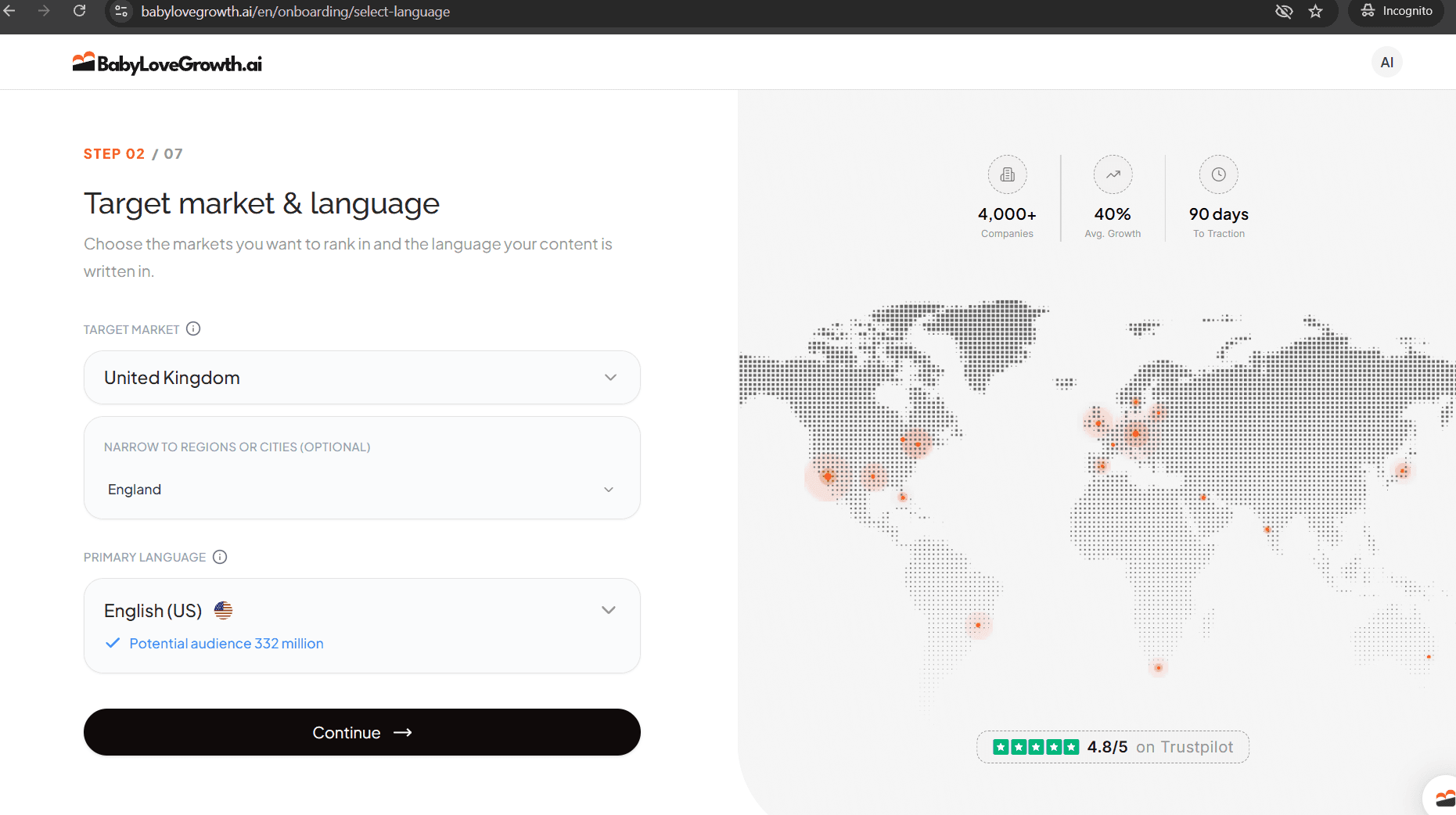
When we entered our domain, it detected our CMS (Framer) on its own. Step two set the market to "Global" and the language to English (US) by default.
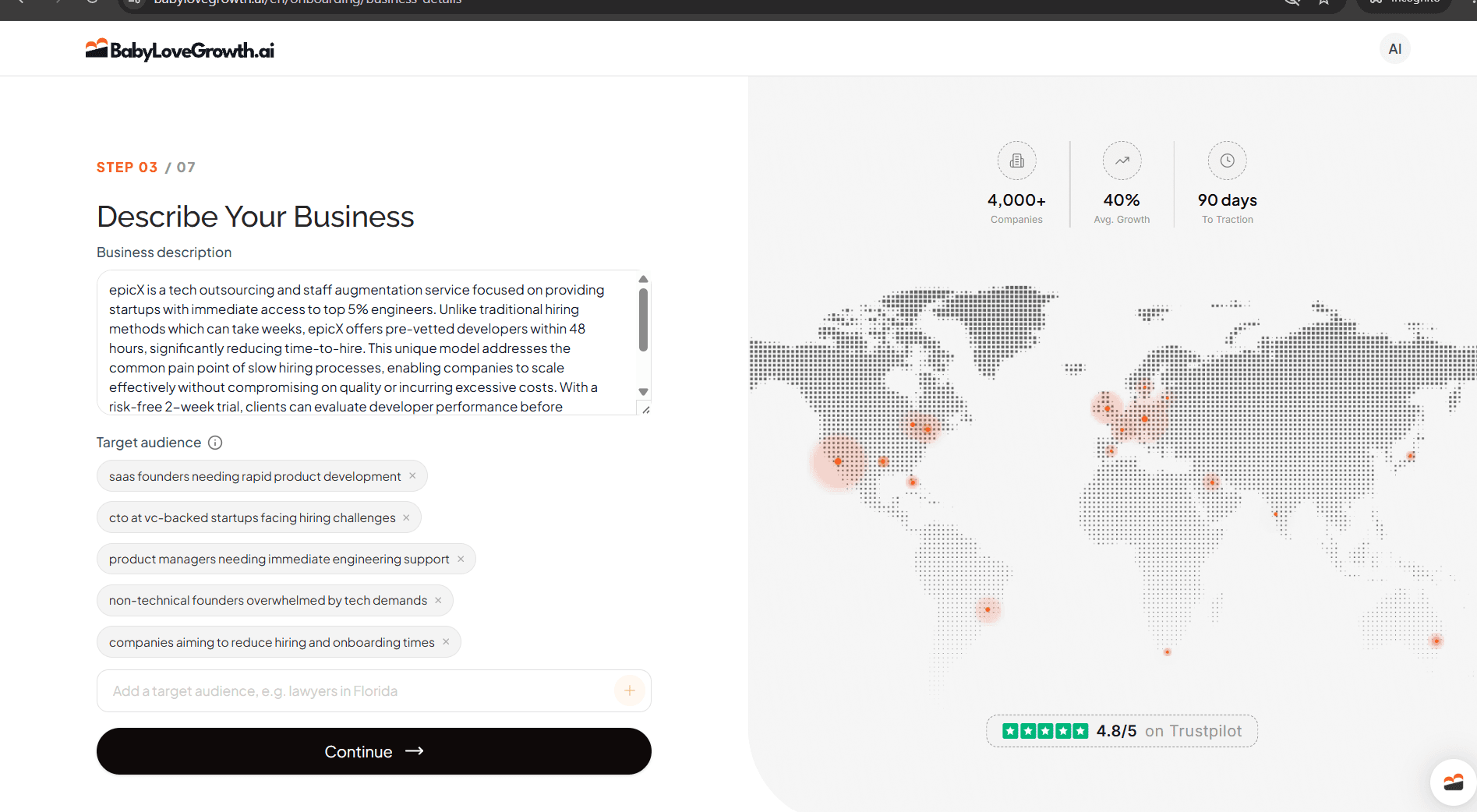
Step three wrote a business description for us and added four audience tags. It was accurate enough to use as is.
Step four picked four competitors automatically. Step five pulled our brand colors and asked us to choose an article cover style. Step six asked for Google Search Console, which you can skip.
If speed to first article is all you care about, this part is hard to fault.
Then you hit the paywall
Step seven is the plan page. Nothing in the product is reachable until you activate a plan.
We tried going straight to the dashboard URL. It sent us back to step one of onboarding.
So the "3-day free trial" is a trial of a paid plan you have to activate first. You can't look around the dashboard, read a sample article or see the keyword plan before that point.
The price you see first is the yearly price
This is the detail most comparison posts miss.
The plan page loads with the "Pay yearly" toggle already switched on. That's why the big number reads $49/month, next to a struck-through $247.
When we switched the toggle off, the price changed to $99/month, billed monthly.

Neither number is hidden. But if you skim, you could easily commit to a full year thinking you're paying $49 a month for a month.
The preview panel also showed a mock ChatGPT answer recommending our own brand first. That's an illustration of the goal, not a measurement, so don't read it as a prediction.
Inside the 3-Day Trial: What We Saw on Our Own Site
Once we activated the trial, the dashboard still stayed locked for a while. A progress bar sat at "6 of 7 complete" on the final step, building the 30-day content plan, for roughly 10 minutes after its timer read "0 minutes left." Only then did Blog content, Backlinks, Site health and AI visibility open up.
Here is what each part showed.
The article was better than the reviews suggest

Its first article for us was a 2,311-word how-to on automating SEO reporting. It had a TL;DR, a table of contents, two data tables, a sources section, 11 external links and 10 internal links to real pages on our site. Honestly, it read better than "junk."
But three things would have stopped us publishing it as is:
It invented a first-person voice. A "Perspective" section is written as if from our team ("That is the reason we built Keytomic...") and signed with a real team member's first name, taken from the account. Nobody on our side said any of it.
It stated our pricing. It quoted plan names and prices for us that we'd have to verify line by line before publishing.
It leaned on single-source stats. One AI citation figure came from a single practitioner write-up.

That's the real editing cost. The prose is fine. The claims and the voice need checking every time.
On the trial, each article also ends with a "Made with BabyLoveGrowth" attribution line. Activating the subscription removes it, or you can delete it by hand in the editor.
There's also a small prompt under each article offering a backlink credit in exchange for rating it. Given the Trustpilot warning below, we noticed that.
The topic plan overlapped with pages we already have

The calendar queued 29 topics. Several targeted keywords with 10 to 30 searches a month.
More importantly, at least three overlapped with content already on our site or already in our own calendar: automating SEO reporting, SEO client reporting and AI search ranking. The generated article even linked to our existing reporting post, so it knew the page was there.
BabyLoveGrowth says it filters out keywords your site already covers to prevent cannibalization. In our test, that filter didn't catch these.
Keyword control is clearer now, but still opaque

We added three keywords of our own. The tool now shows a summary, which fixes part of the "my keywords disappeared" complaint.
Two became articles. But they were scheduled a month out, on November 22 and 23, behind the 29 queued topics.
The third, "seo automation software," never made it. It gets around 720 searches a month and is a core term for us. The first time, the tool said it wasn't strong enough to become an article. When we added it again later, it said the keyword didn't match our business profile.
Same keyword, two different reasons, and neither is the likely real one: we already rank for it. There's now an option to add a filtered keyword anyway, which helps. But you still can't see why something was actually dropped.
The audit only covers one page on the trial

Site health gave us a score of 54, with Page Speed 48, LLM Optimization 55 and Technical SEO 55. It flagged 38 issues on the homepage and suggested adding an llms.txt file.
The rows below the homepage are blurred placeholders. The trial scans one page only, and checks repeat weekly.
Backlinks run on credits, and the credits come from your articles
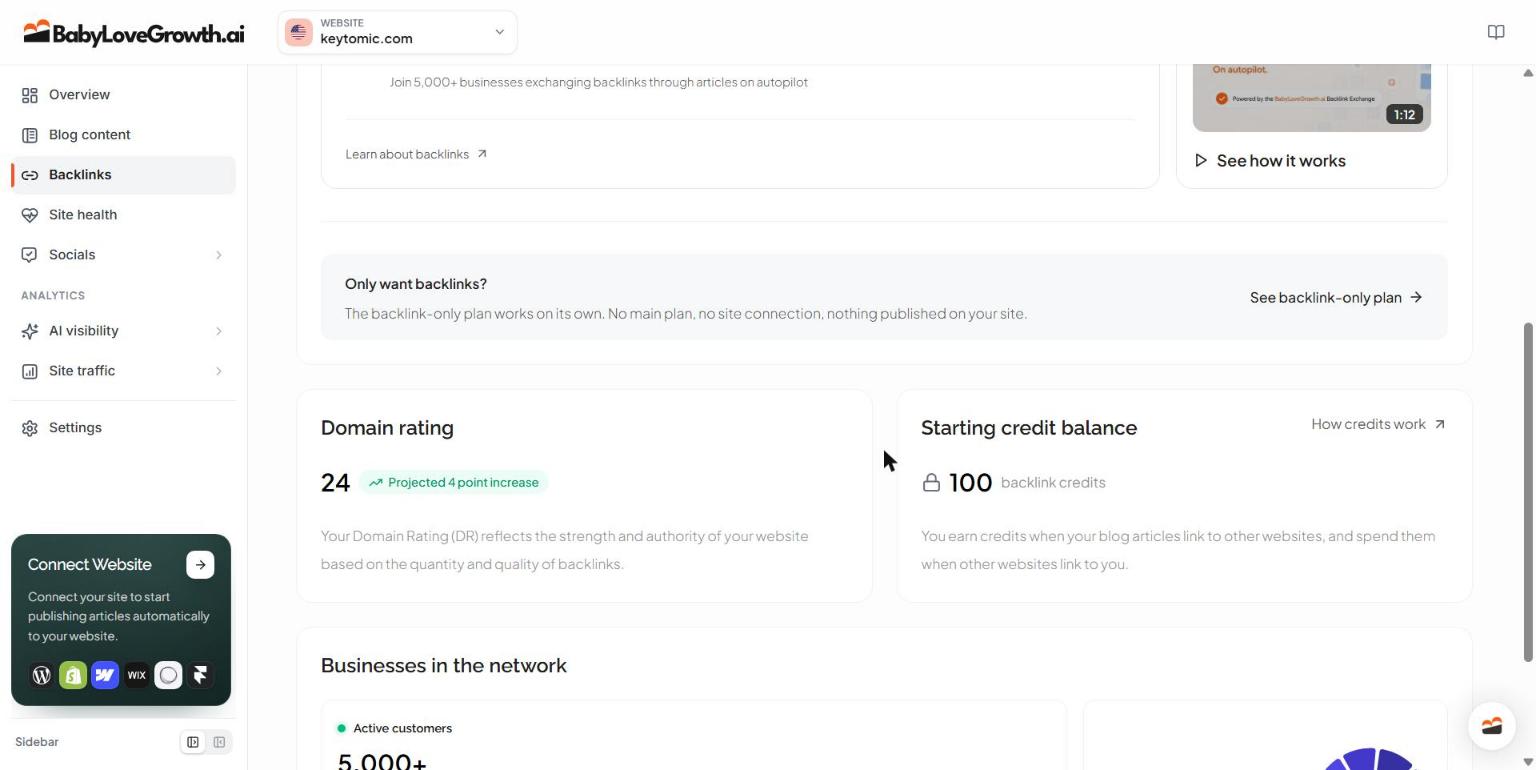
We started with 100 backlink credits. The page explains that you earn credits when your articles link out to other sites in the network, and spend them when those sites link back to you.
In plain terms, the articles published on your blog carry outbound links to network members. That's the exchange. Decide whether you're comfortable with that before you connect your site.
AI visibility gave a useful baseline
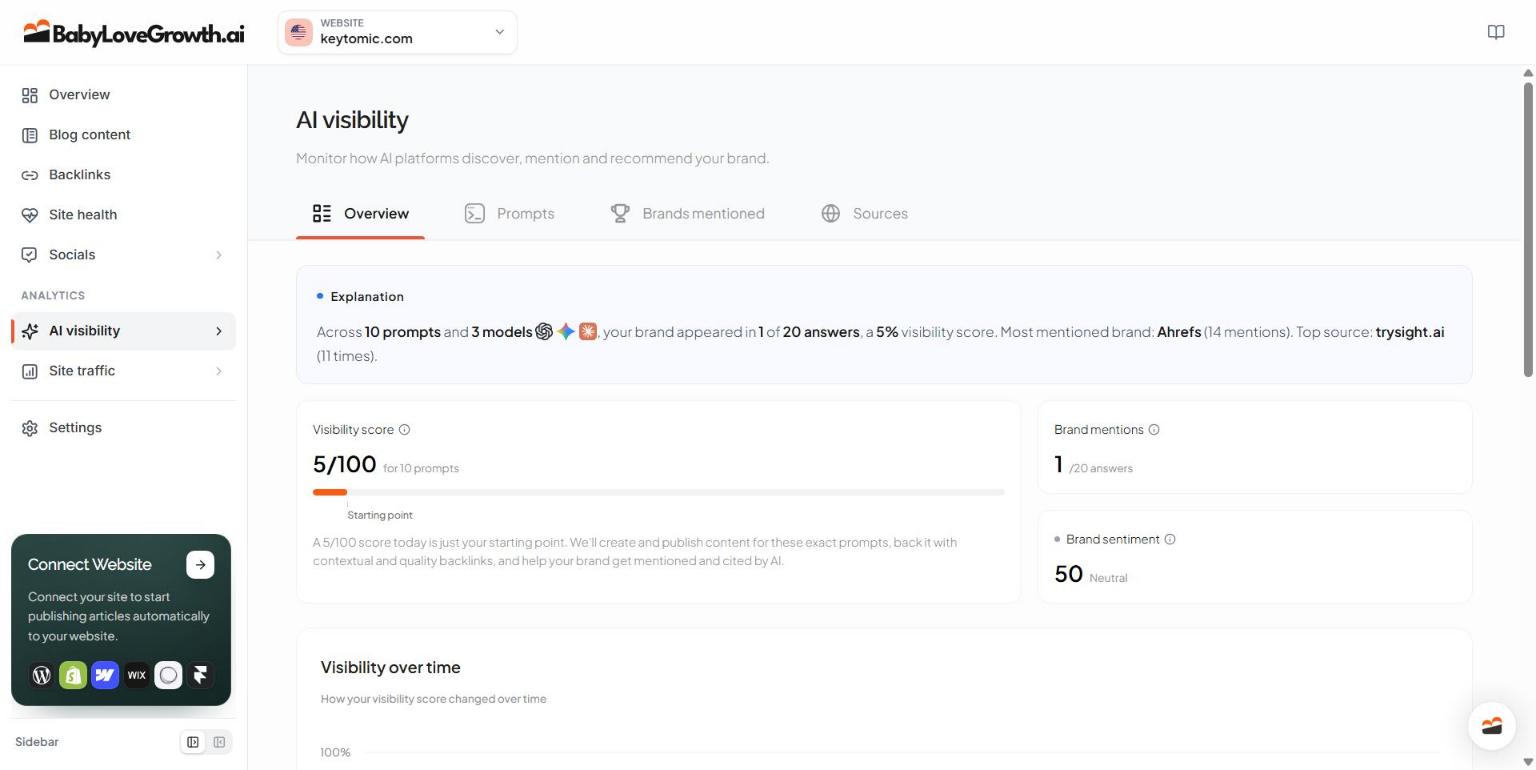
Across 10 prompts, we appeared in 1 of 20 answers, a 5% visibility score. The tool listed which brands appeared instead of us and which sites AI models cited most.
One detail didn't add up. The summary said 10 prompts across 3 models, which should mean 30 answers, but it reported 20.
Settings worth knowing about
The writing settings are more detailed than we expected. You can add custom rules, pick a length band and a citation region, and toggle a TOC, TL;DR, schema and internal links.
Two defaults are worth checking: articles generate every day of the week, and "Mention competitors when relevant" is switched on.
Cancelling the trial was simple from our side. A "Cancel free trial" button sits right on the Subscription page, which showed a $99 charge due when our trial ends.
Why People Look for BabyLoveGrowth Alternatives
Here is the part that surprised us most.

At the time of writing, Trustpilot does not show a rating for BabyLoveGrowth at all. Its profile carries a warning that the company has been offering incentives for reviews, which breaches Trustpilot's guidelines.
That matters because the profile shows 209 reviews, and 85% of them are 5-star. With an incentive warning attached, we treated the critical reviews as the more useful signal and read all of them.
The complaints fall into six clear patterns.
1. The articles need more editing than expected
This is the most common complaint. One reviewer said fixing the daily posts into something meaningful would take them every single day. Another called the output junk, and a third removed the generated posts from their blog after two months.
Our test suggests the problem is less about prose and more about what the article claims. If you have to fact-check every article, you're paying for a first draft, not automation.
2. Results don't show up
Several long-term users reported little to nothing after months of use. One reviewer said they gained zero visibility after four months. Another reported one visit from LLM search in eight months.
SEO is slow, and the company makes that point in its replies. But these are four and eight month timelines, well past a fair test window.

3. You don't fully control the keywords
A 3-star reviewer added around 30 keywords of their own, then couldn't find them again. Support couldn't explain it for two weeks.
BabyLoveGrowth's founder replied that keywords may be dropped when your site already gets impressions for them, to avoid cannibalization. The tool now shows an upload summary, as we saw. But as our own test showed, the stated reason for dropping a keyword doesn't always match the real one.
4. Backlinks go to the wrong pages, or come from weak sites
The same reviewer noticed internal backlinks pointing to old URLs they'd forgotten existed. The company explained the system pulls from everything in your sitemap, including dead pages.
Another reviewer said they were placed on low-authority sites, and one 1-star review waited a long time for a backlink that never came.
For a bundle that leads with "$800+/mo in backlinks," this is the part buyers should test hardest. Our backlink profile audit page explains what to check before you trust any link network.
5. Support is slow, and replies often say "we can't find your account"
Many critical reviews mention slow or missing support. In the company's own public replies, a recurring line is that it couldn't locate an account under the reviewer's name.
6. Billing and cancellation feel sticky
One reviewer described at least six screens trying to keep them from cancelling. Another said an extra purchase went through with a single click; the company replied it was an accidental purchase of an add-on.
To be fair, cancelling the trial looked simple in our account. But combined with a plan page that defaults to yearly billing, it's easy to see why some people feel boxed in.
BabyLoveGrowth Alternatives at a Glance
Tool | Best for | What it fixes vs BabyLoveGrowth | Watch out for |
|---|---|---|---|
Keytomic | Teams that want one connected workflow with review gates | Approval before publishing, visible keyword plan, audits, AI visibility and Reddit agent in one place | Credit limits on each plan; human review still needed |
RankYak | Small sites that want daily posts on autopilot | Narrower bundle, drafts can be reviewed first | Priced per site, so cost grows fast across many sites |
Outrank | Founders who want volume and many languages | Single plan, unlimited users | No AI citation tracking; backlink exchange model still applies |
Search Atlas | Agencies running many client projects | Far broader SEO suite and reporting | Plan structure is complex; overkill for one site |
Alli AI | Technical and on-page fixes at scale | Bulk on-page changes and schema | Not an article writer or content planner |
The 5 Best BabyLoveGrowth Alternatives
1. Keytomic
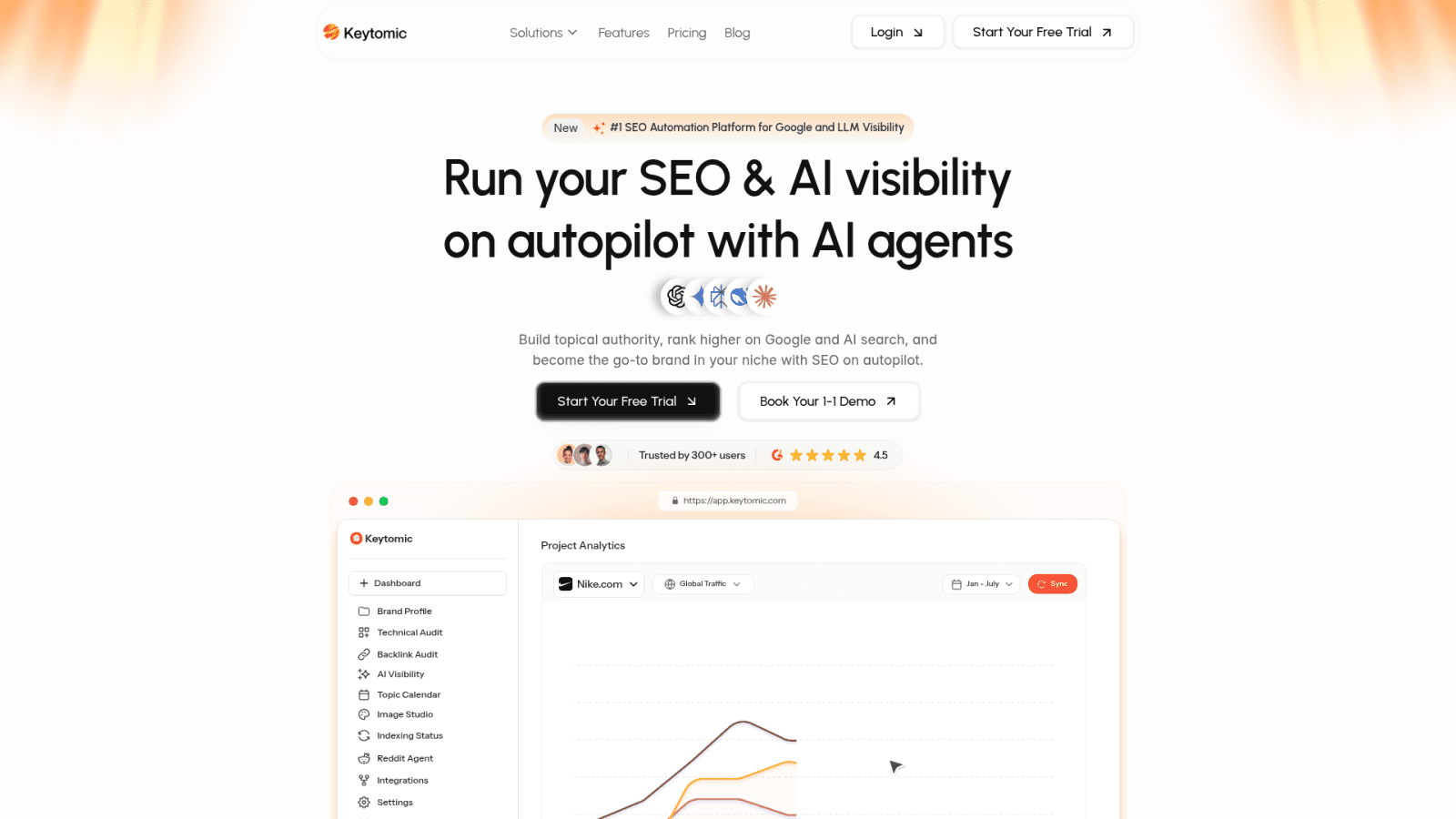
Keytomic covers the same jobs BabyLoveGrowth sells, but it's built around approval rather than autopilot. That directly targets complaints 1, 3 and 4 above, and the topic overlap we saw in our own trial.
Here is how it maps to the problems we found:
Keyword control. AI keyword research feeds a topical map and a content calendar you can see and edit. Keywords don't vanish quietly.
Content you review first. The AI blog writer drafts into a calendar, and you approve before autoblog publishing pushes anything live.
Site health. A technical SEO audit and backlink profile audit show which pages and links are actually worth pointing at.
AI search. The AI visibility tracker monitors how your brand shows up in AI answers, and a Reddit AI agent covers the community side.
Indexing. Multi search engine indexing pushes new pages to search engines instead of waiting for a crawl.
It publishes to WordPress, Shopify, Webflow, Framer, Notion, Next.js and more. See the full integrations list. There's also an MCP server if you'd rather run SEO from Claude or ChatGPT.
Pricing: the Pro plan was listed at $99/month with 30 blog credits when we checked in October 2026. Confirm current limits on the Keytomic pricing page, or start a trial.
Best for: founders, lean marketing teams and agencies that want automation without giving up the final say.
Limitation: credits cap output, and you still need a human pass on facts and claims. That's by design, not a workaround.
For a feature-by-feature breakdown, read our BabyLoveGrowth vs Keytomic comparison or the Keytomic vs BabyLoveGrowth page.
2. RankYak
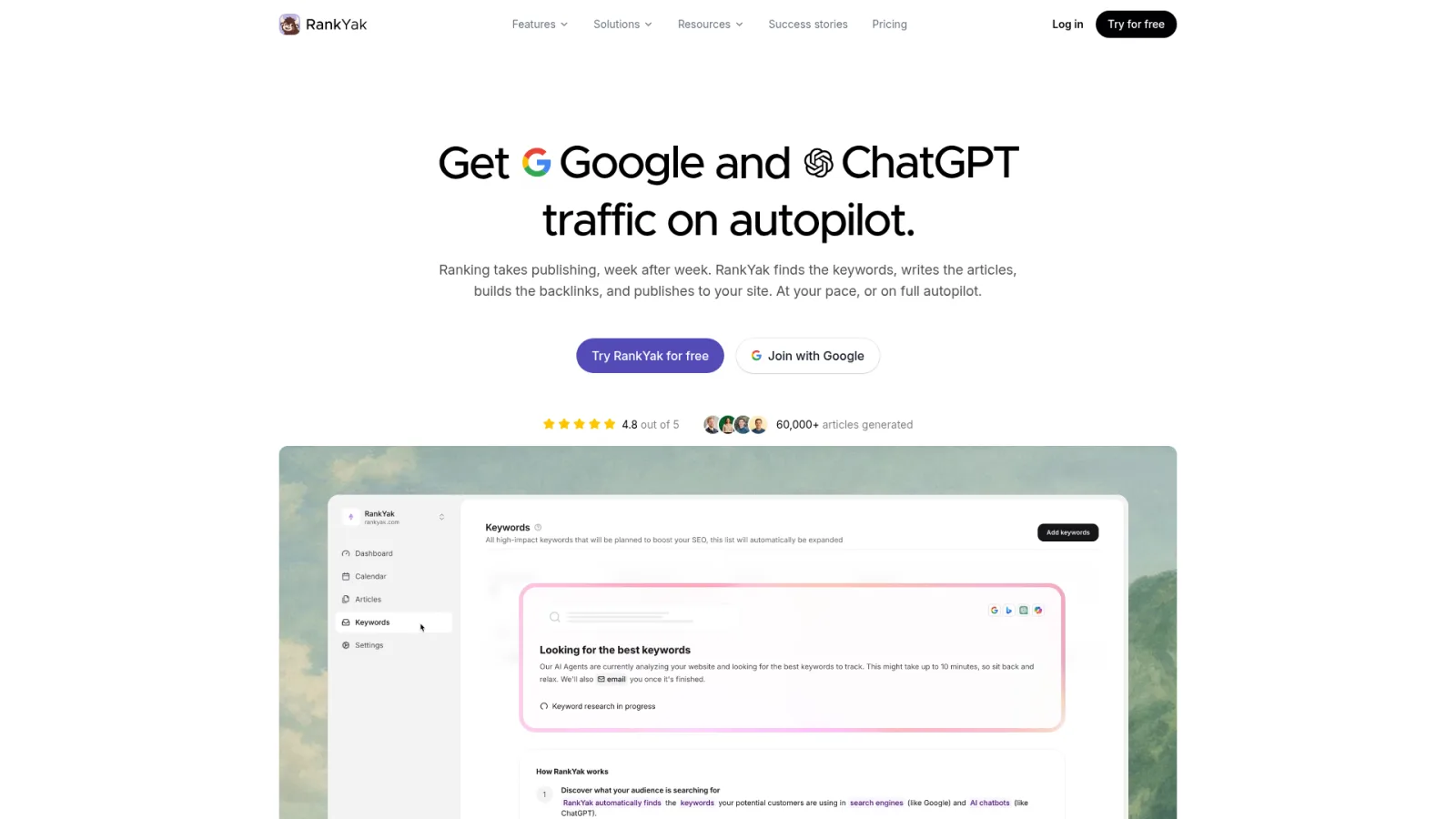
RankYak is the closest like-for-like swap. It does keyword research, a daily content plan, one article a day, CMS auto-publishing and a backlink exchange.
What it leaves out is most of the bundle: no AI citation tracking and no Reddit agent. If those extras were never why you signed up, that's a plus. It also lets articles land as drafts you review first, which helps with complaint 1.
Pricing: $99 per site per month. Five client sites means about $495 a month before add-ons.
Best for: single-site owners and small businesses that want a steady cadence.
Watch out for: it still runs a backlink exchange, so complaint 4 doesn't fully go away. See how it stacks up in our Keytomic vs RankYak comparison.
3. Outrank
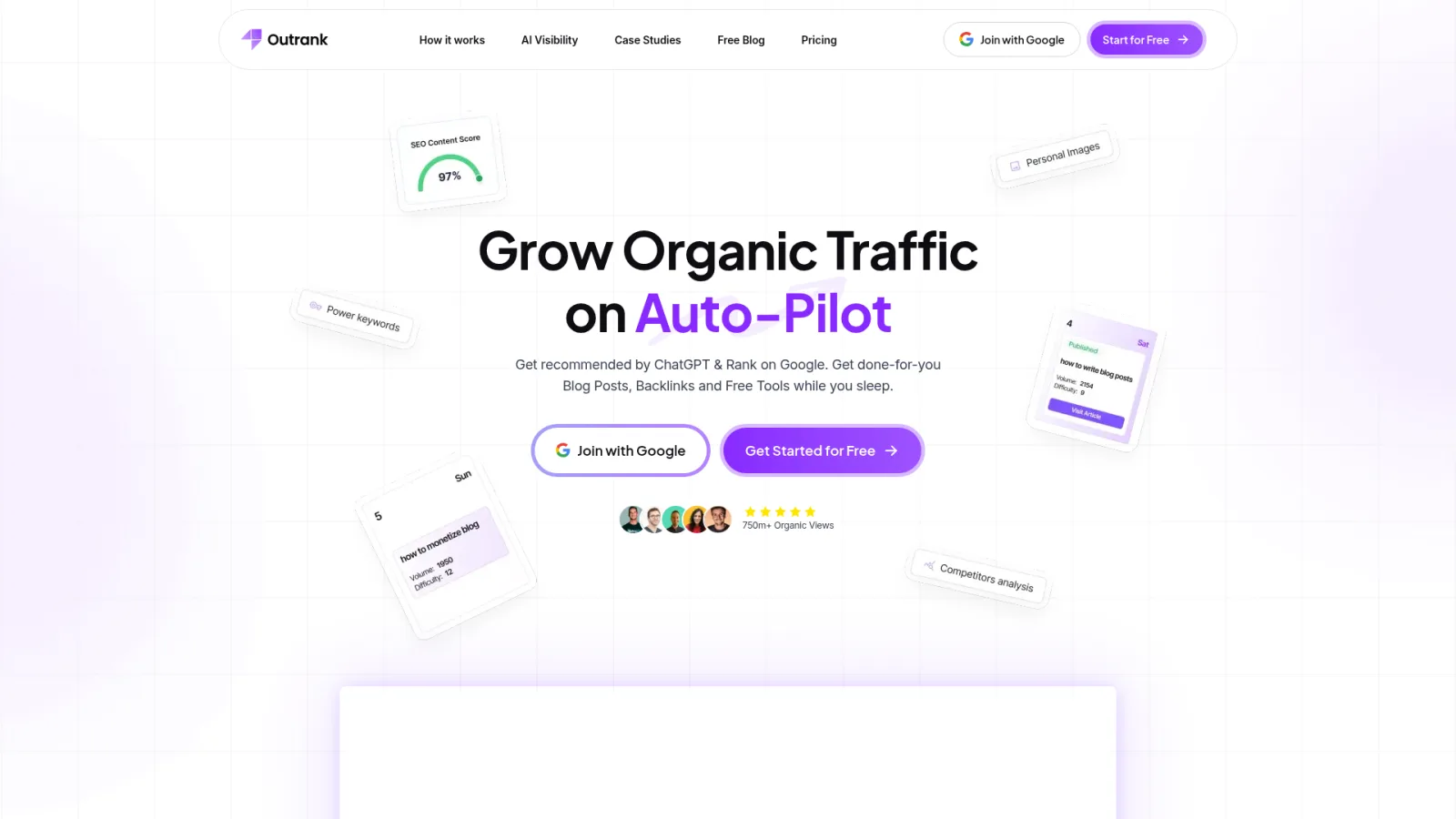
Outrank is the product BabyLoveGrowth gets compared to most. Same buyer, same 30 articles, same $99 on monthly billing, and link building on both sides.
The difference is the shape of the plan. Outrank sells one plan with unlimited users and 150+ languages, then charges for extra volume as add-ons.
Pricing: $99/month for 30 articles.
Best for: founders and multilingual sites that want output volume.
Watch out for: no AI citation tracking, and you'll want to decide how much pre-publish review your content needs. Read our Outrank vs Keytomic breakdown or the full list of Outrank alternatives.
4. Search Atlas

Search Atlas is a different category: a full SEO suite rather than an autoblogger. It combines OTTO SEO automation, Content Genius, AI visibility tracking, local SEO and white-label reporting.
That's a lot more than BabyLoveGrowth offers, and a lot more to learn.
Pricing: Starter, Growth, Pro and Agency tiers, split by projects, seats and credits. Check whether a price is shown monthly or annually before comparing.
Best for: agencies that need reporting and many client projects in one place.
Watch out for: plan matching takes real effort, and a single site won't use most of it. Our full Search Atlas review and Keytomic vs Search Atlas page go deeper.
5. Alli AI
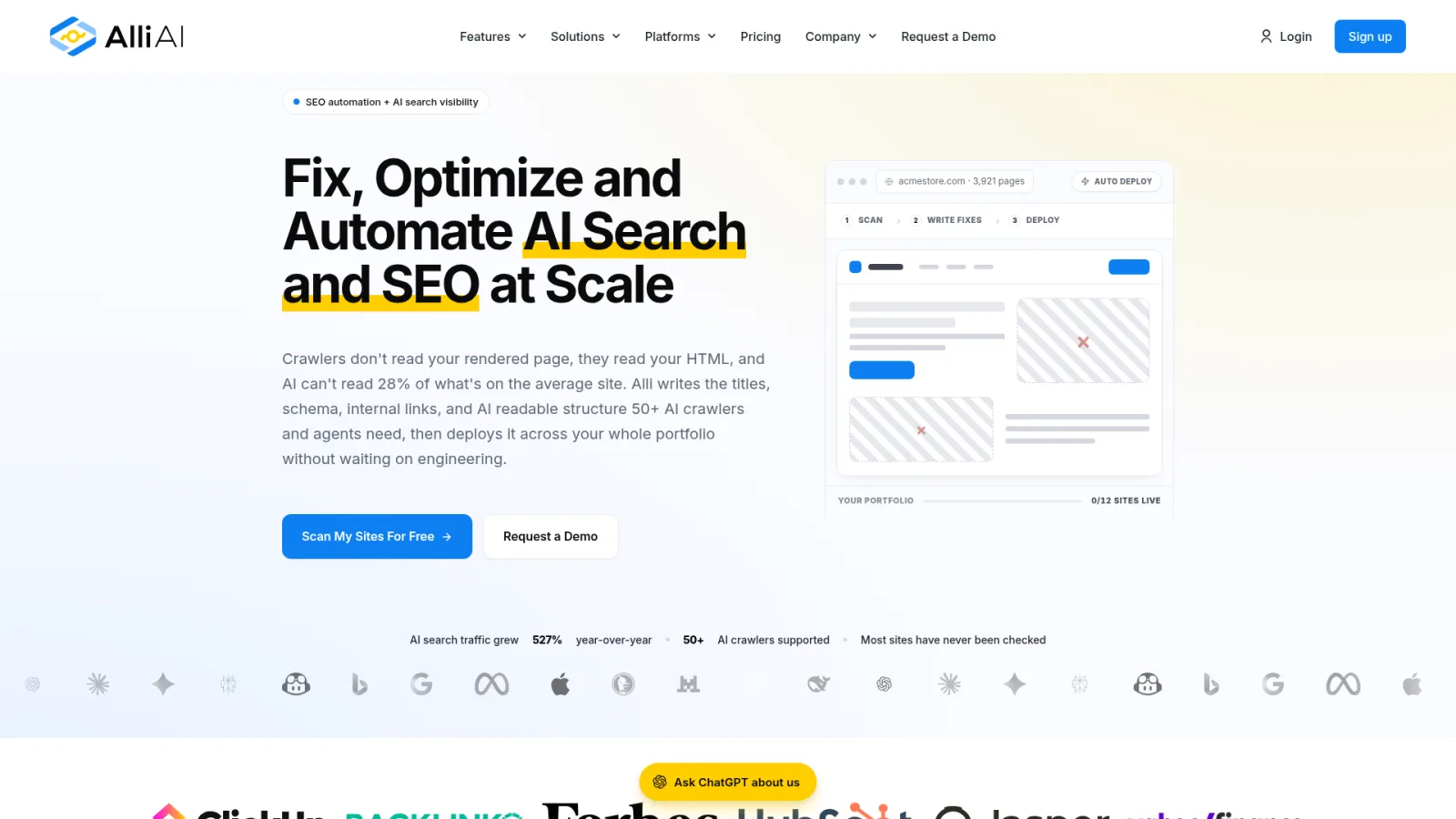
Alli AI is the pick if BabyLoveGrowth's site audit was the part you valued and the articles weren't.
It focuses on technical and on-page automation: bulk on-page changes, schema deployment and site-wide fixes across many pages, plus some AI visibility features.
Pricing: Business, Agency and Enterprise plans, limited by sites, pages and keywords.
Best for: agencies and technical teams managing several sites.
Watch out for: it doesn't plan or write articles, so pair it with a content tool. See the Keytomic vs Alli AI comparison.
How to Pick the Right Alternative
Start from the complaint that made you look, not the feature list.
If your main problem with BabyLoveGrowth was | Look first at | Test this during the trial |
|---|---|---|
Articles needing heavy edits | Keytomic | Approve 3 drafts and time your fact-checks |
Not knowing which keywords it targets | Keytomic | Open the plan and add your own keywords |
Topics overlapping with pages you already have | Keytomic | Compare the plan against your sitemap |
Wanting the same autopilot, just cheaper or simpler | RankYak, Outrank | Draft vs live publishing setting |
Backlink quality worries | Keytomic, Alli AI | Audit your current links before switching |
Managing many client sites | Search Atlas, Keytomic | Cost per extra site or project |
A few more checks are worth doing whichever tool you choose:
Check the billing toggle. Before paying anywhere, confirm whether the price shown is monthly or yearly.
Read the first article for claims, not prose. Look for invented quotes, first-person stories and pricing you never supplied.
Compare the topic plan to your sitemap. Overlap with existing pages is cannibalization waiting to happen.
Clean your sitemap first. Old URLs in your sitemap end up in internal links, as one BabyLoveGrowth user found out.
Audit before and after. Run a free broken link check and a technical audit so you can see what the new tool changes.
If you're still deciding between tool types, our guides on how to choose SEO automation tools and automated vs manual SEO help frame it. For a wider shortlist, see our roundup of SEO automation software.
Frequently Asked Questions
Does BabyLoveGrowth have a free plan?
No, it doesn't. The dashboard stays locked until you activate a paid plan. The 3-day trial starts only after activation, and our account showed a $99 charge due when the trial ends.
Is BabyLoveGrowth $49 or $99 a month?
Both. $49/month is the yearly rate, billed up front. $99/month is the month-to-month rate. The plan page loads with yearly billing selected.
Are BabyLoveGrowth articles good?
The writing itself was solid in our test, with sources, tables and internal links. The risk is in the claims: our first article invented a first-person section in our team's voice and quoted pricing we'd need to verify.
Why does BabyLoveGrowth have no Trustpilot rating?
At the time of writing, Trustpilot shows a warning that the company has been offering incentives for reviews, and the rating is hidden because of it.
How do BabyLoveGrowth backlinks work?
Through credits. You earn credits when articles on your site link out to other network members, and spend them when those sites link to you. The trial started us with 100 credits.
What is the closest alternative to BabyLoveGrowth?
RankYak and Outrank are the closest in shape: about 30 auto-published articles a month for $99 with a backlink feature. Keytomic is the closest if you want the full bundle with approval steps.
Is there a BabyLoveGrowth alternative with AI visibility tracking?
Yes. Keytomic and Search Atlas both include it. Our list of AI visibility tools covers dedicated trackers too, and you can try our free AI visibility tracker.
Are link exchange networks safe?
It depends on how they work. Google's spam policies treat excessive link exchanges as link spam, and any penalty lands on your domain, not the network's. Review where links come from before you rely on them.
Can any tool guarantee rankings or AI citations?
No, none can. Treat any guarantee as a refund policy, not a forecast.
So, Which Way Are You Leaning?
After running BabyLoveGrowth on our own site and reading what its unhappy users say, the pattern is clear. The tool isn't lazy. It writes a lot, plans a lot and links a lot.
People leave because they can't see or control enough of what it's doing: which topics it picks, why a keyword got dropped, what an article claims in their name, and where their links go.
So the real question isn't which tool has the longest feature list.
It's this: how much of your site are you comfortable letting software publish without you looking first?