TL;DR
The best LLM visibility tool depends on whether you need simple monitoring, enterprise intelligence, broad prompt discovery or a workflow that helps you act on visibility gaps.
Keytomic: Best for SMBs that want AI visibility monitoring connected to keyword research, content planning, publishing and indexing.
Profound: Best for enterprises needing deep answer-engine, citation and competitive intelligence.
Otterly.AI: Best affordable standalone option for recurring prompt monitoring.
Peec AI: Best for marketing teams that want straightforward AI visibility analytics.
Ahrefs Brand Radar: Best for large-scale, search-backed prompt and competitor discovery.
Semrush AI Visibility Toolkit: Best for teams already using Semrush.
Writesonic: Best for connecting AI visibility findings to content creation and optimisation.
Scrunch: Best for enterprise teams monitoring visibility, citations, agent traffic and broader AI customer journeys.
Traditional rank trackers can tell you whether a page ranks in Google.
They cannot fully tell you whether ChatGPT recommends your company, whether Perplexity cites your website, or whether Gemini describes a competitor more favourably than your brand.
That is the role of an LLM visibility tool.
These platforms repeatedly run relevant prompts across AI search and answer engines, record which brands and sources appear, and help marketing teams understand their visibility relative to competitors. Depending on the platform, they may also track citations, sentiment, factual accuracy, AI referral traffic and content opportunities.
There is no universal winner. The best choice depends on whether you need:
Affordable monitoring.
Enterprise-level answer-engine intelligence.
Large-scale prompt discovery.
Agency reporting.
Traditional SEO data alongside AI visibility.
A workflow that helps you act on the findings.
Our top recommendations are:
Best for SEO execution plus AI visibility: Keytomic
Best for enterprise answer-engine intelligence: Profound
Best affordable standalone monitor: Otterly.AI
Best focused analytics experience: Peec AI
Best for search-backed market research: Ahrefs Brand Radar
Best for existing Semrush users: Semrush AI Visibility Toolkit
Best for connecting monitoring to content production: Writesonic
Best for enterprise AI customer-experience monitoring: Scrunch
Editorial disclosure: Keytomic publishes this guide and is one of the platforms included. Third-party products were researched using their official websites, documentation and public pricing information available on July 14, 2026. Unless explicitly stated, Keytomic did not independently benchmark-test the third-party platforms. Features and prices can change.
How we evaluated the tools
We assessed each platform using seven criteria:
AI platform coverage: Which answer engines, regions and languages can it monitor?
Prompt control: Can users track their own prompts, topics, personas and locations?
Measurement depth: Does it distinguish mentions, recommendations, citations, sources, sentiment and share of voice?
Historical reliability: Does it rerun prompts and retain enough history to reveal trends instead of one-off answers?
Actionability: Does it only identify a visibility gap, or help the team address it?
Workflow fit: Is it designed for founders, in-house marketers, agencies or enterprise teams?
Pricing accessibility: Can a team understand the likely cost before committing?
Google’s reviews guidance favours useful, in-depth evaluation, evidence, meaningful comparisons and clear explanations of what distinguishes one option from another. This article therefore avoids declaring one product the best for every user.
We excluded developer-oriented LLM observability products such as LangSmith and Helicone. Those products monitor applications built with language models, including traces, latency, errors and token use. This guide covers brand visibility inside consumer-facing AI answers, which is a different problem.
LLM visibility tools compared
Tool | Best for | Public starting price* | Prompt or coverage starting point | Main advantage | Important limitation |
|---|---|---|---|---|---|
Keytomic | SMBs needing monitoring plus SEO execution | $99/month | Tracks major AI engines through its visibility workflow | Connects findings to research, content, publishing and indexing | Public pages do not disclose every monitoring limit |
Profound | Enterprise answer-engine intelligence | $99/month, annual billing | Starter: ChatGPT and 50 prompts | Deep enterprise analysis and expansion options | Broader coverage requires higher plans |
Otterly.AI | Affordable standalone monitoring | $29/month | 15 prompts; four base platforms | Accessible entry price and daily tracking | Extra AI engines may require add-ons |
Peec AI | Focused marketing analytics | See live pricing | Starter: 50 prompts and three selected models | Clear interface and daily prompt monitoring | Standard plans limit models and projects |
Ahrefs Brand Radar | Search-backed market discovery | $199/month | Large organic-prompt database; custom tracking available | Broad discovery without building every prompt manually | Multiple AI indexes can increase cost |
Semrush AI Visibility Toolkit | Existing Semrush customers | $99/month | 25 tracked prompts and one Brand Performance domain | AI visibility inside a broader SEO ecosystem | Relatively limited base prompt allowance |
Writesonic | Visibility plus content action | $79/month billed annually | 50 prompts across three platforms | Combines tracking, audits and content workflows | Wider engine coverage and Action Center require higher tiers |
Scrunch | Enterprise AI customer journeys | From $250/month | 350 monitored prompts | Combines visibility, citations, agent traffic and page audits | More platform than small teams may need |
*Pricing and plan limits were verified from public product materials on July 14, 2026. Confirm current terms directly with each provider before purchasing.
What is an LLM visibility tool?
An LLM visibility tool measures how a brand, product or website appears in answers generated by AI search and answer platforms.
The principal measurements include:
Mention rate: How often an answer names the brand.
Recommendation rate: How often the brand appears in a shortlist or recommendation.
Citation rate: How often the answer links to or attributes information to the brand’s website.
Share of voice: How frequently the brand appears relative to selected competitors.
Sentiment: Whether the brand is described positively, neutrally or negatively.
Descriptive accuracy: Whether the answer presents current and correct product information.
Source visibility: Which websites and pages are cited for relevant topics.
AI referral traffic: Visits identifiable as coming from AI platforms.
This data is fundamentally different from a traditional rank position. Generated answers can vary between models, prompt wordings, locations and repeated runs. Recent research found that one-off measurements can produce a misleadingly precise view of a brand’s AI visibility; repeated sampling is necessary to understand the underlying pattern.
For a deeper explanation of how sources may enter generated answers, read How ChatGPT Actually Picks Sources.
The eight best LLM visibility tools
1. Keytomic: best for turning visibility gaps into SEO execution
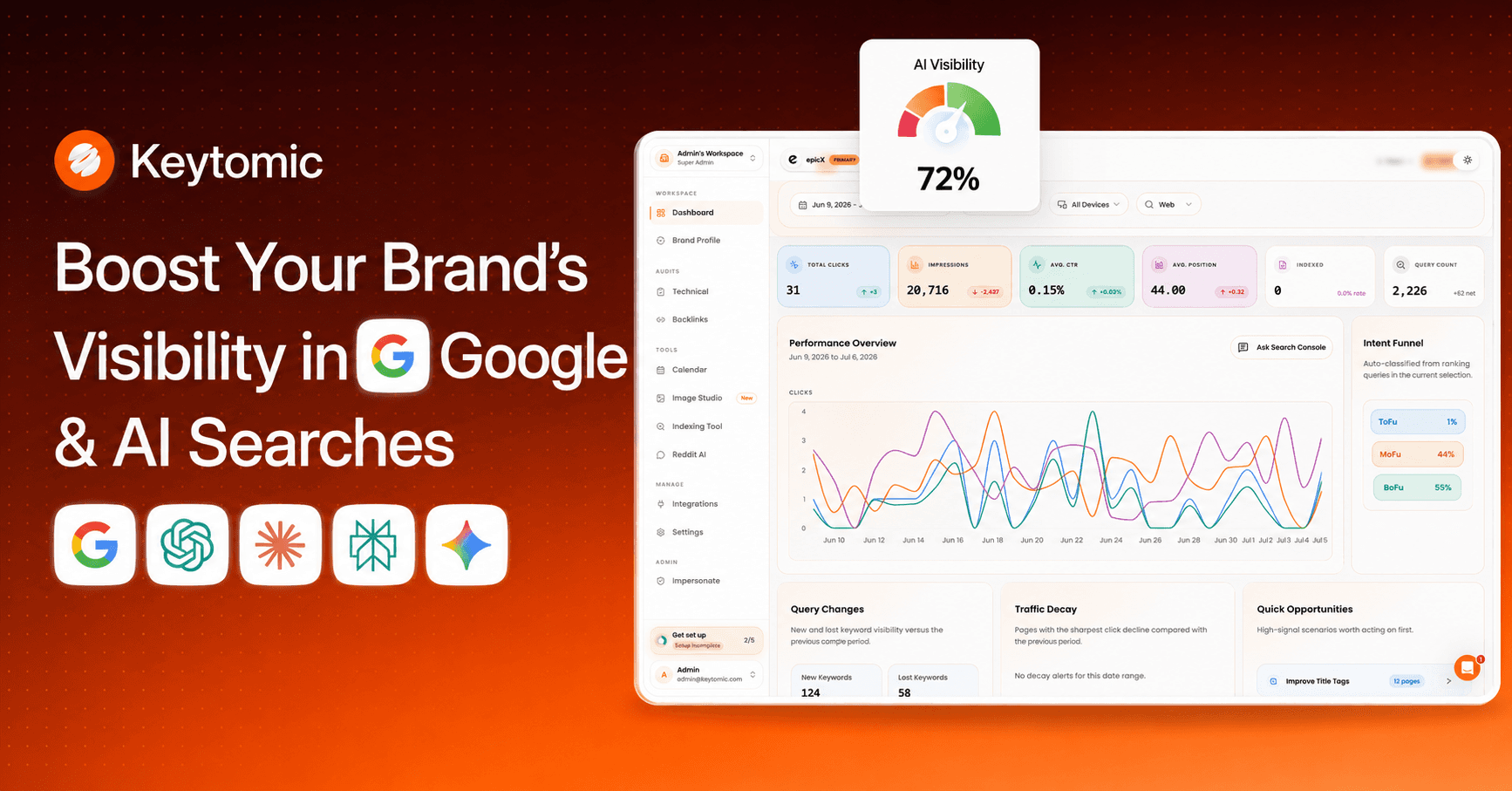
Keytomic combines AI visibility tracking with keyword research, content planning, article generation, CMS publishing, indexing workflows, technical SEO checks and multilingual publishing.
Its primary difference is scope. A dedicated monitor can show that your brand is missing from an important group of prompts. Keytomic is designed to help a smaller team move from that diagnosis into content planning and publishing without assembling several separate tools.
The Keytomic AI Visibility Tracker checks brand visibility across ChatGPT, Gemini, Perplexity and Claude. Keytomic’s broader product profile also includes 30-day content planning, CMS publishing, indexing workflows and AI visibility monitoring.
Best for
SMB founders without a large SEO department.
In-house marketers managing both Google and AI visibility.
Agencies that want research, publishing and monitoring in one workflow.
Teams struggling to turn reports into consistent execution.
Companies seeking to reduce the number of disconnected SEO products they operate.
What to consider
Keytomic is broader than a standalone visibility tracker. A mature enterprise with established research, content, publishing and analytics systems may prefer a specialist monitoring platform.
Keytomic’s public pages do not specify every prompt, project and historical-data limit, so prospective users should confirm those limits before purchase.
Pricing
Keytomic’s standard positioning starts at $99 per month, with annual pricing advertised at a lower effective monthly rate.
Verdict
Choose Keytomic when your primary challenge is not only measuring AI visibility, but also producing and publishing the work needed to improve it.
Run a free AI visibility audit.
2. Profound: best for enterprise answer-engine intelligence
Profound is an answer-engine optimisation platform for companies that need detailed visibility, citation and competitive intelligence.
Its Starter plan costs $99 per month when billed annually and tracks 50 prompts in ChatGPT. Its Growth plan costs $399 per month, tracks 100 prompts and covers three answer engines. Enterprise packages can monitor up to ten answer engines while adding multi-company tracking, tailored prompt programmes, SSO and dedicated support.
Best for
Enterprise brands.
Organisations managing several markets or business units.
Teams that need citation and competitive-source analysis.
Companies with dedicated SEO, content and analytics resources.
Organisations that can operationalise a substantial answer-engine dataset.
What to consider
The $99 Starter plan is narrower than the complete Profound platform because it is limited to ChatGPT. Teams that need broader engine coverage should evaluate the Growth or Enterprise cost rather than comparing vendors only by their entry price.
Verdict
Choose Profound when deep, enterprise-oriented answer-engine analysis is more important than an inexpensive or lightweight monitoring workflow.
3. Otterly.AI: best affordable standalone monitoring tool
Otterly.AI offers a relatively accessible way to begin monitoring recurring AI-search prompts.
Its standard platform tracks ChatGPT, Google AI Overviews, Perplexity and Microsoft Copilot. Google AI Mode and Gemini are offered as additional options on current plans. Monitoring runs daily, and higher plans add prompt research, citation analysis, reports, exports and larger audit allowances.
The public monthly plans currently start at:
Lite: $29 per month for 15 prompts.
Standard: $189 per month for 100 prompts.
Premium: $489 per month for 400 prompts.
Discounted annual pricing is also available.
Best for
Startups beginning their first AI visibility programme.
Smaller in-house marketing teams.
Agencies testing demand before investing in an enterprise platform.
Teams needing straightforward daily monitoring.
Companies that already have separate SEO and content tools.
What to consider
The entry plan provides a small prompt allowance. Additional engines and prompt packages can change the real cost, so compare plans using the exact prompt volume and platforms your business requires.
Verdict
Choose Otterly when you want affordable, recurring monitoring without buying a broad content or enterprise marketing platform.
4. Peec AI: best for focused marketing analytics
Peec AI is built around a comparatively focused AI-search analytics experience for marketing and SEO teams.
Standard plans let customers select three models from options including ChatGPT, Google AI Mode, AI Overviews, Microsoft Copilot, Perplexity and Gemini. The Starter plan includes 50 prompts, daily tracking, unlimited users and one project. Pro increases this to 150 prompts and two projects, while Advanced supports 350 prompts, five projects and Looker Studio integration. Enterprise packages add more models, custom prompt setup, API access, SSO and unlimited projects.
Peec currently bases its price on the number of prompts and models analysed and offers a 15% annual-billing discount. Its public pricing page dynamically displays the monetary amounts, so verify the current price directly rather than relying on an old comparison article.
Best for
In-house marketing and SEO teams.
Users who value a clean, focused interface.
Small agencies with a manageable number of clients.
Teams that need daily custom-prompt tracking.
Organisations that want to separate brand mentions from source citations.
What to consider
Starter, Pro and Advanced plans limit users to three selected AI models. Enterprise requirements such as API access, more models and unlimited projects require a larger package.
Verdict
Choose Peec AI when you want focused visibility analytics without a large collection of surrounding content-production features.
5. Ahrefs Brand Radar: best for search-backed market discovery

Ahrefs Brand Radar combines AI visibility research with Ahrefs’ existing search and competitive-intelligence databases.
Its distinguishing capability is broad discovery. Rather than requiring users to define every prompt before seeing data, Brand Radar lets marketers research brands and topics across hundreds of millions of search-backed prompts. Ahrefs’ June 2026 documentation reports coverage of more than 405 million such prompts. It also supports custom prompt tracking for questions that matter to the business but may not appear in the larger database.
Brand Radar AI starts at $199 per month. Ahrefs also sells custom-prompt packages starting at $50 per month for teams that primarily need their own recurring prompt checks.
Best for
SEO teams already working in Ahrefs.
Competitive and category-wide research.
Discovering relevant prompts without starting from a blank spreadsheet.
Comparing cited domains with existing SEO data.
Teams that need both broad market exploration and selected custom tracking.
What to consider
Its large prompt database and custom tracking packages solve different problems. Monitoring several AI indexes and custom prompts can cost more than a specialised entry-level monitor.
Verdict
Choose Brand Radar when you need to understand the larger AI-search market, not only a fixed list of prompts selected in advance.
6. Semrush AI Visibility Toolkit: best for existing Semrush users
Semrush AI Visibility Toolkit integrates AI visibility research with Semrush’s established SEO ecosystem.
The toolkit includes:
Visibility benchmarking.
Competitor research.
Prompt research.
Brand-performance reporting.
Sentiment and narrative analysis.
Daily prompt tracking.
AI-search checks within Site Audit.
The current $99-per-month package includes one Brand Performance domain, 25 tracked prompts, daily AI Analysis and Prompt Research allowances, AI-search checks for up to 100 audited pages and CSV exports. It does not currently include a free trial.
Best for
Existing Semrush users.
Teams wanting AI visibility beside their SEO campaigns.
Marketers who need prompt research and competitor data.
Companies monitoring one primary domain.
Teams wanting AI accessibility checks in a technical audit.
What to consider
Twenty-five tracked prompts may be too restrictive for a company with several products, audiences or markets. Additional domains, users and prompt allowances increase the cost.
Verdict
Choose Semrush when operational simplicity inside your existing SEO platform matters more than obtaining the largest standalone prompt allowance.
7. Writesonic: best for connecting visibility data to content action
Writesonic combines AI-search tracking with site audits, content production and optimisation workflows.
Its Starter plan costs $79 per month when billed annually and tracks 50 prompts across ChatGPT, Gemini and Google AI Overviews. The $199 Basic plan increases this to 100 prompts and 300 answers per day. The $399 Growth plan adds sentiment analysis and limited Action Center functionality. Enterprise plans support ten AI platforms, custom markets and languages, full Action Center access, reporting integrations and broader workflow controls.
Best for
Content-led marketing teams.
Businesses wanting monitoring and article production in one system.
Teams that need site audits alongside AI visibility.
Companies seeking recommendations and execution workflows.
Larger teams requiring broad platform coverage at the enterprise tier.
What to consider
The $79 and $199 plans cover only ChatGPT, Gemini and Google AI Overviews. Features such as wider engine coverage, complete sentiment analysis and full Action Center access require higher plans.
Verdict
Choose Writesonic when your team wants to connect monitoring data with content production and optimisation inside one platform.
8. Scrunch: best for enterprise AI customer-experience monitoring
Scrunch approaches AI visibility as part of a broader AI customer journey.
Its platform includes prompt management, citation tracking, page audits, topic monitoring, personas, agent-traffic measurement, integrations and optimisation insights.
Public plans start at approximately $250 per month. The Starter tier monitors 350 prompts and includes five page audits and three personas. Growth increases those allowances, while Enterprise supports custom requirements. Scrunch monitors major platforms including ChatGPT, Claude, Gemini, Perplexity, Google AI Mode and AI Overviews.
Best for
Enterprise businesses.
Multi-brand organisations.
Agencies running sophisticated AI-search programmes.
Teams interested in agent traffic as well as citations.
Organisations requiring a broader AI customer-experience view.
What to consider
Scrunch may be excessive for a small business that only needs basic mention and citation tracking. Its value is strongest when the team will use its audits, personas, integrations and agent-experience capabilities.
Verdict
Choose Scrunch when AI search is part of a broader enterprise customer and agent experience—not simply another visibility report.
How to choose an LLM visibility tool
1. Decide what action the data must support
Do not start by asking which platform tracks the most AI engines.
Start with the decision you need to make:
Which product is underrepresented?
Which competitors dominate important recommendations?
Which websites influence the answers?
Which existing page should be improved?
Is the problem content, authority, technical access or inaccurate third-party information?
Do we need to report AI visibility to clients?
Do we need to connect visibility to leads and revenue?
A monitoring platform is useful only when its data changes a decision.
2. Build a representative prompt set
A large prompt count is not useful when the prompts are commercially irrelevant.
A practical 50-prompt starting framework is:
Prompt group | Number | Examples |
|---|---|---|
Customer problems | 15 | “How do I solve…?” |
Product-category questions | 10 | “What type of software helps with…?” |
Comparisons and buying decisions | 10 | “Best X for Y,” “X vs Y” |
Alternatives and switching | 5 | “Alternatives to…” |
Branded accuracy questions | 5 | “What does Brand X do?” |
Implementation or post-purchase questions | 5 | “How do I use X for…?” |
This is a planning framework, not an industry rule. Adjust the mix according to the business model, customer journey and markets.
For deeper prompt discovery, combine customer language, Search Console data and the related questions generated by AI-search fan-out. Google describes query fan-out as issuing concurrent related searches across subtopics to gather enough information for a fuller answer.
3. Check whether the tool measures repeatedly
One screenshot is not a trend.
Ask:
How frequently are prompts rerun?
Are identical conditions preserved?
Can results be segmented by engine, country and language?
Does the platform preserve raw answers?
Can you review historical variance?
Does it report uncertainty or only one definitive score?
Can you export the underlying data?
AI answers are probabilistic. Studies in 2026 found that repeated runs can produce materially different citations and brand visibility, meaning visibility should be evaluated as a distribution rather than a fixed rank.
4. Separate mentions, recommendations and citations
A brand mention is not the same as a citation.
Consider these four outcomes:
Outcome | Meaning |
|---|---|
Absent | The brand is not included |
Mentioned | The brand appears in the answer |
Recommended | The brand appears as a relevant solution |
Cited | The brand’s site is used as an attributed source |
A company may be recommended without receiving a link. Another may receive citations for research without being recommended as a product.
Measure the outcomes separately.
5. Do not compare proprietary scores across tools
A 60% visibility score in one platform may not equal 60% in another.
Platforms can differ in:
Prompt sets.
Number of runs.
Models used.
Location and language.
Weighting.
Treatment of citations and mentions.
Competitor selection.
Handling of answer variations.
Use scores to monitor movement within the same platform and stable campaign. Do not assume they are interchangeable benchmarks.
6. Assess actionability
The most useful tool should help your team move from:
“We are missing from these prompts”
to:
“Here is the page, source, product statement or authority gap we should address.”
Look for:
Cited-page analysis.
Competitor source analysis.
Content-gap identification.
Factual-accuracy monitoring.
Page-level recommendations.
Internal workflow integrations.
Export or API access.
Clear ownership of recommended actions.
7. Calculate the true cost
Compare the price at the volume you actually need.
Include:
AI engines.
Prompt checks.
Countries and languages.
Projects or brands.
Users.
Historical storage.
API or BI access.
Reports.
Additional domains.
Overages.
Annual commitments.
A $29 entry plan may cost more once engines and prompts are added. A $199 platform may be better value when it replaces another tool the team already pays for.
A 14-day pilot for comparing AI visibility tools
Before committing to a long annual contract, run the same controlled pilot across your shortlist.
Step 1: Select 20 commercially meaningful prompts
Use a mix of:
Five problem prompts.
Five product-category prompts.
Five comparison prompts.
Three branded-accuracy prompts.
Two post-purchase prompts.
Step 2: Keep the conditions consistent
Use the same:
AI engine.
Country.
Language.
logged-in or logged-out state where applicable.
Date window.
Competitor set.
Step 3: Monitor for two weeks
Evaluate whether the tool:
Detects the same mentions found in the raw answer.
Correctly distinguishes citations from unlinked mentions.
Preserves answer history.
Makes changes easy to investigate.
Handles repeated or variable answers transparently.
Identifies useful sources.
Produces recommendations your team can execute.
Step 4: Compare decision quality, not dashboard design
At the end of the pilot, ask:
Which platform gave us the clearest, most defensible next action?
That question is more useful than asking which interface displayed the highest score.
Which AI visibility metrics matter?
Mention rate
The percentage of tracked answers in which the brand is named.
This is a useful baseline, but it does not reveal whether the brand is accurately described or recommended.
Recommendation rate
The percentage of tracked commercial answers that include the brand as a suitable option.
This is generally more meaningful than a passing mention for product and service companies.
Citation rate
The proportion of answers that link to or explicitly attribute information to the brand’s website.
Track both the overall domain and the specific pages receiving citations.
Competitive share of voice
How frequently the brand appears compared with a stable competitor group.
Do not repeatedly change the competitors or prompt set and then interpret the resulting movement as genuine growth.
Descriptive accuracy
Whether AI systems correctly state:
What the product does.
Who it serves.
Its current features.
Its pricing model.
Its category.
Its differentiators.
Its limitations.
Incorrect visibility can be more damaging than no visibility.
Source share
The websites influencing the answers:
Your own pages.
Competitor sites.
Review platforms.
Industry publications.
Forums.
Documentation.
Videos and social content.
Source share helps distinguish an on-site content problem from an external-authority problem.
AI referral engagement and conversions
Track identifiable referrals, but remember that not every AI-assisted journey preserves referral information.
Review:
AI referral sessions.
Engaged sessions.
Trial or demo clicks.
Lead submissions.
Assisted conversions.
Branded-search demand.
Customer-reported discovery sources.
A prompt-weighted visibility score
For internal reporting, teams can weight prompts by business importance instead of treating every question equally.
A simple framework is:
Prompt-weighted visibility = total of prompt importance × outcome score, divided by total prompt importance
For example:
Absent = 0
Mentioned = 1
Recommended = 2
Cited = 3
This is an internal planning model, not an industry-standard metric. Its purpose is to stop a low-value informational mention from carrying the same importance as a high-intent product recommendation.
What LLM visibility tools cannot prove
No external platform has complete access to the internal retrieval and ranking systems used by AI companies.
An LLM visibility tool cannot definitively prove:
Your fixed “rank” inside an AI model.
What every user will see.
The exact cause of a citation.
That one optimisation produced a visibility increase.
That visibility will automatically produce revenue.
That one prompt library represents the entire market.
That the same answer will persist after a model update.
That all AI-assisted journeys will appear in referral analytics.
Treat the platform as a measurement and diagnostic system, not an oracle.
Should you use a platform or an agency?
Choose a software platform when:
Your team can build a meaningful prompt set.
Someone owns the reporting.
Your SEO and content teams can implement the findings.
You need recurring monitoring.
You want the underlying data in-house.
Choose an agency when:
No internal person owns AI-search strategy.
You need expert interpretation and implementation.
The business has complex markets or multiple stakeholders.
External mentions and digital PR are central to the strategy.
Leadership needs a managed reporting programme.
Use a hybrid approach when the internal team wants to own the data but needs outside support for strategy, content, digital PR or technical work.
How to improve visibility after choosing a tool
Monitoring is only the diagnostic layer.
1. Confirm crawlability and indexability
Important pages must be accessible, indexable and internally discoverable. Fix technical barriers before rewriting content.
2. Map prompts to the correct pages
Do not create a new article for every prompt variation.
Group related prompts by underlying user problem and map each group to the page that can answer it most completely.
3. Refresh stale or incomplete content
Update:
Facts.
Product details.
Prices.
Screenshots.
Examples.
Sources.
Dates.
Recommendations.
Limitations.
Use the LLM citations checklist to review citation readiness without assuming that formatting alone guarantees inclusion.
4. Add information competitors cannot easily reproduce
Examples include:
Original testing.
First-party data.
Practitioner experience.
Decision frameworks.
Customer questions.
Templates.
Tools.
Calculators.
Transparent methodologies.
Clear explanations of limitations.
Google recommends unique, non-commodity content that genuinely helps visitors rather than pages made mainly to capture search variations.
5. Strengthen your brand’s factual consistency
Keep product facts consistent across:
Your homepage.
Product pages.
Documentation.
Authoritative profiles.
Review sites.
Press coverage.
Partner pages.
Structured data.
Correct outdated third-party information when practical.
6. Earn credible external corroboration
AI systems may rely on sources beyond the brand’s own website.
Relevant industry coverage, expert references, independent reviews, customer discussions and original research can reinforce what the company claims about itself.
7. Measure repeatedly
Keep the highest-value prompts stable and watch trends over time.
Avoid reacting to one answer or one day of movement.
For an implementation sequence, use the 30-day AI search optimisation roadmap or read How to Improve Brand Visibility in AI Search Engines.
What Google says about AI visibility
Google says AI Overviews and AI Mode may use query fan-out to explore related subtopics and supporting sources. However, the foundational requirements remain familiar:
Publish useful, original content.
Ensure important pages are crawlable and indexable.
Use clear internal links.
Provide a good page experience.
Keep facts and structured data consistent with visible content.
Avoid producing pages for every possible long-tail variation.
Google does not require a special AI schema or a particular “LLM-friendly” paragraph format.
Structured data can still help Google understand eligible content and support conventional search features, but it does not guarantee inclusion in an AI answer.
Read Schema Markup and AI Visibility for a practical explanation of where structured data helps—and where its role is commonly overstated.
Which LLM visibility tool should you choose?
Choose according to the team and job:
Choose Keytomic when you need visibility monitoring connected to keyword research, content planning, publishing and indexing.
Choose Profound when enterprise-grade answer-engine intelligence is the priority.
Choose Otterly.AI when affordable, straightforward recurring monitoring matters most.
Choose Peec AI when your marketing team wants a focused analytics experience.
Choose Ahrefs Brand Radar when you need broad, search-backed prompt and competitor discovery.
Choose Semrush when AI visibility should live inside your existing Semrush workflow.
Choose Writesonic when you want tracking connected to content and optimisation actions.
Choose Scrunch when your enterprise needs visibility, citations, agent traffic and broader AI customer-experience functionality.
Before buying, run a controlled pilot and inspect the raw answers behind the scores.
The right platform should make the next business decision clearer. If it only gives you another number to monitor, it has not solved the underlying problem.
Check your current visibility with Keytomic, or start a Keytomic trial.
Frequently asked questions
How accurate are LLM visibility tools?
They can reliably automate repeated monitoring, but no platform captures every possible answer. Accuracy depends on its prompt set, engines, locations, sampling frequency and mention/citation detection. Evaluate trends and distributions instead of treating a single score as definitive.
How many prompts should a business track?
A focused business can begin with approximately 25–50 prompts covering customer problems, product categories, comparisons, alternatives and brand accuracy. A multi-product, multi-country company may need hundreds. Relevance is more important than raw volume.
How often should prompts be checked?
Daily monitoring is useful for volatile or commercially important prompts. Weekly monitoring may be sufficient for slower-moving categories. In either case, use repeated runs and stable conditions rather than drawing conclusions from a one-off answer.
Can an AI visibility tool guarantee citations?
No. A platform can identify current visibility, citations and opportunities. It cannot force an independent AI system to cite or recommend a page.
Are mentions or citations more important?
They measure different outcomes. Mentions indicate brand awareness inside the answer. Citations indicate source attribution. A commercially useful programme should normally measure mentions, recommendations, citations and accuracy separately.
Can Google Analytics track traffic from AI platforms?
GA4 can identify some AI referrals when the platform passes referral information. It will not capture every AI-assisted journey, so combine referral reporting with conversions, branded search and customer-reported discovery.
Do I need llms.txt or special AI schema?
Not for Google Search. Google says there is no special schema requirement for its generative AI features, and its current guidance does not treat llms.txt as a Google visibility requirement. Continue using accurate structured data where it is appropriate for the visible page type.
Author bio
Salam Qadir is Product & Growth Lead at Keytomic, an AI SEO automation platform. He has worked in SEO and digital marketing for over seven years across SaaS products, service businesses and content operations. Connect with him on LinkedIn.