Table of Contents
Share Article
How to Improve Visibility in Google AI Overviews A Practical SEO Framework
How to Improve Visibility in Google AI Overviews A Practical SEO Framework
How to Improve Visibility in Google AI Overviews A Practical SEO Framework

Ahsan Iqbal
Marketing Growth Expert

Learn how to improve Google AI Overviews visibility with crawlability, topical authority, answer-first content, measurement, and honest limits.
Improve Google AI Overview visibility by applying strong technical SEO, creating useful original content, covering the full question behind the query, and making important claims easy to verify.
Google says there are no special AI Overview requirements or special schema types needed. Pages must still be indexed and eligible to appear in Google Search with a snippet.
Use clear headings, direct answers, tables, examples, internal links, and visible evidence for both people and machine retrieval, but do not treat formatting as a guarantee of inclusion.
Measure Google AI feature impressions where Search Console provides them, then combine that data with rankings, citations, branded queries, and conversions.
You may rank on page one for a query and still have no idea whether Google’s AI summary box is citing your page, borrowing your answer, or ignoring you entirely. That gap between traditional ranking and AI feature visibility is where most SEO teams are stuck right now.
The practical question is not “How do I trick AI Overviews?” It is “How do I make my site eligible, useful, trusted, and measurable?” Those are four separate problems, and they each have a different fix.
This guide covers how Google selects AI Overview sources, how to map the full query behind your topic, how to build topical authority and fix technical access, and how to measure AI search visibility using the tools available today, including Google’s own generative AI performance reports announced on June 3, 2026, which are rolling out to a subset of properties and must be checked for your specific account.
What Google AI Overviews Are and How They Select Sources
Google AI Overviews are AI-generated summaries that appear at the top of certain search results pages, synthesizing information from multiple web sources into a single answer block with supporting links. They are part of Google’s broader shift toward generative AI in Search, alongside Google AI Mode, which offers a more conversational, multi-turn experience.
These features use query fan-out: Google’s system breaks a user’s question into related sub-queries, retrieves relevant pages across each, and synthesizes a response. The cited supporting links are not always the top-ranking organic results. They represent what Google’s systems judged as the most relevant and reliable passages for each component of the answer.
How Google AI Overviews Differ From Traditional Organic Results
Traditional organic results return a ranked list of blue links, each representing a single page. AI Overviews synthesize content from multiple sources into a single AI-written response, then surface supporting links beneath. A page can appear as a supporting link without holding a top organic position, and a page in position one may not be cited at all.
This is not a replacement for organic rankings. Google has confirmed that its existing SEO practices remain foundational for AI features, and organic visibility is still the primary traffic channel for most queries.
Feature | Traditional Organic | Google AI Overviews |
|---|---|---|
Result format | Ranked list of links | AI-synthesized answer + supporting links |
Source count | One page per position | Multiple pages per answer |
User intent served | Navigational, informational, transactional | Primarily informational and research queries |
Click behavior | Direct to ranked page | Supporting links beneath the summary |
Guaranteed by ranking? | Position reflects ranking | Inclusion not guaranteed by ranking |
Requires special schema? | No | No |
Eligibility is necessary, but it is not sufficient for inclusion.
What Google Requires Before a Page Can Appear
According to Google Search Central’s AI features documentation, pages must be indexed, eligible to appear in Google Search with a snippet, and aligned with Google’s Search policies and people-first content standards. There are no additional technical requirements, no special schema types, and no AI-specific files needed.
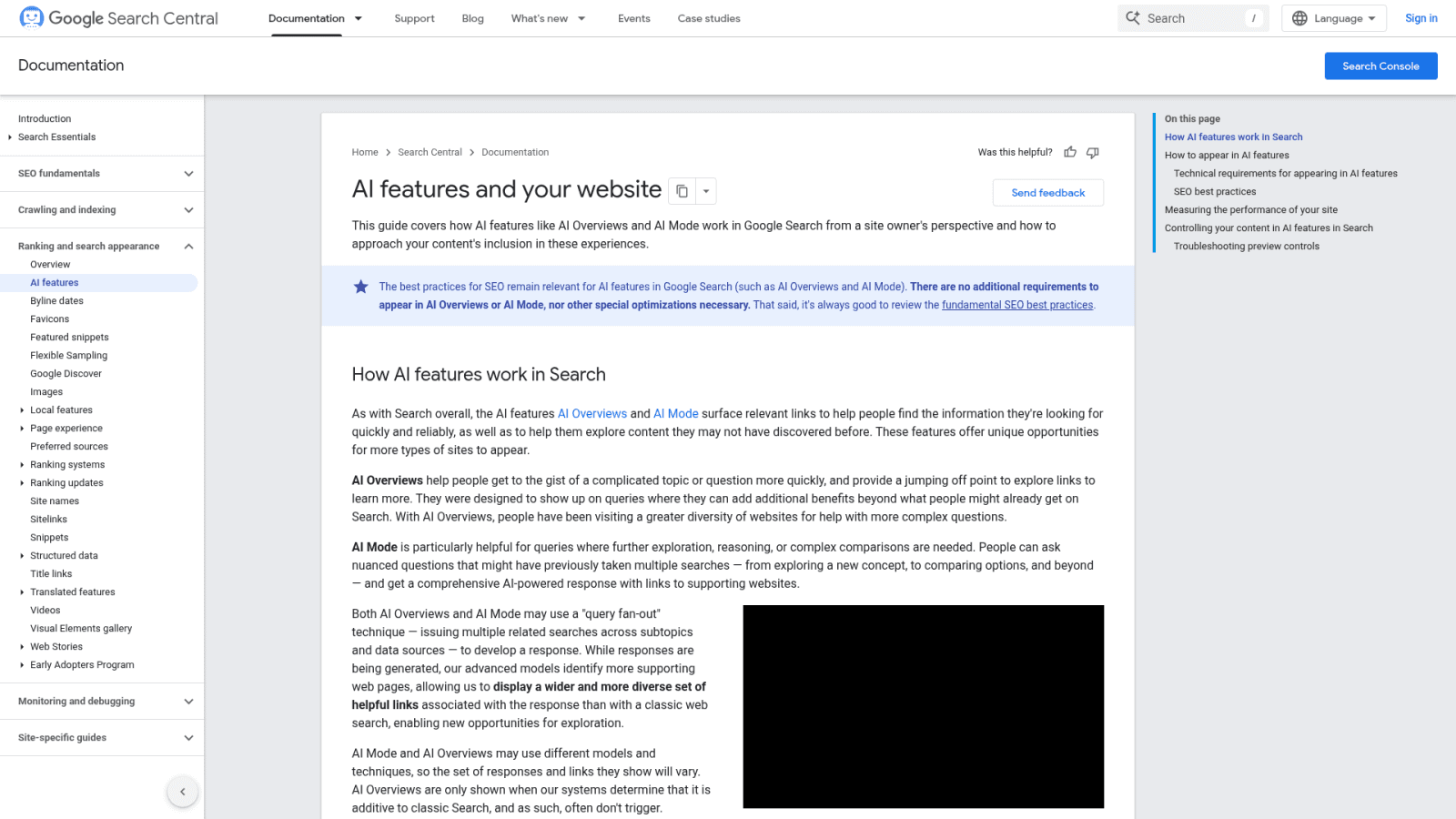
If a page is blocked in robots.txt, marked noindex, or has a nosnippet directive, it cannot qualify. Meeting these eligibility requirements does not guarantee inclusion in any specific AI Overview.
What You Can and Cannot Control
Controllable | Not Controllable |
|---|---|
Content quality and original value | Whether an AI Overview triggers for a query |
Intent and follow-up question coverage | The exact passage Google cites |
Internal links and topical depth | Model variation across users or sessions |
Technical accessibility and indexability | Inclusion on a specific query at a specific time |
Author accountability and entity clarity | Competitor citation frequency |
Structured data accuracy | Google’s internal relevance weighting |
Build a Query Map Around the Questions Google May Fan Out
Before writing a single heading, map the full query network the article needs to cover. AI Overviews are powered by query fan-out: the system generates related sub-queries from the user’s original question and pulls sources for each. If your page only answers the primary query, it may be ineligible for the follow-up components of the summary.
Start With the Core Search Intent
Classify the primary query by intent type: informational, comparison, problem, definition, or buyer. For a topic like Google AI Overviews, the core intent is informational with an implementation layer. The reader wants to understand the system, then take action.
This article targets informational intent. It is not a tool roundup, a pricing comparison, or a GEO strategy guide. Keeping that scope tight matters because AI Overviews tend to surface narrow, intent-matched answers rather than broad strategy pieces.
For AEO versus SEO differences or broader multi-engine strategies, those require separate pages with their own focused intents.
Cover Follow-Up Questions Without Creating Thin Pages
Not every related question needs a separate URL. Use this decision model before creating new content:
Separate URL (QDP): The question has distinct intent, a unique audience, and enough depth to justify 800 words or more. Example: AI visibility tracking tools, Keytomic versus alternatives, or GEO strategy.
Heading (QDH): The question is a natural sub-topic of the parent page and adds depth without changing intent. Example: “How Google selects supporting links” under this article.
Sentence or list item (QDS): The question needs one clear answer and no more. Example: “Do AI Overviews require special schema?”
Rejection: The question overlaps with an existing page and creating a new section would cause cannibalization.
For the operational guide to Answer Engine Optimization, keep that as a separate URL rather than merging it into this guide.
Map Entities, Attributes, and Predicates Before Writing
The central entity in this article is Google AI Overviews. Its key attributes include eligibility, source selection, query fan-out, crawlability, indexing, content quality, authorship, structured data, internal linking, and measurement. The predicates that describe it are: uses generative synthesis, requires indexing, surfaces supporting links, cites relevant passages, varies by query and session, measures through impressions, and does not guarantee inclusion.
Covering these attributes consistently across headings and body copy builds the entity signal that helps Google understand your page’s full relevance scope.
Strengthen Topical Authority and Source Credibility
Google’s approach to source reliability for AI features follows the same E-E-A-T framework it applies to organic rankings. Experience, expertise, authoritativeness, and trustworthiness are evaluated at the page level, the author level, and the domain level. None of these guarantees AI Overview inclusion, but their absence makes inclusion less likely.
Here is what builds genuine source credibility:
A named author with a verified role and relevant background
Claims supported by official documentation, primary research, or documented observation
Internal links to related pages that provide supporting topical depth
Consistent entity naming across the site (Google AI Overviews, not “Google’s AI feature” in one place and “AI summary” in another)
External links to primary sources, not aggregator summaries
An editorial review step that catches unsupported or outdated claims
According to Google’s helpful content guidance, content created primarily to rank rather than to help people is evaluated negatively regardless of formatting or schema. Source accountability matters more than cosmetic AI formatting.
Make the Page Accountable to a Named Author
This article is published by Keytomic, an AI-based autonomous SEO engine that handles keyword discovery, content planning, and publishing workflows. The author’s bio, role, and relevant experience should be visible on the page and verified before publication. A reviewed-by line from a qualified technical SEO reviewer adds a second layer of accountability where available.
For any section involving personal testing, screenshots, or product walkthroughs, use first-person language only for observations that are documented and verifiable.
Build Supporting Coverage Around the Central Entity
A single strong page on Google AI Overviews is not enough to establish domain authority on the topic. Surrounding articles that cover related entities reduce Google’s uncertainty about your site’s topical depth. Internal links to these pages signal that this article is part of a structured cluster, not an isolated post.
Relevant supporting pages include how topical authority works in SEO, Keytomic’s GEO guide, and what E-E-A-T means for Google SEO.
Use Evidence Instead of AI-SEO Assertions
Many articles on this topic present short answers, FAQ blocks, and exact paragraph counts as confirmed Google selection signals. They are not. Google’s own documentation states there are no additional technical requirements for AI features beyond standard SEO eligibility. Write recommendations as editorial best practices, not as Google-confirmed rules, unless a primary Google source supports the specific claim.
Format Pages for Retrieval Without Writing for a Formula
Clear formatting supports retrieval because it reduces ambiguity for both readers and machine systems. That is a practical usability argument, not a promise that any specific structure will trigger an AI Overview citation. Google Search Central confirms there are no special formatting requirements for AI features.
With that limitation stated, here is what actually helps:
Open every section with a direct answer in the first two sentences, before adding context or examples.
Use descriptive H2 and H3 headings that match the real question a reader would ask.
Keep paragraphs to three lines or fewer. One idea per paragraph.
Use tables to show relationships, comparisons, or decision matrices where prose would be ambiguous.
Use numbered lists for sequential steps and bullet lists for non-ordered items.
Place evidence close to the claim it supports. A source reference buried four paragraphs after the claim it supports is harder to extract.
Define technical terms the first time they appear, especially entities that have multiple meanings (AI Mode versus AI Overviews, for example).
Answer the Heading Before Adding Context
Every H2 and H3 in an AI-optimized article should function as a standalone question-and-answer unit. The heading poses the question. The first 50 words deliver the answer. The remaining paragraph adds context, evidence, or an example.
This structure makes it easier for Google’s systems to identify the extractable passage for each component of an AI summary. It also makes the article faster to scan for human readers, which reduces bounce signals.
Use Tables, Lists, and Definitions Where They Reduce Ambiguity
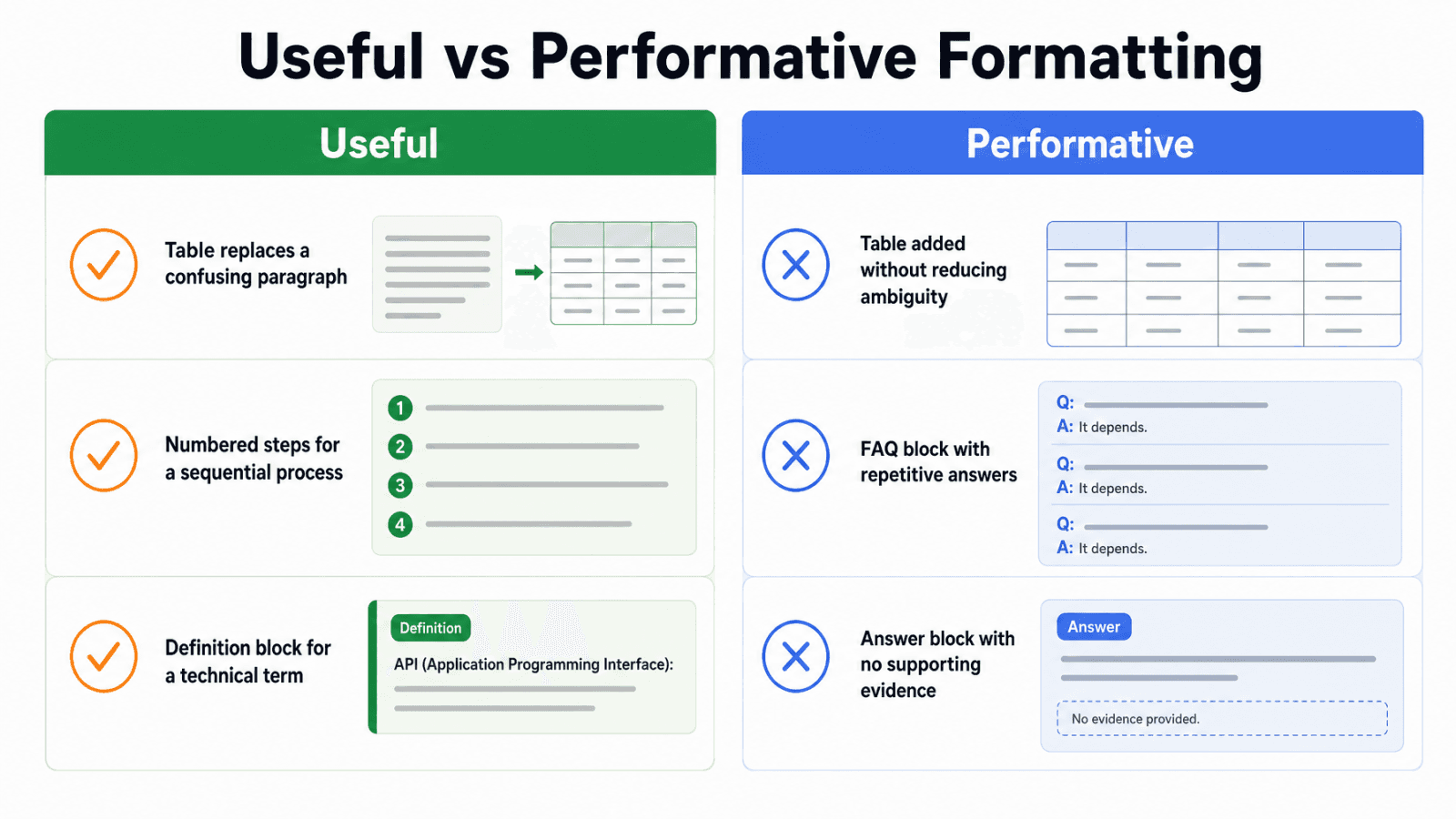
Tables are particularly useful for showing what is controllable versus what is not, comparing feature sets, or presenting a decision matrix. Lists work best for sequential steps or grouped requirements. Definitions work best when a term is used differently across the industry and needs a clear, stable anchor on this page.
The key distinction is “useful versus performative.” A table that replaces a confusing paragraph is useful. A table inserted to look structured, without reducing any ambiguity, is performative and adds no retrieval value.
Make Claims Citation-Ready and Easy to Verify
Write one factual claim per sentence where possible. Put qualifiers near the claim rather than at the end of the paragraph. Link to primary sources when the link resolves a factual question rather than just adding a reference count.
For any claim about Google’s behavior, the source should be Google Search Central or an official Google product announcement. For any claim about Keytomic’s capabilities, the source should be the current official product pages, checked before publication.
Fix Technical Accessibility Before Chasing AI Visibility
Technical access is a prerequisite, not a tactic. A page that is not indexed cannot appear in AI Overviews. A page with a nosnippet directive cannot be used as a supporting link. A page that renders incorrectly on mobile or blocks JavaScript may be indexed with missing content. All of these problems need to be resolved before any content or formatting improvement will have an effect.

Follow this dependency-ordered workflow from Google’s crawling and indexing documentation:
Check index status using the URL Inspection tool in Google Search Console.
Confirm no accidental noindex or nosnippet directives exist in the page’s HTTP headers or meta tags.
Validate the canonical URL points to the intended page version.
Check robots.txt to confirm Googlebot is not blocked from the page or its resources.
Test rendering using the “Test Live URL” function to confirm JavaScript-dependent content is visible.
Confirm mobile usability with the Mobile-Friendly test or the Core Web Vitals report.
Verify sitemap inclusion and resubmit if the page was recently added.
Check internal discovery: is the page linked from at least one other indexed page on the same site?
Validate structured data accuracy against visible page content.
Check Crawlability, Indexing, and Snippet Eligibility
A page must be indexed and eligible to appear with a snippet before it can qualify as a supporting link in Google AI features. If the URL Inspection tool shows a page as not indexed, or if the page carries a nosnippet directive, resolve that before any other AI visibility work.
For new or recently updated pages, request indexing through the URL Inspection tool and monitor recrawl status over the following two weeks.
Keep Canonicals, Structured Data, and Visible Content Consistent
Valid structured data should describe only what is visibly present on the page. Google does not require special schema for AI Overviews. Where the page genuinely supports it, Article, FAQPage, and BreadcrumbList markup can help describe the content to Google’s systems and may support relevant search features, but schema cannot compensate for thin or ineligible content.
For a deeper look at schema markup and AI visibility, including what types are worth implementing and what is often misapplied, that dedicated resource covers the tradeoffs more fully.
Validate Rendering and Internal Discovery
Run a mobile rendering check to confirm all body content, headings, and structured data are visible after JavaScript execution. Check that no resources critical to content rendering are blocked in robots.txt. Confirm the page appears in the sitemap and is linked from related internal pages with descriptive anchor text, not generic labels like “click here” or “read more.”
Internal links using IndexNow and crawler discovery can accelerate how quickly newly published or updated pages enter the index and become eligible for AI features.
Measure Visibility Beyond Traditional Rankings
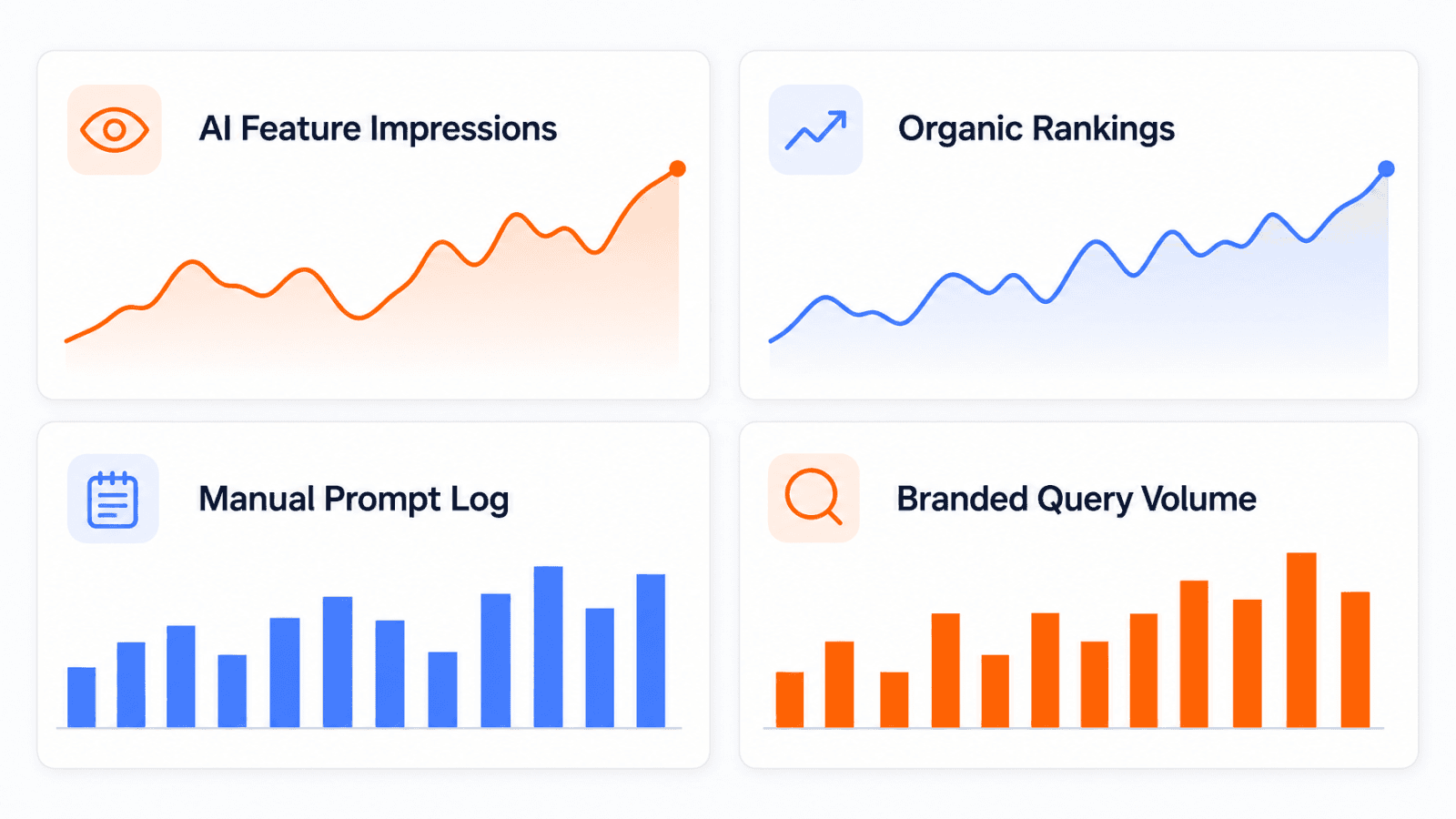
AI search visibility cannot be measured entirely through standard rank tracking. A page can appear in an AI Overview for a query where it holds position eight, and vice versa. Measurement needs to cover multiple data streams to produce a reliable picture.
Metric | Source | What It Measures |
|---|---|---|
AI feature impressions | Google Search Console generative AI report | How often URLs appear in AI Overviews and AI Mode |
Organic impressions and clicks | Search Console standard performance report | Traditional ranking visibility |
Manual prompt observations | Controlled query set | Overview presence, cited URLs, brand mentions |
Branded query volume | Search Console, Google Trends | Indirect brand awareness signal |
AI citations on other engines | Third-party tracking tools | Citations in ChatGPT, Perplexity, and others |
Assisted conversions | GA4 attribution | Revenue contribution from AI-visible traffic |
For broader AI visibility across engines beyond Google, the how to improve brand visibility in AI search engines guide covers cross-engine measurement approaches separately.
Use Google Search Console for Google AI Feature Data
Google announced dedicated Search Generative AI performance reports in Search Console on June 3, 2026. These reports provide impressions from AI Overviews, AI Mode, and generative AI features in Discover, broken down by page, country, device, and date. Click data is not included in the current version.
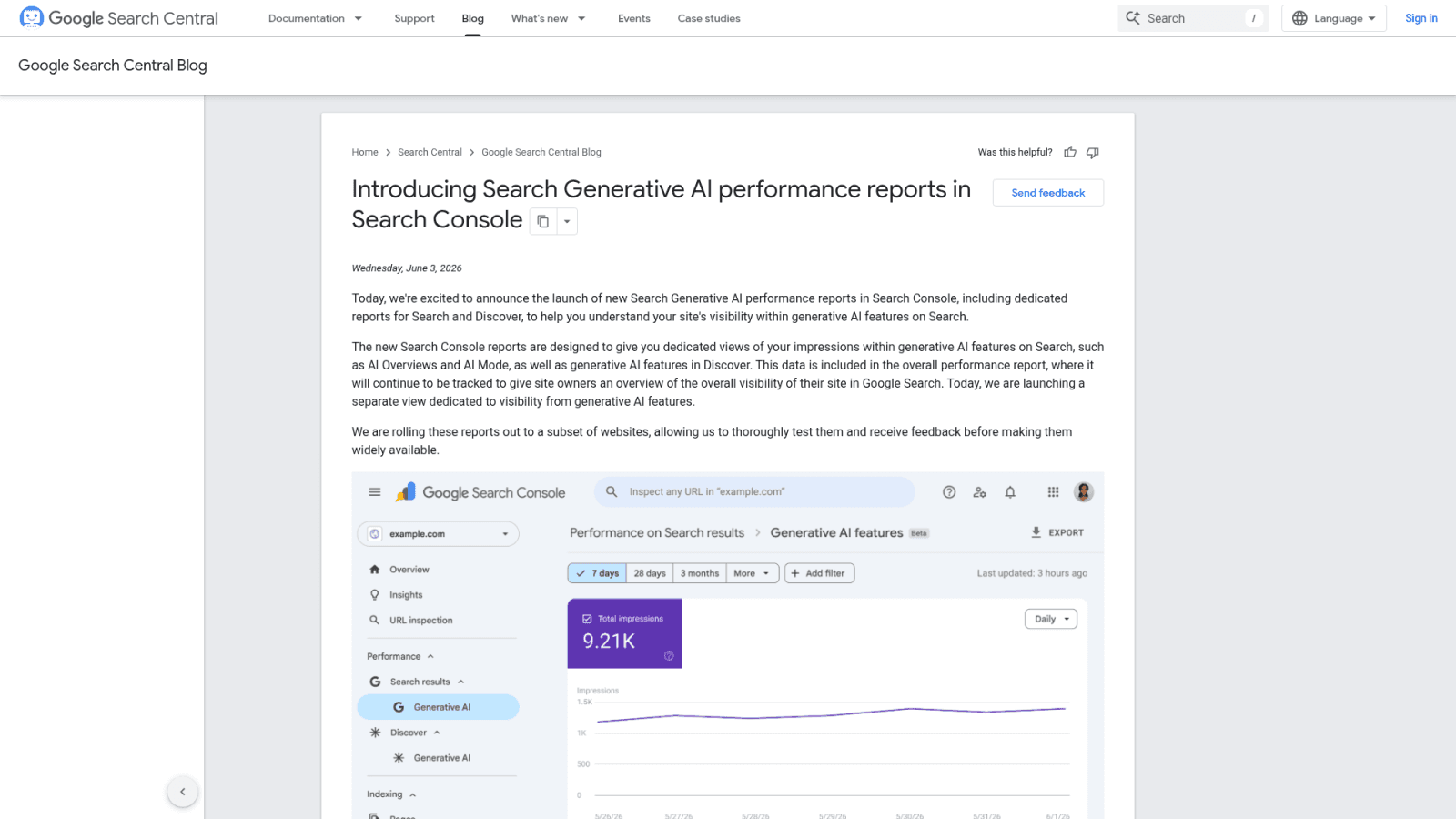
The rollout began with a subset of UK-based website owners and was still expanding as of the announcement date. Check your specific Search Console property to confirm whether the generative AI report is available before treating it as accessible in your workflow.
The Keytomic AI Visibility Tracker provides a complementary measurement layer for tracking brand mentions and citations across supported AI systems, alongside Search Console data for Google-specific signals.
Create a Repeatable Prompt and Query Set
Manual prompt testing is directional, not conclusive. A single query result reflects one model state, one location, one device, and one moment. To make observations useful, you need a controlled protocol.
Recommended setup:
Select 10 to 30 real buyer and research questions across category, problem, comparison, branded, and follow-up intent.
Record: date, location, device type, query text, whether an AI Overview appeared, which domains were cited, whether your brand was mentioned, which competitors were mentioned, and what the answer said.
Run the same set at 14, 30, and 60-day intervals to identify stable patterns versus one-off appearances.
Label all manual results as directional observations, not official Google data.
For a fuller methodology on how to measure AI citations across engines, that resource covers sampling approaches, tracking frequency, and what citation data can and cannot tell you about revenue impact.
Separate Visibility From Business Impact
An AI mention is not automatically a qualified lead or a revenue event. Distinguish impressions (your URL appeared in an AI feature), citations (a reader could see your source link), and clicks (a reader clicked through). Then layer in branded search volume changes and assisted conversions from GA4 to understand whether AI visibility is contributing to business outcomes.
Teams that conflate “we appeared in an AI Overview” with “we won AI search” tend to make premature decisions about what is working. AI search monitoring for SEO strategy goes deeper on how to connect visibility data to strategic decisions without overstating what the data shows.
How Keytomic Supports Google and AI Search Visibility Workflows
Keytomic publishes this article, so this section explains where its workflow fits and where it does not.
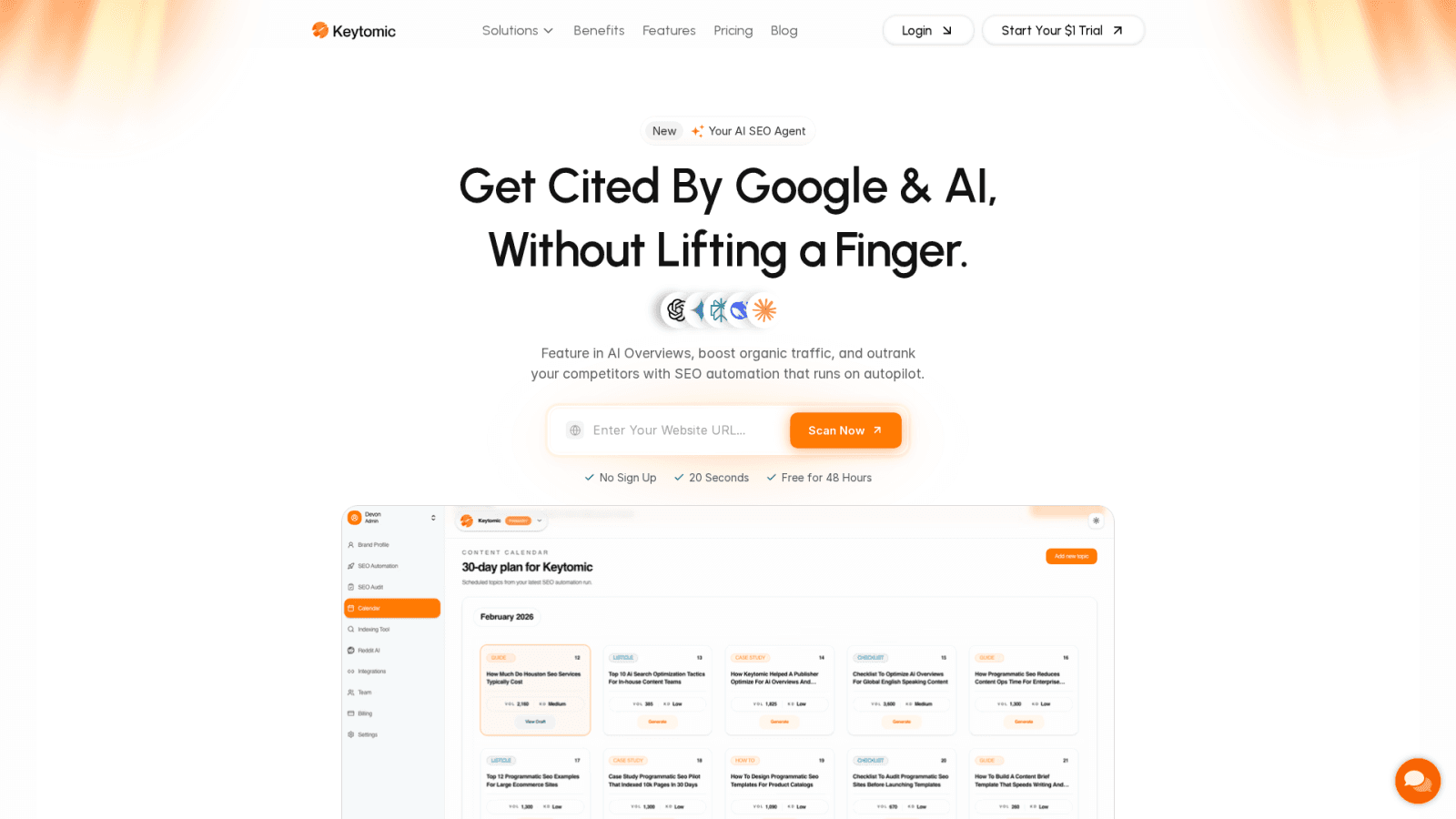
The Keytomic SEO automation platform is designed to connect keyword discovery, content planning, human review, publishing, and AI visibility measurement into a single workflow. The goal is to reduce the handoff gaps between these steps, not to replace the strategic judgment or editorial review that each step requires.
Keytomic capabilities and availability referenced here were checked against its official pages in August 2026.
Connect Keyword Discovery to a 30-Day Content Roadmap
Keytomic’s publicly documented workflow starts with keyword and topic discovery, then generates a 30-day content roadmap that maps out which pages to create or update across a defined period. This approach addresses a common execution gap: teams often identify AI visibility opportunities but have no structured plan for publishing the supporting content that would make those opportunities actionable.
The roadmap does not guarantee AI Overview inclusion. It provides a prioritized publishing schedule built around search intent and topical coverage, which are inputs to eligibility, not outputs.
Move From Approved Content to Publishing and Indexing
Once content is reviewed and approved, Keytomic’s platform supports auto-publishing and CMS connectivity to move content from draft to live without manual upload steps. Human review remains a required step for factual accuracy, brand voice, sensitive claims, and final approval before any content is published.
The platform is not a replacement for editorial judgment. It reduces the operational overhead between the approval decision and the indexing event. To see how this workflow operates in practice, book a Keytomic workflow demo.
Use AI Visibility Tracking as a Measurement Layer
Keytomic’s official pages describe tracking brand mentions, prompts, and AI citations across supported AI systems as part of its measurement layer. This provides visibility into whether and where your brand appears in AI-generated answers, beyond what Google Search Console currently reports.
This tracking layer does not access Google’s internal selection data. It provides an observation-based view of citation patterns that, combined with Search Console’s generative AI report, gives a more complete picture than either source alone.
Common Google AI Overview Optimization Mistakes
Most mistakes in this area fall into two categories: technical eligibility errors and content quality errors. Technical errors prevent inclusion regardless of content quality. Content quality errors prevent inclusion even when technical access is perfect.
Mistake | Why It Fails | Fix |
|---|---|---|
Keyword stuffing headings and first paragraphs | Triggers quality filters; reduces readability | Write for the reader’s question, not keyword density |
Copying AI-generated summaries from other sources | Thin, non-original content is ineligible | Add original analysis, examples, or documented observations |
Citing unsupported statistics | Reduces trust and credibility signals | Use only statistics with a traceable primary source |
Blocking Googlebot in robots.txt or adding nosnippet | Prevents indexing and snippet eligibility | Audit directives before publishing or updating pages |
Treating FAQ schema as a ranking shortcut | Schema clarifies; it does not select for AI features | Implement FAQPage only when FAQs are visible and accurate |
Creating a separate page for every long-tail variation | Thin pages compete with each other; dilutes authority | Use intent clustering and QDP/QDH/QDS decisions |
Claiming guaranteed inclusion in AI Overviews | Misrepresents how Google’s systems work | Use language like “can improve eligibility” |
Treating Answer Formatting as a Ranking Shortcut
Clear answers improve usability and make passages easier to extract, but Google’s documentation states there are no additional AI Overview requirements beyond normal SEO eligibility and quality practices. Formatting is a readability improvement, not a selection formula.
The practical implication: spend more time on original content, accurate claims, and topical depth than on engineering the perfect answer block structure.
Publishing Claims Without Evidence or Review
Every number, Google behavior claim, product feature, or performance outcome needs a source assignment before publication. Claims that cannot be traced to official documentation, a verified brand record, or a documented observation should be rewritten as cautious recommendations or removed entirely.
This applies to claims about Google’s internal selection mechanisms in particular. Google has not published a complete specification of how AI Overviews choose sources. Any article that presents a definitive recipe should be read with that limitation in mind.
Measuring One Prompt and Calling It a Trend
AI Overview results vary by query, session, location, device, and model state. A single manual query result is a data point, not a trend. Build a repeatable prompt set, run it consistently across time intervals, and label all manual observations as directional rather than conclusive. Reserve stronger claims for patterns that hold across multiple sessions and query variations.
What Do You Need to Know About Google AI Overviews?
Can You Guarantee Inclusion in a Google AI Overview?
No. Google’s documentation is explicit: eligibility does not guarantee inclusion. Even a fully indexed, snippet-eligible, high-quality page may not appear in AI Overviews for a given query because inclusion depends on relevance, reliability, source diversity, and model decisions that vary by session.
Do Google AI Overviews Replace Traditional SEO?
No. Google has confirmed that existing SEO best practices remain relevant for AI features. Organic rankings continue to drive the majority of search traffic, and AI Overviews appear selectively on informational queries, not across all search surfaces.
Is Special Schema Required for Google AI Overviews?
No. According to Google Search Central, there are no additional technical requirements or special schema types for AI features. Accurate structured data that describes visible content can still support applicable search features like FAQPage or Article rich results.
Can a Page Appear in an AI Overview Without Ranking First?
Possibly. Google requires a page to be indexed and snippet-eligible, but the exact relationship between organic position and AI feature selection varies. A page outside the top 10 can appear as a supporting link if its content is judged highly relevant to a specific component of the synthesized answer.
How Long Does It Take to Improve AI Overview Visibility?
There is no universal timeline. Indexing a new or updated page typically takes days to weeks, depending on crawl frequency and site authority. AI feature appearances are influenced by query-level factors that change independently of rankings. Measure over a defined baseline period (30 to 90 days minimum) rather than expecting a fixed result window.
How Do You Track Brand Visibility in Google AI Mode?
Use Google Search Console’s generative AI performance report where available (rolling out from June 3, 2026, starting with a subset of UK properties). Combine that with a controlled manual query set, and use third-party AI citation tracking for visibility across other AI engines. Verify report availability in your specific property before depending on it in your workflow.
Does E-E-A-T Make a Page Appear in AI Overviews?
E-E-A-T is a quality and credibility framework, not a direct inclusion trigger. Pages that demonstrate experience, expertise, authoritativeness, and trustworthiness are more likely to meet the quality bar that makes them eligible candidates, but E-E-A-T compliance does not cause AI Overview inclusion on its own.
Should You Create a Separate Page for Every AI Search Query?
No. Use intent clustering and QDP/QDH/QDS decisions to determine whether a question earns a separate URL, a heading, a sentence, or no coverage at all. Thin, overlapping pages compete with each other and dilute topical authority rather than building it.
When Is Keytomic Not the Right Fit?
Keytomic may not be the right fit for teams with mature, fully integrated SEO workflows, strong internal execution capacity across every workflow stage, or a need for specialist analytics beyond the platform’s documented capabilities. Confirm current feature availability and limitations on Keytomic’s official pages before making a decision.
Choose the Next Google AI Overview Action Based on Your Bottleneck
Rather than applying every tactic at once, identify your primary constraint and start there:
Technical access problem: The page is not indexed, is blocked by robots.txt, carries a nosnippet directive, or fails to render correctly. Fix this first. No content improvement will matter until the page is eligible.
Content relevance problem: The page is indexed but does not clearly answer the query or its follow-up questions. Rewrite the opening section and restructure headings to cover the full query intent before anything else.
Authority problem: The page answers the query but lacks supporting coverage, internal links, named authorship, or source attribution. Build the topical cluster and add the missing credibility signals.
Measurement problem: Visibility cannot be assessed because no baseline exists. Set up a Search Console baseline, check whether the generative AI report is available in your property, and establish a repeatable manual query set.
Once you have a baseline, check your current AI Overview and AI Mode citation patterns using the Keytomic AI Visibility Tracker, or review the full workflow through the start a Keytomic trial to see where automation can reduce the gap between diagnosis and execution.
AI Overview visibility is an ongoing SEO, content, and measurement process. There is no one-time formatting fix that holds across all queries, all sessions, and all model states. The teams that make consistent progress are the ones that treat eligibility, quality, and measurement as a continuous loop rather than a single optimization sprint.
Improve Google AI Overview visibility by applying strong technical SEO, creating useful original content, covering the full question behind the query, and making important claims easy to verify.
Google says there are no special AI Overview requirements or special schema types needed. Pages must still be indexed and eligible to appear in Google Search with a snippet.
Use clear headings, direct answers, tables, examples, internal links, and visible evidence for both people and machine retrieval, but do not treat formatting as a guarantee of inclusion.
Measure Google AI feature impressions where Search Console provides them, then combine that data with rankings, citations, branded queries, and conversions.
You may rank on page one for a query and still have no idea whether Google’s AI summary box is citing your page, borrowing your answer, or ignoring you entirely. That gap between traditional ranking and AI feature visibility is where most SEO teams are stuck right now.
The practical question is not “How do I trick AI Overviews?” It is “How do I make my site eligible, useful, trusted, and measurable?” Those are four separate problems, and they each have a different fix.
This guide covers how Google selects AI Overview sources, how to map the full query behind your topic, how to build topical authority and fix technical access, and how to measure AI search visibility using the tools available today, including Google’s own generative AI performance reports announced on June 3, 2026, which are rolling out to a subset of properties and must be checked for your specific account.
What Google AI Overviews Are and How They Select Sources
Google AI Overviews are AI-generated summaries that appear at the top of certain search results pages, synthesizing information from multiple web sources into a single answer block with supporting links. They are part of Google’s broader shift toward generative AI in Search, alongside Google AI Mode, which offers a more conversational, multi-turn experience.
These features use query fan-out: Google’s system breaks a user’s question into related sub-queries, retrieves relevant pages across each, and synthesizes a response. The cited supporting links are not always the top-ranking organic results. They represent what Google’s systems judged as the most relevant and reliable passages for each component of the answer.
How Google AI Overviews Differ From Traditional Organic Results
Traditional organic results return a ranked list of blue links, each representing a single page. AI Overviews synthesize content from multiple sources into a single AI-written response, then surface supporting links beneath. A page can appear as a supporting link without holding a top organic position, and a page in position one may not be cited at all.
This is not a replacement for organic rankings. Google has confirmed that its existing SEO practices remain foundational for AI features, and organic visibility is still the primary traffic channel for most queries.
Feature | Traditional Organic | Google AI Overviews |
|---|---|---|
Result format | Ranked list of links | AI-synthesized answer + supporting links |
Source count | One page per position | Multiple pages per answer |
User intent served | Navigational, informational, transactional | Primarily informational and research queries |
Click behavior | Direct to ranked page | Supporting links beneath the summary |
Guaranteed by ranking? | Position reflects ranking | Inclusion not guaranteed by ranking |
Requires special schema? | No | No |
Eligibility is necessary, but it is not sufficient for inclusion.
What Google Requires Before a Page Can Appear
According to Google Search Central’s AI features documentation, pages must be indexed, eligible to appear in Google Search with a snippet, and aligned with Google’s Search policies and people-first content standards. There are no additional technical requirements, no special schema types, and no AI-specific files needed.
If a page is blocked in robots.txt, marked noindex, or has a nosnippet directive, it cannot qualify. Meeting these eligibility requirements does not guarantee inclusion in any specific AI Overview.
What You Can and Cannot Control
Controllable | Not Controllable |
|---|---|
Content quality and original value | Whether an AI Overview triggers for a query |
Intent and follow-up question coverage | The exact passage Google cites |
Internal links and topical depth | Model variation across users or sessions |
Technical accessibility and indexability | Inclusion on a specific query at a specific time |
Author accountability and entity clarity | Competitor citation frequency |
Structured data accuracy | Google’s internal relevance weighting |
Build a Query Map Around the Questions Google May Fan Out
Before writing a single heading, map the full query network the article needs to cover. AI Overviews are powered by query fan-out: the system generates related sub-queries from the user’s original question and pulls sources for each. If your page only answers the primary query, it may be ineligible for the follow-up components of the summary.
Start With the Core Search Intent
Classify the primary query by intent type: informational, comparison, problem, definition, or buyer. For a topic like Google AI Overviews, the core intent is informational with an implementation layer. The reader wants to understand the system, then take action.
This article targets informational intent. It is not a tool roundup, a pricing comparison, or a GEO strategy guide. Keeping that scope tight matters because AI Overviews tend to surface narrow, intent-matched answers rather than broad strategy pieces.
For AEO versus SEO differences or broader multi-engine strategies, those require separate pages with their own focused intents.
Cover Follow-Up Questions Without Creating Thin Pages
Not every related question needs a separate URL. Use this decision model before creating new content:
Separate URL (QDP): The question has distinct intent, a unique audience, and enough depth to justify 800 words or more. Example: AI visibility tracking tools, Keytomic versus alternatives, or GEO strategy.
Heading (QDH): The question is a natural sub-topic of the parent page and adds depth without changing intent. Example: “How Google selects supporting links” under this article.
Sentence or list item (QDS): The question needs one clear answer and no more. Example: “Do AI Overviews require special schema?”
Rejection: The question overlaps with an existing page and creating a new section would cause cannibalization.
For the operational guide to Answer Engine Optimization, keep that as a separate URL rather than merging it into this guide.
Map Entities, Attributes, and Predicates Before Writing
The central entity in this article is Google AI Overviews. Its key attributes include eligibility, source selection, query fan-out, crawlability, indexing, content quality, authorship, structured data, internal linking, and measurement. The predicates that describe it are: uses generative synthesis, requires indexing, surfaces supporting links, cites relevant passages, varies by query and session, measures through impressions, and does not guarantee inclusion.
Covering these attributes consistently across headings and body copy builds the entity signal that helps Google understand your page’s full relevance scope.
Strengthen Topical Authority and Source Credibility
Google’s approach to source reliability for AI features follows the same E-E-A-T framework it applies to organic rankings. Experience, expertise, authoritativeness, and trustworthiness are evaluated at the page level, the author level, and the domain level. None of these guarantees AI Overview inclusion, but their absence makes inclusion less likely.
Here is what builds genuine source credibility:
A named author with a verified role and relevant background
Claims supported by official documentation, primary research, or documented observation
Internal links to related pages that provide supporting topical depth
Consistent entity naming across the site (Google AI Overviews, not “Google’s AI feature” in one place and “AI summary” in another)
External links to primary sources, not aggregator summaries
An editorial review step that catches unsupported or outdated claims
According to Google’s helpful content guidance, content created primarily to rank rather than to help people is evaluated negatively regardless of formatting or schema. Source accountability matters more than cosmetic AI formatting.
Make the Page Accountable to a Named Author
This article is published by Keytomic, an AI-based autonomous SEO engine that handles keyword discovery, content planning, and publishing workflows. The author’s bio, role, and relevant experience should be visible on the page and verified before publication. A reviewed-by line from a qualified technical SEO reviewer adds a second layer of accountability where available.
For any section involving personal testing, screenshots, or product walkthroughs, use first-person language only for observations that are documented and verifiable.
Build Supporting Coverage Around the Central Entity
A single strong page on Google AI Overviews is not enough to establish domain authority on the topic. Surrounding articles that cover related entities reduce Google’s uncertainty about your site’s topical depth. Internal links to these pages signal that this article is part of a structured cluster, not an isolated post.
Relevant supporting pages include how topical authority works in SEO, Keytomic’s GEO guide, and what E-E-A-T means for Google SEO.
Use Evidence Instead of AI-SEO Assertions
Many articles on this topic present short answers, FAQ blocks, and exact paragraph counts as confirmed Google selection signals. They are not. Google’s own documentation states there are no additional technical requirements for AI features beyond standard SEO eligibility. Write recommendations as editorial best practices, not as Google-confirmed rules, unless a primary Google source supports the specific claim.
Format Pages for Retrieval Without Writing for a Formula
Clear formatting supports retrieval because it reduces ambiguity for both readers and machine systems. That is a practical usability argument, not a promise that any specific structure will trigger an AI Overview citation. Google Search Central confirms there are no special formatting requirements for AI features.
With that limitation stated, here is what actually helps:
Open every section with a direct answer in the first two sentences, before adding context or examples.
Use descriptive H2 and H3 headings that match the real question a reader would ask.
Keep paragraphs to three lines or fewer. One idea per paragraph.
Use tables to show relationships, comparisons, or decision matrices where prose would be ambiguous.
Use numbered lists for sequential steps and bullet lists for non-ordered items.
Place evidence close to the claim it supports. A source reference buried four paragraphs after the claim it supports is harder to extract.
Define technical terms the first time they appear, especially entities that have multiple meanings (AI Mode versus AI Overviews, for example).
Answer the Heading Before Adding Context
Every H2 and H3 in an AI-optimized article should function as a standalone question-and-answer unit. The heading poses the question. The first 50 words deliver the answer. The remaining paragraph adds context, evidence, or an example.
This structure makes it easier for Google’s systems to identify the extractable passage for each component of an AI summary. It also makes the article faster to scan for human readers, which reduces bounce signals.
Use Tables, Lists, and Definitions Where They Reduce Ambiguity
Tables are particularly useful for showing what is controllable versus what is not, comparing feature sets, or presenting a decision matrix. Lists work best for sequential steps or grouped requirements. Definitions work best when a term is used differently across the industry and needs a clear, stable anchor on this page.
The key distinction is “useful versus performative.” A table that replaces a confusing paragraph is useful. A table inserted to look structured, without reducing any ambiguity, is performative and adds no retrieval value.
Make Claims Citation-Ready and Easy to Verify
Write one factual claim per sentence where possible. Put qualifiers near the claim rather than at the end of the paragraph. Link to primary sources when the link resolves a factual question rather than just adding a reference count.
For any claim about Google’s behavior, the source should be Google Search Central or an official Google product announcement. For any claim about Keytomic’s capabilities, the source should be the current official product pages, checked before publication.
Fix Technical Accessibility Before Chasing AI Visibility
Technical access is a prerequisite, not a tactic. A page that is not indexed cannot appear in AI Overviews. A page with a nosnippet directive cannot be used as a supporting link. A page that renders incorrectly on mobile or blocks JavaScript may be indexed with missing content. All of these problems need to be resolved before any content or formatting improvement will have an effect.
Follow this dependency-ordered workflow from Google’s crawling and indexing documentation:
Check index status using the URL Inspection tool in Google Search Console.
Confirm no accidental noindex or nosnippet directives exist in the page’s HTTP headers or meta tags.
Validate the canonical URL points to the intended page version.
Check robots.txt to confirm Googlebot is not blocked from the page or its resources.
Test rendering using the “Test Live URL” function to confirm JavaScript-dependent content is visible.
Confirm mobile usability with the Mobile-Friendly test or the Core Web Vitals report.
Verify sitemap inclusion and resubmit if the page was recently added.
Check internal discovery: is the page linked from at least one other indexed page on the same site?
Validate structured data accuracy against visible page content.
Check Crawlability, Indexing, and Snippet Eligibility
A page must be indexed and eligible to appear with a snippet before it can qualify as a supporting link in Google AI features. If the URL Inspection tool shows a page as not indexed, or if the page carries a nosnippet directive, resolve that before any other AI visibility work.
For new or recently updated pages, request indexing through the URL Inspection tool and monitor recrawl status over the following two weeks.
Keep Canonicals, Structured Data, and Visible Content Consistent
Valid structured data should describe only what is visibly present on the page. Google does not require special schema for AI Overviews. Where the page genuinely supports it, Article, FAQPage, and BreadcrumbList markup can help describe the content to Google’s systems and may support relevant search features, but schema cannot compensate for thin or ineligible content.
For a deeper look at schema markup and AI visibility, including what types are worth implementing and what is often misapplied, that dedicated resource covers the tradeoffs more fully.
Validate Rendering and Internal Discovery
Run a mobile rendering check to confirm all body content, headings, and structured data are visible after JavaScript execution. Check that no resources critical to content rendering are blocked in robots.txt. Confirm the page appears in the sitemap and is linked from related internal pages with descriptive anchor text, not generic labels like “click here” or “read more.”
Internal links using IndexNow and crawler discovery can accelerate how quickly newly published or updated pages enter the index and become eligible for AI features.
Measure Visibility Beyond Traditional Rankings
AI search visibility cannot be measured entirely through standard rank tracking. A page can appear in an AI Overview for a query where it holds position eight, and vice versa. Measurement needs to cover multiple data streams to produce a reliable picture.
Metric | Source | What It Measures |
|---|---|---|
AI feature impressions | Google Search Console generative AI report | How often URLs appear in AI Overviews and AI Mode |
Organic impressions and clicks | Search Console standard performance report | Traditional ranking visibility |
Manual prompt observations | Controlled query set | Overview presence, cited URLs, brand mentions |
Branded query volume | Search Console, Google Trends | Indirect brand awareness signal |
AI citations on other engines | Third-party tracking tools | Citations in ChatGPT, Perplexity, and others |
Assisted conversions | GA4 attribution | Revenue contribution from AI-visible traffic |
For broader AI visibility across engines beyond Google, the how to improve brand visibility in AI search engines guide covers cross-engine measurement approaches separately.
Use Google Search Console for Google AI Feature Data
Google announced dedicated Search Generative AI performance reports in Search Console on June 3, 2026. These reports provide impressions from AI Overviews, AI Mode, and generative AI features in Discover, broken down by page, country, device, and date. Click data is not included in the current version.
The rollout began with a subset of UK-based website owners and was still expanding as of the announcement date. Check your specific Search Console property to confirm whether the generative AI report is available before treating it as accessible in your workflow.
The Keytomic AI Visibility Tracker provides a complementary measurement layer for tracking brand mentions and citations across supported AI systems, alongside Search Console data for Google-specific signals.
Create a Repeatable Prompt and Query Set
Manual prompt testing is directional, not conclusive. A single query result reflects one model state, one location, one device, and one moment. To make observations useful, you need a controlled protocol.
Recommended setup:
Select 10 to 30 real buyer and research questions across category, problem, comparison, branded, and follow-up intent.
Record: date, location, device type, query text, whether an AI Overview appeared, which domains were cited, whether your brand was mentioned, which competitors were mentioned, and what the answer said.
Run the same set at 14, 30, and 60-day intervals to identify stable patterns versus one-off appearances.
Label all manual results as directional observations, not official Google data.
For a fuller methodology on how to measure AI citations across engines, that resource covers sampling approaches, tracking frequency, and what citation data can and cannot tell you about revenue impact.
Separate Visibility From Business Impact
An AI mention is not automatically a qualified lead or a revenue event. Distinguish impressions (your URL appeared in an AI feature), citations (a reader could see your source link), and clicks (a reader clicked through). Then layer in branded search volume changes and assisted conversions from GA4 to understand whether AI visibility is contributing to business outcomes.
Teams that conflate “we appeared in an AI Overview” with “we won AI search” tend to make premature decisions about what is working. AI search monitoring for SEO strategy goes deeper on how to connect visibility data to strategic decisions without overstating what the data shows.
How Keytomic Supports Google and AI Search Visibility Workflows
Keytomic publishes this article, so this section explains where its workflow fits and where it does not.
The Keytomic SEO automation platform is designed to connect keyword discovery, content planning, human review, publishing, and AI visibility measurement into a single workflow. The goal is to reduce the handoff gaps between these steps, not to replace the strategic judgment or editorial review that each step requires.
Keytomic capabilities and availability referenced here were checked against its official pages in August 2026.
Connect Keyword Discovery to a 30-Day Content Roadmap
Keytomic’s publicly documented workflow starts with keyword and topic discovery, then generates a 30-day content roadmap that maps out which pages to create or update across a defined period. This approach addresses a common execution gap: teams often identify AI visibility opportunities but have no structured plan for publishing the supporting content that would make those opportunities actionable.
The roadmap does not guarantee AI Overview inclusion. It provides a prioritized publishing schedule built around search intent and topical coverage, which are inputs to eligibility, not outputs.
Move From Approved Content to Publishing and Indexing
Once content is reviewed and approved, Keytomic’s platform supports auto-publishing and CMS connectivity to move content from draft to live without manual upload steps. Human review remains a required step for factual accuracy, brand voice, sensitive claims, and final approval before any content is published.
The platform is not a replacement for editorial judgment. It reduces the operational overhead between the approval decision and the indexing event. To see how this workflow operates in practice, book a Keytomic workflow demo.
Use AI Visibility Tracking as a Measurement Layer
Keytomic’s official pages describe tracking brand mentions, prompts, and AI citations across supported AI systems as part of its measurement layer. This provides visibility into whether and where your brand appears in AI-generated answers, beyond what Google Search Console currently reports.
This tracking layer does not access Google’s internal selection data. It provides an observation-based view of citation patterns that, combined with Search Console’s generative AI report, gives a more complete picture than either source alone.
Common Google AI Overview Optimization Mistakes
Most mistakes in this area fall into two categories: technical eligibility errors and content quality errors. Technical errors prevent inclusion regardless of content quality. Content quality errors prevent inclusion even when technical access is perfect.
Mistake | Why It Fails | Fix |
|---|---|---|
Keyword stuffing headings and first paragraphs | Triggers quality filters; reduces readability | Write for the reader’s question, not keyword density |
Copying AI-generated summaries from other sources | Thin, non-original content is ineligible | Add original analysis, examples, or documented observations |
Citing unsupported statistics | Reduces trust and credibility signals | Use only statistics with a traceable primary source |
Blocking Googlebot in robots.txt or adding nosnippet | Prevents indexing and snippet eligibility | Audit directives before publishing or updating pages |
Treating FAQ schema as a ranking shortcut | Schema clarifies; it does not select for AI features | Implement FAQPage only when FAQs are visible and accurate |
Creating a separate page for every long-tail variation | Thin pages compete with each other; dilutes authority | Use intent clustering and QDP/QDH/QDS decisions |
Claiming guaranteed inclusion in AI Overviews | Misrepresents how Google’s systems work | Use language like “can improve eligibility” |
Treating Answer Formatting as a Ranking Shortcut
Clear answers improve usability and make passages easier to extract, but Google’s documentation states there are no additional AI Overview requirements beyond normal SEO eligibility and quality practices. Formatting is a readability improvement, not a selection formula.
The practical implication: spend more time on original content, accurate claims, and topical depth than on engineering the perfect answer block structure.
Publishing Claims Without Evidence or Review
Every number, Google behavior claim, product feature, or performance outcome needs a source assignment before publication. Claims that cannot be traced to official documentation, a verified brand record, or a documented observation should be rewritten as cautious recommendations or removed entirely.
This applies to claims about Google’s internal selection mechanisms in particular. Google has not published a complete specification of how AI Overviews choose sources. Any article that presents a definitive recipe should be read with that limitation in mind.
Measuring One Prompt and Calling It a Trend
AI Overview results vary by query, session, location, device, and model state. A single manual query result is a data point, not a trend. Build a repeatable prompt set, run it consistently across time intervals, and label all manual observations as directional rather than conclusive. Reserve stronger claims for patterns that hold across multiple sessions and query variations.
What Do You Need to Know About Google AI Overviews?
Can You Guarantee Inclusion in a Google AI Overview?
No. Google’s documentation is explicit: eligibility does not guarantee inclusion. Even a fully indexed, snippet-eligible, high-quality page may not appear in AI Overviews for a given query because inclusion depends on relevance, reliability, source diversity, and model decisions that vary by session.
Do Google AI Overviews Replace Traditional SEO?
No. Google has confirmed that existing SEO best practices remain relevant for AI features. Organic rankings continue to drive the majority of search traffic, and AI Overviews appear selectively on informational queries, not across all search surfaces.
Is Special Schema Required for Google AI Overviews?
No. According to Google Search Central, there are no additional technical requirements or special schema types for AI features. Accurate structured data that describes visible content can still support applicable search features like FAQPage or Article rich results.
Can a Page Appear in an AI Overview Without Ranking First?
Possibly. Google requires a page to be indexed and snippet-eligible, but the exact relationship between organic position and AI feature selection varies. A page outside the top 10 can appear as a supporting link if its content is judged highly relevant to a specific component of the synthesized answer.
How Long Does It Take to Improve AI Overview Visibility?
There is no universal timeline. Indexing a new or updated page typically takes days to weeks, depending on crawl frequency and site authority. AI feature appearances are influenced by query-level factors that change independently of rankings. Measure over a defined baseline period (30 to 90 days minimum) rather than expecting a fixed result window.
How Do You Track Brand Visibility in Google AI Mode?
Use Google Search Console’s generative AI performance report where available (rolling out from June 3, 2026, starting with a subset of UK properties). Combine that with a controlled manual query set, and use third-party AI citation tracking for visibility across other AI engines. Verify report availability in your specific property before depending on it in your workflow.
Does E-E-A-T Make a Page Appear in AI Overviews?
E-E-A-T is a quality and credibility framework, not a direct inclusion trigger. Pages that demonstrate experience, expertise, authoritativeness, and trustworthiness are more likely to meet the quality bar that makes them eligible candidates, but E-E-A-T compliance does not cause AI Overview inclusion on its own.
Should You Create a Separate Page for Every AI Search Query?
No. Use intent clustering and QDP/QDH/QDS decisions to determine whether a question earns a separate URL, a heading, a sentence, or no coverage at all. Thin, overlapping pages compete with each other and dilute topical authority rather than building it.
When Is Keytomic Not the Right Fit?
Keytomic may not be the right fit for teams with mature, fully integrated SEO workflows, strong internal execution capacity across every workflow stage, or a need for specialist analytics beyond the platform’s documented capabilities. Confirm current feature availability and limitations on Keytomic’s official pages before making a decision.
Choose the Next Google AI Overview Action Based on Your Bottleneck
Rather than applying every tactic at once, identify your primary constraint and start there:
Technical access problem: The page is not indexed, is blocked by robots.txt, carries a nosnippet directive, or fails to render correctly. Fix this first. No content improvement will matter until the page is eligible.
Content relevance problem: The page is indexed but does not clearly answer the query or its follow-up questions. Rewrite the opening section and restructure headings to cover the full query intent before anything else.
Authority problem: The page answers the query but lacks supporting coverage, internal links, named authorship, or source attribution. Build the topical cluster and add the missing credibility signals.
Measurement problem: Visibility cannot be assessed because no baseline exists. Set up a Search Console baseline, check whether the generative AI report is available in your property, and establish a repeatable manual query set.
Once you have a baseline, check your current AI Overview and AI Mode citation patterns using the Keytomic AI Visibility Tracker, or review the full workflow through the start a Keytomic trial to see where automation can reduce the gap between diagnosis and execution.
AI Overview visibility is an ongoing SEO, content, and measurement process. There is no one-time formatting fix that holds across all queries, all sessions, and all model states. The teams that make consistent progress are the ones that treat eligibility, quality, and measurement as a continuous loop rather than a single optimization sprint.
FREE AI Visibility Audit

Is Your Brand Visible in AI Searches?
Free AI Visibility Audit → See where you appear (and where competitors appear).
Read More From Our Blog...
Best AI Tools for Increasing Visibility in LLMs 2026

Peec AI vs Keytomic (2026): Which AI Visibility Platform Is Better?

Top 10 best AI SEO tools for content automation in 2026

Start Getting Cited By Google
and AI Searches on Auto-Pilot


AI SEO agents research keywords, write & publish ranking content, track AI citations, and grow your brand visibility — while you focus on the business.


Trusted by 300+ users

4.5
Start Getting Cited By Google
and AI Searches on Auto-Pilot
Automate your SEO to rank faster, and showing up in AI search, without the guesswork.
Trusted by 300+ users
4.5
Start Getting Cited By Google
and AI Searches on Auto-Pilot
AI SEO agents research keywords, write & publish ranking content, track AI citations, and grow your brand visibility — while you focus on the business.
Trusted by 300+ users