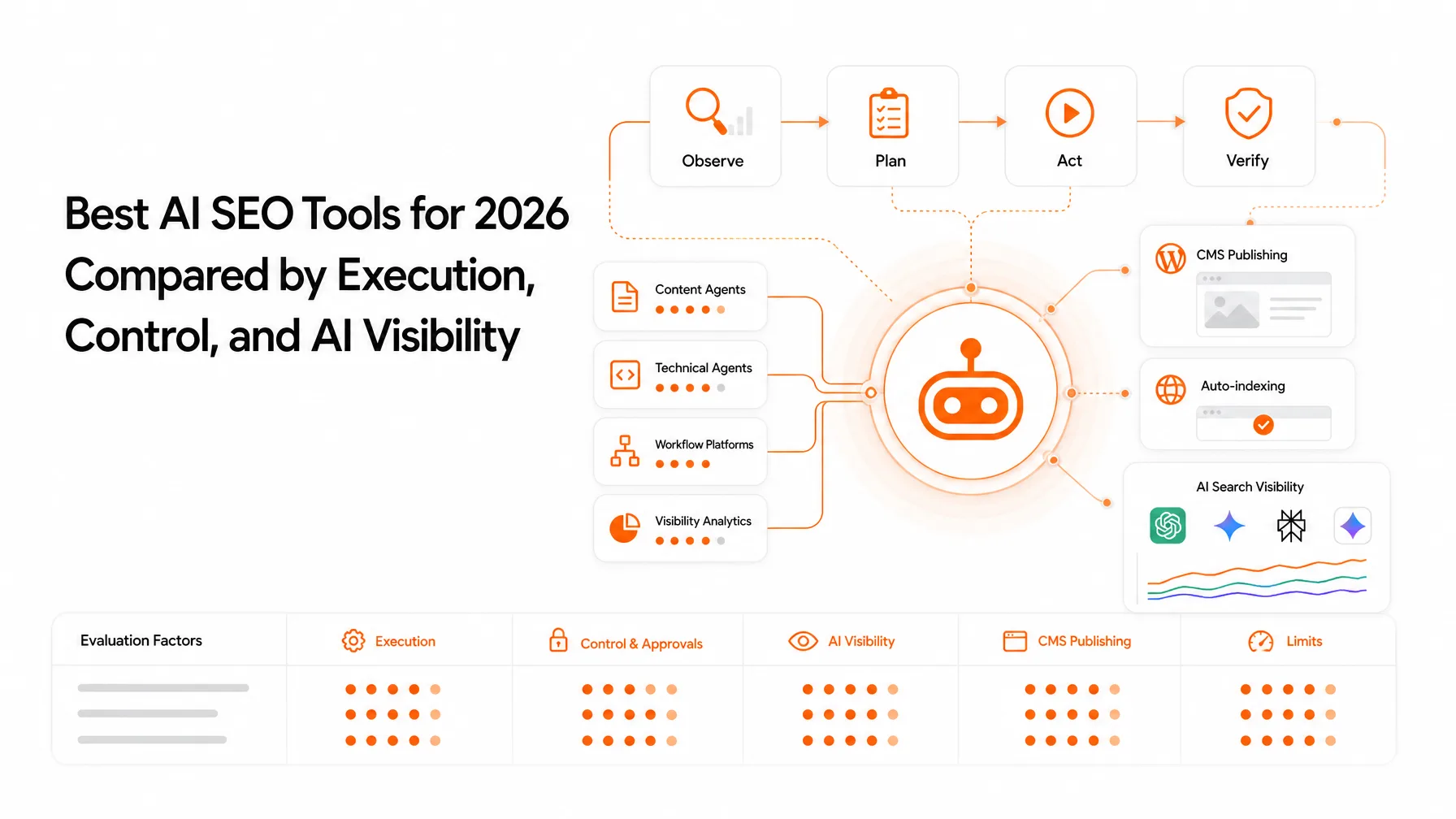
Law firm website SEO is the coordinated work of making practice areas, locations, attorneys, technical health, local signals, and consultation paths easy for search engines and prospective clients to understand. Fix crawlability and site architecture first, then local signals, attorney-reviewed content, contact paths, and measurement. Verify progress in Google Search Console and Google Business Profile instead of expecting guaranteed rankings.
Your site lists five services, the firm serves three towns, and nobody can say which page is supposed to rank. That's the usual starting point for a managing partner or marketing manager, and one more keyword rarely fixes it.
The real problem is a chain: page scope, indexation, local evidence, attorney credibility, contact paths, and measurement all depend on each other. I'm approaching this from a product and growth angle, the same lens behind the Keytomic SEO automation platform, not as an attorney, so nothing here is legal advice. For the wider strategy, see our broader SEO guide for lawyers; this checklist stays on website fixes for law firm SEO.
The checklist moves from foundations to content, local signals through Google Business Profile (GBP), technical checks, conversion paths, and monitoring in Google Search Console (GSC). It ends with a 30-day order of operations.
What Law Firm Website SEO Needs to Accomplish
Law firm website SEO is the coordinated improvement of structure, content, local relevance, technical access, trust, and intake. Google describes SEO as helping search engines crawl, understand, and present useful content, as laid out in Google's SEO Starter Guide. Raw traffic is only one measure of success.
Make the firm's services, jurisdictions, and attorneys easy to understand
A visitor should know within seconds what the firm handles, where it practices, and who would handle the matter. Search engines need the same clarity, expressed through page scope and plain language.
Connect search visibility to qualified consultations
Impressions don't pay anyone's salary. The useful question is whether the right person found the right page, trusted it, and made contact.
Prioritize dependencies instead of isolated keyword edits
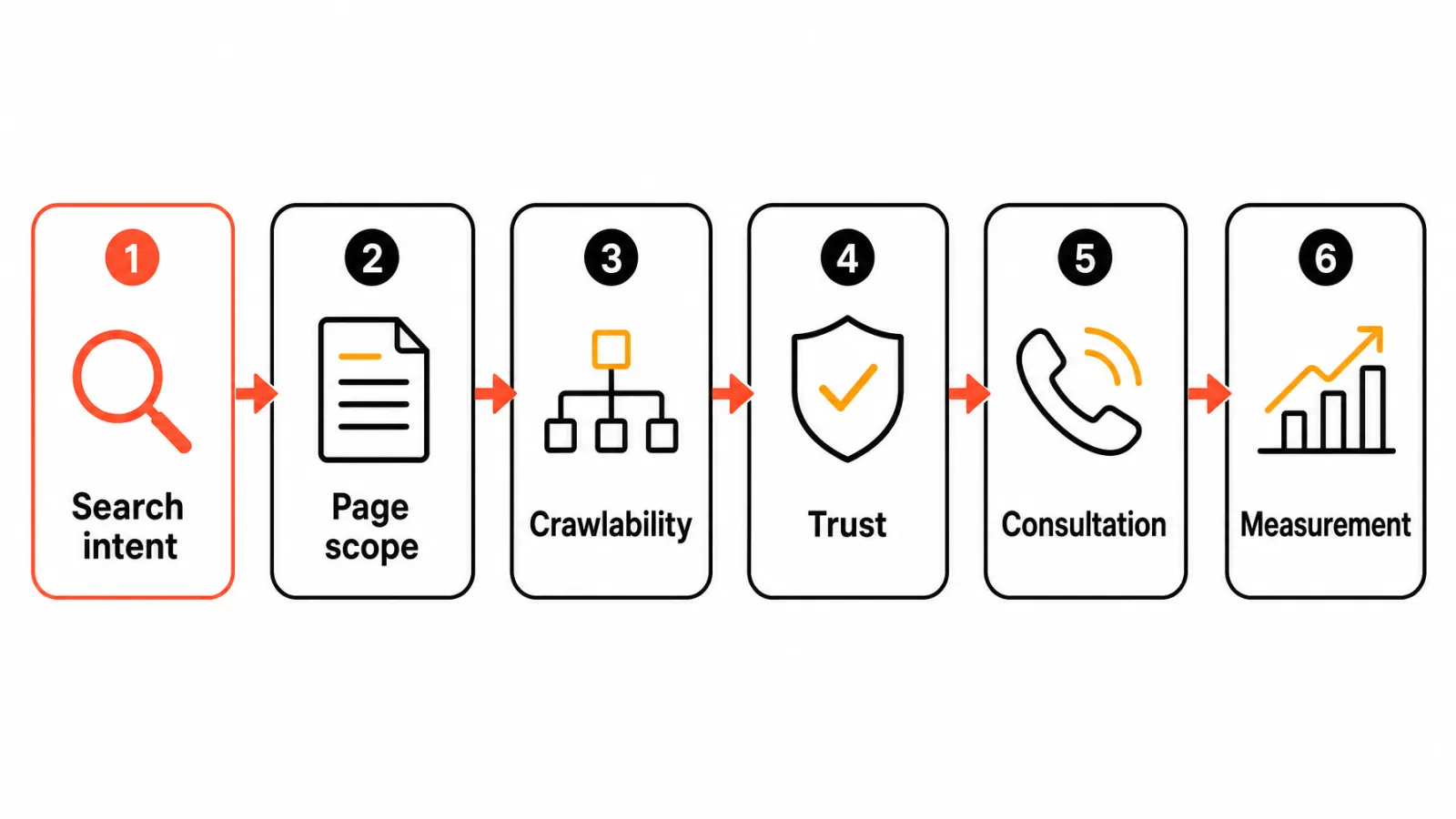
A polished service page that search engines can't index does nothing. Work in this order: Search intent > page scope > crawlability > trust > consultation > measurement.
15 Law Firm Website SEO Fixes to Prioritize First
So what should a law firm fix first? Start with indexation and page scope, because every later fix depends on them. The table below shows where each fix sits.
Fix | Issue | Priority | Dependency | Evidence needed |
|---|---|---|---|---|
1 | Unclear practice and location pages | High | None | Page inventory confirmed by the firm |
2 | Generic metadata | Medium | Fix 1 | Crawl export of titles |
3 | Thin service pages | High | Fix 1 | Reviewed page drafts |
4 | Weak site structure | High | Fix 1 | Page relationship map |
5 | Missing contextual links | Medium | Fix 4 | Internal link audit |
6 | Local relevance gaps | High | Fix 1 | Verified office and service areas |
7 | Inaccurate GBP details | High | Fix 6 | Profile matches website |
8 | Missing or mismatched schema | Medium | Fixes 1, 4 | Validation results |
9 | Technical blockers | Urgent | None | GSC and crawl reports |
10 | Mobile and speed problems | High | Fix 9 | Field data, phone test |
11 | Thin trust signals | High | Verified bios | Credentials from first-party sources |
12 | Content gaps | Medium | Fixes 1, 3, 11 | Intake questions, reviewer sign-off |
13 | Contact friction | High | Fix 10 | Tested forms and tracking |
14 | Weak authority signals | Medium | Fixes 3, 11 | Real relationships and assets |
15 | No measurement | Urgent baseline | None | Baseline report |
How this checklist was built: the 15 fixes come from the supplied outline, current Google documentation, and recurring themes in live search results. They're ordered by dependency, with crawlability and scope first, then content and local relevance, then trust, conversion, authority, and monitoring. This isn't a ranking of firms, agencies, or software, and it includes no client audit or test results.
Fix 1: Clarify Each Practice Area and Location Page
Separate three page types: a practice area page (such as personal injury), a matter or case-type page within it, and a genuine office or service-area page. Create a separate page only when the service, search intent, jurisdiction, audience, or local substance is meaningfully different. Does every practice area need its own page? Not automatically, and the same test applies.
Swapping [city] and [state] across near-identical pages adds little. The firm should publish pages only for places and jurisdictions it genuinely serves.
Fix 2: Improve Title Tags and Meta Descriptions
Write unique, descriptive titles that match the page and the search intent. A template might read [Practice Area] Lawyer in [City] | [Firm Name], with placeholders replaced only by facts the firm can confirm. Descriptions help users judge a result, though Google may rewrite them.
Don't promise a ranking or CTR lift from a metadata edit alone. Verify with a crawl export that flags duplicates, truncation, and mismatches with page content.
Fix 3: Strengthen Law Firm Service Page Content
A service page should answer the visitor's next question before it sells. Include a direct answer, matter types served, a process overview, the relevant jurisdiction, what a prospective client may want to prepare, the attorney or reviewer behind the page, the limits of general information, and a clear next step.
Any explanation of rights, deadlines, fees, or outcomes needs qualified legal review. Don't invent attorney experience or imply individualized advice.
Fix 4: Build a Logical Website Structure
Aim for a hierarchy a stranger could sketch: homepage, practice hubs, service pages, attorney profiles, office pages, resources, and a consultation page. Use short descriptive URLs and add breadcrumbs where they help, following Google's breadcrumb structured data documentation.
Verify by mapping every important page to a parent and checking that none is buried.
Fix 5: Add Internal Links That Support Client Journeys
Link informational posts to the relevant service page, service pages to attorney profiles, office pages to the services offered there, and related resources to a consultation path. Use descriptive anchors such as 'personal injury consultation process' instead of 'click here.'
Links should be live, crawlable, and useful. A crawl will show whether priority pages receive contextual links or sit orphaned.
Fix 6: Optimize for Local SEO
Google describes local results as driven by relevance, distance, and prominence, according to Google Business Profile's local ranking guidance. Local SEO for law firms therefore means accurate business details, real locations, relevant service pages, natural local references, and reviews handled within platform and bar rules.
Don't assign percentage weights to citations or reviews. Should a firm build a page for every city? No, only where there's real local substance.
Fix 7: Improve the Google Business Profile
Treat the GBP as a checklist: verification, accurate name, primary category, services, description, phone, website, hours, photos, office details, updates, and review responses. Keep every detail consistent with the website, since mismatches weaken the signals covered in our guide on how to rank higher in Google local listings.
Don't add keywords to the name unless they're part of the real-world business name, and don't promise map pack placement. Follow Google's policies and applicable legal advertising rules, and have counsel review review-request practices.
Fix 8: Add Relevant Legal Schema Markup
Schema.org defines LegalService as a business type for legal services, per Schema.org's LegalService type definition. Use LegalService or LocalBusiness and Organization for the firm, Person for attorneys, Article for posts, and BreadcrumbList for visible breadcrumbs, but only where the markup matches the page.
Add FAQPage only if the same questions appear on the page. Don't expect rich results, since Google's FAQ rich result changes limit them to well-known authoritative government and health sites. Validate markup before publishing.
Fix 9: Resolve Technical SEO Problems
Work through this list, and separate each detected issue from its business impact:
Indexability: noindex tags, robots.txt blocks, and URL Inspection results in GSC
Canonical tags and duplicate URLs
Redirect chains, broken links, and status codes
XML sitemap accuracy
JavaScript rendering of key content
Not every audit warning is equally urgent. Fix blockers on high-value pages first, then problems with clear evidence. If key practice pages are indexed but still invisible, check the common reasons pages get indexed but don't rank.
Fix 10: Improve Mobile Experience and Page Speed
Check responsive layouts, readable text, tap targets, form usability, tap-to-call links, intrusive pop-ups, and image weight. Google's Core Web Vitals documentation lists good thresholds: LCP within 2.5 seconds, INP under 200 milliseconds, and CLS under 0.1.
Those metrics describe real-world loading, responsiveness, and visual stability, not the whole ranking system. For a closer look, see how important page speed is for SEO. Check field data in GSC, then test the contact path on an actual phone.
Fix 11: Demonstrate Experience and Trust
Show verified attorney bios, roles, admissions, education, and professional activity, plus clear authorship and editorial review on legal content. Separate the attorney author, the SEO author, and the legal reviewer. Google's guidance on helpful content stresses clear authorship and accurate attribution, though no single signal guarantees anything. Our breakdown of Google's E-E-A-T framework explains how these trust signals fit together.
Don't invent case results, awards, specialist status, or testimonials. State-specific advertising rules need review by someone qualified in that jurisdiction.
Fix 12: Create Content Around Real Legal Questions
Start from actual intake questions: process, document preparation, terminology, and what to ask in a consultation, tied to jurisdiction and client stage. Plan them with an SEO content calendar workflow and name an owner for time-sensitive updates.
General information isn't individualized advice, and substantive answers need legal review. Can AI write this content? It can help organize research and drafts, but humans must fact-check and approve it.
Fix 13: Strengthen Consultation and Contact Paths
Review visible phone links, forms, consultation expectations, accessibility, privacy notices, spam protection, confirmation messages, and call and form tracking. Counsel should review privacy, intake, and disclaimer language for the jurisdiction, because a conversion tweak isn't a legal requirement.
Measure qualified inquiries, not only form fills or phone taps. Submit test inquiries and confirm each reaches intake and is tracked.
Fix 14: Earn Relevant Legal and Local Backlinks
Look for real relationships and useful assets: bar associations, local organizations, community partnerships, legal publications, civic or university resources, and original research. Tie every outreach idea to something genuine.
Skip link schemes, irrelevant directories, paid links, fabricated sponsorships, and unverified awards. No link type carries a fixed value, so judge each by relevance and usefulness.
Fix 15: Monitor Rankings, Indexation, and Search Visibility
Build a recurring report from GSC impressions, clicks, CTR, average position, query match, indexed pages, and issue trends. Add GBP actions, analytics engagement, calls, forms, and qualified consultation status, plus signed-matter attribution only where it can be measured lawfully and reliably.
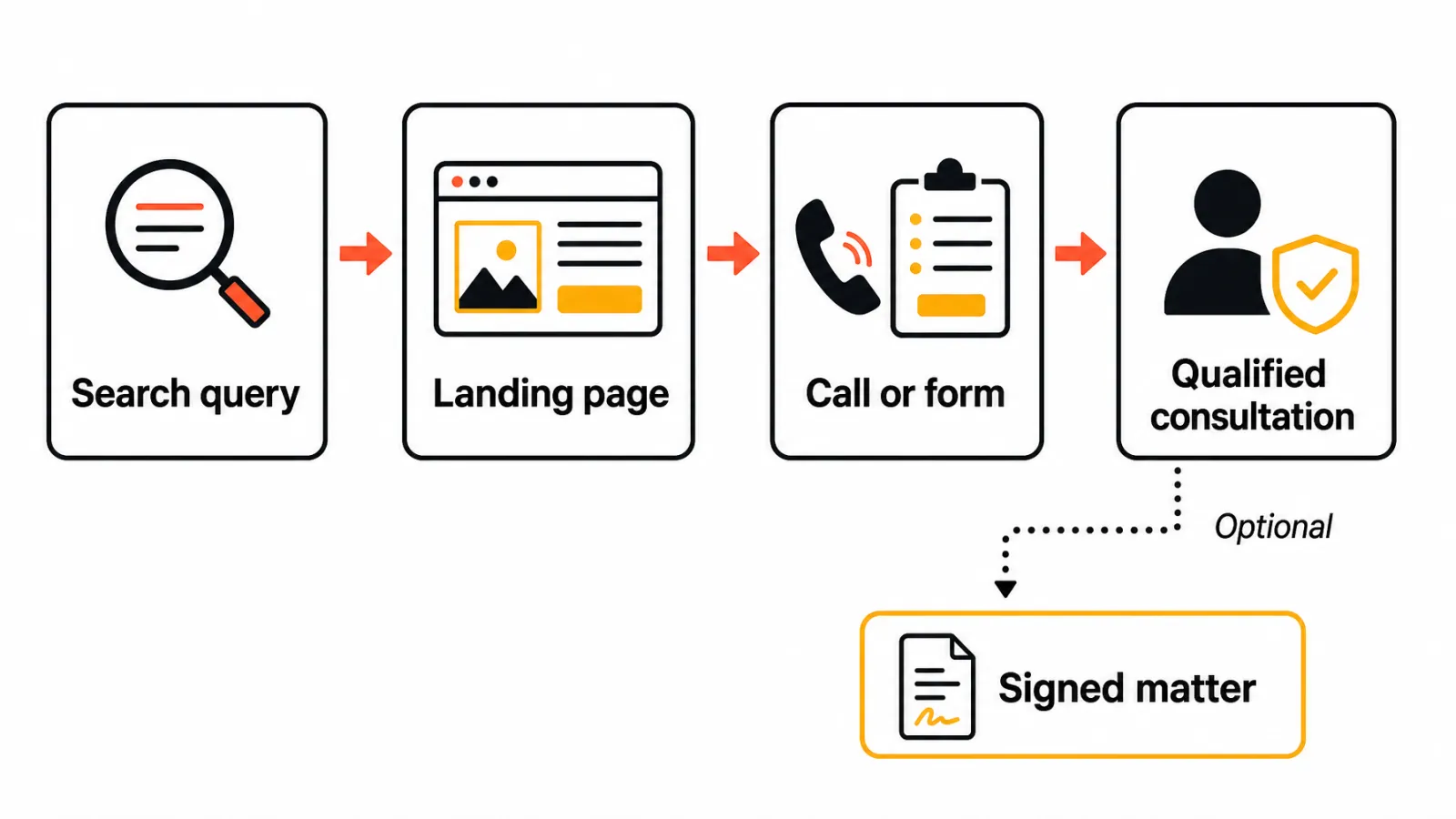
How can a firm measure SEO beyond rankings? Follow the chain from query to landing page to contact to qualified consultation. AI citation pickup can be tracked as an observation, but rankings don't equal revenue.
How to Implement the 15 Fixes in 30 Days
Thirty days is enough to implement these fixes in order, not to promise results. Here's the sequence, with owners and proof of completion.
Period | Priority | Owner | Completion evidence |
|---|---|---|---|
Days 1 to 3 | Baseline indexation, top queries, GBP accuracy, key practice pages, forms, contact paths | Marketing lead | Documented baseline and issue list |
Days 4 to 10 | Fix noindex, canonicals, redirects, broken links, sitemap, mobile blockers, hierarchy | Developer | Re-crawl and URL Inspection checks |
Days 11 to 20 | Improve practice pages, attorney profiles, local content, links, metadata | Content owner and attorney reviewer | Reviewed drafts and live-link checks |
Days 21 to 30 | Publish approved updates, assign maintenance, connect measurement | Marketing lead | Dashboard baseline and next review date |
Days 1 to 3: Establish the baseline and find blockers
Record GSC queries, indexed pages, GBP details, and contact paths before changing anything. Without a baseline, later movement can't be tied to a specific fix.
Days 4 to 10: Repair technical and structural dependencies
Technical and structural work gates everything else, so it goes first. Re-crawl after each batch.
Days 11 to 20: Improve practice pages, trust signals, and local assets
Now improve priority pages, bios, metadata, and local assets. Each draft should clear legal review before it goes live.
Days 21 to 30: Publish, measure, and assign ownership
Publish approved updates, name maintenance owners, and set the next review date. Treat this as an implementation window, not a ranking promise.
Running through these fixes by hand means juggling a crawl tool, a GBP checklist, a content calendar, and a reporting dashboard separately. Keytomic can tie the research, technical audits, drafting, and visibility monitoring behind Fixes 9, 12, and 15 into one approval-based workflow, with legal review and final sign-off staying with the firm.
Frequently Asked Questions About Law Firm Website SEO
What is law firm website SEO?
Law firm website SEO is the coordinated improvement of a legal website's structure, content, technical accessibility, local relevance, trust signals, and consultation paths.
What should a law firm fix first for SEO?
Fix indexation and page architecture before publishing more content. Pages that search engines can't crawl or understand won't benefit from new articles.
Does every practice area need its own page?
A practice area usually deserves its own page when the service, intent, jurisdiction, or audience is meaningfully different. Otherwise, consolidate.
Should a law firm create a page for every city it serves?
No, a law firm should not create near-identical city pages without genuine local substance and a real service reason.
How does local SEO for law firms differ from national SEO?
Local SEO adds location and business-profile signals to the broader work of making services and content relevant.
How do I improve a law firm's Google Business Profile?
Keep the profile verified, accurate, complete, policy-compliant, and aligned with the firm's real-world services and location.
What schema should a law firm website use?
A law firm may use relevant Schema.org types such as LegalService, LocalBusiness, Organization, Person, Article, and BreadcrumbList when the markup matches visible page content.
How long does law firm SEO take?
There is no universal SEO timeline because results depend on competition, site history, technical health, content quality, authority, and implementation consistency.
How can a law firm measure SEO beyond rankings?
Measure qualified inquiries, consultation quality, indexed pages, relevant queries, clicks, CTR, and lead attribution alongside rankings.
Can AI write legal SEO content?
AI can assist with research organization and drafting, but legal content still needs human fact-checking, editorial review, and qualified jurisdictional review.
Choose the Next Fix Based on Evidence, Not Guesswork
Before your next sprint, ask three questions:
Is the site crawlable and indexable?
Do the right service and location pages exist?
Can the firm connect search activity to qualified inquiries?
Pick the answer that exposes a verified blocker, and fix that first. For law firm website SEO, that rule beats any generic task list. The best next SEO fix is the highest-impact verified blocker that prevents the right client from finding, trusting, or contacting the firm.