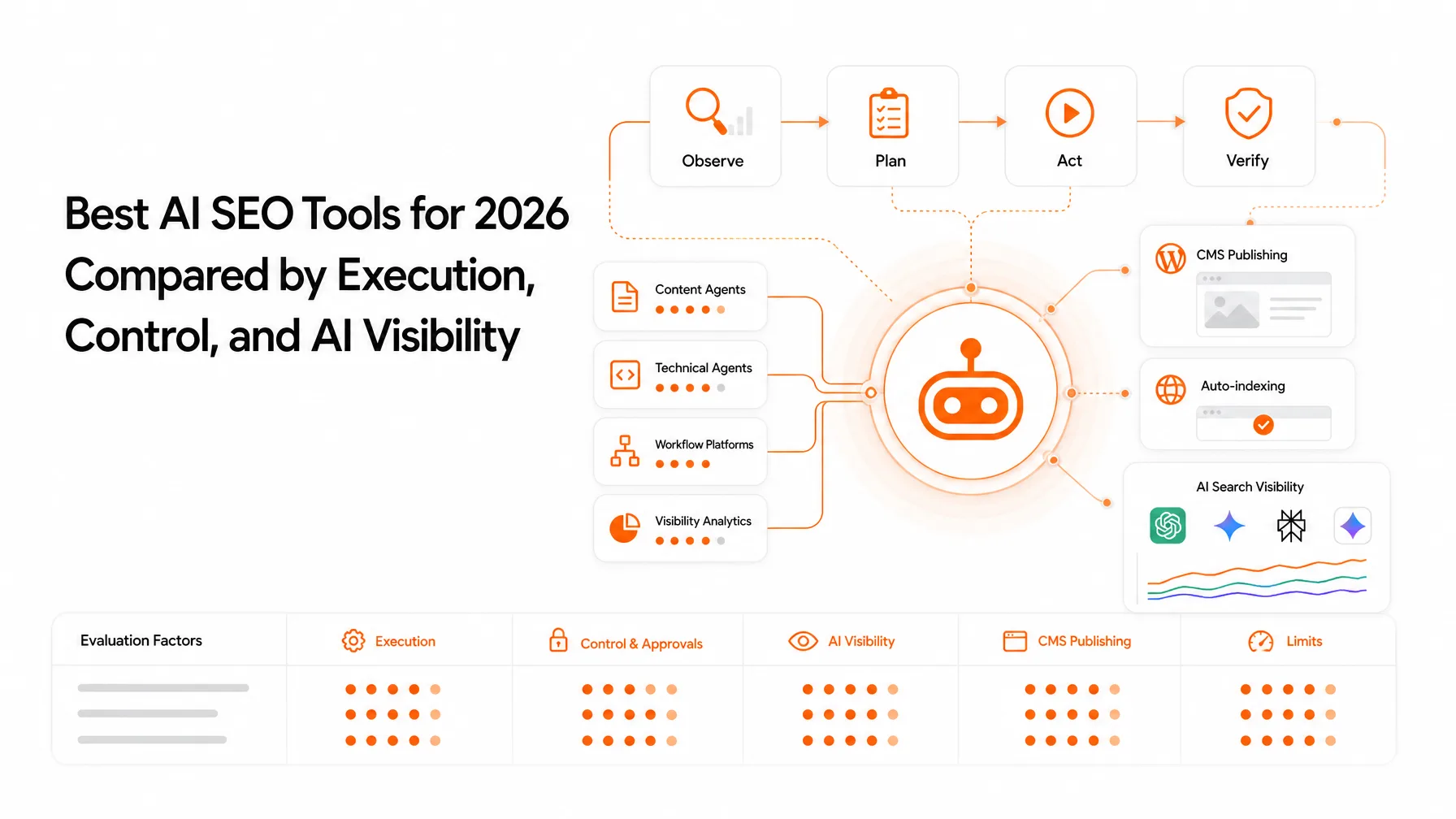
AI visibility for local businesses is how often AI search experiences mention, recommend, or cite a business when people ask local questions. It's not a Google ranking or a Map Pack position.
The practical path: keep business facts consistent, maintain a complete Google Business Profile, publish useful service and location content, keep key pages crawlable, earn credible references, and test a fixed set of real prompts.
You show up in Google Maps, your reviews look healthy, and then a customer asks an AI assistant for a nearby provider and your business isn't mentioned. Or it is, but with last year's services, the wrong suburb, or hours you changed months ago. That's a frustrating spot, and it's getting more common.
Here's the thing: there's no hidden ranking factor to chase. AI visibility for local businesses comes down to whether several systems can identify the same business, understand what it does and where, and find enough reliable evidence to describe it accurately. Google says its AI features build on the same foundational SEO practices as regular Search, with no special AI-only markup required.
Keytomic publishes this guide, and I'm writing it from a product and growth angle. It covers how AI visibility differs from local SEO, why businesses get missed, which signals matter, how to fix the foundation, and how to track real prompts without promising citations.
How AI Visibility Works for Local Businesses
AI visibility is an observed outcome, not an official search metric. You get it by running a fixed set of local prompts, like "best [service] in [city]", across the engines your customers use, then recording what each answer says. Nobody publishes a universal AI visibility score, so any number you see is specific to the tool that produced it.
For a broader look at how this plays out across AI platforms, see our guide on AI search visibility for B2B SaaS — the measurement principles carry over to local businesses too.
Aspect | Traditional local SEO | Google AI features | Broader AI assistants (ChatGPT, Google Gemini, Claude, Perplexity) |
|---|---|---|---|
What you observe | Map Pack and organic positions for a query | Whether your pages appear as supporting links in Google AI Overviews or AI Mode | Whether your business is mentioned, recommended, or cited in a generated answer |
What it relies on | Relevance, distance, and prominence, plus site quality | Indexed pages that are eligible for normal Google Search visibility | Varies by provider, so check each provider's documentation or test prompts |
How you check it | Rank checks and performance reports | Performance reports plus recorded observations | Dated prompt logs with engine, location, and exact wording |
AI visibility is not the same as a local ranking
A business can hold a strong Map Pack position and still be missing from an AI answer. It can also be named in an answer without holding a top organic position. Google's documentation says a page must be indexed and eligible for normal Search to appear as a supporting link in its AI features.
Clicks matter here too. In a Pew Research Center analysis of 900 US adults' browsing in March 2025, users clicked a traditional result in 8% of visits with an AI summary and 15% without one. Only 1% of visits with a summary included a click on a link inside it. That sample is US-based and Google-wide, not local-specific, but it shows why being named in the answer can matter as much as the link underneath.
One more distinction, and it's where most guides blur things. Keep these four observations separate:
Mentioned: the business name appears in the answer.
Cited: a source shown or linked belongs to the business or describes it.
Recommended: the answer presents the business as a good option for that prompt.
Accurately described: services, location, and hours match reality.
Merging them into one score hides the real problem. A business that's mentioned with the wrong phone number has a different issue from one that's never mentioned at all.
What an AI answer may use to describe a business
Depending on the engine, an answer may draw on the business's own website, local profile data, reviews, directories, and press mentions. Google documents how its own features work. ChatGPT, Google Gemini, Claude, and Perplexity each behave differently, and I wouldn't treat any single observed answer as a rule.
Treat claims about their sources as hypotheses until provider documentation or a dated prompt test supports them.
Why the answer changes by prompt, location, and AI platform
The same need, worded differently, can return different businesses. "Best [service] near me" and "who offers [service] with [specific need] in [neighborhood]" are illustrative prompts, not verified demand data, and they can surface different results.
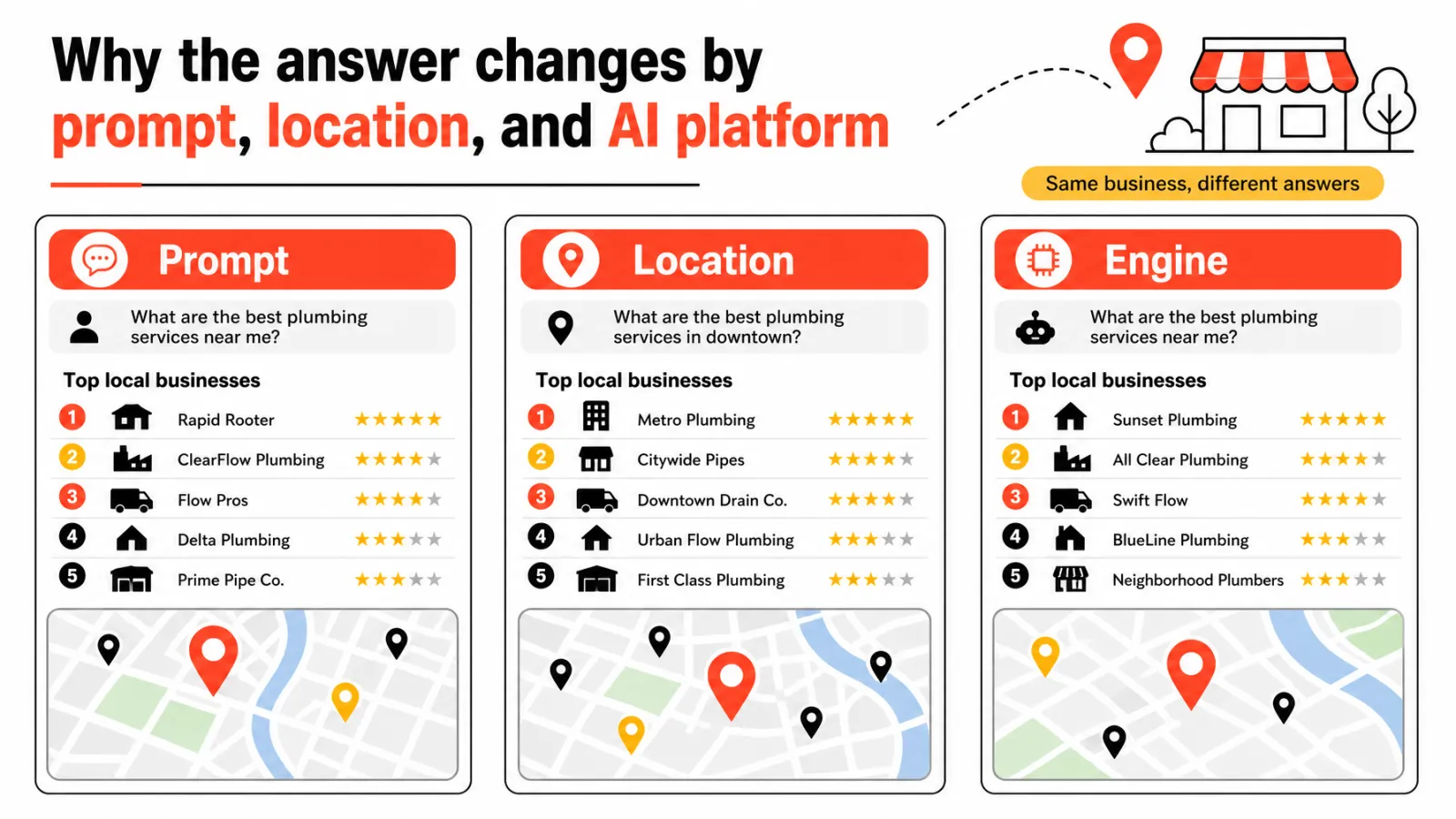
Location, engine, user context, and timing all shift the answer too. That's why one screenshot of one answer proves very little, and why a fixed prompt set logged over time is the fairest way to see movement.
Why Is My Local Business Missing From AI Search Answers?
Usually the business is hard to identify, hard to verify, or hard to reach. These are diagnostic categories, not universal ranking factors. My decision rule for AI visibility for local businesses: repair identity and access gaps before publishing more content, because new pages built on shaky facts just scale the problem. Our guide on how to improve brand visibility in AI answers covers the full diagnostic across platforms.
A quick symptom check:
Wrong or outdated details in answers: compare hours, address, and services across your profile, site, and directories.
Never named, even for your core service: check whether service pages exist, are indexable, and name the areas you serve.
Named, but competitors get recommended: look at which credible sources corroborate them and not you.
The business entity is inconsistent across the web
Is your business name written the same way everywhere? Variations in name, category, phone, hours, or service area can make it harder for any system to treat scattered mentions as one business. An illustrative example: "Acme Plumbing" on your site and "Acme Plumbing & Heating Ltd" on a directory.
The website explains the service but not the local context
A service page often says what you do but not where, for whom, or for which local problems. Thin, near-identical city pages don't fix that. Clear, distinct local detail does.
Important pages or business details are hard to crawl or verify
Pages blocked in robots.txt, marked noindex, or never linked internally are hard for any system to find. Incomplete profile fields and few credible third-party references make the business harder to verify. Diagnose these before you read anything into your prompt results.
The Core Signals That Support Local AI Visibility
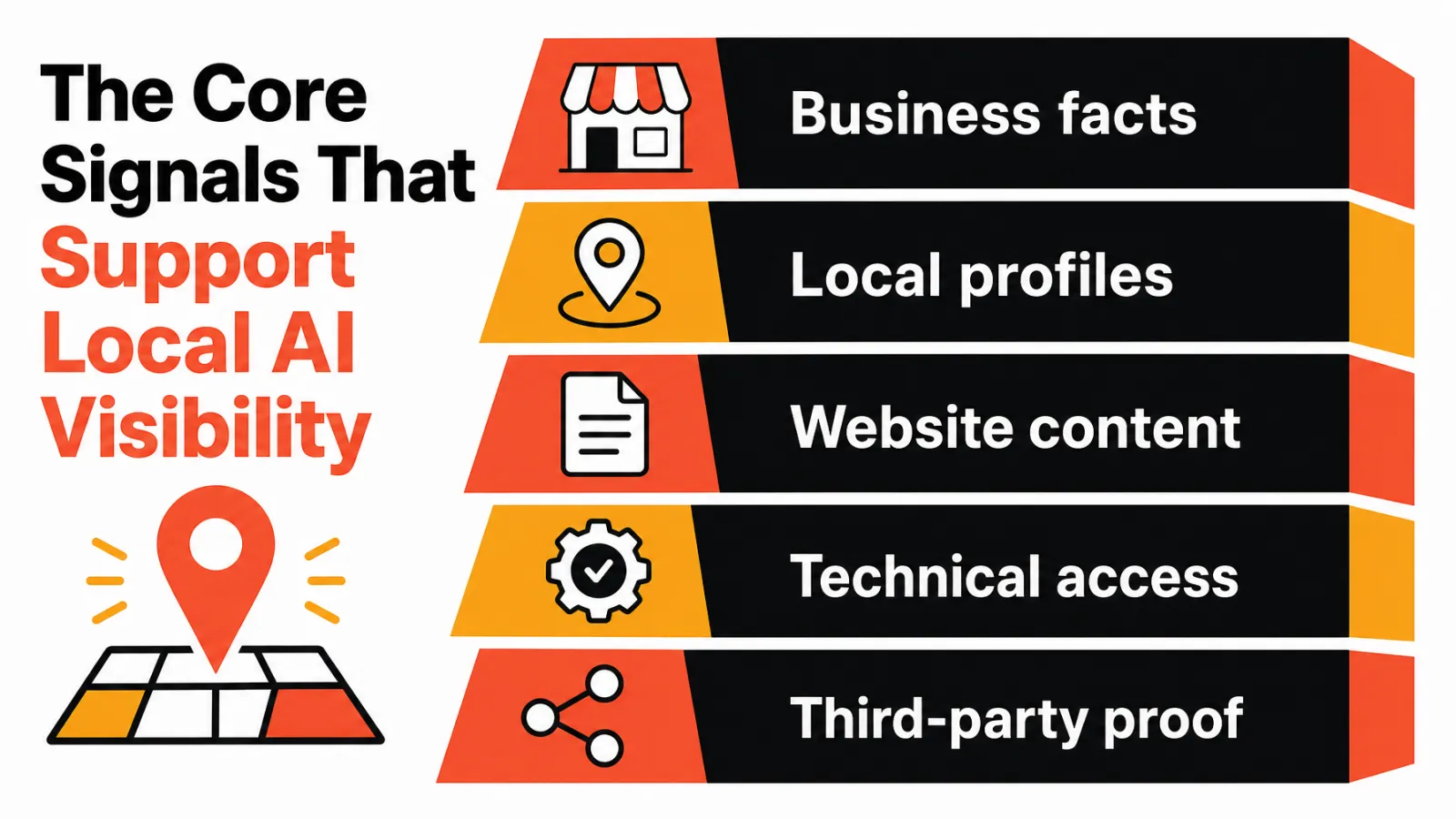
Think of it as an evidence stack, not a tactic checklist. The layers are first-party business facts, local profile data, website content, technical accessibility, and third-party corroboration. Each proves something different, and none guarantees a recommendation.
Google Business Profile and accurate local business information
Google says local results are based on relevance, distance, and prominence, and it recommends complete, accurate details such as address where applicable, hours, category, and attributes. See Google's Business Profile guidance on local ranking for the official wording. Reviews and helpful responses can help a business stand out, but they don't promise an AI recommendation.
Google Business Profile is an important information source, especially on Google surfaces. I wouldn't generalize it to every AI provider.
Service pages, location pages, internal links, and structured data
Your site should say what you do, where you serve customers, who you serve, and why you're relevant to the local problem. Internal links help people and crawlers find those pages.
LocalBusiness markup communicates business details to Google, must match visible page content, and doesn't guarantee a rich result or citation. Structured data for AI visibility covers how markup intersects with AI search specifically. Google's LocalBusiness structured data documentation explains the properties and testing.
Reviews, citations, and third-party references
Credible directories, local press, industry bodies, and community organizations can corroborate who you are and what you do. Treat business citations as a reasonable, testable supporting layer, not a guaranteed cause of AI mentions. Never buy artificial mentions or fake reviews; it's dishonest and puts your reputation at risk.
Helpful content, author context, and evidence of real expertise
E-E-A-T is a quality and trust concept, not an isolated ranking switch. Show who is behind the work: named practitioners, qualifications you actually hold, real project details, and local specifics. Google's optimization guide for AI search stresses helpful, non-commodity content and warns against manipulation.
How Can a Local Business Improve Its AI Search Visibility?
Work through these four steps in order. Each one makes the next more reliable.
Step 1: Audit the business entity and local profiles
Compare these details across your website, Google Business Profile, and major directories:
Business name, category, and service wording
Address or service area, phone, and URL
Hours, including holiday hours
Services and attributes
Fix mismatches at the source first, then update the copies.
Step 2: Build useful service-and-location coverage
Strengthen core service pages with who, where, and how.
Add location pages only when each has distinct, useful information such as real areas served and genuine local questions.
Add supporting problem pages and FAQs, linked from related pages.
Should you create a page for every city? Not unless each page earns its place. Near-duplicate pages are a quality risk, not a visibility plan.
Step 3: Fix crawlability, internal linking, and structured data
Confirm key pages return valid responses and aren't blocked or set to noindex.
Link them from the site and include them in the sitemap where appropriate.
Keep canonical URLs consistent.
Make sure LocalBusiness markup matches visible content.
Google's crawling and indexing documentation covers robots.txt, sitemaps, and canonicalization. A technical fix removes a barrier; it doesn't automatically earn a citation.
Step 4: Track real customer prompts and citation context
Build a stable prompt set by service, location, problem, and comparison intent, and keep the wording fixed. Then run it on a schedule. Good AI visibility tracking across major assistants records mentions, citations, context, and competitor appearances. For a deeper look at how to set up LLM citation tracking, that guide walks through the methodology in detail.
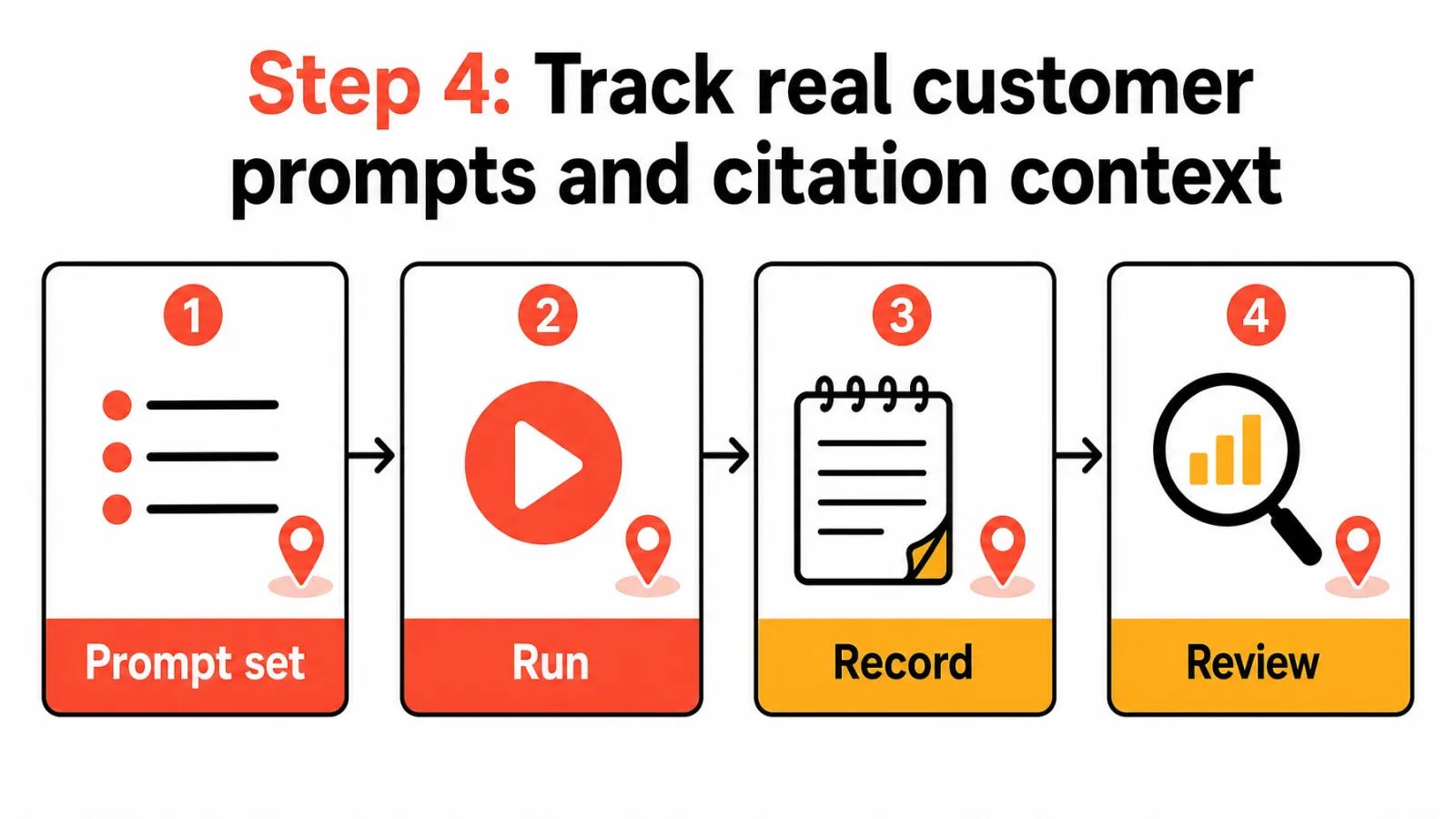
Here's an illustrative log template (columns only, not results):
Prompt and engine
Date and location
Business mentioned or recommended
Cited source
Description accurate or not
Competitors present
If you report numbers from this log, add a short methodology note with engine, date, location, prompt set, and number of runs.
Local SEO and AI Search Optimization: What Changes?
Local SEO stays the base layer. AI search optimization adds an observation layer on top of it. If you're comparing your options, our roundup of the best local SEO tools covers both traditional and AI-focused platforms.
Area | Local SEO | AI search optimization |
|---|---|---|
Rankings | Tracks Map Pack and organic positions for target queries | Tracks whether the business appears in generated answers for a fixed prompt set, with no single universal position |
Citations | Builds consistent directory listings and local references | Records which sources are cited or shown and whether they describe the business correctly |
Answer inclusion | Not measured directly | Notes whether the business is mentioned, recommended, cited, and accurately described per engine |
Entity clarity | Keeps name, address, phone, and hours consistent across profiles | Does the same, then checks how each engine describes the business |
Source quality | Prefers relevant, credible local listings and links | Reviews which credible pages corroborate the business and where competitors have stronger support |
What stays the same
Accurate business information, useful content, crawlability, internal links, legitimate reviews, and local relevance. So can AI search optimization replace Google Business Profile work? No.
What becomes more important
Prompt-level observation, how the business is described, the context around cited sources, variation between engines, and answer accuracy.
What not to chase
Avoid a secret prompt, guaranteed citations, a single universal AI visibility score, and special files presented as mandatory (Google says AI-only files aren't required for its features). Skip content written only to manipulate related queries.
A Monthly AI Visibility Checklist for Local Businesses
One priority rule: fix inaccurate business facts before expanding content, and fix inaccessible pages before interpreting any visibility change. Once a month, work through these checks for AI visibility for local businesses.
Profile and entity checks
Business name, category, hours, and services match across profile, site, and directories.
Service area or address is correct.
Profile updates, photos, and review responses are current.
Website and content checks
Service and location pages are still accurate and distinct.
Key pages are indexable, linked internally, and in the sitemap.
Structured data matches visible content.
Measurement and decision checks
Rerun the fixed prompt set and log engine, date, and location.
Note inaccurate descriptions, cited sources, and competitor presence.
Record new legitimate references.
Pick one fix for the month.
Frequently Asked Questions About Local AI Visibility
What is AI visibility for a local business?
It's how often AI answers mention, recommend, or cite your business across a fixed set of local prompts. It's an observation, not an official ranking metric.
Is AI visibility the same as local SEO?
Local SEO remains the foundation. AI visibility adds a layer that records how generated answers mention and describe your business.
How can I get my local business mentioned in ChatGPT?
No submission form or switch guarantees it. Keep business facts consistent, publish useful content, earn credible references, and test prompts regularly. Our guide on how to improve brand visibility in ChatGPT walks through the specifics.
Does Google Business Profile affect AI visibility?
It's central to Google local presence and may inform some systems. Don't assume every AI provider uses it, and keep it complete and accurate regardless.
Do reviews and citations guarantee AI recommendations?
They support local trust and corroboration, but no single signal guarantees a recommendation. Keep them legitimate and consistent.
Does LocalBusiness structured data guarantee AI citations?
It helps communicate eligible business details to Google, which doesn't promise a rich result, ranking, or citation. Keep markup matching visible content.
How should a local business measure AI visibility?
Use a stable prompt set, repeat it on a schedule, and log engine, location, mentions, citations, accuracy, and competitor presence.
Should I create a page for every city I serve?
Only when each page offers distinct, useful local information. Near-duplicate pages made for query variants add quality risk without helping customers.
Can AI search optimization replace local SEO?
Google's guidance says foundational SEO practices remain relevant for its AI features, so profiles, content, and crawlability still matter.
How often should I check local AI visibility?
Pick a consistent schedule that fits your resources and how often your business changes. Stick with it so comparisons stay fair.
Decide What to Fix First
Start with what's actually broken, because AI visibility for local businesses rewards a sound foundation more than extra content volume.
If business facts differ across profiles, repair profiles and entity data first.
If the site is hard to crawl or vague about services and locations, fix the technical and content foundation.
If the foundation is sound but AI answers still omit or misdescribe you, set a prompt-level baseline and investigate which sources are missing.
Getting found in AI answers starts with the same thing good local SEO has always needed — accurate facts, useful content, and pages that are actually reachable. What's new is the observation layer: running real prompts on a schedule and logging what each engine says. Keytomic's local SEO workflow connects the foundation to the measurement side, and the AI Visibility Tracker handles the prompt monitoring — so if you're ready to move from guessing to measuring, it's a practical place to start.