Table of Contents
Share Article
How to Build AI Search Visibility for B2B SaaS Brands
How to Build AI Search Visibility for B2B SaaS Brands
How to Build AI Search Visibility for B2B SaaS Brands

Ahsan Iqbal
Marketing Growth Expert
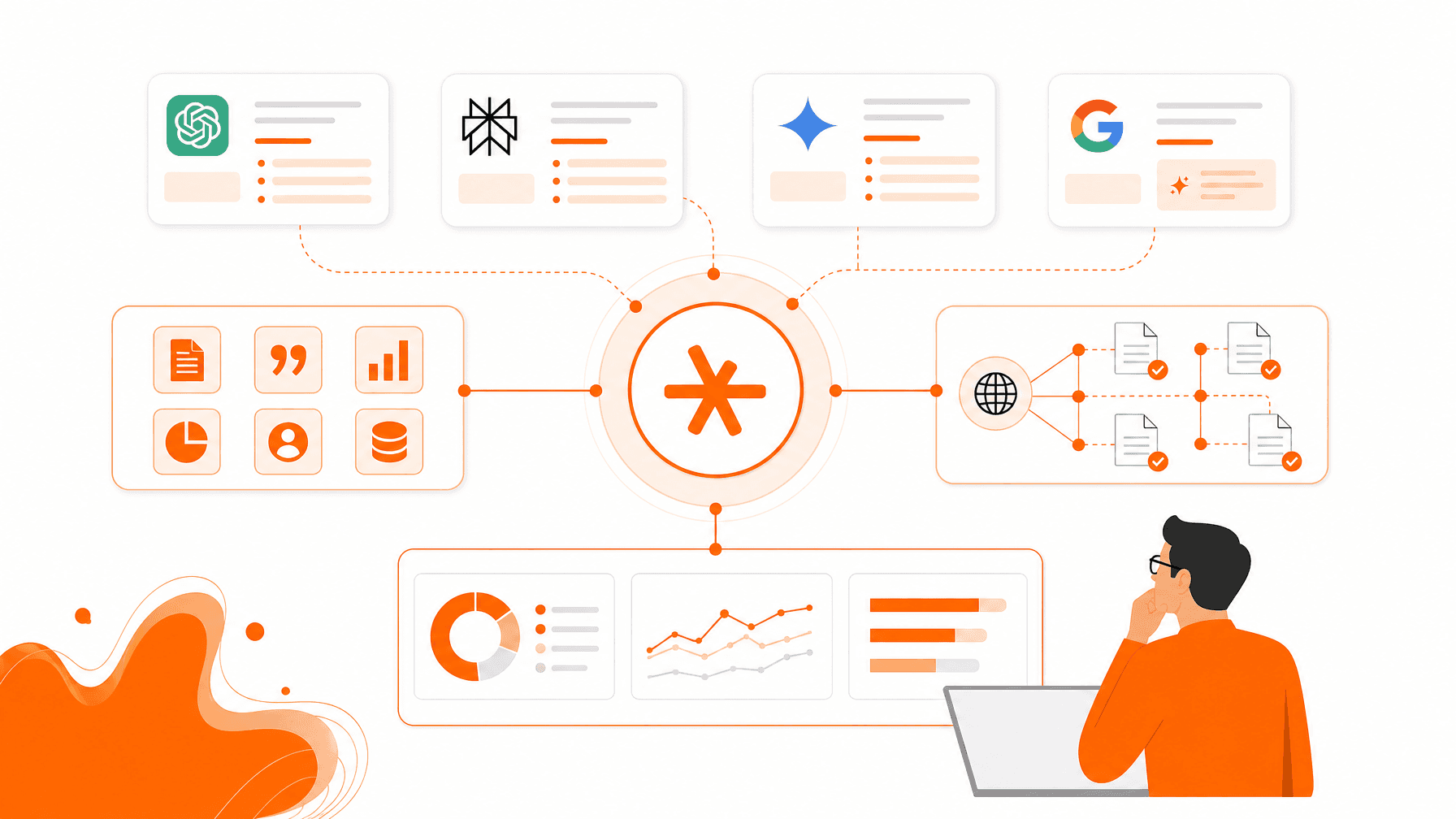
Learn how B2B SaaS teams build AI search visibility across ChatGPT, Perplexity, Gemini, and Google AI features with evidence and measurement.
AI search visibility for B2B SaaS is the extent to which a company is found, understood, mentioned, cited, recommended, and accurately represented in AI-generated answers.
Improve it by clarifying the product entity, publishing evidence-backed answers to buyer prompts, keeping important pages crawlable and internally linked, and earning credible third-party corroboration.
Measure mentions, citations, cited URLs, competitor presence, accuracy, referrals, and conversions across fixed prompts. No platform guarantees inclusion or placement.
Update note — September 1, 2026: This guide was reviewed against current Google Search, Ahrefs, BrightEdge, Bain, and DerivateX research. The citation-overlap figures were corrected and separated by methodology, Google’s Search Console AI-reporting rollout was refreshed, and new links were added to Keytomic’s AI visibility, platform, integration, and indexing workflows.
Your team ranks on page one for the category keyword. Google Search Console shows healthy impressions. But when a buyer asks ChatGPT or Perplexity which tools solve their problem, your brand is absent from the answer. That gap is not a Google problem. It is an AI search visibility problem, and it is costing B2B SaaS companies pipeline they will never see.
As of September 1, 2026, Google documents AI Overviews and AI Mode as Search experiences that use existing indexing fundamentals and may apply query fan-out to pull from supporting web pages. Google also says its Search Console generative-AI performance report rollout reached all websites worldwide on August 31, 2026. OpenAI separately documents crawler access for ChatGPT search through OAI-SearchBot. Neither platform guarantees inclusion or uses a published universal ranking formula.
This guide covers the full operating model: how to define visibility, diagnose why your brand is missing, prioritize the right signals, create citation-ready content, measure repeatably, and evaluate where automation can reduce execution effort without compromising quality.
What Does AI Search Visibility Mean for B2B SaaS?
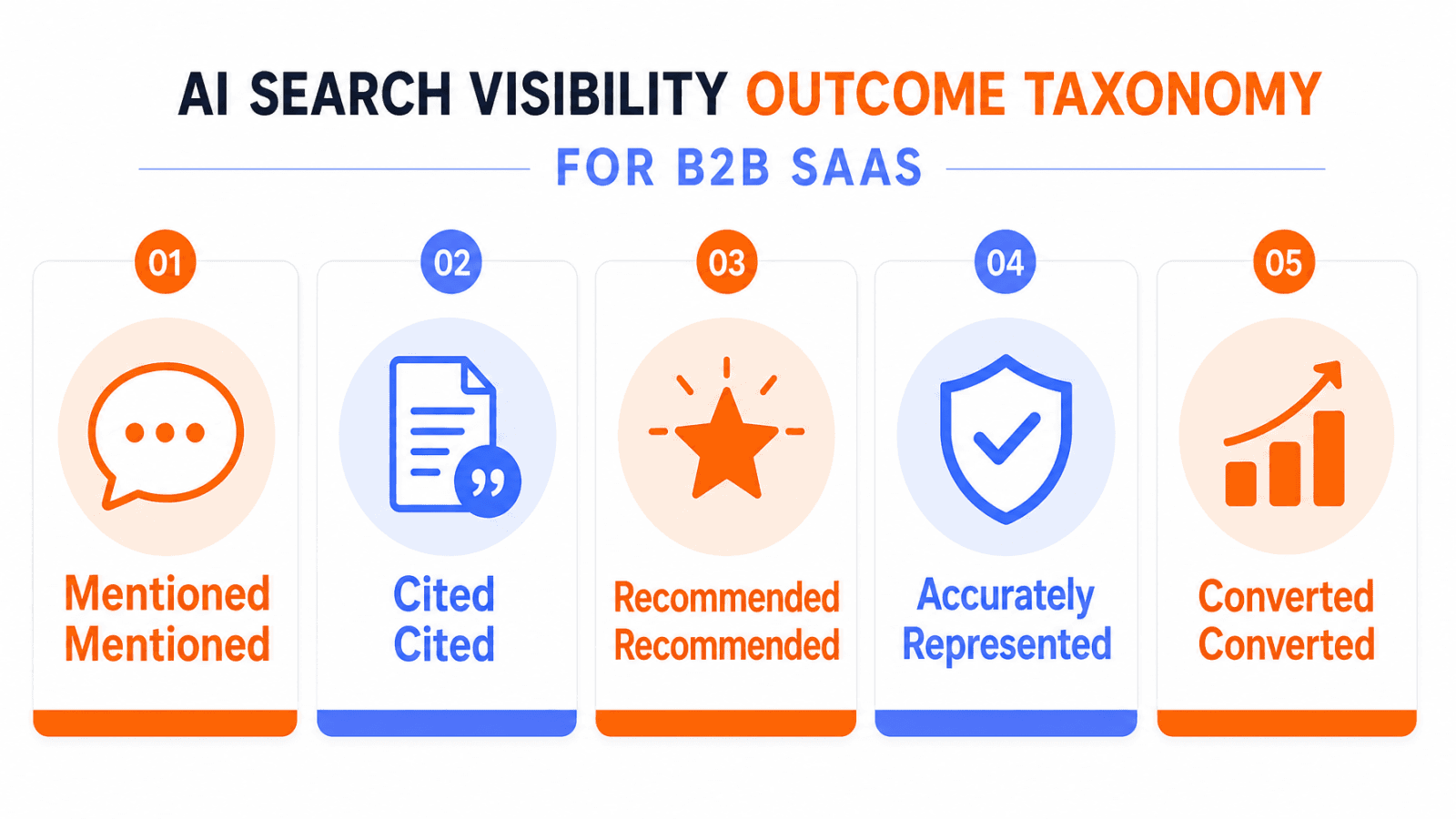
AI search visibility is not a single metric. It is a set of observable outcomes across multiple platforms and prompt types. A brand can be mentioned without being cited, cited without being recommended, and recommended without being accurately described. Each outcome has a different commercial value and requires different evidence to achieve.
For B2B SaaS teams, the relevant surfaces include ChatGPT, Perplexity, Google Gemini, Google AI Overviews, Google AI Mode, and Microsoft Copilot. Each platform uses different retrieval mechanisms, crawl policies, and synthesis logic, so performance on one does not predict performance on another.
How AI Visibility Differs From Google Rankings and Branded Search
Dimension | Traditional Google Ranking | AI Search Visibility |
|---|---|---|
Unit of success | Page position on SERP | Mention, citation, or recommendation in AI answer |
Ranking factor | Crawlability, relevance, authority | Entity clarity, evidence quality, retrieval access, corroboration |
Traffic signal | Click-through rate from SERP | AI referral sessions where identifiable |
Measurement tool | Google Search Console | Prompt testing, AI tracker, GSC referral filter |
Position-to-citation overlap | High in traditional SEO | About 17% in BrightEdge’s analysis; 37.9% in Ahrefs’ separate study |
Competitor proximity | SERP neighbors | Brands cited in the same AI answer |
A strong Google position does not guarantee an AI citation. In a BrightEdge analysis, about 17% of AI Overview-cited sources also ranked in the organic top 10. A separate Ahrefs study reported 37.9% using 863,000 keyword SERPs and 4 million AI Overview URLs. These figures use different datasets and definitions, so treat them as directional evidence rather than one universal rate.
Which AI Search Surfaces Matter to SaaS Buyers?
Different platforms dominate different stages of the B2B buying journey. ChatGPT and Perplexity tend to appear in early category discovery and problem-solving prompts. Google AI Overviews and AI Mode intercept queries when buyers move to comparison, implementation, and validation. Microsoft Copilot is increasingly embedded in enterprise workflows where procurement decisions are made.
Mapping your brand to each surface separately is more useful than targeting a generic AI presence score, because the citation logic, crawler access, and content requirements vary meaningfully between them.
What Does a Useful Visibility Baseline Include?
Before measuring, define the minimum dataset. A useful baseline records: the prompt, the platform, the model version where available, the date, the country, the login state, whether web search was active, the cited URLs, which competitors appeared, representation accuracy, sentiment, and any referral or conversion evidence from analytics.
A single prompt run is not a baseline. AI responses vary by session, model update, and web-search state. A repeatable baseline requires the same prompt set run across the same conditions at fixed intervals.
Why Do B2B SaaS Brands Disappear From AI Answers?
Absence from AI answers usually reflects a weakness in one or more layers of a dependency chain: access, entity clarity, content relevance, evidence quality, and measurable corroboration. The problem is rarely one missing tactic. It is usually a compounding of several unaddressed gaps.
A DerivateX benchmark of 50 B2B SaaS companies across 1,400 buyer-intent prompts found that 44% scored below 50 out of 100, with an average AI Presence Score of 56.9. Because this is agency-produced benchmark data, use it as a dated directional benchmark rather than a universal industry rate.
Is the Product Entity Clear Enough for AI Systems?
AI retrieval systems interpret your brand through entity signals: the product category, the audience served, the use cases covered, the integrations listed, the pricing status described, the team associated with it, and the terminology used consistently across first-party and third-party pages.
When those signals conflict or are absent, systems cannot reliably associate your product with a buyer prompt. A SaaS platform described as a workflow tool on the homepage, a productivity app in a partner directory, and an automation suite in a press release is three different entities to an AI system. Consistent naming, category association, and feature framing across all pages is a prerequisite, not an optimization.
Does the Brand Have Enough Evidence Beyond Its Own Website?
AI systems tend to corroborate brand claims through third-party sources before including them in answers where trust is implicit. A Bain & Company analysis using proprietary ScrunchAI data across roughly 500 million citations reported that 89% of unbranded prompts were fulfilled by third-party sources. That is a study result, not a universal rule, but it reinforces why independent reviews, editorial coverage, communities, and partner references matter alongside owned content.
Useful corroboration sources include customer reviews on G2 or Capterra, editorial mentions in recognized publications, independent case studies, documentation referenced by partner platforms, and community discussions where the product is named accurately. This is not about backlinks in isolation. It is about whether external sources confirm and elaborate on what your own site claims.
Can Search and AI Crawlers Access the Important Pages?
Content cannot be cited if it cannot be retrieved. Before changing any content, make your website agent-ready by checking the following:
robots.txtdoes not block Googlebot, OAI-SearchBot, or PerplexityBot on product, comparison, documentation, or pricing pagesKey pages are indexed and not set to noindex
Canonical URLs point to the correct indexable version
Pages render meaningful HTML without JavaScript-only content that crawlers cannot parse
Internal links connect important pages to each other so crawlers can reach them
The XML sitemap is current and submitted to Google Search Console
WAF or CDN rules do not block known AI crawlers by user agent
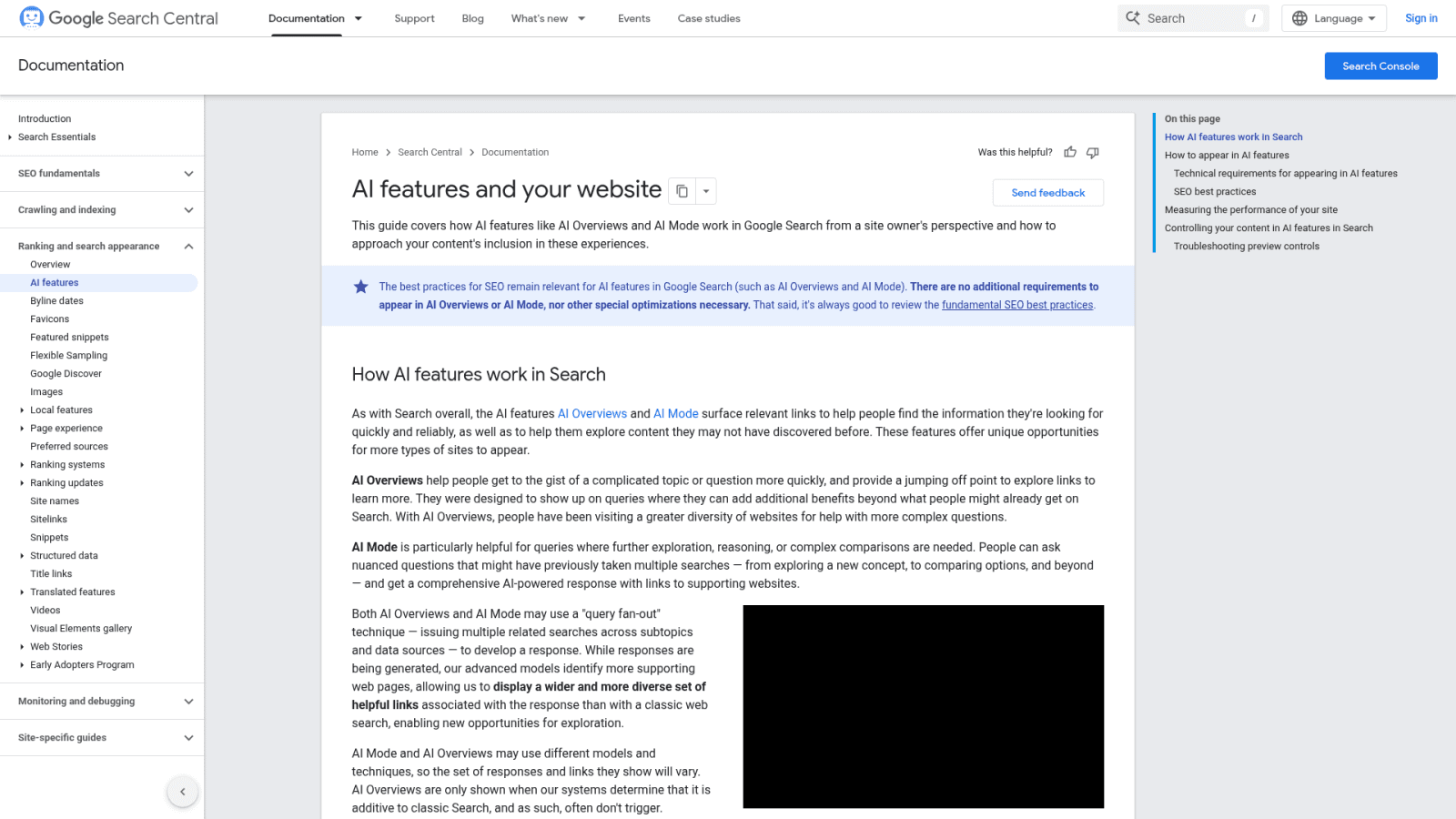
Google’s AI features documentation confirms that pages must be indexed and eligible for Search before they can contribute to AI Overviews or AI Mode. There are no additional special technical requirements beyond standard Search fundamentals.
Which Signals Should a B2B SaaS Team Prioritize?
Prioritize signals that make the brand easy to identify, retrieve, verify, and connect to buyer intent. The table below uses a PPR filter (Prominence x 0.4 + Relevance x 0.4 + Popularity x 0.2) as an editorial framework, not a scientific ranking model.
Signal | PPR | Evidence Required | Business Decision Supported |
|---|---|---|---|
Entity clarity and category association | 4.8 | Consistent terminology across all pages | Reduces AI ambiguity about what you are |
Technical crawlability and rendered text | 4.8 | Crawler logs, GSC coverage report | Access prerequisite before content changes |
Buyer prompt coverage by stage | 4.6 | Mapped prompt universe with page inventory | Identifies content gaps by funnel stage |
AI visibility measurement | 4.6 | Fixed prompt log with dates and sources | Baseline before attribution or comparison |
First-party product facts and documentation | 4.4 | Official product pages, dated documentation | Supports comparison and evaluation prompts |
Third-party corroboration and customer evidence | 4.4 | Reviews, editorial mentions, case studies | Trust and recommendation context |
Structured data | 4.0 | JSON-LD matching visible page content | Rich result eligibility and content interpretation |
The most useful investments are entity clarity and technical access because they are prerequisites for everything else. Teams that add structured data before fixing crawlability or entity consistency are working out of order.
Entity Clarity and Category Association
Entity clarity means your product is consistently described by the same category, audience, core use cases, and key differentiators across your homepage, documentation, comparison pages, blog posts, partner pages, and external profiles.
When an AI system encounters your brand across multiple sources using consistent language, the product entity becomes easier to retrieve and accurately represent. Inconsistent naming or category drift across pages creates retrieval ambiguity, and to build topical authority in SEO at scale, that consistency must extend across the entire content program.
Citation-Ready Content and First-Party Facts
Citation-ready content answers a specific buyer question with a direct, verifiable response within the first 50 words of a section, uses clear headings that map to buyer questions, includes visible facts with source attribution, and acknowledges honest limitations. Understanding how ChatGPT selects sources makes clear that self-contained, well-structured answers are more extractable than dense narrative prose.
Technical Accessibility and Structured Data
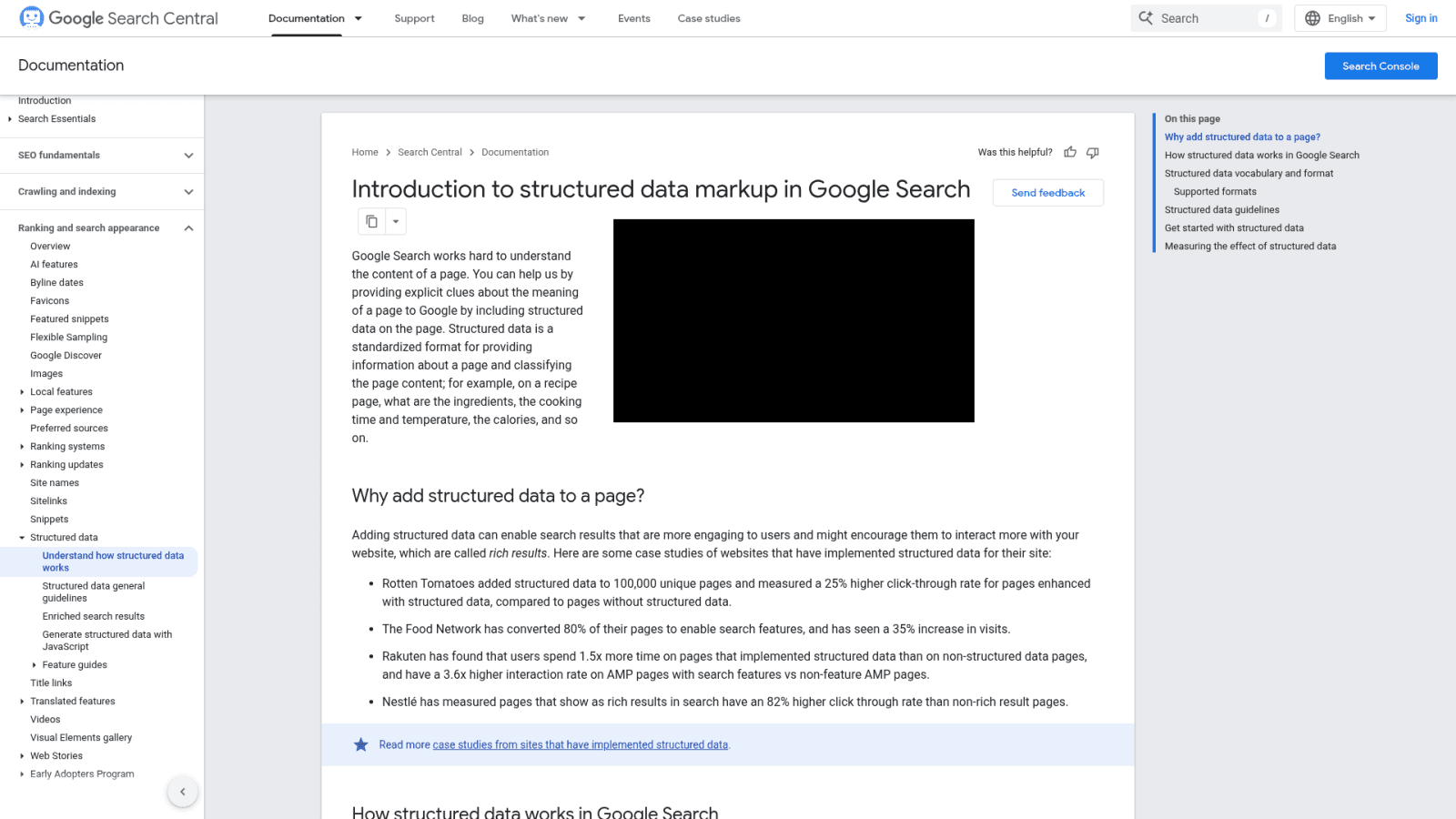
Google’s structured data documentation states that markup must represent visible page content and does not guarantee a rich result or AI citation. Structured data helps systems interpret page content and qualify for supported search features. It is a useful signal, not a mechanism for forcing inclusion.
Third-Party Corroboration and Customer Evidence
Evidence hierarchy matters here. Independent editorial coverage and verified customer reviews carry more corroboration weight than self-published testimonials. A documented case study with a named customer and a described outcome is more useful than a generic quote. Do not convert testimonials into general performance claims. Use actual evidence or describe it conservatively.
How Do You Build an AI Search Visibility Strategy for B2B SaaS?
Start with prompt mapping and technical access, then build evidence-backed content and measure repeated outcomes. The strategy is a dependency chain, not a parallel checklist.
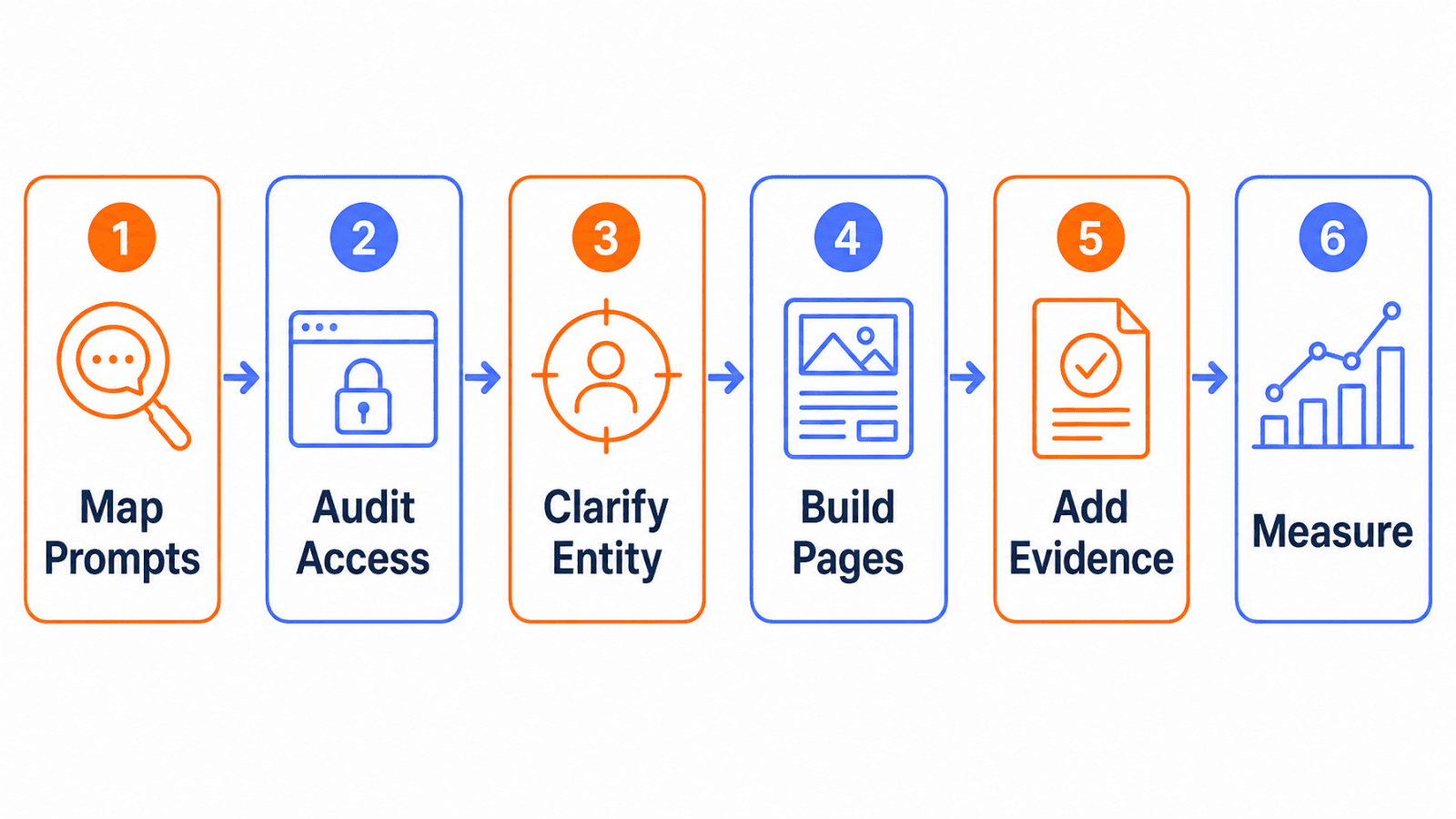
Step 1: Map the Buyer Prompt Universe
Group the prompts your buyers actually use by type:
Category discovery: “What tools help SaaS teams with [problem]?”
Problem solving: “How do I fix [specific workflow issue]?”
Comparison: “[Tool A] vs [Tool B] for [use case]”
Alternatives: “Best alternatives to [competitor]”
Feature research: “Does [Tool] integrate with [platform]?”
Objection handling: “Is [Tool] suitable for enterprise security requirements?”
Validation: “What do users say about [Tool]?”
For B2B SaaS buying committees, these prompts come from multiple stakeholders: the end user evaluating daily workflow fit, the technical buyer checking integrations and security, and the economic buyer reviewing pricing and vendor credibility. Map prompts to each role separately.
Step 2: Audit Retrieval and Entity Clarity
Before creating new content, check whether existing pages are accessible and consistently described. Run a technical access check using the crawler checklist in the previous section. Then audit entity consistency: does every page use the same product name, category, and audience description? Do third-party pages reflect your current positioning?
This audit frequently reveals that the reason a brand is missing from AI answers is not a content gap. It is a retrieval or clarity gap that new content cannot fix.
Step 3: Create Pages That Answer Buyer Follow-Up Questions
Build connected pages for the question types that matter to your buying committee. Each prompt type maps to a page type and an evidence requirement:
Buyer Prompt Type | Page Type | Evidence Burden |
|---|---|---|
What is [category]? | Definition or overview page | Low: editorial synthesis is sufficient |
[Tool A] vs [Tool B]? | Comparison page | High: requires official feature pages and independent sources |
Does it integrate with [X]? | Integration documentation | High: requires current official integration status |
What do customers say? | Case study or review summary | Very high: named customers, methodology, dated evidence |
How is pricing structured? | Pricing explanation page | Very high: requires verified current pricing page |
Apply QDP, QDH, and QDS controls: each distinct sub-topic earns its own page, heading, or sentence. Never over-cover a topic that needs its own URL, and never compress a page-worthy topic into a paragraph.
Step 4: Add Evidence, Attribution, and Limitations
Every claim that matters to a buyer decision needs a traceable source. Product capability claims need official product pages. Performance claims need a dated study with methodology. Competitor comparisons need the competitor’s own official pages. Honest limitations belong in the same content as the claim, not hidden in a footer disclaimer.
Content that acknowledges what a product does not do is more citation-worthy than content that claims superiority across every dimension. AI systems and buyers both recognize credibility through specificity and honesty.
Step 5: Strengthen Internal and External Context
Internal links connect your content program into a coherent topical network. Link upward to your pillar page, laterally to related topics like the difference between AEO and SEO, and downward to product, documentation, integration, and conversion pages. External links should support specific claims, not inflate link counts.
For each external link, confirm the source is current and the anchor explains what the source proves. Per Google’s guidance on using Search Console and Analytics for SEO, these tools measure different parts of the discovery and conversion journey, and should be used together rather than treated as substitutes.
Step 6: Measure Repeatedly and Improve the Weakest Layer
Run the same prompt set across the same platforms at fixed intervals. Classify each result as: absent, mentioned without citation, cited with URL, cited and recommended, or cited and accurately represented. Track the progression across time periods, not as a single snapshot.
Platform-specific tracking tools are available for different surfaces. For Bing and Microsoft Copilot, the Bing Webmaster Tools AI Performance report provides citation totals, cited pages, and grounding queries. The report notes that aggregated citation data does not represent a universal authority score. For ChatGPT, OpenAI’s publisher documentation covers OAI-SearchBot access and how to identify ChatGPT referral traffic in analytics. Use the AI visibility tracker for brand mentions and citations to monitor across ChatGPT, Gemini, Perplexity, and Claude from a single dashboard.
Which Content Formats Help B2B SaaS Brands Get Cited?
Content is more useful for citation when it answers a specific buyer question with visible facts, relevant context, evidence, and clear limitations. Not every format serves every funnel stage. Match the format to the prompt type.
Comparison and Alternatives Pages
Comparison and alternatives pages tend to rank well for evaluation-stage prompts. The evidence burden is high because every feature claim needs an official source: your product page for your own claims, the competitor’s product page for theirs. Neutral selection criteria, honest limitations, and clear best-fit guidance make these pages more citation-worthy than marketing-forward comparisons. Do not rank any tool first without independently verified evidence.
Use-Case, Integration, and Documentation Pages
Integration pages are among the highest-value B2B SaaS content types for AI citation because buyer prompts about compatibility are extremely specific. A page that clearly answers whether your product integrates with a named platform, describes the setup requirements, and acknowledges any limitations is directly extractable. Use official product documentation or verified brand context for all technical claims.
Original Research, Customer Proof, and FAQ Pages
Original research with methodology, dated customer evidence with named outcomes, and self-contained FAQ pages all contribute to AI citability. FAQs are particularly useful because the format matches how AI systems extract answer-length responses. Every FAQ answer should begin with a direct response sentence, be factually grounded, and avoid repeating claims made elsewhere in the same content without new supporting detail.
How Should You Measure AI Search Visibility?
Measure AI visibility as a set of observable outcomes across fixed prompts, platforms, dates, cited URLs, competitors, accuracy, referrals, and conversions. Do not collapse these into a single score because each outcome requires a different response.
Which Visibility Metrics Matter?
Track these metrics in your measurement framework:
Mention rate: How often your brand name appears in AI responses to target prompts
Citation rate: How often a URL from your domain is linked or referenced in the response
Recommendation rate: How often your brand is actively suggested as a solution
Cited URL frequency: Which specific pages are cited most across prompts
Competitor share of voice: Which competitor brands appear in the same answers
Representation accuracy: Whether the AI’s description of your product matches your actual offering
Sentiment: Whether the framing is positive, neutral, or negative
Prompt coverage: What percentage of your target prompt set produces any mention
AI referral traffic: Sessions attributable to AI platforms in analytics where identifiable
Assisted conversions: Pipeline influenced by AI-referred sessions, without claiming full attribution
How Do You Design a Repeatable AI Visibility Test?
Fix the following variables for every test run: the exact prompt text, the platform, the model version where available, the date and time, the country and language setting, the login state, and whether web search is enabled. Record the full response, the cited URLs, which competitors appeared, an accuracy assessment against your product documentation, and a sentiment label.
Run the same set at 14, 30, 60, and 90-day intervals. A single run provides a snapshot. A series of runs across the same conditions reveals trends, platform-specific patterns, and the impact of content changes.
How Do Search Console and Analytics Fit Into the Model?
Google Search Console measures impressions, clicks, average position, and query-level performance for Search. Analytics measures sessions, behavior, and conversion events. These tools answer different questions and neither fully captures AI visibility without a dedicated prompt-testing layer.
ChatGPT referral traffic can be identified in analytics when the referrer matches ChatGPT domains. On August 31, 2026, Google said its Search Console generative-AI performance reports had rolled out to all websites worldwide. The reports expose impressions, pages, countries, devices, and dates for generative-AI features such as AI Overviews and AI Mode. Track these data alongside manual prompt testing rather than treating any single tool as a complete visibility picture.
How Keytomic Supports AI Search Visibility for B2B SaaS
Disclosure: Keytomic publishes this guide and offers SEO automation and AI visibility tools. Product descriptions in this section are first-party claims and should be evaluated against current documentation. Product and feature descriptions were checked against Keytomic’s public website on September 1, 2026. Recheck current availability before publication.
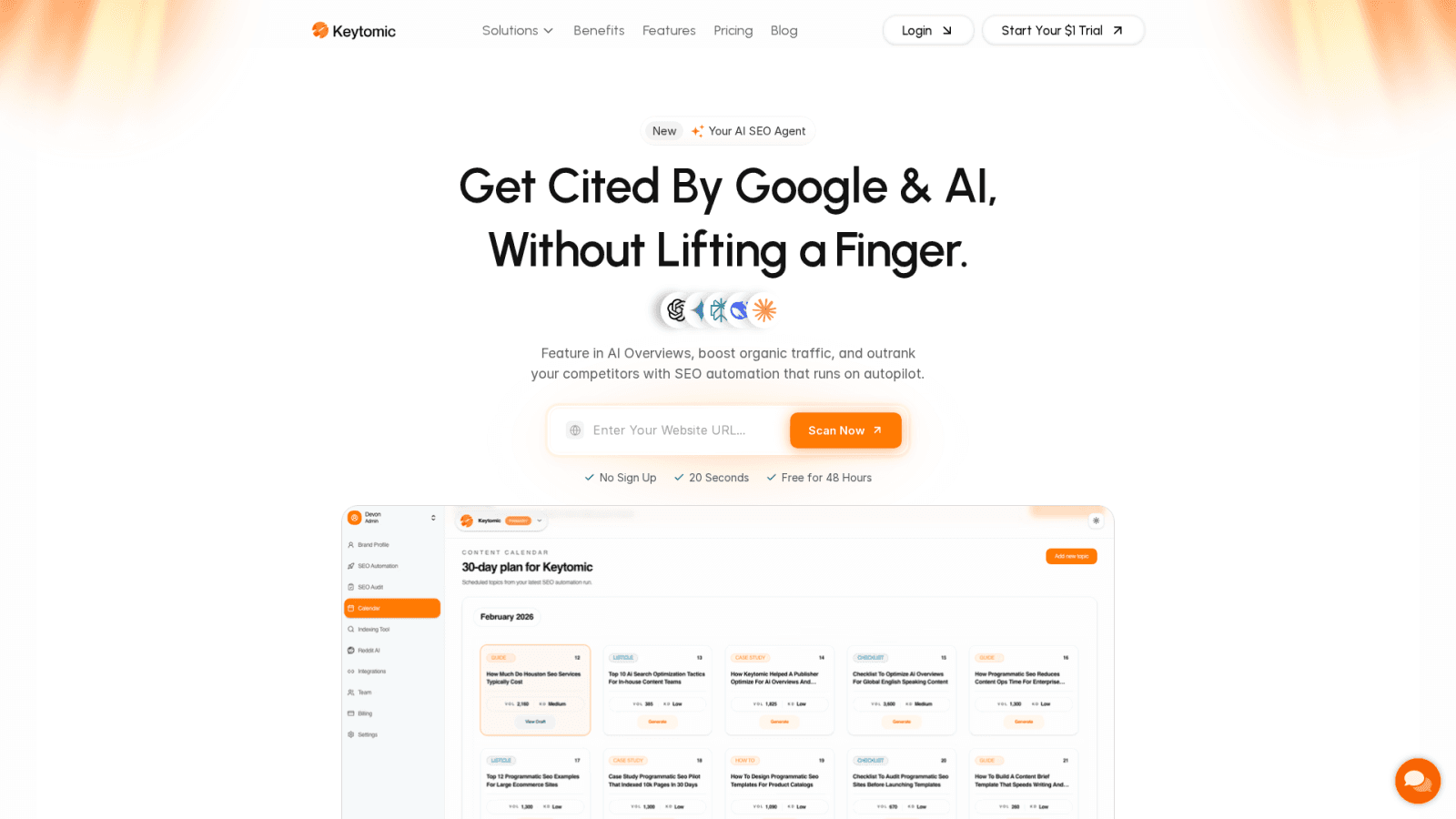
Keytomic is an AI-based SEO automation platform designed to reduce the execution gap between strategy and published, measurable content. For B2B SaaS teams managing keyword research, content planning, production, publishing, and AI visibility monitoring across multiple surfaces, the platform consolidates those steps into a unified workflow.
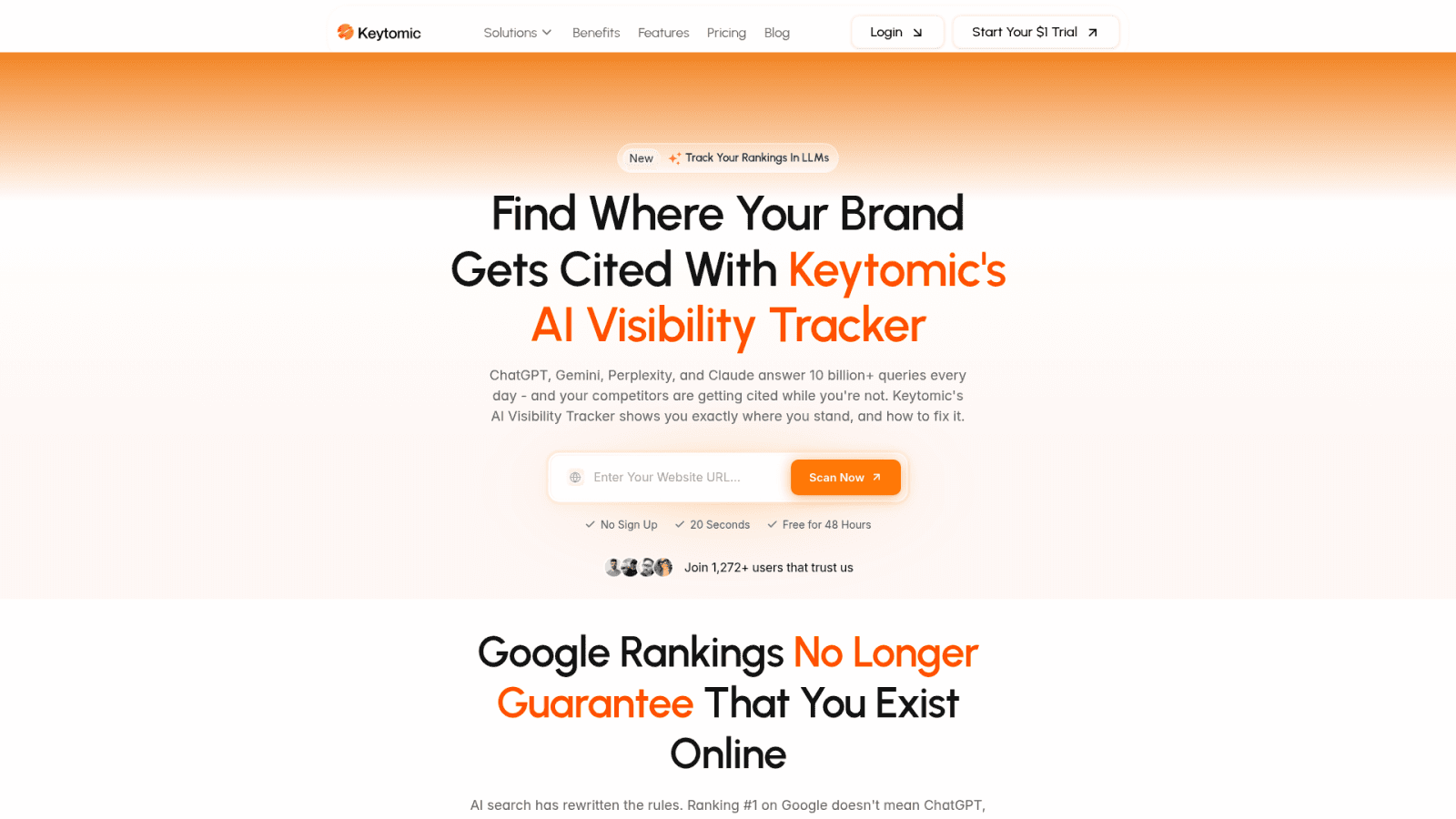
Where Keytomic Fits in the SEO and AI Visibility Workflow
Based on verified public product pages, Keytomic supports the following stages:
For teams implementing this model on WordPress, the WordPress SEO automation workflow connects research, publishing, indexing, and AI-visibility measurement. Teams measuring commercial impact can also connect Google Analytics alongside Search Console.
Keyword research and prompt discovery: Automated identification of target keywords and query clusters for both Google and AI search surfaces
30-day content calendar: Structured planning that maps content output to topical authority and buyer prompt coverage
Content generation: AI-assisted drafting aligned to E-E-A-T protocols, with editorial review as part of the production step. See the semantic SEO automation workflow for how content is structured around related queries.
CMS publishing: Direct publishing to WordPress, Shopify, Webflow, Framer, Ghost, and other supported platforms.
Google Search Console integration: Dashboard access to GSC data for indexing, impressions, and query tracking through the Google Search Console integration.
AI Visibility Tracker: Brand mention and citation monitoring across ChatGPT, Perplexity, Gemini, and Claude through the AI Visibility Tracker.
Technical SEO audits: Hybrid SEO/GEO audit capabilities covering accessibility and structured data through the technical SEO audit feature.
Indexing workflows: Auto-indexing support for reducing time from publication to Search eligibility with multi-search engine indexing.
To evaluate whether the workflow fits your team’s needs, book a Keytomic demo and review which capabilities are currently live for your use case.
What Still Requires Human Review?
Automation handles production volume and consistency. It does not replace judgment. The following require human review at every stage:
Strategic positioning and product differentiation decisions
Brand voice calibration and editorial tone enforcement
Source validation for statistics, competitor claims, and product facts
Compliance review for regulated industries or sensitive claims
Customer proof validation before publishing case studies or testimonials
Final publishing approval before content goes live
Automation that bypasses these steps creates the exact type of low-value, inaccurate, or unsupported content that Google’s people-first content guidance warns against. To help you choose SEO automation tools that fit your governance model, evaluate each workflow stage separately.
When Is Keytomic Not the Right Fit?
Keytomic is designed for lean B2B SaaS teams and founders who need workflow efficiency across research, production, and monitoring. It may not be the right fit for teams that require fully manual editorial writing without AI assistance, regulated content requiring legal or medical compliance review, highly specialized subject matter where deep niche analytics outweigh workflow consolidation, or strategies built entirely around backlink acquisition without content production.
If your bottleneck is purely backlink strategy or your team requires granular on-page NLP scoring equivalent to dedicated content optimization tools, evaluate the gap before committing to any platform. Use SEO automation software for unified workflows as a reference for understanding where consolidation adds value and where specialization is still needed.
What AI Search Optimization Mistakes Should B2B SaaS Teams Avoid?
The most damaging mistakes are unsupported claims, unclear product facts, blocked pages, keyword-only planning, generic automated content, and measurement without a fixed test design. Each has a corrective action.
Why Keyword-Only Planning Misses AI Search Intent
Traditional keyword planning maps search volume to content topics. AI search operates through query fan-out: a single buyer prompt can generate multiple sub-queries that AI systems resolve independently before synthesizing a response. A brand that covers the primary keyword but lacks pages for follow-up questions about integrations, pricing structure, security, implementation, or alternatives will appear for the surface query but drop out when the buying committee probes deeper.
This is why how to improve brand visibility in AI search engines requires prompt mapping at the level of buyer intent, not just keyword volume. Google’s AI features documentation describes query fan-out as a mechanism AI systems use to gather supporting information before generating a response.
Why Unsupported Product and Competitor Claims Create Risk
Claims that cannot be traced to an official product page, verified competitor page, or independent credible source are liabilities in AI-cited content. AI systems increasingly use grounding against verifiable sources. When your content makes a claim that conflicts with an authoritative external source, the external source tends to win the citation. Every claim in a comparison, integration, or capability page should map to a source or be written as a qualified observation.
Why Publishing Volume Is Not a Visibility Strategy
Google’s scaled content abuse guidance is explicit: producing large volumes of content primarily to manipulate search rankings, regardless of the tool used to produce it, violates spam policies. Automation is useful for reducing production friction, not for replacing original value. The governance question is whether every published piece answers a real buyer question with verified facts and honest limitations, or whether it fills keyword gaps with content that was never going to earn a citation.
Frequently Asked Questions About AI Search Visibility for B2B SaaS
What Is AI Search Visibility for B2B SaaS?
AI search visibility for B2B SaaS is the degree to which a product is found, accurately described, mentioned, cited, and recommended in AI-generated answers across platforms including ChatGPT, Perplexity, Google Gemini, and Google AI Overviews. It covers brand presence, representation accuracy, and the buyer actions that follow.
How Is AI Search Visibility Different From SEO?
SEO focuses on page rankings in traditional search results, measured through impressions, clicks, and position. AI search visibility measures whether your brand is included in AI-generated answers regardless of page position. The two overlap in technical access, content quality, and E-E-A-T signals, but AI visibility also requires entity clarity, third-party corroboration, and prompt-specific coverage that standard SEO does not fully address.
How Do I Improve AI Search Visibility for a SaaS Company?
Start with technical access: confirm key pages are indexed and crawlable by AI bots. Then clarify the product entity across all first-party and third-party pages. Build citation-ready content that answers buyer prompts directly. Add credible third-party corroboration through reviews and editorial coverage. Measure visibility across fixed prompts at regular intervals and improve the weakest layer first.
Can a B2B SaaS Brand Guarantee a ChatGPT Citation?
No. ChatGPT and other AI platforms do not offer guaranteed inclusion or placement. Citation depends on crawlability, content quality, entity recognition, corroboration, and the prompt context at the time the query is run. Platform behavior also changes with model updates and web-search availability.
Does Structured Data Make a SaaS Brand Appear in AI Answers?
No, not directly. Structured data helps AI and search systems interpret page content and qualifies pages for supported rich result types. It is a useful signal for content interpretation, but Google states explicitly that markup does not guarantee a rich result or AI citation. Access and content quality remain the primary dependencies.
What Content Should a SaaS Company Create for AI Search?
Prioritize use-case guides, comparison pages with neutral criteria, alternatives pages, integration documentation, pricing explanations with verified figures, original research with methodology, dated customer proof, and self-contained FAQ pages. Each format should answer a specific buyer prompt with direct, verifiable information and honest limitations.
How Do I Track AI Search Visibility Across ChatGPT and Perplexity?
Define a fixed set of buyer prompts, run them across each platform at fixed intervals under consistent conditions, and record the response, cited URLs, competitor presence, accuracy, and sentiment. Platform-specific tools like the AI visibility tracker for brand mentions and citations can automate prompt execution and citation logging across multiple AI engines simultaneously.
How Long Does AI Search Visibility Take to Improve?
There is no guaranteed timeline. Retrieval-time changes may surface after a page is crawled and indexed, while sustained cross-platform visibility depends on crawl frequency, content quality, corroboration, and platform updates. Treat six to eight months as an editorial planning horizon—not a promise—and measure progress through repeatable prompt tests.
Should B2B SaaS Teams Invest in GEO, AEO, or Both?
Generative Engine Optimization (GEO) focuses on being cited in AI-generated answers. Answer Engine Optimization (AEO) focuses on being the direct answer to specific queries. SEO focuses on traditional search rankings. All three share dependencies: indexed and crawlable pages, clear entity signals, high-quality content, and E-E-A-T indicators. Investing in one without the others creates gaps. Treat them as overlapping layers of the same visibility infrastructure, not competing strategies. For a detailed breakdown, see the difference between AEO and SEO.
Can SEO Automation Improve AI Search Visibility?
Automation can support keyword research, prompt mapping, content planning, content production, CMS publishing, indexing workflows, and citation monitoring. It cannot replace strategic positioning, factual review, brand voice decisions, or third-party corroboration. Used with proper editorial governance, automation reduces execution friction so teams can produce more citation-ready content without increasing headcount.
What Should a B2B SaaS Team Do in the Next 30 Days?
The most common mistake is trying to fix everything simultaneously. Identify the weakest layer first, then address it before moving to the next dependency.
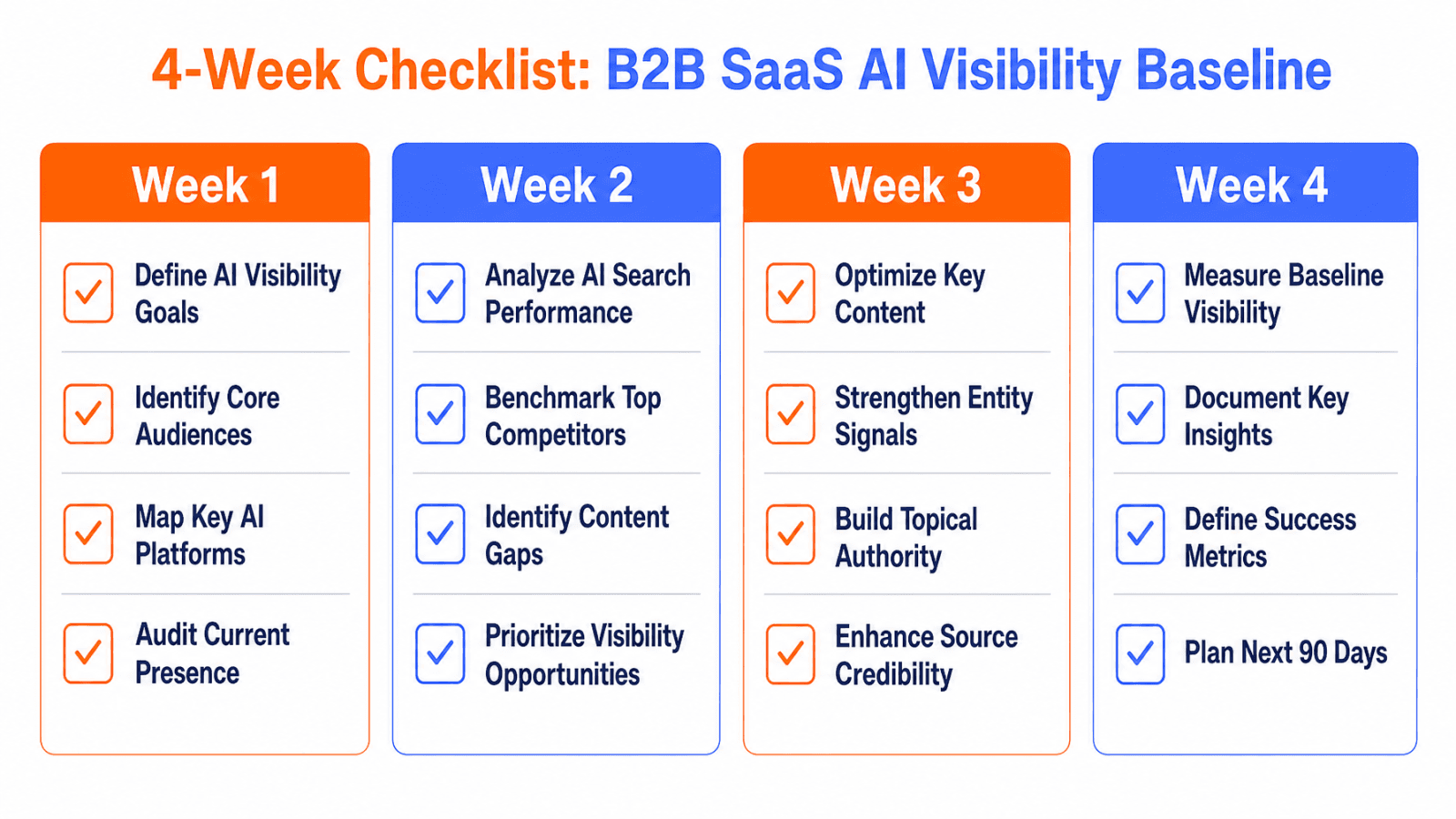
A Four-Week AI Visibility Baseline Checklist
Week 1: Entity and Technical Audit
Confirm key product, comparison, integration, and documentation pages are indexed in Google Search Console
Check robots.txt for blocks on Googlebot, OAI-SearchBot, and PerplexityBot
Audit naming consistency: is the product described the same way across your homepage, blog, partner pages, and review platforms?
Identify any canonical errors or noindex tags on pages that should be crawlable
Use the Keytomic technical audit or check whether a page is accessible to Googlebot before making content changes
Week 2: Prompt Universe and Measurement Baseline
Define 15 to 25 buyer prompts across category discovery, comparison, integration, objection, and validation types
Run each prompt across ChatGPT, Perplexity, Google AI Mode, and Gemini
Record: response text, cited URLs, competitor presence, accuracy vs your product page, and sentiment
This is your baseline. Do not change content until it exists.
Week 3: Priority Content and Evidence Updates
Identify the prompt types where your brand is completely absent
Build or update the pages that answer those prompts directly, using official product documentation for all claims
Add or update structured data on high-priority pages, confirming it matches visible content
Secure or update at least one third-party citation source: a review platform profile, an editorial mention, or a partner documentation reference
Week 4: Re-Test, Document, and Decide What to Automate
Re-run the same prompt set under the same conditions
Compare results against Week 2 baseline and document changes
Identify which gaps require more content, more evidence, or technical fixes
Decide which production steps benefit from automation and which require ongoing human review
Choose the Next Step Based on Your Bottleneck
The bottleneck determines the next action:
Access problem: Fix robots.txt, noindex, or canonical issues before creating any new content
Ambiguity problem: Standardize product entity, category, audience, and feature language across all pages
Content gap: Build the missing buyer prompt page with verified facts and honest limitations
Evidence gap: Strengthen third-party corroboration through reviews, editorial mentions, or documented case studies
Production bottleneck: Evaluate a controlled automation workflow with editorial governance built in
Measurement gap: Establish the fixed prompt baseline before attributing any results to content changes
To track brand citations across AI platforms systematically and connect visibility data to your content workflow, review the AI visibility tracker for brand mentions and citations or book a Keytomic demo to see the full research-to-publish workflow.
AI search visibility for B2B SaaS is the extent to which a company is found, understood, mentioned, cited, recommended, and accurately represented in AI-generated answers.
Improve it by clarifying the product entity, publishing evidence-backed answers to buyer prompts, keeping important pages crawlable and internally linked, and earning credible third-party corroboration.
Measure mentions, citations, cited URLs, competitor presence, accuracy, referrals, and conversions across fixed prompts. No platform guarantees inclusion or placement.
Update note — September 1, 2026: This guide was reviewed against current Google Search, Ahrefs, BrightEdge, Bain, and DerivateX research. The citation-overlap figures were corrected and separated by methodology, Google’s Search Console AI-reporting rollout was refreshed, and new links were added to Keytomic’s AI visibility, platform, integration, and indexing workflows.
Your team ranks on page one for the category keyword. Google Search Console shows healthy impressions. But when a buyer asks ChatGPT or Perplexity which tools solve their problem, your brand is absent from the answer. That gap is not a Google problem. It is an AI search visibility problem, and it is costing B2B SaaS companies pipeline they will never see.
As of September 1, 2026, Google documents AI Overviews and AI Mode as Search experiences that use existing indexing fundamentals and may apply query fan-out to pull from supporting web pages. Google also says its Search Console generative-AI performance report rollout reached all websites worldwide on August 31, 2026. OpenAI separately documents crawler access for ChatGPT search through OAI-SearchBot. Neither platform guarantees inclusion or uses a published universal ranking formula.
This guide covers the full operating model: how to define visibility, diagnose why your brand is missing, prioritize the right signals, create citation-ready content, measure repeatably, and evaluate where automation can reduce execution effort without compromising quality.
What Does AI Search Visibility Mean for B2B SaaS?
AI search visibility is not a single metric. It is a set of observable outcomes across multiple platforms and prompt types. A brand can be mentioned without being cited, cited without being recommended, and recommended without being accurately described. Each outcome has a different commercial value and requires different evidence to achieve.
For B2B SaaS teams, the relevant surfaces include ChatGPT, Perplexity, Google Gemini, Google AI Overviews, Google AI Mode, and Microsoft Copilot. Each platform uses different retrieval mechanisms, crawl policies, and synthesis logic, so performance on one does not predict performance on another.
How AI Visibility Differs From Google Rankings and Branded Search
Dimension | Traditional Google Ranking | AI Search Visibility |
|---|---|---|
Unit of success | Page position on SERP | Mention, citation, or recommendation in AI answer |
Ranking factor | Crawlability, relevance, authority | Entity clarity, evidence quality, retrieval access, corroboration |
Traffic signal | Click-through rate from SERP | AI referral sessions where identifiable |
Measurement tool | Google Search Console | Prompt testing, AI tracker, GSC referral filter |
Position-to-citation overlap | High in traditional SEO | About 17% in BrightEdge’s analysis; 37.9% in Ahrefs’ separate study |
Competitor proximity | SERP neighbors | Brands cited in the same AI answer |
A strong Google position does not guarantee an AI citation. In a BrightEdge analysis, about 17% of AI Overview-cited sources also ranked in the organic top 10. A separate Ahrefs study reported 37.9% using 863,000 keyword SERPs and 4 million AI Overview URLs. These figures use different datasets and definitions, so treat them as directional evidence rather than one universal rate.
Which AI Search Surfaces Matter to SaaS Buyers?
Different platforms dominate different stages of the B2B buying journey. ChatGPT and Perplexity tend to appear in early category discovery and problem-solving prompts. Google AI Overviews and AI Mode intercept queries when buyers move to comparison, implementation, and validation. Microsoft Copilot is increasingly embedded in enterprise workflows where procurement decisions are made.
Mapping your brand to each surface separately is more useful than targeting a generic AI presence score, because the citation logic, crawler access, and content requirements vary meaningfully between them.
What Does a Useful Visibility Baseline Include?
Before measuring, define the minimum dataset. A useful baseline records: the prompt, the platform, the model version where available, the date, the country, the login state, whether web search was active, the cited URLs, which competitors appeared, representation accuracy, sentiment, and any referral or conversion evidence from analytics.
A single prompt run is not a baseline. AI responses vary by session, model update, and web-search state. A repeatable baseline requires the same prompt set run across the same conditions at fixed intervals.
Why Do B2B SaaS Brands Disappear From AI Answers?
Absence from AI answers usually reflects a weakness in one or more layers of a dependency chain: access, entity clarity, content relevance, evidence quality, and measurable corroboration. The problem is rarely one missing tactic. It is usually a compounding of several unaddressed gaps.
A DerivateX benchmark of 50 B2B SaaS companies across 1,400 buyer-intent prompts found that 44% scored below 50 out of 100, with an average AI Presence Score of 56.9. Because this is agency-produced benchmark data, use it as a dated directional benchmark rather than a universal industry rate.
Is the Product Entity Clear Enough for AI Systems?
AI retrieval systems interpret your brand through entity signals: the product category, the audience served, the use cases covered, the integrations listed, the pricing status described, the team associated with it, and the terminology used consistently across first-party and third-party pages.
When those signals conflict or are absent, systems cannot reliably associate your product with a buyer prompt. A SaaS platform described as a workflow tool on the homepage, a productivity app in a partner directory, and an automation suite in a press release is three different entities to an AI system. Consistent naming, category association, and feature framing across all pages is a prerequisite, not an optimization.
Does the Brand Have Enough Evidence Beyond Its Own Website?
AI systems tend to corroborate brand claims through third-party sources before including them in answers where trust is implicit. A Bain & Company analysis using proprietary ScrunchAI data across roughly 500 million citations reported that 89% of unbranded prompts were fulfilled by third-party sources. That is a study result, not a universal rule, but it reinforces why independent reviews, editorial coverage, communities, and partner references matter alongside owned content.
Useful corroboration sources include customer reviews on G2 or Capterra, editorial mentions in recognized publications, independent case studies, documentation referenced by partner platforms, and community discussions where the product is named accurately. This is not about backlinks in isolation. It is about whether external sources confirm and elaborate on what your own site claims.
Can Search and AI Crawlers Access the Important Pages?
Content cannot be cited if it cannot be retrieved. Before changing any content, make your website agent-ready by checking the following:
robots.txtdoes not block Googlebot, OAI-SearchBot, or PerplexityBot on product, comparison, documentation, or pricing pagesKey pages are indexed and not set to noindex
Canonical URLs point to the correct indexable version
Pages render meaningful HTML without JavaScript-only content that crawlers cannot parse
Internal links connect important pages to each other so crawlers can reach them
The XML sitemap is current and submitted to Google Search Console
WAF or CDN rules do not block known AI crawlers by user agent
Google’s AI features documentation confirms that pages must be indexed and eligible for Search before they can contribute to AI Overviews or AI Mode. There are no additional special technical requirements beyond standard Search fundamentals.
Which Signals Should a B2B SaaS Team Prioritize?
Prioritize signals that make the brand easy to identify, retrieve, verify, and connect to buyer intent. The table below uses a PPR filter (Prominence x 0.4 + Relevance x 0.4 + Popularity x 0.2) as an editorial framework, not a scientific ranking model.
Signal | PPR | Evidence Required | Business Decision Supported |
|---|---|---|---|
Entity clarity and category association | 4.8 | Consistent terminology across all pages | Reduces AI ambiguity about what you are |
Technical crawlability and rendered text | 4.8 | Crawler logs, GSC coverage report | Access prerequisite before content changes |
Buyer prompt coverage by stage | 4.6 | Mapped prompt universe with page inventory | Identifies content gaps by funnel stage |
AI visibility measurement | 4.6 | Fixed prompt log with dates and sources | Baseline before attribution or comparison |
First-party product facts and documentation | 4.4 | Official product pages, dated documentation | Supports comparison and evaluation prompts |
Third-party corroboration and customer evidence | 4.4 | Reviews, editorial mentions, case studies | Trust and recommendation context |
Structured data | 4.0 | JSON-LD matching visible page content | Rich result eligibility and content interpretation |
The most useful investments are entity clarity and technical access because they are prerequisites for everything else. Teams that add structured data before fixing crawlability or entity consistency are working out of order.
Entity Clarity and Category Association
Entity clarity means your product is consistently described by the same category, audience, core use cases, and key differentiators across your homepage, documentation, comparison pages, blog posts, partner pages, and external profiles.
When an AI system encounters your brand across multiple sources using consistent language, the product entity becomes easier to retrieve and accurately represent. Inconsistent naming or category drift across pages creates retrieval ambiguity, and to build topical authority in SEO at scale, that consistency must extend across the entire content program.
Citation-Ready Content and First-Party Facts
Citation-ready content answers a specific buyer question with a direct, verifiable response within the first 50 words of a section, uses clear headings that map to buyer questions, includes visible facts with source attribution, and acknowledges honest limitations. Understanding how ChatGPT selects sources makes clear that self-contained, well-structured answers are more extractable than dense narrative prose.
Technical Accessibility and Structured Data
Google’s structured data documentation states that markup must represent visible page content and does not guarantee a rich result or AI citation. Structured data helps systems interpret page content and qualify for supported search features. It is a useful signal, not a mechanism for forcing inclusion.
Third-Party Corroboration and Customer Evidence
Evidence hierarchy matters here. Independent editorial coverage and verified customer reviews carry more corroboration weight than self-published testimonials. A documented case study with a named customer and a described outcome is more useful than a generic quote. Do not convert testimonials into general performance claims. Use actual evidence or describe it conservatively.
How Do You Build an AI Search Visibility Strategy for B2B SaaS?
Start with prompt mapping and technical access, then build evidence-backed content and measure repeated outcomes. The strategy is a dependency chain, not a parallel checklist.
Step 1: Map the Buyer Prompt Universe
Group the prompts your buyers actually use by type:
Category discovery: “What tools help SaaS teams with [problem]?”
Problem solving: “How do I fix [specific workflow issue]?”
Comparison: “[Tool A] vs [Tool B] for [use case]”
Alternatives: “Best alternatives to [competitor]”
Feature research: “Does [Tool] integrate with [platform]?”
Objection handling: “Is [Tool] suitable for enterprise security requirements?”
Validation: “What do users say about [Tool]?”
For B2B SaaS buying committees, these prompts come from multiple stakeholders: the end user evaluating daily workflow fit, the technical buyer checking integrations and security, and the economic buyer reviewing pricing and vendor credibility. Map prompts to each role separately.
Step 2: Audit Retrieval and Entity Clarity
Before creating new content, check whether existing pages are accessible and consistently described. Run a technical access check using the crawler checklist in the previous section. Then audit entity consistency: does every page use the same product name, category, and audience description? Do third-party pages reflect your current positioning?
This audit frequently reveals that the reason a brand is missing from AI answers is not a content gap. It is a retrieval or clarity gap that new content cannot fix.
Step 3: Create Pages That Answer Buyer Follow-Up Questions
Build connected pages for the question types that matter to your buying committee. Each prompt type maps to a page type and an evidence requirement:
Buyer Prompt Type | Page Type | Evidence Burden |
|---|---|---|
What is [category]? | Definition or overview page | Low: editorial synthesis is sufficient |
[Tool A] vs [Tool B]? | Comparison page | High: requires official feature pages and independent sources |
Does it integrate with [X]? | Integration documentation | High: requires current official integration status |
What do customers say? | Case study or review summary | Very high: named customers, methodology, dated evidence |
How is pricing structured? | Pricing explanation page | Very high: requires verified current pricing page |
Apply QDP, QDH, and QDS controls: each distinct sub-topic earns its own page, heading, or sentence. Never over-cover a topic that needs its own URL, and never compress a page-worthy topic into a paragraph.
Step 4: Add Evidence, Attribution, and Limitations
Every claim that matters to a buyer decision needs a traceable source. Product capability claims need official product pages. Performance claims need a dated study with methodology. Competitor comparisons need the competitor’s own official pages. Honest limitations belong in the same content as the claim, not hidden in a footer disclaimer.
Content that acknowledges what a product does not do is more citation-worthy than content that claims superiority across every dimension. AI systems and buyers both recognize credibility through specificity and honesty.
Step 5: Strengthen Internal and External Context
Internal links connect your content program into a coherent topical network. Link upward to your pillar page, laterally to related topics like the difference between AEO and SEO, and downward to product, documentation, integration, and conversion pages. External links should support specific claims, not inflate link counts.
For each external link, confirm the source is current and the anchor explains what the source proves. Per Google’s guidance on using Search Console and Analytics for SEO, these tools measure different parts of the discovery and conversion journey, and should be used together rather than treated as substitutes.
Step 6: Measure Repeatedly and Improve the Weakest Layer
Run the same prompt set across the same platforms at fixed intervals. Classify each result as: absent, mentioned without citation, cited with URL, cited and recommended, or cited and accurately represented. Track the progression across time periods, not as a single snapshot.
Platform-specific tracking tools are available for different surfaces. For Bing and Microsoft Copilot, the Bing Webmaster Tools AI Performance report provides citation totals, cited pages, and grounding queries. The report notes that aggregated citation data does not represent a universal authority score. For ChatGPT, OpenAI’s publisher documentation covers OAI-SearchBot access and how to identify ChatGPT referral traffic in analytics. Use the AI visibility tracker for brand mentions and citations to monitor across ChatGPT, Gemini, Perplexity, and Claude from a single dashboard.
Which Content Formats Help B2B SaaS Brands Get Cited?
Content is more useful for citation when it answers a specific buyer question with visible facts, relevant context, evidence, and clear limitations. Not every format serves every funnel stage. Match the format to the prompt type.
Comparison and Alternatives Pages
Comparison and alternatives pages tend to rank well for evaluation-stage prompts. The evidence burden is high because every feature claim needs an official source: your product page for your own claims, the competitor’s product page for theirs. Neutral selection criteria, honest limitations, and clear best-fit guidance make these pages more citation-worthy than marketing-forward comparisons. Do not rank any tool first without independently verified evidence.
Use-Case, Integration, and Documentation Pages
Integration pages are among the highest-value B2B SaaS content types for AI citation because buyer prompts about compatibility are extremely specific. A page that clearly answers whether your product integrates with a named platform, describes the setup requirements, and acknowledges any limitations is directly extractable. Use official product documentation or verified brand context for all technical claims.
Original Research, Customer Proof, and FAQ Pages
Original research with methodology, dated customer evidence with named outcomes, and self-contained FAQ pages all contribute to AI citability. FAQs are particularly useful because the format matches how AI systems extract answer-length responses. Every FAQ answer should begin with a direct response sentence, be factually grounded, and avoid repeating claims made elsewhere in the same content without new supporting detail.
How Should You Measure AI Search Visibility?
Measure AI visibility as a set of observable outcomes across fixed prompts, platforms, dates, cited URLs, competitors, accuracy, referrals, and conversions. Do not collapse these into a single score because each outcome requires a different response.
Which Visibility Metrics Matter?
Track these metrics in your measurement framework:
Mention rate: How often your brand name appears in AI responses to target prompts
Citation rate: How often a URL from your domain is linked or referenced in the response
Recommendation rate: How often your brand is actively suggested as a solution
Cited URL frequency: Which specific pages are cited most across prompts
Competitor share of voice: Which competitor brands appear in the same answers
Representation accuracy: Whether the AI’s description of your product matches your actual offering
Sentiment: Whether the framing is positive, neutral, or negative
Prompt coverage: What percentage of your target prompt set produces any mention
AI referral traffic: Sessions attributable to AI platforms in analytics where identifiable
Assisted conversions: Pipeline influenced by AI-referred sessions, without claiming full attribution
How Do You Design a Repeatable AI Visibility Test?
Fix the following variables for every test run: the exact prompt text, the platform, the model version where available, the date and time, the country and language setting, the login state, and whether web search is enabled. Record the full response, the cited URLs, which competitors appeared, an accuracy assessment against your product documentation, and a sentiment label.
Run the same set at 14, 30, 60, and 90-day intervals. A single run provides a snapshot. A series of runs across the same conditions reveals trends, platform-specific patterns, and the impact of content changes.
How Do Search Console and Analytics Fit Into the Model?
Google Search Console measures impressions, clicks, average position, and query-level performance for Search. Analytics measures sessions, behavior, and conversion events. These tools answer different questions and neither fully captures AI visibility without a dedicated prompt-testing layer.
ChatGPT referral traffic can be identified in analytics when the referrer matches ChatGPT domains. On August 31, 2026, Google said its Search Console generative-AI performance reports had rolled out to all websites worldwide. The reports expose impressions, pages, countries, devices, and dates for generative-AI features such as AI Overviews and AI Mode. Track these data alongside manual prompt testing rather than treating any single tool as a complete visibility picture.
How Keytomic Supports AI Search Visibility for B2B SaaS
Disclosure: Keytomic publishes this guide and offers SEO automation and AI visibility tools. Product descriptions in this section are first-party claims and should be evaluated against current documentation. Product and feature descriptions were checked against Keytomic’s public website on September 1, 2026. Recheck current availability before publication.
Keytomic is an AI-based SEO automation platform designed to reduce the execution gap between strategy and published, measurable content. For B2B SaaS teams managing keyword research, content planning, production, publishing, and AI visibility monitoring across multiple surfaces, the platform consolidates those steps into a unified workflow.
Where Keytomic Fits in the SEO and AI Visibility Workflow
Based on verified public product pages, Keytomic supports the following stages:
For teams implementing this model on WordPress, the WordPress SEO automation workflow connects research, publishing, indexing, and AI-visibility measurement. Teams measuring commercial impact can also connect Google Analytics alongside Search Console.
Keyword research and prompt discovery: Automated identification of target keywords and query clusters for both Google and AI search surfaces
30-day content calendar: Structured planning that maps content output to topical authority and buyer prompt coverage
Content generation: AI-assisted drafting aligned to E-E-A-T protocols, with editorial review as part of the production step. See the semantic SEO automation workflow for how content is structured around related queries.
CMS publishing: Direct publishing to WordPress, Shopify, Webflow, Framer, Ghost, and other supported platforms.
Google Search Console integration: Dashboard access to GSC data for indexing, impressions, and query tracking through the Google Search Console integration.
AI Visibility Tracker: Brand mention and citation monitoring across ChatGPT, Perplexity, Gemini, and Claude through the AI Visibility Tracker.
Technical SEO audits: Hybrid SEO/GEO audit capabilities covering accessibility and structured data through the technical SEO audit feature.
Indexing workflows: Auto-indexing support for reducing time from publication to Search eligibility with multi-search engine indexing.
To evaluate whether the workflow fits your team’s needs, book a Keytomic demo and review which capabilities are currently live for your use case.
What Still Requires Human Review?
Automation handles production volume and consistency. It does not replace judgment. The following require human review at every stage:
Strategic positioning and product differentiation decisions
Brand voice calibration and editorial tone enforcement
Source validation for statistics, competitor claims, and product facts
Compliance review for regulated industries or sensitive claims
Customer proof validation before publishing case studies or testimonials
Final publishing approval before content goes live
Automation that bypasses these steps creates the exact type of low-value, inaccurate, or unsupported content that Google’s people-first content guidance warns against. To help you choose SEO automation tools that fit your governance model, evaluate each workflow stage separately.
When Is Keytomic Not the Right Fit?
Keytomic is designed for lean B2B SaaS teams and founders who need workflow efficiency across research, production, and monitoring. It may not be the right fit for teams that require fully manual editorial writing without AI assistance, regulated content requiring legal or medical compliance review, highly specialized subject matter where deep niche analytics outweigh workflow consolidation, or strategies built entirely around backlink acquisition without content production.
If your bottleneck is purely backlink strategy or your team requires granular on-page NLP scoring equivalent to dedicated content optimization tools, evaluate the gap before committing to any platform. Use SEO automation software for unified workflows as a reference for understanding where consolidation adds value and where specialization is still needed.
What AI Search Optimization Mistakes Should B2B SaaS Teams Avoid?
The most damaging mistakes are unsupported claims, unclear product facts, blocked pages, keyword-only planning, generic automated content, and measurement without a fixed test design. Each has a corrective action.
Why Keyword-Only Planning Misses AI Search Intent
Traditional keyword planning maps search volume to content topics. AI search operates through query fan-out: a single buyer prompt can generate multiple sub-queries that AI systems resolve independently before synthesizing a response. A brand that covers the primary keyword but lacks pages for follow-up questions about integrations, pricing structure, security, implementation, or alternatives will appear for the surface query but drop out when the buying committee probes deeper.
This is why how to improve brand visibility in AI search engines requires prompt mapping at the level of buyer intent, not just keyword volume. Google’s AI features documentation describes query fan-out as a mechanism AI systems use to gather supporting information before generating a response.
Why Unsupported Product and Competitor Claims Create Risk
Claims that cannot be traced to an official product page, verified competitor page, or independent credible source are liabilities in AI-cited content. AI systems increasingly use grounding against verifiable sources. When your content makes a claim that conflicts with an authoritative external source, the external source tends to win the citation. Every claim in a comparison, integration, or capability page should map to a source or be written as a qualified observation.
Why Publishing Volume Is Not a Visibility Strategy
Google’s scaled content abuse guidance is explicit: producing large volumes of content primarily to manipulate search rankings, regardless of the tool used to produce it, violates spam policies. Automation is useful for reducing production friction, not for replacing original value. The governance question is whether every published piece answers a real buyer question with verified facts and honest limitations, or whether it fills keyword gaps with content that was never going to earn a citation.
Frequently Asked Questions About AI Search Visibility for B2B SaaS
What Is AI Search Visibility for B2B SaaS?
AI search visibility for B2B SaaS is the degree to which a product is found, accurately described, mentioned, cited, and recommended in AI-generated answers across platforms including ChatGPT, Perplexity, Google Gemini, and Google AI Overviews. It covers brand presence, representation accuracy, and the buyer actions that follow.
How Is AI Search Visibility Different From SEO?
SEO focuses on page rankings in traditional search results, measured through impressions, clicks, and position. AI search visibility measures whether your brand is included in AI-generated answers regardless of page position. The two overlap in technical access, content quality, and E-E-A-T signals, but AI visibility also requires entity clarity, third-party corroboration, and prompt-specific coverage that standard SEO does not fully address.
How Do I Improve AI Search Visibility for a SaaS Company?
Start with technical access: confirm key pages are indexed and crawlable by AI bots. Then clarify the product entity across all first-party and third-party pages. Build citation-ready content that answers buyer prompts directly. Add credible third-party corroboration through reviews and editorial coverage. Measure visibility across fixed prompts at regular intervals and improve the weakest layer first.
Can a B2B SaaS Brand Guarantee a ChatGPT Citation?
No. ChatGPT and other AI platforms do not offer guaranteed inclusion or placement. Citation depends on crawlability, content quality, entity recognition, corroboration, and the prompt context at the time the query is run. Platform behavior also changes with model updates and web-search availability.
Does Structured Data Make a SaaS Brand Appear in AI Answers?
No, not directly. Structured data helps AI and search systems interpret page content and qualifies pages for supported rich result types. It is a useful signal for content interpretation, but Google states explicitly that markup does not guarantee a rich result or AI citation. Access and content quality remain the primary dependencies.
What Content Should a SaaS Company Create for AI Search?
Prioritize use-case guides, comparison pages with neutral criteria, alternatives pages, integration documentation, pricing explanations with verified figures, original research with methodology, dated customer proof, and self-contained FAQ pages. Each format should answer a specific buyer prompt with direct, verifiable information and honest limitations.
How Do I Track AI Search Visibility Across ChatGPT and Perplexity?
Define a fixed set of buyer prompts, run them across each platform at fixed intervals under consistent conditions, and record the response, cited URLs, competitor presence, accuracy, and sentiment. Platform-specific tools like the AI visibility tracker for brand mentions and citations can automate prompt execution and citation logging across multiple AI engines simultaneously.
How Long Does AI Search Visibility Take to Improve?
There is no guaranteed timeline. Retrieval-time changes may surface after a page is crawled and indexed, while sustained cross-platform visibility depends on crawl frequency, content quality, corroboration, and platform updates. Treat six to eight months as an editorial planning horizon—not a promise—and measure progress through repeatable prompt tests.
Should B2B SaaS Teams Invest in GEO, AEO, or Both?
Generative Engine Optimization (GEO) focuses on being cited in AI-generated answers. Answer Engine Optimization (AEO) focuses on being the direct answer to specific queries. SEO focuses on traditional search rankings. All three share dependencies: indexed and crawlable pages, clear entity signals, high-quality content, and E-E-A-T indicators. Investing in one without the others creates gaps. Treat them as overlapping layers of the same visibility infrastructure, not competing strategies. For a detailed breakdown, see the difference between AEO and SEO.
Can SEO Automation Improve AI Search Visibility?
Automation can support keyword research, prompt mapping, content planning, content production, CMS publishing, indexing workflows, and citation monitoring. It cannot replace strategic positioning, factual review, brand voice decisions, or third-party corroboration. Used with proper editorial governance, automation reduces execution friction so teams can produce more citation-ready content without increasing headcount.
What Should a B2B SaaS Team Do in the Next 30 Days?
The most common mistake is trying to fix everything simultaneously. Identify the weakest layer first, then address it before moving to the next dependency.
A Four-Week AI Visibility Baseline Checklist
Week 1: Entity and Technical Audit
Confirm key product, comparison, integration, and documentation pages are indexed in Google Search Console
Check robots.txt for blocks on Googlebot, OAI-SearchBot, and PerplexityBot
Audit naming consistency: is the product described the same way across your homepage, blog, partner pages, and review platforms?
Identify any canonical errors or noindex tags on pages that should be crawlable
Use the Keytomic technical audit or check whether a page is accessible to Googlebot before making content changes
Week 2: Prompt Universe and Measurement Baseline
Define 15 to 25 buyer prompts across category discovery, comparison, integration, objection, and validation types
Run each prompt across ChatGPT, Perplexity, Google AI Mode, and Gemini
Record: response text, cited URLs, competitor presence, accuracy vs your product page, and sentiment
This is your baseline. Do not change content until it exists.
Week 3: Priority Content and Evidence Updates
Identify the prompt types where your brand is completely absent
Build or update the pages that answer those prompts directly, using official product documentation for all claims
Add or update structured data on high-priority pages, confirming it matches visible content
Secure or update at least one third-party citation source: a review platform profile, an editorial mention, or a partner documentation reference
Week 4: Re-Test, Document, and Decide What to Automate
Re-run the same prompt set under the same conditions
Compare results against Week 2 baseline and document changes
Identify which gaps require more content, more evidence, or technical fixes
Decide which production steps benefit from automation and which require ongoing human review
Choose the Next Step Based on Your Bottleneck
The bottleneck determines the next action:
Access problem: Fix robots.txt, noindex, or canonical issues before creating any new content
Ambiguity problem: Standardize product entity, category, audience, and feature language across all pages
Content gap: Build the missing buyer prompt page with verified facts and honest limitations
Evidence gap: Strengthen third-party corroboration through reviews, editorial mentions, or documented case studies
Production bottleneck: Evaluate a controlled automation workflow with editorial governance built in
Measurement gap: Establish the fixed prompt baseline before attributing any results to content changes
To track brand citations across AI platforms systematically and connect visibility data to your content workflow, review the AI visibility tracker for brand mentions and citations or book a Keytomic demo to see the full research-to-publish workflow.
Ahsan Iqbal
Salam Qadir
Marketing Growth Expert
Marketing Growth Expert
Ahsan Iqbal is a Marketing Growth Expert at Keytomic, where he works on growth strategy and evidence-led content about SEO automation and AI search visibility for B2B SaaS teams.
Ahsan Iqbal is a Marketing Growth Expert at Keytomic, where he works on growth strategy and evidence-led content about SEO automation and AI search visibility for B2B SaaS teams.
FREE AI Visibility Audit

Is Your Brand Visible in AI Searches?
Free AI Visibility Audit → See where you appear (and where competitors appear).
Read More From Our Blog...
Best AI Tools for Increasing Visibility in LLMs 2026

Peec AI vs Keytomic (2026): Which AI Visibility Platform Is Better?

Top 10 best AI SEO tools for content automation in 2026

Start Getting Cited By Google
and AI Searches on Auto-Pilot


AI SEO agents research keywords, write & publish ranking content, track AI citations, and grow your brand visibility — while you focus on the business.


Trusted by 300+ users

4.5
Start Getting Cited By Google
and AI Searches on Auto-Pilot
Automate your SEO to rank faster, and showing up in AI search, without the guesswork.
Trusted by 300+ users
4.5
Start Getting Cited By Google
and AI Searches on Auto-Pilot
AI SEO agents research keywords, write & publish ranking content, track AI citations, and grow your brand visibility — while you focus on the business.
Trusted by 300+ users