How the data was collected. Ratings, review counts, pricing and feature lists come from each app’s public Shopify App Store listing, read on Sept 30, 2026. Prices and review counts change constantly, so treat every number as a snapshot and check the live listing before you buy. I did not install every app on a test store for this update, so where I describe behaviour beyond what the listing says, I say so.
Ranking Methodology
Every app here was scored against six weighted criteria, not gut feeling. SEO coverage (30%) asks whether the app handles technical, on-page, content, and off-page SEO, or just one narrow slice of it. AI/GEO readiness (20%) looks at schema quality, LLMs.txt support, and whether the app helps you get cited by ChatGPT, Perplexity, and AI Overviews, not just ranked on Google. Ease of use (15%) covers setup time and whether you need a developer. Real user ratings (15%) come from the Shopify App Store. Site-speed impact (10%) checks whether the app adds script bloat instead of removing it. Pricing and value (10%) weighs what you get against what you pay, free tiers included.
The order below is an editorial judgment against those criteria using the listing data as of Sept 30, 2026. It is not a lab benchmark, and I have not published a single “score” number, because a decimal would suggest more precision than a listing review can support.
What the listings show at a glance
Rank | App | Best for | Shopify rating (reviews) | Free plan? | Paid pricing (listing) | Built for Shopify | On the App Store since |
|---|---|---|---|---|---|---|---|
1 | Sherpas: Smart SEO | AI metadata, alt text, JSON-LD, LLMs.txt | 5.0 (955) | Yes | $14.99, $24.99, $49.99 /mo | Yes | 2015 |
2 | TinySEO (formerly TinyIMG) | Images, speed, technical SEO | 5.0 (2,520) | Free to install, 50 image optimizations/mo | $14, $23, $49 /mo | Yes | 2019 |
3 | Keytomic | Content, technical audits, AI-visibility tracking | n/a (not an App Store app) | 3-day trial | $99/mo Pro, $999/mo Agency | n/a | n/a |
4 | Tapita AI SEO Optimizer | Multilingual SEO, GEO/AEO, speed | 5.0 (2,625) | Yes | From $9.99/mo | Yes | 2023 |
5 | SearchPie | Beginners who want SEO on autopilot | 4.9 (2,440) | Yes | From $39/mo | Yes | 2019 |
6 | Avada SEO Suite | Free on-page basics | 4.9 (4,680) | Yes | $34.95, $99 /mo | Yes | 2020 |
7 | StoreSEO | Audits + AI fixes, MCP connector | 5.0 (756) | Yes (25 products) | $14.99, $39.99 /mo and up | Yes | 2021 |
8 | Booster SEO | Autopilot fixes at catalog scale | 4.8 (5,487) | Yes | From $39/mo | Yes | 2016 |
9 | Plug in SEO | Learning SEO with audits and keyword research | 4.6 (673) | No (free trial) | $29.99, $49.99, $79.99 /mo | Yes | 2011 |
10 | SEO Manager (venntov) | Long-running monitoring and redirects | 4.6 (492) | No (7-day trial) | $9, $29, $59 /mo | No | 2012 |
11 | SEO King | Broad toolkit with unlimited free basics | 4.8 (540) | Yes | $9.99/mo and up | Yes | 2017 |
12 | JSON-LD for SEO | Dedicated schema | 4.9 (441) | No (7-day trial) | $399/yr | No | 2015 |
13 | Yoast SEO for Shopify | Best-practice guidance in the product editor | 4.3 (176) | No (14-day trial) | $19 or $45 /mo | Yes | 2021 |
Sources: each app’s Shopify App Store listing, read Sept 30, 2026.
Three add-ons that solve one problem each (schema, indexing, alt text) are in the specialist section.
What Shopify Automates for You, and What You’ll Still Have to Do
Shopify hands you a real foundation before you install a single app. It auto-generates an XML sitemap, adds SSL to every page, gives you clean URL structures under /products/ and /collections/, and applies basic canonical tags so a product reached through a collection path usually points back to the clean product URL.
What Shopify does not do is decide which keywords matter for your catalog, write product descriptions that answer buyer questions, or catch it when two apps quietly inject conflicting schema on the same page. It won’t compress your images unless you tell it to, and it has no opinion on whether ChatGPT or Perplexity ever mentions your store.
That gap, between what the platform hands you and what needs a human decision or a specialized tool, is where every app on this list earns its place. None of them replace strategy. They remove the repetitive, error-prone parts of execution so you can spend your time on the parts that need judgment. If you’re not sure where your store stands, run through the Shopify SEO checklist first.
How to Choose the Right App for Your Store
Start by naming your single biggest bottleneck instead of trying to fix everything at once.

Slow pages: you need an image and speed app first (TinySEO, Tapita).
Messy metadata or missing alt text: automate that next (Sherpas, Booster, SearchPie).
Schema conflicts: fix those with one dedicated schema source (see the duplicate schema check).
Basics covered but traffic is flat: the problem is probably content and internal linking, not another app. Start with Shopify keyword research and the Shopify SEO guide.
Pick two or three apps that cover different jobs rather than five that overlap. When in doubt, check what your theme already handles natively before adding a tool that duplicates it.
Best For: Matching Apps to Your Store Type
New stores with a small catalog: start with a free plan (Tapita, Avada, StoreSEO, SearchPie or Sherpas) and get canonical tags, alt text and metadata in order before spending anything.
Image-heavy stores (fashion, home, print-on-demand): TinySEO. Page speed is usually the binding constraint for visually driven catalogs.
Large catalogs with hundreds of SKUs: bulk-editing tools like Sherpas: Smart SEO or Booster SEO turn a week of manual metadata work into an afternoon. StoreSEO’s free plan is limited to 25 products, so plan for a paid tier at this size.
Multilingual stores: Tapita and Sherpas list multilingual support; check the language list on the listing for your markets before installing.
Stores that suspect thin or conflicting schema: a dedicated schema app (JSON-LD for SEO or Schema Plus), used instead of the schema features in your other apps.
Agencies managing several stores: something that scales across clients, like Keytomic’s agency plan or StoreSEO.
Stores chasing AI search citations: Keytomic tracks them. Sherpas, StoreSEO, Booster, Tapita and SEO King all list LLMs.txt or AI-search features, but generating a file is not the same as knowing whether AI tools cite you.
1. Sherpas: Smart SEO, Best for AI Metadata Automation

Screenshot: Sherpas: Smart SEO on the Shopify App Store, captured Sept 30, 2026.
On the listing: 5.0 from 955 reviews · Built for Shopify · on the App Store since Aug 2015 · developer Sherpas Design · free plan.
Sherpas: Smart SEO automates the repetitive parts of on-page SEO: AI-written meta tags, alt text and product descriptions, JSON-LD structured data, broken-link detection and IndexNow. It also lists AI-search features: an LLM catalog (LLMs.txt and Agents.md), an MCP server for AI assistants, and Google Search Console integration. Its language list is long (English, Italian, German, Dutch, Danish, Swedish, Japanese, French, Chinese, Spanish, Korean and more), which matters if you sell in several markets.
Pricing (listing): Free (broken links check on 100 pages, 50 image optimizations, 20 AI generations, meta and alt tag optimization, sitemap, noindex tags, automatic audit of 20 pages). Pro $14.99/mo, Business $24.99/mo, Premium $49.99/mo (annual billing saves about 17%). Paid tiers include a 7-day trial.
Pros: 15 years on the store with a perfect rating; strong automation-to-price ratio; broad language support; AI-search tooling on the paid tier.
Cons: The most useful features (JSON-LD, LLMs.txt, bulk optimization) are on Pro and up. A handful of public reviews report that uninstalling can revert applied metadata, so back up your settings before removing it.
Best for: Store owners who want metadata and schema handled automatically without touching code.
2. TinySEO (formerly TinyIMG), Best for Image Optimization and Speed

Screenshot: TinySEO on the Shopify App Store, captured Sept 30, 2026.
On the listing: 5.0 from 2,520 reviews · Built for Shopify · on the App Store since June 2019 · developer TinySEO (former TinyIMG).
TinyIMG has been rebranded as TinySEO. If you’re following older guides or its old name, it’s the same product. The listing covers image compression and resizing, lazy loading, minified JS and CSS, ALT text and filename optimization, JSON-LD (including return policy and shipping details), LLMs.txt, broken links with 301 redirects, HTML sitemaps, IndexNow, an AI blog builder and site audits.
Pricing (listing): Pay as you go: free to install, 50 free image optimizations a month, then 3¢ per extra image. Beginner $14/mo, Advanced $23/mo, and a $49/mo tier above that.
Pros: Strong review volume for a technical app; the free tier is enough to see a speed improvement on a small catalog; it does the image and speed job thoroughly.
Cons: Its schema and other extras overlap with other apps. Don’t run its JSON-LD alongside a second schema app, or you’ll risk duplicate structured data (see common Shopify SEO issues).
Best for: Image-heavy stores that need speed fixed first.
3. Keytomic, Best for Content, Technical Audits and AI Search Visibility

Screenshot: Keytomic’s Shopify page (a product preview from keytomic.com, captured Sept 30, 2026).
Keytomic is an AI SEO automation platform, trusted by 300+ users, built to handle content, technical SEO, and AI visibility tracking in one connected workspace. It isn’t a single-toggle Shopify App Store app: it connects to your store through a catalog sync (see the Shopify integration and Shopify platform page) and publishes straight to your Shopify blog.
What it does:
Product-aware content engine. Reads your product titles, images, variants, collections and prices, then writes SEO articles and comparison content around what you actually sell, linking back to product and collection pages.
AI visibility tracking. Shows how often your store is cited in ChatGPT, Gemini, Claude and Perplexity, with sentiment analysis, prompt-level tracking and competitor comparison. You can try the free AI Visibility Tracker first.
Bi-weekly technical SEO audits, an ongoing check rather than a one-time scan.
[AI Image Studio](/features/image-generation-ai-tool), which turns your existing Shopify product photos into on-brand lifestyle visuals for blog content.
Why it’s #3, not #1: it does a different job from the apps above. It doesn’t replace image compression or on-theme metadata automation, and it costs more. I’ve put it below the two highest-reviewed App Store apps because independent, publicly verifiable reviews carry more weight than my own.
Pricing:
Plan | Price | Best for | What you get |
|---|---|---|---|
3-day trial | Free for 3 days, then $99/mo | Testing before you commit | Full Pro access, 3 blog credits, 1 custom image credit, AI visibility on 1 platform |
Pro | $99/mo ($79/mo billed yearly) | Most Shopify stores, up to 3 seats | 30 blog credits/mo, 50 custom image credits, AI visibility across ChatGPT + Gemini, technical audits, Reddit automation, backlink opportunities |
Agency (DFY) | $999/mo | Agencies and hands-off brands | Everything in Pro, unlimited seats, a dedicated SEO manager, AI visibility across ChatGPT + Gemini + Claude + Perplexity, monthly strategy reporting |
For context, a single Sherpas or TinySEO subscription costs $14 to $25 a month and handles one job. Keytomic Pro costs more because it replaces a metadata app, a content writer or freelancer, and a separate AI-visibility tool bought individually.
Best for: Stores that already have their technical basics handled and want to grow organic traffic and AI citations without hiring a content team. Start a free trial and connect your store to see what a product-aware article looks like on your own catalog.
4. Tapita AI SEO Optimizer, Best for Multilingual SEO and GEO

Screenshot: Tapita AI SEO Optimizer on the Shopify App Store, captured Sept 30, 2026.
On the listing: 5.0 from 2,625 reviews · Built for Shopify · on the App Store since March 2023 · developer Tapita · free plan.
Tapita is the newest app here with a large review base. The listing covers an on-page SEO audit, AI meta tags, Google schemas, LLMs.txt, image compression and alt text, broken links, sitemaps, AI-written blog posts (AI credits), and hands-on support for Google Search Console and Merchant Center errors. Multilingual SEO is a headline feature.
Pricing (listing): Free (unlimited on-page audits, essential JSON-LD schemas, 900 image compressions a month, bulk and AI metadata optimization, bulk alt text for 50 products). Business $9.99/mo (or $101.88/year), with add-ons of +$5/mo for a Grow plan, +$30/mo Advanced and +$60/mo Shopify Plus. Extra SEO audit pages and AI credits cost extra.
Pros: Generous free plan; broad feature set at a low starting price; multilingual focus.
Cons: The plan structure with add-ons is harder to price than a flat tier, and a 2023 launch means a shorter track record than Sherpas or Booster.
Best for: Multilingual stores and budget-conscious stores that want a wide feature set.
5. SearchPie, Best for Hands-Off Automation
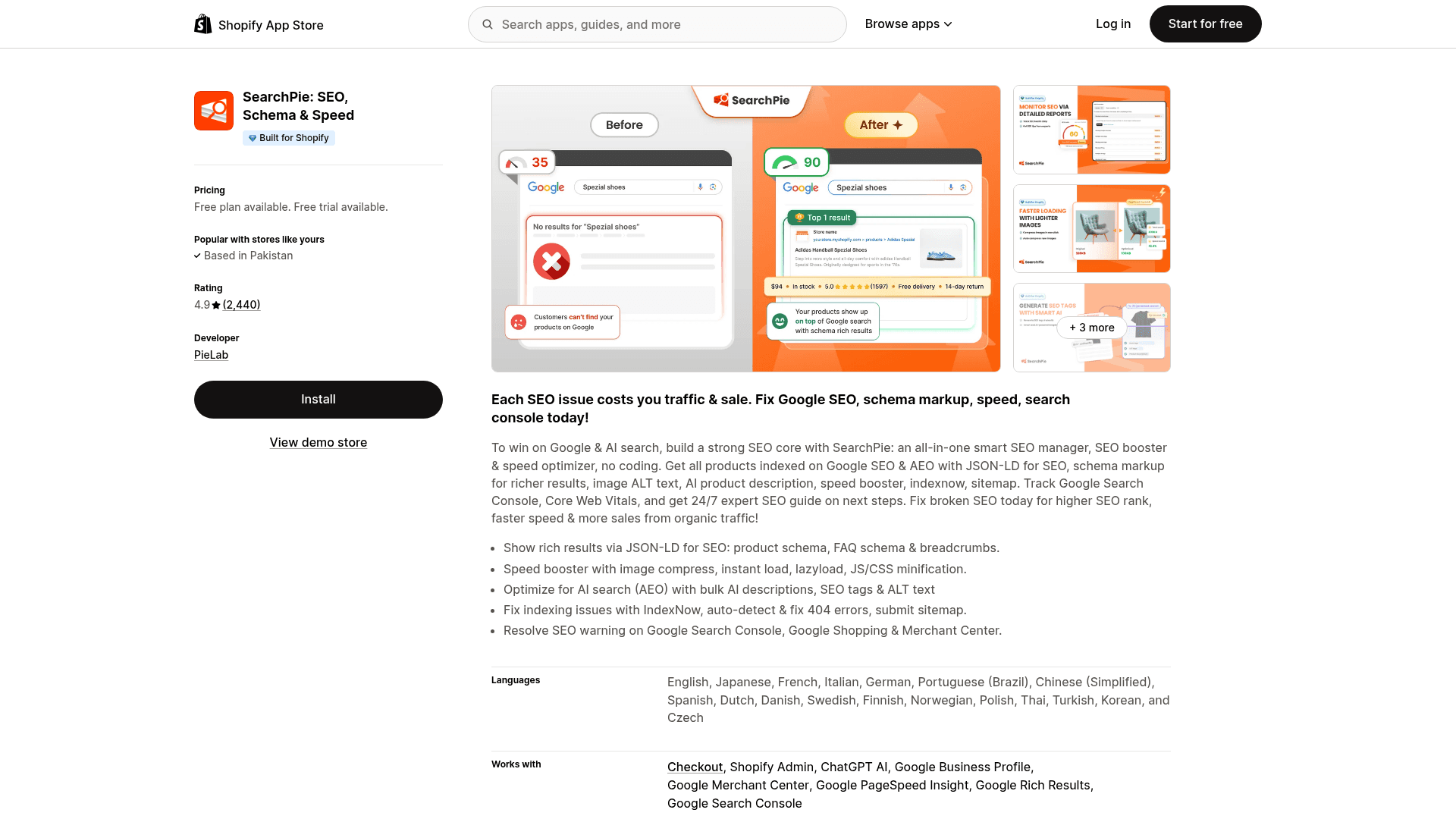
Screenshot: SearchPie on the Shopify App Store, captured Sept 30, 2026.
On the listing: 4.9 from 2,440 reviews · Built for Shopify · since July 2019 · developer PieLab · free plan.
SearchPie leans into “set it and mostly forget it”: a daily SEO score, breadcrumbs and store schema, sitemap, 50 image compressions, bulk meta tags and alt text with templates, 50 AI-generated SEO tags and 404 detection on the free Starter plan. Premium adds price, rating, stock and FAQ schema, 500 image compressions, JS minification, auto-optimized tags, automatic 404 fixes and backlink submissions. It also tracks Search Console and Core Web Vitals.
Pricing (listing): Starter free; Premium $39/mo ($374.40/year).
Pros: Low learning curve; useful free plan; 24/7 support advertised on the listing.
Cons: The paid tier starts at $39, higher than several rivals with comparable features. Automation can feel restrictive if you want to tune schema page by page.
Best for: First-time Shopify owners who haven’t touched SEO settings yet. Pair it with the Shopify SEO guide so you know what it’s doing behind the scenes.
6. Avada SEO Suite, Best Free Tier for On-Page Basics

Screenshot: Avada SEO Suite on the Shopify App Store, captured Sept 30, 2026.
On the listing: 4.9 from 4,680 reviews · Built for Shopify · since April 2020 · free plan.
Avada’s listing centres on an AI SEO Audit Agent that scans every page and applies fixes in one click, an on-page optimizer (lazy loading, minification, structured data, sitemaps, redirects) and a built-in SEO checklist. Free: 100 image optimizations, basic speed booster, HTML sitemap, meta tags, 20 on-page audits, 100 AI credits, basic structured data and alt text optimizer. Pro: $34.95/mo with unlimited image optimization, unlimited audits, 1,000 AI credits, broken link manager, XML sitemap, robots.txt editor. Enterprise: $99/mo with one-on-one consulting.
Pros: One of the largest review bases on the store; the free plan covers real on-page basics; 7-day Pro trial.
Cons: The free plan caps audits and AI credits; the interface pushes upgrades; deeper AI/GEO work sits behind Pro or Enterprise.
Best for: New or budget-conscious stores getting on-page fundamentals in order. Related reading: best ecommerce platform for SEO.
7. StoreSEO, Best for AI Fixes, Audits and an MCP Connector

Screenshot: StoreSEO on the Shopify App Store, captured Sept 30, 2026.
On the listing: 5.0 from 756 reviews · Built for Shopify · since Oct 2021 · developer Storeware · free plan.
StoreSEO is an AI SEO and image optimizer that writes alt text, meta tags and schema, compresses images, adds JSON-LD and FAQ schema, creates sitemaps and LLMs.txt, requests indexing, and connects to Google Search Console and Google Analytics. Its built-in MCP connector lets you drive it from Claude or ChatGPT.
Pricing (listing): Free Forever for up to 25 products (SEO score, 200 AI credits, 25 image optimizations, LLMs.txt and Agents.md generator, 5 tracked keywords). Lite $14.99/mo (100 products, one-click schema, indexing requests, GA and GSC), Essential $39.99/mo (250 products) and higher tiers above that.
Pros: Generous free plan for small catalogs; unusually complete for the price; AI-assistant connector.
Cons: Plans are priced by product count, so cost rises with catalog size.
Best for: Stores that want audits plus AI-assisted fixes and Search Console data in one place.
8. Booster SEO, Best for Autopilot Fixes at Scale

Screenshot: Booster AI SEO + AEO Optimizer on the Shopify App Store, captured Sept 30, 2026.
On the listing: 4.8 from 5,487 reviews (the most on this list) · Built for Shopify · since March 2016.
Booster’s pitch is continuous scanning and automatic fixes: image optimization, broken-link repair, meta updates, plus LLMs.txt, structured data and AI-optimized meta tags. It also has a free plan (SEO score and health badge, alt-text optimization with templates, broken-link detection, manual audits, 50 weekly image syncs, weekly email reports, 24/7 chat support). Pro is $39/mo ($349/year) and adds unlimited meta optimization, autopilot fixes, structured data and sitemap submission.
Pros: Largest review base here; autopilot fixing saves manual work on big catalogs.
Cons: Meta title/description optimization and automatic fixes require the $39 tier. As with any autopilot tool, review AI-generated tags before they go live.
Best for: Larger catalogs that want continuous fixes without manual passes.
9. Plug in SEO, Best for Learning SEO With Audits and Keyword Research

Screenshot: Plug in SEO on the Shopify App Store, captured Sept 30, 2026.
On the listing: 4.6 from 673 reviews · Built for Shopify · since June 2011 (the oldest app here).
Plug in SEO is built around diagnosing problems and teaching you to fix them: page scans, comprehensive SEO audits, AI deep keyword research, titles and descriptions tools, JSON-LD tools and one-click broken-link redirects, with AEO tools for AI search. It states that you approve every AI-written change.
Pricing (listing): Lite $29.99/mo (200 pages), Standard $49.99/mo (2,000 pages, plus a free 30-minute call with an SEO expert), Premium $79.99/mo. There’s no free plan, but each tier has a 7-day trial.
Pros: Keyword research inside the app; good for merchants who want to learn; expert call on higher tiers.
Cons: Priced above most alternatives, with no free plan.
Best for: Merchants who want guided diagnosis and keyword research, not full automation.
10. SEO Manager (venntov), Best for Long-Running Monitoring and Redirects
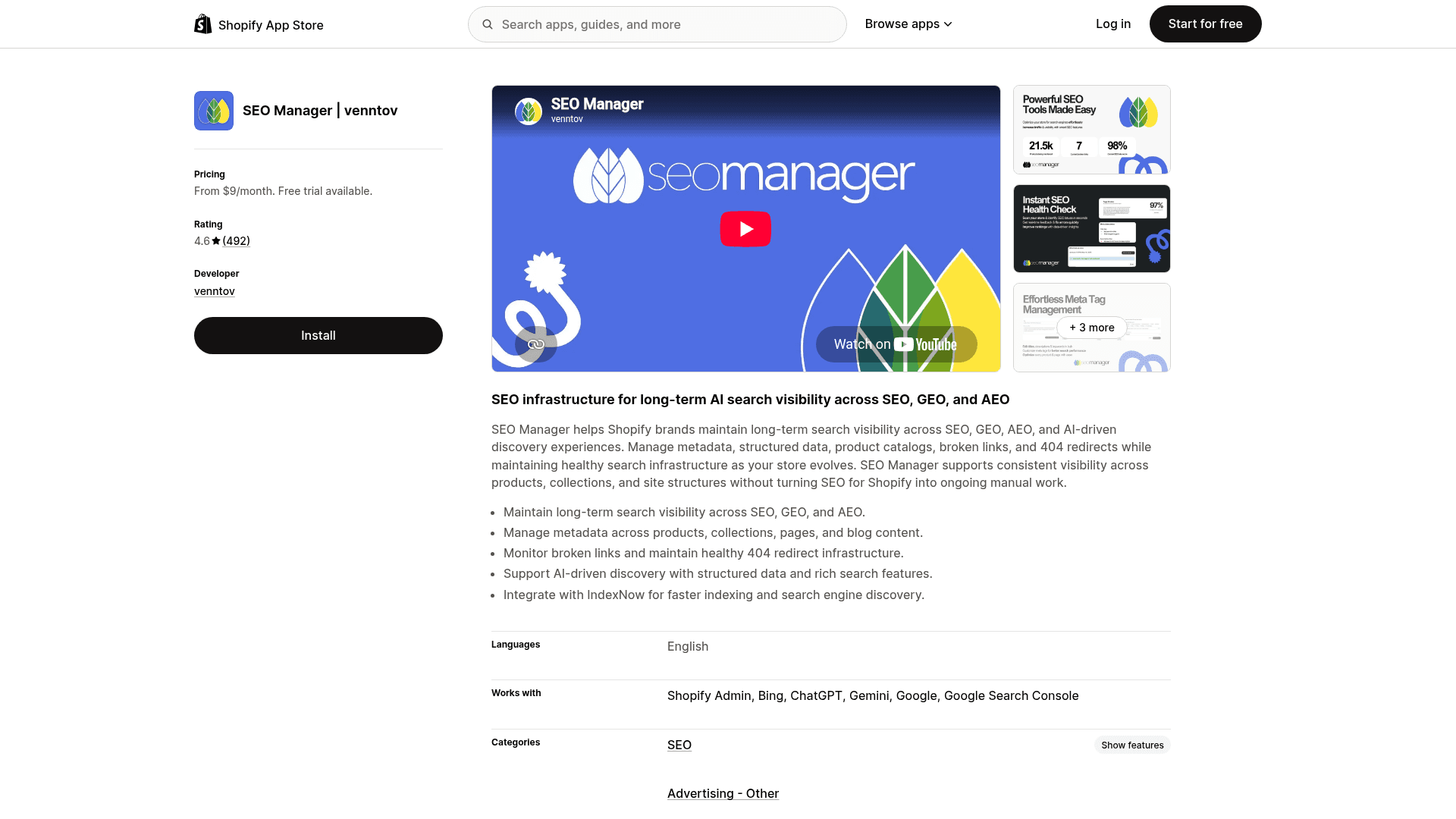
Screenshot: SEO Manager (venntov) on the Shopify App Store, captured Sept 30, 2026.
On the listing: 4.6 from 492 reviews · not Built for Shopify · since May 2012 · English only.
SEO Manager is positioned as SEO infrastructure: SEO monitoring and scoring, Google result simulation, structured data testing, metadata, out-of-stock redirects and broken-link/404 management, with AI content and advanced Google integration on the top tier.
Pricing (listing): Starter $9/mo, Essential $29/mo, Professional $59/mo, each with a 7-day free trial. No free plan.
Pros: Low entry price; strong on 404s and redirects; works with Google Search Console, Bing, ChatGPT and Gemini per the listing.
Cons: No Built for Shopify badge, English-only listing, and no free plan to test with.
Best for: Stores that mainly need monitoring and redirect management at a low monthly cost.
11. SEO King, Best Free Toolkit With LLMs.txt

Screenshot: SEO King on the Shopify App Store, captured Sept 30, 2026.
On the listing: 4.8 from 540 reviews · Built for Shopify · since Feb 2017 · developer Engage Apps · free plan.
SEO King bundles SERP audits, image optimization, JSON-LD, backlinks, broken links, image sitemaps, LLMs.txt, Core Web Vitals and Search Console analytics, and generates titles, descriptions and alt text in bulk or via MCP. It also has a free plan (unlimited alt text, meta title and meta description updates, photo renaming and product photo optimization, plus store scans and Search Console analytics). Paid plans start at $9.99/mo for 500 pages and add automated AI, bulk photo optimization, a fast editor, robots.txt and LLMs.txt, and advanced JSON-LD schemas.
Pros: Unusually generous free tier; wide feature set at a low price; Built for Shopify.
Cons: Broad toolkits can overlap with apps you already run. AI-generated text still needs a human pass for brand voice.
Best for: Stores that want a lot of tooling on a small budget.
12. JSON-LD for SEO, Best Dedicated Schema App

Screenshot: JSON-LD for SEO on the Shopify App Store, captured Sept 30, 2026.
On the listing: 4.9 from 441 reviews (98% five-star) · not Built for Shopify · since Oct 2015 · developer Ilana Davis LLC.
JSON-LD for SEO does structured data and little else: it connects the fields used for Google rich results, Merchant Center (Shopping, Ads, YouTube Shopping) and AI search, updates automatically if you change themes, and includes a data audit, ongoing rich-result monitoring, unlimited support and a video course. There’s no free plan; the listing shows $399/year with a 7-day free trial.
Pros: Deep, validated schema coverage; Merchant Center compatible; strong support model.
Cons: The most expensive way to add schema on this list, and it does nothing for content, speed or off-page SEO. Turn off other apps’ schema when you use it.
Best for: Stores with complex products or review apps that already handle content and speed and need schema right.
13. Yoast SEO for Shopify, Best for Best-Practice Guidance
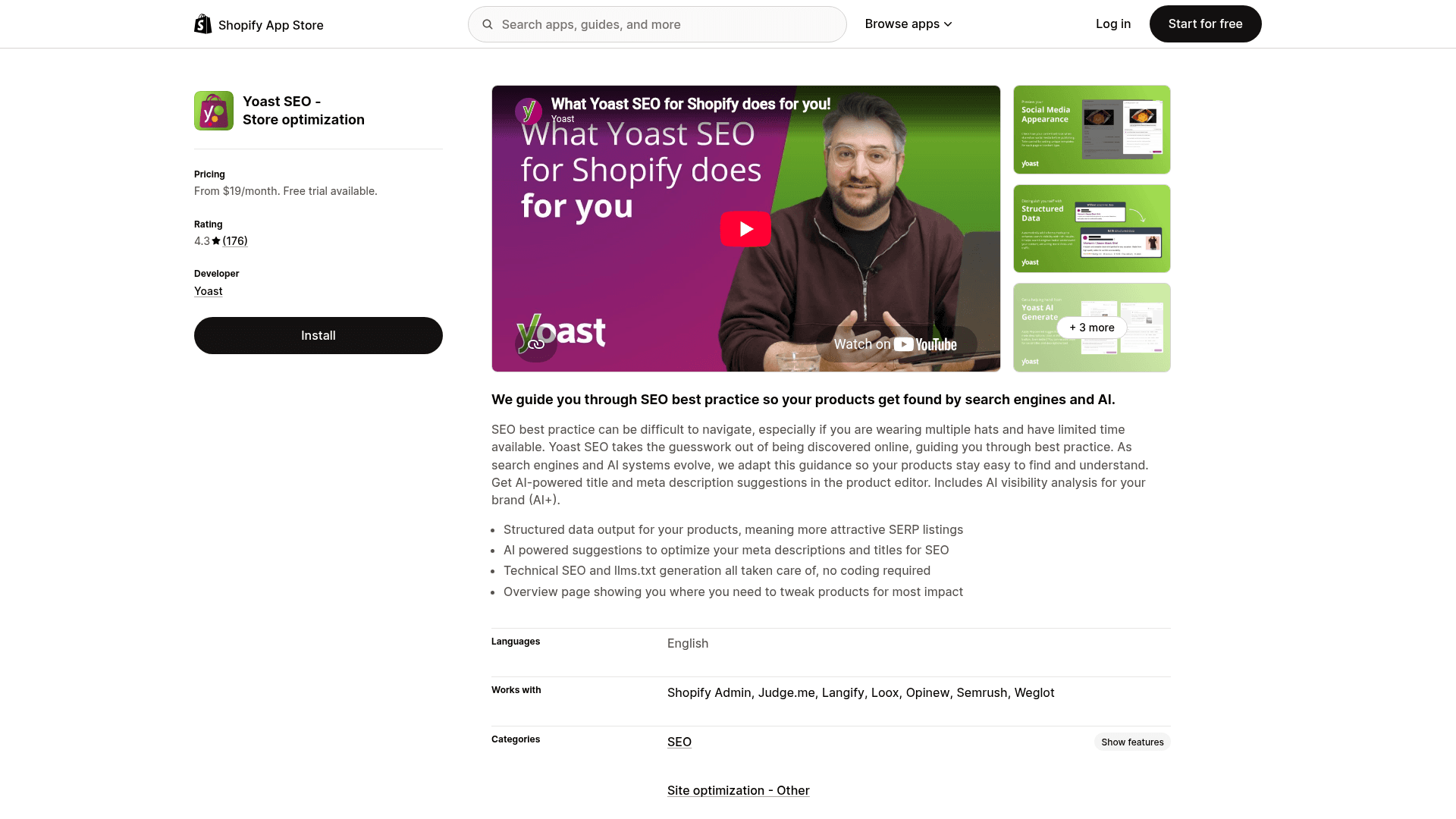
Screenshot: Yoast SEO on the Shopify App Store, captured Sept 30, 2026.
On the listing: 4.3 from 176 reviews · Built for Shopify · since Sept 2021.
Yoast brings its guidance approach to Shopify: SEO and readability analysis in the product editor, AI title and meta description suggestions, automatic structured data, technical SEO improvements and bulk import/export. The higher AI+ tier adds an AI visibility index, sentiment analysis, competitor benchmarking and citation tracking.
Pricing (listing): Premium $19/mo ($190/year), AI+ $45/mo ($450/year); 14-day free trial; no free plan.
Pros: Familiar brand; good for merchants who want to be told what to fix as they write.
Cons: The lowest rating and fewest reviews here, no free plan, and it’s guidance-heavy rather than automation-heavy.
Best for: Merchants who already use Yoast elsewhere and want the same workflow in Shopify.
Specialist add-ons
These solve one problem each and sit alongside a main app:
Schema Plus (listing): 5.0 from 592 reviews, not Built for Shopify, since 2018. Advanced JSON-LD compatible with review apps such as Judge.me, Loox, Okendo, Stamped.io and Yotpo. Lite $10.99/mo (5 product and review schemas), Essential $20.99/mo (250, plus Organization, blog and breadcrumb schemas). 14-day trial.
InstaIndex (listing): 4.7 from 61 reviews, since 2024. Automatic IndexNow submissions, JSON-LD, a 404 monitor and AI-mention tracking on higher tiers. Intro pricing is $1/mo for the first three months on Basic, then $14/mo. A young app with a small review base.
AltText.ai (listing): 4.5 from 141 reviews, since 2023. AI alt text for product and blog images with accessibility framing (ADA, WCAG). Free to install with your first 25 images free, then $3 per 50 images or $5/mo for 100 images.
How to Check for Duplicate Schema (Two Minutes)
Two apps adding schema is the most common avoidable mistake on this list. Here’s how to check your own store:
Open a product page, right-click and choose View page source.
Search for
application/ld+json. Count the blocks and note which"@type"each contains.If you see more than one
"@type": "Product"block on the same page, two sources are injecting product schema (your theme, a review app, and an SEO app are the usual culprits).Paste the URL into Google’s Rich Results Test and check for duplicate or conflicting items.
Keep one schema source and turn the rest off in each app’s settings.
Common Mistakes With Shopify SEO Apps
Installing several all-in-one apps. Their features overlap (schema, sitemap, meta tags), and they can override each other. Choose one primary app plus one or two specialists.
Publishing AI-generated meta tags without review. Bulk AI output tends to be generic. Spot-check your top 20 products by revenue.
Uninstalling without a backup. Some apps write metadata or code into your theme. Export or note your settings before you remove one.
Treating `LLMs.txt` as a strategy. It’s a file. Google’s own guidance says you don’t need new AI-specific files or markup to appear in AI features. Whether AI tools cite you is something you have to measure separately.
Judging an app by its free plan alone. Check which features are paid before you build a workflow around it. The free plans above differ a lot in caps (25 products, 20 audits, 50 images).
Do SEO Apps Actually Work for Shopify?
Yes, but only for what they’re built to do. An app can fix duplicate schema, compress images, or generate meta tags in bulk, and none of that requires a developer. What no app can do is invent demand, build backlinks for you overnight, or replace keyword strategy and content. If you install five SEO apps and your rankings are still flat, the problem is usually structural: thin collection pages, weak internal linking, or no content strategy. Start with the Shopify SEO checklist and category page SEO best practices.
Do You Need an SEO App or an SEO Expert?
Use an app when the problem is repetitive execution: metadata, alt text, schema, redirects, image size. Hire an expert (or use a done-for-you plan) when the problem is judgment: which collections to build, how to structure internal links, how to recover from a traffic drop, or how to interpret Search Console. Most small and mid-sized stores can cover the technical and on-page layer with two or three apps; strategy and outreach still need a person.
Free vs. Paid Shopify SEO Apps
Free plans cover the on-page basics, but their limits differ, so compare them:
App | Free-plan headline limits (listing) |
|---|---|
Tapita | Unlimited on-page audits, 900 image compressions/mo, bulk alt text for 50 products |
Avada SEO Suite | 100 image optimizations, 20 on-page audits, 100 AI credits |
StoreSEO | 25 products, 25 images, 200 AI credits, 5 tracked keywords |
SearchPie | 50 image compressions, 50 AI SEO tags, 404 detection |
Sherpas: Smart SEO | 50 image optimizations, 20 AI generations, audit of 20 pages |
SEO King | Unlimited alt text and meta updates, photo optimization |
TinySEO | Free to install, 50 image optimizations/mo |
Booster SEO | 50 weekly image syncs, alt-text templates, manual audits |
Paid tiers earn their cost on volume (bulk editing across hundreds of SKUs), automation (AI-generated content instead of manual descriptions), and anything involving ongoing content production or AI visibility tracking.
Shopify SEO Apps vs. WooCommerce SEO Apps
Shopify apps generally integrate faster because they don’t depend on a plugin ecosystem the way WooCommerce and WordPress do, but they’re more locked into Shopify’s fixed URL structure. If you’re comparing platforms, see our breakdown of common WooCommerce SEO issues and the best ecommerce platforms for SEO.
FAQs
What are the best free SEO apps for Shopify?
Tapita, Avada SEO Suite, StoreSEO, SearchPie, Sherpas: Smart SEO, SEO King and TinySEO all offer free plans that cover the on-page basics. Their caps differ (see the free-plan table above).
How many SEO apps should a Shopify store run?
Two or three, on different jobs (for example, one for images and speed, one for metadata and schema, one for content). More than that often creates duplicate schema and script bloat.
Do I need a paid app, or can free ones handle everything?
Free tiers handle the basics well. Paid tools pay off once you need bulk editing at catalog scale, ongoing content production, or AI visibility tracking.
Which Shopify SEO app is best for AI search (ChatGPT, Perplexity, AI Overviews)?
Several listings advertise LLMs.txt and AI-search features (Sherpas, StoreSEO, Booster, Tapita, SEO King, Yoast AI+). Keytomic tracks actual citations across ChatGPT, Gemini, Claude and Perplexity. Generating a file and being cited are different things, so measure both.
Is TinyIMG the same as TinySEO?
Yes. The developer is listed as “TinySEO (former TinyIMG)”, and the app is now called TinySEO.
Can a Shopify SEO app replace hiring an SEO specialist?
For most small to mid-sized stores, for the technical and on-page layer, yes. Content strategy, backlink outreach and Search Console analysis are still on you or whoever manages your store.
Is Keytomic on the Shopify App Store?
No. It’s a connected AI SEO platform that integrates through a catalog sync, similar to how Google Analytics or Klaviyo connect, rather than a lightweight admin toggle. That’s why it has no App Store rating in the table above.
Which apps are Built for Shopify?
As of Sept 30, 2026 the badge shows on Sherpas, TinySEO, Tapita, SearchPie, Avada, StoreSEO, Booster, Plug in SEO, SEO King and Yoast. It does not show on SEO Manager, JSON-LD for SEO or Schema Plus.
How long before a Shopify SEO app shows results?
Technical fixes like broken schema or slow images can show measurable improvement within weeks. Content and AI visibility gains usually take 60 to 90 days at minimum, since search engines and AI systems both need time to crawl, index, and build trust in new content.
Automating Shopify SEO
If you want one platform that covers content, technical audits, and AI visibility, Keytomic is worth a look, with my bias disclosed below. If you’d rather build your own stack, pair TinySEO for images and speed with Sherpas: Smart SEO (or a dedicated schema app) for metadata and schema. For the full picture, the Shopify SEO Guide covers the strategy and the Shopify SEO Checklist gives you the step-by-step to run before you install anything. Want to see what a product-aware, AI-visibility-tracking approach looks like on your own catalog? Start a free trial and connect your store in a couple of minutes.
Disclosure
I work at Keytomic, and I’ve placed Keytomic at #3, not #1, because most of the apps above have public, independently verifiable review histories and Keytomic does not have an App Store rating. That’s a conflict of interest either way, and you should factor it in. I’ve applied the same criteria to every app, shown the source of every number, and said plainly where a competitor does something better (TinySEO on image compression, JSON-LD for SEO on dedicated schema depth). Cross-check ratings and pricing on the App Store before you install anything. Some links on this page may be affiliate links.