The best AI tools for ecommerce SEO are the ones that solve the store’s actual bottleneck. Some platforms research keywords and competitors. Some improve product and category content. Some automate technical fixes or publishing. Others measure whether brands and products appear in ChatGPT, Google AI Overviews and AI Mode, Gemini, Perplexity, and Copilot. Most ecommerce teams need a small, connected stack rather than one tool that claims to do everything.
I am Salam Qadir, Product and Growth Lead at Keytomic. I have worked in SEO and digital marketing for more than seven years across ecommerce, SaaS, and content operations. When I assess AI SEO software, I focus on the path from opportunity to published change to measurable outcome. A long feature list is less useful than knowing whether a tool can improve the right product, collection, guide, or feed at the right time.
Updated September 20, 2026: I rechecked the tool categories, official product pages, pricing references, ecommerce use cases, AI-search terminology, and selection criteria. I also expanded the comparison to cover catalog size, Shopify fit, product-level tracking, feed data, citations, prompt monitoring, execution, and limitations. Features and prices change quickly, so treat every plan detail as a dated reference and verify it with the vendor.
Disclosure: Keytomic is first because this article is published by Keytomic and it directly addresses the end-to-end workflow described here. That placement is not independent proof that it is best for every store. No vendor paid for inclusion. I label what comes from direct product knowledge and what comes from public vendor documentation so readers can judge the evidence.
Quick answer: the best AI ecommerce SEO tool by job
Primary job | Best-fit tool to evaluate | Why it belongs on the shortlist |
|---|---|---|
End-to-end SEO planning and execution | Keytomic | Connects research, topical planning, content, publishing, indexing, audits, and AI visibility |
Broad SEO data plus AI visibility | Semrush | Combines an established SEO suite with brand mentions, citations, prompt research, and AI-readiness analysis |
Commerce-first product AI visibility | Yotpo Discover | Tracks products and categories across AI engines using catalog and shopper signals |
Enterprise AI-answer monitoring | Profound | Focuses on brand visibility and answer-engine intelligence for larger organizations |
Large web index and brand visibility research | Ahrefs Brand Radar | Links AI visibility analysis with Ahrefs’ search and web data |
Revenue and marketing attribution | Triple Whale | Helps ecommerce teams connect marketing activity to commercial outcomes |
Enterprise search operations | BrightEdge | Designed for governance, reporting, and optimization across large organizations |
Accessible rank tracking and AI monitoring | SE Ranking | Pairs conventional SEO monitoring with growing AI-search visibility features |
Content optimization | Surfer | Supports content briefs and on-page optimization workflows |
Focused AI-search monitoring | Otterly.AI | Offers a narrower way to track brand mentions, citations, and prompts |
On-page implementation | Alli AI | Emphasizes deploying and managing on-page SEO changes |
Catalog product content | Describely | Focuses on scaled product descriptions and ecommerce content operations |
My practical recommendation is to choose one system of record for opportunity and measurement, then add a specialist only when the workflow demands it. A 40-product direct-to-consumer brand, a 5,000-SKU Shopify store, and a multi-market retailer do not need the same stack.
For the wider operating model behind these decisions, see Keytomic’s ecommerce SEO workflow.
See More: AI Visibility Tools: What to Compare
What AI visibility means for ecommerce
AI visibility is the degree to which a brand, product, category, or source appears accurately in AI-generated answers. Traditional rank tracking asks where a URL appears for a keyword. AI visibility monitoring asks different questions:
Is the brand mentioned for a relevant buying prompt?
Is a product recommended, compared, or excluded?
Which source URLs are cited?
Does the answer describe price, availability, specifications, and positioning correctly?
How does visibility change by model, geography, device context, or prompt wording?
Can the team connect a visibility gap to a content, technical, product-data, or authority action?
For ecommerce, a brand mention is not the same as product visibility. A tool may show that the company appears in an answer while missing whether a specific SKU, collection, or use case is recommended. Ask what the platform actually samples and at what level it reports.
How I evaluated these tools
I used a weighted framework designed for ecommerce SEO and generative engine optimization, also called GEO or answer engine optimization.
Criterion | What I looked for | Weight |
|---|---|---|
Ecommerce fit | Products, collections, variants, feeds, Shopify or platform workflow, large-catalog handling | 20% |
Search research | Keywords, competitor gaps, intent, topic planning, and page-type decisions | 15% |
AI visibility data | Models covered, prompt methodology, mentions, citations, share of voice, history, and regions | 20% |
Execution | Content production, briefs, technical recommendations, publishing, and workflow handoffs | 15% |
Measurement | Rankings, indexation, visibility trends, commercial outcomes, exports, and integrations | 15% |
Evidence and transparency | Documented methodology, data definitions, limitations, pricing clarity, and support | 10% |
Operational fit | Seats, permissions, reporting, implementation effort, and total cost | 5% |
Evidence labels used below: “direct product knowledge” means I can describe the Keytomic workflow from the publisher side. “Official documentation reviewed” means the assessment is based on the vendor’s public product and help pages, not a claim that I personally operated every enterprise feature. Public marketing pages can omit limits, so request a real demo with your own domain and catalog.
What to verify before buying an AI SEO tool
Do not buy based on an undifferentiated “AI-powered” label. Ask vendors to show these details:
Prompt source: Are prompts manually tracked, modeled from demand, taken from a proprietary database, or generated by the tool?
Engine coverage: Which versions of ChatGPT, Gemini, Google AI, Perplexity, Copilot, Claude, or shopping experiences are measured?
Sampling: How often are answers collected, from which regions, and with what personalization controls?
Entity level: Does the tool report brand mentions only, or can it track product names, collections, attributes, and cited URLs?
Execution: Can the team turn a gap into a brief, page improvement, technical fix, or publishing task?
Catalog support: Are variants, feeds, structured data, product availability, and thousands of URLs handled?
Commercial link: Can results be joined to Search Console, analytics, revenue, or merchandising data?
Export and ownership: Can you export prompts, citations, content, and history if the subscription ends?
The 12 best AI tools for ecommerce SEO and AI visibility
1. Keytomic: best for connecting research, content, and visibility
Evidence: direct product knowledge and public product pages.
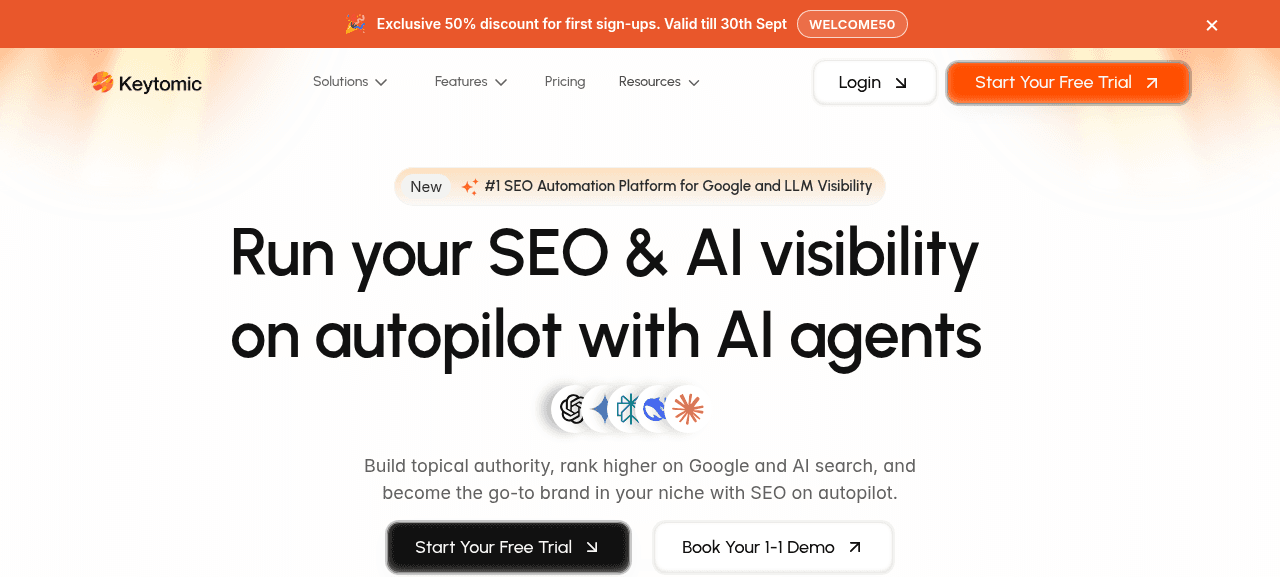
Keytomic is built to connect AI keyword research, competitor analysis, topical mapping, content production, automated publishing, indexing, technical audits, and AI visibility tracking. The benefit for a lean ecommerce team is continuity. An opportunity does not have to die in a spreadsheet before someone briefs, drafts, reviews, publishes, and measures the page.
Best for: ecommerce and SaaS teams that want a connected SEO workflow without assembling many point solutions.
Watch-outs: confirm the exact limits, integrations, and level of automation for your plan. A platform can accelerate research and production, but product expertise, merchandising decisions, fact checking, and editorial approval still belong to the team.
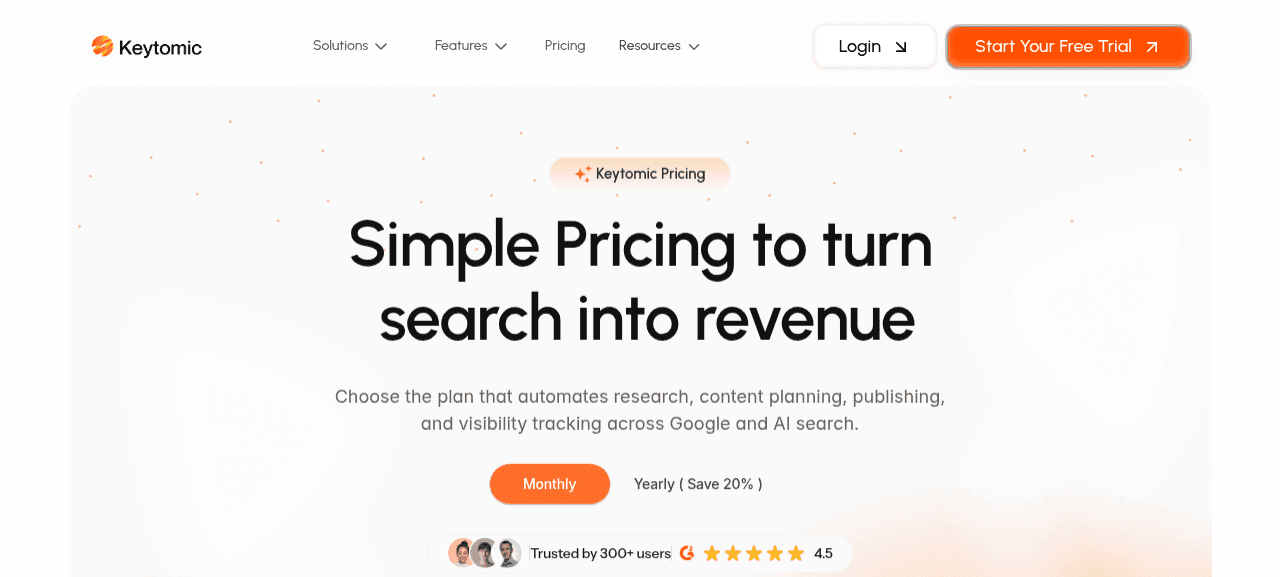
Keytomic plan comparison reviewed during the September 2026 update. Check the live pricing page for current limits.
2. Semrush: best broad SEO suite with AI visibility

Evidence: official product, help, and pricing pages reviewed September 20, 2026.
Semrush combines keyword and competitor research, site auditing, rank tracking, backlinks, content workflows, and AI visibility. Its public AI Visibility solution covers brand benchmarking, mentions, citations, sentiment, prompt research, competitor gaps, and AI-readiness analysis. The AI Visibility pricing page listed a base plan at $99 per month per domain when billed annually at the time of this refresh.
Best for: teams that want a mature SEO data suite and AI-search reporting under one vendor.
Watch-outs: domain, seat, toolkit, prompt, and report limits can make total cost higher than the entry price. Ask which data is sampled daily, which is database-level research, and what is included in each plan.
3. Yotpo Discover: best commerce-first product visibility platform
Evidence: official Yotpo Discover materials reviewed September 20, 2026.
Yotpo Discover is an AI visibility and optimization platform built around ecommerce catalogs. Its public product page describes product, category, and regional tracking across AI engines, prompt intelligence informed by commerce interactions, and agents that turn gaps into onsite, content, and activation work.
Best for: established ecommerce brands that want AI-search monitoring connected to product catalogs, reviews, loyalty, and shopper language.
Watch-outs: Yotpo says the initial release is designed for brands generating more than $10 million in annual GMV. Smaller stores should confirm eligibility, pricing, engine coverage, and whether the workflow complements or duplicates existing review and content tools.
4. Profound: best for enterprise answer-engine intelligence
Evidence: official product materials reviewed.
Profound focuses on how brands appear in AI answers, which sources influence those answers, and where competitors earn visibility. Its positioning suits organizations that treat AI search as a monitored channel with executive reporting, market comparisons, and dedicated optimization work.
Best for: enterprise brands, agencies, and teams with enough resources to act on large visibility datasets.
Watch-outs: enterprise intelligence can be more platform than a small store needs. Request ecommerce-specific examples at product and category level, not only brand-level dashboards.
5. Ahrefs Brand Radar: best for joining AI visibility with web and search data
Evidence: official Ahrefs materials reviewed.
Ahrefs Brand Radar extends brand research into AI answers while Ahrefs provides established backlink, keyword, competitor, and content data. That combination is valuable when a team wants to compare cited sources, search performance, and web authority rather than view AI mentions in isolation.
Best for: SEO teams already using Ahrefs that want AI-search analysis connected to their existing research habits.
Watch-outs: verify model coverage, update frequency, regional support, prompt volumes, and plan requirements. Large-scale mention discovery is different from tracking a tightly controlled prompt set over time.
6. Triple Whale: best for commercial measurement around ecommerce marketing
Evidence: official product materials reviewed.
Triple Whale is known for ecommerce analytics and attribution. It belongs in this comparison because SEO and AI visibility must eventually connect to business outcomes. Its strongest role is not replacing a crawler or content optimizer. It is helping teams interpret marketing performance, customer journeys, and revenue data.
Best for: DTC brands that need a commercial measurement layer across acquisition channels.
Watch-outs: attribution platforms do not automatically explain why a category page lost rankings or why a product is absent from AI answers. Pair revenue analysis with specialist search data.
7. BrightEdge: best for enterprise SEO governance
Evidence: official product materials reviewed.
BrightEdge supports enterprise search programs with research, recommendations, reporting, and governance. Large retailers may value the ability to organize work across business units, markets, page types, and stakeholders more than a low entry price.
Best for: multi-market retailers and organizations with formal SEO operations.
Watch-outs: implementation, training, and procurement matter. Ask for a proof of concept using your catalog, your countries, and your reporting requirements.
8. SE Ranking: best accessible SEO monitoring with expanding AI coverage
Evidence: official product materials reviewed.
SE Ranking offers rank tracking, website auditing, competitor analysis, backlinks, content tools, and AI-search features. It can be a practical middle ground for smaller agencies and in-house teams that need conventional SEO monitoring plus visibility into newer search surfaces.
Best for: teams that want broad monitoring without immediately moving to enterprise software.
Watch-outs: compare the exact AI engines, prompt limits, locations, history, and citation data in the plan you are considering.
9. Surfer: best for structured content optimization
Evidence: official product materials reviewed.
Surfer is centered on content planning and on-page optimization. Ecommerce teams can use it for buying guides, comparisons, and editorial content that supports product categories. It is less naturally suited to managing variant feeds, faceted navigation, or the full technical health of a large catalog.
Best for: content teams producing search-led commercial and educational pages.
Watch-outs: optimization scores are directional. Do not add terms or length merely to match a score. Product accuracy, firsthand expertise, search intent, and conversion usefulness remain more important.
10. Otterly.AI: best focused AI visibility monitor for smaller teams
Evidence: official product materials reviewed.
Otterly.AI focuses on monitoring brand mentions, links, and visibility across AI search experiences. A narrower product can be attractive when the team already has keyword research, crawling, and content systems and only needs an additional AI-search tracking layer.
Best for: brands and agencies starting a controlled prompt-monitoring program.
Watch-outs: verify how prompts are selected, how often they run, which locations are available, and whether product-level entities can be separated from general brand mentions.
11. Alli AI: best for deploying on-page SEO changes
Evidence: official product materials reviewed.
Alli AI emphasizes implementing and managing on-page SEO changes across sites. This can help teams that identify many template-level improvements but struggle to get every change into a development queue.
Best for: teams with execution bottlenecks and repeatable on-page changes.
Watch-outs: any automated deployment layer requires governance, rollback, testing, and clear ownership. Confirm how changes interact with the ecommerce platform, theme, apps, localization, and future releases.
12. Describely: best for scaled product-content operations
Evidence: official product materials reviewed.
Describely focuses on ecommerce product content at scale. It can help teams create or standardize descriptions, titles, and supporting catalog copy when product data is structured and review processes are clear.
Best for: merchants and agencies managing many product records that need consistent content operations.
Watch-outs: generated descriptions do not replace product-data governance, original photography, verified specifications, category strategy, technical SEO, or conversion testing. Avoid publishing unsupported claims at scale.
Which tools fit different catalog sizes?
Store profile | Practical starting stack | Priority |
|---|---|---|
Small DTC catalog, under 250 SKUs | Keytomic or SE Ranking, Search Console, Merchant Center, analytics | Fix product data, core collections, buying guides, and measurement before adding many tools |
Growing Shopify store, 250 to 5,000 SKUs | Keytomic or Semrush, feed tooling, crawler, focused AI visibility monitor if needed | Template quality, collection architecture, content workflow, and controlled prompt tracking |
Large catalog, 5,000 to 100,000 SKUs | Broad SEO platform, catalog-content specialist, feed system, analytics or attribution layer | Automation with QA, faceted navigation, structured data, internal linking, and inventory-aware content |
Enterprise or multi-market retailer | BrightEdge, Profound, Semrush, or Ahrefs depending on governance and data needs, plus internal data systems | Regional coverage, permissions, data exports, product entities, executive reporting, and cross-team execution |
SKU count is only a proxy. A 100-product catalog with poor specifications and inconsistent variants can be harder than a 10,000-product catalog with disciplined data. Evaluate data quality, platform complexity, markets, team size, and publishing capacity together.
SEO tool, feed tool, or AI visibility platform?
These categories overlap but are not interchangeable.
SEO platforms research search demand, competitors, links, rankings, technical issues, and content opportunities.
Feed and product information tools manage structured product attributes, availability, titles, identifiers, channel rules, and syndication.
AI visibility platforms sample or analyze AI answers, mentions, citations, sentiment, and prompt-level presence.
Content systems produce briefs, product copy, category guidance, and editorial pages.
Analytics and attribution tools connect visits and campaigns to revenue or customer behavior.
A store may need all five functions, but it rarely needs five expensive platforms on day one. Map the workflow, identify the missing function, and buy for that gap.
See More: Best Shopify SEO Apps and Best AI Tools for LLM Visibility
A 30-day implementation plan
Days 1 to 3, define outcomes: choose a small set of commercial categories, products, and buying questions. Record current rankings, clicks, revenue, and AI-answer presence.
Days 4 to 7, clean inputs: validate product names, identifiers, variants, availability, prices, descriptions, images, canonicals, and structured data.
Days 8 to 12, map intent: connect keywords and prompts to category pages, product pages, comparisons, buying guides, and support content.
Days 13 to 18, improve pages: update titles, headings, decision support, internal links, product data, author evidence, and citations. Use the ecommerce category page SEO guide for collection templates.
Days 19 to 22, publish carefully: review every factual claim, preserve URLs, test templates, and use multi-search-engine indexing only for clean canonical pages.
Days 23 to 26, track: monitor a fixed prompt set, organic query clusters, citations, indexed pages, and commercial actions.
Days 27 to 30, decide: identify which tool produced usable decisions, which duplicated another system, and which lacks enough evidence to renew.
How to run a fair vendor test
Ask every shortlisted vendor to work from the same test pack: one domain, ten priority categories, twenty products, twenty-five buying prompts, three competitors, two target countries, and a thirty-day period. Require exports and definitions for every metric.
Then score the output on decisions, not screenshots. Did the tool find a problem you could verify? Did it help an owner make a change? Did that change improve crawlability, content usefulness, rankings, citations, product engagement, or revenue? If the answer is no, more dashboard data is not automatically more value.
Frequently asked questions
What is the best AI SEO tool for Shopify?
The best choice depends on the job. Keytomic is a strong option for connected keyword, content, publishing, audit, and AI visibility workflows. Semrush or Ahrefs can suit research-heavy teams. A feed or product-content tool may be more important when catalog data is the real constraint. Review Keytomic’s Shopify platform and Shopify integration for current fit.
Which AI visibility platform is best for ecommerce and AI shopping?
Choose a platform that can separate brand, category, and product visibility; document its prompts and sampling; track citations; support your countries; and connect findings to content or product-data actions. Profound and Semrush suit broader programs, while focused monitors can suit smaller teams.
Is an ecommerce SEO or feed tool enough for AI visibility?
Not always. SEO tools, product feeds, and AI visibility trackers measure different parts of the system. Strong product data and crawlable pages are foundational, but a dedicated tracker may still be needed to measure prompts, mentions, recommendations, and cited sources.
Can AI tools write product descriptions safely?
They can draft and standardize content, but a human or governed data process must verify specifications, claims, compatibility, price, availability, safety information, and brand language. Automating unsupported claims across thousands of products creates legal, trust, and SEO risk.
How many AI prompts should an ecommerce brand track?
Start with a small, stable set that represents category discovery, product comparison, use cases, objections, and brand questions. Twenty-five to fifty well-chosen prompts are often more actionable than thousands of opaque prompts. Expand only when the team can interpret and act on the data.
How often should AI visibility be measured?
Weekly or monthly trend reviews are usually more useful than reacting to every daily fluctuation. Keep the prompt set, market, and methodology stable, annotate site changes, and compare AI visibility with organic search and commercial outcomes.
Does schema markup guarantee AI citations?
No. Accurate structured data can help machines understand products and pages, but it does not guarantee a ranking, rich result, recommendation, or citation. See the schema markup and AI visibility guide and Google’s product structured data documentation.
Final recommendation
Buy the smallest stack that closes the loop from opportunity to action to measurement. For most ecommerce teams, that means reliable product data, a connected SEO workflow, clean analytics, and a focused AI visibility layer only when it produces decisions the team can execute. Reassess the stack every quarter because engine coverage, prompt limits, pricing, and vendor capabilities are changing quickly.
See More: Top AI Search Visibility Tracking Tools, LLM Citations Checklist, and Shopify SEO Guide