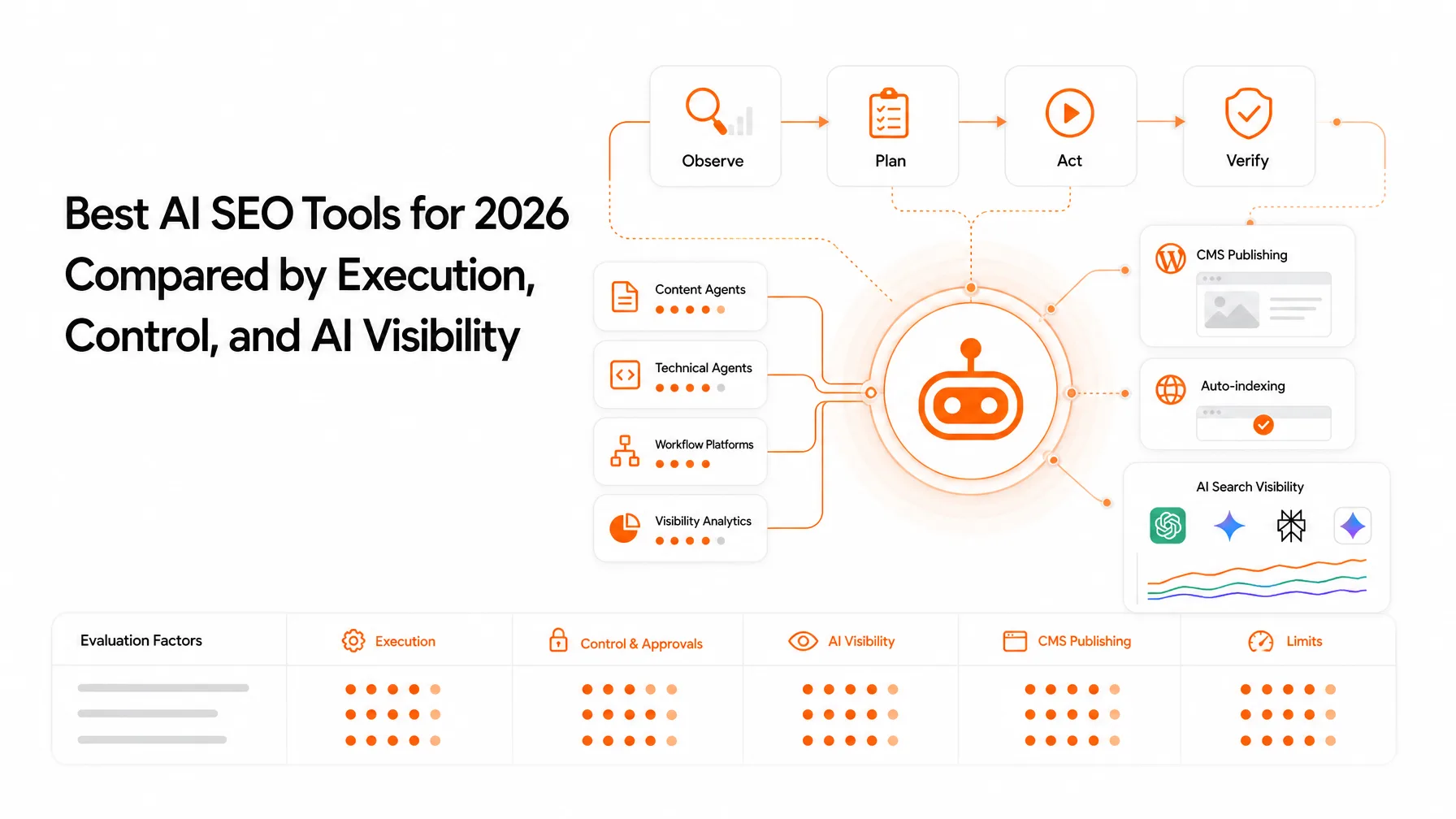
The nature of search engine optimization has changed. What used to be a practice focused on keyword optimisation, link building, and content creation has now become a complex system that needs to operate at machine speed. New players like ChatGPT, Perplexity, Google AI Overviews, and Gemini are increasingly intercepting a growing share of informational search queries before users reach traditional results pages. This has created a new strategic layer known as Generative Engine Optimization (GEO) - the practice of ensuring that brand content is discovered, interpreted, and cited by AI systems rather than simply indexed by crawlers. For businesses operating in 2026, SEO is no longer a department function; it is an automated infrastructure problem that demands system-level thinking, not individual task management.
The growing demand for hands-off execution has pushed a category of tools often described as SEO autopilot platforms into mainstream adoption. These platforms promise to reduce the manual workload of SEO - from keyword research to content publishing - with varying degrees of automation and intelligence. Two platforms frequently compared in this space are Rankaria and Keytomic. Both employ AI to speed up content creation and minimise effort. However, the depth of what they automate, and how they measure success, diverges significantly. This comparison examines both platforms across automation scope, visibility tracking, workflow design, and strategic capability - to determine which tool actually functions as a complete SEO autopilot in 2026.
Keytomic vs Rankaria - What Do These Platforms Actually Do?
What Rankaria Does
Rankaria is an AI-powered SEO automation platform designed to streamline content generation and publishing workflows at scale. Its core proposition is to reduce the time and effort required to produce optimised articles - taking keyword inputs and outputting ready-to-publish content with minimal human intervention. It is marketed towards companies and agencies with high-volume blog content creation needs, with optimisation signals built into the generation process. Rankaria is positioned as a semi-autonomous content autopilot: it handles the writing, it handles the scheduling, and it aims to keep the editorial pipeline flowing without a human writing team behind every piece.
The tool is best understood as a content-driven SEO automation system. Its workflow centres on input → generation → publish, and its value proposition is rooted in speed and output volume. For content-heavy strategies targeting long-tail keywords or programmatic coverage across topic clusters, Rankaria offers a practical route to scale. However, its automation scope is largely confined to the production phase of the SEO lifecycle, which creates measurable gaps when viewed against the full demands of modern search performance.
What Keytomic Does
Keytomic is a full SEO automation engine that covers the complete lifecycle of search performance - from keyword intelligence and topic clustering through to content generation, publishing, auto-indexing, and AI search visibility tracking. Unlike content-focused tools, Keytomic is designed to function as an SEO operating system: it automates not just the creation of content but the conditions required for that content to perform. This includes accelerating Google indexing, monitoring how content appears in AI-generated answers, tracking entity presence across platforms such as ChatGPT and Perplexity, and feeding performance data back into ongoing optimisation decisions.
The platform is particularly suited to teams and agencies that have moved beyond treating SEO as a content production exercise and now view it as a continuous execution system. For a deeper overview of how Keytomic approaches full-system SEO, its architecture reflects the distinction between tools that assist individual tasks and platforms that run the entire operation autonomously.
Why These Tools Are Compared
Both Rankaria and Keytomic sit in the same commercial category - AI-powered SEO automation - and both appeal to similar buyer profiles: businesses looking to scale organic search without growing their SEO headcount. Both use large language models for content creation. Both reduce manual workload significantly compared to traditional SEO workflows. The distinction that drives this comparison, however, is fundamental: Rankaria automates the creation phase of SEO, while Keytomic automates the entire SEO system. For teams evaluating an SEO automation software investment in 2026, that difference determines whether the tool solves the surface problem or the structural one.
Feature-by-Feature Comparison (Deep Analysis)
The table below maps both platforms across the functional categories that define a complete SEO automation system in 2026:
Feature | Rankaria | Keytomic |
|---|---|---|
Content Generation | Strong | Strong |
Content Optimisation | Moderate | Moderate |
Moderate | Advanced Automation | |
Topic Clustering | Moderate | Strong |
Publishing Automation | Strong | Advanced |
Auto Indexing | Limited | Core Feature |
SEO Workflow Automation | Moderate | Full Lifecycle Automation |
AI Visibility Tracking | Limited | Advanced |
Entity Tracking | Limited | Strong |
Technical SEO | Limited | Strong |
Internal Linking Automation | Moderate | Strong |
Search Intelligence | Limited | Advanced |
The feature gap is most visible in the post-publish phase. Rankaria performs competitively on content generation and publishing automation - both platforms match each other on output capabilities. The divergence begins at indexing, where Rankaria offers limited automated submission, and widens significantly across AI visibility tracking, entity monitoring, technical SEO, and search intelligence. Keytomic’s architecture is built to close the feedback loop that most content automation tools leave open: publish a piece, confirm it is indexed, monitor how it performs in both traditional and AI search, and feed that data back into future content decisions.
Which Tool Is the Ultimate SEO Autopilot in 2026?
What “SEO Autopilot” Actually Means
The phrase “SEO autopilot” has been applied broadly to any tool that reduces manual effort. However, a genuine autopilot system in aviation does not merely take off - it navigates, monitors conditions, corrects course, and hands over data. Applying that definition to SEO, a true autopilot must cover: keyword discovery and intent mapping; AI-assisted content generation and optimisation; CMS publishing and scheduling; automated indexing submission; performance tracking against organic benchmarks; and AI search monitoring across generative platforms. The majority of tools on the market automate parts of this system - typically the creation phase. This means businesses using content-only automation tools are flying manually in all the areas that actually determine whether content ranks and converts.
Rankaria as an Autopilot Tool
In the areas it covers, Rankaria is a capable content autopilot. It reduces the time required to go from keyword target to published article, it applies basic SEO optimisation signals at the point of generation, and it enables teams to maintain consistent publishing cadences without manual writing effort. For businesses whose primary bottleneck is content volume - particularly those targeting long-tail keyword clusters where speed of coverage matters - Rankaria solves a real problem efficiently.
The limitation becomes apparent when performance measurement enters the conversation. Rankaria provides limited visibility into what happens after content is published: whether it has been indexed, how it ranks, whether it is surfacing in AI-generated answers, and which pieces are underperforming and require updates. Without this feedback loop, the “autopilot” metaphor breaks down - the plane is taking off but the instruments are not reporting back.
Keytomic as an SEO Autopilot System
Keytomic’s architecture is designed to close every gap in the SEO lifecycle. The platform automates keyword research and topic clustering, generates and publishes content, submits pages for indexing - with documented evidence of 67% faster indexing in independent case studies - and then tracks how that content performs across both Google and AI search engines. The AI search monitoring capability is particularly relevant in 2026, where a growing proportion of branded queries are being answered by generative systems rather than traditional results pages. By measuring citation frequency, entity presence, and brand mention patterns across AI platforms, Keytomic provides the feedback data that enables continuous strategy refinement.
The core principle here is that automation without feedback is an incomplete system. Publishing content at scale increases topical coverage, but without performance data feeding back into decisions about which topics to pursue, which pieces to update, and which formats are gaining traction in AI search, growth stalls. Keytomic’s closed-loop design addresses this directly.
Which Is the Better AI SEO Agent in 2026?
Evaluated through the lens of AI SEO agents - autonomous systems that execute SEO tasks without requiring human orchestration at each step - the distinction is clear. Rankaria behaves as a content automation agent: it receives an objective (produce content on these keywords), executes against it, and stops at publish. Keytomic behaves as a full SEO execution and intelligence agent: it receives a growth objective, builds the content infrastructure to serve it, ensures that infrastructure is visible to both traditional and AI search engines, and monitors and reports on results continuously.
The “best” tool is therefore context-dependent. For teams whose sole requirement is publishing more content faster, both platforms are viable. For teams running SEO as a performance system - where ROI must be measured, AI visibility tracking managed, and strategy adapted to outcomes - Keytomic operates at a fundamentally different level of completeness.
Content Generation and Optimisation - Where Rankaria Competes Strongly
AI Content Creation
Rankaria’s core competency lies in AI-assisted article generation. The platform enables users to input target keywords and receive fully drafted, structurally formatted content outputs at speed. For content teams managing high-volume publishing pipelines - local landing pages, category coverage, long-tail informational articles - this reduces production time substantially. The generation engine applies basic on-page optimisation logic at the point of output, meaning content arrives with heading structures, keyword placement, and readability considerations already incorporated.
This is a genuine competitive strength. Speed of topical coverage matters in SEO - particularly for domains building authority in competitive niches where gap analysis reveals hundreds of underserved keyword opportunities. Rankaria’s ability to move quickly from keyword list to published content serves this goal well, and its output quality is sufficient for informational content strategies targeting mid-to-low competition queries.
Publishing Automation
Both platforms offer automated publishing workflows that connect content generation to CMS deployment, reducing the manual steps between a written article and a live page. Rankaria’s publishing automation is a strong feature: content can be scheduled, deployed, and managed without requiring a developer or an SEO editor to intervene at the publication stage. For agencies managing multiple client sites or businesses operating content-heavy digital properties, this removes a consistent operational bottleneck.
Limitations of Content-Only SEO Systems
The structural limitation of content-only automation becomes apparent over time. Publishing content consistently does not guarantee indexing, and indexed content does not automatically translate into rankings or visibility. Without a mechanism to confirm that published pages have been discovered and processed by Google, content pipelines can run efficiently while performance stagnates. More critically in 2026, content that ranks on traditional SERPs may still be absent from AI-generated answers - a gap that content-only systems have no visibility into and therefore cannot address.
Teams relying exclusively on content automation also lack the feedback data needed to make strategic corrections. If twenty articles are published and fifteen underperform, a content-only system cannot identify the reason or recommend a path to improvement. This creates a ceiling on the ROI of content automation that only a performance-integrated system can overcome.
SEO Automation and Visibility - Where Keytomic Leads
Full SEO Lifecycle Automation
Keytomic’s differentiated value begins where Rankaria’s capability ends. The platform extends automation beyond content generation to cover the conditions that determine whether content actually performs. Keyword research and topic clustering are built into the intake process, meaning content is generated against strategically validated targets rather than raw keyword lists. Once content is published, automated indexing protocols push pages to Google’s discovery queue immediately rather than waiting for organic crawling - a step that can meaningfully reduce the time between publication and first ranking signal.
This full-lifecycle approach eliminates the need for teams to manage multiple disconnected tools. Keyword tools, content generators, CMS integrations, indexing checkers, and performance dashboards are consolidated into a single operating environment. For agencies and growth teams looking at the best AI SEO tools for content automation, the reduction in tool stack complexity represents a measurable operational advantage.
AI Visibility and Citation Tracking
One of Keytomic’s most strategically relevant capabilities in 2026 is its AI visibility tracking. As ChatGPT, Perplexity, Google AI Overviews, and Gemini absorb a growing share of search behaviour, the metric of success in SEO is no longer solely organic rank position - it is also whether a brand is being cited and recommended by AI systems in response to relevant queries. Keytomic tracks brand mentions and citation patterns across these platforms, providing data that most SEO tools do not yet measure.
For brands operating under the principles of Answer Engine Optimisation (AEO) and GEO, this tracking capability is not optional - it is the primary signal of whether content strategy is working in AI-mediated search. The LLM citations checklist framework that Keytomic operationalises helps teams understand what structural and content attributes make pages more likely to be cited in AI-generated answers. This is an area where Rankaria offers no equivalent capability, representing a significant strategic gap for any business measuring performance in 2026.
Indexing and Performance Feedback Loop
Keytomic’s feedback architecture creates a continuous improvement loop that content-only tools cannot replicate. Published content is indexed faster. Performance data - rankings, click-through rates, AI citation frequency - flows back into the platform. That data informs decisions about which topics to pursue next, which existing pages require optimisation, and where content gaps remain. This design means the platform gets more effective over time as the data set grows, rather than operating as a static production engine.
For teams building a 30-day AI search optimisation roadmap or scaling an SEO programme across multiple client accounts, this feedback loop is the structural feature that separates tool-based SEO from system-based SEO.
Pricing Comparison - Autopilot vs Tool-Based Value
Rankaria Pricing Positioning
Rankaria’s pricing is structured around content output - the volume of articles that can be generated and published within a given plan. This positions the platform as a cost-efficient option for teams whose primary KPI is publishing cadence. For businesses running content-heavy SEO strategies with large keyword targets and consistent publishing requirements, the cost-per-article model can deliver reasonable economies of scale. The value proposition is straightforward: more content, faster, at a lower per-unit cost than human editorial teams.
Keytomic Pricing Positioning
Keytomic’s pricing reflects its position as an all-in-one SEO automation system. The value case is not cost-per-article but cost-per-tool-stack-replaced: keyword research tools, content generators, indexing checkers, AI visibility trackers, and performance dashboards consolidated into a single platform. For teams currently paying separately for each of these functions, Keytomic’s pricing represents a consolidation opportunity as much as a content investment.
Cost vs Capability
The cost comparison depends entirely on what problem the buyer needs to solve. Rankaria may represent lower direct costs for teams whose requirement is purely content volume. Keytomic’s total cost of ownership argument strengthens significantly when the alternative is maintaining five to seven separate tools alongside a content automation platform. For businesses prioritising ROI through measurable ranking improvements and AI visibility gains - supported by improve brand visibility in AI search data - the performance evidence makes the investment case more defensible than content volume alone.
Workflow Comparison - How Each Tool Actually Works
Rankaria Workflow
Keyword Input → AI Content Generation → Publish
Rankaria’s workflow is linear and output-focused. Users define keyword targets, the platform generates optimised content, and that content is published to the target site. The process is efficient and repeatable, and it requires minimal configuration once the initial parameters are set. The workflow is well-suited to high-volume, high-frequency publishing strategies where the primary constraint is production bandwidth rather than strategic depth.
Keytomic Workflow
Keyword Research → Content Generation → Publish → Auto-Index → Track Performance → Optimise
Keytomic’s workflow extends the standard content automation loop into a continuous performance cycle. After publishing, pages enter an automated indexing queue that prioritises discovery by Google’s crawlers. Performance data begins accumulating as pages gain traction - organic positions, traffic patterns, and AI citation frequency are all tracked in real time. That data feeds back into strategic decisions: which keywords are gaining ground and deserve cluster expansion, which published pages are underperforming and require content updates, and which emerging topics align with the brand’s demonstrated authority. This creates a compounding growth dynamic that a linear publish workflow cannot replicate.
For teams who have moved beyond asking “how do we produce more content” to “how do we build an SEO system that grows over time,” this workflow loop is the defining structural difference.
Use Case Breakdown
Use Case | Rankaria | Keytomic |
|---|---|---|
Content Scaling | Strong | Strong |
SEO Automation | Moderate | Advanced |
Weak | Strong | |
Publishing Automation | Strong | Strong |
Technical SEO | Weak | Strong |
Search Intelligence | Weak | Strong |
Full SEO Systems | Limited | Strong |
Strengths and Limitations
Rankaria Strengths
Fast AI content generation at scale
Strong publishing automation with CMS integration
Efficient for high-volume, long-tail content strategies
Low barrier to entry for teams new to SEO automation
Rankaria Limitations
Limited AI visibility tracking across generative search platforms
No automated indexing submission layer
Minimal performance feedback loop after content is published
Less strategic SEO depth - optimisation logic is primarily surface-level
Not designed for full SEO lifecycle management
Keytomic Strengths
End-to-end SEO automation covering the full lifecycle - from keyword research to improve brand visibility in AI search
Advanced AI visibility monitoring with citation and entity tracking across ChatGPT, Perplexity, and Google AI Overviews
Automated indexing for faster time-to-rank
Performance data feedback loop enabling continuous optimisation
Consolidated tool stack reducing complexity and operational overhead
Keytomic Limitations
Less focused on pure high-volume writing workflows for content-only strategies
Requires understanding of SEO systems thinking to leverage full platform depth
Broader feature set may exceed the requirements of teams with simple content-only goals
Common Mistakes When Choosing an SEO Autopilot Tool
Mistake 1 - Thinking Content = SEO
The most common misalignment in evaluating SEO automation tools is conflating content production with SEO performance. Publishing articles consistently is a necessary component of organic growth, but it is not sufficient. Google’s indexing, ranking, and AI citation systems reward content that has been optimised, indexed promptly, and that demonstrates topical authority over time. Teams that select content automation tools and then measure success by article count rather than ranking movement or traffic growth will consistently underperform against teams operating with integrated performance measurement.
Mistake 2 - Ignoring AI Visibility
In 2026, measuring SEO performance only through traditional metrics - impressions, clicks, and organic position - misses a growing portion of search behaviour. AI search platforms now resolve a significant volume of queries without sending traffic to source pages, which means brand presence in AI-generated answers is a performance dimension that exists independently of SERP rank. Teams that do not measure AI search visibility tracking tools cannot know whether their brand is being cited, recommended, or excluded by the AI systems their audience increasingly uses for research and discovery.
Mistake 3 - Choosing Based on Output Instead of Outcomes
Evaluating SEO tools on the number of articles they can generate per month prioritises input metrics over output outcomes. The relevant performance question is not “how much content can this tool produce” but “how much of that content will rank, drive traffic, and earn citations in AI search.” A tool that produces 200 articles per month with no performance tracking cannot answer that question. A platform that produces 80 articles, ensures they are indexed, monitors their performance, and feeds data back into the next cycle delivers a fundamentally different - and measurably better - return on investment.
Teams evaluating their options should consult a structured approach to choosing SEO automation tools that prioritises lifecycle completeness over raw output volume.
Conclusion
SEO automation is evolving into its second generation. The first generation solved the content production problem - AI tools made it possible to generate articles at scale without proportionally scaling editorial teams. The second generation is solving the system problem: ensuring that content is indexed, measured, and continuously improved based on real performance data across both traditional and AI search environments. Rankaria represents a capable first-generation solution: it automates content creation and publishing reliably, and for teams whose primary bottleneck is output volume, it delivers value. The gap opens at the point where measurement and adaptability become the dominant requirements.
In 2026, the concept of SEO autopilot is no longer about generating content at scale. It is about building systems that can execute, measure, and adapt continuously. The difference between tools like Rankaria and platforms like Keytomic lies in how complete that system truly is.
Frequently Asked Questions
What is SEO autopilot?
SEO autopilot refers to a system or platform that automates the end-to-end process of search engine optimisation with minimal human intervention. A true SEO autopilot covers keyword research, content creation, publishing, indexing, performance monitoring, and AI search monitoring. Most tools only automate portions of this cycle - typically content generation and publishing - rather than the complete system required for sustainable organic growth in 2026.
Is Rankaria a fully automated SEO tool?
Rankaria automates content generation and publishing effectively, making it a strong tool for scaling article output. However, it does not automate the full SEO lifecycle. Key components such as automated indexing submission, AI visibility tracking, entity monitoring, and performance feedback loops are either limited or absent in Rankaria’s current feature set, which means it functions more accurately as a content automation tool than a complete SEO autopilot system.
How does Keytomic differ from content automation tools?
Keytomic extends automation beyond content creation to cover the conditions that determine whether content actually performs. While content automation tools focus on generating and publishing articles, Keytomic additionally handles automated indexing, tracks performance in both traditional and AI search environments, monitors brand citations across generative platforms such as ChatGPT and Perplexity, and feeds performance data back into ongoing optimisation. This closed-loop architecture positions Keytomic as an SEO operating system rather than a standalone content tool.
Which tool is better for AI SEO in 2026?
For teams whose strategy includes AI search visibility as a primary performance metric, Keytomic is the stronger platform. It tracks brand citations and entity presence across AI search engines, provides data on how content performs in generative answers, and integrates this visibility data into the broader SEO optimisation workflow. Rankaria does not offer equivalent AI visibility measurement. The rise of GEO and AI visibility tools as standard practice in 2026 makes this a meaningful capability distinction.
Do automated SEO tools actually work?
Automated SEO tools deliver meaningful results when they are evaluated against the right criteria. Content automation reduces production time and enables consistent publishing cadence, which supports topical authority development over time. Full-lifecycle automation tools like Keytomic go further, ensuring content is indexed promptly, measured accurately, and optimised continuously based on performance data. The caveat that applies to all SEO automation is that content quality and backlink development remain factors that automated tools complement rather than replace entirely.
What is AI visibility tracking?
AI visibility tracking is the practice of monitoring how often and how accurately a brand or website is cited, mentioned, or recommended by AI-powered search systems such as ChatGPT, Google AI Overviews, Perplexity, and Gemini. As these platforms handle an increasing volume of search queries in 2026, traditional rank tracking provides only a partial picture of search performance. AI visibility tracking fills this gap by measuring brand presence in generated answers - a metric that determines whether a brand is being discovered by audiences who never reach a traditional results page. Keytomic’s AI visibility tools are purpose-built for this measurement layer.
Can I use both Rankaria and Keytomic together?
There is no functional barrier to using both platforms simultaneously, but the combination is unlikely to be necessary for most teams. Keytomic’s content generation capabilities are comparable to Rankaria’s in terms of output quality and speed, and the platform additionally provides the lifecycle management, indexing, and visibility tracking that Rankaria does not. Teams currently using Rankaria for content automation and seeking to add AI visibility measurement and performance feedback would find Keytomic’s consolidated architecture a more efficient solution than maintaining both platforms in parallel.
Which platform is better for SEO agencies managing multiple clients?
For agencies managing multiple client accounts, the operational requirements extend beyond content generation to include performance reporting, indexing verification, and AI visibility measurement across different domains. Keytomic’s full-lifecycle architecture supports this multi-account management more comprehensively than Rankaria. The consolidation of keyword research, content generation, indexing automation, and performance tracking into a single platform reduces the operational overhead of managing multiple tool logins, reporting exports, and data sources for each client account.