Table of Contents
Share Article
Profound vs Keytomic in 2026 Which AI SEO Platform Is Better
Profound vs Keytomic in 2026 Which AI SEO Platform Is Better
Profound vs Keytomic in 2026 Which AI SEO Platform Is Better

Ahsan Iqbal
Marketing Growth Expert

Profound vs Keytomic compared across AI visibility, SEO automation, content workflows, CMS publishing, integrations, pricing, and best-fit teams in 2026.
Profound is the stronger fit when your primary need is dedicated AI search measurement, prompt intelligence, citation analysis, competitive benchmarking, or enterprise AEO analytics.
Keytomic is the stronger fit when your primary need is a connected workflow that runs from keyword research through a 30-day content roadmap, content production, CMS publishing, indexing, technical checks, and AI visibility tracking.
Neither platform should be presented as a universal winner. Exact pricing, plan limits, integrations, and feature availability must be verified against official vendor pages before any purchase decision.
If you’re comparing these two platforms, the decision comes down to a single question: is your bottleneck measurement or execution? Profound and Keytomic operate in the same broad category of AI SEO platforms, but they solve fundamentally different problems. Feature and availability details in this article were checked against official product pages in August 2026. Pricing and plan limits should be rechecked before purchase.
The buyer who needs a clear picture of how their brand appears across ChatGPT, Perplexity, Claude, and Gemini is looking for something different from the buyer who needs to research keywords, build a content calendar, produce articles, publish to a CMS, and push pages into indexing without stitching together five tools. One platform prioritizes insight. The other prioritizes output.
This comparison maps each platform’s confirmed capabilities, flags what requires verification, and gives you a decision framework grounded in workflow fit rather than feature count. It is an official-source desk comparison, not a hands-on performance test.
Profound vs Keytomic: Quick Comparison Overview
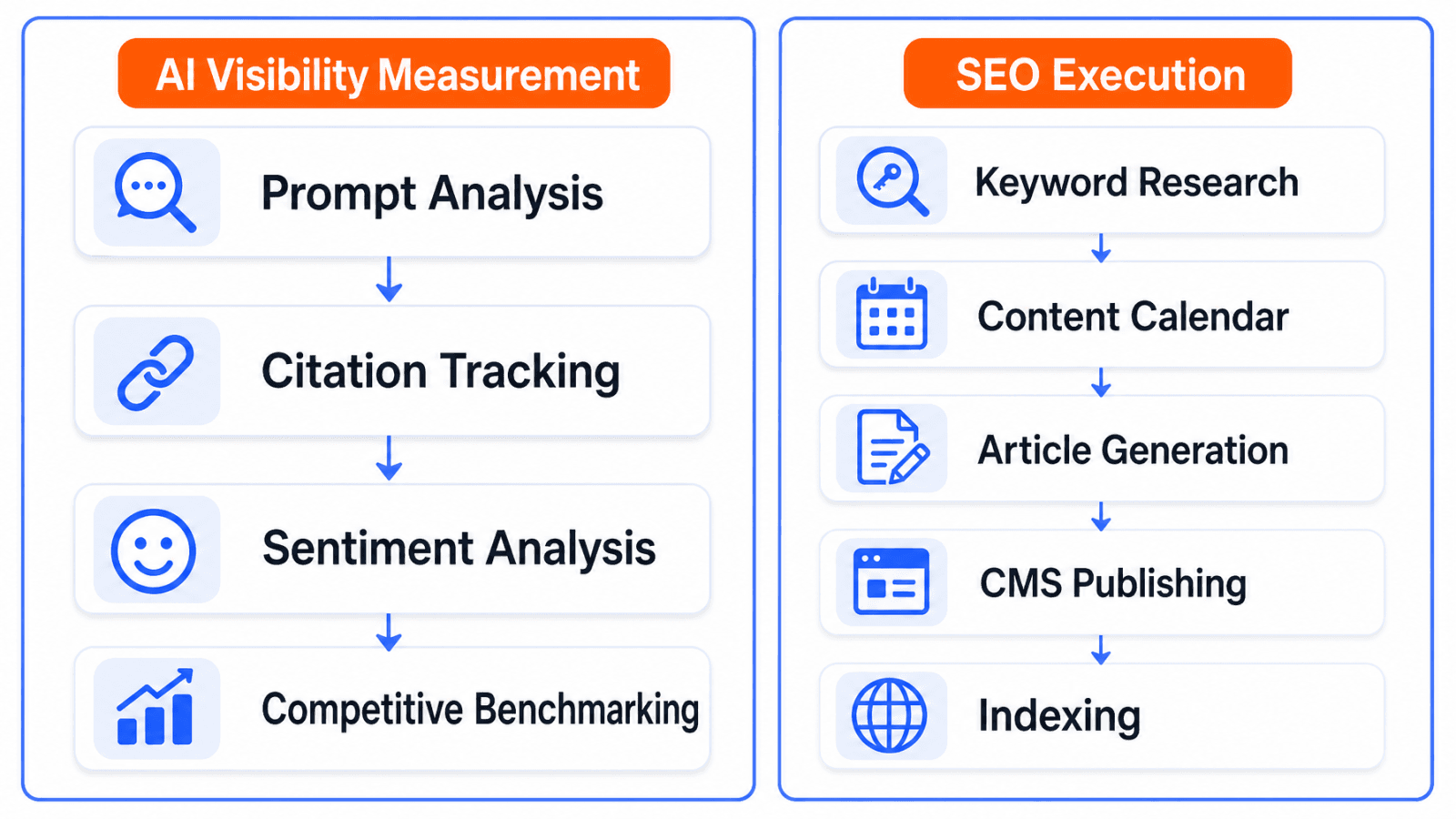
Which platform is better for your workflow?
Profound fits teams that need dedicated AEO measurement, prompt-volume research, citation analysis, multi-engine visibility benchmarking, and enterprise AI search analytics. Keytomic fits teams that need one connected workflow covering SEO research, content operations, CMS publishing, indexing, technical checks, and AI visibility. If your primary bottleneck is measurement, evaluate Profound first. If your primary bottleneck is execution, evaluate Keytomic first.
Comparison table: Profound vs Keytomic
Capability | Profound | Keytomic |
|---|---|---|
Primary category | AI search visibility measurement and AEO analytics | End-to-end SEO automation and content execution |
Yes. Covers ChatGPT, Perplexity, Gemini, Claude, Copilot, and others | Yes. AI Visibility Tracker covers major LLMs | |
Prompt intelligence and demand data | Yes. Prompt Volumes from 1.5B+ real AI conversations | Requires confirmation |
Citation and sentiment tracking | Yes. Citations, sentiment, share of voice | Requires confirmation on full citation scope |
Keyword research and topical planning | Requires confirmation as a traditional SEO workflow | Yes. Automated keyword discovery and 30-day calendar |
SEO content generation | Via Profound Agents (credit-based, plan-dependent) | Yes. AI content generation with SEO scoring |
CMS publishing | Via Profound Agents (requires configuration) | Yes. Named CMS integrations including WordPress and Shopify |
Auto-indexing | Requires confirmation | Yes. Built-in indexing for Google, Bing, and AI engines |
Technical SEO audits | Requires confirmation | Yes. Technical site health checks |
Competitive benchmarking in AI | Yes | Requires confirmation on depth |
Pricing model | Plan-dependent prompts and Agent credits. Exact pricing requires official-page verification | Official homepage shows pricing tiers. Exact figures require verification before purchase |
Best fit | Enterprise and mid-market teams prioritizing AI search measurement | SMBs, agencies, and in-house teams prioritizing connected SEO execution |
Feature and availability details were checked against official product pages in August 2026. Pricing and plan limits should be rechecked before purchase.
Profound is the stronger fit for AI search measurement, while Keytomic is the stronger fit for connected SEO execution, subject to current plan and feature verification.
What this comparison can and cannot prove
This article compares publicly available official product documentation, help center pages, and confirmed homepage claims from both vendors. It does not include a repeatable hands-on product test, independent performance scores, ROI calculations, or implementation quality judgments. Any claim marked “Requires confirmation” should be verified directly with the vendor before purchase.
What Profound Is Built to Measure and Execute
Profound is an agentic marketing platform built specifically for AI visibility analytics, starting from the premise that a growing share of purchase decisions now begin with a query in ChatGPT, Perplexity, or Gemini rather than a Google search. Its architecture was designed for AEO from the start, not retrofitted from a traditional SEO tool.
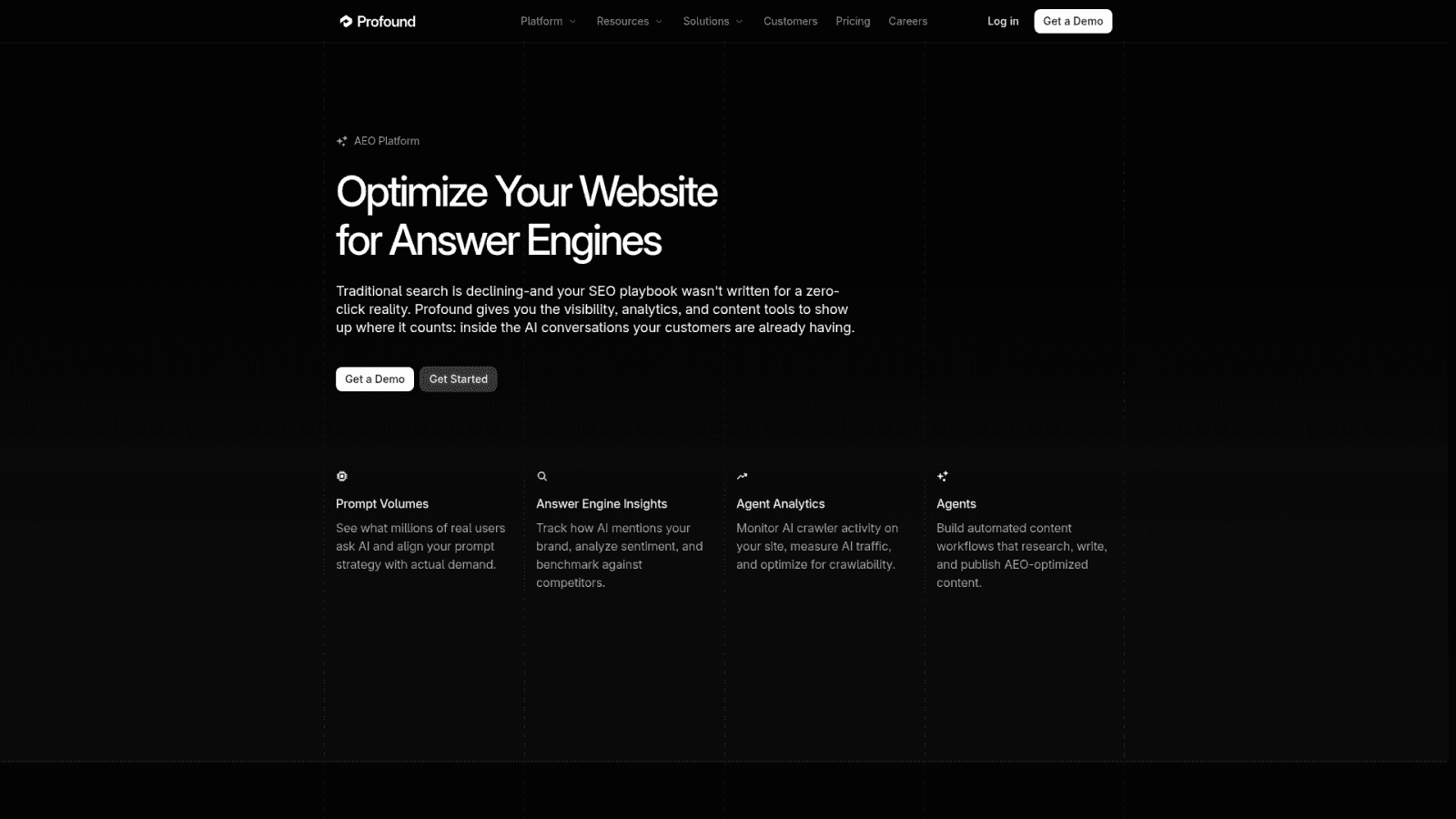
How Profound measures AI search visibility
Profound tracks brand presence across more than ten answer engines, including ChatGPT, Claude, Perplexity, Gemini, Copilot, Grok, Meta AI, DeepSeek, Google AI Mode, and Google AI Overviews, by capturing real user-facing responses rather than relying on API outputs alone. The platform provides visibility scores, share of voice, citation tracking, sentiment analysis, and competitive benchmarking across these engines.
A key distinction worth understanding: prompt-based visibility scores, citation share, sentiment, and AI crawler activity measure different layers of the AI search system. They are not direct equivalents to Google Search Console impressions or click-through rates. Profound’s official product documentation describes Prompt Volumes as data drawn from real AI conversations, giving teams a picture of what users are actually asking AI engines rather than which prompts a team manually chose to monitor.
How Profound connects data to AEO workflows
Profound Agents are modular, node-based workflows that connect visibility data to content creation, optimization, and publishing actions, as described in Profound’s official Agents documentation. Agents use a credit-based consumption model with plan-dependent credit allowances, and higher usage thresholds typically require an Enterprise discussion according to Profound’s official help center. Human-in-the-loop checkpoints are part of the workflow model where documented.
For teams evaluating the distinction between AI SEO agents and workflow orchestration, understanding where automation ends and human review begins is a practical requirement before purchase.
Who should evaluate Profound first?
Profound is worth evaluating first when the team’s primary need is AI prompt research, multi-engine visibility measurement, citation analysis, AI crawler analytics, attribution, competitive benchmarking in AI, or enterprise governance controls. It is positioned toward mid-market and enterprise teams, with pricing that reflects that positioning. Teams that primarily need content production and publishing automation alongside AI visibility will need to confirm whether Profound’s Agent capabilities cover their execution requirements at their plan level.
What Keytomic Is Built to Automate
Disclosure: Keytomic publishes this comparison. The Keytomic section below explains where the platform fits and where it may not, using official sources and verified capabilities only.
The Keytomic AI SEO automation platform is positioned as an execution layer that connects SEO discovery, content operations, CMS publishing, indexing, and AI visibility tracking in one workflow. Where Profound leads with measurement, Keytomic leads with output.
From keyword research to a 30-day content calendar
Keytomic’s workflow begins with automated keyword discovery, scanning a site’s niche, existing content, and competitive landscape to identify high-intent, rankable opportunities. The output is a 30-day content calendar built around topical authority clusters, which a human reviews and approves before content generation begins.
This research-to-calendar step is the foundation of topical authority in SEO: covering a subject area with sequenced, interconnected content rather than publishing isolated articles. The calendar sets the production sequence and prevents content gaps that undermine cluster authority.
From content creation to CMS publishing and indexing
Once the calendar is approved, Keytomic generates SEO-scored content with on-brand images and publishes directly to connected CMS platforms. Named integrations include WordPress and Shopify, among others, according to the official Keytomic homepage. The current integration matrix should be verified before implementation because the homepage names several platforms without providing a full compatibility table.
After publishing, Keytomic’s built-in indexing system submits new pages to Google, Bing, and other search engines and AI platforms for faster discovery. Indexing submission does not guarantee ranking or inclusion, and Google’s official guidance on AI features confirms that crawlability and content helpfulness remain the foundation of search eligibility regardless of indexing speed.
How Keytomic adds AI visibility to SEO operations
Keytomic includes an AI Visibility Tracker that monitors brand mentions and LLM visibility across major AI engines. This positions AI visibility as part of the same operational loop as keyword research and publishing, rather than a separate analytics layer that requires a second tool. For teams looking to improve brand visibility in AI search engines without adding another platform, this integration is a practical consolidation.
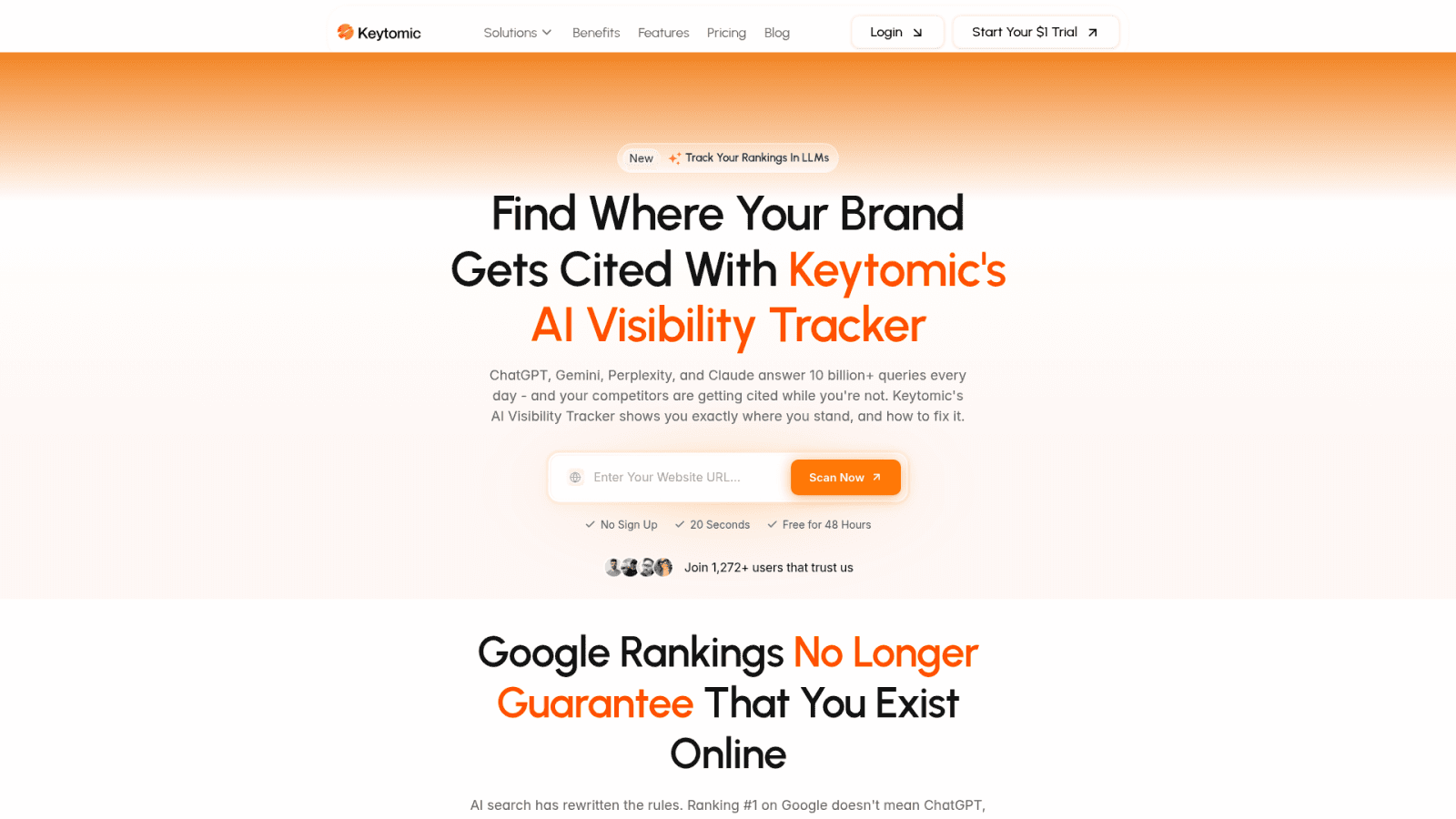
Technical site health checks are also part of the Keytomic workflow according to official homepage claims. The depth and configurability of these audits should be confirmed with the vendor before treating them as a replacement for a dedicated technical SEO tool.
Profound vs Keytomic: Feature-by-Feature Comparison
AI visibility measurement and prompt intelligence
Profound holds a clear advantage in the depth of AI visibility measurement. Its Prompt Volumes feature draws on real user conversation data to show what audiences are actually asking AI engines, which is a different data layer from manually tracked visibility prompts. Keytomic’s AI Visibility Tracker monitors brand mentions and LLM presence, which is useful for execution teams but does not replicate Profound’s prompt-demand intelligence or the breadth of its Answer Engine Insights. Teams that need AI search monitoring as a core input to SEO strategy will find Profound’s measurement depth more suited to analytics-led programs, while Keytomic’s tracker serves teams that want AI visibility integrated into their content execution loop.
For a clear view of AEO versus SEO workflow differences, the key distinction is whether visibility data drives content decisions or content decisions drive visibility measurement.
Keyword research, topical planning, and content briefs
Keytomic’s keyword research and 30-day calendar workflow is a confirmed core capability from official homepage claims. Profound’s official product documentation describes AI search analytics and Agent-driven workflows but does not position the platform as a traditional full-stack keyword research tool. Buyers who need structured topical planning alongside AI visibility measurement should confirm Profound’s keyword research scope directly before assuming parity.
SEO content generation and publishing automation
Keytomic generates content and publishes it to a connected CMS as part of its core workflow. Profound Agents can handle content creation and publishing actions within a configured node-based workflow, but this requires credit usage and plan-appropriate setup. The key difference is that Keytomic’s content and publishing workflow is the primary product, while Profound Agents extend an analytics platform with execution capabilities. Neither replaces human editorial judgment, and E-E-A-T in Google SEO remains a human responsibility that automation cannot fully replicate.
Technical SEO, indexing, and integrations
Capability | Profound | Keytomic |
|---|---|---|
Auto-indexing | Requires confirmation | Yes, built-in for Google and Bing |
Technical site audits | Requires confirmation | Yes, confirmed on homepage |
WordPress integration | Via Agents (plan-dependent) | Yes, confirmed |
Shopify integration | Requires confirmation | Yes, confirmed |
API access | Requires plan confirmation | Requires plan confirmation |
Schema markup support | Requires confirmation | Yes, schema markup and AI visibility supported |
Auto-indexing accelerates discovery but does not guarantee inclusion or ranking. GEO strategy for AI search visibility depends on content quality and structure, not submission speed alone.
Reporting, attribution, and human oversight
Profound’s reporting is built around AI visibility metrics: visibility score trends, citation share, sentiment shifts, competitive benchmarks, and Agent Analytics for workflow attribution. Keytomic’s reporting covers SEO performance, content scoring, and AI visibility monitoring within its unified dashboard. Plan-dependent export, API access, and attribution features require confirmation from both vendors before assuming availability at a given tier.
How to Compare Profound Pricing and Total Tool Stack Cost
What each vendor publicly verifies
Claim | Official source | Status |
|---|---|---|
Profound uses plan-dependent prompt limits | Confirmed August 2026 | |
Profound Agents use a credit-based model | Profound help center | Confirmed August 2026 |
Keytomic homepage shows pricing tiers | Keytomic.com | Confirmed August 2026, exact figures require re-verification |
Profound public dollar pricing | Official Profound pricing page | Not verified in this brief. Check tryprofound.com directly |
Do not use third-party review sites or SEO blog screenshots as the source of official vendor pricing for either platform.
How prompts, credits, seats, and usage limits change cost
The monthly subscription price is rarely the full cost. For Profound, the real cost depends on how many prompts are tracked, how many Agent credits are consumed, how many workspaces or seats are required, and whether enterprise features require a procurement cycle. For Keytomic, cost depends on the number of CMS connections, content volume per month, the plan tier, and whether any features require add-ons.
For SEO automation software evaluation criteria, total cost of ownership should include platform fees, any complementary tools still required, editorial review time, and implementation effort.
A total cost of ownership worksheet
Before committing, map these cost inputs using your own estimates:
Platform fee: Vendor’s current confirmed monthly or annual rate
Complementary tools still needed: Keyword research tools, rank trackers, or analytics platforms not replaced
Content production labor: Hours per article not automated, multiplied by team cost
Editorial review: Time required for factual, legal, and brand review per published piece
CMS operations: Setup and maintenance for integrations
Technical implementation: Onboarding, configuration, and migration effort
Migration time: Historical data, prompt libraries, content assets, redirects, and tracking continuity
All calculations above are reader-entered estimates. Neither vendor’s savings claims have been independently verified in this brief.
Which Platform Fits Your SEO Workflow?
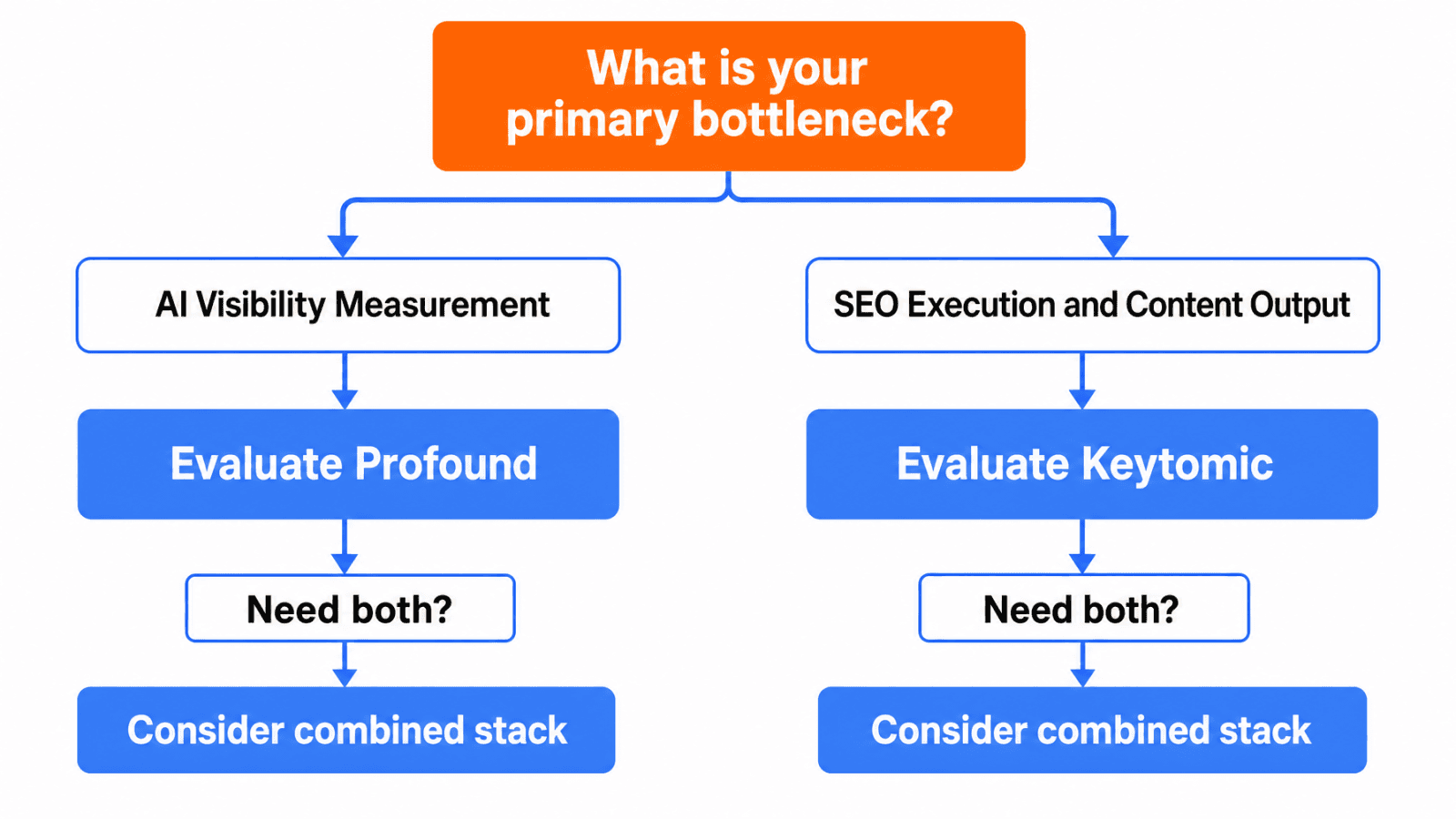
Choose Profound when measurement is the primary bottleneck
Choose Profound if your team needs dedicated AEO measurement, prompt-volume research drawing on real AI conversations, citation analysis, multi-engine competitive benchmarking, AI crawler analytics, or enterprise governance controls. Confirm plan access, prompt coverage, credit consumption, regional availability, and implementation support before committing.
Choose Keytomic when execution is the primary bottleneck
Choose Keytomic if your team needs one workflow connecting keyword discovery, a 30-day content roadmap, AI-assisted content production, CMS publishing, indexing, technical checks, and AI visibility monitoring. Confirm current CMS support, indexing method, content review controls, AI engine coverage, and whether the workflow replaces the tools already in your stack before committing.
Use a combined stack or neither when appropriate
A combined stack is justified when the team needs both the depth of Profound’s prompt intelligence for strategic AEO decisions and Keytomic’s connected execution workflow for content output. Combined stacks increase total cost and operational complexity, so this approach makes sense primarily for teams with budget and bandwidth to manage both.
Neither platform may be the right move if your existing stack is already mature, deeply integrated, and performing well. Migration disruption, historical data loss, and retraining time carry real operational costs that a feature comparison alone cannot capture. One honest limitation for both platforms: neither guarantees rankings, AI citations, traffic, or conversions, and Keytomic’s terms explicitly state that automated outputs require human review.
How Keytomic Connects Research to Publication and AI Visibility
This section explains Keytomic’s intended workflow using official sources. Keytomic publishes this comparison.
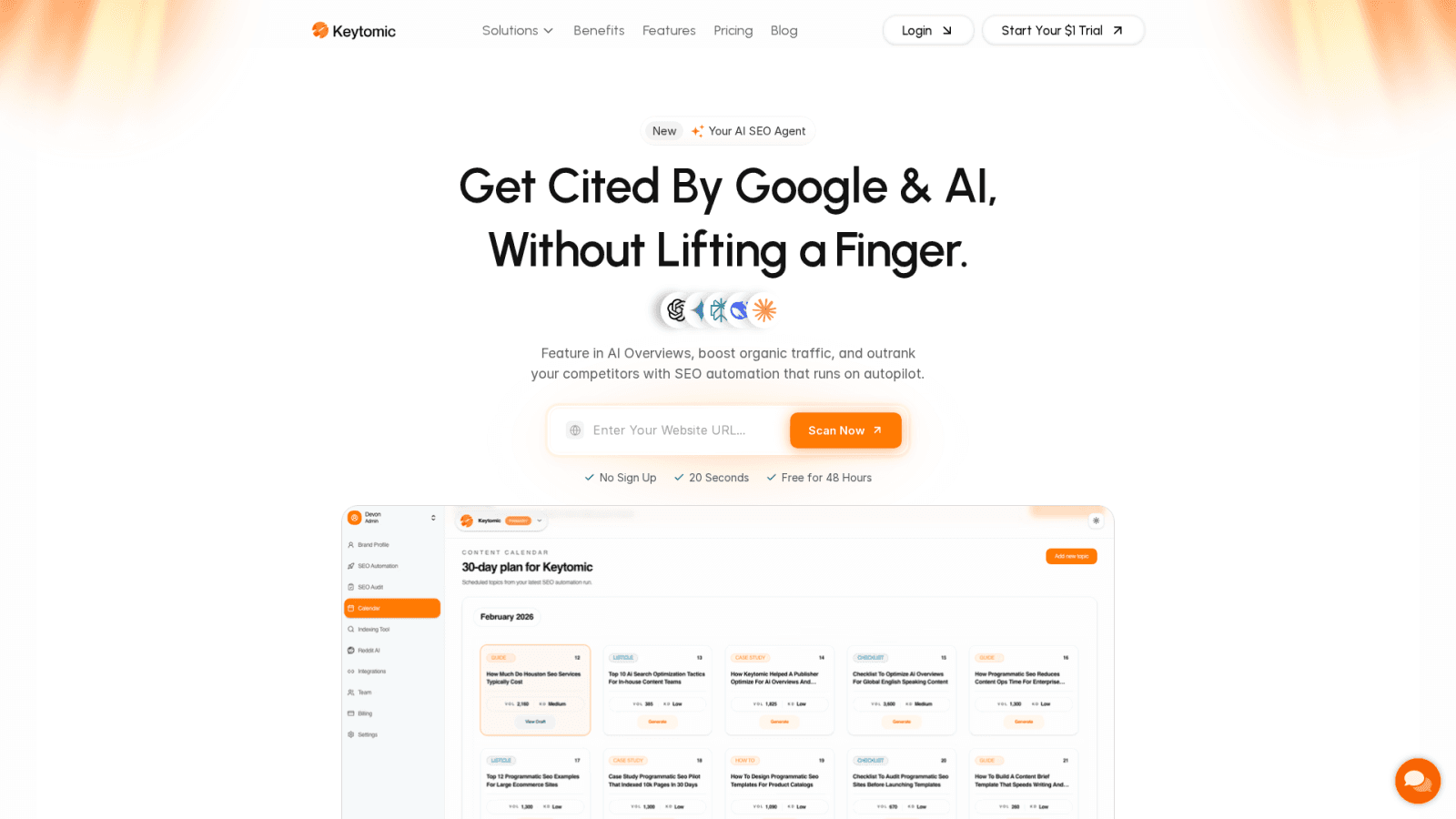
The connected workflow: discover, plan, create, publish, measure
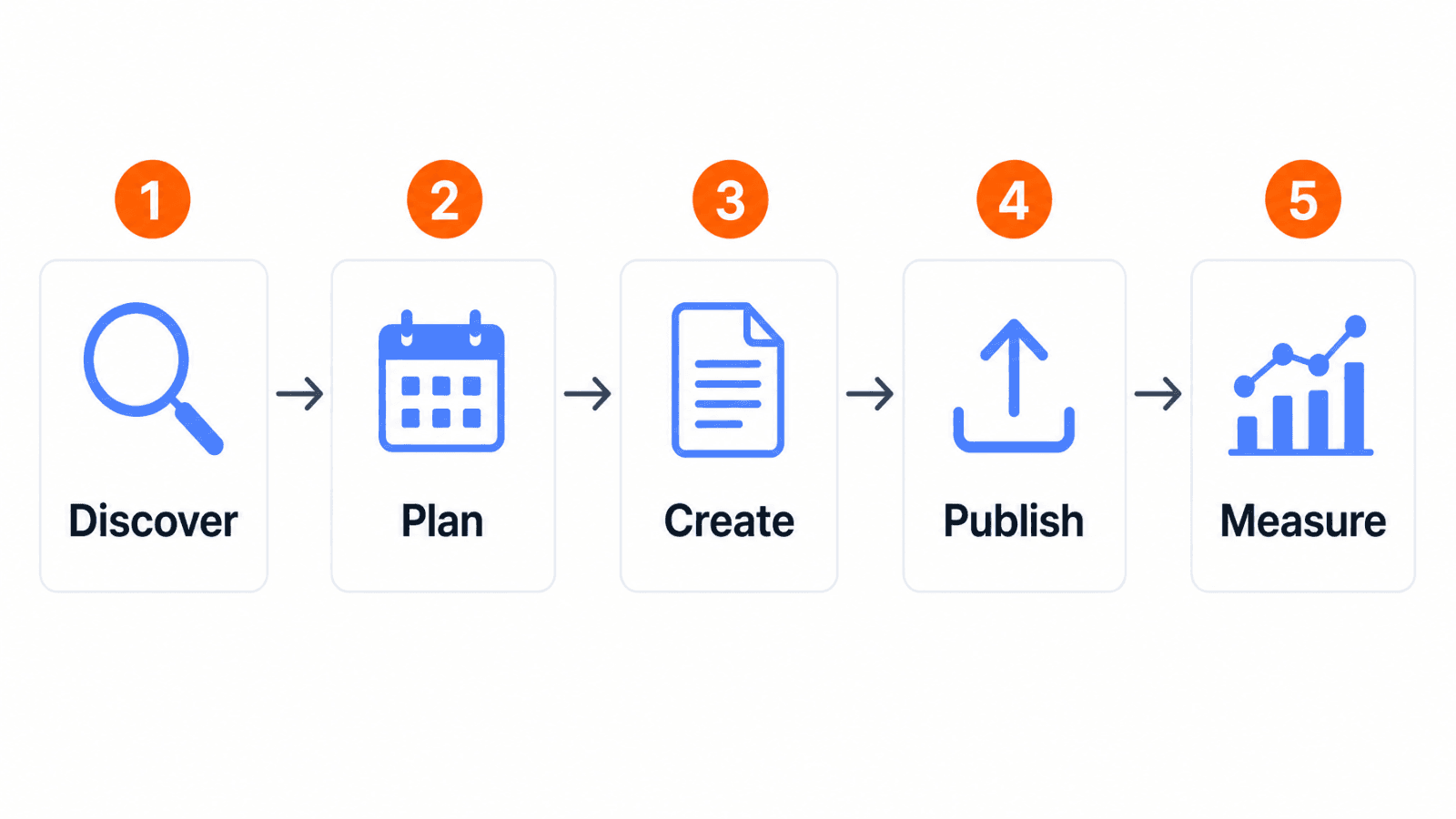
Discover: Keytomic’s AI scans your site, niche, and competitive landscape. Input: your domain and target niche. Output: a ranked list of high-intent keyword opportunities. Human checkpoint: review and prioritize the keyword set before calendar generation.
Plan: The platform builds a 30-day content calendar sequenced around topical authority clusters. Input: approved keyword priorities. Output: a structured calendar with article titles, target keywords, and publishing schedule. Human checkpoint: approve, adjust, or reject calendar items before generation begins.
Create: Keytomic generates SEO-scored articles with on-brand images, internal links, schema markup, and structured data. Input: approved calendar item. Output: a complete draft with SEO scoring. Human checkpoint: editorial review for factual accuracy, brand voice, legal claims, and final approval.
Publish: Approved content is pushed directly to the connected CMS. Input: approved draft. Output: live page on the target domain. Human checkpoint: final publish confirmation where the workflow requires it.
Measure: The AI Visibility Tracker and SEO analytics monitor rankings, brand mentions in AI engines, and technical health. Input: live published content. Output: visibility reports and actionable follow-up tasks.
Keytomic is designed as an execution layer that reduces fragmented toolstack overhead, as described on the Keytomic AI SEO automation platform homepage.
Where human review remains necessary
Automation handles the repeatable parts of this workflow. Human judgment remains necessary for topic strategy, brand voice calibration, factual verification, regulated or sensitive claims, legal review, and final publication approval. Keytomic’s terms and conditions state explicitly that users remain responsible for all published content and that automated outputs may contain errors or unsupported claims. This is not a limitation unique to Keytomic: E-E-A-T in Google SEO requires demonstrated expertise, authoritativeness, and trustworthiness that no automation tool can fully inject into content.
When Keytomic is not the right fit
Keytomic is not the right fit for teams with a mature, deeply integrated SEO stack that already covers keyword research, content production, and publishing efficiently. It is also not suited for organizations producing highly regulated content where legal review requirements make rapid publishing workflows impractical. Teams that specifically need enterprise-grade AEO analytics, deep prompt-intelligence databases, or multi-engine attribution reporting beyond what Keytomic’s confirmed public pages describe should evaluate Profound or a dedicated AEO analytics platform alongside or instead of Keytomic.
Profound vs Keytomic: Limitations and Tradeoffs
Profound tradeoffs to validate before purchase
Before purchasing Profound, buyers should verify: exact public pricing for their intended plan tier, prompt coverage across the engines that matter for their region and market, credit consumption rates for Agents at their expected usage volume, whether CMS publishing through Agents is available at their plan level, API access scope, regional data coverage, and what implementation support is included. The operational difference between AEO and GEO matters here because Profound’s strongest capabilities sit in AEO measurement, while GEO execution may require additional tools.
Keytomic tradeoffs to validate before purchase
Before purchasing Keytomic, buyers should verify: which CMS platforms are fully supported at their plan level, how the indexing submission method works and what coverage it provides, what content review controls exist, which AI engines are covered in the AI Visibility Tracker, the depth of reporting and export capabilities, usage limits per plan, and whether the workflow genuinely replaces the specific tools currently in the team’s stack.
Claims that should never appear without proof
Neither platform should be described using unsupported guarantees, specific ranking percentage improvements, traffic increase claims, citation rate promises, exact customer counts, integration lists not confirmed in official documentation, certifications not verified on official pages, or competitor limitations not supported by official documentation. The tradeoff is simple: publishing unsupported claims creates liability and erodes reader trust. Before switching from either platform, verify historical data portability, contract terms, and workflow ownership continuity.
Frequently Asked Questions About Profound and Keytomic
Is Profound better than Keytomic for AI search visibility?
Profound offers deeper AI visibility measurement, including Prompt Volumes from real user conversations, multi-engine citation tracking, and competitive benchmarking. Keytomic’s AI Visibility Tracker integrates AI monitoring into an execution workflow rather than positioning it as a standalone analytics layer. For teams whose primary need is measurement depth, Profound is the stronger fit, subject to plan confirmation.
Is Keytomic a Profound alternative?
Yes, for buyers seeking a connected SEO execution and AI visibility workflow in one platform. Keytomic does not replicate Profound’s depth of prompt intelligence or AEO analytics, so teams that specifically need those capabilities should verify whether Keytomic’s AI Visibility Tracker meets their measurement requirements before treating the two as equivalent.
What does Profound do?
Profound is an agentic marketing platform that measures how brands appear across AI answer engines, tracks citations, sentiment, and share of voice, provides Prompt Volumes from real AI conversations, and enables content and optimization workflows through a node-based Agents system.
What does Keytomic do?
Keytomic automates the SEO workflow from keyword discovery through a 30-day content calendar, AI-assisted content generation, CMS publishing, built-in indexing, technical site audits, and AI visibility monitoring in one connected platform.
Does Profound generate and publish SEO content?
Profound Agents can handle content creation and publishing actions within configured node-based workflows, as confirmed by official Profound documentation. This requires credit consumption and appropriate plan access. It is not a turnkey publishing product in the same sense as a dedicated content automation platform: configuration, credits, and plan tier all affect what is available.
Does Keytomic track ChatGPT and Perplexity visibility?
Yes, based on official Keytomic homepage and AI Visibility Tracker page claims checked in August 2026. Coverage should be reconfirmed on the official feature page before purchase, as AI engine support may change.
How should I compare Profound pricing with Keytomic pricing?
Compare official plan prices, prompt limits, Agent credits, content volume, seats, integrations, complementary tools required, and editorial labor costs. Do not use third-party blog posts or review-site snapshots as vendor pricing facts. Check each vendor’s official pricing page directly before making a final decision.
Can either platform guarantee rankings or AI citations?
No. Neither Profound nor Keytomic guarantees rankings, AI citations, traffic, or conversions. Keytomic’s terms and conditions explicitly state this, and no SEO or AEO platform controls how Google or AI engines respond to published content.
Which platform is better for a small SEO team?
The answer depends on the team’s primary constraint. A small team with limited bandwidth that needs to produce and publish content consistently will find Keytomic’s connected workflow more practical. A small team whose main job is reporting AI visibility to stakeholders will find Profound’s measurement capabilities more directly useful, subject to budget fit.
Should I use both platforms?
A combined stack makes sense when the team needs Profound’s prompt intelligence for strategy and Keytomic’s execution workflow for output. Before building a combined stack, model the total cost including both subscriptions, integration overhead, and operational complexity against the actual workflow gain.
Profound vs Keytomic: Decision Framework and Next Steps
Five questions to answer before choosing
Is the primary bottleneck measurement or execution? If you need better data on how your brand appears in AI answers, evaluate Profound first. If you need to produce and publish more content efficiently, evaluate Keytomic first.
Which answer engines and regions must you monitor? Confirm each platform’s engine coverage and regional data availability before assuming parity.
How much content must ship each month? A platform built for analytics requires additional configuration to match the output volume of a platform built for production.
Which CMS, analytics, API, and approval integrations are mandatory? Map your required integrations against each vendor’s confirmed list, not assumed support.
What is the total cost after complementary tools and human labor? The platform subscription is the starting point, not the full picture.
Recommended next step for Keytomic-fit teams
If your primary bottleneck is execution and you need keyword research, content production, CMS publishing, indexing, and AI visibility in one workflow, the practical next step is to review Keytomic’s full workflow and book a Keytomic SEO workflow demo to confirm whether current integrations, plan limits, and capabilities match your requirements. If dedicated AEO measurement is the priority, validate Profound’s current plans and implementation details directly with their team before committing.
Profound is the stronger fit when your primary need is dedicated AI search measurement, prompt intelligence, citation analysis, competitive benchmarking, or enterprise AEO analytics.
Keytomic is the stronger fit when your primary need is a connected workflow that runs from keyword research through a 30-day content roadmap, content production, CMS publishing, indexing, technical checks, and AI visibility tracking.
Neither platform should be presented as a universal winner. Exact pricing, plan limits, integrations, and feature availability must be verified against official vendor pages before any purchase decision.
If you’re comparing these two platforms, the decision comes down to a single question: is your bottleneck measurement or execution? Profound and Keytomic operate in the same broad category of AI SEO platforms, but they solve fundamentally different problems. Feature and availability details in this article were checked against official product pages in August 2026. Pricing and plan limits should be rechecked before purchase.
The buyer who needs a clear picture of how their brand appears across ChatGPT, Perplexity, Claude, and Gemini is looking for something different from the buyer who needs to research keywords, build a content calendar, produce articles, publish to a CMS, and push pages into indexing without stitching together five tools. One platform prioritizes insight. The other prioritizes output.
This comparison maps each platform’s confirmed capabilities, flags what requires verification, and gives you a decision framework grounded in workflow fit rather than feature count. It is an official-source desk comparison, not a hands-on performance test.
Profound vs Keytomic: Quick Comparison Overview
Which platform is better for your workflow?
Profound fits teams that need dedicated AEO measurement, prompt-volume research, citation analysis, multi-engine visibility benchmarking, and enterprise AI search analytics. Keytomic fits teams that need one connected workflow covering SEO research, content operations, CMS publishing, indexing, technical checks, and AI visibility. If your primary bottleneck is measurement, evaluate Profound first. If your primary bottleneck is execution, evaluate Keytomic first.
Comparison table: Profound vs Keytomic
Capability | Profound | Keytomic |
|---|---|---|
Primary category | AI search visibility measurement and AEO analytics | End-to-end SEO automation and content execution |
Yes. Covers ChatGPT, Perplexity, Gemini, Claude, Copilot, and others | Yes. AI Visibility Tracker covers major LLMs | |
Prompt intelligence and demand data | Yes. Prompt Volumes from 1.5B+ real AI conversations | Requires confirmation |
Citation and sentiment tracking | Yes. Citations, sentiment, share of voice | Requires confirmation on full citation scope |
Keyword research and topical planning | Requires confirmation as a traditional SEO workflow | Yes. Automated keyword discovery and 30-day calendar |
SEO content generation | Via Profound Agents (credit-based, plan-dependent) | Yes. AI content generation with SEO scoring |
CMS publishing | Via Profound Agents (requires configuration) | Yes. Named CMS integrations including WordPress and Shopify |
Auto-indexing | Requires confirmation | Yes. Built-in indexing for Google, Bing, and AI engines |
Technical SEO audits | Requires confirmation | Yes. Technical site health checks |
Competitive benchmarking in AI | Yes | Requires confirmation on depth |
Pricing model | Plan-dependent prompts and Agent credits. Exact pricing requires official-page verification | Official homepage shows pricing tiers. Exact figures require verification before purchase |
Best fit | Enterprise and mid-market teams prioritizing AI search measurement | SMBs, agencies, and in-house teams prioritizing connected SEO execution |
Feature and availability details were checked against official product pages in August 2026. Pricing and plan limits should be rechecked before purchase.
Profound is the stronger fit for AI search measurement, while Keytomic is the stronger fit for connected SEO execution, subject to current plan and feature verification.
What this comparison can and cannot prove
This article compares publicly available official product documentation, help center pages, and confirmed homepage claims from both vendors. It does not include a repeatable hands-on product test, independent performance scores, ROI calculations, or implementation quality judgments. Any claim marked “Requires confirmation” should be verified directly with the vendor before purchase.
What Profound Is Built to Measure and Execute
Profound is an agentic marketing platform built specifically for AI visibility analytics, starting from the premise that a growing share of purchase decisions now begin with a query in ChatGPT, Perplexity, or Gemini rather than a Google search. Its architecture was designed for AEO from the start, not retrofitted from a traditional SEO tool.
How Profound measures AI search visibility
Profound tracks brand presence across more than ten answer engines, including ChatGPT, Claude, Perplexity, Gemini, Copilot, Grok, Meta AI, DeepSeek, Google AI Mode, and Google AI Overviews, by capturing real user-facing responses rather than relying on API outputs alone. The platform provides visibility scores, share of voice, citation tracking, sentiment analysis, and competitive benchmarking across these engines.
A key distinction worth understanding: prompt-based visibility scores, citation share, sentiment, and AI crawler activity measure different layers of the AI search system. They are not direct equivalents to Google Search Console impressions or click-through rates. Profound’s official product documentation describes Prompt Volumes as data drawn from real AI conversations, giving teams a picture of what users are actually asking AI engines rather than which prompts a team manually chose to monitor.
How Profound connects data to AEO workflows
Profound Agents are modular, node-based workflows that connect visibility data to content creation, optimization, and publishing actions, as described in Profound’s official Agents documentation. Agents use a credit-based consumption model with plan-dependent credit allowances, and higher usage thresholds typically require an Enterprise discussion according to Profound’s official help center. Human-in-the-loop checkpoints are part of the workflow model where documented.
For teams evaluating the distinction between AI SEO agents and workflow orchestration, understanding where automation ends and human review begins is a practical requirement before purchase.
Who should evaluate Profound first?
Profound is worth evaluating first when the team’s primary need is AI prompt research, multi-engine visibility measurement, citation analysis, AI crawler analytics, attribution, competitive benchmarking in AI, or enterprise governance controls. It is positioned toward mid-market and enterprise teams, with pricing that reflects that positioning. Teams that primarily need content production and publishing automation alongside AI visibility will need to confirm whether Profound’s Agent capabilities cover their execution requirements at their plan level.
What Keytomic Is Built to Automate
Disclosure: Keytomic publishes this comparison. The Keytomic section below explains where the platform fits and where it may not, using official sources and verified capabilities only.
The Keytomic AI SEO automation platform is positioned as an execution layer that connects SEO discovery, content operations, CMS publishing, indexing, and AI visibility tracking in one workflow. Where Profound leads with measurement, Keytomic leads with output.
From keyword research to a 30-day content calendar
Keytomic’s workflow begins with automated keyword discovery, scanning a site’s niche, existing content, and competitive landscape to identify high-intent, rankable opportunities. The output is a 30-day content calendar built around topical authority clusters, which a human reviews and approves before content generation begins.
This research-to-calendar step is the foundation of topical authority in SEO: covering a subject area with sequenced, interconnected content rather than publishing isolated articles. The calendar sets the production sequence and prevents content gaps that undermine cluster authority.
From content creation to CMS publishing and indexing
Once the calendar is approved, Keytomic generates SEO-scored content with on-brand images and publishes directly to connected CMS platforms. Named integrations include WordPress and Shopify, among others, according to the official Keytomic homepage. The current integration matrix should be verified before implementation because the homepage names several platforms without providing a full compatibility table.
After publishing, Keytomic’s built-in indexing system submits new pages to Google, Bing, and other search engines and AI platforms for faster discovery. Indexing submission does not guarantee ranking or inclusion, and Google’s official guidance on AI features confirms that crawlability and content helpfulness remain the foundation of search eligibility regardless of indexing speed.
How Keytomic adds AI visibility to SEO operations
Keytomic includes an AI Visibility Tracker that monitors brand mentions and LLM visibility across major AI engines. This positions AI visibility as part of the same operational loop as keyword research and publishing, rather than a separate analytics layer that requires a second tool. For teams looking to improve brand visibility in AI search engines without adding another platform, this integration is a practical consolidation.
Technical site health checks are also part of the Keytomic workflow according to official homepage claims. The depth and configurability of these audits should be confirmed with the vendor before treating them as a replacement for a dedicated technical SEO tool.
Profound vs Keytomic: Feature-by-Feature Comparison
AI visibility measurement and prompt intelligence
Profound holds a clear advantage in the depth of AI visibility measurement. Its Prompt Volumes feature draws on real user conversation data to show what audiences are actually asking AI engines, which is a different data layer from manually tracked visibility prompts. Keytomic’s AI Visibility Tracker monitors brand mentions and LLM presence, which is useful for execution teams but does not replicate Profound’s prompt-demand intelligence or the breadth of its Answer Engine Insights. Teams that need AI search monitoring as a core input to SEO strategy will find Profound’s measurement depth more suited to analytics-led programs, while Keytomic’s tracker serves teams that want AI visibility integrated into their content execution loop.
For a clear view of AEO versus SEO workflow differences, the key distinction is whether visibility data drives content decisions or content decisions drive visibility measurement.
Keyword research, topical planning, and content briefs
Keytomic’s keyword research and 30-day calendar workflow is a confirmed core capability from official homepage claims. Profound’s official product documentation describes AI search analytics and Agent-driven workflows but does not position the platform as a traditional full-stack keyword research tool. Buyers who need structured topical planning alongside AI visibility measurement should confirm Profound’s keyword research scope directly before assuming parity.
SEO content generation and publishing automation
Keytomic generates content and publishes it to a connected CMS as part of its core workflow. Profound Agents can handle content creation and publishing actions within a configured node-based workflow, but this requires credit usage and plan-appropriate setup. The key difference is that Keytomic’s content and publishing workflow is the primary product, while Profound Agents extend an analytics platform with execution capabilities. Neither replaces human editorial judgment, and E-E-A-T in Google SEO remains a human responsibility that automation cannot fully replicate.
Technical SEO, indexing, and integrations
Capability | Profound | Keytomic |
|---|---|---|
Auto-indexing | Requires confirmation | Yes, built-in for Google and Bing |
Technical site audits | Requires confirmation | Yes, confirmed on homepage |
WordPress integration | Via Agents (plan-dependent) | Yes, confirmed |
Shopify integration | Requires confirmation | Yes, confirmed |
API access | Requires plan confirmation | Requires plan confirmation |
Schema markup support | Requires confirmation | Yes, schema markup and AI visibility supported |
Auto-indexing accelerates discovery but does not guarantee inclusion or ranking. GEO strategy for AI search visibility depends on content quality and structure, not submission speed alone.
Reporting, attribution, and human oversight
Profound’s reporting is built around AI visibility metrics: visibility score trends, citation share, sentiment shifts, competitive benchmarks, and Agent Analytics for workflow attribution. Keytomic’s reporting covers SEO performance, content scoring, and AI visibility monitoring within its unified dashboard. Plan-dependent export, API access, and attribution features require confirmation from both vendors before assuming availability at a given tier.
How to Compare Profound Pricing and Total Tool Stack Cost
What each vendor publicly verifies
Claim | Official source | Status |
|---|---|---|
Profound uses plan-dependent prompt limits | Confirmed August 2026 | |
Profound Agents use a credit-based model | Profound help center | Confirmed August 2026 |
Keytomic homepage shows pricing tiers | Keytomic.com | Confirmed August 2026, exact figures require re-verification |
Profound public dollar pricing | Official Profound pricing page | Not verified in this brief. Check tryprofound.com directly |
Do not use third-party review sites or SEO blog screenshots as the source of official vendor pricing for either platform.
How prompts, credits, seats, and usage limits change cost
The monthly subscription price is rarely the full cost. For Profound, the real cost depends on how many prompts are tracked, how many Agent credits are consumed, how many workspaces or seats are required, and whether enterprise features require a procurement cycle. For Keytomic, cost depends on the number of CMS connections, content volume per month, the plan tier, and whether any features require add-ons.
For SEO automation software evaluation criteria, total cost of ownership should include platform fees, any complementary tools still required, editorial review time, and implementation effort.
A total cost of ownership worksheet
Before committing, map these cost inputs using your own estimates:
Platform fee: Vendor’s current confirmed monthly or annual rate
Complementary tools still needed: Keyword research tools, rank trackers, or analytics platforms not replaced
Content production labor: Hours per article not automated, multiplied by team cost
Editorial review: Time required for factual, legal, and brand review per published piece
CMS operations: Setup and maintenance for integrations
Technical implementation: Onboarding, configuration, and migration effort
Migration time: Historical data, prompt libraries, content assets, redirects, and tracking continuity
All calculations above are reader-entered estimates. Neither vendor’s savings claims have been independently verified in this brief.
Which Platform Fits Your SEO Workflow?
Choose Profound when measurement is the primary bottleneck
Choose Profound if your team needs dedicated AEO measurement, prompt-volume research drawing on real AI conversations, citation analysis, multi-engine competitive benchmarking, AI crawler analytics, or enterprise governance controls. Confirm plan access, prompt coverage, credit consumption, regional availability, and implementation support before committing.
Choose Keytomic when execution is the primary bottleneck
Choose Keytomic if your team needs one workflow connecting keyword discovery, a 30-day content roadmap, AI-assisted content production, CMS publishing, indexing, technical checks, and AI visibility monitoring. Confirm current CMS support, indexing method, content review controls, AI engine coverage, and whether the workflow replaces the tools already in your stack before committing.
Use a combined stack or neither when appropriate
A combined stack is justified when the team needs both the depth of Profound’s prompt intelligence for strategic AEO decisions and Keytomic’s connected execution workflow for content output. Combined stacks increase total cost and operational complexity, so this approach makes sense primarily for teams with budget and bandwidth to manage both.
Neither platform may be the right move if your existing stack is already mature, deeply integrated, and performing well. Migration disruption, historical data loss, and retraining time carry real operational costs that a feature comparison alone cannot capture. One honest limitation for both platforms: neither guarantees rankings, AI citations, traffic, or conversions, and Keytomic’s terms explicitly state that automated outputs require human review.
How Keytomic Connects Research to Publication and AI Visibility
This section explains Keytomic’s intended workflow using official sources. Keytomic publishes this comparison.
The connected workflow: discover, plan, create, publish, measure
Discover: Keytomic’s AI scans your site, niche, and competitive landscape. Input: your domain and target niche. Output: a ranked list of high-intent keyword opportunities. Human checkpoint: review and prioritize the keyword set before calendar generation.
Plan: The platform builds a 30-day content calendar sequenced around topical authority clusters. Input: approved keyword priorities. Output: a structured calendar with article titles, target keywords, and publishing schedule. Human checkpoint: approve, adjust, or reject calendar items before generation begins.
Create: Keytomic generates SEO-scored articles with on-brand images, internal links, schema markup, and structured data. Input: approved calendar item. Output: a complete draft with SEO scoring. Human checkpoint: editorial review for factual accuracy, brand voice, legal claims, and final approval.
Publish: Approved content is pushed directly to the connected CMS. Input: approved draft. Output: live page on the target domain. Human checkpoint: final publish confirmation where the workflow requires it.
Measure: The AI Visibility Tracker and SEO analytics monitor rankings, brand mentions in AI engines, and technical health. Input: live published content. Output: visibility reports and actionable follow-up tasks.
Keytomic is designed as an execution layer that reduces fragmented toolstack overhead, as described on the Keytomic AI SEO automation platform homepage.
Where human review remains necessary
Automation handles the repeatable parts of this workflow. Human judgment remains necessary for topic strategy, brand voice calibration, factual verification, regulated or sensitive claims, legal review, and final publication approval. Keytomic’s terms and conditions state explicitly that users remain responsible for all published content and that automated outputs may contain errors or unsupported claims. This is not a limitation unique to Keytomic: E-E-A-T in Google SEO requires demonstrated expertise, authoritativeness, and trustworthiness that no automation tool can fully inject into content.
When Keytomic is not the right fit
Keytomic is not the right fit for teams with a mature, deeply integrated SEO stack that already covers keyword research, content production, and publishing efficiently. It is also not suited for organizations producing highly regulated content where legal review requirements make rapid publishing workflows impractical. Teams that specifically need enterprise-grade AEO analytics, deep prompt-intelligence databases, or multi-engine attribution reporting beyond what Keytomic’s confirmed public pages describe should evaluate Profound or a dedicated AEO analytics platform alongside or instead of Keytomic.
Profound vs Keytomic: Limitations and Tradeoffs
Profound tradeoffs to validate before purchase
Before purchasing Profound, buyers should verify: exact public pricing for their intended plan tier, prompt coverage across the engines that matter for their region and market, credit consumption rates for Agents at their expected usage volume, whether CMS publishing through Agents is available at their plan level, API access scope, regional data coverage, and what implementation support is included. The operational difference between AEO and GEO matters here because Profound’s strongest capabilities sit in AEO measurement, while GEO execution may require additional tools.
Keytomic tradeoffs to validate before purchase
Before purchasing Keytomic, buyers should verify: which CMS platforms are fully supported at their plan level, how the indexing submission method works and what coverage it provides, what content review controls exist, which AI engines are covered in the AI Visibility Tracker, the depth of reporting and export capabilities, usage limits per plan, and whether the workflow genuinely replaces the specific tools currently in the team’s stack.
Claims that should never appear without proof
Neither platform should be described using unsupported guarantees, specific ranking percentage improvements, traffic increase claims, citation rate promises, exact customer counts, integration lists not confirmed in official documentation, certifications not verified on official pages, or competitor limitations not supported by official documentation. The tradeoff is simple: publishing unsupported claims creates liability and erodes reader trust. Before switching from either platform, verify historical data portability, contract terms, and workflow ownership continuity.
Frequently Asked Questions About Profound and Keytomic
Is Profound better than Keytomic for AI search visibility?
Profound offers deeper AI visibility measurement, including Prompt Volumes from real user conversations, multi-engine citation tracking, and competitive benchmarking. Keytomic’s AI Visibility Tracker integrates AI monitoring into an execution workflow rather than positioning it as a standalone analytics layer. For teams whose primary need is measurement depth, Profound is the stronger fit, subject to plan confirmation.
Is Keytomic a Profound alternative?
Yes, for buyers seeking a connected SEO execution and AI visibility workflow in one platform. Keytomic does not replicate Profound’s depth of prompt intelligence or AEO analytics, so teams that specifically need those capabilities should verify whether Keytomic’s AI Visibility Tracker meets their measurement requirements before treating the two as equivalent.
What does Profound do?
Profound is an agentic marketing platform that measures how brands appear across AI answer engines, tracks citations, sentiment, and share of voice, provides Prompt Volumes from real AI conversations, and enables content and optimization workflows through a node-based Agents system.
What does Keytomic do?
Keytomic automates the SEO workflow from keyword discovery through a 30-day content calendar, AI-assisted content generation, CMS publishing, built-in indexing, technical site audits, and AI visibility monitoring in one connected platform.
Does Profound generate and publish SEO content?
Profound Agents can handle content creation and publishing actions within configured node-based workflows, as confirmed by official Profound documentation. This requires credit consumption and appropriate plan access. It is not a turnkey publishing product in the same sense as a dedicated content automation platform: configuration, credits, and plan tier all affect what is available.
Does Keytomic track ChatGPT and Perplexity visibility?
Yes, based on official Keytomic homepage and AI Visibility Tracker page claims checked in August 2026. Coverage should be reconfirmed on the official feature page before purchase, as AI engine support may change.
How should I compare Profound pricing with Keytomic pricing?
Compare official plan prices, prompt limits, Agent credits, content volume, seats, integrations, complementary tools required, and editorial labor costs. Do not use third-party blog posts or review-site snapshots as vendor pricing facts. Check each vendor’s official pricing page directly before making a final decision.
Can either platform guarantee rankings or AI citations?
No. Neither Profound nor Keytomic guarantees rankings, AI citations, traffic, or conversions. Keytomic’s terms and conditions explicitly state this, and no SEO or AEO platform controls how Google or AI engines respond to published content.
Which platform is better for a small SEO team?
The answer depends on the team’s primary constraint. A small team with limited bandwidth that needs to produce and publish content consistently will find Keytomic’s connected workflow more practical. A small team whose main job is reporting AI visibility to stakeholders will find Profound’s measurement capabilities more directly useful, subject to budget fit.
Should I use both platforms?
A combined stack makes sense when the team needs Profound’s prompt intelligence for strategy and Keytomic’s execution workflow for output. Before building a combined stack, model the total cost including both subscriptions, integration overhead, and operational complexity against the actual workflow gain.
Profound vs Keytomic: Decision Framework and Next Steps
Five questions to answer before choosing
Is the primary bottleneck measurement or execution? If you need better data on how your brand appears in AI answers, evaluate Profound first. If you need to produce and publish more content efficiently, evaluate Keytomic first.
Which answer engines and regions must you monitor? Confirm each platform’s engine coverage and regional data availability before assuming parity.
How much content must ship each month? A platform built for analytics requires additional configuration to match the output volume of a platform built for production.
Which CMS, analytics, API, and approval integrations are mandatory? Map your required integrations against each vendor’s confirmed list, not assumed support.
What is the total cost after complementary tools and human labor? The platform subscription is the starting point, not the full picture.
Recommended next step for Keytomic-fit teams
If your primary bottleneck is execution and you need keyword research, content production, CMS publishing, indexing, and AI visibility in one workflow, the practical next step is to review Keytomic’s full workflow and book a Keytomic SEO workflow demo to confirm whether current integrations, plan limits, and capabilities match your requirements. If dedicated AEO measurement is the priority, validate Profound’s current plans and implementation details directly with their team before committing.
FREE AI Visibility Audit
Is Your Brand Visible in AI Searches?
Free AI Visibility Audit → See where you appear (and where competitors appear).
Read More From Our Blog...
Best AI Tools for Increasing Visibility in LLMs 2026

Peec AI vs Keytomic (2026): Which AI Visibility Platform Is Better?

Top 10 best AI SEO tools for content automation in 2026

Start Getting Cited By Google
and AI Searches on Auto-Pilot


AI SEO agents research keywords, write & publish ranking content, track AI citations, and grow your brand visibility — while you focus on the business.


Trusted by 300+ users

4.5
Start Getting Cited By Google
and AI Searches on Auto-Pilot
Automate your SEO to rank faster, and showing up in AI search, without the guesswork.
Trusted by 300+ users
4.5
Start Getting Cited By Google
and AI Searches on Auto-Pilot
AI SEO agents research keywords, write & publish ranking content, track AI citations, and grow your brand visibility — while you focus on the business.
Trusted by 300+ users